APH
APHFOLKLORE – NEWCASTLE 1938 (Feb – Dec)
Sean 0’Faolain – Oide (Boys School)
Girls School – Mrs Stack – 7/2/’38 – 31/5/’38
THE OLD SCHOOLS
There was an old school in this locality which is now a closed hall.
Previous to the building of that old school in 1856, the people used to go to Esker. They also went into Athenry where there was a school which was taught by a man who lived there named Watt Quinn. There was an old Protestant school in this district not more than 200 yards from the old national school. The old protestant school was built by a Miss Hall who lived in Knockbrack for the purpose of proselytising.
When the Parish Priest of this parish at that time heard that some of the children of his parish were going to the protestant school. He was very much annoyed and this he got up this old school in opposition to it. Previous to these old schools there were hedge school-masters. These teachers either taught under a hedge or in a cabin. They would go round from place to place and would spend a day or two in each district. Their favourite book was “Reade ma daisey” which meant Reading made easy. This was an English book as there was no Irish taught at that time. The children wrote on slates with chalk. The master sat on a stool or stone and the pupils sat around him. There were very good scholars, and the people liked them very well.
NAMES OF PLACES ROUND ABOUT US
TYAQUINN – the origin of Tyaquinn comes from a hermit who lived there by the name of Deacain. The gable of the house in which this hermit lived is still standing. It was blasted several times with dynamite, it would warp, but it would refuse to fall. It was said at this gable, the hermit had his altar. It is supposed that Deacain prayed during his life that this gable would stand.
NEWCASTLE – Got its name from the last castle which was built by the O’Kellys of Hy-many. The castle was not long built when it fell or was knocked down by some other chieftain.
SHUDANE – Shudane is so called, because a man named Sodan occupied all the land where the village of Shudane now stands.
TAMPLE-MOYLE- got its name from two roofless churches that are there.
TYASAXON – Tysaxon is so called because an Englishman lived there and the people called his house Tige Sasanac.
CURRANTARMID – got its name from a cairn where a Diarmuid was buried.
TOORKEEL – Toorkeel is so called because a slender round tower was built there, but there is no trace of that round tower to be seen at present.
BALLYBOGGAN – Ballyboggan was so called because the land around Ballyboggan is marshy and very soft.
GRAIGABBEY – got its name from a Grey abbey which was built there long ago
LANDLORDS
General Hall was the 1st landlord of this property and after his death his son Captain Hall was the next landlord. After the Captain’s death Major Henry Hall was the next landlord up to 1908 and in that year Major Hall sold his property to the Irish land Commission, Dublin, and all his farms were divided by the Irish Land Commission and given over to his tenants. The Halls owned this property near100 years. The last landlord is about 7O years old, and he is still living in the north of Ireland. The people thought him a great landlord. He thought to evict a few families about 45 years ago for non-payment of rent, but the land league was too strong at that time, and the priests and people stopped the landlord from carrying out the eviction. General Hall bought his property from the Burkes of Tiaquin. The landlord had great power over his tenants, he was paid twice a year in cash and if you hadn’t cash, he would take crops or stock. Every landlord had his own bailiff you could not do anything in your land but the bailiff would have told your landlord.
A CASTLE
There is a village in the townland of Athenry called Ballydavid. It is thought that about 190 years ago a man named David Burke was living here. He was a protestant, but his wife Barbara Blake was catholic. When they got married Burke promised he would let any children they would have be reared Catholics. They had one son who was just like his grandfather Augustine Blake. When he child was born the mother got him baptised. The father having forgotten all his promises swore that none of his name or race should ever be catholic. Accordingly, he sent his son to be reared in the house of his brother George Burke not knowing that the latter was himself instructed in the catholic doctrine. About a year later George Burkes secret was discovered and David found out that his child was being brought up catholic. He set fire his castle and drowned himself in Cahertubber. The ruins are visible yet of the castle.
OLD CASTLES
There was a big castle in Bengarra long ago, it belonged to the Bodkins. When the Bodkins died it fell into the hands of the Halls of Knockbrack. When Halls left, it was uninhabited and it fell away. It is now in ruins and there is nothing left except the stables and court yards.
ROUND TOWERS
There is a round tower in Cloonkeen It was built by Edward Burke whose descendants still live there. It was attacked by a handful of Danes and all the people were killed because the Danes are said to have got on to the roof from a rope-ladder and had jumped down into the door-step. They were let in because the people inside thought they were Irish and they were taken so unexpectedly that they were unable to do anything.
FLAX
Long long ago, flax grew in several fields and bogs. They spent several days pulling the flax in the fields because they had no mowing machines that time, When they had it all pulled, they took it to a drain in the bog and left it steep for 9 or 10 days. They then took 1t up and spread it on the grass t bleach, When it was well bleached, they too it into the house and shackled it with a stick called a shackle and made it like wool. The old women used to weave is into threads, Long ago the old women used to go to the weavers shop and spend & day warping the threads which they made from flax and then the weaver finished it and made the cloth. The day on which the women went to the weavers house was a great day for the children.
BASKET MAKING
In the village of Knockbrack there lived about 60 years ago a great basket-maker named Thomas Cummins. He did not come from anywhere in Connacht, and no one knew who his father or mother were. His name was found written on a piece of paper which was sewed to his coat, He could make fine basket out of any sort of rods and he died at the age of 75 7esrs.
PIACE NAMES
LOUGHANNORA – not far from Tiaquin here is a village called Loughannora, About 75 years ago a man named Mr Burke downed Tiaquin estate. His estate was heavily mortgaged, but he would not pay anyone that would be able to give him the eviction warrant would get £100 but very few ventured because if they brought the warrant a bell would ring and all the stewards would run after and after the messenger and throw the messenger into the lakes, One day a lovely young lady rode up on horse-back and handed s letter to Mr. Burke, Then she galloped off but Mr Burke’s steward, Mr. Keating, caught her and caused her to be drowned in the lake and so it was called “Lough Nora after the Lady.
FORGES AND BLACKSMITHS
In Newcastle a man lived named Pat Madden and his family. He was a Blacksmith he had a forge and himself and his family used to work at the trade, On the main road where Thomas Whelan is now living his forge is situated. Maddens forge was thatched. Another family of Blacksmiths were living in CLoonkeen named Thomas Heavy. He died about 20 years ago. The bellows is the instrument that that blows the fire for the blacksmith without this he could not work. The tools are- the anvil what he uses for making all Instruments on, the shoeing pinchers, shoeing hammer, a rasp another tool called a cutter and a knife for paring horses’ hooves. He also uses a 10lb sledge for sledging out the shoes, ploughs, scuffles, spades and slanes. Part of the harrow la mar by the carpenter and is mounted by iron by the blacksmith. He puts on de tyres and wheels in the open air because he has to put down a big fire to redden the tyre before is goes on the wheel. He cools it off with cold water and while it is cooling it is a tightening the joints of the wheels.
SHOPS
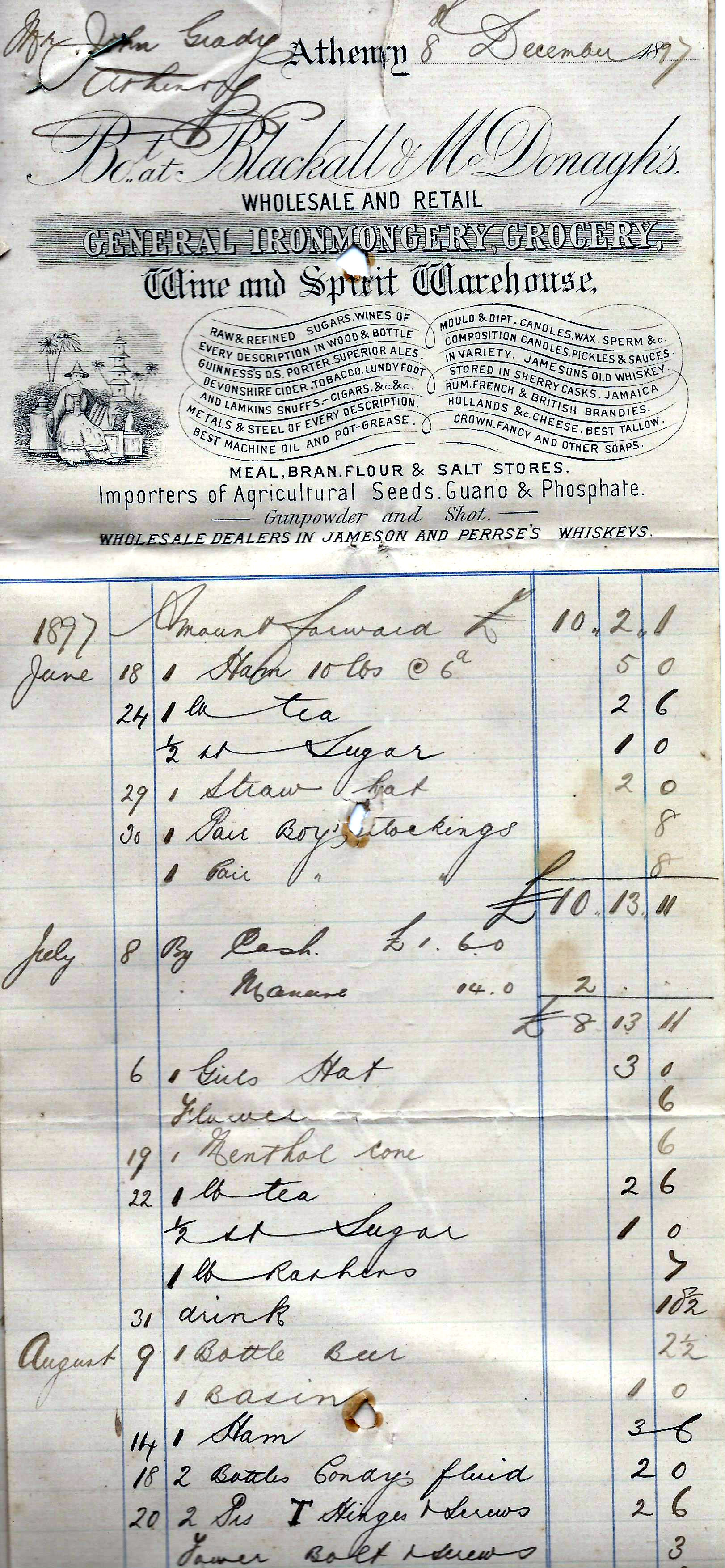
There were four shops in Newcastle long ago; The names of the people who owned the shops were Mr. Tom Feeney, Mr. James Burke, Mrs Mary Burke who had another shop and Nrs. Sully Corbett. There was a forge as well as a shop belong to Mr. Feeney and he used to shoe horses free, for any farmer who would give him scrap-iron. Mr. Burke lived just beyond the bog and the bridge of Liklen. Mrs Burke owned a small shop and she had also had a “Sheebeen” where she kept drink or “Potheen” unknown to the police. If she saw anyone making “Potheen” she would threaten to tell the police if they did not give her some. Mrs Corbett used to sell loaf bread