APH
APHHello, Is it all over?
Author : Mauyen Keane
Publisher: Ababúna Press, 1984
Experiences of a nurse from Greethill, Athenry in Jersey and Germany during World War II.
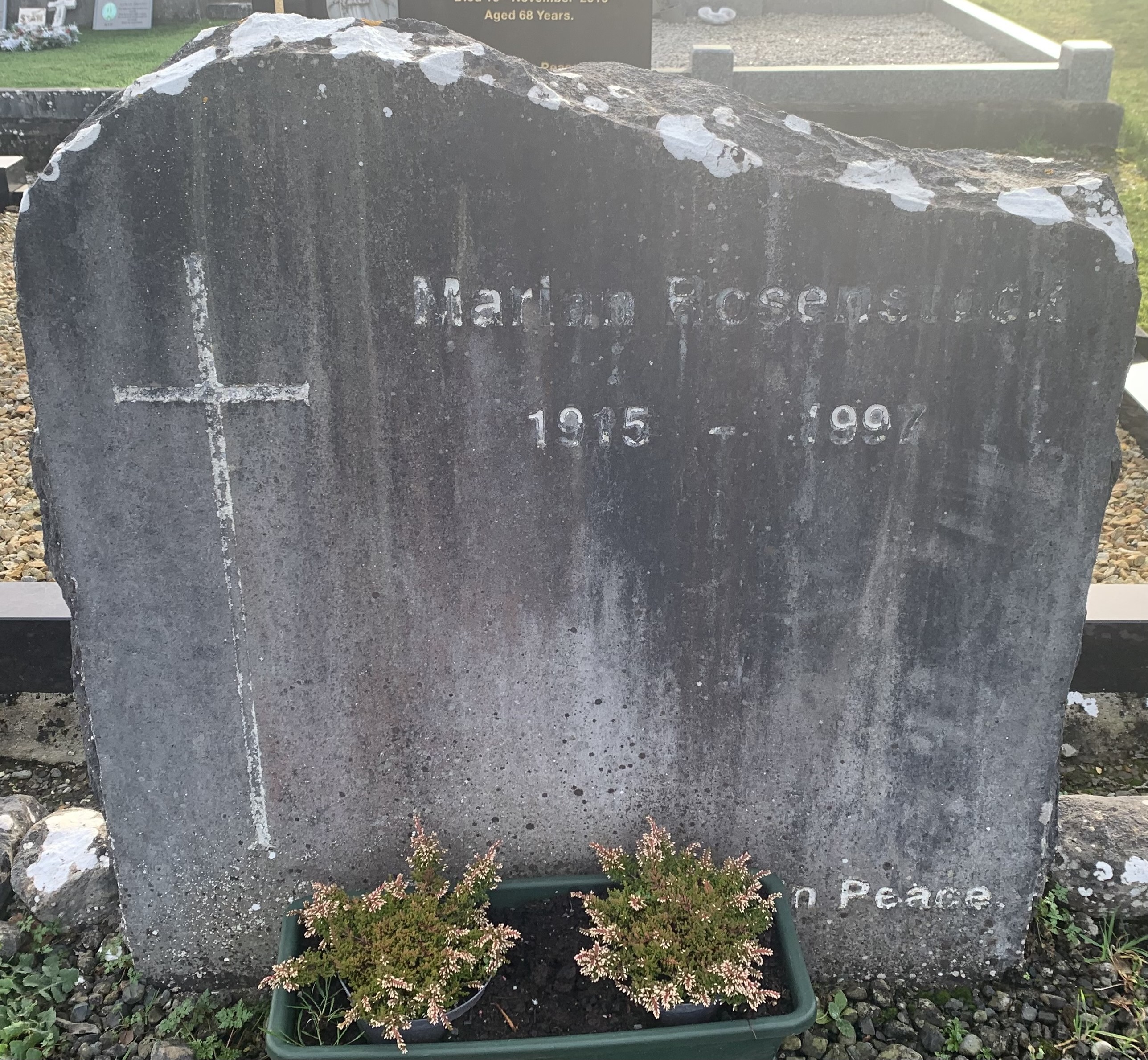
Acknowledgement: A special thanks to the Rosenstock, Keane and Keary families for their kind permission to share this publication.
“I’ll be down on my knees praying for you, girleen.”
Those were the parting words of my mother as I left home for the first time. She was feeling too sad to see me off with my father and all the others from the hushed, almost eerie little railway station. It was an autumn day in 1936, and the first signs of parting came when old Bob was harnessed to the side-car. Our favourite horse had been around since we were children. His work was light. He used to take us to Mass and needed no prompting from the reins, for he knew every turn of the road and some of us swore that he knew it was Sunday when it dawned. I still have very early memories of bringing him down from the hill by the mane when my father used to still ride him to funerals – my father went to funerals quite a lot.
My big brother was reluctantly putting my luggage into the well of the side-car, a sign that it was time to go. The little well acted as a boot with a lid on top and a cushion for the driver. My mother grew very sad as she remembered the parting of my eldest sister years before for the mission fields. I was only going to the Channel Islands to train as a nurse. I had just left school and, as I’d never been outside of Ireland before, it was a giant step for me. My parents would have liked me to enter an Irish hospital, but the waiting list was very long and I grew impatient to begin training. My mother’s cousin, a doctor in Jersey, suggested that I come to the General Hospital there. I agreed immediately.
As we drew near the town, we could hear the sounds of festivity. It was Show Day in Athenry: horse-jumping competitions, sports, a carnival and all the fun of the fair; happy faces, laughing children, three-card-trick men and the well-wishers who paused in their merry-making to wish me good luck.
“Remember, if you don’t like it out there, there’s always home.” My father’s parting words went through my head as I sat in the train on my way to Dublin. I can remember nothing of that train journey. My mother’s face and what she told me as I said good-bye kept going through my mind, as did the friends and neighbours who called the night before to dance and talk the night away as was the custom then.
The harbour lights of Dún Laoghaire woke me up from my reverie. I pictured so many travellers who had taken this lonesome trip to Holyhead. It was my first time on a boat of any size and I proved a very bad sailor. At times I felt so sick especially nearing Holyhead, I wished the far from luxurious old cattle boat would just keel over. The fact that I couldn’t swim a stroke didn’t seem to matter. We docked at last around midnight and boarded the train for London.
Euston Station was a far cry from the deserted, rain-washed little station I had left behind a day and a half before. But the predominant feeling I had was one of relief, being off the boat. Apart from the sea-sickness, I had an innate fear of water. never forgot the stories I had heard told around the fire when was a child. The tragedies that families suffered on the west coast of Ireland because of the sea, fishermen who went out in small boats to eke out a living and never returned. Many of them, though the sea was their livelihood and natural habitat never learned to swim either. I used to find this very strange until someone explained that they didn’t swim because there wasn’t much point: the cold and turbulent waters would ensure a slow death. This fear of water hasn’t left me to this day and I never did learn to swim.
It was 6.00 a.m. in London. I felt very much alone. I must say I didn’t get to see very much of it and I thought of Wordsworth’s “View from Westminster Bridge”: Dull would he be of soul…. Well this was one particular soul certainly had to pass by, even though I had no idea as to how I was supposed to reach my destination. However, I decided not to panic and put on the air of a well-seasoned traveller and somehow managed to arrive in Southampton with a couple of hours to spare.
The crossing was calmer than from Ireland, and this time no fish got fatter on my account. Sleep caught up with me at last and my eyes opened to the sun, flooding the pier of St. Helier. Jersey at last!
There, waiting to welcome me, was my cousin Brendan and his wife Dorothy, a native of the island. I had never met her, this tall slender lady in her late twenties. She looked so unusual, with a golden tan and dark, thick hair plaited and wrapped in two side buns. Brendan’s warm welcome in a still musical Cork accent and Dorothy’s equally warm and gracious welcome made me quickly forget the lonesome journey.
They drove me away down the road from the harbour, pausing to show me the General Hospital. It stood bathed in the afternoon sunshine and I visualised myself inside, happy in the profession I had always wanted. On arrival at their home, leaving St. Helier’s quaint narrow streets behind, I was greeted by the lively chatter of their two small children.
“But first, a cup of tea!” , said Brendan. A cup of tea, I thought, just what I’d been longing for all along but hadn’t even realised it. Oh no, I gasped to myself as I sipped the Jersey tea and tried to be as discreet as I could about it.
“Oh dear, I think that’s China tea you’re drinking,” exclaimed Brendan who must have noticed my expression, and soon I had a cup of the old familiar Indian tea in front of me. Now I could talk, and I began to sense that I was going to like Jersey and this house, which indeed became a home away from home for me during my seven year stay on the island.
For a month after that I enjoyed a wonderful time and marvelled at the constant sunshine. Taking the children to the beach was great fun though I was always afraid that they’d run out into the sea – even though they could swim like ducks. Little Patricia and Barry must have wondered why their grownup cousin only wanted to play ball with them but I tried to compensate for this by telling them stories. When my repertoire ran out I just made them up as I went along. This came easily enough to me as I had been the storyteller of the family at home. I remember being assigned to nurse my baby sister who was recovering from the measles. I would borrow my father’s large white handkerchief to make a nurse’s cap and wash and peel a little stick to act as thermometer. We never had any need for a thermometer at home; my mother’s hand on the brow would quickly detect a degree over body heat. Indeed, we never had need of a doctor either. Anyway, as a reward for enduring my “treatment”, my little sister would be told a story or two of my own to put her to sleep.
Visiting Dorothy’s mother in her gracious home, Sion Hall was always a new and enjoyable experience. She would collect me in her little red car and show me round the island. She was a vivacious grandmother whose energy belied her sixty odd years. She spoke French fluently, being Jersey-born, and she would often talk about the local dialect or Patois, still spoken among the older inhabitants. Madame Langlois would indeed have been an unsuitable way to address this happy-go-lucky grandmother who was quick to advise me, “Just call me Granny”. Granny Langlois would attend the local dances with her sons and friends, enjoying every minute of it.
The time had come to present my credentials at the Hospital. The matron was not as awe-inspiring as I had imagined. She assigned me to the surgical wards, starting the following morning. The Home Sister showed me my little cubicle and presented me with my uniform. The modern nurse’s dress is a far cry from the one we had, with its stiff and starchy studded collars. Leaving me with a list of the rules of the Nurse’s Home her exit lines were, “With patients, always remember: be kind but firm.”
The rules of the hospital in pre-war years were very military You were thrown in at the deep end, straight on to the wards Junior nurses soon discovered that it wasn’t the hard work that was the worst part of it; it was the senior nurses who, in their final year, constantly reminded the junior that she was only a ” mucky pro.”
That first night before I went on duty I could hear the mixture of Scottish, English and Irish accents as they changed in their cubicles. A nurse from County Down dropped in first to wish me luck on my first day and told me that she was starting again. But it was time for lights out before she had time to explain. I could hardly sleep that night in anticipation of what the next morning would bring.
“Hawpaws six, Nayss, Hawpass six!” It was the junior night nurse repeating the summons to duty from cubicle to cubicle. What a contrast the Irish nurse was to have been later on, tapping softly on the door, as if in apology, and then in a voice just above a whisper: “Haaf six, nurse, haaf six.”
Struggling with a collar stud and cuffs, I was surprised to see Una, my first acquaintance, standing behind me, anxious that I should hurry; and then fixing my cuffs for me. Slightly aghast that she herself should have been ready so quickly, I tried to pull myself together and started to run off, only to be quickly reminded that a nurse is never seen to run except in case of fire or haemorrhage.
“Oh yes,” said Una, “I have been here before.” Tragic circumstances during her first year called her home. Her mother had died suddenly just before her first exam and she had stayed too long at home. Once again, she had to start at the bottom, assigned to the female wards.
The Home Sister sat on her rostrum as we entered the dining room at 7.00 a.m. I sat at the end of the long table. The staff nurses sat at a round table, looking so cosy and serene as if they had met for a chat over a cup of coffee. The long table, in contrast, was stiff and silent, except when the commanding voices of the senior nurses were heard. I was somewhat taken aback by the sergeant-major-like rasps of “pawss the marmalade please, pawss the butter please, pawss the toast please,” pawss this please, pawss that please by the time anything had reached the other end of the table, we were passing again. Then the Home Sister tinkled her little bell and sent us on to the wards.
The sister in charge always arrived one hour later than the staff nurse. On reporting to a Scottish staff nurse, I was assigned to bed making, accompanied by a semi-senior nurse. The envelope corners and tight tucking in of the patients completed, I was about to follow my companion out of the ward when a patient asked me to pour him a drink. Feeling needed and useful at this, my first request, I was about to pour when the staff nurse entered to inspect the ward before the Matron’s Round. As she moved along the row of beds, I heard her say what sounded like “Straighten your corset, nurse!” She repeated the order. It sounded so ridiculous – how could she possibly know that I might be wearing a corset, not to mention that it wasn’t straight? My patient came to my rescue: “Straighten the castors of my bed,” he whispered. As I bent down to perform this mundane duty, my blushes were hidden, so she could never have known how I had interpreted her order. After she had walked past, the Jersey patient smilingly added, “I dinna kin either sometimes!”
The sluice room, that bane of a young probationer’s life, one could never forget. The strong, pungent smell of lysol disinfectant on the dressing trolley utensils seemed to pervade everywhere and forever. Rubber gloves were not used at the time with the result that much of our off-duty time was spent treating our sore, red hands. Every second Sunday was a half day. As there were no evening masses at that time, Catholic nurses were called at 4.30 a.m. We were indeed early morning joggers on our way to the convent orphanage chapel, taking short-cuts through the side-streets.
After four months on male surgical wards, I was surprised t see my name on the notice-board for night-duty. “Lucky you!” commented Una, “now you’ve got the day off!”
I was assigned to the chronic wards on the top floor. The patients were all terminal cases and here I was to become all too familiar with the aged and the dying. Some of the ladies spoke Jersey Patois at times. The night sister in charge of the whole hospital did two rounds in the night. I was quite excited about being in charge but, at first, a little scared of the responsibility. The first night, I kept walking up and down the two wards shining my torch on the patients’ faces lest someone should die suddenly without my knowing. Of course I only succeeded in waking them up and then everyone was looking for attention. There were two old ladies who were able to get out of bed and they did just that at various intervals through out the night. They were both quite senile and one was always getting ready to go to a party. Her night-wandering companion, being less worldly, spent her time constantly looking for her Bible.
As I grew used to my duties, I would pause in the nurses’ office to enjoy the inevitable cup of tea. In the deathly stillness of one such night, I heard the soft shuffle of slippers approaching the nurses room. Suddenly, there in front of me, ghostlike in the dim blue light of the corridor, my wandering patient held the Bible firmly in her left hand, admonishing me, or so seemed, with her right, quoting: “Believe in the Lord and you are wealthy!”
Wealthy we are not, I mused, as I tucked the old lady back into her bed. Our ten shillings a week was nothing to complain about however; at least we didn’t have to pay for food and lodgings.
As death tended to come so often in the early hours of the morning, the latter half of night duty was very busy indeed. A nurse from another ward always came to my assistance in the laying out of the dead. One night in particular I will never forget. Two people had just died. The vicar and the relatives had left. The strong voices of the day nurses were music to my ears that particular morning as I was writing my report. Back in the night-nurses’ quarters I could hear the usual whispers: another “escape” was under way. We used to contrive to wake each other at certain times and slip past the night sister’s door. She remained on guard making sure we had the necessary quota of sleep before we went out. There I was looking forward to a long luxurious bath when I heard my name being urgently called by a junior day nurse. I was to report to the day sister immediately. As I hurriedly got back into uniform, I wondered what this sudden summons to duty might mean. On arriving at the wards, I remembered that no questions were allowed.
“On duty, sister,”. was all I said at first and the middle-aged sister looked me up and down. “Straighten your cap, nurse!” she commanded and then handed me a container with the patient’s false teeth. In icy tones, she ordered: “Go down to the mortuary, nurse, and insert these teeth where they belong!”
Walking quickly with the container to the mortuary, I located my former patient and gave her back her teeth.
“May I go off duty now sister?”, I requested, greatly relieved, on reporting back. I was free to sleep at last.
On completion of night duty, having asked especially to have all my off duty days in one stint, I enjoyed a wonderful free week with my cousins. A trip on Dorothy’s father’s yacht to St. Malo was arranged. Her father loved his boat and spent all his leisure hours on the water or painting or fixing his boat.
Dorothy’s youngest brother joined us and decided that this was a good opportunity to make me learn to swim. His method of teaching was very straightforward indeed and the beginning of our journey was far from enjoyable, as I spent all my time resisting his attempts to throw me into the water. Thanks to Granny Langlois, I was eventually excused from any further swimming lessons; she must have realised that I’d only sink like a stone. But What a lovely sunny day it was; I even steered the boat for a while. The sick and the dying were now forgotten as the happy party drew near St. Malo.
I was quite excited as we wandered around the ancient walled city. I remember writing hurriedly on a card, telling them at home that I was in France for the day. I was the only one on board on the return journey who was as red as a lobster; I had to be treated for sun-burn at the hospital.
I spent the last few days of my little holiday at Sion Hall, the home of Dorothy’s mother. There we walked together along shady lanes with her massive though docile St. Bernard. In the mornings, I was awakened by her French maid who served me breakfast in a silk canopied bed. Such a heavenly change it was from my little cubicle and the cry of “Half past six, nurse.”
Back on duty again, this time on the female surgical wards. Exam fever was mounting and the usual visits to the cinema had to be forgotten. The exam was held on the mainland in Portsmouth. All the patients wished us well, reminding us that it was lucky to touch a sailor’s cap if the fleet was in. The fleet was in all right. They were all over the place as we walked to the examination hall. The tune “All the nice girls love a sailor” came to mind. Still, we were too timid to touch their caps; nevertheless, I managed to pass my first state exam and joyfully sent the news home. Una, who was looking forward to her holiday after getting the exam, had to leave suddenly for the funeral of her father. This time, there was no lingering in Ireland and she returned with her younger sister Maura to join us.
I was due my first holiday. Overseas nurses were allowed to take one month’s vacation but this was to include the two weeks allotted to the following year. It was a difficult decision but I eventually settled for the month with the thought of a long holiday at home. How wonderful it would be to be at home for Christmas! I decided to wait until then. However, I soon learned that every nurse had to be on duty on Christmas Day. This was of course the wise decision of Matron who had so many overseas nurses in the hospital. She promised, however, that I could leave on St. Stephen’s Day, or Boxing Day, as she called it.
Duty was light on Christmas Day with all the nurses on and we wandered through all the wards with greetings to those patients that we couldn’t discharge.
That night, we had our own special concert for them. Porters were busy wheeling patients to our biggest ward. Our makeshift stage was small, and I danced a jig to the tune of The Rocky Road to Dublin. I was leaving the next morning on the first boat. At the concert, we impersonated the resident doctors, much to the amusement of some of the patients, although a Dublin doctor was taken by surprise and did not entirely approve of our antics. The Scottish staff nurse who gave me my first duty sang Coming through the Rye and the haunting melody Will Ye No Come Back Again.
After the concert, I began to pack my bags for home. This was one night when nobody checked for lights out. My friend Una who had been home and back again, shared my excitement. The smell of smoke from the cheap Grey’s cigarettes, the lively chatter from all the cubicles, the laughter… it could only have been Christmas. In a month I would be twenty one years old and I felt sure that the past one and a half years in Jersey had indeed been the turning point in my life.
Everyone was in a happy mood aboard the boat as we sailed out to Southampton. The sea was calm but high winds didn’t worry me any more because I was going home. This time I knew where I was going when I arrived at Euston Station; I was walking on air with joy.
The boat from Holyhead to Dún Laoghaire was full of jovial men and women wearing paper hats and singing carols and songs of Ireland; some of them hadn’t been home for years on end. Everyone was up on deck as the boat drew in at six o’clock in the morning. The Angelus bell was ringing. Men’s heads were bared and women’s bowed to the prayer of the Angelus. It was a profound, strangely elating experience hearing that Angelus bell for the first time in one and a half years.
In my impatience to get home, I thought the train which stopped at every conceivable station en route to the West would never arrive, but there, at last, was the first of the stony walls and less than an hour later the happy and excited faces of my parents were welcoming me home. Outside the station, old Bob stood patiently with the side car and off we all went, on the last leg of my happy journey, home for Christmas. As I mounted the steps of that old side-car on the first leg of my journey back to Jersey three weeks later, little did I know but that it was to have been my last ride ever on it. Ten years would elapse before my next return.
Back to the hospital again I was assigned to Emergency Admittance. This was to last for three months before I was again put on night duty, back on male surgical where I had first started as a junior.
On a night in September, 1939, a patient reminded me that it would be late next morning before I got to bed. Chamberlain was due to speak on the wireless at 11.00 a.m. We assumed the he was going to make a speech on Hitler’s invasion of Poland which had just taken place. We night nurses waited on and gathered round the set and listened. The slow and solemn words of Chamberlain boomed into our ears. ”On this day September the third, 1939, I now declare war on Germany” War! The news left us dumbfounded. All the rumours of impending war that had circulated up to that time had never been taken too seriously but now we wondered how it could affect us and how soon.
We were assured by the authorities that life on the island would go on as usual. But all the tourists left suddenly an some Scottish and English nurses left for the mainland. Una and Maura were among those of us who left. It was 41 years later before I was to meet both of them again. Maura had entered the medical Sisters Of Mary and Una married an American and went to live in California.
But now gas masks were issued. They were a grim reminder that we were in a state of war. Ration books were also issued but as we lived in, we never saw those books ourselves. Many young men on the island left to join the forces on the mainland.
Every householder had to make sure that no light whatsoever showed at night: the blackout.
Cakes and the famous Jersey cream were rationed, much to the relief of some of the more figure-conscious among us. Very few Jersey girls had entered our training school and as Christmas drew near, the shortage in staff became very noticeable. The Red Cross nurses had to stand in and assist in the afternoons.
With the coming of spring, Hitler seemed to be riding on the crest of the waves. People listened to the news bulletins in grave silence. Brendan was forecasting very hard times for everyone on the island. Still, there was a quaint air of gaiety about, even if slightly forced. The streets, of course, were devoid of tourists. The hotel across the way – the Gloucester Hotel – was closed down and boarded up, the owner having long since departed for England. We used to observe the visitors staying at that hotel, breakfasting leisurely on the terrace, from the windows of our night-nurses’ home, their laughter and gaiety stilled now. The hotel was eventually taken over by the nurses as sleeping quarters, and though it was much more comfortable, we were always uneasy when off-duty, enquiring about the latest news bulletin.
At the end of May, panic struck the island and chaos followed in its wake. The bailiff of Jersey had just announced the occupation of Paris by the Germans. He added that the invasion of the Channel Islands was imminent and might only be a matter of days. Loudspeakers blared out, advising the people to remain calm, that free passage to the mainland would be available for as long as possible. People were asked to form queues taking only necessities with them.
Inside the hospital, doctors, nurses and porters were rushing here and there. All of Matron’s staff seemed to be queueing up outside her office to pick up their diplomas or references. Others went straight over to the hotel to pack, not even bothering to do that. I remember entering the office and seeing Matron’s face as she signed papers for her staff, pausing every now and then as she wrote to look up with pleading eyes, desperately hoping that at least some of us would stay.
The familiar voice of our lecturer, Mr. Haliwell, was heard over the loudspeaker. He was calling all the nurses to the committee room which also acted as a lecture room. Matron’s pen dropped from her hand with relief and we all followed her to hear what Mr. Haliwell had to say.
We found him standing beside the skeleton, his usual position. How wonderful it would be I thought if this were just another ordinary day. The sun shone in on his troubled face, and his proud Englishman’s voice began to tremble as he addressed us. “Nurses, I have decided to send my wife and children to the mainland and I advise those of you who have ties there to leave. I know you will depart with the dignity befitting your profession. This is a very grave time for all of us and we have no way of knowing how long we may be under German rule. Prisoners we will be, of course, but naturally those of you who volunteer to stay will be most welcome. Let me assure you that you will be needed.”
Silently, we filed out of the room as though we’d been given tranquilizers but outside, chaos still reigned. Everywhere we went we heard words like, “Go, go now, while you still can, no one will be safe!”, and “The Germans are brutes, they’re uncivilized, they’ll kill us all!”
Running with a crowd down the hospital avenue towards the big gates, I could see nurses coming out of the home clutching small suitcases. I sat on the steps wondering what I should do. What would my parents think of me if I stayed? But I had already made up my mind. Nurses shuffled past in a hurry, looking back and asking, “What are you doing, Keane? Why aren’t you packing?”
One nurse in particular, from County Cavan, stopped and stared at me in amazement. “Come home, you fool, come home!” She pulled at my cape, tearing it in her excitement. Josie and Kate shook me out of my stupor. They were from Northern Ireland and had also decided to stay. We were joined by Joan from Tipperary and all four of us clasped hands in silence and smiled, like four children lost in a wood and meeting up at the same time in mutual support. A Jersey sister was later to christen us “The Four Musketeers”
We went straight on to all the wards and the welcome we received made us feel very happy in our professions as nurses. “We thought you’d left us all high and dry!,” one of them exclaimed with a big beam on his face.
As we rushed from ward to ward we were welcomed by a grateful Mr. Haliwell and the medical officer, both of whom were unable to conceal their relief and delight. The Dublin doctor, Bill Henderson, came rushing up to congratulate us, he himself was on his way back to Mother Ireland, he said. We gave him our addresses and he promised to let our people know that we were staying on. The doctor from Northern Ireland had decided to remain and he too rejoiced in the news that we weren’t leaving. Two of the English sisters stayed as did the Jersey nurses, of course.
We gathered together over a cup of tea and discussed the fairest method of distributing our skeleton staff. This time we were all as one, sisters, junior nurses: now that the war had begun for us our military regulations regulations were quickly forgotten. We were like one big family.
I had to make a fleeting visit to Brendan and Dorothy. They weren’t leaving the island but Brendan had tried to persuade me to return home while I still could, as boats were available for another day or two. But nothing or nobody could make me change my mind now. I always wondered what the real reason was for my “stubbornness” in insisting on staying behind. Was it my professional need to help? Or sheer youthful curiosity and the spirit of adventure?
Two days passed and trickles of people were still putting out to sea in the last few boats. The last plane had flown out, and the airport had closed down. We heard that the very last boat was due to leave. Then all communications to England were finally broken off. We were alone. My musketeer friends d and I went down to the harbour to watch the boat sail out. The le gangway was up and the passengers waved to us. They must have surely felt that they were bidding us a last farewell. It was all like a dream. We stood there on the deserted harbour in silence, watching the boat recede, ever so slowly, out over the curve of the sea. It was gone. “Ah well, we volunteered, didn’t we?”‘ said Joan, and we hurried back together in the direction of the hospital.
If work can be described as a therapy for sadness, then we certainly had more than our share of it. I remember sitting on the steps of the hospital one sunny day, snatching a few moments rest with Anne, a Jersey nurse. There was no official off-duty and we never left the grounds. The stillness in the street opposite us and the eerie silence of that bright day in June 1940 was quite unforgettable. How would they invade us?, we asked each other, and when?
There were times we wished they would hurry up about it and get their blasted invasion over and done with and leave us to concentrate on our work. Tension and anxiety became unbearable. The days went by. Still no sound from the notorious Luftwaffe. Were they really brutes? Would they ship us off to God knows where, as rumour had it? Matron, instead of her usual morning and evening rounds, was now always walking through the wards calmly and with a watchful eye checking that her nurses weren’t exhausting themselves.
One night, as we were resting, still in uniform, we were startled by the roar of low flying planes. We jumped up and rushed over to the hospital but could only hear the terrifying drone of the planes fading away into the distance. It was 4.00 a.m. We decided to stay on duty. The Matron arrived early and told us to take it easy and see the film at the local cinema to get our minds off the work and the terrible anticipation of war. The cinema was called The Opera House and only afternoon performances were shown since the crisis began. Joan and I looked forward to the break and hoped we’d be able to concentrate on the film which, ironically enough, was called “Vigil In The Night”, about a nurse. But even if we had been able to pay attention to the story-line, we were destined not to see it through to the end: mid-way through, the whole house shook with a loud bang like an explosion. Rushing to the exit was no problem because there were so few people in the cinema, and there was no panic. Then we saw that a German boat had entered the harbour and had been fired upon by a band of local militia. The Germans had dropped a bomb from the aircraft escorting the boat. Machine-gun fire had been directed at the locals standing by.
Twenty two patients had been admitted to the hospital and trips to the operating theatre continued throughout the night. Brendan and other doctors came in to help, though not many doctors were left in Jersey at this time.
Of the twenty-two, eleven patients survived.
As we worked away on that June evening, leaflets were dropped by low-flying Luftwaffe aircraft with the orders: “This is the German Wehrmacht. We are coming in. Place a white flag on your highest peak. Surrender and no-one will be hurt.”
The surgical wards were now busier than ever. I was in charge of day duty and Josie, my Northern Irish friend, was on nights. One morning I came in early on duty and noticed that something very unusual had happened in the wards. Instead of the usual first reading of the reports to me, Josie related the tidings of the night. Around midnight she was startled by the sound of soldiers’ boots on the stone corridor. A German doctor, accompanied by a very young soldier, greeted her with a click of heels and an outstretched hand. He spoke very little English and, with the aid of a dictionary, told her that the soldier was to be admitted with suspected appendicitis. She tried to tell him that there was no room in the hospital but then he did a round of the four wards and found a bed inside the door of one of them.
Here in this small ward lay the victims of the German machine-gunning. I went over to the ward and saw the young German lying there, screened off from the others, unable to understand a single word we were saying. He couldn’t have been more than nineteen years of age; at this moment in time, his parents didn’t know whether he was alive or dead. He was indeed the first of many German patients I was to treat, and as I continued on my morning round, I was met by hostile glances and bitter reproaches. “Why was the enemy being treated?,” I was questioned time and again. I reminded them that the nursing of the sick knew no national boundaries, but they insisted that he was the enemy and should be treated as such. I assured them that I would try to have him removed to another ward, but I had no time to carry out this promise. The doctor of the night before had arrived with an interpreter, a German who had been a resident of the island. With a low bow and clicking of heels, the middle-aged doctor introduced himself. After examining his patient, he said that he would like to remain on a little longer for observation. Then Matron was summoned. That’s when things began to get a bit dramatic. Having lost all her composure, she looked completely upset as she awaited her orders through the interpreter. All the wounded natives of the island in the ward had to be transferred to another ward. They put me in charge and gave me the task of recruiting other nurses as there were to be more admissions. The unfortunate wounded were now in a crowded ward. Matron, shocked and shaken, visibly trying to collect herself, reminded the doctor that there was an acute shortage of trained staff, that she needed me and could she not arrange to let him have junior nurses instead? The answer was a firm No. The doctor bowed and clicked and simply added, “It is the war, gnädige Frau.”
The Matron looked at me, her arms folded in helpless resignation, and left the ward.
Porters got busy shifting the beds to a ward which was already full and before I knew where I was, I found myself there with one young German patient. I had to contact our surgeon, Mr. Halliwell, and break the news to him about sharing the operating theatre with the enemy.
This is terrible nurse, terrible. ”What if there are emergencies for me?” he asked. Yes, I thought, what would happen then? Would the invader be treated first? Would the medical profession keep their Hippocratic Oath? Matron had informed him, he said, that I was to be in charge and indeed he was sorry to hear it. ”I’m very much afraid that this is only the beginning.” he added, in a murmur, not so much addressing me as talking to himself. “Who knows what drastic measures these Germans will have recourse to next?”
That afternoon I had three more admissions, not war wounds, just the ordinary ills that flesh is heir to. By then, there were already thousands of Germans on the island. The Jersey population in peace time was about 50,00 and some 50% of these had evacuated. A few days later, the Matron was summoned again. She was informed that all four wards as well as the doctor’s office was to be taken over. The chronic patients on the top floor were transferred to a deserted house and male surgical was moved up. A big upheaval had taken place.
By this time, I was in charge of five nurses, four juniors and a semi-senior. Perhaps I should mention that it was merely the luck of the draw which caused me to be singled out by the Germans to take charge. At this stage, none of them had any idea that I was Irish and, thus, politically neutral. Anne had been an au pair in Switzerland before starting her nursing career. She had acquired a fair knowledge of German which, of course, was a considerable asset. Anne became Schwester Ännchen, Nurse Annie, to the Germans. Both doctors and patients always addressed us by our Christian names. This was very new to us as we had always addressed each other by our surnames alone, with the exception of friends of course. The Dublin doctor’s room was now taken over by the German doctor, but visiting doctors arrived on the wards from time to time. We had two German orderlies who were fanatical in their cleaning and dusting of patients’ lockers. They also ran errands for the patients. We saw them returning with sheets, hats, and lots of beautiful dress material, all of which was parcelled up for the soldiers and sent home to their wives, sweethearts and families. By that time the currency in use on the island was German and goods were exchanged in the wards, with the exact change to the very last pfennig handed over to the orderlies. I remember one argument in particular which flared up because of confusion about the difference between the kilo and the pound. Two Jersey cleaning women did the long stone corridor and the floors of the wards. One morning the resident doctor queried: “Why are they on their knees? It is not good for the knees.” Then, to the women’s delight, mops were introduced and became the order of the day.
A kind of a ceremony used to take place before the commencement of the rounds. The visiting doctors varied in rank and would arrive punctually for one or other of the three daily rounds. The orderlies would get very zealous and officious and would always be on their toes when the Mighty Ones were due. The days of “straightening the castors” were nothing compared to the meticulous, almost surgical type of cleaning that had to be carried out. I warned one of them once that he might cause a slipping accident on the lino if he persisted in having it always polished so thoroughly. Another epressed genuine worry as he pointed to the morning rays of sunhine lest they reveal the slightest speck of dust left behind on the black iron bedstead. The doctors would all meet in the stone corridor and the usual clicking of heels. and, by now, familiar greeting of “Heil Hitler” could be heard throughout the wards. Then the handshakes followed. They never “heiled” their Führer to us, it was just the low bow and the handshake.
The handshakes were hard to get used to; three times a day we lad to put up with it, from the resident doctors as well. Of ourse the patients themselves always anticipated the rounds with a certain anxiety: so much depended on these “Visite” whether they could go on leave, be sent home or even be sent to the front. It was of course verboten to discuss the war. But hardly a minute went by without hearing the word Krieg being spoken of amongst themselves. We found all the patients courteous and co-operative. They played cards, showed us pictures of their homeland, of their families and friends. One could see they weren’t all soldiers by choice.
The curfew hours were from 7.00 a.m. to 7.00 p.m. but soon, enough they were extended to 11.00 p.m. The airport. and the harbour were out of bounds. All motor cars except those of doctors were put off the roads. I was saddened to hear the news from Dorothy that her father’s boat had been confiscated. “Anyway, I’m sure he’ll get it back when this nasty old war is over,” she said. The islanders were all so optimistic at first retaining their delightful sense of humour.
At this stage, we were gradually beginning to understand and to speak a little German. One day, however, the interpreter vanished. We heard that he had been conscripted.
The army remained for six months and was replaced by the air force. There was a little ceremony in the corridor as the departing doctor introduced us to the new doctor from the Luftwaffe. He had high praise for our efficiency and dedication to nursing. Our new doctor was a kind, grey-haired man who was well able to speak good English even though he never did so while on the wards. In the nurses’ office he would occasionally speak about the awful futility of war. “We are fighting our cousins,” he would exclaim. Around this time, an order from the commander proved to be one of the biggest shocks and disappointments since the crisis: all wirelesses were to be confiscated. They were to be left at a depot at very short notice. Anyone caught with a set would be severely punished. The last link with the free world was being severed.
One particular visiting doctor proved to be very abrasive. On one occasion, as a junior nurse was leaving the ward without closing the door behind her, he looked up and bellowed out after her: “Mach die Tür zu!” Shut the door! With us, the golden rule was never to close the ward door lest any patient should need us as we went along the corridor. ”Schiesse Engländerin!”, he muttered gruffly to himself. The reasons for keeping the doors open was afterwards explained to this ill-tempered man and before long, uniformed mechanics were to be seen about the hospital installing an electrical calling bell system.
One morning, as three visiting doctors had finished their rounds, there was an unusually long discussion in the corridor. I went to the nurses’ office to see what was going on and, to my great alarm, discovered that our good matron had resigned. I was equally relieved for her sake, however, as I knew well that she couldn’t bear to work for much longer with the enemy. She was also spared the next big upheaval: the female surgical on the opposite floor was to be taken over. I recalled Mr. Halliwell’s words: “I am very much afraid that this is only the beginning.”
Once again, the porters were busy moving beds and patients to a make-shift building at the back of the hospital. A large placard in red was posted over the entrance door to the hospital: ABTEILUNG 1, ERSTER STOCK, section one, first floor. The Germans had now occupied the whole of the first storey.
The big kitchen on the once female wards was staffed with two Italian chefs. They spoke fluent English and a little German.
Sometimes when I arrived in this kitchen with the diet sheets, I would see them chasing each other around the big table with a carving knife. But on seeing me they would stop and break into a broad Mediterranean smile and inform me simply that they Italians were hot-tempered by nature. Italy was fighting on the side of the Germans but there were times when we could never make up our minds which side these Italians were actually on. In hushed voices they would confide in us that the English were bound to win then the very next day you could hear them boasting, ”You simply can’t beat the Germans.” When in the course of the war, Italy actually did change sides, our chefs disappeared overnight and were replaced the following day by two German chefs.
For quite some time now, I was sure that Ireland had also become involved in the war. There was no way of knowing for sure. One of the visiting doctors, on hearing that I was Irish, told me that the English had taken over our ports. That was in 1941, just after Pearl Harbour, and of course he was really referring to Northern Ireland and had assumed that it was all under the same flag. By now all our wirelesses had been confiscated and stored in a guarded warehouse.
One afternoon there was an unusual occurrence; the rounds or “Visite”, always so predictably punctual, were running late. An orderly raced past me and then turned back breathlessly to ask me to get the English surgeon to the operating theatre immediately. The resident doctor had been in a car crash and had asked for Mr. Haliwell. As to the nature of the accident, the orderly had no ideas and as I made my way upstairs to the civilian wards, I imagined the reaction of the overworked surgeon. They had already taken his wards and demanded that they share his operating theatre; now they were looking for treatment.
“They have their own doctors,” he exclaimed, “why me?!” There was nothing I could add to what I had already been ordered to tell him. He fell into silence for a minute or two. He wasn’t going to wait until being ordered at gunpoint so he said: “Tell them I don’t want any retinue nurse. Tell them it shall work alone with you.” When we reached the door of the operating theatre, Mr. Haliwell stood outside while I managed to persuade the two German doctors standing over the patient to leave the theatre. I was relieved to see the patient had only a lacerated upper lip. He turned abruptly to scrub up while I prepared for stitching. As he finished the neat stitches, the patient asked for a Spiegel, unable to articulate the word very clearly. When I translated to Mr. Halliwell, the surgeon exclaimed sarcastically: “A mirror, nurse! On my operating table!” He looked very indignant.
“Oh ha!”, said the Air-Force doctor on the table in English. “I am more beautiful now as before!” He lay there inspecting his stitched lip with satisfaction. But the face of the healer retained its own stiff upper lip and even now more so than before. I must say I was quite amused at the German’s reaction to the operation but I tried not to show it to the Englishman. The patient extended his hand in a gesture of gratitude, but Mr. Halliwell, his gloves now discarded, kept his hands firmly behind his back. “That’s quite all right,” he responded glibly, afternoon.” And he made his way briskly to the exit.
I really felt sorry for that German doctor who clearly found the war as tragic and as useless as his English fellow professional. “My own profession,” he said, sadly, “and he would not take my hand.” I tried to reassure him that the English surgeon wasacting in appalling circumstances forced upon him and the rest of us by the Germans and then I asked him why he had requested to be treated by Dr. Haliwell in the first place. “I thought I might get to know him,” was all he replied.
The airforce was due to leave the island and to be replaced once again by the army. On the evening of the surgeon’s departure, he came back on the wards to say goodbye to us nurses. He presented us with a bottle of champagne and gave us another one which he asked me to pass on to Mr. Haliwell. Champagne, along with all the other luxuries, hadn’t been seen seen the island since the occupation. He wished Mr. Haliwell, would drink a toast to both of them and to peace. And so armed with a bottle of champagne, I waited in the nurses’ office till the evening rounds were over. Before I opened my mouth he was frowning as if in anticipation or some more bad news. “No requests this time, Mr. Haliwell,” I said, as I handed him the rare vintage. Then I relayed the message of goodwill. His tired eyes lit up when he saw the bottle; he was indeed visibly touched. He patted my head in a paternal fashion and said, half-absently, “We have all been under a great strain, nurse.” I could think of nothing else to say other than, “It will be all over soon,” and there and then I found myself firmly believing what I had just said and, with a lighter heart, went quickly downstairs to nurse his enemies.
Tea, that precious beverage, had run out for some time now. and substitute coffee was all there was to drink. Having no ration books of our own, the once richly stocked cafés which now served this coffee didn’t tempt us. Second-hand clothing replaced the exquisite up-to-date garments of the fashion shops, now empty and abandoned. No longer was it an exhilarating experience to stroll through the streets of St. Helier. We nurses loved to walk along the promenade after duty; now we were jogging, rushing to beat the curfew.
The army was with us again. It was March, 1942, a year which was to change the course of my life.
The doctor in charge this time was a Berliner and was accompanied by a medical student in his final year. He was from Hamburg and spoke fairly fluent English with a sprinkling of French when lost for words. He had come directly from France where he’d been stationed for a year. He was tall, lean and fair-haired without any military air about him. Were it not for the handshakes three times daily, one wouldn’t have taken him for a German at all. He had a lively sense of humour, often directed at his uniform. He had studied at Jena University, having spent some time in Heidelberg before that. Then he was posted to field work in France. As he was leaving France, he and his company had had no idea where exactly they were bound for. As they had been given winter clothing and thick woollen gloves, they had assumed that they were bound for Russia. In fact, they only became aware of their destination when the Channel Islands had been sighted on board ship at sunrise. You can imagine the relief and subsequent jubilation.
Dieter and I worked a lot together in the operating theatre. He was always glad to be able to disguise his uniform with the green, surgeon’s theatre gown. Mr. Halliwell’s all white gown stood out in sharp contrast to the dark green colours of the Germans.
There was an unusually high number of fractured bones to be dealt with. Even though war was on, Jersey was still a beautiful island to live in; none of these soldiers would have been anxious to leave it, unless of course to return home for holidays. Every one of them dreaded the thought of being posted to the Russian front. Could this have been the reason for all those broken bones? Naturally, we didn’t dare attempt to find out!
Hamburg had been badly bombed at this stage, and Dieter’s mother. and stepfather were left with a home in ruins. They fled westwards, to the border near Holland. His brother Kurt had left for South America long before war had been declared.
Dieter introduced me to the works of the great German poets. He also introduced me to the writings of our own James Joyce and Oscar Wilde! We arranged our off-duty hours together, which wasn’t much of a problem as I was in charge and organised the timetable myself.
At about this time, Dr. Chemnitz, the man from Berlin who was our chief surgeon, taught me how to administer anaesthetics. It was unprecedented that a nurse should be allowed this responsibility. On hearing this from some of my friends in the civilian wards, Mr. Halliwell at first refused to believe it but later decided that that was the German’s problem and he would have nothing to do with it himself.
Dieter and I would borrow nurses’ bicycles and cycle the length and breadth of the island during our free time. The beaches were still open to civilians but the harbour and airport. were out of bounds. I remember how patient Dieter was in trying to teach me how to swim, but I’m afraid I never succeeded in conquering the old fear of water; not even the enchanting St. Brelade’s Bay with its miles of golden sand could lure me into the sea. But what a contrast it was now to peacetime, when people in their thousands would fill the beach, stretched out in the sunshine, with children everywhere jumping about in the sand. Here, now, we were able to step into our own footprints on returning from our long walks along the strand. Hard to believe that these were evenings in May, 1942, in the middle of a world war. There were no air-raid sirens here, just silence broken by the swish of the tide or the cry of a gull.
One afternoon, as we arranged to go for a walk down Valley de Vaux, Dieter lingered for a while to read his mail. I knew at once that the letter had brought bad news as I saw a look of grief in his eyes. His best friend, a young man of twenty four years, had been killed on the Russian front. He had only been there for a while when he was shot dead while attending the wounded. A cloud of doom hovered over us that summer. afternoon. I think it was only then that the ghastly implications of the war reached me personally; somehow, up to now, I was in a way removed from it, as a nurse would be from a patient, with professional detachment.
On the thirtieth of June, Dieter and I became engaged. Hitler had forbidden any German marrying a foreigner but Dieter was optimistic, believing that this would not apply to the Irish. We threw a small party that night. There were no rings to be bought in Jersey, but that was the least of our worries. Two colleagues of Dieter, my three Irish friends and Ann, who worked with us, arrived at the party. One nurse who didn’t turn up was a local vicar’s daughter who declined the invitation with a little note saying, “I would love to come to your party, but my Frank is in the R.A.F., and don’t forget that Dieter is still the King’s enemy”
Dieter couldn’t help feeling amused at the thought of wishing to hurt her King.
My friends were very happy for me and we all let ourselves go at the party. I still recall the few lines of a song which was sung especially for us that evening:
So schön wie heute,
So muss das bleiben,
So muss das sein …
The following day, I called on Brendan and Dorothy to announce the news of my engagement. I picked a bad time for rejoicing, what with rations getting low and no sign of the war coming to an end, nor even any way of knowing how it was progressing. What a time to let them know that I was about to marry a German. They looked at his picture and the many pictures of the two of us together, commenting wistfully. “What a pity the uniform still divides us.” Still, they were glad that I was happy.
Autumn had come and Dieter’s time on the island was running out. The army would remain on but Dieter was called back to Jena to complete his final examinations. Brendan decided it was time now that he met Dieter. They told me not to come on a moonlit night, to ensure that Dieter’s visit would remain a secret. He received a warm welcome from them both. Dorothy had baked a little sponge cake, a rare sight at this stage of the war. They even produced a bottle of red wine which must have been stored away for a very. special occasion. Brendan seemed to be getting on very well with Dieter until my fiancé was taken aback by the question: “But how do you intend to support your wife?” Dieter replied that at this stage he would have enough on his hands to protect us both from being bombed, whatever about saving up for a house; he was in the process of acquiring permission from the commander to allow me to return with him to Germany and he felt very confident that permission would be granted and that it was only a matter of time.
Our last walks together in the beautiful autumn days became sadder and sadder. Soldiers were still dying in their thousands on the Russian front; Dieter and I might never see each other again.
Early in November, 1942, Dieter was called back to Jena. On the steps of the hospital we said goodbye. These were the self-same steps I had sat on two and a half years before in anxious anticipation of the dreaded German invasion. My mother’s parting words came back to me, and I repeated them to Dieter. I told him I would be praying every day that we’d se each other soon again. Then a soldier drew up in a car. ”Keep smiling” Dieter called back to me, ”and keep asking for that permit to travel.” and so, with a final wave, he was gone through the hospital gates. “Slán!”
I walked slowly up to the steps and thought of home and my mother and hoped she would continue in her prayers for me, ware that I would need them now more than ever, planning I was to travel to Germany across war-torn Europe.
Anne had the coffee brewing. when I arrived back at the nurses’ office. The night nurse was soon due on. She was a married woman in her late forties. She insisted on talking about Dieter before she let me read the report and consoled he in a motherly way; she had grown to know and be fond of Dieter during our brief conversations as we left her to the duties of the night.
I spent all my off-duty hours now at the home of Brendan and Dorothy, or cycling to the commander’s office on the hill. One day I was informed at last that they were considering my request. Christmas had come around again and still no travel permit. But our separation would have been unbearable if we had not been able to communicate by letter. Though it was normally impossible for a German to write to a civilian in occupied territory, we got around this thanks to Dr. Chemnitz, the Berliner, who acted as middle man for our letters. Dr. Chemnitz would jokingly remark about his having never received so many letters in his life.
One afternoon in early January, 1943, there was an emergency. My postman doctor rushed to me telling me that an outgoing German boat had just been attacked. Stretcher after stretcher was being carried in, some straight to the German mortuary. They had been machine-gunned from the air as they pulled out of the harbour. Some of those faces were very familiar, having been recent patients of mine. Death comes so quickly from internal haemorrhage and very few survived. The word “Wasser … Wasser” would be heard but before their lips were moistened, they were gone. They were our first German casualties of the war. Their comrades, some in adjoining beds, were deeply shocked and in the other wards there was a hushed silence. I realised with a shudder that it could just as easily have been Dieter’s boat that had met with the same fate. My own prospective trip began to take on new dimensions, would I ever see Dieter again in this world?
Brendan’s opposition to my leaving had become less vehement. Perhaps because he saw that I had made my mind up once and for all and was not going to be persuaded otherwise, Brendan suggested that I resign at the end of January to have a rest before I left; there were indications now that my request was likely to be granted and that I would be given a travel permit at long last. This was supported by letters from Dieter who had also been making efforts from his side to secure that permission. Brendan advised me to be prepared for the approval to travel at very short notice. As matron was still responsible for the payroll, I submitted my notice of one month to her.
After a month, I picked up my diploma. Mr. Halliwell and Dr. Hanna signed it but not without telling me that they should in fact be certifying me as insane for wanting to travel to Germany into the mouth of hell, as they would have put it, in the middle of a war.
One evening as I rushed up the steps of the hospital on my way to Dr. Chemnitz with a letter for Dieter tightly clutched in my hand, I slipped and fell on the concrete. The hall porter was first on the scene and lifted me gingerly onto a wheelchair. As he passed the lift, he commented sarcastically, “I expect, nurse you’ll want the next floor,” meaning, of course, the German X-ray Department. “Any port in a storm,” I replied, adding, “It’s a German invention anyway, isn’t it? Even the Germans are made of flesh and bone, you know. He left me on the border line and I could hear him muttering away to himself as he went, most probably swearing at me as well as the Germans. The X-ray revealed only a cracked bone in my anklet but Dr. Chemnitz applied plaster and two nurses wheeled me back to my cousins.
Could this be an omen to prevent me leaving the island? I wondered. I felt very helpless and anxious lest the permission, if once cancelled, would never be considered again. Dorothy, as always, was optimistic, and she made me concentrate on getting my clothes together for the big day. Her neighbour, known as Winsie a lovely lady in her late sixties, always called with get well greetings and constantly encouraged me to get back onto my feet. I taught her how to play ”45” a favourite card-game of ours at home, and as she lived alone with only her cat for company, she was happy to see me whenever she called. Hers and my cousin’s home were adjoining houses. One evening Wimsie got so engrossed in the game of cards that she lost track of the time and noticed suddenly to her horror that it was long after 11.00 p.m., the curfew hour. Naturally I thought she would stay the night but she insisted on returning to her own home. This she did by climbing over the nursery, on to the roof and across to her house where she somehow managed to scramble through an open window. “You and your cards!” exclaimed Brendan as he returned back from a night call, ”That dear old lady could have broken her neck!” The dear old lady was back the following evening with a parcel for me which contained an exquisite silk kimono. Dorothy told me later it had all been sewn by hand. It must have taken her ages.
Dieter’s letters were beginning to sound very hopeful, saying that any day now I should expect the good news. I grew restless with my plaster and persuaded Dr. Chemnitz to remove it. This he did, but not without reprimanding me and telling me what a bad patient I was. I told him that Dieter had written that I should try, through Brendan and Dorothy, to get two wedding rings somewhere. He had enclosed a piece of thread, his finger measurement, but added that if I was to go hunting for wedding rings I would have to do so without a plaster of Paris to anchor name down. Dr. Chemnitz shrugged like a Frenchman, muttering something to the effect that love had its own laws.
Dorothy knew someone she thought might be in a position to provide the rings. It was a strange mission, setting off to buy two wedding rings in Dieter’s absence. But Dorothy found it all very romantic because it was so different. “Luck of the Irish!,” she said, as the ring fitted perfectly, “Lets hope this one fits when its gets to Germany.”
It was the end of February. I received what was to have been the last letter from Dieter in Jersey. My spirits sank deeper as I listened to Brendan relate the news about the war. The R.A.F. were attacking Germany by night, the Americans by day. The latest targets, he added, were railway stations and of course troop trains. But how on earth did he know all this?, I asked. “I could not tell you until now,” he said, “but I believe it is my duty to let you know the grave danger that is ahead you.” At the time when all wirelesses were to have been confiscated, he had hidden his in the attic along with some sets belonging to his friends. Twice daily he cautiously listened to the news bulletins from London. I think I would have preferred not to know, but now it was the boat journey to St. Malo that I feared most of all, not so much the train ride up into the heart of Germany. However, nothing was going to stop me now, and Dorothy took out her secret store of food, much depleted, of course, at this stage of the war. Tins of real Jersey cream and little tins of tea, real and precious tea; were now being packed by her with loving care.
Two days later, Anne came to me and told me that I was to report to the commander’s office immediately. “This must be it at last!,” she said excitedly. On arrivine at the office, I knew at once that all was well. I was given bundles of papers to fill in but before I could look at them, he told me that I had to be down at the harbour that very afternoon at 4.00 p.m. I had expected at least a few days notice but now I was due to leave within hours! Then came the instructions. I would not be getting a ration card and so I would have to take a week’s supply of food with me. I interrupted him to inquire as to why it would take a whole week to get to Germany. The reason was that being a civilian, I would not be going directly to Paris but would first travel to St. Malo and from there to Caen where I would receive more papers. The German currency issued for use only on the island would be useless to me and I was to travel on the troop train. My second lot of papers would enable me to travel from there to Paris with French civilians. I would, of course, have to stay overnight in Caen. And on and on the instructions went; time was ticking away. I had already packed all a my worldly possessions but still I couldn’t help feeling that there was so much to do, so many people to say goodbye to. ”Gute Reise!” said the voice and he shook my hand. It was true; the big day had arrived at last. I arrived breathlessly at my cousins’ home. They could scarcely believe how short the notice was and Dorothy immediately rang her mother. I rang Anne who just couldn’t believe it and insisted that I was joking but then fell into a silence and said then that she’d let my Irish friends know immediately. There was commotion and also sadness now, as the children looked on in bewilderment. I told them that I was only going over to the neighbouring island of Guernsey and would see them all again soon. Granny Langlois arrived laden with woolen clothing and a rug, and she said, “Germany is cold and they will have nothing to clothe themselves there and keep warm.” My bag was already heavy. Brendan reminded me that I wouldn’t find a porter anywhere in wartime. One small bag was already full with the food that Dorothy had prepared for me and I could only take Granny Langlois’ rug. She stayed behind with the children, as she stood there waving at the doorway, the once laughing face now looked sad and worried; for a fleeting moment I was reminded of my own mother’s face as I left the world of the west of Ireland behind me.
I walked quickly after Brendan and Dorothy, holding back my tears. We soon reached the hospital gates and I was glad to see Kitty, Josie and Anne standing there. I wondered as I said my last goodbyes to Brendan and Dorothy if I would ever see them again. I went into the hospital to say goodbye to my “postman” doctor and my friends called after me, “Thank him for us too, will you?” Before I could ask why, they added, “He got special permission for us to go down to the harbour and see you off.”
“This is a time for smiling, not for tears!,” said Dr. Chemnitz, “I hope I shall receive some real letters addressed to and meant for me quite soon!
Wishing me luck, he promised to call on us some day, one day, soon. But I never saw him again.
There I was, running down the corridor, remembering being admonished for doing so years before that, when I saw the theatre sister coming towards me. Her arms were outstretched as she pleaded, “Oh nurse, don’t go, don’t go, don’t go! There’s still time to change your mind! You’ll never make it, you’ll never get there alive!” There were tears in her eyes, this strict sister of my training years. “Don’t worry sister, I’ll be all right. I’ll come back to visit this place some day.” And I ran down the stairs. The old English porter was on duty in the hall. I remembered all the letters he used to post for us in peace time and I said goodbye, but he turned away his head, saying loudly, “Thank God you are not English, nurse!”
At the gate I saw Josie lifting my luggage and I glanced up and thought of poor Joan and imagined her waking up in the evening for night duty to hear that I was gone. Twenty five years later I was to meet her again at an Irish race-meeting and when we both got over the initial shock of seeing each other again, she asked, “Why didn’t you wake me?”
We exchanged few words on the short walk to the harbour. As we drew near, Josie, who was the first to hear those military boots on the fateful night of the invasion, recalled our last trip to the harbour in June of 1940. It was deserted then. Now it was alive with activity. A loud sergeant was getting his men into line. “Look,” said my companions, attempting a note of levity ”they’re waiting for you to inspect the troops.” A police woman called out my name and beckoned me into a cubicle where I was thoroughly searched. Then, as she inspected my luggage, I noticed her frowning as she picked up a tin of cigarettes. The patients had given them to me to take to Dieter as rations in Germany were few and far between. “Eine gute deutsche Frau raucht nicht!”, a good German woman doesn’t smoke! But then she nodded in approval on hearing that they were for Dieter. When I came out of the cubicle, the soldiers were already crossing the gangway. One of them was sent over by the sergeant to carry my bags across. I held onto my valuable food case and of course the bag of papers, without which I would have had no chance of ever reaching my destination. It was time to leave my friends now. As I walked slowly away, I was suddenly stopped by a voice which called out, “Where are you going?” Believing it to be just another part of the red tape, I retorted abruptly in German. The voice was wearing civilian clothes and stood at the foot of the gangway. Now on deck, I was still within speaking distance of my friends who told me that the man was in fact the commander himself. But I didn’t care one way or another, almost numb with sadness, excitement and fear. A burly sailor came up behind me and threw a life-jacket over my head. Below, my friends stood sadly with bowed heads not knowing what to say, as the boat began to pull out. It left punctually at 4.00 p.m., and my friends’ last brave effort to raise their voices in farewell was gradually lost in the sound of the engine and the widening stretch of water between us.
White caps waving in the gentle March breeze, waving and waving, was the last sight I had of Jersey, my last memory of an island and its people as well as its invaders that changed the whole course of my life.
I went down below and sat on the edge of a long bench. The troops saluted, but I wondered why they kept walking up and down so nervously, pausing only to light their cigarettes. Surely they were not going to keep this up for the entire duration of the journey? Then I remembered the air attack on the boat some two months before. Here were these trained and hardened soldiers, just as afraid as I was; Brendan was right after all, I thought, this may be sheer suicide, tempting fate as I was.
The boat came suddenly to a standstill. I jumped up from my seat. The anchor had been dropped. But they assured me that there was nothing to worry about and that all was well. Everybody sat; we had pulled into a little cove. “Tommy overhead,” they said, “we must wait until dark.” I began to wonder if they were superstitious about having a woman on board. I prayed that whatever about “Tommy”, someone far greater than all of them put together was watching over the boat at this moment. Feeling the cramped tension of the boat by now, I opened Dieter’s tin of cigarettes and began to chain smoke. ”Mein Gott, wie dieses Fräulein raucht!,”remarked an officer to his companion, never suspecting I could understand his criticism of my smoking. But I was too frightened to give it a second thought. My thoughts were far away, in the west of Ireland. It would be just about teatime now. The radio would be on and they would all be listening in to the latest news on the war. I wondered what they thought of me at that time, what I was doing, when I would be back home again. It would have been beyond their wildest dreams to have imagined that at this moment I could have been on a boat full of German soldiers en route to Germany to marry a German.
At long last, the soft Jersey twilight was over, the anchor raised, and the boat was on its way again. The soldiers were very quiet and were trying to get some sleep; in that darkened boat it was eerie and uncomfortable and I sat there, drowned in dreams and waiting for the end of the journey.
When we arrived in St. Malo, I discovered from two soldiers that we had in fact been extremely lucky; they had recognized the after-smell of bombs. St. Malo had been bombarded as we were hiding in the cove. Everybody disembarked very quickly and seemed to vanish into the night to catch the train to Paris. They hurriedly wished me a safe journey to Caen – and suddenly I was alone, trudging along with my very heavy suitcase. An old Frenchman carrying a blue lantern pointed towards a station. He looked at me suspiciously and must have been wondering what on earth a stray Irlandaise was doing here after curfew. Quickening my steps, I felt sure that my mother was for me as I heard a voice call out, “What are you doing here? We are travelling to Caen!” The officer had heard that I was bound for Germany while he was on the island. He was a dentist for the troops but we had never met. He was surprised to hear that I had to report to Caen for more papers but he’d no idea as to how long we would have to wait for a train. “They are always very late and very crowded,” he told me. Soldiers walked up and down and the waiting room grew colder and colder. I sat there listening to the dentist talk about the warm sunny isle we had left behind us.
After what seemed like an eternity, the train at last pulled in. Suddenly there was a rush to get on to the crowded compartments. ”Schnell!, Schnell! I could hear as I got one leg up I was told: “Halt! Verboten!”, no civilians allowed to which I responded, “Ja, Ja…” but by this time was being literally pushed on to the train by the dentist behind me. “No time to explain to him now,” he said, once inside, ”train pulls out without a pause!” He offered to try to find me a seat but I felt better standing at the door. I looked out at the darkness and prayed that Brendan’s words about trains and stations being bombed in France were wrong this one time.
At last the eternal night had passed and the train chugged on; after four hours of standing, Caen was a very welcome sight indeed: I had got this far and I was still in one piece. The dentist showed me the office where I had to report. He too had to report to his own station, leaving me with greetings for his homeland. At the office, uniformed men and women received me politely. I was given some more papers and some French money in order to pay for my overnight stay in a nearby hotel.
The lady owner of the hotel spoke some English and understood a little German. She sat at my table and I commented on the tiny portion of food. She reminded me that rations had been poor in France for some time now. She told me that many teenagers, boys and girls, from France went to work every day German factories. She spoke of the ruined cities and the increasing death-toll. When I explained to her the real reason for my journey into Germany, she replied with a French shrug and “Ah, oui!” L’amour l’amour!” I opened my tin of tea and one small tin of cream; her eyes popped at the sight of tea but she wouldn’t take any cream in her cup, saying it was far too good to add to tea. What a change and what a great relief it was to be sitting here in pleasant company drinking tea. I slept uneasily that night, dreaming of life-jackets and troop trains. Next morning at the breakfast table, I bartered a small tin of cream for a bottle of red wine to celebrate my arrival in Germany. My hostess, who was very happy with the transaction, told me that I was very lucky not to have been awakened by the air-raid sirens the night before.
I made my way to the station which was about ten minutes on foot. My luggage seemed twice as heavy since I left Jersey. “Here we go again!”, I exclaimed to myself as I saw the train, due to depart at 4.30 p.m., chock-a-block full of civilians bound for Paris and from there on to the factories in Germany. Perhaps it was only my imagination, but I had the distinct feeing as I walked along the platform, that the occupants of the train were looking out at me in a hostile way. An attempt to get into one carriage resulted in my being rudely waved away. I didn’t look French nor could I have been taken to be German, but my luggage must have given them the impression that I was hardly bound for the German factories, I decided I had nothing to lose by asking to travel first class. I saw an officer standing in the doorway and I made my request. He was very surprised that a civilian should want to travel in their compartments. He spoke in French first and then after a careful examination of my papers, he let me through. Three officers, apparently asleep, didn’t notice my entrance. I am on my way to Paris, I thought; Paris.. I settled down, wondering what it would be like. The train didn’t pull out for ages and I must have dozed off a bit, because the next thing I was aware of was that we were moving and the voice of that same officer who had let me through, addressing me, “How did you get in here, Fraulein?” He turned to the others who reminded him that he had let me in here himself. ”Ach so!,” he said, ‘I did not recognise you without your cap!” I hoped he wouldn’t lose his memory a second time before we entered Paris.
It was midnight when I saw the blue lanterns of the station in Paris. The saluting officers departed and vanished in the pitch dark night. Old men here and there stood holding blue lanterns and the passengers from the packed compartments rushed past me, brushing against me with their rucksacks. And so this was Paris, Paris in the springtime. I tried to get directions from one of the old men with the lanterns, but he merely shrugged his shoulders. I hurried out of the station and on to the street where I twisted my ankle in a pothole. There I sat on my suitcase and prayed for help. I looked up and saw two flashlights shining into my eyes. Two policemen turned to each other as if to ask who this lunatic could be, sitting on the street after curfew. I hurriedly got my papers together and thrust them into the hands of one. They meant nothing to either of them but then I showed them my hostel address. They responded in rapid French, gesticulating excitedly, but I simply answered, picking up my case, “merci, merci, au revoir, au revoir” which is just about all the French I knew. I walked in the general direction to which they had pointed and made my way down a dark and silent street. I had begun to resign myself to walking the streets until daylight when all of a sudden a small figure emerged from the shadows. It was a young boy who stood before me, staring at me. Strangely enough, I wasn’t at all startled by his sudden appearance. It was a very curious sensation, almost as if I’d been expecting him to materialise out of the dark. He spoke to me in German. He said that he had overheard my conversation with the policemen and told me that he would guide me to my hostel. I explained to him that I had no money to give him, but I could give him some food in exchange for his help. “Gutes Essen!” he exclaimed, “Abgemacht!,” and each of us gripping part of the handle of my suitcase, we set off together. He was twelve years old, he told me, but he looked much younger. His face was gaunt with big brown eyes and a mop of curly black hair crowned his little head. I trusted this little guide, even when he insisted on keeping to the side-streets. It was hours after curfew so he had to keep well out of sight. Up steps, down steps, along the alleys and lanes he led me till we paused to open up the food case. He couldn’t believe his eyes when he saw the bread, and not just bread but white bread and good meat, and he wolfed the sandwich down. He would not tell me why he was out so late but he talked about grandmother and told me that his father was a soldier. He never once used a word of his native French. He had learned German from the occupying soldiers in the course of his work as a bootlack, messenger boy and whatever job was there to be done. He spoke about the soup kitchens and the dry black bread and I imagined this little fellow to have always known hunger in the tender years of his growth. It all seemed so unreal, sitting there in the night and listening to a little French waif chatting away in German somewhere in the heart of Paris. As we set off again, my satisfied little guardian angel strutted on with renewed energy. “Voila!”, he shouted, pointing to the hostel. He could not cross the street, he said, for fear of being caught by the police. I opened my food case to give him another sandwich, but as I searched in the semi-darkness a torch-light startled us both. Two policemen were now talking very rapidly to the little boy. I tried to intervene and began to communicate with them in German. I could gather that they were leaving him off with a caution, and he quickly put his tiny hand in mine and said goodbye. He turned one final time and waved before disappearing into the shadows and silence of Paris. When I reached the door of the hostel, I was admitted by a German woman in civilian clothing. “Heil Hitler!”, she said, Kommen Sie rein!” This was the first time I was greeted in this fashion and it certainly wasn’t going to be the last. Whatever about heiling your Hitler, I thought, I’m coming in. This sombre looking, square-shouldered woman with her blonde hair scraped back in a bun took a fleeting glance at my papers and told me that my room was on the second floor. No number, No key, but then I wasn’t expecting the Ritz. When I opened he door, I saw a long row of beds occupied by sleeping women.
Nobody stirred as I entered. I crept softly towards the first empty bed I could find and remembered that all those sleeping women were indeed my fellow travellers, bound for the factories in Germany. I sat on the edge of the bed. It looked like one of the hospital beds in Jersey, all neat and tidy and well tucked in. My thoughts went back to sunny Jersey as I sat there, wide awake. I thought of the little boy in the streets. Would he stay out there all night? I thought of Dieter, waiting for me, wondering if I’d ever make it at all. The sleep had gone astray on me, as we would say at home; I knew I wouldn’t get a wink of sleep that night. Then all of a sudden I heard a loud thud on the floor in the middle of the room. For a moment I was in a ward of patients and, reacting impulsively, I walked over quickly to see what had happened. A young girl was writhing on the floor with an epileptic fit. Attending to her, the thought occurred to me that she could not possibly have given the Germans her full medical history when she applied for work in the factories. Everybody was awake now and there was a noisy babble of questions and worried exclamations. I addressed them in German, telling them all to go back to sleep and that all was well. They must have thought I had been employed by the hostel to keep a vigil in the night; I was still fully clothed and none of them had noticed me coming in. I tucked in the teenage girl and the chatter of the others subsided and the room soon was full of sleepers again. I yearned for a cup of tea: No idle wish either, I had the tea in my bag only where could I locate a kettle? The room grew very cold as dawn approached and I envied my fellow travellers the gift of sleep.
At 7.00 a.m. a Frenchwoman came in to wake everybody up and though she said nothing, looked surprised to see that hadn’t gone to bed. Downstairs, we were led into a bleak and cheerless room. A lot of boys had already been assembled about the various scrubbed tables in the room. Then I found myself in a queue with the girls. At one table, you were given a cup of the black substitute coffee and at another, a thick slice of black bread. With breakfast in hand, everyone sat around a long table. I was shocked to see that this ration of breakfast was all that they had been allowed. I wondered how these youths in their growing years managed to keep healthy under such trying circumstances. Beside me, a boy was asking me with his large, hungry eyes for my piece of untouched black dry bread. I broke it in half, sharing it with him another boy and For a wild moment, I wondered what would have happened if I had opened my little food case which I carried around with me like a handbag. But watching them, I knew that I wasn’t hungry myself, couldn’t have been, and was obviously doing very well on the Jersey rations in comparison to this. I went to the office to enquire when the train was due to leave. The German official gave me the sobering news that it could be as late as the following evening. There was no way I could communicate with Dieter. I thought of him going down to the station to meet the train from France day after day.
I took my food case with me and wandered off to see the sights of Paris. The few cars that were to be seen on the streets were driven by the Germans. The Luftwaffe and the Wehrmacht were everywhere to be seen. I tried to picture peace time, walking along the Parisian streets with Dieter, but it simply wasn’t possible. Instead was the reality of a lonely and hungry city with crowds of French civilians rushing past me to join the ration queue. I found myself limping and saw that my ankle was had very swollen. I decided to turn back and apply a cold compress. The room was empty, and at last I was able to partake of a sandwich which I was very fortunate to have, as I had seen what was in store for us for our evening meal. A watery soup with a few stray vegetables floating about in it, along with a similar portion of dry rye bread. To the incredulity of those who had noticed it that evening, I gave my black bread away again. The French girls didn’t report to the hostel until about 10.00 p.m. and a lively chatter ensued before they retired. They had only op a few words of German but they managed to tell me that they had no choice but to work in Germany, because there was neither work nor food in France.“C’est la guerre,” they would add, with a sad shrug of the shoulders. The following evening, a German in civilian clothing addressed us first in French and then slowly in German. We were to depart within the hour by bus to the station. They all travelled so lightly, with rucksacks, ic in comparison to me with my heavy luggage. The guide sat at the back of the bus as it made its way to the station in the evening sunlight. I tried to catch some glimpses of the city and wondered what the grave looking man at the back would say if I asked him for a running commentary. We were soon at the station where we were told to line up. More rucksacked youths had joined us by now from all parts of France, all bound for Germany. They seemed to move like eels as I laboured with my cases to try to keep my place in the line. On the other side of the gateway I could see the long German train and I casually showed the French ticket-collector my papers. My heart missed a beat: he was frowning and proceeded to rattle away in French. I spoke in English and then in German but he had no time for me and he furiously waved his hands. What was going on? But I refused to move and remained rooted to the spot, pointing at the German train. Finally I heard him say very slowly, ”You back to bureau, more papers!” That meant losing my place in the queue and maybe even missing the train in the chase for more papers. I began to panic. ”Oh no!” I shouted, “No, no, no! No more papers! No more bureaus, papers, no more queues! I say no!” But now the little Frenchman was beginning to panic as well, “Back to bureau,” he cried, gesticulating wildly, “back to bureau!” The long line of travellers were at this stage becoming very impatient, stamped their feet and surged forward but my heavy luggage kept me steady in the line. I looked back at their anger and then the chant started, “Back to bureau! Back to bureau!” There seemed to be no way out of this situation but then in a flash of inspiration I shouted as loud as I could, “HILFE! HILFE!”. Two soldiers appeared at once on the spot, asking, “Was ist hier los?” I jumped out of the line and before the Frenchman could intercept me, I thrust my papers into the hands of the bewildered soldier who scanned me quickly: said: “Alles in Ordnung, Fräulein!” He clicked his heels and returned my papers and picking up my luggage, I made way to the platform. I turned my head once to cast a withering look at the Frenchman. Still hurrying along the platform discovered that my precious bottle of wine was dripping down my legs. I stopped to inspect my food case but the guide was now at my side telling me to move on.
“Mein Wein ist kaput!” I said. ”Ach der gute“”Wein,” he murmured in reply. But I counted my blessings, I knew I was over the worst of my journey. In the crush for survival, my light food case was not sufficiently protected. It kept dripping as I boarded the German train, dripping back onto its own French soil.
There was total darkness everywhere, except for the blue lanterns held by the old men on the platform. I could just about discern the faces of the girls sitting opposite me. benches were hard but I didn’t mind that; I wasn’t going to get any sleep anyway. “Bon soir!,” my companions greeted and continued to chat away amongst themselves in French. Suddenly everyone froze to a stillness at the sound of an air raid siren. I jumped up, thinking we would all be herded into a bomb shelter, but an order in French told us to remain seated. The men with the lanterns kept walking up and down. Two or three soldiers sauntered around. I presumed that the R.A.F. planes were returning from bombing raids in Germany or on their way. It was such a relief to hear the all clear and feel the train moving off into the night, way up north into Germany.
Nobody spoke in the carriages and I saw that my companions were trying to sleep. I could not find the apple I was groping for in my food case so I carefully took a candle and struck a match to light it. “LICHT AUS!” screamed a voice. I gasped with fright and blew out the candle without a moment’s hesitation. The apple was quickly forgotten with the shock. I envied the sleeping girls as I sat stiff upright and questioned my sanity for leaving the warm and gentle island which had become my second home. But immediately I thought of Dieter and felt so relieved that I had actually got this far.
At dawn we reached the frontier and the train came to a halt. My fellow-travellers awoke bleary-eyed and shivering. German Red Cross nurses were walking up and down outside and were now approaching our carriage. A long German sausage was handed in through the window, to each of the passengers. ”Nehmen Sie, nehmen sie, take it, take it,” urged the sombre-faced woman as I hesitated, not knowing that this was the custom in war-time Germany at the frontier. A portion of rye bread was handed in by another nurse, and for the first time in a long time I was able to enjoy some nourishing food along with my half-starved companions. It would be by no means the last Wurst we were to have, being the staple diet in the land we had just reached. An order in French and German was again heard. We were all to get out and wash at the pump. I for one had no intention of freezing at that old pump and I asked the guide if I could send a telegram to Dieter. It was a bold request because I had no money to pay for it. I pleaded with him that I had been travelling for six days and that Dieter would be getting very worried at this stage that I hadn’t arrived. Eventually he relented and I gave him the address and the text of the telegram which he sent himself. There was a long delay at the border before we continued the journey. Despite the hard bench, I began to settle down, knowing the telegram had gone before me. I must have been asleep for some time because I awoke to the cry of “Frankfurt! Frankfurt! Alle aussteigen! Alle auss-teigen!” All out again and into different buses. The short walk to the bus seemed to take ages because of the heavy luggage and the rucksacked people passed me out with ease. In between buses there was a long wait in a cold room. I saw that our party was getting smaller and smaller as they sorted us out for the different cities of Germany. Gone was the chatter now, just silent jaded people anxious to get to their destinations. The March climate was so cold in comparison to Jersey, as the last bus took us to a railway station. Only a few French youths remained at this stage, as we went to board the train to Jena I was on the last leg of the long journey. Late that evening! awoke in a dream-like state to the cry of “Jena! Jena! Alle aussteigen! Alle aussteigen!” You bet your life I’ll steig aus, l said to myself, and I hurriedly got my things together.
But when I tried to rise from my seat, I found that I couldn’t move. It had all been too much for me. I scanned the platform for Dieter’s face. The rucksacked people could pass me out now if they wanted to; I was no longer in the race. I was a thousand miles from Ireland now, five hundred miles from Jersey, but strangely, I felt quite at home in this station right now, here in the heart of Germany, in the middle of the war. This warm feeling was crowned by the sight of Dieter who was waving at me now through the window. Speechless with joy, I was in his arms. The nightmare journey was over. Dieter had grown much thinner and the Jersey late summer tan had long since disappeared. We talked and we laughed, walking down the platform, and we shared our warm memories of Jersey’s Valley de Vaux.
“Heil Hitler!” barked the woman who was surveying this laughing, elated but exhausted Irish woman. After glancing at my papers, she told me to apply immediately for ration cards and to register at the labour exchange. But the very thought of more bureaus was sickening at this stage and Dieter explained my situation and asked her if it couldn’t wait until morning. This she eventually settled for, reminding me that I had to report to the police as well, concluding with a Heil Hitler. We hurried away across the cobbled street to catch a tram.
Dieter had booked a room for me near his clinic with a beautiful view of the university town from the balcony. There had been very few actual bombing raids at this time but the air sirens were to be heard day and night. We had to be constantly on the ready to run to the shelter, bringing only those vital provisions in our ever ready kit bag.
As I unpacked my suitcase, the soggy remains of a sandwich was all that remained of the bartered wine and broken bottle. Dieter interrupted my day-dream saying, “I must phone askar and Karin because they are so worried about you.” I greeted his friends who were genuinely concerned for my safety. Oskar, I learned later, had not been conscripted owing to the fact that he had a spot in the lung, what exactly it was I cannot recall. He had already qualified at Jena University as Dieter was doing his two years’ field work in France and in Jersey.
The swollen ankle served me well when I reported to the labour exchange or Arbeitsamt as it was called. I was given a whole week’s vacation and a food ration card. I was indeed lucky as the rule was then ‘No Work, No Ration Card’. We visited Oskar and Karin who gave me a great Céad Mile Failte.
Their English was poor and it was strange holding an all German conversation for the first time with Dieter. Despite being complimented by his friends on my command of the language, Dieter was a hard critic. It had to be Hoch-Deutsch, and high German only, with correct grammar, needless to say. He suggested that I take lectures in the evenings to practise the language. These were to be taken sooner than I expected. I had made the grave mistake of speaking English in the wrong place at the wrong time. It was on a Sunday afternoon, on a brisk, cool March day. Dieter and I were strolling leisurely through the tree-lined streets of Jena, when suddenly we heard the blast of the air-raid siren. We rushed to the nearest shelter and I felt the first terrible shock of a bomb being dropped nearby.
Then the siren went off again; the planes were gone. When we came out of the air-raid shelter, I asked Dieter if he thought there would be many casualties. In normal circumstances, this would have been an innocent and an obvious question to ask anybody. But I spoke in English. “Sie sprechen englisch! Sie sprechen englisch!” cried a horrified middle-aged woman as she turned her gaze from the smoke of the bombs to the bewildered and startled Irish woman who had just spoken. She pointed severely at the damage that had just been done and reprimanded me for speaking in the language of the enemy. She may well had lost someone dear to her on the front, on the other hand she may well have been a hardened member of The Party, as so many of them were, but Dieter took me by the hand and we walked away.
And that’s why my lessons came about sooner than I had expected, Dieter put an advertisement in the local newspaper stating in German, ”Irish girl wishes to improve her German.” We had quite a few replies, but one reply in particular we found amusing. ”I teach you German good,” it said in English, ”we go for walks and you tell me about your green island.” Needless to say, this young man was quickly ruled out by Dieter and he eventually picked out an old lady’s handwriting instead. She was a professor who had taught German in London before the war. I found her pottering in her garden as I called to make arrangements about my lessons. These I would have to postpone until I started in my new post as a nurse in Germany.
I nursed in a woman’s clinic which was a change from my two and a half years of nursing soldiers in Jersey. I was happy in my job but never looked forward to the inevitable queueing for rations after duty. In the open market, there were long queues for home-grown vegetables and fruit. I always felt out of place there and came to the conclusion that it was because I wore too much make-up. In Jersey we weren’t allowed to wear make-up on duty but we made up for this when we got out of uniform and lavishly put on loads of mascara, powder and lipstick – here in wartime Germany, all of these luxuries were nowhere to be seen. I began to reserve this for evening, and slowly blended in with the scrubbed look of the German Hausfrau. I had no time to think about Ireland in the fast-moving land of air-raid sirens and military ritual. I couldn’t help feeling a tinge of guilt when I discovered that St. Patrick’s Day had come and gone without my noticing it. The following, evening, I decided to write a letter home. Dieter was amused at this and reminded me that no civilian was allowed write to any address outside Germany. Still, I wrote a short note enclosing a picture of both of us, without as much as a mention of the word “war”. I set out very early for the post office the next morning with a smile and a prayer but the clerk immediately uttered the all to familiar word “verboten!’ I told him that my parents had known that I was in Jersey but nothing else; in the event of something happening to me, they would at least have had a happy letter from me. After much persuasion, he took the letter from me and stuck it in a pigeon hole, insisting at the same time that there was no guarantee that it would ever leave. That was on March 18th, 1943. Sure enough, that same letter was to arrive in Athenry, County Galway, just over a year later. The letter was heavily censored. To this day, I have never been able to recall what it was that could have been regarded as top secret. I was very careful not to say anything out of place in the letter but I remember seeing the straight, thick black lines, initialled each time at the end of the line, ruled through whatever it was I had written about that day after St. Patrick’s Day in 1943.
We took many pictures in our free time. One or two though were for a special purpose. The “Race Doctor” had asked Dieter for some pictures of me before permission could be granted to marry. Serious-looking profiles were given to this doctor who had the final word on the matter. For three days, we waited anxiously for the verdict. Then came the curt reply: my nose looked “slightly Jewish” and permission to marry was refused. I was still free, however, to nurse in Germany but my nose came between me and wedding bells. “Cheer up!” said my fiance, “where there’s a will, there’s a way!” The way came through a young priest whom Dieter used to know before my arrival in Germany. On an April evening, he arranged to have us secretly married at his house. I put our two little food rations together and made what must have been one of the strangest and tiniest wedding cakes ever. I put on my best dress from Jersey and a big wide-brimmed hat and stood before the mirror to see the result. Just then, Karin walked in. “Oh, take off that big hat!” , she cried, “It will be far too conspicuous! You know that you must not draw any attention to yourself this evening!” She was very excited about our secret wedding and was sorry that she and Oskar could not attend; only the minimum required for the ceremony could go to the priest’s house. Dieter’s entrance put an end to the women’s chat. It was time to go, he said. This was the land of punctuality; the old custom of the bride being twenty minutes late could not apply that evening. Dieter could never be seen without his uniform so he was obliged to wear it for the wedding.
I put the wedding-cake into my handbag. It looked like an oversized oatmeal biscuit. I had “baked” it in the frying-pan. Our hushed conversation on the way to the priest’s house was interrupted by the ritual exchange of salutes. The large, square-shouldered nurses would also bark out a salute as they passed. How I longed to hear a voice in English simply saying Hello. tried to imagine the happy, carefree people in Jersey and Ireland. The priest opened the door immediately and ushered us in with a quick welcome. He introduced us to our bridesmaid and best man, friends of his who were both studying medicine, There was no time to talk, and the priest spread a white Church cloth on a small table and lit two candles. The ceremony had begun. I passed the two rings that lay wrapped up beside the wedding-cake to the best man. It was conducted in Latin and the only part I understood was the last few words in German. “Jetzt sind Sie Mann und Frau.” I heard my new name for the first time from the priest as he congratulated me. The best man bowed low and presented me with a bunch of violets. Ever since that April evening in 1943, these simple little flowers have been my favourite. The bridesmaid was very excited and came to the conclusion that every wedding should be a secret one. The priest went down to his cellar and came up with a bottle of wine. The best man played his guitar. The sight of the wedding cake I had hesitantly placed on the table turned the merriment in to an uproar of laughter. We proceeded to cut the cake or at least to go through the motions. To an outsider, it was an ordinary get-together among friends. It was late when we broke up but we had to call on Karin and Oskar. There was no such thing as a curfew in Germany during the war, and I still found it hard to get used to being out late at night. The welcome that our friends had for us touched me deeply. Karin had prepared a little wedding feast with their combined rations. For a little while we were able to forget that we were in Germany and that the war was at its height.
Naturally, my landlady had had no idea that I was getting married and so we moved into another flat the following day. The new landlady was a friend of the priest and knew out secret. It was just one room with the use of her kitchen but it was our home. In Germany, the wedding ring is placed on right-hand finger so I switched mine to the left and thus was still always addressed as Fräulein.
Gas and electricity were very rationed at this stage and we often dined out. Dining out, needless to say, wasn’t quite what one would imagine. The à la carte seldom varied and one had to keep the limited rations allotted in the ration book in mind every day. Beer was sold, but the only wine available lay maturing in the cellars of the more fortunate. I was amazed to see the women lifting those big tankards just like men. I had never seen women drinking the Marianne beer in Jersey or Guinness in Ireland, not to mention out of a pint glass or a tankard.
In Jersey, incidentally, I wouldn’t allow Dieter to call me Marianne because of the many advertisements for Marianne Beer all over the island and so he called me Mauyen as my father had used to call me.
Rumours about Dieter and other medical students being sent to Russia grew stronger daily. To be sent there was almost the same as a death sentence and everybody knew it. One evening a colleague approached our table as we were dining out. He bent down and whispered the words, “The rumours are untrue.” I understood what he was saying quite well and we didn’t dare discuss it, taking it as an ordinary greeting. Such a relief it was, that we left the dining room quickly to discuss the glad tidings in private.
But the dark cloud had not passed over. Two evenings later I got home from work earlier than Dieter. When he arrived, I was sure by the look on his face that he had bad news about Russia. Instead, I was so glad to hear that he had just escaped a severe penalty. He had been walking along daydreaming and did not see a soldier saluting him. He was also unaware that an SS officer was also walking behind him. With a harsh shout he was summoned to attention. The soldier was called back and Dieter had to walk up and down saluting or returning that salute at several times. He was very lucky to escape the anger of this tyrant from the Gestapo.
Apart from the usual trips to the air-raid shelter, I would sometimes forget that there was a war on and began my lectures with the professor at her home. Her English had grown very rusty, which was an asset for me, and she spoke only in German. She recalled her happy days in pre-war London and never once made a mention of the word “war”, but I expected that; Dieter had me warned never to discuss anything to do with the war with anybody at any time. I was sorry when my tuition was over but my husband was a hard critic where his native language was concerned so I continued studying grammar at home. Some weeks later, I was happily preparing a small meal when Dieter arrived home. It was a meal that we never touched. Bad news was written all over his face, he looked like a man concussed. Several minutes passed before he could speak, words came as if from a great distance away, faint and slow. “Six of us have been ordered to the Russian front. We leave tomorrow.” Looking back on it now, this was clearly the worst moment of my whole life. There was another long pause and then I heard him say, “I will have to make my will.” was even more terrifying than the first: the word associated with death and I quickly put my hands on his mouth to try and stifle the words. I led him to a chair and the turned to me and said, “Be brave, Oskar and I have put a plan together that may save me if it works.” Here at least was a chance, a hope, and if it failed, the result would be most probably the same. He went on in a murmur, “I refuse to die in Russia for Hitler and his bloody war!”
“But what plan could save you from this?” I interrupted, “What could be done? How many have ever come back Russia?” Then Dieter told me the details of the plan. I could hardly believe my ears. Immediately afterwards, I grew apprehensive and became physically sick. He told me that there was to be a farewell party at a nearby hotel for those officers being sent to the front. The beer would flow freely and it was the one time a soldier could be seen drunk without being punished. Indeed, it was expected of them to get drunk. The plan was that towards the end of this party, Dieter would feign drunkenness, wind his way as conspicuously as possible towards the exit, and fall down the steps of the hotel, all time making sure that he was being observed. Oskar would be waiting nearby and come to his assistance. He would identify himself publicly as a doctor, stating clearly that the man injured himself. This was to be in the fearful hope that an army doctor would not be present at the scene of the accident. Oskar, being a civilian, would have to leave the patient to the army. This was one of the risks involved. If everything went as planned up to this point, Oskar, in the privacy of his own home, would break Dieter’s arm on the bookcase, using heavy books to do so. He would then send for an ambulance to have him taken to hospital. I listened to all of this in fear and awe. When he finished telling me, I asked him if he thought that Oskar with his healing hands could bring himself to carry out this plan. “He is my best friend,” answered Dieter. He will be saving my life. at there was no other way.
According to the plan, Oskar and Karin were to call on me in thee early hours of the morning to break the news. They insisted that I be left in the dark about it all, to make it more convincing, but Dieter knew he could trust me to do the right thing
“Don’t worry now. See you soon!” smiled Dieter, and he was gone. A long night’s vigil was ahead. I sat in my room unable to read. I started to pray and wondered if my mother was thinking of me at that moment. I began to picture her taking her usual short walk by the meadow wall and up the hill with her rosary beads entwined about her hands.
The party was to break up at about one o’clock in the morning. I envisaged the steps of that hotel and the falling figure of Dieter. The old cuckoo-clock in the hallway struck midnight. Another hour passed. I paced up and down, up and down, passing the time. The clock struck again, twice. One way or another it was all over now. And Dieter was the last person in the world I wanted to see at that door. Then suddenly I was startled by a knock. It was the landlady. She complained that I was wasting electricity by keeping the light on. I explained that I was kept up late because of my husband who hadn’t yet returned. he But she consoled me, telling me that it was only natural that the officers would be back late from the party. I turned off the light and went to bed. The clock struck three. Moments later the door-bell rang. I leapt out of bed and thanked God when I heard the subdued voices of Oskar and Karin at the door talking to the landlady. I ran down and asked excitedly if everything was all right and when would Dieter be returning home. Karin, still assuming that I was unaware of the plan, tried to explain that he had been taken by ambulance to a military hospital but that I didn’t have to worry because it was only a fractured arm.
The landlady was now making a cup of ersatz or substitute coffee for everybody and Karin promised to collect me after work in order to visit Dieter. I went to bed but didn’t sleep a wink that night.
Every bone in my body ached when Karin picked me up from work the following day. Only when I was already on the train chugging away on its fifty kilometer journey to the hospital did i ask myself why Dieter had not been admitted to the clinic where he worked.
I found him looking distraught and pale, his arm very swollen with a compound fracture. I watched the nurse applying a co compress and wished that I could have been nursing him myself. We talked about simple, silly things; neither of us dared once even begin whispering about the incident of the night before. But all was well; this time he would not be going to the Russia front. I left him with peace in my heart, knowing that he had escaped what we all felt to be a certain death.
After two weeks, Dieter was discharged. His mother made the long journey from Aurich, near the Dutch border, to visit us. They would both meet me in the evenings after work and we would stroll around the city or visit Oskar and Karin. I remember on one of these strolls the prophetic words of his mother when we discussed peace time and her coming to Ireland to meet my parents: ”Ach, when you reach Ireland, I will be looking down on you from Heaven.” She died, still in her fifties, just a month after peace had been declared.
Here, as opposed to Jersey, I had to rush down the cobble streets to catch a tram to the hospital every morning. In Jersey there were no air-raid sirens that summoned you to a shelter at a moment’s notice and no long queues for food bought with ration cards. But I was happy here in Jena. I remember evening lazing on the balcony, sometimes joined by Oskar and Karin, big bowls of cherries, the men pondering in the waning light over a chess-board, Karin diligently sewing and mending. As I had no ration card for thread, she shared her own with me.
Autumn came, and I was expecting my first baby. I got permission to resign from the hospital much sooner than I had expected; no remarks were made about what they still believed to be my single status. Air-raids were becoming much more frequent now. Dieter advised me to go and rest at the home of a family friend from Hamburg in the Fensterbergen Forest. This was about forty kilometres away. She had fled from the terrible bombing of Hamburg. I agreed for the sake of the baby to come and in mid-October, we made the journey to this lady in the mountains.
Giesele greeted us warmly and ushered us in to her little log cabin. Here, no air-raid siren was ever heard. Her husband, an engineer, was on the Russian front, of all places. She had two young sons, neither of them yet going to school, to take care of.
Walking through the dense forest, one could hear only the gentle tinkle of little cow bells. Later, when the snow came, the whole village looked like fairyland. The children awoke shortly after dawn and stayed out on their sledges all day. They were a source of great comfort and joy to their mother who waited anxiously for her husband’s return. They managed to stay healthy and carefree despite the meagre ration of food. I had the pleasure of meeting her husband while he was on leave. laden with tins of meat. What a great joy it was to be there for that family reunion and all that happiness, short-lived through it was. But happy and peaceful as I should have been, I was restless without Dieter and I worried for his safety. Herself being a wife, Giesele was not surprised to see me packing my bags one night. I was going to surprise Dieter and travel home early next day. Giesele gave me a large stick for walking in the snow the next day to the station. On the train to Jena, I thought of Giesele with gratitude and affection. At that moment she was probably out picking pine cones, helped by her two boys, to supplement the fuel ration for the stove. I wasn’t to know that her simple, idyllic life in the woods was soon to have been torn apart by a telegram from the War Office husband had been reported missing. But she as later to learn that he had in fact been taken as a prisoner of war by the Russians. As the Russians never released their prisoners, she wasn’t to see him until after the war was over and perhaps even long after that. It was many years later that I learned what in fact had happened after the war she returned to Hamburg and day after day joined the throngs of anxious wives and sweet-hearts, holding up photographs of their men folk in the hope that one of the returned prisoners would recognize the face and confirm that he was at least alive. One day, alas, a returned prisoner approached her and recognizing the face told her the news: her husband had been shot dead while attempting to escape.
The train pulled into Jena. I got out and made my way carefully home through the streets where the snow had turned to ice in places. I went around the back to surprise Dieter. I tapped softly on the window but wasn’t heard because of the noise from the typewriter; the hated army jacket out of sight and he had his writer’s cardigan on. Of course he would have to rush into uniform again if the air-raid siren rang. He looked up in surprise and threw open the window: “What are you doing here?” he asked. “Do you want me to go back again or what?” I retorted. But instead of a reprimand for putting the baby at risk he gave me a grand reception and called Oskar and Karin to come and welcome me home. We all went off to the pictus together that evening.
Our first Christmas in Germany was unforgettable. mother-in-law sent us some home-made baby-shaped biscuits to hang on the tree. The wireless played Stille Nacht, Heilige Nacht. There were no bombs that night, thank God. In fact it was one of the happiest Christmases of our lives. New Year 1944, and the war raged on relentlessly. On the last day of January, Dieter woke the landlady up. She had promised to walk with us to the maternity clinic, whatever the hour. We checked in, and I was brought down to the cellar which was fully equipped as a delivery room. The doctor told Dieter that he would send for him in the early morning. He arrived on time to be present for the birth at nine o’clock in the morning. We heard our son’s first cry of objection to war-torn Germany on that cold morning on February the first. Dieter had to rush back on duty to the clinic. I had a strange longing to hear somebody say Hello or Cold morning, isn’t it?, a voice from home, any voice, from anybody, and I wandered off into a dream. I saw my mother handing me a cup of tea, a good strong cup of tea and as I reached out to take it, I awoke and saw a nurse standing over me with a dish in her hand. It contained a local speciality, from Thüringen, consisting of potatoes which are grated while still raw and then made into cakes which are covered in gravy. It was of course a war-time version of the original. “Oh no thank you,” I said, though appreciating the relative wholesomeness of the meal, “All I want is a cup of tea. The nurse smiled at this request knowing that we both knew it was impossible. Then she firmly told me to sit up and eat. But before I could pull myself together, the air-raid siren rang out. “Up, up! Quickly!”, said the nurse, “Come with me!” “But we’re already in a cellar,” I responded drowsily. “Don’t argue,” she said, “take my arm. Come on!.” I went with her and then noticed that my baby was being wheeled away by another nurse in a different direction. I broke away from my guide and followed the nurse who had my baby, ignoring all shouts of protests from my own nurse. Then I found myself in another cellar, the only mother among a dozen wailing babies. I began to gently rock my child.
”We do not rock babies in Germany!” I heard a nurse claim behind me. I began to wonder what other natural ways of tending to a baby would be verboten as long as I was to stay in Germany.
I suppose they were glad to see the back of me and I was handed a baby clothes ration card and some knitting wool when the day came for my discharge. Dieter was there to take us home and it was such a joyous occasion that I never even noticed how cold it was on that bleak February day.
My bridesmaid and best man were again sponsors for the baptism of Michael. A friend had left us a beautiful Romanian cradle; well, babies must have been rocked at some stage in this country, I thought. Michael would be put into the pram before nightfall to be ready for the rush to the air-raid shelter. We also placed some things which amounted to a survival kit in the pram, lest we should be left without a building and everything in it when we came out of the shelter.
That long, bitterly cold winter finally came to an end and I spent the afternoons with Michael on the veranda. Shopping was always done in the early morning and slowly I began to get used to the long queues. There was one old woman in the market place who sold home-grown fruit and vegetables who was very friendly and had a lively sense of humour. She had been very kind to me in the late stages of my pregnancy, although she knew well that I was a foreigner. She would call me from the middle of the queue, saying: “Kommen Sie bitte, gnädige Frau!” Then I would see the women in front of the queue looking furiously at me and I’d almost be too scared to go on. One time one of these women shouted, “Our Führer has forbidden the usage of ‘gnädige Frauen‘ in Deutschland!” As gnädige Frau could be translated as “madam”, I thought to myself in amusement, so the Führer had decreed that there may be no more madams in Germany? I am certain that my friendly fruit seller must have been thinking much the same at the time in response to the remark, from the expression on her face. Here in Hitler’s Germany, at least our thoughts were still free. Die Gedanken sind frei...
But one could only feel sorry for all those suffering and unfortunate women in the food queues. Dieter told me that there had been a bereavement in almost every family in the country during the summer of ’44.
One July afternoon there was a loud knocking at the door. The lady who lived upstairs stood outside. She was crying and in a very distressed condition. “Did you hear the terrible news on the wireless?” she moaned. I told her I hadn’t. “Ach, mein Gott!” she blurted out,” our Führer! Our Führer!… ”They tried to kill him! They tried to kill our Führer!” I was relieved to hear that it was nothing more serious but then I actually found myself sympathising with this poor, misguided eighty-year-old weeping away about her Führer who himself had already caused the deaths of millions.
But what would have been the outcome had the assassination attempt been a success? This was the subject of our hushed conversation when Oskar and Karin called to see us that night. Would it have ended the war?
That September, the air-raid sirens were very frequent. Dieter was getting more and more anxious about our safety in the heart of the city. Another colleague who had a wife and child joined him and Oskar in search of rooms in the suburbs. An old house in need of repair was at last located and all three husbands and wives moved in. We were indeed cramped for space but it was a question of survival not comfort and we adapted very quickly. Right across the way from this house was the air-raid shelter. Gas and electricity were getting scarcer and scarcer and every evening we went to the nearby inn for meals.
Christmas had come again, another Christmas, but the war went on as before. One day I was returning in a tram with dozens of other shoppers when the sirens started up. I’d had a strange feeling that day that I shouldn’t go out. We all jumped out in search of the nearest shelter and soon everyone was scurrying in the same direction. Suddenly, seized by a fear of not making it in time, I stopped dead in my tracks, then turned and ran in the direction of my new home, out of the city. The fog-like screen, put up to hide the city, didn’t stop me. I felt it would hide me too from anyone that might see me and order me to the shelter. I kept running and running. Then I heard a voice shout ”Halt!”, and I ran straight into a lamp-post. But at this stage nobody or nothing was going to stop me. I felt sure that back there in the city I was going to be killed. Right now l didn’t know if I was running in the right direction any more. l just kept on running. I must have been at least a mile from home when I heard the welcome sound of the siren blaring out the all-clear signal. It was music to my ears.
When I got back, Karin was aghast at my foolishness and reprimanded me for risking my life because of some silly premonition or whim. “If this was your famous Guardian Angel warning you,” she laughed, “he was mistaken this time!” But I scolded her for making fun of him and the subject was dropped and the whole thing soon forgotten.
New year 45 was heralded by a big snow. I was expecting our second child and Dieter used to bring the food rations on his way home from the clinic. The milk for adults, or blue milk as I used to call it, and the full milk portion for Michael could be got nearby, which was just as well, as the air-raids had stepped up to in the daytime as well as the night. Refugees from other cities kept pouring into Jena in the belief that it was safer there. What with the intense cold and steadily decreasing rations, it was a long, long winter, that winter of ’45.
Spring came at last. I noticed that Dieter and Oskar were beginning to laugh a little more now, even look happy, over their usual evening games of chess. Their relaxed conversations about the war and their calm and now more confident composures indicated to me that Hitler’s days were numbered. A gleam of light was beginning to appear at the end of the long, black tunnel. Towards the end of April, Karin and I along with Frau Wahn, the third part of this trinity of Hausfrauen, were met by three strained and anxious faces of our husbands at the doorway. “No time to explain!, said Dieter hurriedly, producing a Red Cross band and asking me to sew it on to the arm of his jacket. The other two had asked their wives to do the same for them and as we sewed, we listened to the news. The enemy had reached Weimar, only thirty kilometres west of Jena. English? French? Americans? Russians? Nobody knew. Dieter, Oskar and Helmut had been assigned to the lines to attend the wounded. We were all shocked to hear this and finished our task of sewing on the badges, though much worse than we would have liked to, in our nervous state. Dieter was beginning to get a little impatient as I lingered to secretly sew a tiny miraculous medal inside the band. So it was true. The war was coming to a close. All this time he was telling me that I should be ready to run to the air-raid shelter with our fourteen month old son and that he would be back to celebrate peace with me. I picked up the child and prepared him for the pram I think we must have been all numb with shock as our husbands left for duty.
We waited for the sound of the sirens, but no sound came. Instead, a warden came to the door, holding a lantern and ordering us to go at once to the air-raid shelter. Hurrying out the house, I turned to go back for some worldly possession I had left behind but then I remembered Dieter’s words, ”Just yourself and the baby!” There was some substitute coffee in the flask, enough milk for the baby and some warm clothing for the damp shelter. We were all in now, the great thick heavy door was bolted and the aged warden stood by it with his dim lantern. Indeed, I had often been in this shelter before with the baby while Dieter was at work, but this time it was different Now I had no idea whatsoever where he had been posted to and hoped fervently that out there in Weimar no Russians were coming our way. Karin and Frau Wahn were very concerned about me at this stage of my pregnancy and other women showed great consideration, offering me pillows to put my feet on. Then the first horrible whistling noise of a bomb was heard. All heads were bowed; I bent over my baby’s pram only to see his smiling brown eyes, blissfully oblivious to all of the the danger about him. One woman in particular grew very hysterical. She was a refugee from Dresden, a survivor of the appalling destruction of that beautiful city. All of her people had been killed and she had no-one to turn to. She rolled on the floor back and forth, back and forth, moaning, “Mein Gott! Men Gott! Mein Gott! . . .” Little children howled at the impact of each bomb which shrieked down from the skies to explode in the streets. Some of these bombs must have fallen within a hundred yards of our shelter, maybe even less. , “What do they want?” shouted Karin in a cry of despair, “What are they trying to do? Surely they must stop now! The city is in ruins!” But the bombs kept falling, the bombs kept raining down. Perhaps they wanted to erase everything that was left of Germany from the map. At dawn, the warden pushed open the heavy door, but only very slightly. We could hear the sounds of shots nearby: The bombing had finished. He quickly closed the door again and informed us that they must have been defending the bridge that led into the city. Old men and children were out there, defending the bridge. The very thought of it all was sickening. But I must say that the sound of the shooting made me weep with joy. Compared to the crashing of the bombs. it was nothing; it only meant that the bombs had stopped falling and the war had reached its final stage. Women began to be busy about the place, tending to their babies, gathering their few scraps of possessions together and preparing to leave the shelter. But the door had been closed again and remained bolted. The substitute coffee was gone but at this stage, that was the last thing on anybody’s mind. Everyone had begun to grow restless, peering at the great, silent, closed door of the shelter. I began to feel very chilly despite the extra clothing and longed, like everybody else, to get out into the air.
Midday came, and at last the big heavy door was flung open letting in a sudden flush of daylight. Outside we noticed that there was a bit of a breeze and a weak sun shone. Nobody moved. We stood there, thankful to be alive and able to breathe the fresh air again. A few minutes silence passed before we all started talking again. I shaded the sun from my eyes and looked down the pathway to the left of the air-raid shelter. “I see a soldier!” I cried, “and he isn’t German!” I left my baby with Karin and ran down the pathway. A young soldier, his face blackened and his uniform mud-stained, was making his way towards me. His rifle was pointing at me but I wasn’t in the least bit afraid. Somehow I knew, I knew that this young man was going to tell me any moment now that the war had finally come to an end.
“Hello, is it all over?,” I asked him. “I guess so,” was all this exhausted soldier could say at first. “I guess so,” he echoed, and there was hardly any need to ask him where he had come from. I impulsively waved my hand at his rifle which was still pointing in my direction and only then did he realize it himself. He told me that he had lost his patrol and was looking for the way into the city. I showed him and the seemingly shell-shocked soldier turned and made his way wearily to cross the bridge he had fought for on the dawn of that day.
I ran back to the women to tell them that the Americans had arrived. Karin’s face was aglow as she repeated softly that the Americans had come. I got no reaction whatsoever from the other cluster of women, some of whom were already walking back to their homes, glad to see that they were still intact. Others stood around in a state of bewilderment. “Ah, we lost!”, one of them muttered, head bowed in resignation. But why am I rejoicing?, I asked myself, what good is it all if Dieter never returns? Deep down I had a feeling that he was all right. My mind went back to Jersey in 1939 and that fateful morning listening to the English voice booming out on the wireless, “I now declare war on Germany.” Now, almost six years later, it was all over.
I saw two dead pigeons lying on their backs in the grass. I picked them up and saw that they had bullets in them, victims of the night’s shooting. But I proceeded to carry them back to Karin, announcing that we would be having pigeon for dinner. Holding them up for close scrutiny, I told her I would remove the bullets. Just then, we saw the Americans marching across the bridge. As the jeeps rolled over the bridge, I dropped the pigeons in sheer excitement and shouted “Wunderbar! Wunderbar!” and lifted Michael out of the pram. One of the women shook her head in disapproval, saying sombrely, “Aber wi haben verloren, wir baben verloren!”
Our three husbands were all safe and well. We got the news late that evening from an orderly from the hospital. It appeared that the order to go out and meet the wounded had been changed and all doctors were requested to stand by at the clinic. According to the orderly, the city was a gruesome sight. People who had had no time to reach the shelters and who had remained in their own cellars were blown up when the gas pipes burst and exploded with the bombs.
All public transport systems were of course out of action and two days later I walked with Karin to the clinic for a check-up. Dieter had to stay overnight at the clinic where he was working because there was so much to do. The American doctors there also needed him as an interpreter. All personnel had been screened. The ‘Race Doctor’ who had given the report on my nose committed suicide as the Americans were marching in. Dieter was still obliged to wear the uniform at the clinic, One evening however, he swore he would never be seen in that uniform again and asked for special permission to be demobbed. He went to the colonel’s house late at night, just before curfew. This genial man was having a private party when Dieter, in German uniform, asked to be admitted. The two of them had a lengthy conversation. The outcome was that the colonel had certain papers sent from his office, Dieter’s finger prints were taken and now with these precious documents in his hands, he was a free man. A private accompanied him to the door of our house as it was now well past curfew, I remember well how his tired face became aglow as he flung his uniform to the four corners of the room, swearing at each article in its turn. Wonderful plans were made that night, the war was over and all the haunting fears of the Russian front were behind us forever.
The Americans were a very happy people and we made some good friends through Dieter’s capacity as an interpreter. At first there were rules against fraternising but they did not apply to us now. Houses were taken over and among them, the rooms of Oskar and Karin: I accompanied her one afternoon and acted as interpreter to get some articles from her cellar. I asked one of the soldiers to carry her bag to the tram only to be reminded by another, “I guess you’ve forgotten we’re not supposed to fraternise?” But I answered back “Ah, but the war is all over, isn’t it?” He was astonished that I was able to understand him and he just grinned and said Okay.
On the 11th May, my second son, Pascal, was born. What a contrast it was to that cold morning in the cellar! I was given V.I.P. treatment as all the nurses wanted to learn English. Even the Herr Professor, the Chief Doctor, insisted that I speak only English with him. He wished to know how I got on with the German people in general, allowing for the stresses of wartime. I told him that I got on much better with the men, as the women in general didn’t seem to like me. He laughed at this and replied, “Come back in thirty years time and the women will love you!”‘
The last time I’d had a cup of tea was in March 1943 when I carried Dorothy’s tiny store with me from Jersey. Tea was everywhere to be had now through our American friends. Another privilege granted us was an Out Of Bounds sign outside our house to discourage marauders and prisoners let loose by the Americans, bent on avenging themselves on the Germans. The Russian and Polish prisoners were a constant source of terror to the German people at this time. They were hungry and homeless and understandably filled with hatred and bitterness. We doubted, however, that in these circumstances the sign outside the house would have served any use. Displaced persons presented another great problem, so many having fled to Jena to escape the saturation bombing of the other cities of German But these people slept in peace now, at least, knowing that the bombing was all over. Under the shade of the apple tree at the back, Pascal slept peacefully through those lovely sunny days in late May. To walk beneath a clear, quiet and peaceful sky this much we would never again take for granted. But our new-found happiness was short-lived. One of the American doctors told Dieter confidentially that they were moving out a few days after that. The Russians were coming. It was agreed that they would take their place. Dieter acted immediately and started to plan ways of getting out of Jena. He had the great luck of being presented with a car by an old patient of his who suspected that the Russians would be on the move but insisted on staying nonetheless, saying that the car would be confiscated in any case by the Russians. It was all very well having a car; getting it to move was another problem. Even with a practice of one’s own, which Dieter didn’t have one was allowed a petrol ration to cover a radius of only thirty kilometres. Oskar had a car, but no petrol. And Hamburg, our destination, was a hundred of kilometres away. Nevertheless, as if in expectation of some miracle, we packed all our worldly possessions into one of the cars and allowed ourselves no time to start worrying about the Russians.
Less than twenty four hours later, Dieter came to me and asked me if he would pass as an American. I couldn’t make any sense at all of his question. There he stood, collar up wearing a trenchcoat and grey trilby hat. He had a packet of Lucky Strikes in his hand and began to mimic an American accent. Then he revealed his plan: there were Americans about who were driving the confiscated cars of civilians. He was going to drive straight into a makeshift aerodrome nearby and simply ask for petrol. What could I say? I could only wish him God Speed and keep my fingers crossed. But what would happen if he were found out? Dieter drove to the aerodrome the following day and went straight in without being checked. He drew up by two petrol pumps which were manned by two black soldiers “Fill her up” he said casually. Then he added “Put a few extra cans of gas into the trunk, will you? I guess I could use ’em for where I’m headed. ” “Yes sir!”, the soldier replied, humming softly to himself as the precious fluid flowed in. The extra cans were put in the boot. With a huge sigh of relief, he started up the car and made for the exit. Still in a daze, he saw a man with a machine gun waving him down, He stopped the car and took a deep breath, waiting for the worst. “Sign here, sir!” said the man. Dieter scribbled something on the dotted line and before he could even begin to appreciate his luck he was already out of the airfield and on his way home. I thought it must have been some kind of a miracle when I saw him safely returned and with enough petrol in the car to keep us moving on the long drive west. Everything was ready that night for the early morning start.
Curfew was over at 7 a.m. when we pulled out. Much to our surprise, Dr. Wahn and his wife and two children had decided to remain behind. We reached the first check-point. The soldier on duty was amazed to see our small baby of five weeks. It was the same at every check-point; the soldiers would admire the baby, smile and then let us pass with the usual Okay. A young baby must have been a most welcome sight for these battle-weary soldiers who had obviously seen so much death and destruction about them. The June weather was hot and sultry. I looked back in gratitude as we were leaving the American zone; those spontaneous, cheerful, gum-chewing soldiers always had a kind word for us. Now, as we drew into the British zone, I anticipated a somewhat cooler welcome.
At the first British check-point the soldiers made a thorough examination of everything we had. Our two small passengers were ignored as we heard a crisp, “You may go now.” We had to hurry at this stage because it was getting late and we simply had to make it to Hamburg before curfew. On we drove. As before, we stopped at regular intervals and got out to feed the children. Oskar drove in the smaller car in front of us carrying all our belongings; Dieter, Karin, the children and myself in the bigger car behind. We reached the bridge leading into Hamburg. Two sentries stood on guard. Then came the shock when they ordered us to stop: we were not allowed to cross the bridge. It was after eleven o’clock at night, already past curfew. They did not even check the car at first and even after wet told them that we had two small babies, they still would not let us cross. We were very much afraid now of being left outside of the city, especially as there were so many marauding prisoners let loose. But eventually the sentry seemed to soften and he told us to go back about a half a mile where we would find a camp. There they would put us up for a night. Much relieved, we turned the car around and drove the half mile down to the camp. Two sentries greeted us with a look of great surprise. One went inside to tell our story to the man is charge. And then, to our great joy, two soldiers emerged to greet us with the news that we were their honoured guests for the night. One of them was a Scotsman. He looked down a the baby and said, “Och the poor wee bairn must be tired of all this driving. I’ll take the baby and you take the basket,” he added, to his comrade. I felt like saying,” and I’ll be in Scotland afore ye?” but the thought of the high road or the thought of the low road was more than I could take at this point and so we all followed him into the camp. This friendly Scotsman tenderly handled the baby, cooing and singing to him. He offered to get hot cocoa for Michael and some real tea for the rest of us. The two men were given chairs sitting opposite us, while we slept on a mattress on the floor. The baby was now comfortable in the basket again. Nestling beside me, my eldest son slept peacefully. The last thing I remember seeing before I fell asleep was the boots of a sentry as he paced up and down not far from where our mattress lay.
Very early the next morning, we were awakened by a Scottish accent. There was our soldier friend carrying big mugs of tea and stacks of white bread and butter. The English soldier filled a billy-can with some precious grains of tea for us and the Scotsman filled another billy-can with sugar, a commodity which was very hard to get at the time. I appreciated these gifts very much and we thanked them all heartily for such wonderful hospitality. The English soldier reminded me that hundreds of thousands of Irish soldiers had helped the Allies to bring peace to the world, “although your Dev wouldn’t give us your ports, ” he added, with a grin. They all waved us off cheerfully from the camp grounds and we made our way safely across the Elbe into Hamburg. The city was in ruins after very heavy bombing. But we drove on into a suburb called Blankenese where a widowed aunt of Dieter’s lived with her married daughter. The daughter’s husband was a doctor in the army. This particular aunt had written to me in Jena inviting us to Hamburg to stay with her when the war was over. As we approached her home now, I wondered how welcome I would be arriving unheralded with two small children and all our worldly possessions. There had been no possible way of letting her know in advance that we a coming. We might have gone to Dieter’s mother but she was too far away now up there near the Dutch border. Besides, it would be easier for Dieter to find some work in Hamburg.
Arriving at the gate of our temporary home, my premonition proved to be right; I was indeed received very coldly. She surveyed the packed car, almost ignored the grand-nephews and said something like, “You almost brought the kitchen sink with you!” I got the children inside while Dieter started bringing in the luggage. Oskar and Karin had already heard now that work was almost impossible to get in Hamburg. so they decided to move on immediately to Karin’s mother’s home near the Danish border. When we were in the American tone, we had no real worry about getting ration cards, but here the cry was, “No work, no card.”
Dieter went off the following morning looking for a job. But he returned dejected the following night. This went on for some time. Eventually, he got a post through a hospital in a place called Heide, about sixty kilometres away.
Now I was alone again. The daughter’s husband was reported missing. I saw very little of her as she worked in an office. In her free time she cycled around or played melancholy airs on the piano at home. She and her mother retired very early to I, as curfew hour here was at nine o’clock. My borrowed pram I had to leave behind in Jena and I couldn’t go very far except around the corner for rations. The house was beginning to feel like a prison and I was becoming more and more estranged. A three-day visit from my mother-in-law and her sister broke the sullen silence of the house. There was a lot of laughter and conversation from these two lively ladies and we sipped tea in the sun, the tea I had brought with me in the billy-can. But things became as dreary and as oppressive as ever in that house after they had left.
August came and it rained and rained non-stop. This wasn’t the soft Irish mist I had always liked but a strong, steady rain that forced us to stay indoors all the time. It was in this sad miserable month in 1945 that Dieter’s mother died. Dieter came home less often because of the petrol ration. He concentrated on trying to establish a practice of his own and find rooms for us to live in.
Late September, and I was packing to leave. News of the missing husband had reached us; he was a prisoner in the American zone and he was safe and well. To my great relief Dieter had found a place for us to stay. Our new dwelling was in a small town called Brunsbüttelkoog, about eighty kilometres north of Hamburg. It had only two small rooms but in was home. The town was divided by a canal and Dieter travelled every day on the ferry to his practice on the other side. The landlady lived upstairs with her husband and three children. Her husband was an ex ship’s captain who acted as a pilot to steer the ships into the canal. My children were received with a warm welcome and I was happy here from the beginning. One day, very early in the morning as I was about to heat up a drink for the children, I got a great surprise. “Fire! Fire!” I shouted, as I saw what I thought was smoke coming out from under the door of the washroom. But I saw soon enough that it was steam, not smoke, and then mother and daughter appeared at the door of the washroom as if in a fog. They had been up since four in the morning to light the boiler and were now scrubbing clothes on a washboard, then throwing them into a cauldron to boil. I couldn’t believe my eyes! Later I asked them why it was they had to start so early and now I just couldn’t believe my ears: the clothes had to go out on the line before the neighbours’! This small, thin, singing lady scrubbed and polished all day long. What a delightful contrast it was to where we had just come from, to hear the sounds of laughter and family togetherness which reached our rooms. I wondered if this hard-working young daughter could afford the time to have any social life at all, but later I learned that she was engaged to be married. Meeting her in the hall one evening, I was delighted to see her all dressed up, her eyes aglow, as she prepared for the engagement party upstairs. We could hear, much to our amusement, the serious voice of an M.C. teaching her the Hokey Pokey as the music echoed throughout the house.
A few months later, on the eve of the girl’s wedding, I was taken aback to see a young man draw up on his bicycle and throw an empty bottle at our wall just beside the hall door. For such unusual behaviour, nobody seemed to stir much less make any attempt to catch the vandal on the bike. Then came another on a bicycle and yet another on foot, in his turn smashing empty bottles against the wall and smugly sauntering off. I wondered if they might have been rejected suitors or killjoys and I went to the landlady to find out. “Do you not have that custom at home,” she asked, ”broken glass brings good luck!” It was the bride-to-be’s Polterabend”, or Prenuptial Eve. I wondered what her scrupulously tidy father was thinking about it!
I succeeded, as I thought, in posting a letter to Ireland but never received it. They must now have presumed that I was still in Jena, in the Russian zone. That is to say, if they had received my letter of 18th of March 1943, at all! At this stage they had no way of knowing that I was even alive, not to mention being a mother of two children! One of the Jersey nurses must surely have got a message to them that I left for Germany during the war. Perhaps they had given me up for lost altogether. But my Jersey relatives would surely have consoled them and assured them that I was alive and well.
Rations were now at a dangerously low ebb and old people were dying of malnutrition and the effects of a severely cold winter. Red Cross parcels were coming in but only for displaced persons and for the aged and infirm. The only solution was the black market and we found a middleman through whom we could barter our belongings. This man would go down to the ships at the canal and return with cigarettes. These would in turn be bartered to farmers for flour or even a little meat. On other occasions, we were able to get cocoa or sausages directly from one of the ships through the middleman.
One day a Dutchman called and we bartered our wireless. I still remember clearly the last song we heard on it together, ”I’m beginning to see the light.” In later years, as the song was revived, I remembered food being exchanged for inedibles and the song gone with the Dutchman.
Shortly after this, Dieter went down to the harbour to do some bartering and enquired about the welfare of the Dutch man from his sailor colleagues. He learned from them the trage news that the poor man had met his death wen his boat ran into a mine left over from the war and which had drifted to sea. I couldn’t help thinking of the boat going down, as Dieter related the news to me, and the song, and the wireless at the bottom of the sea.
Soon we were to encounter a new and frightening experience; the sad, helpless voice of the seller at the food queue telling us that there was nothing left. We were also gradually running out of articles to barter. Fear was beginning to set in, fear of hunger and fear for our children.
On one occasion I managed to get some yeast and brown flour from a farmer and had some bread made. I could not bake it myself as I had no oven, just the one hot plate which I plugged in. I handed it in to the bakery and called back for it the next day as it had to stand overnight. I picked it up as it was, as there was no paper or no bags available at that time and the bread looked mountainous in comparison to anything we had been used to from the rations. Everybody stared at it in wonder as they passed by and my landlady and her children were amazed at its size as we sat around together to share it.
She complimented me on my achievement, as she too had once brought some dough to the bakery but the bread turned out to be much smaller. I told her it was the luck of the Irish, wondering what I could have done to earn the much-prized and all too seldom compliment of a German Hausfrau.
But things were getting worse and worse. Dieter suggested that I ask the British authorities for permission to leave for Ireland with the children. No Germans were allowed to leave the country, especially young men with professions.
With a heavy heart, I inquired and was informed that I could indeed travel myself, but without my husband. Dieter had known from the start that I wouldn’t travel without him. And now the very last article on our list to barter was a camera. I prayed for a miracle.
A few mornings later I awoke to the sound of a familiar tune being whistled. It was Irish! As it grew faint, I jumped out of bed and told Dieter that somewhere out there was an Irishman would save us. But he just chuckled and said I must have been dreaming and told me to go back to sleep because it was still very early in the morning. ”I wasn’t dreaming,” I said ”I’m sure I wasn’t!” I know the tune it’s ‘Fr. O’Flynn!’ with that I broke into song,
Father O’Flynn, you’ve a wonderful way with you,
All the young ladies are wishing to play with you
and finishing up with the lines,
Powerfullest creature, tenderest preacher,
And kindliest creature in old Donegal!
My goodness, what a crazy song!” laughed Dieter. “But surely The English soldiers know these Irish tunes as well as the Irish”, but I proceeded to convince him that the lilt of the half-tones of the tune were unmistakably Irish and can only be mastered by an Irishman. Upstairs, the early risers were cleaning and polishing. I went up and asked the ship’s captain if he might enquire at the barracks as to whether there was an Irish person stationed there. Sure enough, that afternoon he returned with he glad tidings that an Irish sergeant from Dublin would be calling on us that evening. The bell rang twice at seven. Written under our doorbell was ”Zweimal klingeln,” ring twice so I knew it was for us and already I could hear the Irishman whistling away outside the door.
“Hello Irish! I’m Paddy,” he said, before I even opened my mouth. His real name was Jim but his comrades always called him Paddy. Under his arm was a loaf of white bread and a bottle of Bovril. I had almost forgotten that bread could be so mite. This jolly Irishman got on famously with Dieter and it was heart-warming to hear him whistle soft Irish lullabies to the children. Paddy was very concerned about our health. “What’s the use in being a doctor and a nurse if you have nothing to eat yourselves?’ he asked. I told him that I had written to my people at home but had got no reply. I asked Paddy if he would do me a great favour of writing to my parents for me. “I’ll do better than that!” , he said. “I’ll be going on leave shortly and I’ll go down and say hello to them in person!” The miracle I had prayed for was answered. Someone who had seen us in the flesh would be going to my old home.
Every evening, Paddy visited us and there was always a little food parcel under his arm. One evening he came early. “Start writing a long letter, Irish,” he said, “and I’ll be your postman.” It was only when he had left for Ireland that I fully realized what a marvellous person he was, sacrificing part of his precious leave to make that trip to the west for me.
Paddy duly arrived back in Germany with the exciting news. He had a parcel from Ireland under his arm this time. I could hardly wait to let him sit down before overwhelming him with all my questions. He had been met at the station by my two very excited brothers and on reaching my home, he was received like a prodigal son. The rejoicing and many questions he had to answer had left him in a daze. His only worry was that all the excitement would be too much for my mother . He showed them the pictures of the early years of the war and we were not so skinny. My mother settled down in due course to enjoy Paddy’s famous visit. They had been unable to get a Red Cross message to the Russian zone, as they thought we were still there. This is when I found out that they had in fact received my St. Patrick’s day letter a year after I had sent it, most of it being censored. My mother always believed that I was alive somewhere, no matter what people said.
“Hard old sergeant me,” said Paddy, “was feeling emotionally upset until everyone grew calmer, and I mellowed with the whiskey.” Paddy was asked whatever it was that possessed me to remain on the island knowing that the Germans were coming in. How could Paddy have answered if I didn’t even know myself! I heard that my baby sister had become a nun in a teaching convent in Dublin and Paddy was able to find the time to visit her as well. But when I inquired about my father he kept on trying to avoid the subject. When the bottle of whiskey was getting lower, my mother suggested that it was time for the Rosary. They gave him a spare Rosary beads and a cushion for his knees. It must have been the longest Rosary of his life.
Before the end, he jumped up, thinking it was finished, only to be given another cushion and be told gently but firmly to wait for the trimmings. There, the big log and turf fire had now reached the ember stage but the talk continued over his nightcap of punch. Finally, an exhausted sergeant was shown to his bedroom. It was my mother’s room; Paddy began to describe the enormous feather bed. “I took another look at it from the doorway and asked them if I was supposed to take a running jump at it!” Well, I was in tears of laughter listening to him and Dieter was highly amused. Paddy had brought the old home back to me after all these years. Rather suddenly, I thought he decided it was time to go. “Leave the nun’s letter for the end,” he said and left. I read my mother’s letter describing all the excitement of meeting Paddy and then I proceeded to open my, youngest sister’s letter. A black-edged picture of my father dropped out on to the floor. I stared at the memorial card, unable to believe that it was real. When a picked it up, I discovered that my father was over one year dead. Of course Paddy did not want to tell me and he did not call for two nights after that, lest I would be reminded of the sad news. But sure enough, his whistle would be heard soon after and he would be there at the door with the inevitable parcel of food under his arm. The Irish Red Cross parcels were trickling through very slowly. One morning I was very surprised to get a letter from an Irish nurse who had the rank of major in the British army. She was a member of the organization U.N.R.A. Her brother and my younger brother had met when they were stationed at an agricultural institute in Tipperary. This lady arrived on the ferry with lots of baggage, including a long sailor’s bag carried by a sailor. She looked like somebody from pre-war days returning after a long absence. Margaret arrived with rich, luxurious food I hadn’t seen or heard of for years, as well as warm clothing for the children. She was amazed to see the children looking so well but was truly shocked at the sight of our own ghostly appearance. It was delightful to hear a soft Cork accent again and to hear all the news about Ireland We had high tea that afternoon and the children enjoyed the feast of dark chocolate and cake. In the midst of all the excitement, little children’s faces were seen pressing against the window-pane. We went to the kitchen and began to butter white bread. The landlady helped us as we dished out mugs of cocoa and chunks of chocolate to the hungry children. The news had spread and the numbers increased steadily as we worked away in the kitchen. Having experienced hunger ourselves, it was a great pleasure to be of help to the little children at the window.
That evening, Paddy called as usual. I wanted to surprise him with my guest and just ushered him in. He stood at the living room door, wide-eyed with wonder and thought it was a mirage de was looking at. The table was all decked out like a banquet and bottles of wine and champagne stood on the side-table. Then on seeing Margaret’s military jacket on the chair, he was about to salute her, but her cheery voice interrupted him. “If you’re Irish, come into the parlour!” Paddy merely replied, “And here am I with a loafeen of bread under my arm!” I ushered him to a seat at the table, putting his welcome contribution in a prominent place on the table. Dieter was explaining the story of the whistler to Margaret , that if I hadn’t heard his tune, Paddy would have gone on leave to Dublin unaware of our existence. After tucking in the now over-fed children, I was able to join the happy party in the merry celebration. There was great rapport between the Dubliner and the Corkonian, with a bit of Galway thrown in for good measure. There was much laughter as tall tales of Ireland were told to Dieter.
“It looks as it you’re going to have an Irish invasion, Dieter!”, said Paddy, as he left in the wee hours of the morning. Margaret stayed for two more days afterwards. We walked a lot and talked a lot and crossed on the ferry each evening to Dieter’s practice. Sadly she took her leave and shortly after that, Paddy too was posted far away from us. It was the last of the Irish callers. Our worries about food bartering were over and we were now able to share the luxuries with close friends while they lasted. I would secretly hide tiny bags of precious tea and some coffee, bringing them out sparingly, little by little. I always felt sure that we would have a very special day to enjoy them. What I was thinking of was the day on which we would receive permission for Dieter to travel with me to Ireland. Dieter had very little hope for this, however; he always said that the case was closed.
One day a parcel of food arrived from America. Along with it was another parcel full of buttons. They were from my eldest sister, a nun in the State of Maryland. They had heard out there that there wasn’t a button to be had in Germany. She also sent warm clothes for the children. The buttons, ranging from tiny to very large, were good currency for bartering. The next day, Dieter was leaving for the practice and he told me to watch out for the Button Man. He had already made contact with a middleman who arranged to call at our home. This was to be my very first experience at bartering. We had always trusted the middlemen and I felt sure I would be able to make a good. bargain. The German middleman arrived punctually and I could see that he was most impressed with my display. Only an hour before that I was playing with the buttons with the children, making shapes of animals, building houses, playing tiddledywinks, but now I had them all arranged for the shrewd eye of the German we were expecting. He told me on examination of the buttons that he would have to show them first to the dealer. I trusted him with my large bag of buttons and off he went. We never saw him again.
At that time in Ireland, every possible effort was being made to secure permission for Dieter to leave Germany. We would receive the news from an English official; the answer was always no. It was early in November and bitterly cold and I prayed that the winter with all its hazards would not set in too soon.
On a foggy evening, in the November of 1947, a telegram arrived that was to change the course of our lives. I was saying good-night to the children when I was interrupted by the doorbell. An Englishman in a black cape greeted me with the words, “Telegram for you, madam. No reply required”, and he walked briskly away. On opening it, the lines kept hopping as I read over and over again: UNDER THE UNUSUAL CIRCUMSTANCES YOUR HUSBAND IS ALLOWED TO ACCOMPANY YOU TO IRELAND. I stood like a statue, unaware of the bitter cold that rushed through the open door. It was all too much for me. Another great moment of joy, and Dieter was not there to share it with me; he was out on calls on the other side of the canal. I ran into the bedroom and took the two sleeping children from their cots, shouting wildly, “Wir fahren nach Irland! Wir fahren nach Irland!” I laughed, I cried, hugging the children, and telling them that miracles do happen. In the midst of all this, the bewildered face of the landlady was staring at me. She begged me to put the children back to bed and when I refused, she insisted on holding on to them for a while. I kept waving the telegram. Only then the thought occurred to me that she couldn’t understand English. The tears streamed down her cheeks as she told me how fortunate I was, now that I saw a dream come true. I was indeed the happiest woman in the world. The children became giddy and mischievous and the sleep had gone astray on them. The landlady, holding one of them, kept repeating to herself the wish that Dieter would return as soon as possible. We went out and stood by the hall doorway, waiting for the sound of the ferry in the dense fog. After a while, Dieter’s key was heard in the door. Seeing us standing in the hallway, he knew immediately that something very unusual had happened. I kept waving the telegram, saying, “We’re all going to Ireland. Were all going to Ireland!” He leaned against the hall table for support and he grew pale at the great news. He read it over and over again, then looking up he would ask, “Is it true? Is it really true?”
I had a small portion of tea in reserve, always careful measuring it for wee cups of tea, but tonight was a night for the pot and I threw the whole lot in. The children slept while we discussed the various preparations for Ireland. Neither of us could have known that it was solely through the intervention of Lord Killanin in my home county of Galway who negotiated with Lord Peckenham in England, that made it all possible. Between the two Lords, not forgetting the Lord above, our wish was granted.
Our friends, delighted with the news though sad to see us go, helped us to barter the few possessions we had left. We could not take the car out of the country, of course, so that had to be exchanged. German Reich Marks were of no use to us anywhere and a local middleman said he would call on the morning of our departure for our bed.
Last minute packing kept us up very late on the eve of our departure, which was to have been in the afternoon of the following day. At six o’clock in the morning, we were awakened by an urgent bell. There at the front door stood the middleman. coming to claim his bed. Of course, this is what they mean by morning, I said to myself. After that, we were ready in very good time for the afternoon and I took the children out into the crisp, frosty air, pausing once to visit the little church. Here I thanked the Lord who had watched over us both from the beginning right up to this happy day.
Herr Moritz, the man whom we had given our car to, drove us to Hamburg. As we crossed on the ferry, Dieter’s friends and ex-patients waved to us, wishing us Gute Reise.
We disembarked at Hamburg harbour and said good-bye to Herr Moritz before taking a bus to the airport. I remember clearly how upset our three year old son was on having to leave his Dad’s Graues Auto, his grey car, behind him. This was quickly forgotten when Fuhlsbüttel Airport came in sight. We boarded the large four-engined aircraft and lifted off from German soil. I had spent almost four years in Germany. Now, at last, I was on the way home, back to Ireland. We touched down at Northolt Airport in England. Getting through the customs here marred that great feeling of joy and freedom which we were now beginning to discover. Dieter was interrogated for a long time, being questioned about any possibility of his having been a member of the Nazi Party in Germany. His papers proved conclusively that he was not. But one man in particular was still extremely hostile towards him. Eventually he let us through with the words, “Remember you an only remain twenty four hours in England.” I remarked that there was no need to remind us and that we were on our way as quickly as possible to Ireland.
We stayed overnight in a hotel nearby. We felt very tired and Dieter was still very upset about the interrogation at the customs. I knew it would be so different at the customs in Dublin and I assured Dieter that he would never be interrogated again.
Next morning, we were down at the small airport looking at a tiny plane. Dieter walked around it a few times and asked an official, “Is this little craft really safe?” “As sound as a bell!” came the reply from an Irishman. There was only one hostess on board. Air traffic was very light after the war. Five other passengers, apart from the crew, made up the entire number of people travelling along with us. Our travelling expenses had all been paid for by my family at home. I had no money to send a telegram to my sister in the Dublin convent, but the kind air-hostess from County Mayo obliged us immediately and sent the telegram which cost five shillings and she has never been paid to this day!
The children ran up and down the aisle of the airplane being amused by and amusing our fellow passengers, until it was time to fasten our seat-belts. “There’s Ireland!” I shouted, as we cruised over Ireland’s Eye;
“Can you see Granny too?”, the children asked in German. We landed at Baldoyle airport. Agog with excitement, we reached the customs office and I was the first to hand in my provisional passport, which was specially made for me by the English military in Hamburg. A cheerful, middle-aged man stamped it and welcomed me home. He looked at Dieter’s passport and said to me, “And this must be your husband?” Then turning to Dieter, he extended his hand in a warm greeting, “Ah, you’re welcome to Ireland, Doctor!” I could have hugged this man who gave him such a lovely welcome. Dieter just looked at me in wonder, saying, “Ja.. Ja! This is your Ireland.”
Outside the customs, we waited for my baby sister and I wondered how she would look in nun’s garb. Hurrying towards us, I saw a tall figure in black, her arms outstretched in welcome. With her was my other sister’s fiancé who was living in Dublin.
“You certainly have changed!” she exclaimed, as she paused for a breath. Dieter, of course, got a big welcome, and the children were hoisted high for a better look. My future brother-in-law was delighted that Dieter could speak English so well.
We took a taxi out to the convent in Chapelizod and there we were surrounded by nuns, all eager to meet the long lost Germans. After a while, the reverend mother tactfully led us away to a quiet room where we dined and talked a lot. Men, of course, were not allowed to stay in the convent overnight and Dieter joined my future brother-in-law to his flat. My sister got special permission to stay up late. We sat beside a big turf fire on that evening of December, 1947, and talked through the night. Beside us, the children slept soundly in their beds. We heard the convent bell for prayers at dawn. My sister prepared to go, while I prepared for bed. “You must write it all down one day!” she called back, hurrying off to the chapel.
That afternoon, we took the mail-train to the West. Our passengers thought that I too was a German as we all spoke German with one another. They talked among themselves about the Germans, not about the war, but how industrious they were as a nation. I was very amused when one man added, “Ah, I take off my hat to the Germans!”
As we drew near the station I knew so well, I was overcome with joy, Looking through the window for a familiar face, I saw everybody waving. It was hard to recognize her at first but it was indeed my married sister accompanied by her husband. Tears of joy were in her eyes as she embraced me, saying, hard to believe that you are here at last!”
There was a grand welcome from both of them for Dieter and the children. “You’ll have to teach them English right away!,” she said, “I don’t want to miss a word!” They had come in their motor car to meet us; the old side car and Bob were gone with the decade.
In no time we had reached Briar Hill. All along the little road bonfires were burning. Friends and neighbours had come out on all sides cheering and welcoming us home. Dieter suggested that we stop but I knew them better than that; they would not have expected us to stop until we reached the old home. The children were standing up in the car and waving back at the cheering crowd, wondering in their tender years what it was all about. I thought of the aged emigrant making his last journey home who said that he would almost venture another trip for the sake of the joy of returning.
The last bonfire was in full flame as we turned into the avenue of our journey’s end to Greethill. The gates were wide open, the Christmas roses in bloom. I could see the Virgin in stone inside the big tree beside the pillar. Everybody was out. That is, all except my mother: on hearing that we had reached Dublin, she ran a temperature and had to be confined to bed. The children scrambled out of the car quickly, Dieter got out and I tried to follow them but I felt numb all over and couldn’t move. One of my brother’s hands was gently assisting me now and the great rirá began. My remaining sister at home approached me looking astonished, as she remarked, “Ah I don’t know you! You said you would never change!” She turned away and into the house and upstairs crying out loud. Dieter advised me to let her cry and I ran to my mother’s bedroom to find her also in tears; she kept weeping as she hugged me and when I told her that she should be laughing, all she could say was, “Just let me look at you: sure you’re hardly there at all!”
After a while, she tried to be her old self again and asked for her new son and grandchildren to be brought in to her. This was a great moment in her life. I was again reminded that I should teach them English right away, and we left her resting, her shining eyes following us out of the room. Her great moment had come at last in answer to all her prayers. As she waved us out, I could see the Rosary beads entwined in her other hand to begin her thanksgiving prayers.
By this time my sister had recovered, and she began to give me a belated welcome. She had taken the day off from teaching and had been busy baking and preparing a wonderful meal for us. Later on that evening, the visitors kept coming in groups.
Looking at those people I used to know as children was a strange and sad experience because they were all young men and women now. The older women especially were very concerned about our health. As they welcomed us, I could hear them whispering to each other, “But will they ever get over it? Herself and himself are far too thin.” If only they had known that I was suddenly beginning to feel proud of my willowy figure, they would surely have been shocked. One of my brothers commented on the serious faces of our visitors, “This is more of a wake than a re-union!” he joked, “we’ll have to liven up the party!” A wake, I heard him say so casually, he who had brought back again the memory of my father. I missed my father’s face very much on this grand occasion. I pictured him pouring drinks for the house and smoking his pipe contentedly by the fireside as he talked to Dieter. Later he would have wisely suggested not to tax the strength of the tired travellers.
Our children slept peacefully in the house where I was born. The long talk was over for a while and the callers had all gone home. It was time now to say the Rosary.
“Can this be real?” asked Dieter, as he too, like Paddy the year before, was handed a cushion to kneel on.
“Yes, love” I answered, “We are home. We are home.” It was all over.