APH
APH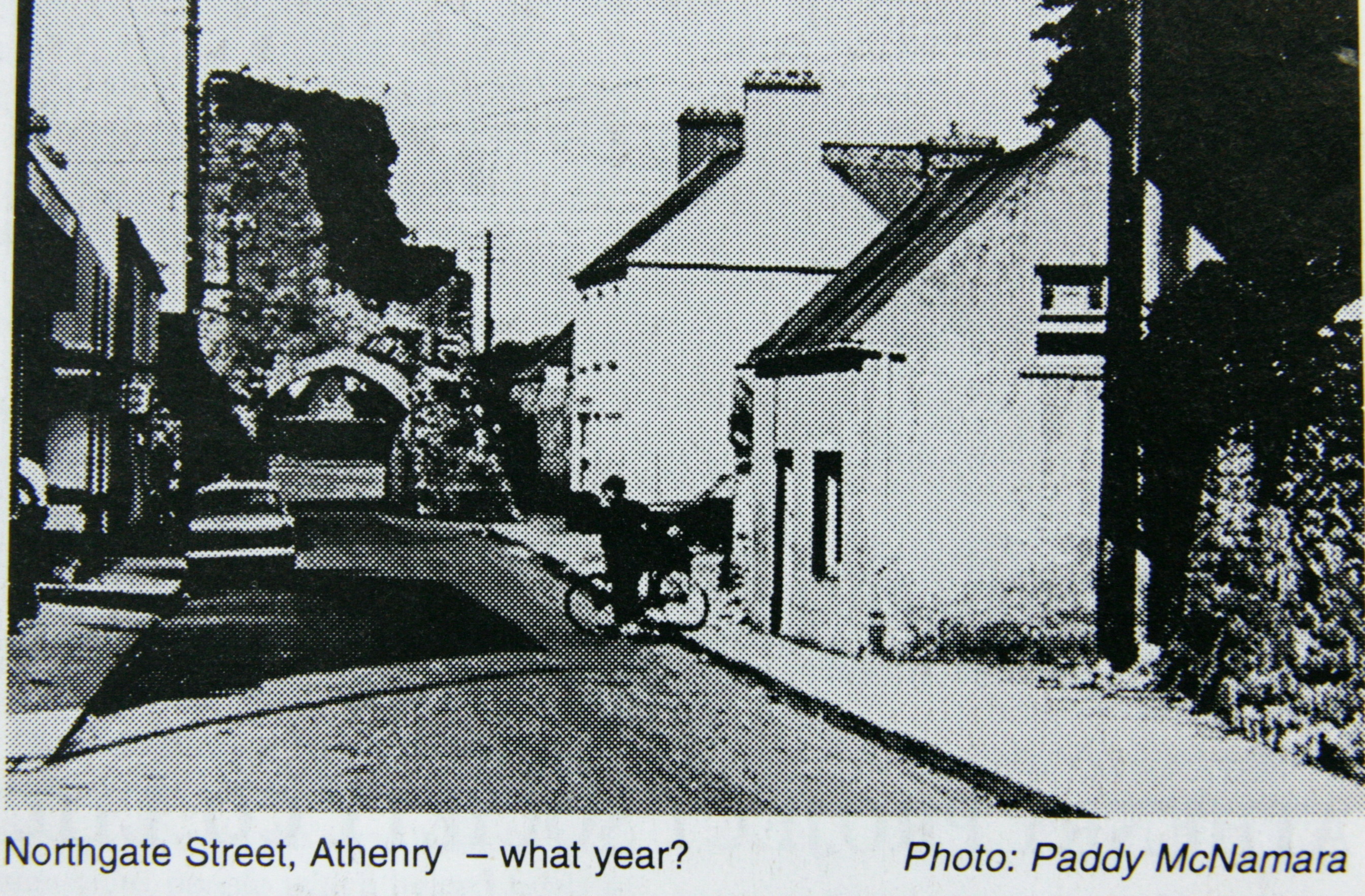

Family
My name is Ned Waldron. My mother was Margaret Madden who was born in 1899. My father, John Waldron, was born in 1897.
I was born in 1938 and with me in the family were my brothers Michael and Paul and my sister, Rose.
Sadly, my brother, Peter, died when he was 10 months old.
Schooldays
I started school in ‘Baby Infants’ in the Convent National School when I was four years old. I was taught by Sister Dominic and Sister Baptist.
After my First Holy Communion I and all the boys in our class transferred to the Boys’ National School in Old church Street, which had opened in 1940. There I was taught by Mrs. Woods, who was a lovely lady. After Mrs. Woods my teacher was Sean King.. Mr. King lived in Monivea. Once he fell off the roof of his house when he was trying to put up a windmill.
My childhood in North Gate Street.
My home was a small house near the North Gate or the ‘Arch’ as it is known locally. The street was a busy place with lots of shops and families.
As you come under the ‘Arch’ from the Caheroyn/Monivea road the first house on the right was owned by Tommy and Delia Cheevers who ran a grocery shop and a travelling shop in which they drove out to the villages around the parish and sold groceries to families. Their children were Eileen, Sean, Brendan and Thomas.
Next door was John and Mrs. Donohue’s shop and their family of Anthony, Seamus and Maura.
Next to them lived Garda Frank and Mrs. O’Rourke and their children Sean, Francis, Cherrie, Patricia and Eilish.
After that was Hession’s grocery and butcher business owned by Michael and his wife. They had a large family: Paddy, Owen, Mickey, Martin, Fr. Paul, Mrs. Coen, Mrs. Healy, Mrs. McDonagh and Sister Andrew.
Next to Hessions was Corbetts who ran a very large grocery and hardware business and were big employers in the community. They made doors, coffins and harnesses for horses. They sold seed potatoes, manure and other farm materials.
Working there at the time were John O’Dowd, Vincent Feeney, Jackie Monaghan, Jimmy Ryan, Timmy Reilly, Jimmy McCormick, Jimmy Burke. In the office were Gerard Browne, Mrs. Corley, and Paddy Regan.
Next to Corbetts was the pub owned by Martin Glynn. Martin had worked in Corbetts and had come to Athenry from Cappataggle. He had two daughters Patricia and Rita.
Ruanes agricultural machinery business was next door to Glynn’s pub. Before the ESB provided electricity to the town Ruanes supplied electric power to many premises, both public and private. They also had a mineral water business and they sold the product all over Ireland. The father was James Ruane and he was a County Counselor. His sons were Tom, Jim and Raymond. The staff was made up of Frank Kilkelly, Gerry Gronnelly, Mattie McNamara, Jim Kearns, Paddy Brennan. A Miss Brannelly worked in the office.
Next door to them was the Fallon family, who had a bar business. Later the Houlihan family bought the place and continued in the pub trade. The Houlihan children were Jackie, Frank and Dermot together with their sisters Lola, Evelyn and Josie.
You had the Brennan family next door and they had a pub business. Paddy and Mrs. Brennan had two in family, J.J. and Lena.
Next door to the Brennans was James Walsh who also had a pub. He had a son Bobby who became a priest. Later on Dan Whelan bought the place, which is now called ‘Dan’s Bar’.
After Walsh’s was James Fahy’s grocery shop, which also sold ice cream, bicycles and radios. James and his wife had three sons, Tom, Seamus and Pascal.
Beside Fahys was Nolan’s pub. Batty and Mrs. Nolan had no family. Batty had a beautiful singing voice. It was a great place to buy a pig’s head.
Mr. and Mrs. Martin Cunniffe lived next door to Nolans. Martin was a cobbler who died very young and Mrs. Cunniffe emigrated to America with her whole family. I remember them heading down to the railway station on their way to Cobh in Cork to catch the liner to the States.
Next to the Cunniffes were the Doherty sisters, Aggie and Annie Jo. They sold sweets, ice cream and fruit. A Coppinger girl from Monivea worked in their shop.
At the top of the street was the corner shop owned by the Dalys. They ran a drapery business.

Starting again below at the arch and on the left side of the street was the premises owned by Paddy and Margaret Doherty. Paddy was a sheep dealer and farmer. He owned the tolls that were collected on Fair days in the town. Margaret ran a shop selling groceries, delph, ice cream and shoes. They had four girls in the family: Maureen, Patsy, Ruthie and Geraldine.
I lived with my family next door to them.
Next to my home were several yards used by nearby shops as storage.
After that was the home of Mick Goode and his wife. Mick was a skilled fisherman and gentle, quiet soul.
Then you had Mr. and Mrs. Curran and they had three sons Albert, Joseph and Tony.
Next door to them was the large drapery shop owned by the Fitzsimons family-Sue, Masie, Joe and Rhoda. Rhoda married Eddie Somers who worked in the business.

Across the entrance to Burke’s lane was Annie Kelly’s step-down pub. Mr. and Mrs. Kelly had three sons: Timmy, John and Michael. Michael won an All Ireland Junior Handball title in partnership with Gerrry Cronnelly. Also on the premises was a saddler called John Bane. There were two flats overhead. In one lived Mrs. McHugh and her daughter. In the other was Mrs. Beatty who had a son and daughter. Charlie Redmond and his wife ran a tailoring business there too.
Next door was Mrs. Mullins and her son who had a barber shop.
Then there was Josie McCabe and his mother and they had a sweet and confectionary shop.
On the corner was Higgins’ paper shop. Over the shop was a flat in which John Crosbie and his wife, Mary B, lived. They had three in family-Maureen, Ann and Johnny.
The school playground was at the back of the school was very small and there I played with my friends: Frank Sweeney, Eamon Brody, Sweeney, Raymond Ruane, Sweeney and Frank Rabbitee.
My Memories of Newford
My family moved to a council house in Newford in 1945. My home in North Gate Street was a rented thatched house that had electricity, an outside tap and a toilet. Our Newford house was to be the one that the Stokes family had occupied but it had no water or electricity and had an outside dry toilet. It was a three bedroom house. Next door to the Stokes was the Holian family, Mrs. Holian and two daughters, and that was a three bedroom dethatched house too.
Across the road was Mattie Doherty and his daughter, Noreen. Adjacent to them was the house occupied by the Feeneys, mother, father and two sons in their early twenties.
Next to them was Mrs. Cawley along with her daughter, Mary Murphy. And adjacent to them was Mrs. McLoughlin, who was blind and her son, Michael.
After that came Mr. and Mrs. Kelly. Next door to them was the Murphy family, mother, father and son.

When my father got the key to the house we were told we could move into Stokes’ house on the Friday. However, during the week my father received a notice from Galway county Council telling us that the Feeney family with four persons was getting Stokes’ house with three bedrooms and we were to move into the Feeney house that had only two bedrooms for the six persons in my family, four of whom were young children. It would make you wonder what influences came to bear on the change of allocation of the houses.
So my father, in hard and difficult times, had to set about extending the house and installing electricity, a toilet and bathroom. The nearest water supply was the hand pump over the bridge in Prospect, near where Eamon Brody now lives. We had to draw water from it for ourselves and for our elderly neighbours, several times a day.
We had lovely, pleasant and good neighbours. At night Mrs. McLoughlin would be brought to visit our house by her son and afterwards my mother walked her back home. Mrs. McLoughlin had a great memory. Sadly, her husband worked on the railway but was killed on the railway near Pollnabonny bridge.
Mattie and Nonnie Doherty were nice neighbours who gave us sweets as a treat. Mattie had some funny expressions:
‘here’s this for yourself and put it inside your shirt’:
another one was
‘go on up to bed now and give the fleas their supper’.
Mrs. Cawley was from Cavan. Mr. Cawley won an All Ireland football title with Galway.
Mr. Kelly worked in the Farmyard, now known as Mellows College. They were a quiet couple and they spoiled us with gifts of sweets.
Paddy and Mrs. Murphy had a son, Jackie, who worked for local farmers.
The Holians house consisted of Winnie, Aggie and their mother. Aggie worked for Doctor Bligh. Aggie was a very kind-hearted woman who later married Jack Cunniffe. Jack was very good at dramatics. Once I was trying to play the accordion at the gate of his house. He called me over and said that the best place to practice was down at Mount Shaw, which at the back of our house. I was on my way down to it when I realized that Jack wanted peace and quiet and all I was producing was beautiful ‘noise’. Winnie was the foreperson in the local bag factory. Mrs. Holian smoked a clay pipe.
The Feeney family had a garage and petrol pump. Father and sons worked in Ruane’s garage in North Gate Street. Mrs. Feeney was the caretaker of the Protestant Church in the centre of town. At that time TB was rampant and highly contagious and, sadly, Mr. Feeney and his two sons caught it and died. After that happening Mrs. Feeney left Athenry and went to live in Dublin, her native city. Later on the Caulfield family moved into the Feeney house.
The gate lodge at Newford was occupied by Christy Kelly and his wife, Alice. Like a lot of locals he too was employed in the Farmyard.
The Newford farmhouses were occupied by two families of the Somers brothers-Mick and Mary Ellen and Pat and Betty. The wives were second cousins. Mick had a cure for ringworm. Large numbers of people used to call to him to get the cure. There was a large lawn around the houses and it used to be covered with daffodils in the spring. We were frequent visitors and we got tea and bread and jam as a treat. There was great hospitality among the people during those years. The houses were later demolished and the new road leading to the motorway runs across where they stood.
Playtime
Most of my friends at that time lived in Prospect and Ballygurrane. These included: Raymond Ruane, Thomas Sweeney, Maurice Ruane, Eamon Brody, Tom Curran, Nicholas King, Frank Sweeney, Martin Fahy, Tom Heavey, Tony Burke, Peter Dunleavey.
We played many games. One popular one was to sit on the roadside wall and take down the numbers of the passing cars. Like most boys we got up to some devilment. We used to tie strings on to doorknockers and we drove the house occupants mad with this prank. Another one was when we got an empty egg box and filled it with broken eggs. We placed it in the middle of the road. We hid and watched the reactions of people who examined what they thought was the real thing. We also raided local orchards.

The river Clarin was another favourite place for us. John Crosbie and Paddy Qualter took us fishing there. Raymond Ruane’s brother, Jim, built a raft there one time and we sailed all the way down to where Joyce’s supermarket is today.
Jumping into the quarry hole on one side of the Ennis bridge was great fun for us. We didn’t injure ourselves as there were plenty of bushes to break our fall.
Mass, the Stations and Funerals
That same quarry led to a path along by the railway and we used that as a short cut to the church. We came out on to the street where the Garda station is today.
The priests at that time were Father O’Malley, Father Mulrennan and Canon McGaugh.
Sunday Masses were on at 8, 10 and 11.30 am. The sacristan was Nellie O’Regan. Before I was allowed to be a Mass server I had to practice as a helper to the priest at Sunday’s evening devotions.
I served at 7am Masses for weddings and that gave a real meaning to the term ‘wedding breakfast’. Along with the priest there usually there were only 4 people present- the bride, groom, bridesmaid and best man. After the ceremony the newly-weds went to the bride’s house for breakfast and then took the train to Dublin or Cork for their honeymoon.
Serving at station masses out the country was an eye opener. It also meant that we enjoyed a half day off from school. After mass the priest, along with a few local ‘dignitaries’, were given breakfast in the parlour while the remainder of the neighbours had it in the kitchen. Usually we got a money ‘stand’ from the people of the house.
When a person died a high or a low Mass was said for the deceased. This also gave us a half day off from classes and there was great competition among the servers to see who would be chosen for this. Usually it was the sacristan who chose the servers.
August was mushroom time and the fields used to be covered with them. Tom Heavey’s mother roasted them on the prongs of a fork and added butter when they were cooked. They smelled beautiful and were delicious.
We spent lots of time catching rabbits and hunting. We gave a hand to farmers to save the hay and were rewarded with tea and sandwiches.
At Christmas the church was packed for mass. In the house 12 candles were lit. My mother bought the ‘Christmas’ from Brownes in Bridge Street. They always gave a gift for giving them our custom during the year. We bought our meat from Bradys in Church Street.
Lady Day in Athenry during the 1940s and 1950s
Lady Day was held on the 15th of August every year. The origin of the day dates back to the 14th century when tradition says that a soldier fleeing from the Battle of Athenry had a spiritual encounter with Our Lady.
People came in droves from all over County Galway and further afield. The town used to be thronged with people from early morning to late at night.
My mother came from Knockaunglas House which, during those years, was the only house between the town and Lady’s Well. On Lady Day my mother and aunt entertained many relations and friends with tea and scones. My uncles used to earn money by parking and minding bicycles. They also operated a ‘cloakroom’ where people left their coats for a small charge. When my brothers and I were older we continued that ‘business’, which was a nice little earner for us. We made plenty of money on the day. The present generation continues doing it by parking cars instead of bicycles.

Trains came from Galway carrying large crowds. Many others came on bicycles, ass and cart and on foot. Their goals were to do their devotions at Lady’s Well and afterwards meet friends, some of whom they wouldn’t have met since the year before.
The day gave a huge boost to the local economy. The shops and pubs did a ‘roaring’ trade selling tea, sandwiches and drink to the pilgrims. In Bridge Street, Browne’s and Kinneen’s shops set up counters outside their doors selling sweets, minerals and other goods. In the Square there were entertainers lifting cartwheels over their heads, lying on beds of nails, breaking slates on their chests. The town was black with people.
When the people had their fill of all of that they headed for the Well. They went to the Lady’s Well a mile about side the town to do their devotions or ‘rounds’ of the well. The ‘rounds’ consisted of saying the rosary with others as they walked in circles around the white-washed wall of the well. They washed their feet in the stream, drank water from the well and took a bottle of it home to bless their family and farm.
There was no Mass said at the Well during those years. Only the laity was involved. It was only in much later years that the priests became involved by saying Mass there. The devotions went on all day and into hours of darkness until one o’clock in the morning. There was no grotto at the well until the 1950s.
Down through the years the Murphy family -mother, father and sister- looked after and cared for the well and its surroundings. They deserve the highest praise for their dedication to this special spiritual place in the parish.
Toffs’ amusements came to town for the day after a stint at the Galway races. We, as children, were out early on the road watching for them to appear the day before Lady Day. It was the highlight of the year for us.
They set themselves up in Taylor’s field, which is now the town park. We enjoyed the swinging boats, the chair a planes and the bumper cars. We ate sweets and drank lemonade while we played ‘Pongo’, which was a type of Bingo, with pieces of paper marking the numbers on our boards. If the day was windy and someone came in the door to the ‘Pongo’ tent the wind blew the paper pieces all over the place and the whole game had to be called again.
In the 1960s it was noticed that attendances began to decrease. However, they revived in the 1970s when Mass began to be celebrated at the Well. The fortnightly Lady Day festivals organized by Athenry Junior Chamber during that time also brought the crowds back and increased attendance numbers visiting the Well.
From that time on greater interest was taken in all aspects of the Well. A committee was set up to care for and develop it into what is now a place of great and prayerful devotion for locals and visitors.
Trainee Electrician

When I was around 12 years old my parents urged me to go into the electrical trade. This came about after the family moved to Newford and the local electrican, Silvie Brennan, who worked for Ruane’s of North Gate Street came to wire the Newford houses. I gave him a helping hand and after school I continued to do odd jobs for him. Silvie had a keen interest in cycling as I had and I enjoyed helping him. Later Silvie went to England and worked as a technician for the BBC. He’s still alive and is an uncle to Raymond and Rosilind Ryan of Caheroyn Drive.
I left school at 14 and started working on the rural electrification scheme that was in full swing at the time in Athenry and surrounding areas. Two electricians Paddy Fury from Galway and Peter Fox from Moycullen set a workshop in Old Church Street where Joe and Rita Burke lived. I approached them and they took me on as an apprentice. We worked throughout Counties Galway and Clare wiring houses and churches.
My first job was in wiring Christy Howley’s Furniture workshop, ‘St. Bernadette’s’ in Cross Street. When that was finished Paddy Fury told me to put the stuff back in the workshop and lock-up as he was going drinking with Christy in Fox’s Bar. I went up with the key to Paddy and to get my wages. Christy said to Paddy ‘you’d better look after that young lad as he came from good stock’.
Paddy Fury was a tough taskmaster but he respected you. He was a brilliant tradesman but very courteous and respectful to everyone. Paddy Fox was a gentleman and a good character. They were happy times and both treated me very well. Later Paddy Fox emigrated to England and I stayed on with Paddy fury.
Working in England
By 1957 I had finished my apprenticeship. However, I hadn’t done any industrial electrification work. I decided to go to work in England and I stayed with my uncle, Paddy Madden in Bermingham. Next door to Paddy lived an electrician named Ken Yorke and my uncle had told him that I was coming over and would be looking for work. Ken had said he would talk with his foreman, Jim Berry from Waterford who later on transferred to Galway and installed the large transformers in Merlin Park Hospital. He was the man who was sent out years before to do the metering in the Newford houses.
Ken Yorke took me to the office to meet the personnel manager. I gave him my references and explained that I had no electrical theory. He took me on as an ‘improver’ and sent me to college every Monday, Tuesday and Thursday evenings. I was paid full wages while I was studying my courses, which lasted 18 months. I was then able to marry my practical experience with the electrical theory. However, after the course finished I got ill and was told to take a break and go home for a while.
Working in Tipperary and Kilkenny
So at the end of 1958 I returned home and while there a job for an electrician was advertised in the press to work in Tipperary for Leo Dwyer wiring creameries and rural houses in a scheme called ‘Post Development work’. I got the job on a trail basis for three weeks.
I journeyed by train to Limerick Junction with my toolbox and case. A taxi driver was kind enough to take me to Clonmel wher I got the bus to Ballingarry, south Tipperary. I found digs with three ESB lads in a local house. The houseowners were very good to me.
Next morning Leo collected me and off we went. The work involved wiring Creameries, coal mines and houses. We also worked in Callan, County Kilkenny. On the second day Leo, who loved greyhounds and hurling matches, asked me to stay on with him. In all I was with him for 3 years.
Working for the ESB
Around that time an advertisement for an electrician to do industrial work appeared in the local paper at home. I applied for it and returned to Galway for the interview in the ESB office. Mr. Charlie O’Driscoll and Jackie O’Brien interviewed me and after it was over they said that I could start in a fortnight.
I got on well. My first big job in 1961 was the wiring of the Potez factory. They made oil heaters on the site now occupied by Thermo King. After that it was off to Dundalk for three months to work in the Harp Brewery. It was very specialized work.
I returned to Galway and for two weeks did work in the seaweed factory in Ballyconneely. Later on I worked in a factory owned by Austrians in Ennis that made spectacles. While there I was appointed foreman at the age of 24.
Other places that I worked in were the filtration plant on Achill Island and the shirt factory in Westport. While there I met Anne, my future wife, and we got married in 1966. Along with my ESB crew we wired the new maternity unit in Castlebar hospital and the extension to the Mental hospital.
Back in Athenry we worked on the Goulding depot and after that we were sent to the film set of the movie King Arthur that was being filmed in Kilchreest. We stayed for the duration of the filming looking after the maintenance of the operation.
By this time the industrialization of Galway was beginning with the establishment of the Mervue industrial estate. We also worked on many projects including the extension to University College, Galway, Roche’s Stores and the extension of the public lighting system throughout the county.
Following that I began to work fulltime in the office, doing relief work and as an advisor.
I retired in May 1998.