APH
APH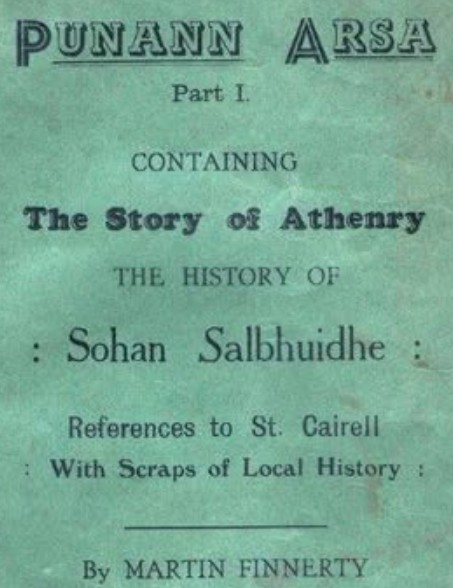
Punann Arsa: The Story of Athenry (Part 4)
Author: Martin Finnerty
Source: Galway Observer, December 30, 1950
St. Cairlle’s Miracle – The Lake Monster
In those far off days when there were no boundary fences, no tillage, or when tillage was very rare, and when tribes worked for an existence on the communal system, it is difficult to realize how there could be a Cluan at all, or a meadow, as we understand the word today. But when we reflect that from the date of the battle of Magh na Cruimhe to the time of the coming of St. Patrick, great clearances and headway could have been made and tillage and meadow land in existence, yet, I incline to conclude that the word Cluan did not creep into Irish place names for many centuries afterwards. It will be noted That Cormac Gaeling, grandson of Cian, cut his way and secured expansion for the Clan Cian to the county of Sligo. At a later stage the Clan Macne made inroads into this country of his, and cut his territory in two almost. St. Patrick found the descendants of Cormac Gaeling and those of his son, (Luigh Lewy) occupying large territories in Co. Sligo i.e. north Sligo and parts of Mayo. On the bank of Lough Arrow in the territory of the Luighne this race of Luigh, St. Patrick established a church at a place at present and apparently for centuries back called Tamhnach (P. Townach). This name is in my opinion a corruption of Domhnach. We learn from the annalists that the Saint laid the foundation of his Church on Sundays, hence my contention that Domhnagh (Donagh) not Tamhnach is the original designation of this ancient church. This church he later raised to a monastery over which he placed Bishop Cairell, and under whose jurisdiction he placed St. Mathoua (Mahona) one of the first veiled virgins (Dr. Healy) in an adjoining convent.
Bishop Cainell
We learn that in those days, and for seven centuries afterwards, the Episcopal jurisdiction of a bishop contracted or expanded with the contraction or expansion of the clann territories whose bishop he was. Of course Bishop Cainell was some great and holy man belonging to some other great clann. I am afraid it would be rejected as so much rameis; and contrary to the writings of all authorities that St. Patrick’s objective was on all occasions to secure the head of the clann. In this line of church administration, St. Patrick has shown his greatness, and foresight. It is permissible to assume that the great apostle became fully aware of the numerical strength, prestige, far-flung domination, and territorial acquisition of this pagan race. It is as plain as daylight that he lent every effort to secure a promise of the line for the sacred apostle succession. Am I to ask did he not succeed? My firm conviction is that he did. and also my opinion is that Bishop Cainell was a son, or grandson or at all events a descendant of a tribes mark, marking him as almost seventh in descent from Cian. Dr. Healy also writes: “It is (or words to this effect) difficult to ascertain where St. Mathona went after leaving Tawnagh, but we may assume that when Bishop Cainell left Tawnagh, she went north to her relatives in Tiramly, and was probably buried there”. I am aware that the name of St. Cairell is by the natives of this area in north Sligo forgotten. To trace the missionary career of St. Patrick’s great disciples presents no great difficulty. We learn from the Tripartite life of St. Patrick that the Saint spent seven weeks in the Ciannachta area, the area previously mentioned, or north county Dublin, and part of Louth. On each Sunday he cut the foundation of a church and each church he called Dominieu (Latin): this is cognate with Domhnach (Donagh) in Irish which means Sunday
Names Remain in Dublin
Considering that a great city has come on what was then a rich pastoral area: the place names of these churches must long since have been forgotten, but we still have Donnycarney holding its own, where St. Carney is also commemorated and there is also Donabate, north of the Liffey and this means Donagh na mBhad, or Sunday of the boats.
That St. Cairell accompanied our National Apostle is not only probable, but almost in my opinion a certainty. The conversion of this great tribe, with all the prejudices and the obstacles incidental to the christianising mission necessitated the assistance of a missionary who was of the blood of Cian, a near relative and one of themselves, such a prelate was St. Cairell. Even though the annalists and great authorities seem to have kept “dryfoot” or in other words did not get “wetfoot” in the region that became the scene of St. Cairnell’s labours. Yet, historical facts – and these I draw from only need to be assembled to remove the doubts and reservations regarding St. Cairell and to place the true story regarding his life and labours outside of the realms of conjecture.
I now arrive at a stage in his life where a heavy task of his life work remained to be done. The Clan Cian of Cullibh Oige had not so far heard the word of God. That their near relative, and clansman, came amongst them to preach the gospel of the True Faith there can be no gainsaying. Neither can there be any regarding his success, and ultimate commemoration of the saint. So much achieved he was destined to come and live amongst his relatives, the Clan Cian of Collaibh Oige. He founded a church in their midst and as well as may be judged at a central point of the then territory or territories of which they were the inhabitants, appointed or ordained clergy from amongst the converts, performed many miracles and made an end to paganism in their midst.
Monster in the Lake
Tradition to this day preserves an account of miracles to his credit. An account of one is as follows –
“There was at that time in the pre-townland of Gortnalun a large deep lough that would not be the extent of a lake. It was supposed to be unfathomable, at least it was very deep and experts centuries afterwards were unable to fathom it. Today it is surrounded by bog: at that time there was no bog there. Local inhabitants were disturbed because of some unearthly monster that existed in its waters. At night time its head appeared above its waters and its eyes had thrown dazzling lights such as powerful lights would at the present day. Some say a sight of same meant death to those who came within its range. This may be an exaggeration. Be this as it may local people were at all events terrified. St. Cairell was informed as to the existence of the infernal monster.
With bell, book, and candle light under cover of the night, he set out from Clan Cian Cainnell. About midway he knelt on a large stone and prayed. This stone was known down through centuries as Leacht na Ghlun. The stone was said to have borne the impress of the saint’s knees, a little cealtrach or child’s burial ground has the memory perpetuated even in the ordinance map i.e. Leacht na Ghlun.
Hooked in Monster
St. Cairell proceeded and must have had a guide until he came near the lough where the monster existed. He knelt and prayed four times and the fifth time on the bank of the lough. An account says he hooked in the monster. Another account says that the latter worked his way and cleft the bog in two. There is dividing line from this point to Clough townland called Eidar da mBhoin and it is said that this is the trail of the monster. This could not be as there was no bog there at the time. A little stream that drained the adjoining townlands kept its unerring course while the great bogs had grown on both sides of same. At all events that was the end of the serpent, but the account of its end will not die while people live in the area. Ever since this lough is known as St. Cairell’s holy well. At Lough Cairell on the 13th June each year, people from far and near come to perform stations and kneel and pray where the saint knelt and prayed more than fifteen centuries ago. Formerly a pattern was held there but apparently was not a pattern of what their saint would have and rightly or otherwise the meetings were church prescribed. St. Cairell is the patron saint of Clan Cian Cainell where there was erected the ancient church which church and a holy well exists to perpetuate his memory. The historians and annalists have little claim to the commemoration of St. Cairell. Whether by indifference or want of knowledge of facts and circumstances he has received scant justice by all.
Converted the Clann
Where mention is made of him it is recorded that he was an eight-century saint. This might be overlooked if there was a large number of saints of the same name but there were only two St. Cairell’s and one whose life and labours in the fifth century there is no difficulty in following.
Where the saint had episcopal supremacy over the tribes and branches of same it is now difficult to arrive at a conclusion but it is fairly safe to assume that his spiritual endeavours were not wanting to procure the convention of all-facts are not wanting to sustain this assumption. We know that Clan Cian Eilie were christianised nearly one hundred years before St. Brendan came to Clonfert and that the churches at Clonfert and Clan Mac Gavise were not erected to let in the lights to Christianity but to feed the children of the faith, and further to propagate enlightenment and learning. That St. Cairell visited Cian Cian Eilie before he came to Clan Cian Cainell as there could possibly be intercourse between the latter and the clans in Sligo via the Shannon for previous centuries is possible if not probable. That he contracted the Clan Cian Eilie and had been a prime factor in the evangelization of same there is not doubt.
That Clan Cian Eilie had been under his episcopal jurisdiction till his end is pointed to by facts and circumstances. His Suidhe (See) at Clan Cian Cainell was founded midway between Clan Cian Eilie and the territories of Luigh, Gaelings and Calry in Sligo and Leitrim. That his Suidhe (See) was founded slightly off the ridge of Connaught, the only route possible by land in those days between say Birr and Sligo territories is an indication that well studied provision had been made for covering that vast territory-the ridge of Connaught by land and the Shannon from Carrick to Banagher and Portumna.
That in St. Cairell’s time the descendants of the tribe of Cian, the Clan Cian, Cianachta, Luighne Gaelinge, etc, were numerically the strongest — whose territories were the most far flung— if not the most powerful in Ireland at that period.