APH
APHSource: Times Pictorial, Week ending October 18, 1952

IN some parts of the west, they told me to by-pass Athenry on my way back to the east. “Athenry is dead from the neck up. Nothing of interest has happened there since 1504. The most you could write about it is that it is the only graveyard in the country with buses running in and out of it! “
But, as usual, ” they ” were hopelessly wrong, for at the moment another, if less spectacular, ” Battle of Athenry ” is under way-and it is being fought, for the most part, by one man, whose dream it is to keep the youth of the town and district from emigrating. But of that, more anon.
It was market day in Athenry when I arrived, but I was not aware I this until the local Garda sergeant drew my attention to it. No more than twelve people-buyers who didn’t want to buy, and sellers who didn’t want to sell-were gathered round four pony carts containing about fifty to sixty bonhams.
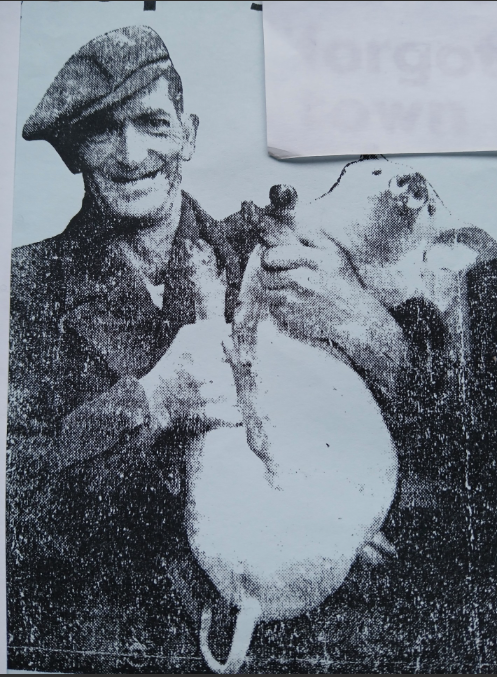
Man with protesting pig is Pat Donoghue
PIGS AT MARKET
Patrick Donoghue (a buyer) claimed that the pigs were selling dear var. Pat Flaherty (a seller) said that the pig buyers wanted a man to give his pigs away for nothing these days. The bonhams didn’t think much of the proceedings here, and they squealed lustily every time they were taken up for vetting. “We’ve been having poor markets lately,” Brendan Higgins told me across the counter of his public house in Davis Street. “You would see a great difference, if you were here when we hold our annual show. It’s hard to get standing room in the town then.”
HUNTING TALK
Brendan Higgins, whose family are old ” residenters” in the town has one all-absorbing topic of conversation- horseflesh. In his youth up to a few years ago he hunted in what is still acknowledged as one of the most dashing packs in the country, the Galway Blazers. As you probably know, we had number of American hunting enthusiasts over here last season. They’re still talking about the stone walls and about the weather!
Over in the West the weather was unusually fine last season, with the result that the visiting Americans returned to “God’s Own Country ” and told their friends about the marvellous” winter climate enjoyed by the Green Isle! Since then, Mr. C. Daly, Secretary of the hunt, has received letters from America intimating that a still larger quota of hunting visitors may be expected this season. “I hope it keeps fine for them,” chuckled Brendan Higgins.
A COME-BACK
With a population of roughly a thousand souls, and a relatively high incidence of emigration, this little market town, which once encompassed an area greater than that of Galway city, is fighting desperately to make an economic comeback. Like its prototypes in every part of Ireland, Athenry needs new and permanent sources of employment for the boys and girls coming from the local schools. Charlie Taylor and his family have been wrestling with this problem since the beginning of the century. and Taylor’s Corn and Saw-Mills provides all-the-year- round employment for eight local people. Charlie and his brother Herbert together keep the wheels turning in what must surely be the oldest corn mill in the West of Ireland, if not, indeed, in the entire country,
” The earliest mention of this mill was in 1575, when the town was besieged and burned by the Mac-an Earlas. When the walls and fortifications were built around Athenry this old mill, for some unknown reason, was excluded. It Stood just beyond the walls, so that during the siege the citizens possessed plenty of grain but had no means of milling it.
“When the town was again rebuilt the stonemasons made doubly sure that the walls encircled the mill. It has been here ever since, grinding away.”
NEW FACTORY
Down on the ground floor, and hidden away in a corner, Charlie showed me the old stone querns with which the corn was ground in olden days. They are still in excellent order, and. I was assured would still give service if put into operation.
In their place, however, has recently been installed a modern roller mill-in fact, the only one of its type in the country. In his efforts to maintain and increase local employment Charlie was instrumental in launching the Western Sack and Bag Company, Limited, on the outskirts of the town. Here bags and sacks imported from Britain and the Six Counties are reconditioned. At the moment about 12 to 14 local people are employed but there are hopes of an early and large-scale expansion.
Now meet the man whose dream it is to create full employment in the town and whose efforts in this direction have met with truly remarkable success over the past four years. He is 35-3ear-old Christopher Howley, proprietor of St. Bernadette Industries, which manufactures ” everything possible from wood.
To find Christy one must first find that corner of the factory from which the greatest amount of sawdust or timber shavings is lying. It’s ten to one that Christy will be in the thick of it. Root him out into the sunlight and away from the whining machines and he will tell you his story.
” Four years ago [ got fed up watching the town slowly dying. I saw the local kids playing with toys imported from Germany or Japan, saw the local farmers’ wives buying wooden butter dishes, churn dishes, even chairs that had been manufactured abroad. I was only a ‘hick ‘ carpenter, but I knew that if I once got the chance, I could turn out the same articles, better finished, and at a cheaper price. I hadn’t tuppence in my pocket at the time, but I had a queer kind of faith in the idea. It was worrying me for weeks, so one evening I dropped into the chapel lo say a prayer to St. Bernadette. I made a kind of bargain with the saint that evening: if she helped me to get the factory going, I promised to put her name on everything we manufactured.”
And Christy has honoured his portion of this strange pact ever since.
Christy Howley at work
GARDEN “FACTORY”
Starting a factory, on just a bare idea coupled with the type of faith which moves mountains, and without a penny piece of capital, seems an utter impossibility. Christy Howley succeeded. He began by making wooden toys in an extension tacked on to his own kitchen
The toys were solidly made and they were cheap. Christy sold them all. To his friends and to townspeople in general he became the epitome of enterprise.
He began to expand his ” factory” down the back garden towards the river, and he tock om helpers. When these were not making furniture, they were lending a hand to extend the factory floor space, usually after official working hours. And he found his workers in the most unlikely places.
He “rescued ” young furniture workers almost out of their time in other towns -young men and women already saving up for a one-way ticket lo a cross-Channel down or city. He took others out of “dead end” jobs in the neighbourhood because some queer instinct told him they possessed the makings of that type of labour so essential to his own success. He wanted workers who would live up to that name, who would give unstinted effort in return for higher wages than they had ever hitherto received.
ORDERS ROLL IN
One by one the machines were moved into the growing factory and clamped into position. Production figures rese. The men, smothered in sawdust at their improvised benches, were soon surrounded hy towering walls of chairs; fireside chairs, dining room chairs, traditional Irish
farm kitchen chairs Tables, wardrobes, wooden churns, toys followed as the scope of Christy Howley’s enterprise broadened out.
The orders kept pouring in-from 46 towns in Ireland, and even from has far afield as the United States of America, where some equally enterprising Yank had heard of the traditional Irish chairs being turned out by St. Bernadette Industries.
“] have sixteen men and women employed here with me now” says Christy. ” But, If I had the capital, 1 could increase this figure lo nearly one hundred overnight. It’s hard to dig up capital in a little town like this, which has been dead’ since 1916. Down here we have been ignored, hy successive Governments, even though it is blatantly obvious that we are an “undeveloped area.” During the troubles, though, this place was a hot bed of rebellion. Come on int0 the kitchen and I’ll show evidence of that fact.
Dutifully 1 followed him into the house. In one room was a tastefully decorated shrine of St. Bernadette; in another the wall were hung with vivid engravings of historical incidents, ranging in time from 1798 1o 1922. A picture of His Holiness the Pope took pride of place on one wall, with two good Protestant patriots Theobald Wolfe and Charles Sewart Parnell guarding him on either side!
From a drawer Christy removed a small pearl-handled revolver, a Martini rifle and a British bayonet and scabbard, all of these articles had lately been dug up from the hack garden when the factory premises were being extended.” The revolver belonged to Liam Mellows and I remember the day he buried it in the garden * Christy’s mother told me. Mirs. Howley was herself an active member of Cumann na mBan, and she recollects with a shudder the time when there was so much armaments buried in her back garden she was terrified to strike a match.
“The Rebellion was planned in Martin Hynes’s house on this street, one of the most historical in the town even if no one takes any notice of it nowadays” says Mrs Howley.
NEW REBELLION
Christy and his mother are currently planning another rebellion – against the fates that for so long have threatened to ignore their once prosperous town and against the local unemployment which has been XXX the youth towards the export ships
“Capital or no capital we XXX on St Bernadette, As time goes on, we’ll absorb more and more of those who would clear out of the town. We’re building up a good company, and the factory is working under pressure. We can’t lose because we have the genuine enthusiasm, every single one of the workers, and because we have St Bernadette on our side” Christy Howley concluded and then went back to his work machines
Somehow, I believe he is right and the future prospects for Athenry is assured so long as men of Christy’s calibre continue to live and dream among and within the shadows of its ruins.

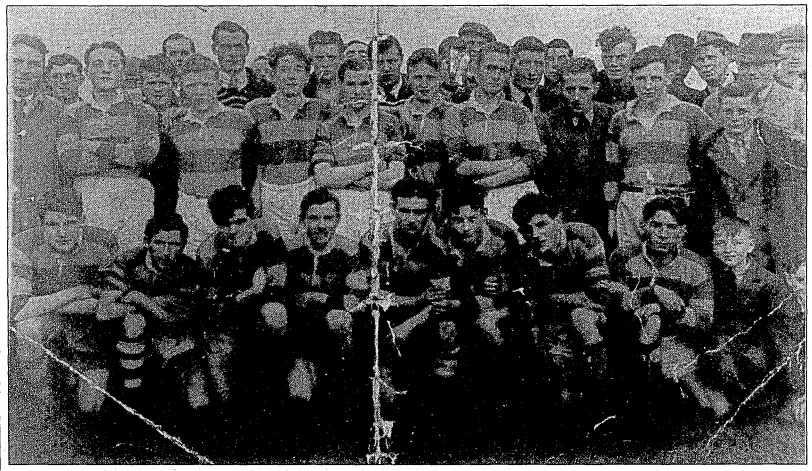
Athenry Boys National School
Man with protesting pig is Pat Donoghue