APH
APHSource: Connacht Tribune 1 March 1958
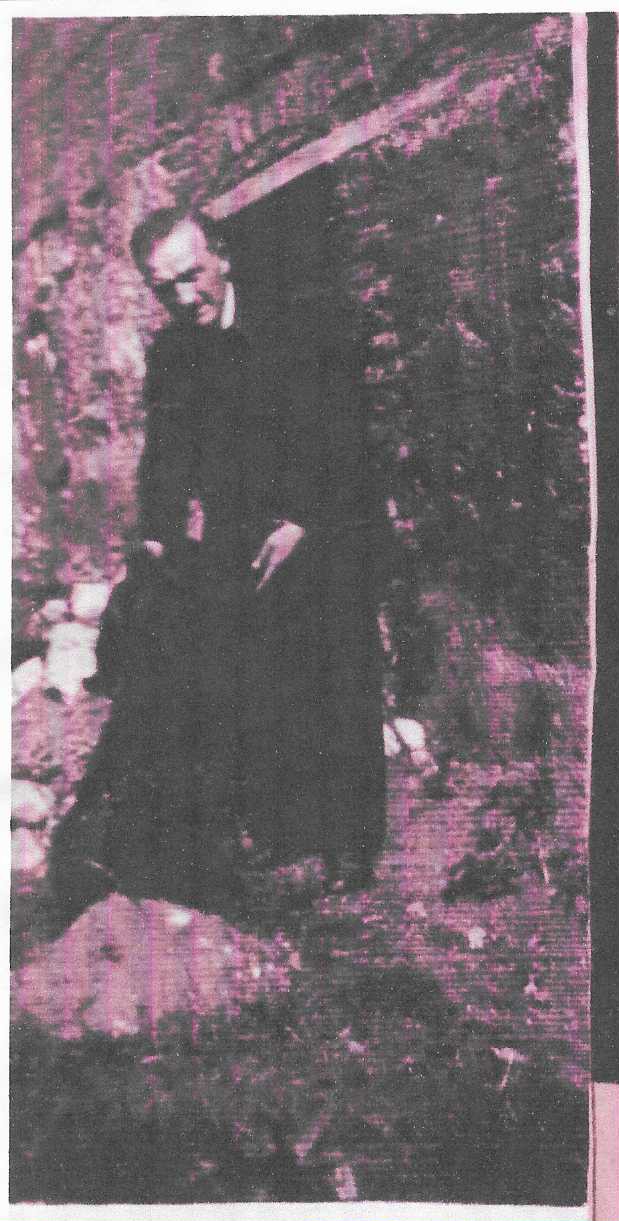
REV. PROF. T. FAHY, M.A., B.D., who has retired from the Chair of Ancient Classics in U.C.G. after 30 years, was born in the townland of Gloves, Athenry, in December, 1887. Referring in an interview to the birthplace, “Gloves,” he sald it was an anglicised corruption of the Irish “Glamha.” He had never heard of such a place name in any other part of the county, and he had never heard an explanation of the etymology of the name. It was referred to in the ” History Of The Dominican Order” as Glamha an Bhain.
REV. FR. FAHY got his first schooling in Esker, which had been an old monastery of the Dominicans. They fled Athenry after invasion. Asked if he had any recollection of his early days, he said he still vivid memory of his teacher, Michael Henchy, from Corofin, County Clare. Michael Henchy was a man of splendid stature, standing over six feet and an athlete of the first rank. Weight-throwing and weight-lifting were in his line. He was an excellent teacher, a man of personality and character. He often told me if I stuck to my books I might come to something. “If I have not reached the Parnassan heights which Michael Henchy visualised, it is not his fault”
ABOUT 1900 Father Fahy became a student of Esker College, then the diocesan college for Clonfert. In the following year Esker was taken over by the Redemptorists and the diocesan college transferred to The Pines, Ballinasloe, which had been a Protestant college.
One particular comment Fr. Fahy had about the secondary school in Esker and Ballinasloe, was the very sound education boys got in those days, especially in the Classics. “They got a very thorough drilling in grammar. Greek especially was acquired in the hard way. But still a big number of boys took Greek all through the secondary course.” There must, he thought, be, proportionate to the population, more people in Ireland with some knowledge of Greek than in any other country of the world outside of Greece.
He passed in to Maynooth in 1905 and graduated in Ancient Classics in the Royal University in 1908. Then he spent the usual four years studying Theology and Sacred Scripture and after ordination in 1912 movedto the Dunboyne Establishment, where he resumed the study of the Classics, After two years teaching in The Pines he returned to Maynooth as Assistant Professor of Classics in 1915, and in 1927 succeeded the late Rev. Professor Dempsey as Professor of Classics In Galway.
ASKED if he had taken part in any controversy, Rev. Fr. Fahy recalled that in the 1930’s he had contributed to a discussion
ONE little incident Rev. Fr. Fahy had to recall about that occasion in Athens was the following: When he was preparing his speech for the opening ceremony he was approached by a friendly Belgian delegate whom he had met on the boat between Brindisi and the Piraeus. The Belgian was disturbed and said the Irish delegation would not be allowed to speak next day. Previously, arrangements had been made in the office and each allotted a special time for speaking. The Belgian delegate, whose wife was an Athenian and who had opportunity for inside information, informed him that the British delegation had protested that Ireland was part of the British Commonwealth and that the British delegation spoke for the British Commonwealth. The friendly Belgian also gave a hint how to counter this petty manoeuvre.
“I immediately went to the office,” said Rev. Fr. Fahy, and told the Athenian lady in charge that I heard some change had been made in the arrangements. She spoke English fluently with a perfect accent. ‘You’re the Irish delegate. The British delegation are speaking for you.’ I asked her why. ‘Don’t you belong to the British Empire. Aren’t you British?’ I asked her if when Greece belonged to the Turkish Empire the Greeks were satisfied to be called Turkish. The reaction was immediate. There was no reply. She blushed to the ears and indignantly stroked out the new arrangement. Freedom of speech, on which the old Greeks set such store, was given back to the Irish!
A SKED if in his 30 years lecturing in U.C.G. he had any particularly brilliant students; he said that in the very first year one of his students was Miss Margaret Heavey of Athenry. had won the Travelling Studentship in Ancient. She was certainly the only lady in the history of the N.U.I. who won that distinction. Miss Heavey is now Lecturer in Greek through Irish in U.C.G. Later still there was another coveted distinction. A student named Sean Connoliy entered for the Lord Cromer prize for an essay on a Greek subject. Candidates had to be subjects of the British Commonwealth of Nations and a certain age. Scan Connolly was six months over age, he admitted, and was a subject of the Irish Republic. Yet he got the prize. The last person in Ireland to win that prize was Fr. Aubrey Gwynn, S.J., of U.C.D .. whose father had such close associations with Galway. Sean Connolly is now Rev. Sean Connolly, C.SS.R., and is giving missions up and down the country.
CONCERNING the future of U.C.G., Rev. Fr. Fahy said he thought the prospects were bright. We have a fine body of students, serious m in d e d and industrious for the most part. Besides, Galway is an ideal University centre-the population is big enough to give students ample opportunities for sporting and cultural activities, and not big enough to obliterate completely the personality of the student body. Moreover, Galway is in every sense a clean city and an ideal centre for young people to pursue their University careers.
Asked what his plans for the future were, he said he would like to visit the Holy Land. And then sit down and prepare might and main for the final examination which cannot now be many leagues distant.”
A MEMBER of a family strongly nationalist, he brought the news of the disbandment to the Galway Volunteers under Liam Mellowes at Lime Park, Athenry, in Easter Week and wrote Meliowes’ speech when the 1916 leader stood for election in Meath constituency in 1918. The chaplain to the Galway Volunteers was Rev. Fr. Feeney who had to go on “the run” after the Rising. Fr. Feeney’s health broke down and efforts were being made to get him to the U.S.A. Rev. Fr. Fahy interviewed Sir John Maxwell, Commander-In-Chief of the British Forces, and succeeded in getting permission for Fr. Feeney to leave Ireland. Later Rev. Fr. Fahy furnished the Historical Society with an account of the Rising in Galway.
Sport
A KEEN sportsman, he was an expert horseman in his youth and won the stonewall championship of the show onhis own horse at the first Galway Show .. He also takes a keen interest in coursing and is president of the Galway and Oranmore Coursing Club. He was also president of the Connacht Council N.A.C.A. shortly after coming to U.C.G. Rev. Fr. Fahy maintains a ‘close association with his former students and with Maynooth College, and from 1954 to 1957 was president of the Maynooth Union. He has represented the student body of U.C.G. on the Governing Body for over ten years.