APH
APH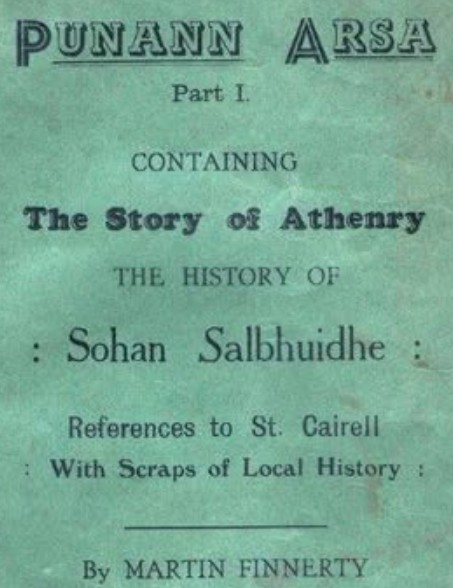
Punann Arsa: The Story of Athenry (Part 6)
Author: Martin Finnerty
Source: Galway Observer, January 13, 1950
ECCELESIASTIC DESCENDANTS OF THE CLAN
Other eminent ecclesiastics have been recorded as descendants of the Clan. St. Finian was a descendant of an Ciannachta. St. Canice the patron of Kilkenny was a native of the Cannachta territory, Derry, and probably was also a descendant. The name changed slightly as he travelled and in Scotland he bore the name of Kenneth and having regard to the native Scotch Gaelic dialects, it bears some relation to Ciannachta. Two descendants of an Luigue or O’Garas of that tribe filled the archiepiscopal See of Tuam in succession in eighteenth century and yet an earlier one, St. Dahonna of whom I shall make mention later in this article.
It will be noted that in relation to official records the form Clan Caen Cairyll is the one met with. Wrote Rev. Dr. Wakeman former Protestant rector of Athenry-Anno 1441. On the petition of John and David Mulcaryll, (Brothers of the Third Order of St. Francis, priests of the diocese of Clonfert) to the Vatican, it was stated that Thomas, Bishop of Clonfert, with the consent of the Dean and Chapter, gave perpetual alms to them and other brethren of the said Order conventually with them, present and future, the Temple of the parish church of Clan Caen Cairyll in the said diocese chapels, &c., together with a third part of all ecclesiastical lands, around and about the said church defined by the high road which goes eastward to the farm called Gortagana Beagh and returns southward and northward mention being made by the following fronts which define the parcel, namely-Croscailin Gortanacarit, Gortnatrapue, Acha Ada, Goirte Mercel, Meilic, Macanna, Ceilonagroise, Park Beag, and all the meadow and marshes as far as Ampein and reservations being made by way of canonical portion of the forth portion of funeral dues arising from outside parishes, that the said bishop gave them license and authority to rebuild and convert the said Temple into a monastery for the propagation of religion and the increase of divine worship, and that John (Whyte), the present bishop made like gift to them. He accordingly orders if he finds the above gifts lawful to confirm and approve of them.
Footnote: (Calena Papal Letters IX. 211-2 Wading XI. 420. quoted in Fitzmaurices. Materials for the history of Irish Franciscan Promise. Little Manchester(1920). Anno 1453 Papal permission obtained by David Mulcairyll to convert the house at Clan Caen Cairyll from the third to the first Order of St. Francis. Inscribed monument at Clan Caen Ciryll churchyard to Edmund Kelly. Epic Cloufertises. the inscription reads—
“Here layeth Right Rev. Father (Right Revd. Father in God Edmond Kelly, Doctor of Sorbourne, formerly Vicar General of Diocese. first Almoner to the elector of friars envoy to the court of Vienna and also Lord Bishop of Clonfert requiescent in Pace.”
Above inscription is contained in the journal of the Roval Society of Antiquarians, 1897.
PAPAL PETITION GRANTED
It will be noted that the petition sent to the Pope in 1441 was granted in 1453 or twelve years afterwards.
There was a sort of tradition that St. Cairyll was one of the third brothers and that a dispute arose between one of these and the brothers who were engaged in the buildings of the monastery of Kilconnell. This dispute may have arisen between the brothers. Dard and John Mulcaryll and the members of the Community at Kilconnell, but be this as it may, the erection of the monastery at Clan Caen Cariyll took place one thousand years after St. Cairyll’s time and it would appear there was neither building nor church at Kilconnell in St. Cairyll’s time.
The Rev. Dr. Wakeman, protestant rector of Athenry. has written expressing surprise that more mention had not been made by Catholic writers of so distinguished a churchman and prelate as Dr. Edmond Kelly had been. The memorial monument to his memory within the walls of the ancient monastery does credit to the sculptors whose hands had chiselled and lettered a model work of art, but for many years back, it reveals evidence of neglect and the inscription moss grown. To make matters worse, quite recently the portion of the Abbey wall into which the monument was fixed has fallen, the effect being that the monument is now decapitated
BISHOP O’KELLY
It would appear that Bishop Thomas O’Kelly, Lord Bishop of Clonfert (not Edmond) was the donator, and through his will provision was made to provide the land and the wherewithal for the establishment of the monastery. The ancestral home of this branch of the O’Kelly family was at Crearon, a short distance from the said monastery and the bishop was probably a landed proprietor. It will also be seen that permission of the Abbot of Knockmoy had to be obtained. As the latter was the Abbot of a Cistercian monastery, it may be taken for granted that he was a member of the O’Kelly family, and had some lien on the lands, and he may have been one of the trustees in the will of Bishop O’Kelly. It is known to history that the lay Abbot of Knockmoy held what was regarded as a hereditary position, and this was a right of a member of the O’Kelly family until a dual calamity was visited on the religious community, to wit a visit from Ivelon and a flagrant act of apostasy of the lay abbot.
I now propose to deal with St. Caireils successor. St. Dahonna succeeded St. Cairyll and from St. Dahonna is derived the modern barony of Tyaquinn. Through St. Cairyll’s succession St. Dahonna the name of the old territory Collab Oige became superseded by the altered one Ait T. Suidhe Dahonna. This name had been shorted and pronounced Tee Achuinne. It will be noted that in the correct original Irish appelation the “Ait” is dropped and so is the letter “d”. The historian explains this erroneously in that it is given as Tigh Dahonna, or the religious house of St. Dahonna. I desire to point out that the difference between Tigh Dahonna and T. Suidhe Dahonna amounts to the fact that the former leads us nowhere, which the latter is the guiding factor that leads to the history of this ancient illustrious churchman.
Ait T. Suidhe Dahonna is the original Irish form and translated into simple English it means the place of the Bishop’s See. It is obvious in the course of time, the present and modern barony of Tyaquinn was known and pronounced Tee Ahauinne- and Sydney when establishing the baronnial system gave it the present angle form. The original form I insist was Art T. Suidhe Shonna (the ‘D” dropped) and this established the fact that St. Dahonna was a bishop, and according to ecclesiastical laws at the time a saint of the first Order.
FROM COUNTY SLIGO
Having related so much I now come to the point: who was St. Dahonna or where did he hail from? The answer is plain. He came from the territory of Luighne in Co. Sligo, and although forgotten by the inhabitants of the territory names in this county, he is the patron of the ancient territories of Cormac Gaeling and of Luighne. This established the fact that he succeeded St. Cairyll as Bishop to the same tribes, i.e. the Sodhna Gaelimga, Luighne, and Clan Cian (the later in this county). He does not appear to have founded a church in this county. The ruins of the church he established exist about a mile from the town of Boyle and is known as Cill An Easa (the church of the waterfall, or the church of Dahonna Mac Ere).
Again the fact that he founded his church in the territory of the aforementioned tribes, the fact that he was known as Mac Ere shows that his lineage was known to the Clans and that Ere, his father, was known to them cannot be left out of consideration
Again taking into account that he founded his church about three or four miles from Tawnach (or Domhnach) the original church of St. Cairyll, and again his Suidhe (See) at Tyaquin about the same distance from Clan Cian Cairyll, that Tawnach is from Cill an Easa, or the Church of Dahonna Mac Ere, there is little or not room left for doubt that both held benign sway over the same territories and the same tribes. The importance of St. Dahonna’s Suidhe (See) at Cill an Easa (Boyle) may be gauged by the fact that a man named O’Flynn who was Eireannach to the church succeeded to the ownership of the territories of Carly (in Sligo and Leitrim) so did his descendants, and handed same down to this successor so that the ancient territory of Carly became O’Flynns territory.
THE O’FLYNNS
It would appear that a large tract of land obtained as an adjunct to Dahonna’s Suidhe (See) or to Cill an Easa, of which successive members of the O’Flynn’s family became managers, and part of these lands would probably be where the present town of Boyle is situated, and the inference is that a member of the family by some means acquired ownership and also secured expansion when finally the whole Carly area became O’Flynn’s territory. This could hardly have occurred had the O’Flynns not been descendants of the Clan Gaelings.
For half a century efforts have been made to get some light thrown on the lifework and history of St. Cairell, and the church appears to have been cautious in according actual recognition. Let me hope that as the result of my efforts, I have tipped off a number of milestones on the road to episcopal sanction. At all events I feel confident that I have travelled with sure footedness regarding the various tribes names. Again adverting to my observations regarding Tawnach, I have stated that in my opinion this name should be Domhnach. My reason for this surmise is: This church on the banks of Lough Arrow in north Sligo was definitely founded by St. Patrick to which he appointed Bishop Cairell, whom he consecrated. It was the custom of St. Patrick to lay the foundation of one church each week, and this he performed invariably on Sundays. Churches so founded got the name “Domhnach” – the Irish for Sunday.
We have a Donaghpatrick in Headford, at the present day and Donagh Donny and the like, are the tracing of these ancient churches. With these facts in mind I have arrived at such conclusion regarding the ancient Suidhe (See) of Tawna seven such churches have been founded on Sundays in the Ciannachta territory north of the Liffey. In the area I can only trace Donnycarney and Donabale. At present, those better acquainted with the territory may trace others
Finally, I hold that Clan Cian Cairyll church was founded by St. Cairyll in the fifth century and that this was the only church in the present diocese of Clonfert in St. Patrick’s time.