APH
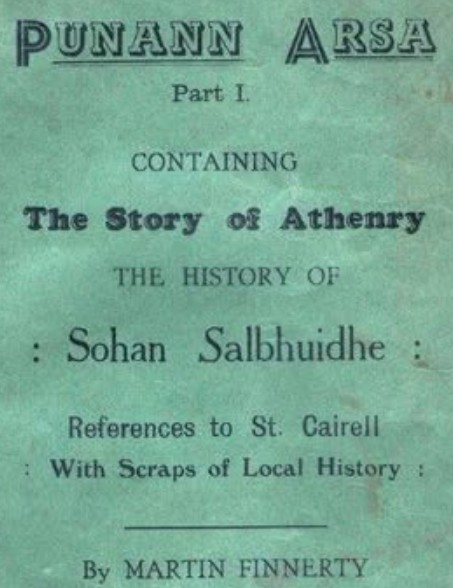
APHThe Story of Athenry (Part 7)
Author: Martin Finnerty
Source: Galway Observer, January 20, 1950
A CONVERT TO THE TRUE FAITH
While facts of recorded history when assembled and put in order make plain that bishop Dahanna was next to Bishop Cairell in the episcopal succession, there is not (and I assume will not) anything to show that Dahanna was of the tribe of Luighne or Gaelinga.
At the same time Dahanna is convincingly accounted for. When St. Patrick descended from the rick he met a chieftain name Eric who owned some territory at Muonisk near the shores of Clew Bay. He preached to this chief and the latter became a convert to the true faith. Eric at this time was a widower and entered Holy Orders and was ordained a priest by St. Patrick. Eric had then a family amongst whom were Benignus and Mathona, both of whom have earned a lasting place in history and particularly in Church history (Dalton history of the Archdiocese of Tuam). It appears there was a third member of this family and this was Dahanna already referred to. While this is not very clear, Dr. Joyce in his “Irish place names” in referring to Tyaquin and Cill an Easa, refers to Dahanna Mac Eric as the patron saint of an area near Boyle. It may be noted that Dr. Healy has referred to St. Mathona as one of the first veiled virgins and sister to Benignus. Dr. Dalton has written of Eric as the father of Mathona and Benignus, and Dr. Joyce has written of Dahanna as Dahanna Mac Erick, there is not room left for doubt, but that Dahanna, Benignus and Mathona were sons and daughter of the same parents. Leaving these great authorities out of consideration the co relationship indicated in the names, Dahanna and Mathona cannot be left out of account while concluding that both were brother and sister.
Having regard to the fact that St. Mathona established her convent at Tawnach (Donach) under the jurisdiction of Bishop Cairell, there can be no doubt but Dathona was a contemporary of St. Cairell but must have been very many years junior to the latter. In those days when names were not hereditary, the names of Dathona and Mathona may have been a variant of an ancestral one.
It is clear that four great saints who were amongst the first apostolic missionaries to head the beacon of Christianity in Ireland, and these had this starting point in the Gaelinga Luighne territories
ST. CAIRELL
The foregoing I wish to be regarded as a combination of recorded history lined with patent ones, and also linked with my own impressions. How these may be adjusted with the following, I shall leave the reader to judge.
“I beg to acknowledge from a giant but gentle scholar and historian, Mr. Patrick Moran, M. A. Crowbeg, Westport, the following historic records. Mr. Moran himself has translated these from Latin and Irish as will be observed
“In his note Martin VIII, Colgan says that the old Martyrology (Dengus Gorman) and Tallacht speak of Cyril or as they write it Cairell having his feast day on the 13 June, a feast day celebrated in Tir Ross. It speaks of two Cairells in the genealogy of the saints, St. Carillus, son of Neasan, son of Erea of the line of the kings of Laighean (Leinster) and St. Carell, son of Curran.
The second chapter of the life of Jarlath, Bishop of Tuam, says: Among the disciples of Saint Benen, were at St. Nectar (or Nectare) Curnan, Bedan, Mugan Buadmual, Birran Modomhie, “Cairell or Carol” and the sons of Demangart and other distinguished men”
At page 609 XV March the names of seven saints children of Nessan are given, St. Beonus, Abbot of Cuillin, St. Carellus, St. Flannius, St. Maraduchas, St. Diehullus, St. Munissa, Neslugius”.
In a note the genealogy of these is given thus: St. Beaonus, Carellus, Flainus, Murelachs and Dichulus, son of Nessan, son of Erc, son of Aed Kerr, son of Colman, son of Corpre, son of Dulang, son of Enda Niadh, son of Pressal (Breasal), son of Bealach.
O’Cleary genealogy but by Father Paul Walsh, Cairell, son of Neasan, son of Erc, son of Aoah, son of Cilman, son of Cairbre, sone of Oilell, son of Dulang, son of Enda Niagh of the race of Laighin.
Cairell, son of Cornan, son of Fran (Frena), son of Frondchaird, son of Sodhan Salbuidhe, of the race of Cinal Cearnach.
I have also received the following form Mr. Moran which he has translated from the old Irish.
Translated from the Irish original published in Leitschrift fur Ceiltesche Philologie, Vol. VII.
CREACHAN AND CIANOG
A rich and prosperous landholder named Creachan Cianestach Nac Singaile lived in the west of Connaught. His wife, Cianeg was daughter of Ciachavan the erenach of Addergoola in the district of Luighne. Nothing was wanting to their happiness except that they had neither son nor daughter. In prayer and fasting they besought the saints and the holy patrons that they might be blessed with children to inherit their wealth, but in no place however holy did they get the fruit of their petition. Conversing one night after going to bed they said”It is sad that we, who are so well off, have no son or daughter. There is a devout senior said Creachan to Cianog in the faithche of Sogan Salbiudhe, that is to say in Cluain Cairaill, namely Cairaill son of Fiachra Araide and that Caireall is the second Patrick of that fifth for Patrick himself did not consecrate any place he knew Caireall was to consecrate, so go to him and fast with him and you will get relief from him. Cianog came to Caireall and fasted three times on Caideall, and Caireall with all his community fasted to help her seven hundred and seventeen saints. for that was the number of Cairreall’s household and after his three days fast Caireall came to Cianog to tell her the angel victors reply.
“We went said Cairell (true friend of the creator) relating the story to Ciano seven hundred and seventeen saints of us to request that you might become pregnant. All our efforts did not succeed in having your child a son but in conversation for that, your soul shall enjoy eternal life. Go to your house and you will become pregnant and will bear two daughters. One in the beginning of the night whom you will call Osnadh. That Osnadh will marry Erchad Mac Murchada, and will have a daughter of Erchad who will be mother of Brian Borumh Mac Cianneide and of all the seven valiant sons of Cianneideach. Afterward she will marry Madseachlainn, son of Arga and will bear him two fine sons, Lochlan and Conchobar. from whom will spring the Mi Lochlann and Concotbair of those districts. And the daughter that will be born at the end of the night you will call Ereise. She will marry Tadg of the tree towers and will bear him three sons, Concobhar, Maelbrunaid and Muredach, and the beginning of Cianogs rhapsody after she had reached her castle that night was: “The seed of BeBinn in white Burren. The seed of Creise in plentiful Cruahan”.
For those who have like myself sought for data regarding St. Caireall, father of Mathonna and Benignus, and the above recording are convincing that there was at least two saints of the name and will also be satisfied that the opinions of those who held that Cairell was not a saint will no longer be listened to by the simplest folk.
PATRON SAINT
Of the two saints whose existence is recorded, my own opinion is that Caireall, son of Curnan is the patron Saint of Clan Cian Caireall, and that he is the one recorded as the disciple of St. Benen and that the disciple of St. Benan is the one whose feast day is celebrated in Tir Dois. The reader will naturally inquire or wonder where is the place named Tir Rois. The reader is refereed to a preceding statement of mine regarding Collaiv Oige. I desire to point out that Tir Rois and Collaiv Oige are both synonymous terms, both meaning the territory of the forests. To come to closer grips with the subject matter Rois and Oige would mean the woods or woods of an Oige, Collavi Oige exactly the same, scarcely necessary to labour the point when aware that Aireall is a saint, a fact which those who should have know so, found some difficulty to convince themselves of. Yet while records were not available although obtainable, true as the dial to the son, Caireall has been looked to as the patron saint of the ancient parish of Cloncian Cairell. Although churches have been dedicated to his memory and the ruins of these churches only the names are left, and there are no holy wells, except one, bearing the name, In the area around Kilconnell and Aughrim, the name St. Careall is forgotten, only the remnant of the old ruins, and the place name to tell the tale.