APH
APHSource: Fas Scheme
When smallpox was raging in Athenry every house in river lane got it, except two large families who lived in the eyes of Maddens bridge. According to Dr. Leonard it was because they had so much contact with cattle.
An old thatched church called the “mass house” was at the back of Hanberrys or nearer the Swam Gate.
Moggins bridge was an old rustic bridge that spanned an overflow stream of the main river which then ran through River Lane and around the tower to the Pound.
Taken from the convicted list of Rebels Galway – 1798, crimes such as the following were committed:
- Houghing and carrying away the flesh houghed cattle. Their sentence was to find security to be of the peace for seven years.
- Tendering unlawful oaths and had to serve life abroad.
- Administering or assisting to administer unlawful oaths. In this case they were pardoned on finding security for future good conduct.
The unpaved road known as Scotts lane connected Castlelambert and Lisheenkyle.
The timber on the Castlelambert Estate was valued at £4,901 in 1892.
Rabbitts in Tysaxon always noted as a great house for music and hadone of the first threshers in the area.
The hiring fairs were always after 11.30 mass on Sundays.
From the 1827 census it is evident that Knockbrack is the only area with all fourth grade land.
The ancient church of Tigh Saxon was destroyed by lighting in 1177, while in the reign of Henry the VII. A friary for the Franciscans was founded which was later granted to the Burgesses of Athenry.
In 1905 Burton W. Persse owned the townland of Bottom (101 acers) on which there were no tenants. He also owned Boyhill (185 acers),on which there was one tenant. Thomas Sice who had 4 and a half acres. By 1920 Mr. Persse had gone and four Nolan children, Hanberrys, Feeneys, Cassidys and Higgins had got division of the estate. In 1920 the C.D.B. divided Boyhill among 14 tenants, areas varying from 24 acers to one acre.
The first mention of the De Wetts (Derrydonnell F.C.) is between the years 1899 and 1901 as local papers failed to report any matches involving Athenry Teams during 1899 and 1900.
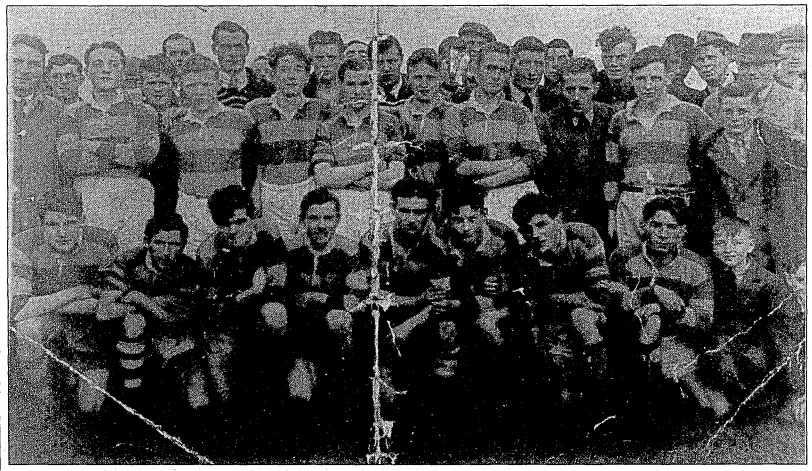
During the late 20’s and early 1930’s t e Cussane Team trained inMartin Doherty’s field and later moved to Waltie Walsh’s field in Carnaun. During those days there were three teams in the Parish, namely Athenry, Newcastle and Cussane.
Cussane Hurling Club in 1940 consisted of: M. Gill, P. Fahy, A. Gill, W. Broderick, M. Coffey, M. Connolly, J. Feeney, B. Naughton, C. Broderick, T. Broderick, J. Madden, P. Lally, M. Fahy, D. Glynn and P. Mullins.
The three parish teams played in the North Board and were continually in rivalry with each other until the late sixties when the three were amalgamated into one parish team known as St. Mary’s, Athenry. During those years Cussane produced some excellent players and won the North Board Intermediate Final in 1959, 1963 and 1966.