APH
APHby Ann Healy
Source: Tuam Herald Supplement (1837-1987)
THERE is an old saying that still exists: ‘Athenry was, Galway is, Aran shall be the best of the three.” Whatever about the rest of the seanfhocal, Athenry certainly was a great medieval town. Nowadays, Athenry has become a thriving residential satellite town, approximately 12 miles from Galway city. The town has somehow managed over the years, however, to quietly understate the historical and architectural importance of its numerous medieval monuments and buildings.
As its people go about their daily lives they are surrounded by reminders of Athenry’s glorious and sometimes tormented past. There is King John’s Castle for instance, the Dominican Priory, St Mary’s Church, the town walls and of course, the Arch, or North Gate. Unlike many other towns in Ireland, with monuments of lesser importance, Athenry has never exploited its heritage for tourist purposes. To some people, this has been a good thing that has retained the integrity and dignity of the town’s history. To others, the time is- long overdue when Athenry will be recognised as an important tourist attraction.
.In the last decade or more such fine remnants of medieval Ireland have been recognised as being among the finest examples of Norman architecture to be found anywhere in the country. Steps are being taken to preserve them for posterity and make them more accessible to an appreciative public at present.
MEDIEVAL TOWN
To the visiting motorist the first noticeable feature of the town is its narrow streets that lead invariably to the town square. Ancient towns were not designed for heavy traffic and Athenry is no exception. Such annoyances are quickly forgotten though as one looks around to find pieces of the past defiantly intruding into the present.
As each piece is uncovered it fits together with another until the mosaic that becomes the living history of the town is revealed. Athenry has a strong tangible sense of place and time which may be attributed to its long and colourful history. For Athenry the skeletons of history do not live merely between the pages of a book. Her historical skeletons are prominently displayed in almost every part of the town. They serve to remind the observer of the town’s rich past, its failures in battle as well as its triumphs.
Athenry never experienced triumph in battle but the remarkable resilience and tenacity of its people in the face of famine, disease, poverty, colonialism, not to mention suppression, both political and religious, is without doubt triumph enough.
PRE-NORMAN SETTLEMENTS
It is recorded in every Irish history book that Athenry was first settled by the Normans early in the 13th century. There is no doubt that the Normans came to Athenry and they left fine buildings, many of which are still standing today, to prove this. However, it would be naive to think that the Normans were the first settlers. Long before they ever set foot in Ireland, Athenry was discovered as a place of strategic military importance. The name of the town which in Irish is Baile Atha Riogh, indicates the town’s true origin. There is a ford on the Clareen river which flows through Athenry. This ford was of course, very important in Norman as well as pre-Norman times. As no kings of any note are associated with the area, the name should be translated as ‘River Ford’ and not the accepted ‘King’s Ford’, rige being an ancient Indo-European word referring to rivers. It is thought that King John’s Castle was built on the site of a Rath or Dun that predates all Norman settlements. It is also believed that the ford was probably controlled by an Irish chief who lived in the Dun which was only 200 yards away. This ford, on the river Clareen, was the meeting place of three principalities which were, Aidhne, the territory of O’Heyne and O’Shaughnessy; Hy-Many, the territory of O’Kelly; and Moy-Seola, the territory of O’Flaherty.
Evidence of pre-Norman settlement in Athenry is very scarce and much relies on conjecture. In fact, up until the twelfth century when the Deanery of Athenry, consisting of Athenry, Tysaxon and Kilmeen was added to the Tuam diocese, at the Synod of Kells, Co. Meath, Athenry’s history remains shrouded in’ mystery.
Nobody knows who converted Athenry to Christianity. Perhaps St. Brendan, passing on his way to Clonfert, preached there. It has been suggested that Athenry was converted in the 5th century by St Dahuna who was situated at Tiaquin now in the parish of Athenry because he probably had dominion over the neighbouring clans.
In any event it was Athenry’s advantageous position that first attracted the Normans to the area. The Normans were very astute when it came to military matters and they quickly seized the opportunity to avail of Athenry’s strategic position as a defensive halting place on the main road from Meath and from the Lord of Connaught’s chief castle at Loughrea to his main seaport, Galway. The ford on the river was of prime importance, and they had complete control over that
KING JOHN’S CASTLE
Three years after Richard de Burgo’s invasion of Connacht Myler de Bermingham, son of Peter de Bermingham and second Lord Athenry came to Athenry having the whole barony to himself by tenure. Not much is known about Meyler’s personality, but he must have been a proud and intelligent man. lt was he who built King John’s Castle, the earliest remaining Norman building in the town, probably on the site of the earlier Rath or Dun. This castle is one of the finest 13th century castles remaining in Ireland and has much the same layout as that of Dunmore castle, which was built by the de Berminghams. Meyler named his castle in Athenry after King John of England who incidentally was already dead before the castle was built. The castle was built around 1238 and has some architecturally interesting features. The building is three storeys high, one storey being added at a later date. The vaulted roof on the ground floor is supported by square pillars, an unusual feature of such structures. The main apartment above is entered through a doorway of unusual elaboration and the elegant trefoil windows have pointed heads. Much of the outer curtain or defensive wall still stands. The irregular shape of the courtyard is probably due to the wet surroundings as the river touches it on the eastern side. The curtain wall has two corner towers, a corner-buttress and a strongly fortified gate. The lowest storey at ground level was probably used for storing food. A stone stairway once led to the great hall door on the first floor. The hall floor was made of wood and was covered, possibly with rushes. In winter a fire burned on a stone slab in the centre. Dried animal skins would have been used to cover the narrow windows, through which the smoke escaped. The family probably slept on the second floor. It had a wooden floor as remains of this are still to be seen. The roof was possibly thatched with straw and rushes. This 13th century castle was deserted as a place of residence during the 15th century and was then looked upon as a citadel.
A ditch which had surrounded the castle for defensive purposes was filled in during the drainage scheme of 1847. This scheme lowered the river by six feet, diverted its natural course and turned it into a mill-course. The bed of the diverted river was seized by squatters who built hovels there and so River Lane, as it is known today, was born. The squatters paid no rent and could not be removed as the river bed was no-man’s-land.
DOMINICAN ABBEY
Meyler de Bermingham also commissioned the building of the Dominican Abbey of SS. Peter and Paul. Construction of the Abbey was started in 1241 and finished in 1261. It was recognised by four Popes and St. Dominic is said to have asked for it to be built. Meyler died in 1252, before the building was finished. His remains are interred there. Although the Abbey was founded by an Anglo-Norman the building owed much to Irish patronage. The original building was quite simple in design. Afterwards the refectory was built by Fedhlim O’Conor in 1265, ‘the dormitory was built by Eoghin O’Heyne and the chapterhouse by Conor O’Kelly. The various architectural and sculptural styles clearly evident today in what remains of the Abbey outline the phases of destructions, burnings and restorations endured during its long and eventful history.
In 1423, the Abbey was accidentally burned and the large. scale re-building which resulted never emulated the original. During the reign of Queen Elizabeth, a decree was issued whereby the Monastery at Athenry was dissolved and ‘its possessions given to the Mayor, and corporation of Athenry for a rent of 26 shillings and 4d. That same year, 1574, the town was sacked and burnt by the ‘Macan-larlas’. They were Ulick and John Burke, sons of the Earl of Clanricarde. They set fire to and plundered the Church. which was attached to the Abbey, even though the mother of one of them was buried there. Apparently, their animosity towards the Anglo-Normans in Athenry overcame any misgivings they may have had about carrying out the act of desecration.
Sir Henry Sidney, Lord Deputy of Ireland gave orders for the town to be rebuilt. But the very next year the town was again attacked by the Mac-an-larlas who drove the builders away and destroyed the new walls and buildings. More attempts were made to rebuild the town only for it to be sacked and plundered by Red Hugh O’Donnell and the northern Irish in 1596. On this occasion the Abbey Church and Monastery were not destroyed.
In 1627, Athenry Corporation, under orders from King Charles 1st, gave the Monastery of Athenry to four Galway merchants. They in turn, gave the Monastery back to the friars who re-established themselves there in 1638. The Abbey became a university in 1644. In 1649, Cromwell’s soldiers wrecked the Abbey and it is said they even stabled their horses there.
MEDIEVAL TOWN WALLS
The walls of Athenry which enclose 25 acres are quite remarkable and easily represent the finest of medieval town walls remaining in Ireland. Opinion was divided as to when the existing walls were built but historians generally date them at 1316, the same year as the famous Battle of Athenry.
A wall probably did exist before this date as a 3-year murage was obtained in 1310 but this wall was either destroyed or integrated after the Battle of Athenry. Perhaps the original wall was made of wood, and this was replaced by stone or, alternatively, if the original wall was of stone it was fortified by the addition of six towers and six strong gates.
The walls were built as boundary walls and not for defence purpose. They were too thin to have a military significance, and their towers were too small to be properly manned. It is now held that a deep ditch or moat which was fed by the river, existed immediately outside the walls and completely surrounded the town. This moat provided great protection against Invaders and traces of it can still be seen in places. The walls, towers, and moat were built partly to provide protection, but mainly to lend status to Athenry.
Over 75 percent of Athenry’s town walls remain to be seen. The town wall extends from the Dominican Abbey to the east southwards to Prospect, In the west. It then runs from behind Ruane’s of Prospect to Brady’s, In Church Street (formerly Chapel Lane), From there all traces of it are lost for approximately 200 yards until it reappears at the back of the Church, a little before Is reaches the convent tower. From there it runs to the North Gate, and it forms a boundary wall between the old and the new Primary schools. Court Lane is built on the ditch of the wall as it makes its way eastwards again. Traces of the wall can be seen further on, east of the milldam, then through River Lane, behind Madden’s Forge. Shortly afterwards it again joins up to the Abbey.
The wall had six important gates and six towers that were added on à later date. These gates and towers were added on at different times, and their exact dates of origin remain uncertain. The North Gate, or Arch, as it is popularly known, is the only remaining gate. It dates to the late 16th or early 17th century and still dominates the busiest entrance to the town from the Tuam and Monivea roads.
Before the walls of the town were built, the sites of the North Gate and the Spital Gate, to the south, were possibly the only entrances to the town as traces of ancient roads lead to them.
Chapel Gate, or Brittan Gate as it was also called, to the east were added much later and the exact date of their origin is unknown. When the Abbey was built in the 13th century it is thought Laragh Gate was opened. At this time also a bridge across the river was built to link the town to the Abbey and so Bridge Street got its name.
Immediately to the east side of Spital Gate, which is now only represented by a fragment of ruins, is the spot where Red Hugh O’Donnell’s men stuck their knives or swords in between the stones to make a makeshift ladder to scale the walls and sack the town in 1596.
Castle Gate existed near King John’s castle, and the south and final gate was Loro Gate (or Swan Gate), the latter name still remaining, which was situated near Prospect.
BATTLES OF ATHENRY
The first recorded battle which took place in Athenry was the battle of 1249. Tradition has it that the Irish took on the Anglo-Normans on August 15th, which is the Feast of the Assumption.
It is said the Blessed Virgin was on the Anglo-Norman side as they had pleaded with the Irish to postpone the battle for a day to honour her.
The Irish ignored the Norman pleas. and they suffered heavy losses as the battle raged. In atonement for their profanity in fighting on a holy day, the Irish established the pilgrimage to Our Lady’s Well, not far from the town. The battle was fought not long after the Dominicans had come to Athenry and they had special devotion to Our Lady. Their perseverance probably sustained devotion and pilgrimage to the holy well which has lasted down through the centuries to the present time.
BATTLE OF ATHENRY 1316
The Battle of Athenry, fought on August 10th, 1316. is undoubtedly the greatest battle ever fought in the history of the sown. The Anglo-Normans, led by Sir William Leigh de Burgh and Richard de Bermingham, the fourth baron of Athenry, known as Risdearch-na-gCath, Richard to the Baitles, for the numerous successful battles he fought against the Irish, met a strong Irish side at Athenry. The Irish force, consisting of the O’Shaughnessys, the O’Heyne, the O’Kellys, O’Flahertys, O’Rourkes, and others, was led by Fedhlim O’Conor, King of Connaught. The natural objective of O’Conor was to drive the foreigners out of his territory and he was assisted by the Princes of Thomond, Breffinl, Meath, and Conmaicne. The Irish proved no match for the Anglo-Norman side whose bowmen cut the Irish lines to pieces. It was reported that 8.000 Irishmen were slain including O’Conor and most of the chiels of Connacht and including O’Conor and most of the chiels of Connacht and Munster. The defeat finished any hope the Irish had of getting the Anglo-Normans out of Connacht and of stopping the landlord system in the West of Ireland. Their defeat had an important bearing on Edward Bruce’s Irish campaign and broke the power of the O’Conors for ever.
To add to the almost total destruction of battle-torn Athenry after the sackings of 1574 and ’75, Red Hugh O’Donnell and Theobald Burke sacked and burned the town in 1596. They picked a route via Derrydonnell to launch their attack on Athenry. Their army scaled the walls near Spittal Gate and the town fell to them without much trouble. The Dominican Abbey and Church alone escaped the fire.
After this last assault Athenry never really recovered its former status and by degrees it sank to the level of a village. There was no economic prosperity and so the town never expanded outside the town walls as other towns had done.
LEPER HOSPITAL
A leper hospital once existed in Athenry near the Spital Gate. Traces of the building are still in evidence on the inner side of the town wall. The disease, which was introduced into Ireland by the Crusaders, who brought it back from the East, thankfully did not spread because those affected were segregated in time. People were not so lucky when it came to the smallpox epidemic which swept through the north and west of Ireland from 1864 to 1874 and literally decimated the whole community of Athenry.
The disease was first introduced into Athenry on March 1st, 1874, and quickly spread after March 17th. The lack of proper hospital accommodation augmented the rapid spread of the disease which struck nearly every household in the town.
Dr. Leonard, who had a practice In Athenry at the time appealed, for the provision of a cottage hospital to deal with the epidemic. The town was panic-stricken. There were no gravediggers, no coffins. Farmers in the surrounding hinterlands refused to have anything to do with people from the town and so many. lost their jobs. People stopped going to Mass for fear of infection and shopkeepers in the town lost their trade as customers took their business elsewhere.
In desperation and as a last resort to try and save the remaining population, Dr Leonard converted the west wing of his own house (Town House), into a smallpox hospital. Makeshift sheds were also built at the back to house the large number of patients. The workhouse provided beds and blankets. In isolating the disease as much as possible, Dr Leonard halted its spread within four months of the initial outbreak. The west wing of the house was never re opened.
Dr Leonard won the love and admiration of the poor people of Athenry, He died in 1893 and is buried at the back of the Catholic Church.
An official report written on the subject of the smallpox epidemic in the west and north of Ireland, from 1864 to 1874, paid particular attention to the situation in Athenry and tells of the squalid, poverty-stricken nature of the town. The author wrote in great detail that the sanitary condition of the town was appalling, with no public water supply. A single pump was the only source of water for the whole town. A sewage-polluted river and a few wells of dubious quality were also used by the people.
The houses in Athenry were not fit for human habitation. They were sunk below the level of the streets with only one room, and many had no windows. The author refers to River Lane as being the worst street in Athenry with its hovels being ‘wretched’. He noted smallpox was evident in four of the hovels there. He comments that like the rest of the houses in Athenry these hovels were unfit for human habitation. The Artisans’ Dwellings Act, under which houses could be declared unfit for human habitation only applied to towns of 25,000 inhabitants and so Athenry did not qualify.
The author noted how houses had dung heaps at the rear and slops were flung out onto the street. Excrement was disposed of in a remarkable way: Heather was cut in a nearby bog and
heaped up against the house, usually close to a window (ifthere was one). For a whole year all excrement, slops, etc., were thrown onto the heather which acted like a giant sponge. Then when the spring came the valuable heap was sold to a farmer for manure.
REVIVAL OF THE TOWN
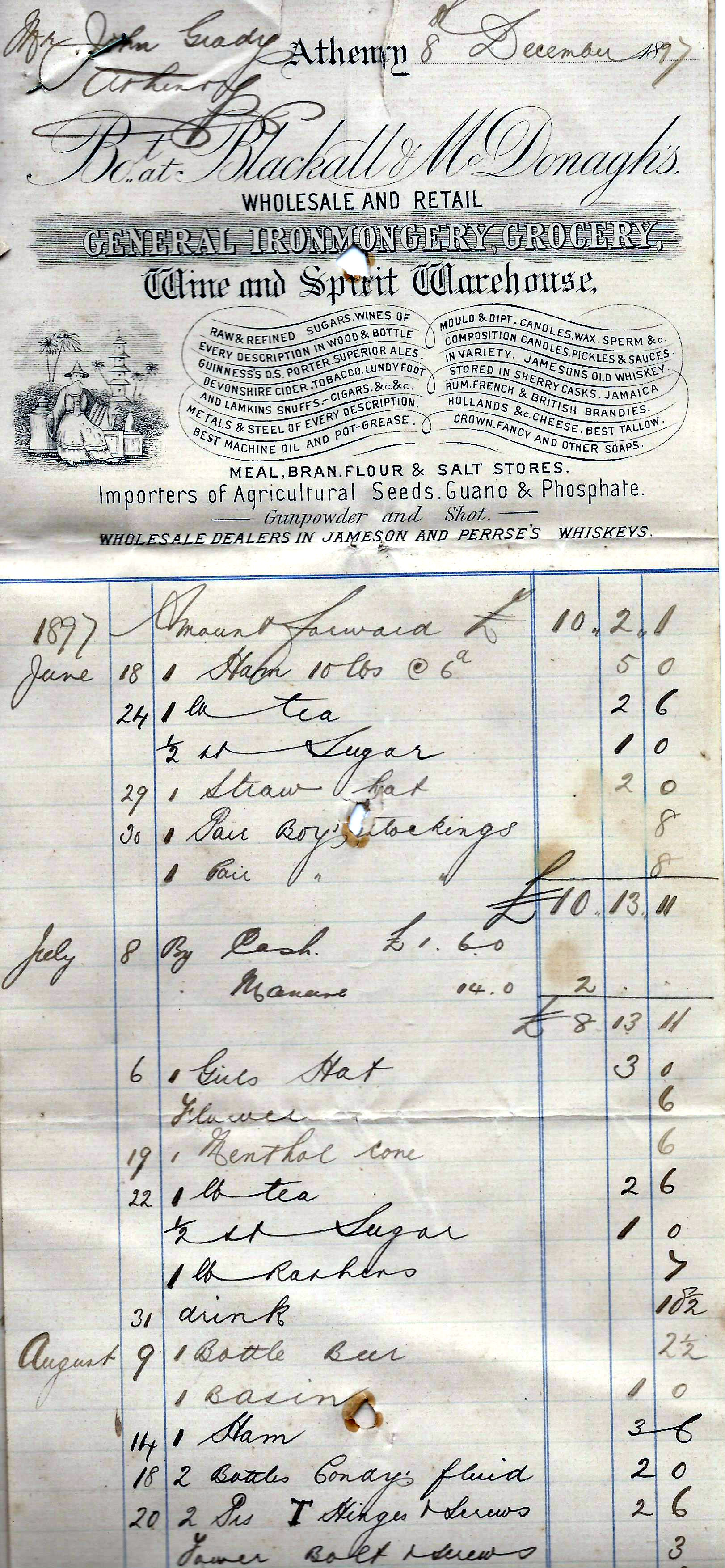
Athenry began to recover during the 1880s. People who had emigrated were helping those at home and the economy benefited. Traders were able to give credit to farmers as the Gladstone Act granted them co-ownership of their holdings. Just before the turn of the century, the building trade was booming and many new houses had been built in the town. In the 1890s Abbey Row was built. It got its name from the Dominican Abbey which backs onto it. The building where Kinneens and Linnanes now live in Bridge Street, was also built around this time. In 1886 a large store, resembling a modern supermarket, was opened by Blackall and McDonagh where Tommy Coppinger’s shop, facing onto the square and Fitzsimon’s, North Gate street, now live,
The cottages at Kingsland, New Fort, and Boyhill were built around 1900 and Caheroyan cottages were under construction in 1910. The houses in Cross street were built in 1902. In 1911, Browne’s shop in Bridge Street was then the Court Hotel.
In 1907, the Lambert estate was divided by the Land Commission among the people. The Town Tenants’ League was formed and their militant behaviour ensured that nearly every town tenant got a piece of land.
Dick Murphy built the Town Hall in 1907. The hall proved very popular in later years as films were shown twice a week and dances were held every weekend.
Old Church Street got its name from the former church which was situated at the back of Hanberry’s Hotel. The late Canon Canton, P.P from 1890 to 1920, lived there while the present Parochial House was under construction. He invited the Presentation Sisters in Tuam to come and teach.
In 1852 the Catholic Church was built on the site of the present church which was built in the early 1960s The labour for the construction of the earlier church was completely voluntary.
The railway line was laid as far as Athenry in 1851 and the Railway Hotel was built at this time. Around 1975, Athenry became a railway junction, and the town gained some economic importance. Shortly afterwards a Post Office and R.I.C. barracks were built.
INDUSTRIES
The oldest industry in Athenry must be the Mill. Or Taylors Mill as it was known. The actual building itself which was situated in Taylor’s field, to the south-west of King John’s , Castle, is now gone.
The mill was built by the Dominicans in the.16th century. Its history runs parallel to that of the Abbey and much of the rest of the town. In the 17th and 18th centuries the mill was used for weaving. Most of the inhabitants of the town then were weavers or cottoners. This industry died out before the 1900s. At one time a man named Irwin owned the mill. He diverted the river course in 1874 and had the bed lowered by six feet to make the mill race. He built the Town House in the Front Law where Dr Leonard and his family later lived.
The Taylor family also owned the mill at-one stage, They sold it in the 1960s, and it was bought with parish funds. The castle was also included in the deal. The late Canon Gibbons then made the castle available to the Board of Works. who set up their regional headquarters there. The site now belongs to Athenry Community Council who intend to develop the area for tourist purposes.
The bag factory also enjoyed many years of success during the 1930s, ’40s and ’50s. It was situated in Caheroyan Road is now owned by McNamara’s garage. When the present church was under construction in the early 1960s, the old factory was used as a temporary chapel.
Today, Athenry has a number of small yet prosperous industries and businesses. Many retailers employ young people while Byrne-Mech Ltd. has a large, young workforce. Tommy Quinn, Caheroyan Road, also employs a number of people and there are numerous small thriving businesses in the surrounding hinterlands.
Athenry is also a farming town. The Mart, Athenry Creamery Co-Op; and ACOT Research College, employ a great many people while serving the farming community. The town has two primary schools and two post-primary colleges,
Athenry has a buzzing social life with many specialist clubs and societies. Perhaps the best known of these is the drama group who have a long a famous history. They have staged countless memorable plays in the Town Hall down through the decades and are as strong, talented and popular today as they ever were.
Children and young adults in Athenry today have many sporting facilities at their disposal. The older citizens are also well cared for and Athenry Community Council has helped ensure the quality of life for the older generation is as good as it possibly can be.
Athenry has come a long way. It looks to the future and perhaps its prosperity can be attributed to this It has a growing population and the new housing estates that have sprung up in the’ last few years have spawned a very young population that will carry the fate of Athenry into the 21st century, hopefully with as much faith and optimism as the past generations.
Whatever the future holds, this medieval town can boast a strong, defiant past that will carry its people into a more peaceful and prosperous future.
* This article was abridged for space reasons