APH
APH
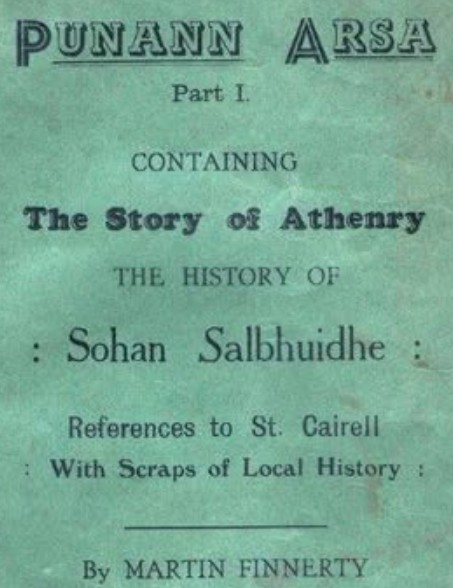
Punann Arsa: The Story of Athenry (Part 1)
Author: Martin Finnerty
Source: Galway Observer, December 2, 1950
As regards the story of this historic little town there are those-authors, and others who believe the same was founded by the Normans. The Normans arrived and settled there early in the twelfth century, and from then until their decline have made a mark on Irish history.
Authorities have also written that this town had no civil history before the arrival of the Normans; that it had no church, and no church history, and that it was doubtful if the word of God were heard there before the coming of the Normans. An author makes the suggestion that probadly St. Brendan travelled the route on his way from Inchiquinn to Clonfert and preached to the people. That could be, but I am of opinion that St. Brendan did not travel by land at all, and that he sailed in his craft down the Corrib to the sea around by Limerick and up the Shannon to Clonfert. On the other hand there existed at Tyaquinn in the present parish of Athenry as early as the fifth century the Episcopal See of St. Dahonna so that Bishop Dahonna must have had spiritual dominion over the clanns that lived around Athenry at that time and that Christianity became firmly rooted there. As regards the historical associations of the town. Ptolmy writes that it was the chief seat of ancient kings. I am convinced that Piolmy was correct and facts bear evidence of the validity of his records.
As regards the root names of Athenry the pseudonym is Baile Atha Riogh. It would appear that the appellation got trained on to the imagination of some “knowledgable” person. The reason given by some body is that three ancient territories converged at the little river that runs near the town, that each king forded the river. That seems at first sight fairly good colour for the theory. But for those who subscribe to the acceptance of same they must be open to the conviction that the present town of Athenry had no name until the three kings met there, or accepted the boundaries to their, territories there. Let it well be borne in mind that Athenry had a name and an ancient name with a storied past and a background of antiquity when Ptolmy wrote about it. otherwise, where did he find the name? At that time the O’Heynes. O’Kellys and OFlahertys were unheard of there. Therefore, I confidently assert that the original name is Blean Dun Riogh. i.e. the inlet of the Kings Dún, and the names derived from the ancient dún that is known to exist to the present day and runs alongside of the town. This dun has been a wonderful structure constructed through six or more Irish miles across the country. One head is at Greyford south of the present town, and the other head at the northern end at Roundfield about a mile west of Monivea: here there is an end, but only just a break and another structure through miles of a country westward.
When I was a young lad I stood on a summer’s day at the head of this dun at Roundfield, a feeling of awe came over me on looking down into it. The entrance was by descent with a well constructed stone stairway, I could hear the trickle of a little waterfall below. The little waterfall appeared to be about 20 feet below. This entrance, I understand has since been closed as it was dangerous for stock. I am of opinion that there is no other dun to be found in Ireland of such dimensions and that it was the work of the Firbolaga. Presumably after the battle of Moytura, and when this province was then alloted to Sreang, a section of the tribe settled on the mainland and another went to Aran. The province was then named after Sreang; hence Cuigs Sreang. The dun at Blea un Riogh is evidence of the fact that it was the work of the fir bolga, Or attycots. There was no other tribe in existence at any time to do such marvellous work except the tribe who constructed Dun Aengus at Aran. Judging by the magnitude of the work the court at Tara would be only as a cottage compared with a grand palace dome. The entire dún is from six to ten Irish miles long. To construct this it was necessary to cut a canal at least twenty feet deep and this was done through a carefully selected ridge of country. This kingly habitation appears to be about ten feet wide, ten feet in height built of well-set stone on either side, a stone arch and about ten feet of earth for a covering; it is surmised that there are off rooms here and there. That this was the prime seat of the Connacht kings from the days of Sreang to those of Conn of the hundred battles there can be little doubt. Facts and circumstances bear out the historian, and the latter confirms the facts, and facts puts us in mind of the destiny of the kings or antiquity-under fame, under arms, and underground. Presumably, the present town of Athenry had its origin at a time when the “camp fires burned low” at the head of the dún and within the regal fortress, and the kings retinue encamped there.
From that time the town derived its old time name Blean Dun Riogh. It will be observed that the n d is dropped, and the name stands as all native speakers pronounced it and that was Blea ‘un Riogh; this means the entrance to the kings Dun. The word Blean is more easily understood in Irish, but it means an inlet on either sea or land, and in this instance it has done duty as the entrance of the kings dún. As is obvious the situation demanded extension and well-planned protective measures, and it may be assumed that skill and labour expended the construction of a fortification were on a scale that left the minimum to risk.
There is another Bleann, now a lownland about a mile from the town, and that this was the outer doorway; there is little room for any doubt. Sometimes the term Baile Blea ‘un Kiogh has been used, not generally but it will be found in the verses of Raftery, and the Collins’. I mention this to explain that if the name Baile Atha’un Riogh, as apparently presently accepted the bardes would have been using two “Bailes” in the one sentence and that would have made the bards ridiculous: or to put it in other words in a sentence of four words to have two meaning the same. Perhaps poetic laws would admit. Again it will be noted that we have not been presented with the anglicised form of either Baile Atha un kiogh, or blea ‘un kiogh. Athenry is not cognate for either.
Let me say that Athenry is the derivative of Ait Dinn Riogh and in plain means the place of the kings fortress. The name in English Ait Dinn Riogh of Dinn Riogh, another townland connected with one of the most remarkable events in Irish history.
(TO BE CONTINUED)