APH
APH
Editor: Gerry Burke
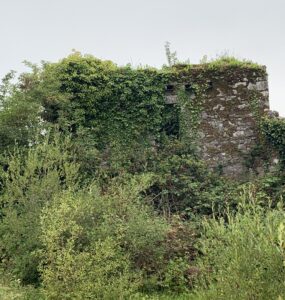
Dovecotes are buildings which were used to house pigeons in years gone by, a circular, square or rectangular house where doves/pigeons were kept. They have internal niches for roosting and breeding, a door at ground level for human access and an opening in the roof or gable for pigeon access. They date from the medieval period (5th-16th centuries AD) and continued in use until c.1900. Dovecotes are a common feature associated with the the Big House. Athenry Town House was built by John Lopdell between 1822 and 1830. It was originally known as ‘River View’ before it was called Athenry House.
Athenry Dovecote
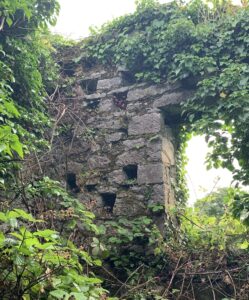
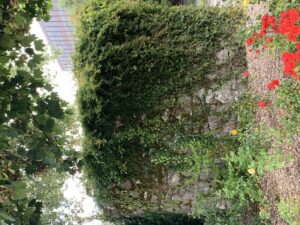
Athenry Dovecote was hidden behind the Athenry Creamery building while it existed. The opening of Aldi has exposed the dovecote to public view and can be seen to the right as one exits the Aldi store. Both buildings were located in the walled orchard of Athenry House. The dovecote is of isosceles triangle shape and is approximately 20ft. x 20ft. x 15ft.
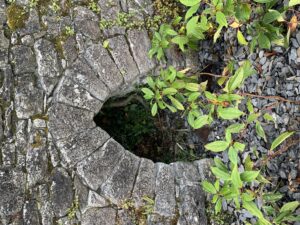
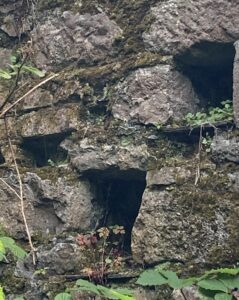
The side facing Aldi has a pointed arched cut stone doorway for human access at ground level. The ground level is much higher at the doorway than it formerly was as there is a considerable drop to the original floor level inside the building. The wall overlooking the Athenry House site and the River Clarin has a window for pigeon access. Stone between ground level and the window entrance was usually finely polished to prevent rats climbing and gaining access to the dovecote. There is a dividing wall of approximately 5ft, in height inside the building which runs parallel to this wall. It is believed that the building had a wooden/slated roof. It is impossible to count the number of nest holes in the Athenry dovecote as the majority of the walls internally are ivy covered as are the two external walls facing Athenry House.
Stone dovecotes were built in Ireland from the Norman period onward, to supply meat to monastic kitchens and to large country houses. The provision of nesting and roosting
accommodation for pigeons was practiced in Mesopotamia 6000 years ago and there is, a beautiful ceramic model for a set of farm buildings made 2000 years ago in China, with its dovecote in place.
These buildings are known as dovecotes, pigeon houses, columbaria and culverhouses (culver being the Anglo-Saxon for pigeon). Although most of these structures are no longer in use, a number are still to be found in many parts of the world. In addition to providing meat, the pigeon has played an important role in carrying messages, in both peace and war, since remotest times: the bird’s unique homing instinct enables it to return to its nest from considerable distances.
Wartime Uses
Pigeons were used as messengers in wartime. The pigeon post was in operation while Paris was besieged for four and a half months during the Franco-Prussian War of 1870-1871. Thousands of messages, official and private, were thus taken into and out of the besieged city. After the war, Germany at once set about the establishment of military dovecots. Medals were awarded by the Emperor for birds that accomplished flights of more than 120 miles.
In the First World War the birds were housed in mobile lofts behind the trenches and were carried by the crews of tanks and seaplanes for emergency use, while in the Second World War they were routinely taken on bomber planes. Their role in the intelligence service was also important; they often accompanied allied agents when they were dropped by parachute into enemy territory.
In the kitchen
In the modern day it is difficult to appreciate the valuable role played by pigeon flesh in the past, when food was scarce and monotonous, especially in the winter months. Because fodder was scarce most farm stock was slaughtered each autumn and the meat preserved by salting and smoking. Only a few animals were kept for breeding. Not only was it eaten in the winter months, it also featured regularly throughout the year on the menus of the great households, where variety of dishes was the rule. The squabs or ‘squeakers’ (four weeks old) were considered highly delectable, and even today French recipes insist on young birds being used.
Medicinal uses
In the past, the bird was valuable not only in the kitchen. Medicinally, pigeon constituted an ingredient in the superstitious and often gruesome remedies of the Middle Ages and even earlier. In Roman times, Pliny recommended the blood of pigeons as a cure for bloodshot eyes, and centuries later several maladies, incuding ‘melancholy sadness’, were supposed to be cured by applying a live pigeon cut in half to the head or, sometimes, the soles of the feet. Another remedy used the dried and powdered lining of the bird’s stomach as an internal medicine for ‘dysenteries’. An even less attractive mixture of bird’s dung and watercress was often prescribed as an ointment for the cure of baldness and gout.
Husbandry
In addition to these uses, the dovecote itself had several other economic advantages. The cost of the birds’ upkeep was negligible because they foraged far and wide in the countryside and needed supplementary feeding only when snow was on the ground, although some owners provided grain more regularly. Tenants of landlords who lived in the big houses were not too pleased when pigeons descended on corn fields at sowing and harvesting time.
Apart from the need for periodical cleaning and squab collection, little care was required because, once settled in the dovecote, the pigeons’ inborn homing instinct would suffice. Before allowing the pigeons to fly abroad, it was customary to confine, feed and water them within the dovecote until the pairs had mated and hatched their first brood, by which time they had generally formed a firm attachment to the place. Another precaution was to obtain the pigeons from a distant source, as the birds would be less likely to return to their original abode. The birds generally mate for life and are highly prolific; each pair produces two chicks about six times annually for seven years or so. During this time the parents fatten the squabs, until they are four to six weeks old. An unfailing supply of squabs could thus be relied upon. They were usually culled at the age of four weeks when still covered with down and before the pin feathers had developed. At this stage the flesh was soft, juicy and fat, and without any trace of the toughness brought about by the exercise of flying. Adult pigeons were culled to remove unproductive stock and in the nineteenth century large numbers of live birds were trapped with nets for shooting matches.
Fertiliser Uses
The dung from the dovecote, a useful by-product, was considered very valuable agriculturally and more
potent than other farmyard varieties. Pigeon fertiliser was essential for herb gardens and economically more highly valued than equivalents produced by cattle, sheep or pigs as one load was considered worth ten loads of other dung. It was also essential for the successful growing of hemp, which was widely used for cloth, rope and sack making. It has been used for centuries in Italy and France for vines and in Iran for melons. The use of pigeon guano as fertilizer continued throughout history up until the development of artificial fertilisers that resulted in cheaper more efficient means of fertilisers.
Tanning and Gunpowder
In the tanning industry it was employed to soften leather and in the early seventeenth century it was a major source of saltpetre for the manufacture of gunpowder. Saltpetre was extracted from the pigeon guano and mixed with charcoal and sulphur to make the gunpowder, a necessity in warfare after the advent of the gun. Production of saltpetre from pigeon guano ended in the late 18th century when it was found to be naturally occurring in South America.
Feathers
Nothing was wasted: the feathers and down of the pigeons, like other farmyard fowl, customarily supplied the filling for pillows and feather beds and it was a common superstition that those who slept on pigeon feathers would live to a ripe old age.
Sport
Hundreds of dovecote pigeons were used as quarry in the ancient sport of falconry and, much later, in the popular pigeon-shooting matches of the nineteenth century. As many as 120 birds at a time were required for one of these matches, up to two shillings being paid for each bird. This led to much organised pilfering from the dovecotes. By the early 1920s this practice gave way to clay target shooting. Pigeon-racing still enjoys a considerable following today in many countries.
Sites
In medieval times the choice of a site for the dovecote, whether belonging to castle, monastery, manor or farm, seems to have been haphazard. Several broad considerations were important in choosing the best site although there was no general agreement. A position free from surrounding trees was thought
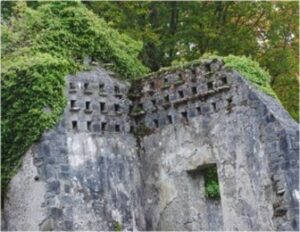
desirable, not only because the dovecote would be clearly visible to the homing birds but also because the sound of wind in the trees, like other loud noises, was believed to unsettle them. Shelter from the prevailing wind was another factor in siting the dovecote and openings for the birds were often constructed so as to face south, for maximum sun as is the case in Athenry. A source of water in the vicinity from which the birds could drink and in which they could bathe was thought essential with the Clarin River nearby. Pigeons need an abundant water supply, particularly during their annual moult in the autumn. Finally, the ever-present considerations of security dictated that the dovecote itself and particularly its entrance door should be within sight of the main house, the Athenry dovecote being clearly visible from the back of Athenry House.
Rights
In Norman and medieval times the building of a dovecote was a feudal privilege restricted to the barons, abbots and lords of the manor and later extended to the parish priest. This provoked little conflict because in economic and practical terms building a dovecote was beyond the capacity of the poor. Building sanctions were, however, gradually relaxed. In the seventeenth century it has been estimated that there were 26,000 in England. A distribution map for Ireland does not exist at present.
A century or so later, no farmhouse was complete without one. Severe punishment was meted out to those caught stealing or killing pigeons. The harsh penalties aroused bitter resentment amongst the rural population and in France the issue has been cited as a contributory cause of the unrest leading to the French Revolution. By 1800 pigeon-keeping was already in marked decline.
Exterior Design
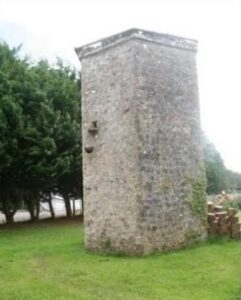
Ancient dovecotes were round but later in the 17th century square and rectangular dovecotes were built and later abandoned in favour of an octagonal, occasionally hexagonal design in the 18th century. Athenry’s example is quite unique as it is triangular. There is a triangular-shaped red-brick dovecote with oval windows set in brick surrounds at the rear of No. 96, O’Connell Street, Limerick, Limerick Chamber of Commerce Offices.
Interior design
The inside of a large dovecote can be a most remarkable sight. The walls of the dimly lit, cavernous interior are lined from top to bottom with row upon row of nest holes, often as many as a thousand or more. Each nesting place had to be large enough to accommodate at least one parent and two chicks but was sometimes stretched to the limit when eggs were being incubated by the hen bird at one end while
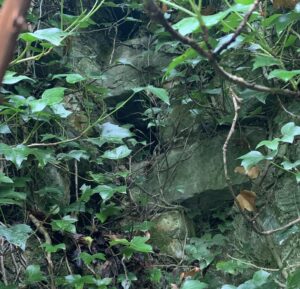
chicks were being fed by the cock at the other; such was the rapid breeding cycle of the bird. Continuous ledges running below the tiers were sometimes provided for each row. These projections served both for the birds to alight upon and as footholds for those collecting eggs and squabs. In the Athenry example slate served as a flooring for a number of nesting place and also as an alighting ledge. An ingenious invention known as a potence, from the French term meaning a gallows, was an early labour-saving device. The structure consists of a central stout wooden pole, pivoted above and below. One or two ladders were attached to lateral arms, the whole assembly rotating to provide convenient access to the nests at all levels. Square, rectangular and triangular dovecotes did not lend themselves to this arrangement and instead occasionally contained a scaffold of beams close to the walls which was reached by ladder and provided walkways. The earliest dovecotes were designed for practical purposes and built according to local tradition and it was not until the eighteenth century that their ornamental aspect was exploited.
It would be wonderful to see Athenry dovecote cleared of internal debris and of ivy internally and externally so everybody could have a full appreciation of its former use.
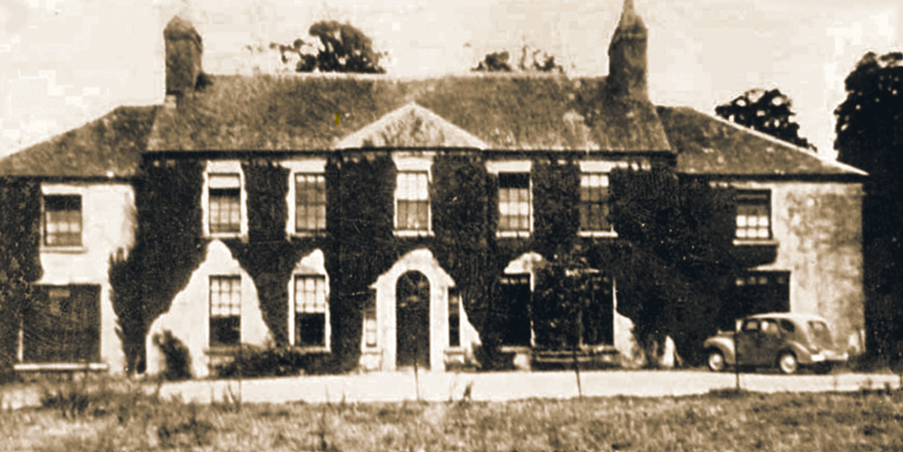

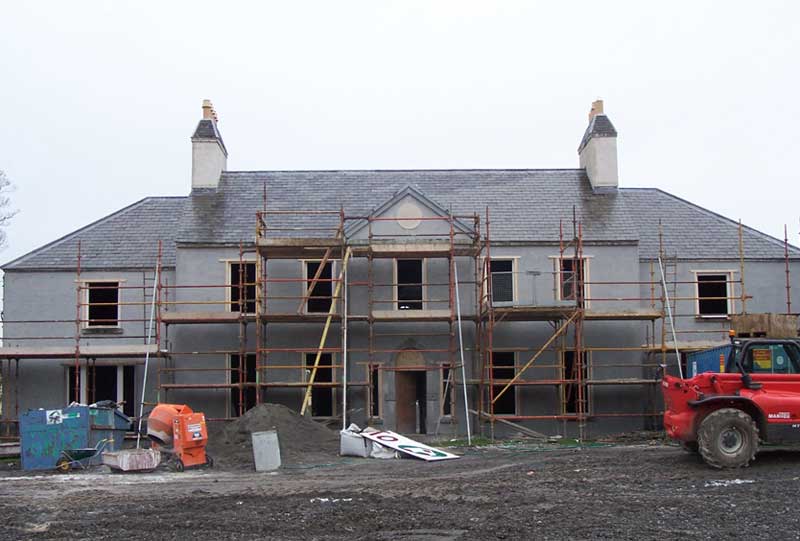
Photo: John Halligan Architects