APH
APH
Source: Galway Advertiser, Thursday February 10, 2022 – Thursday March 3, 2022
On March 2 1875, the medical officer of the Athenry Dispensary District, Dr WJ Leonard, wrote an urgent letter to the Local Government Board (LGB ) in Dublin, regretting to report a ‘very bad case of smallpox’ which had come into his district the previous day. He briefly described how it was discovered:
William Burke, 22 years of age, took ill the previous Saturday February 17. He was employed as a baker’s assistant to Mr Patrick Corcoran in Tuam, where he was resident. The local doctor, Dr Turner, visited him and ordered his ‘immediate removal to hospital, and that his bed and blanket should be destroyed’.
However, William asked to go home to his family at Tyaquin. Mr Corcoran assisted him to the railway station, where he walked with ‘great difficulty’. He was left seated in a carriage while Corcoran returned to the office to purchase a ticket. Then ‘fearing detention by the constabulary, Corcoran left Burke seated in the carriage and returned home.’
Dr Leonard hoped that ‘the poor sufferer may recover’, for ‘he suffered dreadful gastric irritation on the way from Tuam’. However, on arriving at Athenry, Burke, with assistance, made his way to a friend, a publican named Nolan, who lent him a coat (since returned ), and setting him on his way on Whelan’s car, to Tyaquin six miles distant.’
Dr Brodie, the Local Government Inspector, became immediately involved. He updates the LGB in a letter (March 21 ), saying he called to check on young Burke, to find that he had died. Burke’s father, who insisted on carrying his son to his grave, has since contacted the disease. The priest who attended Burke, Rev Walsh, has also contacted the disease, and lies ill at Kinneen’s Hotel, Athenry. This is a busy hotel especially with commercial travellers ‘the danger of propagation is obvious’.
Growing unease
Some action was immediately required. The hotel was to be closed until it is thoroughly disinfected. If the proprietor, Mr Kinneen ‘a wealthy man who appears to ignore the law against the spread of infections’ and that if he continues not to cooperate, the police were to enforce a closure order.
Legal proceedings have begun against Mr Corcoran for wilfully assisting William Burke to return to his home at Tyaquin, when specific instructions were given that he was to be conveyed immediately to hospital, as he was clearly suffering from ‘a dangerous contagious disease.’ *
The question of hospitalisation is raised following another case of the disease, this time a 12 years old boy who had been vaccinated. He lived with his father and mother, niece, and five other children, at Newcastle, about three miles from Athenry. Dr Leonard feared that removal of the boy to the Loughrea Workhouse hospital, a distance of 12 or 14 miles ‘would be attended with serious danger’.
A specially dedicated ‘hospital’ or outhouse, isolated from the community, would be the preferred solution, and the urgency to find a suitable premises would preoccupy the medical authorities for some days. Understandably there was a growing unease in the community. As word spread that there was an outbreak of smallpox in the area, people were understandably nervous. Transporting patients across the county might be problematic. In the meantime it was decided to leave the boy with his family.
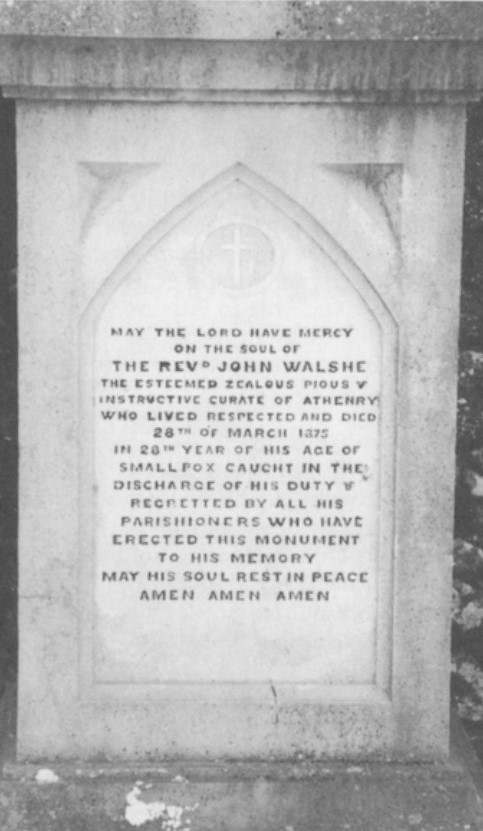
Fr Walsh died from the disease, and is buried that same day. Mr Kineen, now clearly alarmed, promises to have ‘the bed, bedding, and every article of furniture in the room burned, the paper removed from the wall, and the wall thoroughly lime-washed’.
Newspaper report
Compulsory vaccination of children against smallpox was introduced in Ireland 1863. Within a decade or so, the instance of smallpox was very much reduced, but it sometimes reappeared, out of the blue, in places like Athenry causing widespread concern. **
Of all the infectious diseases smallpox was the most feared. Parents dreaded the alarming signs of fever, vomiting, and severe skin rash, leading to 80 percent death in children. Survivors risked being left blind, with facial scarring, but lucky to be still alive. It was not unusual to see adults with pitted faces, the sign of a childhood infection.
The Galway Vindicator, in a leading article on March 24 1875, reckoned that this outbreak of smallpox was imported into county Galway by vagrants, first appearing in Dunmore and then Tuam, where there were many fatal cases.
‘The disease was reputedly brought from Tuam to Athenry by a baker named Walsh (Burke? ) who came home on March 1 with smallpox, and died a few days later.
‘Within a few weeks it was widespread throughout the town and neighbourhood despite a vaccination campaign. By May there were over 100 deaths, the town was isolated, and Dr Leonard converted part of his house into a hospital, with additional sheds at the back, to accommodate patients.’
‘Mrs Burton Persse of Moyode, opened a fund for the relief of the town, but the other landlords were not as helpful.’
Refused admission
It is likely that in the Dublin of the time, smallpox was ever present, at least until the effects of mass vaccination reduced its virulence. The chairman of the Tuam Board of Guardians, Robert Bodkin, returned from Dublin where he had spent a week. He felt unwell leaving the city, and now resides at his home having been ‘attacked with smallpox’.
A distressing letter from Dr Leonard April 14, who was called to visit Catherine Cannon, who resides in a lodging house kept by her aunt in Athenry, part of which is a bakery. Eight other people share the same dwelling. “The poor afflicted creature, who has scarcely sufficient covering, has no mother, her father was never a help to her, and not able even if willing, to attend to her wants. She is suffering from smallpox and piteously asked me to have her removed to hospital. She is entirely destitute’.
Dr Leonard complains to the Local Government Board that when he sent an order to the hospital, attached to the Loughrea workhouse, for the immediate removal of Catherine he was refused. Instead the relieving officer, Thomas Lally, called to the doctor’s house, and without consulting the Guardians in Loughrea, he refused to remove the patient, and gave 2s for her father as a relief.
Dr Leonard demands to know if he is disbarred from discharging his duty to the suffering poor: ‘I must respectfully ask the Board if the union hospital is open to smallpox patients, and if such, inform the relieving officer of his duty.’
NOTES: * The case against Patrick Corcoran is heard on May 10 1875, and he ‘was fined £2.10s, or in default, one month’s imprisonment.’
** The early methods of smallpox vaccination were crude to say the least. Infectious material, perhaps scabs or pus, were taken from an infected person, or sometimes from a corpse. That material was scratched on the skin of the recipient, who, hopefully developed a less severe infection from which he/she would recover and develop immunity. This, Dr Ciarán Wallace, TCD, says was as risky as it sounds.
Edward Jenner’s discovery, in 1798, that inoculation with the much milder cowpox, produced a similar resistance to smallpox, was a real breakthrough. Jenner’s method became widespread, and was first introduced to Ireland in 1800. By 1863 his vaccination method was deemed so successful that it was made compulsory, along with the registration of births, for all infants in Britain and Ireland. You could be fined if your child was not vaccinated. This created determined opposition in England, and the emergence of the British Anti – Vaccination League which led to a relaxation in the law, but in Britain only. Ireland did not object to its compulsory nature. It was accepted as a godsend.
George Bernard Shaw sent a letter of support to the League’s 1911 conference, describing the distribution of ‘dirty and dangerous’ calf lymph to children as ‘nothing short of attempted murder’.
Smallpox patient sparks riot in Loughrea
Part II
The initial refusal by the Loughrea Workhouse hospital to accept smallpox patients was smartly over ruled by the Local Government Board (LGB ). It suggested that some out-houses or offices, at the hospital, could be converted to receive the patients while keeping them separate from the other sick. It was satisfied that the resident doctor there, Dr Lynch, ‘will afford valuable advice and assistance’. The board warned that it was essential smallpox sufferers were kept isolated from other people. However, the Loughrea Board of Guardians, with responsibility for the hospital, did not heed the rebuke.
Dr WJM Leonard, Medical Officer of the Athenry Dispensary, had worked tirelessly dealing with the outbreak of smallpox in his area, which is yet in its infancy. He even converted out-buildings at his house of residence into a make-shift hospital while other arrangements were being made. Unfortunately, this resulted in a relative of his being ‘attacked by the disease’.
He reported another case to the LGB, that of Mary Gallagher, who lived with her parents, two sisters and her brother, in one small room, which they call ‘home’. He feared that unless prompt measures were taken ‘this dreadful disease will spread beyond control’. Miss Gallagher lived at Larkin’s Lane. He asked that a ‘proper mode of conveyance’ be supplied to take her to the Loughrea hospital.
A furious letter
The ‘mode of conveyance’, or ambulance, was a simple covered wagon with a horse and driver. The ambulance collected its patient in Athenry, and proceeded cross country, to the Loughrea hospital.
Unfortunately, it became known that the patient within the wagon was suffering from smallpox. It was market day in Loughrea, and the town was crowded. As the ambulance began to make its way through the crowds there were shouts, and fists raised in anger. ‘People got very excited’ and would have sent the van back to where it came from ‘were it not for the interference of the constabulary’. The constabulary, however, could not prevent the ambulance being stopped, its driver removed, and the horse unbridled. Somehow the patient was made walk away, while the wagon was taken to a waste place in the town, and set on fire.
The following day, April 16, 1875, an indignant vice chairman of the Loughrea Board of Guardians, JH Blake JP, wrote a furious letter to the Local Government Board, protesting at the manner with which Dr Leonard had a patient, who was not seriously ill, taken through a crowded Loughrea at 5 pm on market day.
Blake expressed amazement that Dr Leonard ‘would direct a smallpox patient to be driven nine miles through a district where the disease had not yet appeared, and through a town densely populated’. He thought Dr Leonard had acted most injudiciously.
Terror and alarm
The health authority’s defence against smallpox was limited, but removing a sufferer from his/her place of residence was paramount. Particularly as many of the sufferers were among the poor and lived in crowded and unhygienic conditions. Places where sufferers could be isolated and treated for the disease, were fast closing their doors to them. Taking patients to the Loughrea hospital were to be specifically banned as the following irate letter from the Loughrea Town Commissioners to the LGB makes clear: ‘that the medical officer at Athenry having on Thursday last, April 15 instant, being the market day, caused to be sent to the workhouse here a smallpox patient, causing great terror and alarm to the people, which has not, up to the present, subsided, but on the contrary, has increased owing to a rumour that another patient is to be taken this day to the workhouse from Athenry.
‘The Commissioners in the interest of the public, and of order, request the LGB to take immediate action in preventing any other smallpox patients being taken from Athenry or elsewhere, to the workhouse here (Loughrea ); but that suitable hospital accommodation should forthwith be provided in Athenry, or the neighbourhood, for the persons afflicted with the disease.’
A suitable site
Dr Brodie, the Local Government Inspector in Galway, was then working with the hard-pressed Dr Leonard in trying to find suitable accommodation for smallpox patients.
In his own report to the LGB (April 19 ) he said that he met Mr James Clarke, a member of the Loughrea Board of Guardians, ‘who in no uncertain terms expressed his anger at Dr Leonard for sending a smallpox patient through the town of Loughrea, on Market day, causing the riot’. However, Brodie added, ‘in justice to Dr Leonard he has displayed so much energy in coping with the disease that I am certain his directions regarding the removal of patients to hospital will be judiciously exercised.’
But Brodie believed that some good had come out of the unfortunate riot business. The Loughrea guardians, no doubt well aware of their duties to the sick in their area, have written to a firm in London requesting it to forward, ‘without delay’ information on their iron hospitals’ which are ready made, and capable of accommodating 12 patients.
Already Dr Leonard, James Clarke and Brodie had visited several places in the Athenry neighbourhood, to find a suitable site for the erection of the iron hospital. But Brodie feared that what ever site is selected it will not be acceptable by the citizens.
Ravages will follow
The Local Government Board in acquainting Dublin Castle with the disturbing events to date, could not resist commenting ‘that the inhabitants of Athenry and the surrounding neighbourhood, appear to be more alarmed at the means used for the abatement of smallpox than the ravages which will too surely follow from the neglect of the immediate removal of each case to hospital’.
NOTES: Edward Jenner’s brilliant discovery that inoculation with the much milder cowpox was so successful that from 1853 it was made compulsory for all infants in the United Kingdom and Ireland. This was a radical move for the British parliament. Parents who did not produce proof that their child was vaccinated were fined, and eventually imprisoned if their resistance continued.
This created determined opposition in Britain, but had far less impact in Ireland. The British Anti-Vaccination League attacked the state’s ‘infringement on personal liberty’ and the medical risks involved. The law, it argued, was despotic and un-British. It gave the government power over citizens’ bodies.
Campaigners claimed that animal matter, ‘the filth of the cowshed’, was being injected into their children, along with other diseases such as syphilis. The league alleged a cover-up by the medical profession to hide evidence of deaths due to vaccination.
Their campaign was a success. Parents who opposed childhood vaccination on moral grounds could claim exemption by appearing before a special tribunal. This introduced a ‘conscientious objection’ clause in British law, which would become famous during World War I for men refusing compulsory military service.
Ireland was not included in this new vaccination exemption scheme. An Irish Anti-Vaccination League emerged in 1898, but never achieved the same level of success as in England. That same year The Skibbereen Eagle observed: ‘Englishmen sneer frequently at Irish agitation, but to the Irish mind nothing could be more ludicrous than the anti-vaccination crusade’.
Sources include: House of Commons Report: Smallpox – Athenry, published August 13 1875, and essay on the anti – vaxxer movement in England and Ireland, by Dr Ciarán Wallace.
Breakthrough at last in desperate search for a hospital
Part III
With smallpox sufferers in make-shift refuges such as out-buildings, rooms in the Loughrea barracks, and in sheds outside Dr Leonard’s home, all hopes are placed on the ready-made iron hospital ordered from Messrs Braby and Co. London. The hospital was to accommodate 12 patients, but already within five weeks of the first case being reported in Athenry, there were 20 cases of smallpox, three of whom had died.
Clearly more buildings would have to be found; but in the meantime the Loughrea workhouse guardians, who had refused to admit any smallpox patients into their hospital, had set aside beds, bedding and all the necessary accoutrements that the new hospital would need. It had also ordered a new ‘ambulance’ to replace the one burnt by the riot in Loughrea on April 15th; and perhaps their most significant gesture was to employ two experienced nurses from Dublin’s Cork-Street Fever Hospital to help care for the sufferers.*
But finding a site for the new iron hospital had proved difficult. It was hoped that a site in nearby Craughwell would be accepted as a neutral venue, but this was quickly shot down by a visit from the parish priest saying, in no uncertain terms, that Craughwell would not be used to solve Athenry’s problems.
The final site chosen was a waste plot of ground near the barracks, in Athenry town; but no sooner was the site known than there were serious objections.
Deserted streets
Dr Brodie, the Local Government Inspector in Galway, who had been working with Dr Leonard desperately trying to contain the disease, was visited by a deputation of the Athenry townspeople who presented him with a written statement. They claimed the site chosen for the hospital was a ‘commonage,’ and was totally unsuited for a smallpox hospital.
The deputation painted a pretty bleak picture of what had happened in their town: ‘Our streets are now deserted for some time on account of this sickness amongst us. We may be suffering in many ways, but we feel that fixing this hospital almost in our midst, that instead of lessening the evil, would be only continuing it.’
The petition goes on to emphasise that they understood that isolation was the best safeguard from catching the disease, but there was no quarter of the town more frequented than the common; ‘it is convenient for schools attended by about 150 children…it is a thoroughfare for laundry and other uses …and within a short distance from the post office.’
The letter was signed by 39 people, including the parish priest Fr John O’Grady. The letter ended with a firm indication that the people would ‘assert to the last’ their rights to the commonage.
Dr Brodie was almost at his wit’s end. In his written report to the Local Government Board (LGB ) that evening, he says that Dr Leonard and himself ‘found themselves thwarted’ at every step they tried to take: ‘The Loughrea people will not allow us to avail of the workhouse hospital, the parish priest of Craughwell and parishioners will not allow us to erect on the site given to us by Mr J Blake, and now the parish priest, his curate and 37 of the inhabitants of Athenry, are up in arms against us…’
Serious threat
Pressure was building up as the number of new cases are reported. From March 1 until May 17 there were 44 cases of which 11 died. The Local Government Board, however, insisted that the site chosen on the waste ground in Athenry would be the site of the hospital. This time the Athenry curate, Fr Ronayne, ‘stormed forth and asserted that the hospital should not be built upon the commons of Athenry. Let them go elsewhere!’ adding menacingly, ‘that they could do the same as the people of Loughrea did to the van’.
A suitable hospital
And then, when it seemed there was little hope of progress, there was a much needed breakthrough. At a meeting of the Loughrea Board of Guardians on May 9, Lord Dunsandle in the chair, the objections to the Athenry site were given, and it was decided not to proceed with this site.
Instead a suggestion was made that a Mr Irvine owned a substantial dwelling with an adjoining field in the neighbourhood of Athenry, which he was willing to let, and with the minimum of work, could be made suitable as a hospital. This was immediately seized upon by the members. A deal was struck with Mr Irvine, and in a matter of days beds and bedding, clothing and cooking utensils were dispatched, and patients moved in.
The members were not slow in doing their duty this time. Arrangements were also ordered ‘with a respectable baker, butcher, and grocer in Athenry for the supply of provisions.’ It was further decided to relocate the iron hospital, which had also just arrived, to the grounds of the Loughrea workhouse hospital, to be used as an infectious disease unit, quite separate from the other sick.
This time Dr Brodie had a far happier report to the LGB the following day: ‘On my way home from Loughrea yesterday, I visited Mr Irvine’s house. It is situated about a quarter of a mile from the town, quite secluded, with a field attached, and is in every way suitable for the purpose’.
And never forgetting the rule of law the guardians passed a resolution strongly condemning the lawless act in Loughrea on April 15, and the burning of the van. It recommended the government set up a ‘searching inquiry’ into the origin of the case, ‘with a view of making the chief actors amenable to justice.’
There was no cure
Despite all the set backs, the genuine fear of the people, the difficulty Dr Leonard and Brodie had in getting proper hospital care for the sufferers, the total number of smallpox patients during the month of March were 75 cases and 16 deaths. It is hard to establish how many ultimately died from this epidemic, but at one point, from March 5 to June 28 1875, there were more than 141 cases.
Before the epidemic would pass, however, additional temporary buildings were added to Mr Irvine’s house, and in the adjoining field, to take the excess. The iron hospital at the Loughrea workhouse was used to capacity. All cattle fairs and markets were banned in the area. Despite the people’s fears there were no cases of smallpox in Loughrea.
Numbers could have been far higher, but for the actions of the two doctors in isolating sufferers, even when that isolation was primitive; and in the face of a frightened populace. Despite all the drama, this particular outbreak of smallpox was remarkably well contained. Isolation of patients as well as cleanliness, vaccination, and the disinfection of clothes, bedding, and rooms, were all considered important in the fight against the disease. There was no cure. You either got well, or you didn’t.
But by July 13 no new cases were reported. A fund was established for families of the sick which received generous contributions. The Loughrea Board of Guardians, who had so vehemently castigated Dr Leonard for sending a smallpox patient through the crowds in Loughrea, now acknowledged that he ‘had given general satisfaction by his care and attention to the patients under his charge’. It voted him an additional £100 to his salary for one year.
NOTES: * Cork St Fever Hospital, which opened in 1814, was severely tested with the outbreak of typhus in 1826, when 10,000 patients were treated mainly in tents over its extensive grounds. In 1832 Dublin was ravaged by a cholera epidemic. Despite the hospital’s best efforts, thousands died and were hurriedly buried in nearby Bully’s Acre. Typhus came again during the Great Famine when rural dwellers sought refuge in the city; and typhus returned with a vengeance in the 1880s, when Gerard Manley Hopkins, a Jesuit priest and influential poet, died of the disease in Dublin.
The services of the hospital were transferred to Cherry Orchard Hospital in Ballyfermot. The Cork St Hospital closed in November 1953.
How Athenry recovered from its smallpox epidemic
Part IV
The public sanitary conditions in Athenry, were regarded as a disgrace, and not conducive to a healthy environment when an epidemic of smallpox erupted there in the spring of 1875.
Once smallpox was cited, Dr Leonard complained at the ‘inefficiency’ of the sanitary authority, lamenting that Athenry continued ‘to be a filthy place; for its size it is populous, and by the conveyance of railway tracks is a large centre of communication.’
Dr Brodie, the Galway local government inspector, had worked ceaselessly with the Athenry dispensary doctor Dr Leonard, in his efforts to contain the outbreak which, between the months of March and July, had affected more than 140 people. From June onwards, in a series of long and detailed reports to the Local Government Board in Dublin, Brodie endeavoured to reassure it that the crisis was passing, and that newspapers had exaggerated the state of civic unrest.
He is effusive in his compliments to Dr Leonard: who ‘performed his onerous and responsible duties during this trying ordeal with care and attention to the sick poor under his charge, and a self-denial of comfort, or any sort of pleasure or relaxation on his own part, joined to the fact that Dr Leonard, in his domestic affairs, had endured his own share of trouble and loss in the case of a member of his family who had been for weeks suffering from the disease contracted, as is supposed, through the agency of the doctor attending smallpox cases outside, and bringing the disease into his own household.’
‘Sensational news’
The extent to which smallpox was feared by the populace, prompted The Irish Times to report that the people of Athenry were so gripped by panic and terror that the town was left without trade, commerce, or industry.
It reported that ‘the well-to-do inhabitants fleeing out of it (Athenry ) as if from a plague-stricken spot; and where they chanced to take up their temporary abode, but on the fact of it becoming known where they came from, the residents of those places driving them back again. Moreover that fear had established a cordon as effective as a blockade around the town…’
Whether to reassure his board that there never was such alarming behaviour (Brodie was always careful to play down extreme behaviour such as the riot in Loughrea and the burning of the hospital van ), he denied that Athenry was ever in such desperate straits. He claimed that such ‘sensational news which have been from time to time sent to the public papers in the form of letters from known and unknown correspondents ….exaggerate or distort the facts to suit their own purposes’.
‘The result causes unnecessary alarm and terror in the minds of people at a distance and affecting the trade of the town’.
‘Extreme measures’
As regards the alleged distress reported among the labouring classes, Brodie agreed that farmers had objected to hire labourers from Athenry, but had no hesitation in hiring from their own immediate neighbourhood where employment was not restricted. ‘In a short time it is expected the the Board of Guardians will commence sewerage works in Athenry, and this will give some local employment’.
Moreover the relieving officer had been instructed to fully and amply exercise his powers by issuing provisional relief in every case of sudden and urgent necessity. ‘At a meeting of the Board of Guardians last Saturday 159 individuals appeared in his books as having been relieved’.
‘A fund has been formed by some charitable ladies in the locality and already over £100 has been received by them.’
Dr Brodie felt that there was little if any truth in the rumour that poor people would resort to the extreme measures hinted at by the special correspondent. He did not elaborate what the extreme measures were, or who had threatened them. But obviously some threats were made, and the authorities were concerned.
‘Feared and dreaded’
‘In conclusion I may be permitted to observe that smallpox, even in its mildest form, is a disease to be feared and dreaded, and in this instance, coming as it did suddenly and unexpectedly, and to a great extent unprepared for the effects of its visitation, still, that no time was lost in taking measures to combat its ravages and use all legitimate means to isolate the cases’.
Writing this on June 14 1875, Brodie hoped that the worst was over; and that in the future he would be sending ‘more cheering and satisfactory reports’, and that he would soon be able to announce that the present epidemic, ‘like other epidemics, will have disappeared altogether from Athenry and its neighbourhood’.
However, Brodie could not resist a dig at the Board’s oftentimes censorious messages, when he concluded that the mortality rate in Athenry, ‘has not been greater on this occasion than in Dublin’, where, he intimated, throughout the 19th century, a succession of appalling epidemics of typhus, cholera and smallpox had wiped out thousands of her deserted poor.
Conclusion
In her study of the outbreak of smallpox in Athenry, Ann Walsh * questions why, up to the outbreak of smallpox, pressure was not brought to bear on the authorities to ensure that Athenry did not lag to the point of disaster in providing cleansing, drainage and other health services.
Despite the devastating effect of the smallpox epidemic on the Athenry community life returned to normal soon after the disease had passed. The epidemic, though violent, occurred only once and produced a single shock which apparently was quickly forgotten. Families in the parish rallied around each other and operated as a powerful support mechanism in the community. The Roman Catholic marriages in Athenry Parish dropped significantly in 1875 indicating a lack of confidence in the community associated with a fear of planning ahead in an uncertain future. The already declining baptism numbers also decreased in 1875. However the following year the marriage figures rose dramatically indicating confidence was restored in the community and the baptism numbers correspondingly recovered in 1877.
In the short term the outbreak of smallpox drew attention to the overcrowded and insanitary living conditions and produced a campaign of cleaning and disinfecting infected premises and their surrounds. Dr. Leonard, the dispensary medical officer, emerges as the hero during the epidemic. The evidence portrays the doctor as devoted and capable of working day and night, not concerned about material gain and capable of dealing with any emergency. He was the friend of all classes, ready to provide treatment and advice on medical and personal problems.
In her conclusion Ann Walsh believed that It is more difficult to ascertain the impact of the epidemic in the long term. The medical system in force did not improve or alter to any measurable extent and the sanitary system was not expedited in the district as a result of the outbreak. The power and efficiency of the Board of Guardians must be questioned especially with regard to their handling of the iron hospital contract and the proposed sewerage system. In 1876 the Board of Guardians of the Loughrea Union only succeeded in securing a loan of £200 from the Commissioners of Public Works to sink a well in the town of Athenry.
However the disease in the community was successfully contained within a relatively short period of time. After four months the worst of the epidemic had passed and by late June 1875 the disease assumed a mild form. A marked decline in the number of cases was evident and by 1st October all patients had been discharged from hospital. The combined efforts of the medical officer, the Board of Guardians and the local community ensured that the epidemic did not continue to rage out of control and ceased without recurrence.
NOTES: * Smallpox in Athenry, by Ann Walsh, published in the Athenry Journal (1995-2004 ), and previously in the Journal of the Archaeological and Historical Society Volume 48 1996.