APH
APHMemories of an Irish Grandmother
Author: Mrs. Nora Keary, Clorane, Athenry
Acknowledgement: Sincere appreciation to the Keary Family, Clorane and Yvonne Igoe, (Née Keane), Greethill for sharing this publication with us.
They say that in keeping a secret
Some people are truly inept,
For either its not worth the keeping,
Or else its too good to be kept.
For some time past, I have been told that I am keeping secrets. This is not true. It’s just that I haven’t thought them worth writing about. The “secrets” are just the lives and times of people who are gone to their reward. All that I now write, I have told and retold over the years, but young people forget so quickly. Now that I am nearing the end of the road, I have been asked to write instead of talk and thus “leave footprints in the sands of time”.
Memories of childhood are the last things to die in the human breast. As the shadows of life lengthen our thoughts tend to stray more often, to the days of our youth. So much could be written about the old God-loving, hard-working people, who lived in the poorest part of Ireland. The ruins of all the old houses could tell many a sad story – some of them the result of the dreaded evictions. Those who survived that period, had nothing to look forward to but the emigrant ships. The young people went away, the old were left to live and die in loneliness and squalor.
My memory brings me back nearly eighty years. One of my earliest memories is seeing my mother kissing her brother goodbye. It was most unusual in those days, the Spring of 1912, to see a woman kissing a man, but he was going to Australia, which at that time meant a final farewell.
When I was four, my parents took me to visit my grandmother and aunts one evening, a walk of about two miles. When the visit was over, my beloved grandmother insisted on keeping me for the night. I can still see my dad and mam go out the door that night without me and a part of my heart went with them. It was my first night away from home. After that I could never sleep in a room alone.
Rightly or wrongly, I blame it on that particular night.
I must have been quite young when the measles arrived in the village. We had to stay in bed for a few days in a dark room. We got milk and water and dry toast until the spots were gone.
During that illness, I remember my beloved father carried me down to the kitchen to see “Lobber” dancing in his bare feet, on the cement floor. He was one of the many characters who roamed the countryside depending on the charity of the house-holders for a bite and a sup.
Those dear dead days beyond recall. How happy we all were, old and young. No TV, no radio, but books galore…Greek, Latin, French and English; Moore’s Melodies, words and music, and most important of all to me, several books of old recitations, volumes of poetry and old school books.
After walking three miles to school and back my delight was to settle down and read books of songs and poetry. My older sister was more interested in household duties. I too had to do my share, but I still had time for my hobby. The paraffin lamp on the kitchen wall was the only light, but there was always a candle to take us upstairs to bed and I usually had a book with me.
We had a very happy childhood, enjoyed our work, and in later years, looked forward to Sunday nights dancing in the old kitchen. Our house had been the visiting house as long as I can remember. The neighbouring men came in, and played cards with my father, a game of 25, one penny in the game, and two pence on the last game. Then all joined in for a game of scubeen. At 9.30 my mother said:
“Look up at that clock”
That was the signal for the last game. We went down on our knees then for the rosary and the trimmings. The rosary was never missed. In later years when we danced on Sunday nights until the small hours, my father and mother sat one on each hob, and enjoyed the music and songs, then all knelt for the rosary.
How we enjoyed the long hot summer days walking to school. Those were the days when summer was summer and winter, winter. Now Columcille’s prophesy has come true. We scarcely know it’s summer, except by the leaves on the trees. Long ago when summer was nigh, we put away all our winter clothes, and didn’t see them again until we put away our summer clothes. The winters were usually cold and stormy, with long periods of frost and snow. The summers were sunny and dry, with very little rain.
We lived in the village of Greethill, near Athenry, Baile Atha an Rí, the town of the kings. Athenry was the leading market town in Connaght, in the old days. An old prophecy says “Athenry was, Galway is, and Aran will be”. It is hard to imagine Aran, on the edge of the Atlantic, being so important, but with the progress of time one never knows.
The Athenry I knew, eighty years ago, was a quiet sleepy town, which only came to life on Friday, Market Day, Saturday, when people came in for confession, and Sunday, after last mass. There was also a Fair Day once a month.
In those days the fairs were held in the town. Cattle, sheep and horses were packed in on the streets. The householders and shopkeepers put up timber guards to safeguard their doors and walls. They had a busy time cleaning up afterwards.
As we walked through the town on our way to the Convent school on a Friday morning, the streets were filled with horses and carts. Some had loads of seaweed brought in from Maree. Others had cartloads of potatoes, turnips, mangolds, and sacks of corn. Then there were carts of bonhams, mostly ass carts. People believed bonhams looked better in a small cart. The horses were often taken out from the carts, and the shafts put resting on two porter barrels. A nosebag with a meal of oats was put on the horse’s head. “The early bird got the early worm”, and those who were in first got the best stand, beside the old fifteenth century cross that still guards the centre of the town.
When school was over we always looked around to see if there was an empty cart going home our way. We were quite happy to get a lift even in an ass cart. I now wonder how we kept our white pinafores clean on those occasions. Our drivers were often tipsy, after the day’s outing, but we didn’t worry. The horse or donkey knew the way home. There was nothing to impede them: no car, bus, or lorry, not even a bicycle; no plane overhead to frighten them; no tractor or machinery of any kind.
“Oh weren’t they the happy days,
when troubles we knew not
and our mothers made the cally
in the little skillet pot.”
We always loved Fair Days, because the men who had their stock penned up on the side walk sometimes gave us money for sweets. We often got a penny, sometimes two pence. We could buy a packet of biscuits for two pence, or “a penny worth of sweets”. We did not like the horsefair, because the horses were all out on the streets, and we were afraid of getting kicked.
I remember seeing the “Town Crier”, or “Bellman” , as we used to call him, walking through the town ringing his bell. He had very little news except stories about sheep or cattle which had been lost.
Sunday was a very special day in our young lives. There were two masses, first and last. The parish priest usually said last mass. Someone had to walk to first mass, winter or summer, to be home in time to “mind the house”, while the others went to last mass, on the sidecar. Not many had a sidecar and my grandfather owned the only sidecar in our locality. Some of the people travelled on the common cart.
The church was always full for last mass. Most of the farmers went in the front door, and put a penny on the plate. The men went on the right side, and the women on the left. The nuns had their own cubicle near the sanctuary. They were Presentation Sisters, and could not leave the church grounds, even for the Corpus Christi procession, which was held annually through the town.
No one received Holy Communion at last mass. Most people received only once a month, on their Sodality Day – the men of the Sacred Heart Sodality, one Sunday, the women on another, the Third Order of St. Francis on another, and the Children of Mary on another. Last mass took a long time. It began with “The Prayer before Mass”. too long to be repeated here. We usually heard a good sermon. After Christmas and Easter Collections, the names of each parishioner and the amount they had contributed, were read out. A funeral mass was nearly always a “High Mass”. Some of the Esker priests came in to help, and it was like a little taste of Heaven. Benediction of the Blessed Sacrament which we so seldom see now, was another heavenly experience.
After mass the men usually went for a drink, and the women bought their groceries with the price of the butter and eggs, which had been carried in the “well” of the sidecar.
Nearly all those people are gone to their Heavenly home now, but the old walls of Athenry still remain and the old North Gate is still intact. Legend had it that it will never fall until the most handsome man in Ireland walks under it.
Not far from the town lies the village of Monivea, reputed to have the widest street in Ireland – two rows of houses, with a large stretch of grass between them. the grass was useful for drying flax in the old days, when the linen mill was there. Another legend says that St. Patrick cursed Monivea when he was passing through it. It was said that someone milked his goat, and left him without milk. For that, he said that Monivea would never get any bigger or smaller. The local landlord, Lord French lived and died in Monivea. The family mausoleum is still to be seen inside the original old wall which surrounds the demesne.
On the other side of Athenry is “Lady’s Well”, a place of pilgrimage for many years. Tradition has it that Our Lady appeared there when a plague was ravaging the town and showed the people a miraculous well, with pure clean water. True or not, the place is now a hallowed spot because so many rosaries have been said there. For over seven hundred years, people have been coming from far and near to make “The Station”‘. They go around the well fifteen times, reciting the fifteen mysteries of the Rosary. Some of the old people did the rounds on their bare knees, and the men took off their jackets even in pouring rain. Many local people make the station for nine nights, before the feast of the Assumption which is known locally as “Lady Day”. It was, and still is a big day in Athenry. Mass is said at midday at the Well, and there is music and entertainment for the evening hours.
Fifteen centuries of fearful striving
To walk oh Patrick in the Path you trod,
The fifteen mysteries of Ireland’s rosary,
Told unceasingly for love of God.
Sometimes joyful and sometimes glorious,
And often sorrowful with pain and tears,
Oh Patrick, beg from Our Lord for Ireland,
The reward of those fifteen hundred years.
Chapter 3
I grew up in a thatched house. It was a storey and a half, which meant three rooms on top, a window on each gable, and one over the front door. The latter one we called Richard’s window as my beloved uncle slept there. He was my guiding light through all the years until I closed his eyes in death on Spy Wednesday night in 1937. My only regret now is that I didn’t ask him more questions because I can never recall a question left unanswered.
The best room in the house was the parlour. This was reserved for special visitors and for Station Day. That parlour was there long before my time. Throughout the years, our ancestors were noted for their hospitality. Every Christmas my great, great grandfather killed the best beast on the land and held open house for everybody.
Many a priest found refuge in his house when they were hunted like animals with a price on their heads, and many a travelling person found a hot meal and a roof over their heads on a cold night.
Raftery the poet was a regular visitor. The Christmas before he died, he told the people of the house that he himself would die the following Christmas.
When he visited the house the following year, the man of the house said:
“I thought you told me you were going to die this Christmas.”
“If God didn’t tell me a lie,” Raftery replied, “I’ll die tonight.”
After leaving the house he took the same path that he had taken for years. He arrived at Cloonan’s house in Laught, a village near Craughwell. He died there a short time later.
Like Sir John Moore –
They buried him darkly at dead of night,
The sods with their bayonets turning,
By the struggling moonbeams misty light,
And the lantern dimly burning.
— except that they had no bayonets, only spades and no lanterns, only two small candles. Tradition has it that it was a wild stormy night, yet the candles remained lighting until the grave was covered.
Raftery had previously composed a poem about Una Keane, who was always very kind to him. He praised her highly and called the poem Cnocán lobair (Greethill), the Irish name for the village.
In those days the Keanes had a very special mule. When they ran short of tobacco, or any other commodity, they tied a shopping bag with a note around the mule’s neck and sent him off to Blackall Mc Donagh’s, a journey of about three miles. The mule was well known and no one dared touch the bag until he arrived home again.
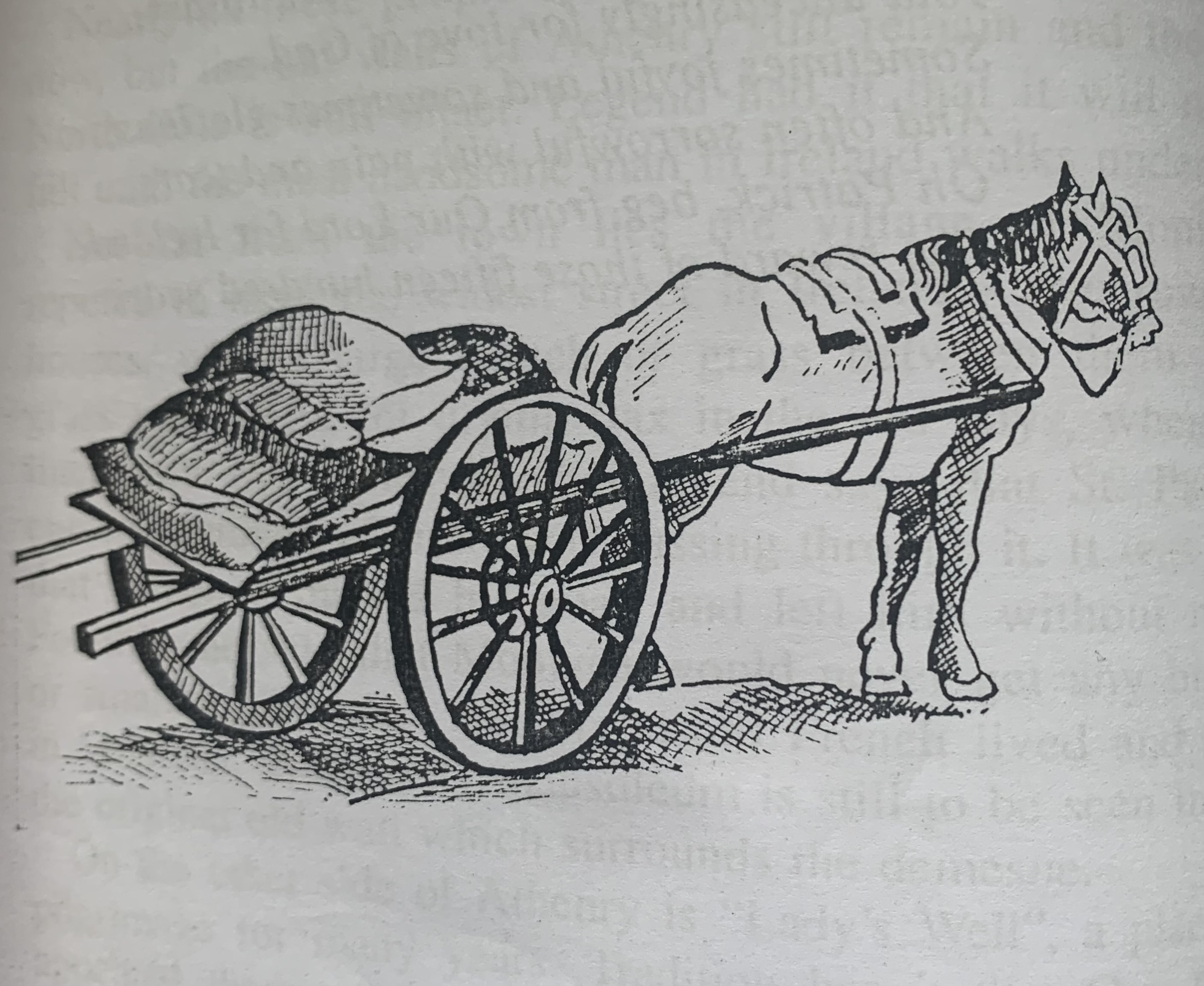
He was a very useful animal for the family, but woe betide any stranger who tried to interfere with him. He helped with all the farm work. He had two large panniers (baskets) slung across his back, and could carry heavy loads with them. When the men went out to work in the fields, he went with them. If they ran short of drinking water, or anything else they needed, he went back to the house for it.
When evening came they sent him for the rusheen (four o’clock tea). He brought it out in crock jars, with a woollen stocking around each jar to keep the tea hot. The amount of jars depended on the size of the methal (crowd) at work. When the potatoes were being dug, the men in the field filled the panniers with potatoes, and the mule brought them back to the house, where another man emptied them, and put them into a pit or shed. The mule went back for another and kept going for the day. I am sure there were not many mules like him. An old saying comes to mind:
“A woman, a pig and a mule, are the three most stubborn things to drive.”
Our mule was an exception to that rule!
Chapter 4
My father was born in the old home at Greethill in 1874, the youngest of ten children. His brother John was just a year older and they were inseparable companions all through childhood. Like all boys they had their share of mischief too, especially John who later became a Jesuit. When John was quite young he took a great interest in the priest’s vestments belonging to his uncle, Fr. Richard. His mother often put them out to air on fine days.
One day, John decided to try some of them on. His father and others were winnowing corn in the barn. It was a breezy day and the chaff had collected on a large deep pool at the end of the yard. When his mother saw the youngster with the much treasured vestments hanging to the ground, she cried out in horror, but he ran away. In the excitement, he ran straight to the pool but John calmly walked across the water and the chaff held him up.
Fr. Richard, who was parish priest in Kilfenora, died in the old home in 1858. He is buried in a special vault beside the family grave in Teampaiel Gal. His brother, Fr. Michael died in Waltham, Massachusetts and is buried out there.
Seventeen priests sang High Mass in the old kitchen for Fr. Richard’s funeral and Mass was said there every year for seven years on his anniversary. John’s four sisters entered religious orders. Sr. Valerie, Catherine and Stanislaus joined St. Joseph De Cluny and Sr. Martina went to The Bower in Athlone.
Now their bones lie whitening in distant foreign lands,
They grew in beauty side by side,
They filled one home with glee.
Their graves are scattered far and wide,
By mount and stream and sea.
The same fond mother knelt at night
O’er each fair sleeping brow
She had each folded flower in sight,
Where are those deamers now?
One sleeps beneath the Pampas grass of Argentina, one in Castilles, West India and another in Inhambane, Mozambique.
Inhambane
My loved sailed o’er the treacherous tide
And safely came into your land,
But the death angel raging along the seaside
Slew her with his pitiless hand.
Inhambane, your name as the silent years roll
Though forgotten by others it be,
Will ring like a death knell in one human soul
A grief deep and boundless to me.
Only one sister ever returned to her native land. She is buried in Mount Sackville, Dublin. Thomas joined the De La Salle Brothers in Castletown and led such a saintly life as Brother Brendan Amedy, that his biography has been written. There are many incidents of his piety and that of his saintly religious sisters. Sr. Valerie was in the West Indies when Brother Brendan died in Castletown. But somehow, even though she was far away, she knew about his death. She heard stones falling on his coffin. A few years after his death, he appeared to his aunt Sr. Teresa in the Mercy Convent Galway and told her she would be in heaven in a few days. She sent for my father and told him she was saying goodbye. She died a few days later in 1906.
Sr. Stanislaus told her sisters in religion one morning that her mother was dead in the old home. She said she saw her mother getting into an aeroplane beside the house and going away over a field of corn. She described the exact field to her brothers afterwards. At the time of Sr. Valere’s death in the West Indies, Sr. Stanislaus saw a vision of her walking into the Sacristy in Dublin. Years later when Sr. Stanislaus lay dying in Dublin, a vision of Sr. Valere was seen by her bedside.
Towards the end of the century, my beloved father and Uncle Richard were the only ones left in the old home with their father and mother. The youngest girl was at school in the Mercy Convent with her aunt Sr. Teresa. Both father and mother were very religious. The rosary was said each night, with many trimmings for recent deaths, absent family members, the sick, and the dying.
As the years rolled on, my father decided to try his luck in distant Chicago. His cousin had promised him work out there. As he bade farewell to his mother, she placed a rosary beads in his hands and told him never to part with them.
On arriving in America, he got a job with a railroad company who were laying vast train tracks through the wild plains of the West. He was soon promoted to “overseer” and he had a group of Dagos working for him. They did not know any English but the first thing they understood was:
“Fill your shovel or fill your coat.”
They became fast friends and he stayed with them for some time.
He had a very good friend in Chicago, Jim Hogan from Roscommon. They had some hard times together before they got their respective permanent jobs. They were together out in the wild West one year and they had to travel one hundred miles to get to Mass and Confession on Christmas Day but they got there. Jim Hogan had a sister called Nancy and from what I have heard she was a good friend of my father’s.
My grandfather died in 1903, and left the house and farm to Richard; who now lived alone with his invalid mother. He tried to manage the house and a hundred and six acres of land, but with all his hard work, he found he could not cope. He wrote and asked my father to come home and take over. His mother also begged him to come. My father felt that Richard should have the home place because he had worked so hard for it. He also had to consider his friend Nancy, who had hoped he would settle in Chicago. Every letter from home caused more heartache and sleepless nights. Still undecided, he went out to work one morning As he returned from his lunch, he spied something white on the long grass. He picked up a card, signed by his sister, a nun, who had been dead for some years. On the reverse side he read:
“Come back to Erin. Old Erin invites you.
Come back again to the land of your birth” .
No more heartaches, the decision was made. He returned to the home land and found many sad changes. He walked from Athenry station and arrived unannounced. He went straight to his mother, and placed the rosary beads she had given him, in her hands.
“You told me never to part with them,” he said. “I never did until now.”
January 2nd, 1945
Neath the ivy-clad ruins of the Tampaill
By his parents and loved ones so blest, With the soft falling snow for a mantle,
We laid our dear Daddy to rest.
The kindest and tenderest of fathers,
A harsh word from him never was heard,
By his neighbours and friends he was honoured,
While at home he was loved and revered.
He never spoke ill of another,
Or believed any scandal going by,
His word was the Law in the Village,
For he never once told a lie.
All through life he had troubles and worries,
And when young had to go far away,
To seek riches and fame by his labour,
And bring wealth to the old home one day.
‘Mid the wide vast tracks of the Prairie,
Where few Irishmen ever had trod,
Where the rustler and cowboy lived reckless,
With no thought of a future or god,
He kept the strong faith of his boyhood,
Where the Buffalo and doggy roam free,
And returned to the land of his fathers,
A shining example to be.
Before leaving the land of his labours,
He received a sad letter from home.
His father was dead and he shrank from the thought
Of seeing his old mother alone.
With thoughts sad and troubled,
when the days work was over,
To rest on the long grass he lay.
He picked up a card, ’twas a message, an answer
To the thoughts that had troubled his mind thro’ the day.
A little white card, it was signed by a nun.
His sister, no longer on earth.
It said: “Come back to Erin, old Erin invites you,
Come back again to the land of your birth”
He returned to his home and found many sad changes,
But his strong courage came to his aid.
He shouldered his burdens, and worked with a will
On the lands where in childhood he played
Success crowned his efforts, and the last years of his life
From all worries and cares were free.
His sons took up duty and made his old age,
As happy as he could wish it to be.
The daughters God gave him – two entered His Service,
One toils where the labourers are few,
The youngest, near home, soothed her father’s last hours,
By his side in her habit of blue.
Goodbye dearest Dad, we leave your bones’ neath the clay,
But we know that your spirit is already at Home.
Plead for your children who will never forget you.
Till we meet ne’er to part, at the Master’s White Throne
My father was a man of great courage and with the money he had brought home with him, he soon had the place in order again. Richard insisted on giving over house and land to him. Richard had no desire to marry and would have entered a religious order years earlier, if he had been free.
I have often wondered what life would have been like if Nancy had come home and married my father, but it was not to be. More than a few Paters and Maters had their eye on the young, good-looking, returned Yank. Those were the matchmaking days, and on a bright August morning, he married my mother after one brief encounter. They settled in the luscious green hills of Greethill. I wonder did he think of Nancy at the wedding procession, as side cars and saddle horses turned up the old boreen that Autumn evening? I do know that neither regretted their partnership through all the years they spent together.
Chapter 5
Even in my young days, matchmaking was still in practice. Many stories were told of all the matches that were broken over the girl’s fortune. The two parties, usually men, met in a public house and of course drink played an important part in the proceedings. Neither the bride or groom were present. All the arrangements had to be settled before they were allowed to meet. The bride’s fortune was often settled according to her appearance. If she was good looking, she did not need a huge fortune but what she lacked in good looks, had to be augmented. To be good looking in those days, meant:
“A fine tall girl, with fine big eyes, fine long jaws, and fine big lips”.
Those were the days before
“All I can carry, the girl that I marry, must be”, became fashionable.
When the fortune was settled the next job was to “go see the place”. Every step of the man’s land was inspected. If all went well there, the groom and his friends went to the bride’s home to “receive the money”. Apparently it was the first time they met. The wedding date was fixed, and both parties went to town to buy the ring. (No man wore a ring in the old days).
On the wedding morning, the groom called for the girl at her home. They returned there with all the guests for breakfast. They usually spent the day there, and went to the man’s house for supper, then spent the night dancing and feasting. All the neighbours and friends had pots of bacon and cabbage, and roast geese, prepared for them. The wedding gifts in those days consisted of huge homemade cakes, roast geese, jars of porter and gallons of whiskey.
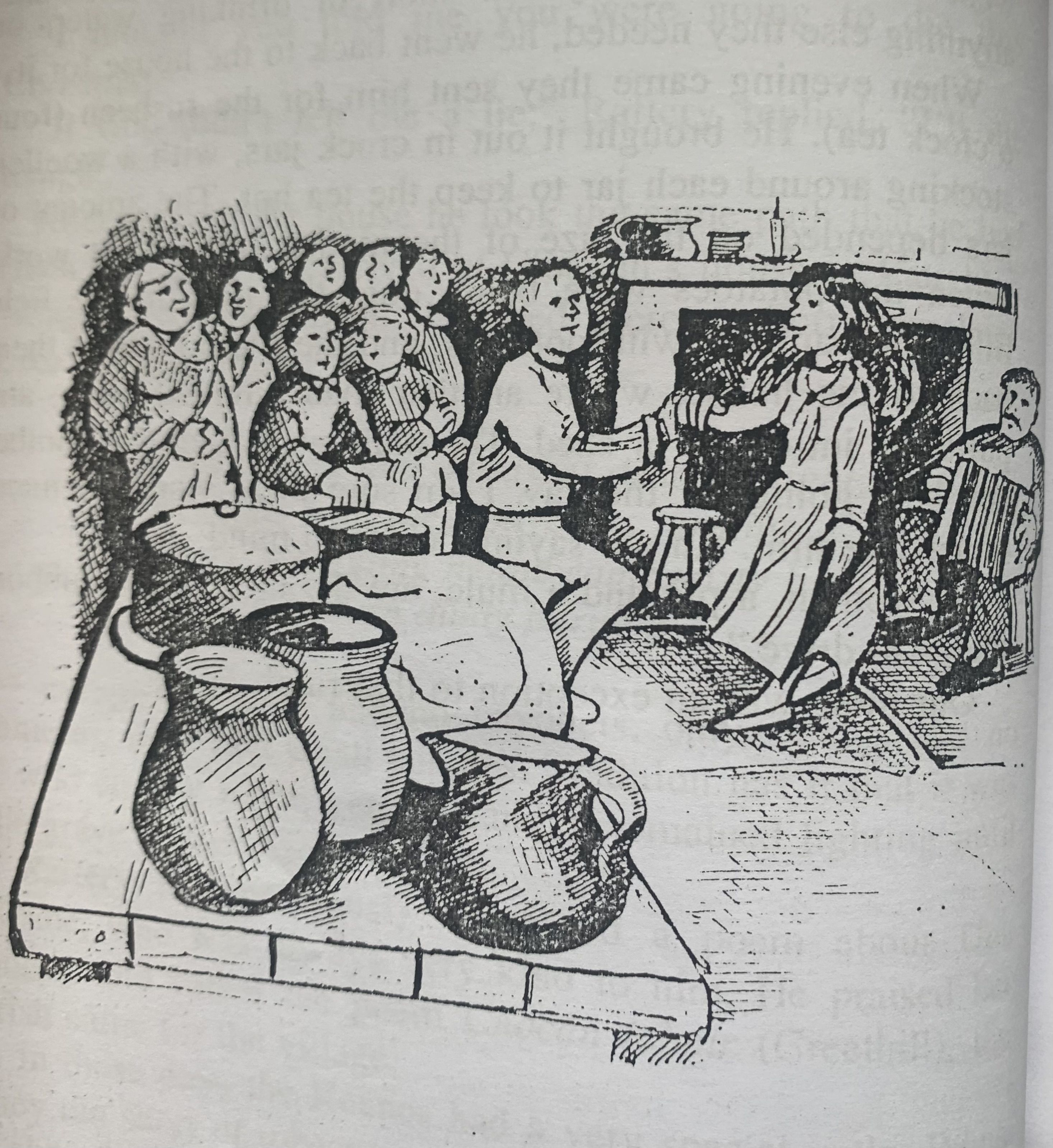
Some of the old customs were still adhered to, when my parents were married. The bride should not appear in public, until the second Sunday after the wedding. She went incognito with a few friends to mass on the first Sunday.
“The Eirigh Amach”, or “Rising Out”, on the second Sunday, was another day of rejoicing, and all night dancing. The bride could not visit her old home until she was a month married. “The Month’s Visit” was another excuse for feasting and dancing. All the neighbours and friends then held parties for the newlyweds, so the festivities lasted a long, long time.
There were many stories told about weddings in the old days. I heard of one man who got the wrong bride. The girl he had seen just once, was replaced by her sister (who was not good looking), at the altar. In later years, he said, he never regretted it. “No man could get a better wife”, he said.
Another story was told of a family whose whole lives were ruined by deception at a wedding. When the girl’s people went “to see the place”, the man had already opened a gap in the neighbouring wall, and let all the stock get mixed, giving the impression that he owned more land and stock. The girl brought a good fortune, but she never forgave her husband. They spent their lives arguing and complaining.
Worse still their children took sides. Sons and daughters did not live in harmony with their parents, and even disagreed over their last resting place.
Another man with an elastic conscience thought of a way to get a good fortune when he married. He took all the sheaves that had been squished with the flail and remade them in a stack again. He even went to the trouble of thatching the stack. When the men came “to see the place”, they decided he was “warm”, by the amount of corn still in his haggard after the winter.
Shrove tide was the usual matchmaking time. In some parishes, the first Sunday in Lent was called “Chalk Sunday”. Any spinster or bachelor who failed to get married during Shrove tide, got a white chalk mark on their coat during mass. This was usually done down at the back of the church, away from the discerning eye of the priest.
The majority of those match-made marriages were very happy. People were easily pleased in the old days. They put their trust in God, and accepted any crosses He sent.
Like the old lady who said she liked the joyful mysteries of the rosary when she was young, but now she said:
“I have turned from the joyful deeds
And I cry on the sorrowful Mysteries,
With tears as big as my beads,
For my beautiful boy with the fever went,
And “Himself” next morning died.
Do you wonder I think of the mysteries
That end with the crucified.
She finished by saying she would have plenty time in heaven to think on the glorious ones.
All the old people treasured their rosary beads and were very faithful to the family rosary. It was a tradition, handed down since the Penal days, when the people were not allowed to hear mass. The rosary kept the Faith alive then. Those who had to immigrate, brought the faith with them all over the world.
The Irish mothers who had their matches made were responsible for that tradition. They believed in the sanctity of marriage, and were faithful to their vows, “Till death do us part”.
There were exceptions of course, like in every walk in life, but to my knowledge they were few in this corner of Ireland.
I knew some people whose marriages were made, and who lived happily together. In particular, I knew one man who was considered one of the finest men in the locality. He had a lovely home, and a good farm. Several girls were introduced to him personally. All were turned down. One was too small, another wore glasses, another was only a gifire, (too giddy). Eventually, a matchmaker arranged a marriage for him to a girl who was neither good looking, tall, or well built. She did not seem to have anything to recommend her. He married her, and idolised her all through life. I am sure no man who ever lived could have loved a woman more than he did. We young people at that time could not understand how, or why, and were anxious to discover the secret. One brave girl asked him, and he told her that when they met, (the one and only time before the wedding):
“She smiled at me, and that smile went straight to my heart”.
The old saying that “marriages are made in Heaven” must be true.
Not all marriages were match made. There were stories of elopements, “runaway marriages” they called them in the old days.
Parents were very particular about the families their children joined. There was a good deal of “two pence looking down on three half pence.”
When the “man of the house” (the man who would inherit the farm) decided to marry, or when his parents decided it was time, the search began.
“So and so seems to be a warm man, who was his wife?”.
Grandparents, perhaps long dead had to be investigated.
“Has he many daughters? Is the eldest girl good looking?”
None of the younger girls could marry until the oldest went first. If all the answers were satisfactory, the matchmaker was given a bottle of whiskey, and sent to the man’s house to ask for his daughter’s hand in marriage, and the performance was started.
Chapter 6
My beloved paternal Grandmother died when I was ten years old. I still have and cherish her rosary beads, Dolour beads, and beads of the Child Jesus. I also have her silver Crucifix, given to her grandmother, Mary Keane from Castleblakenly. It is inscribed:
“The gift of the Rev. P. Mc. Manus to Mary Keane.”
Among my souvenirs, I also have the white, lace-trimmed cap she always wore. She was a beautiful singer, even in her old age. I can vividly recall her singing “The last rose of Summer” and “My heart’s in the Highland.” Her marriage, too, was match made, but with a little difference.
It happened that her husband to be and Sir Richard O’Donoghue, of Priory House, Salthill, were both meeting prospective life partners in the same hotel in Galway. My grandmother was meeting Sir Richard and I never knew the other lady’s name. After a meal in the hotel, they went for a walk around Galway. It began to rain, and the unknown lady pulled out a folding parasol. Grandfather decided she was too grand to be a farmer’s wife. My grandmother had also decided against marrying Sir Richard, so they exchanged partners and remained good friends for life. All this happened way back in 1860. She died in 1919. I remember her funeral quite well.
Funerals were so different in those days. It would be considered a tragedy if anyone died without a priest. The blessed candle was always lighting, and all the relations knelt around the bed and said special prayers for the dying, as well as the rosary. At the last moment the dying hand was put in to the habit which had been previously blessed. Three women always worked together to lay out the corpse. Each took a sip of whiskey before they started and if they were teetotallers they rubbed some whiskey on their faces. Someone closed the eyes and all joined in prayer for “the soul that is now being judged”.
After a few hours, when rigor mortis had set in, the women washed the corpse, put on the habit, covered any mirrors in the room with a white cloth, then placed the bed to face the door. No pregnant woman would be allowed to touch the corpse. The feather bed was taken off and flat boards were put over the mattress to make it level. The corpse was covered with a white quilt, with three folds on top to honour Father, Son and Holy Ghost. The top and bottom of the bedstead were covered with white sheets. The four brass knobs were tied with black ribbon. A vase of holy water was left beside the candles and everyone sprinkled the corpse as they came in. Then all knelt for the Rosary. Six candles were left lighting beside the bed.
Friends and neighbours took turns in the room all through the night. The men had already ordered the coffin and hearse, and spent part of the night cutting tobacco and filling the clay pipes. The pipes were placed in a big skib, and left on the pillar of the entrance gate. Everyone took a pipe on funeral day and said a prayer for the dead. Another custom, now long gone, was to place a plate of snuff on the bed, and each one took a pinch.
The hearse came next day, drawn by two black horses. The driver sat on top, complete with tall black hat, with a large white band around it. In those days friends and neighbours dug the grave, and filled it in again before the mourners left the cemetery.
There were no mass cards, no flowers, except for the very young. There was much more friendship among friends and neighbours in the old days. Neighbours did all the work for the funeral house. If the man of the house died, everything was done for the widow and children afterwards.
Before my time when there were no hearses, the coffin was carried on the common cart and the nearest relative sat on the coffin. They didn’t bring the coffin to the church in those days. They had a three-night wake. The priest then came, and said mass in the house. There were four chairs placed outside the door, and the coffin was left to rest there, for a minute, while the mourners said a last farewell.
Many stories were told of those wakes and funerals. At some wakes games were played. “Harrow, harrow” is the only one I remember hearing of and I do not know how it was played.
Whiskey was bought in gallons, and poteen was easily got. We can well imagine what funerals were like, after three nights drinking and very little sleep. I heard of one woman who sat on her father’s coffin, on the common cart for hours. She kept calling the relations to come and bury her father. When they came out eventually, they gave a bottle of whiskey to the horse. I never heard if they reached the graveyard.
I heard of one young priest who was new in the parish and had a frightening experience. As he was saying the funeral mass on the kitchen table, two clocking hens flew out from under it. They had been sitting on their eggs there, for some time, and choose the wrong moment to make their appearance.
In some parts of the country there were “caoners” (criers), who went to all funerals and cried the dead, even those they never knew. The Banshee was supposed to be heard crying for certain families, especially the O’s and the Mac’s. Not many believe in the Banshee now.
Chapter 7
I never knew my paternal Grandfather, but I know he was a man of great faith and great charity, like his father and grandfather before him. Small wonder then, that my father inherited all the good virtues of his ancestors. He was loved and revered in the village, and in the whole parish and surrounding districts. He never told a lie, and never went back on his word. As we, his nine children grew up, we never heard a cross word from him or uncle Richard.
It was mother who meted out the punishment. The sally rod – a short willow-branch which had no knobs or lumps on it – was always near at hand. It could still hurt, and she did not believe in “sparing the rod and spoiling the child”. Work in the house, and in the fields, was the order of the day. We usually had ten or eleven pigs to feed, two or three sows with their litters of bonhams, hens, ducks, chickens, turkeys, geese and guinea fowl.
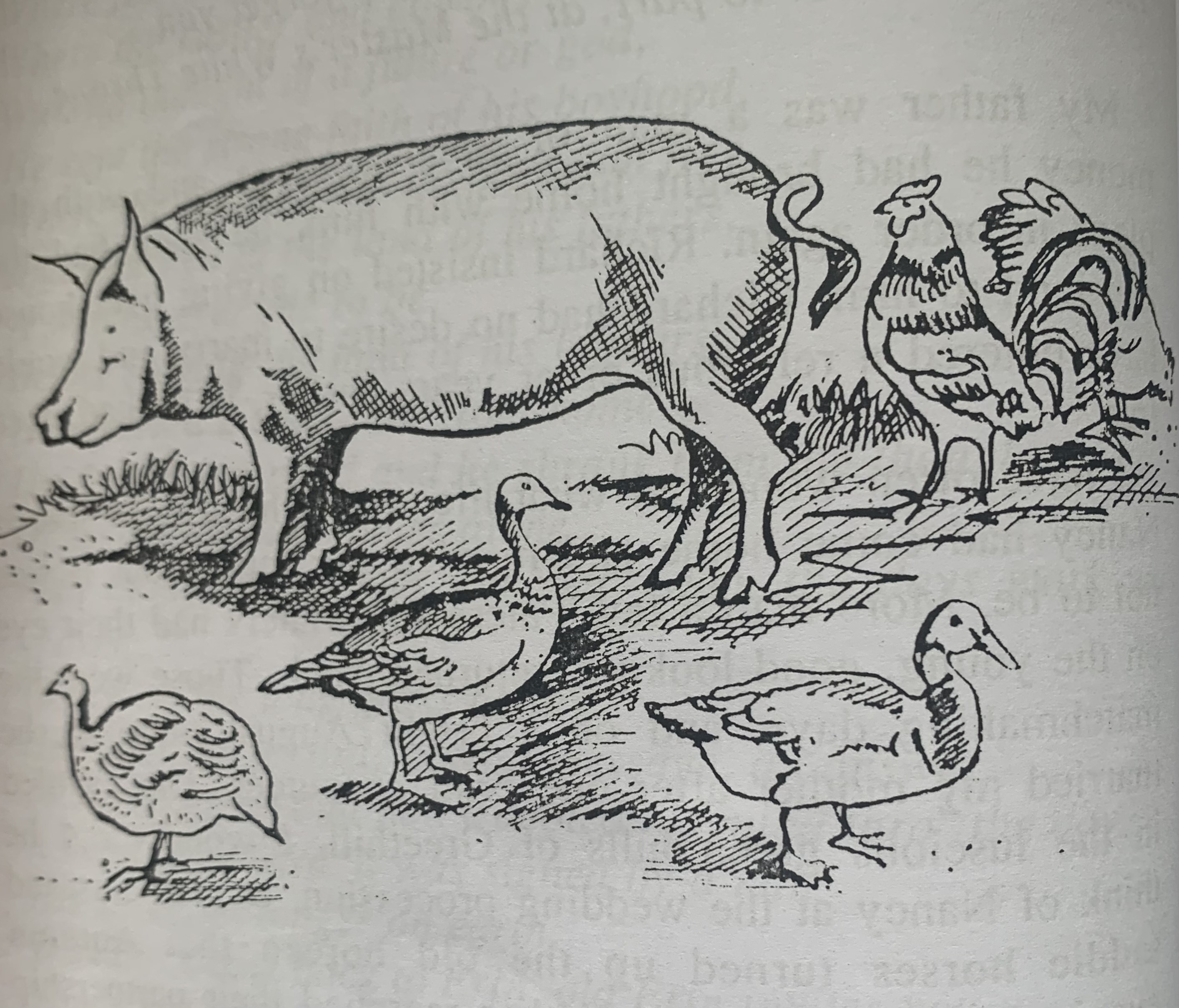
The fowl were not much trouble to look after, except to make sure that they were safe from the fox at night. The sows were the biggest trouble of all. When they were having their litter of bonhams, we had to stay up at night to mind them. Often, on a very cold night, we brought out the kindled sods of turf in an old pot oven, to keep us warm in the stable where we spent the night.
Sows usually had from ten to fourteen little piglets, and it was impossible for the sow to lie down without lying on some of them. Someone had to be there to save the piglets for two or three days and nights. Then they were able to manage on their own. If the sow had thirteen or more, and perhaps twelve teats, we had to bottle feed the extra ones. We usually took them into the kitchen heat, until they were strong enough to be left out in a stable. I remember one “suck” as we called them. He followed me around everywhere, and made a lot of noise if he lost me.
Sows and pigs in general needed plenty of food, and we had to wash and boil potatoes for them. We had a large pot hanging from the crane over the kitchen fire. When one potful was boiled it was emptied into a big tub. The pot was refilled and put to boil again. The contents of the tub had to be chopped and pounded with crushed oats or barley mixed through it. In later years we had a large boiler that took a day’s supply altogether. It was set on a cement stand in the yard, and a place left for fire underneath. Any kind of timber or rubbish could be burned there.
Each season brought its own extra work. During springtime we looked after young lambs and the “sowing of the garden”. The garden was a very important place for sowing early potatoes, cabbage, onion and parsnips. “Cutting the slits” needed some experience. Depending or the size of the potato, three or four slits could be got from one. Each slit had to have an eye, or bud, to make the new potato. The slits were then sown on the drill made by the plough and horses. The horse and cart brought them out to the fields in bags. Half of them were left at one headland, and the rest at the opposite headland. We filled our “prauskeen” (an apron made from a canvas bag) with enough to bring us to the next headland, where we refilled again. We placed the slits twelve inches apart as we travelled backwards along the drill.
In summertime we had to thin out and weed several acres of turnips and mangolds. It was the least popular job of all. The weather was usually dry, and the lumps of clay were like stones under our knees. We often worked in the rain, when the clay was soft beneath us.
Early summer was also turf-cutting time. When we were young, my father travelled ten, and sometimes twelve miles for a creel of turf, usually bought at the bog in a twenty-foot reek, which meant four creels. We helped to make the reek at home and left a space at the bottom for the dog’s house. Then the reek was thatched and covered with galvanized iron sheets and made safe for the winter.
In later years, when my brothers were young men, they cut and saved the turf themselves. They bought the “bank” of turf in the bog, nine or ten miles away. The bank could be any number of perches. The first job was to clean away the “annach” and throw it into the bog hole. The “annach” was one or two feet of waste that covered the good turf. Then the slean (a long knife with a wing on it) was used to cut the sods. The wing helped to shape the sods. The turf was thrown on the “plaus” (the cutaway bog).
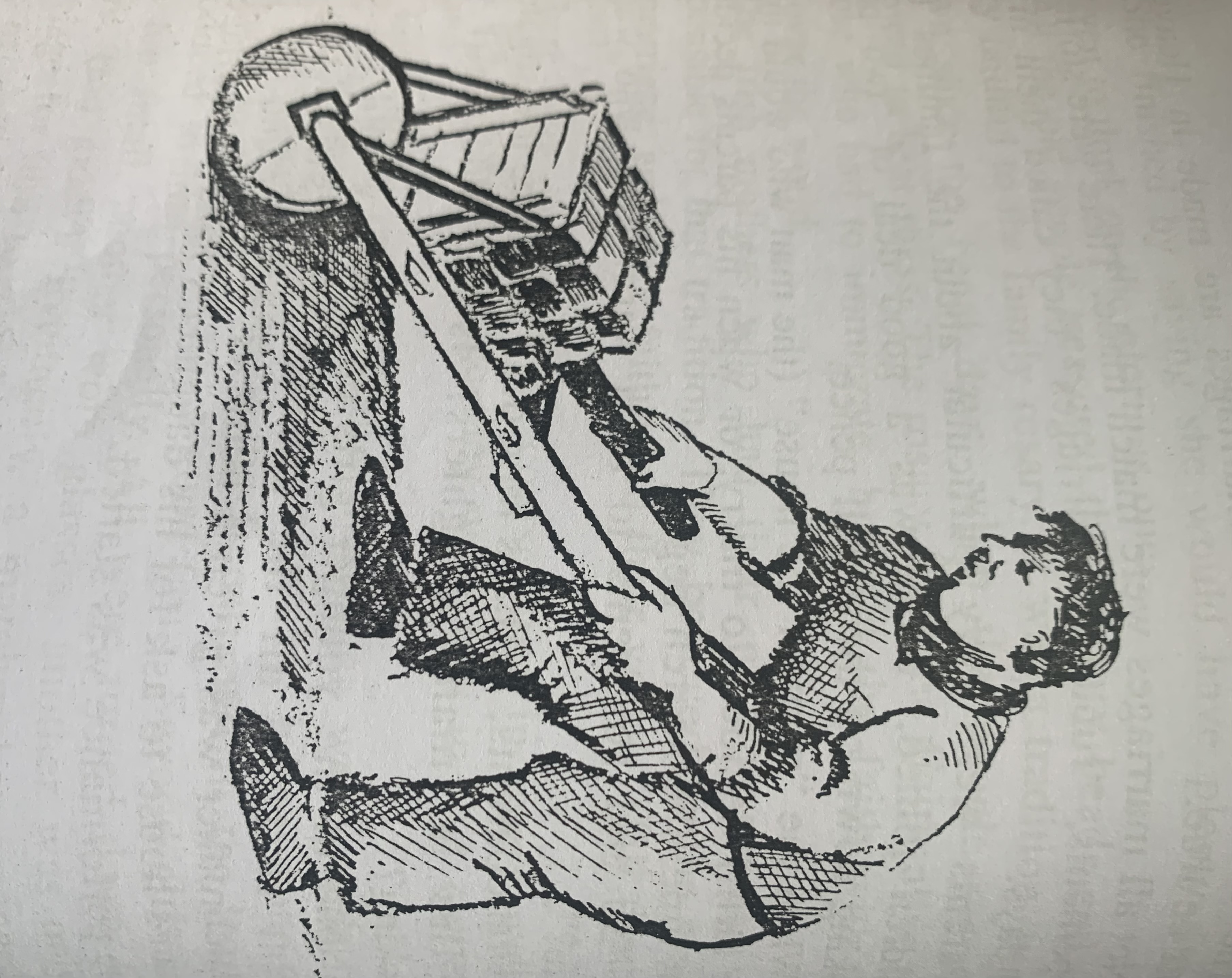
The men with the turf barrows then wheeled it out about sixteen sods in each barrow. If they had any length to go to get a dry place to dump it, it took three wheelers to keep a good sleaner going. The turf was then left to dry for about two weeks. Then it was put into “grogeens”, a few sods standing on edge, and one across the top. After a short time, depending on the weather, it was put into “clamps” (small reeks). Later still it was taken out further near the road. The donkey and cart usually did that, but sometimes they had to carry it out in bags on the men’s backs. It was made into reeks then and the horse and creel could take it home.
We enjoyed saving the hay, even though it was hard work without any machinery. The long swaths (rows) had to be turned with a two-pronged fork. After a few days it was put into handcocks – a few fork fulls on top of each other. A few days later, it was put into trampcocks – a medium sized cock – with a man on top, who tramped on it, and brought it to a point. Then it was tied down with a “sugaun rope” (a rope made from twisted hay, or straw).
In early Autumn, those cocks were all put together in a convenient place for sheep and cattle winter feeding. A large pole was sunk in the ground. The tramp cocks were drawn in with the horse and plough backs (long chains tied together). The hay was built up around the pole, brought to a point, and “the sheep cock” was made. It was then thatched, and safe for the winter.
Autumn was a very busy time for everyone. Wheat, oats and barley had to be cut and saved. If cut with the scythe it had to be “taken out” and divided into sheafs. The sheafs were then “bound” (tied together with a few ears out of the bundle). They were then put into stooks, (ten or twelve sheafs standing against each other). When the stooks were dry, they were taken in to a hagard, where the farmer stored his com.
There, they were made into big stacks and thatched.
When the corn crop was safe, the potatoes had to be picked and graded. The small ones were bagged, and brought home for pig feeding. The good ones were put into a shallow pit in the field. They were shaped up into a triangle and covered with straw. Later they were covered with several inches of clay. They were safe for the winter, unless a rat bored a hole and let in the frost.
Autumn time was also jam-making time. We made several pounds of blackberry jam. Blackberries grew in abundance around the countryside. They did not make good jam on their own, but we always got something to help out – apple, banana, or any other fruit available.
We had already made ketchup with all the mushrooms that were so plentiful in those days. How we enjoyed a meal of mushrooms. Fried in our own country butter they were delicious.
I remember an old yankee lady, who was on her first visit home. She got so excited when she saw the mushrooms.
“Oh give me what I have yearned for, over the years,” she said, “a mushroom with a tiny grain of salt, roasted on the spruce” (the red cinders of an open fire).
Winter brought the long nights, and very severe weather. People tried to stay indoors as much as possible. But someone had to do the “foddering” – a big job in wintertime. All stock had to be hand fed. The old cows had to be kept alive until the first twelve days of April were over, then, according to an old saying, any cow that survived was safe. Bundles of hay had to be drawn from the sheep cock, tied with a rope, and carried out in the fields to the cattle and sheep who had no grass during the frosty weather. The cows and horses were stabled at night. They had to be fed and watered. The horse’s manger was filled with hay, and his ration of oats was put into the feeding pot. The cows, too, had their manger of hay, and a large bathful of sliced or pulped turnips, to be eaten before milking time. When horses and cows were put out in the morning, the stables had to be cleaned out. All the dirty bedding of the night before had to be lifted out with a four-pronged fork. It was piled up in a heap which we called the “the dunghill”. Every farmer’s yard had a dunghill. It was used in spring to manure the crops. Fresh straw was put in for bedding and the feeding started all over again.
Chapter 8
It was during the winter months that all the mending and repairing was done. There was never an idle moment. The men oiled the horses’ tacklings with goose grease, or pig’s lard. If a horse lost a shoe, he was reshod with the large horse nails that were kept specially for the purpose. The horses were given a half clip with the small clippers. The old last was taken down from “the thal”, (a shelf between fireplace and wall, where things only used annually were stored) and the cobbling was done. Nail boots were worn for work on the land, and the soles usually outlived the uppers. The lighter boots and shoes often needed second soles and heels. A packet of tacks and a piece of leather was bought. A pair of half soles were measured and cut out. The scraps left were used for mending heels that were worn on one side. There was usually a protector (metal stud) put on, to prevent it happening again.
Cobbling time was the only time I heard my father sing. He seemed perfectly happy, at peace with the world as he hammered away at the old last. Sometimes he sang “The Lake of Coolfinn”, or “Nell Flaherty’s Drake”. Some snatches of another one, that I never heard in full. It was a controversial one, about who was going to be in heaven.
“The great Salvation Army will be there without a doubt
And also Mr. Carney that we heard so much about”
It was during cobbling time that he taught us The Alphabet that I still remember.
A was an antler who sat in the fog
B was a butcher who kept a great dog
C was a captain all covered with lace
D was a drunkard that had a red face
E was an Emperor with sweat on his brow
F was the farmer who followed the plough
G was the gambler who had no ill luck
H was the hunter who hunted the buck
I was an inspector when drunk he was bold
J was the jarvey who would drive him for gold
K was Kilmainham where our true men died
L was the Land League, our hope, and our pride
M was our Majesty who makes black out of white
N was no rent, that would make all our wrongs right
O was old Ireland that yet will be freed
P was the peeler who sold it for greed
Q was the queen whose use is not known
R was the rifle that kept up her throne
S was the sheriff with woe on his train
T was the toiler that others may gain
U was the union that worked with bitter harm
V was the villain who grabbed up the farm
W is a warrant for death, or for change
X is the express with all eyes, and no brains
Y is young Ireland spreading The Light
Z is zeal that will win the Great Fight
Apart from cobbling there were lots of other things to be done. On a dry day the men went out rebuilding walls, or cutting hazel, and bush for firewood. Wintertime was the best time for cutting firewood, before the sap came on it. It was the time also for cutting and paring scallops that were needed for thatching. The scallops were long thin hazel branches. They were brought in, in bundles, to a stable for shelter. They were then cut into lengths roughly twenty-four inches long. They were then pointed on both sides with a penknife, and made ready for the thatcher. He bent them, and stuck both sides in the thatch to hold down the new straw he was putting on the house or stable. They were also used to hold down the “bobeens” or edge across the top.
Looking back now I wonder how we ever survived, with all the hard work. In spite of all the hardship we were always happy and content. We had plenty of good food, our own bacon, eggs and butter, while fish and potatoes were the main dish of the poorer people in the old days. The fisherman came out from Galway, with his little cart laden with herrings, gurnets, breams and mackerel, according to the season. People bought from him, anywhere along the road. Anyone who could afford it went to Galway, and bought a barrel or two of herrings to last over the winter. Some of them were salted in brine, some were salted and smoked. A large scallop (stick) was measured to the inside of the chimney, then pointed on one side. The pointed side was put through the heads of the fish, until the scallop was filled with hanging herrings. The scallop was then fitted into the chimney over the open fire. When that amount was smoked, the process was started all over again. People were glad to have one of those herrings with potatoes for their supper. If they were lucky enough to have milk, they poured some over the fish, to make gravy.
Ling was another popular dish in those days, especially during Lent. It was a large fish, and could be bought by the pound either fresh or salted. Because of its thickness, ling was cooked differently. It was usually boiled in a sauce made with flour and milk. The other fish was cooked on the gridiron (a small rack with a handle and four short legs) which was placed on the cinders of the open fire, and cooked on both sides.
Fish was always available in Galway. Fish women walked through the streets carrying large skibs of fish on their heads and calling out, “Fresh Mack” or whatever fish was in season.
If we ever complained about our lot, we were told that we had an easy life, compared with the people who had gone before us. Then we heard some stories of hardship.
A woman walked the twelve miles to Galway, and carried an eight stone bag of flour home on her back. Another woman walked from Moycullen to Greethill. She started knitting the long stocking that the men wore with the knee breeches, when she left home. She had to stand outside the house in Greethill for a minute or two to finish it. She would not “give to say”, that she could not finish it. When were told of the people from Galway and elsewhere who travelled throughout the countryside during the famine years. They stole sheep, killed them, and carried them hone on their backs. The farmer or some member of his family stayed out all night to watch the sheep and cattle during the terrible years of 1846 and ’47 when people starved and died of hunger. The remains of the Cauraun, which was built as a crude shelter, is still to be seen near the old Lisheen.
Even in my grandfather’s time some people suffered severe hardship. They had to do all their digging and tilling with the spade. Seaweed, with the help of the dunghill, was the only manure they had for growing their crops. Cutting the seaweed at the sea shore was a very laborious task. The workers had to start very early in the morning when the tide was out. The further out they went the better the seaweed they got. As they cut it, they made it into climeens (large heaps). When the tide came in, it brought the climeens with it. It still had to be carted home if they were lucky enough to have a cart.
Chapter 9
By the end of the season all was ready for winter. The hay in big “sheep cocks”, the corn in large stacks in the haggard, thatched with straw and scallops, ready to be threshed when the steam thresher came to the village. Those stacks of wheat served us well during the war, when food was rationed. We always had enough wholemeal and tried to make white flour by sifting it – first with a large sieve and gradually with smaller ones, including the milk strainer; finally with a silk stocking.
The stocking was cut length wise and the bottom cut off from the heel. The remaining part was formed into a ring which produced the shape of a round bowl. The flour already sifted, was added in small quantities, and sifted for the last time. It was a laborious task, and produced very little flour when all was finished, but it was the only way to get anything like white flour. Those same stockings were very versatile. When the wearer was finished with them, they made excellent polishing cloths. Better still they made good door mats. Instead of cutting them length wise, they were cut round and round in narrow strips, then stitched together and knitted with large knitting needles. Sometimes they were plaited and arranged in ring form to make a round mat. The sole of the stocking had its own use. It was cut in small pieces, and kept for padding cushions. (“Necessity is the mother of invention.”)
In March 1943, I sifted, and resifted, enough to make three large cakes, one of which had to suffice for a wedding cake. There was no fruit except some dried figs. We had very little sugar, but we had our own eggs, and churned our own butter. Those cakes were really delicious. The wedding guests came to the bride’s home for breakfast. The wedding was at the unearthly hour of 7.00 a.m. so that the bride and groom could catch the only train leaving at midday. We put two tables together in the old parlour and seated fifteen at a time. It was a very happy gathering, but these people are nearly all gone now with “the smiles and tears of boyhood years and the words of love then spoken.” In later years there were other weddings, and receptions, when there was no war, or scarcity of anything to mar the happy occasion.
Chapter 10
Story-telling around the old turf fire was a favourite pastime in the long winter nights, when one vied with the other for the best yarn. The majority of those are not worth remembering. The ones that appealed to me are those which I know to be true. They were told by my father and uncle, and neither ever told a lie, or exaggerated any event. The story of Lynch’s Castle, “The Tragedy of Old Galway,” was told over and over in prose and verse. It was quite a long recitation, but we never tired of hearing how Lynch did his duty, and told his son he had to pay the price of his life for killing the young Spaniard.
Young Lynch was the son of James Lynch Fitzstephen who was Mayor of Galway town. In those days Galway ships did much trading with Spain. Many friends were made on both sides and visits were often exchanged. On one such visit the Mayor brought back young Gomez, the Spaniard, with him to Galway. There was great rejoicing when they arrived and everything was done to make the young man feel at home. Walter Lynch, an only child, was delighted to have Gomez for company, but after some time “the green eyed monster came, and set his passions all aflame”. The father of young Agnes, who was Lynch’s fiancée was a fluent Spanish speaker and Gomez often went to his house to enjoy a chat in his own language. Lynch thought he was courting Agnes and became jealous. He followed him to Agnes’s house one night, with intent to kill him.
But the Spaniard ever fleet,
Escaped and started down the street
Seeing not the other’s face
He could not tell who it was gave chase
On he went, still on and on
The many streets and lanes along
His pursuer close behind,
But still no shelter could he find
He is safe at last, he will reach the sea,
And swim for life and liberty.
But no, he is caught, a dagger’s dart
Is pierced with aim into his heart
One long loud cry and all is o’er
He sinks upon the lonely shore.
And Walter he whose hand is red
With the blood so foully shed
Now tried his awful deed to hide
And flung his victim in the tide.
Some fishermen returning home,
In the early morning gloom
Found Gomez’s body, knew the truth
Murdered was the Spanish youth.
When the Mayor heard the terrible news, he said the murderer must be found and hanged. He kept his word, even when he knew the culprit was his only son.
Where was Walter at that time?
We know not, but we know that soon
Came on remorse, that heaven sent boon
His evil passions melted quite
He saw them in their proper light.
Then straight away on his knees he dropped
And raised to heaven his arms aloft.
“O Gracious God in heaven” he cried
“The dying thief was not denied
Now listen to my humble prayer,
And do not leave me to despair.”
Lynch had spent the night out with a search party as his son had not come home. When he heard the terrible news that Gomez’s body was found, he thought that Walter must have been murdered also.
What could it mean, or where was he,
Or did he too lie in the sea.
Done to death by that same hand
That lay young Gomez on the strand?
For the hat young Walter wore
Was also found upon the shore.
Walter had spent the night in a wood close by, begging God’s mercy. When he saw his father approach he knew he would have to face a stern judge, but he made one appeal for mercy.
“Father, here, in heaven’s view
I pardon crave from God and you.
Seek no more, the guilty one,
I am he your only son
Who has brought this dire disgrace
Upon a good and worthy race.”
That father, ah! no words can tell,
How strong the blow, that on him fell,
Before his mental vision flashed
His cherished idol rudely smashed
His blighted hopes, his deep disgrace
That naught but death could ever efface.
He told his son in the presence of the large crowd of onlookers, that he had given his word – the murderer must die. Then, in a voice filled with emotion he said:
“If other were thy judge than I
I might for mercy for thee cry
But no my son to me was given
To show the way that leads to heaven”.
The Galway people who had loved the young lad vowel that they would not let him die. Soon a big mob had gathered. They kept shouting for mercy and told Lynch that no hangman would do the ugly deed for him. Lynch and his son then went home to the castle.
When the mob gathered again next morning, they beheld a strange sight.
“On the castle window arched and high
Between them, and the morning sky
The culprit stands so slim and fair,
His lips move, as if in prayer.
Around his neck, a rope is tied
Fastened to a chain inside.
Beside him, his father, stern and proud,
Was heard by all, to say aloud,
For this sad world do not grieve,
So die my son that you may live.
He draws the rope, the soul is free,
Launched into Eternity.
In a dull street in Galway town
Lynch’s Castle still looks down.
On it is a tablet dull
Engraved with crossbones and a skull.
A motto runs along its breadth
And bears the words: “Remember Death”
“The Tragedy of Old Galway” was related many times but there were other stories. My uncle told of the time his father and neighbours had to journey many miles to get their wheat dried by kiln. Kilns were few and far between. The kiln was a large furnace of brick or stone. The wheat was spread out on some form of stand over the heat and dried. When the wheat was ground at the mill afterwards, it was called caisgín (whole meal).
Someone had to stay all night guarding the wheat, otherwise it would be stolen. This particular kiln was located in a very lonely spot. Thieves had spread a rumour that the place was haunted by an army of soldiers. There were strange noises heard and eventually no one would stay there. My grandfather was determined that his wheat was not going to be stolen, so he took his gun and Holy Water with him and waited.
About midnight he heard a thundering noise and went out to investigate. He saw a very strange object on top of a hill. He said a short prayer, and raised the gun to fire. Just then the object moved and he discovered it was a very valuable horse he had nearly destroyed. That finished the haunting.
Mysterious stories of ghosts and banshees were very popular. Here is another tale my father told. My father and his father were coming home late one night, in their old pony and cart. The pony needed no directions going or coming from the town. On that particular night, he was jogging home as usual, when suddenly he stopped and refused to go on again. My father took him by the head, but no amount of coaxing would make him move. My father looked around, but could see nothing that could have stopped him. The only thing he saw was what he took to be a heap of seaweed on the roadside – a common sight in those days, when the Maree men brought creels of seaweed to the Athenry market. Bits of it fell on the road, and were swept in to the side. My father went to shake up the seaweed and was astonished to hear a girl’s voice say: “Let me out”.
He had hardly time to jump back up onto the car. The pony galloped all the way home, until he left his nose on the entrance gate. He was shaking and covered in froth. When the men went into the house, my Grandmother told them that her cousin, a young girl of twenty-one years, had died. My father started out, and went across the fields to the wake, not far away from where the pony had stopped a short time before. I have already said he was a man of great courage and this story proves it.
Chapter 11
For many years there was a hiring fair in our town. Men came from all parts of Connemara, and stood at a corner after mass on Sunday. The farmers came to hire them for digging potatoes, cutting hay with the scythe and other work, according to the season. Many of them had walked miles in their bare feet the day before, and were glad to get a bed for a shilling in the lodging house. There was no dole or help of any kind in those days, and the men were glad to earn a few pounds.
Sad to say those men were not treated by some of the farmers as well as they should have been. They were put out to work in the dark in the morning and kept at it till dark again. One lad said he did not know if the house he worked in was thatched or slated, as he had never seen it in daylight. The older men who had been coming over for years watched over the newcomers. They told them of the ”good houses” and the “bad houses”, which meant good and bad meals.
As we came out from last mass on Sunday, the street was packed with spalpeens. (as they were called), and farmers, who were hiring them. “Bhfuil socraigh, cen ait?, we often heard, as we passed by. Sometimes a spalpeen who failed to get hired would work for nothing in a house he knew, until the following Sunday. He was spared the trouble of walking so many miles home, and back. Those spalpeens were usually good hardworking men if they were treated properly. I heard of one woman who followed them as they were digging potatoes. She found one potato that was cut accidentally with the spade. She told them they would get no supper if she found anymore. When it happened again, as it sometimes did, they buried the cut ones, so she lost out on her bargain.
A story was told of two spalpeens named “Divine” who were hired in to a good house, and were hoping to be kept on for the winter. One night, as the family rosary finished with
“May the Divine assistance always remain with us”, one of the pair said to the other,
“We’re alright now, they are praying to keep us”.
Here is another story that I know is true. A young spalpeen who worked in my grandfather’s house, walked out every night when the family rosary was about to be said. One night he went out as usual but very soon returned. He was ashen faced and seemed terribly frightened. He went quickly on his knees and answered the prayers. He told them next day that when he went out towards the entrance gate, he saw a lady with a bright shawl on her head, standing on the pillar. He never missed the rosary after that night.
Those days are gone now and so also are the characters who travelled our roads.
”Punish the Foot” who were one boot and left the other foot bare. The reason we were told was that one day in the city, he went into a church to pray. He had one foot inside, before he discovered it was a Protestant church. He took off that boot and left the foot bare ever after.
Other characters included “Mrs. Sloan” who only visited certain houses and “Slant”, who carried a bundle of old umbrellas on his back. He was supposed to be mending old umbrellas, but it was only an excuse to get a meal. Then there was “The Old Fiddler”. He asked for a spot to sleep on the kitchen floor. If anyone asked him to play a tune, he refused unless they gave him six pence.
There was a red haired woman who used to sing:
“What would you do if the kettle boiled over,
What would you do but fill it again,
What would you do if you married a soldier,
What would you do, but travel with him.”
She said she had married a soldier in England, and when they returned to Ireland, she discovered he was one of the travelling class.
Paraic Dubh lived with his sister on a few acres of land. He courted a local girl for fourteen years, but his sister refused to let her into the house because she had no “fortune”. They both remained single for life.
“Scarry” was a foolish man who carried a bag of useless bits of iron on his back. When anyone (who tried to lighten the load for him) asked him for some iron, the answer was always the same:
“I will not give them to you,
I will not give them to the priest,
I will not give them to the bishop,
But I might give them to the Pope”
The Pope was very far away in those days.
“Paddy the Plait” wore his hair in a long plait, and travelled around with his widowed mother. There was Paraic More who prayed to the Seven Angels and “Biddy the Toes” who was always barefoot. She used to say:
“A good thing was never done too often.”
Another character was Johnny Cleary who kept begging a few coppers until he had a shilling. Then he put it into the Post Office and went the next day and took it out again.
There were many others gone before my time. Some, had a few acres of land. Johnny, whose wife was called “The Sweeper”, because she was exceptionally tall; Nappy and Jack Óg, who played cards with my maternal grandfather. There was usually one half-penny in the game and if Jack lost three games, he went home. The old bachelor, who hired a workman for the first time and instructed him:
“You will Sir me, Mam me mother, 2 Biddy (the maiden aunt), and don’t mind the gosoon.”
He meant that he was to be called “Sir”, his mother “Mam”, and his sister “Miss”.
Brige Murray owned a little house and a few acres, quite near my home. She was a simple woman, God rest her, gone before my time. She had one son who joined the Army, and went out to fight in one of the wars. Poor Brige couldn’t read or write and when a letter came from her son, my grandmother read it for her. He told her he was well and happy.
“Yesterday, we made a shift for Lady Smith”. This meant: “We marched to the Battle of Ladysmith.”)
“O Manam O’n Diubail” she said. “When he was at home, he couldn’t even stitch a button on his shirt.” The poor woman thought he had made a shift which was an undergarment that was worn under a petticoat in the old days.
One man who was a widower, a Baintreach, went for a creel of seaweed one day. He saw a woman leaning over the half door of a house by the roadside. On his way back, she was in the same position. He approached her and said:
“Would you marry a Baintreach?”
She accepted right away.
I never saw the “Cracked Hag”. She owned a little cabin, so she had no difficulty in getting a husband from among the many travellers. She was married three times, and on her way home from the burial of the last man, another asked her, and she told him he was late, that she had promised Jim “last night at the Wake”. Some time later, when Jim was reported sick, my father met her, and asked how Jim was. She replied:
“Oh, there he be, ar cuil the cionn, lie the broad the back.”
Mag Donoghue was another who owned a little cabin. She was convinced that all the R.I.C. men in the Moyvilla barracks were anxious to marry her.
The queen of all the characters was Biddy Early who lived in Co. Clare. She had some strange and unusual power. People went to her from all over Ireland to be cured by her potions. There was a story told that she cast a spell on her parish priest when he went to her house, and told her he didn’t approve of her way of life and to discontinue it. She told him to revoke that command or he’d be sorry. Of course he refused, got on his horse and left. He had only gone a short distance, when the horse stopped and refused to move. When he tried to get off the saddle he couldn’t move either. When, in desperation, he decided to go back to Biddy, the horse turned around of its own free will. I do not know how true that story is, but I do know one that is true.
A young girl had been very ill for some time. She had been to see several doctors, but none could find a cure. In a last desperate hope, her parents went to Biddy. She gathered some herbs, and prepared a potion, and told the mother to give it to the patient.
“But,” she said, “when you are passing Lough Kinnlagh be very careful, or the bottle will be taken out of your hands and broken. If it does your daughter will die.
As they were passing the Lough, the bottle was lifted clear from her hands and was broken. The girl died a short time later.
My uncle never tired of telling stories of Dean Swift and his man Jack. Apparently, Jack was an all round man – cook, valet and groom, and as cute as the proverbial fox. According to the stories, Dean Swift was a miser, and Jack had to use all his wits to get enough to eat. One day he brought the cooked turkey to the table, but he had cut of one leg for himself. He told the Dean the bird had only one leg. Later, as they passed through the yard, Jack pointed out a turkey standing on one leg. The Dean said: “Shoo…”, and the turkey moved away on two legs. Jack replied: “Why didn’t you say that to the one on the plate?”
Children sometimes played tricks on the travellers, and often gave them a hard time imitating the lame ones, and annoying them anyway they could. They sometimes shouted: “Sorra mend you!” at the poor unfortunates. Such behaviour often met with severe punishment. Children were told that those people were God’s poor, and that it was a sin to interfere with them. To frighten them and prevent it happening again, they were told that “Sorra” was the devil’s mother’s name. They were also told that if the wind changed while they were imitating a lame person, they would remain lame for life.
Those simple people of long ago. Many of them had very little to give to the travellers, but they were “kindly generous Irish people” and shared what they had.
Even though life was hard, the people were more than content, and happier than they are now. They respected their priests and obeyed the Pope. We never see a man lift his cap when he meets a priest now, but we often hear people criticise them. People are better educated now, but “a little knowledge is a dangerous thing”
Chapter 12
Fr Tom Burke, the famous preacher was gone before my time, but I have heard of his wonderful sermons. He usually travelled on horse-back to the different churches. One wild, wet night he came to our church which was packed, waiting for him. He was wet through when he arrived, and he asked the priests in the Sacristy for a glass of whiskey, and another. They began to worry about him, but he went out on the Altar, and in his best voice shouted,
“To Hell with the Jesuits”
A shocked silence fell upon the gathering. People could not believe their ears.
“To hell with the Jesuits”, boomed the voice of the preacher again.
The people shifted uneasily in their seats.
Fr. Tom had got the desired effect. He raised his voice once more and said:
“These are the words, my dear Brethren, ringing through France tonight.”
He was a powerful preacher — I wish we had some like him now
We had some wonderful Redemptorists for our missions some years ago. We always knew what the topic of the sermon was going to be. First night, Confession, then Death, Judgement, Hell, Heaven and “Woe to the Scandal Giver”. The mission went on for three weeks.
It was a general mission, men and women together. Of course the babies and young children had to be there, as there was no one left at home to mind them. The older children had their own mission before the end. Many a hardened sinner came back to God during the mission.
Three priests gave the mission. One had a voice that would “coax the birds out of the bushes”, and he would go around the parish to visit the “black sheep” (people who had allowed their religious practices to wane). They were few and far between in my young days and there was certainly no “black sheep” left after the mission. The principal priest who “opened” and “closed” the mission was usually older and more experienced than the other two.
Confession started early in the first week. The men knelt in rows on one side of the confessional, and the women knelt on the other side. “Men” and “women” was written over each door. It was pointed out to the men that it was woe-men if they went in the wrong line. The people were usually asked to make a general confession since the last mission, three years before. Confession was no easy task in those days. “Company keeping” was a sin, unless with a view to marriage. Anyone who was “keeping company” should avoid lonely places and all occasions of sin. There was always a powerful sermon on that subject. Premarital sex did not need a sermon. It was not fashionable then. Married people were warned about birth control. They were told that marriage was a sacrament instituted for the procreation of mankind, and if anyone interfered with it in any way, they were guilty of mortal sin. There was only one form of birth control and that was self control.
Some of the confessors were more lenient than others. There was always one of the three, who became favourite with the younger people, and his popularity was easily discerned by the crowd outside his confessional.
The church was packed full each night. The children were put sitting on the kneeler at the altar rails, and more of them inside in the sanctuary. The priest who gave the sermon came off the pulpit wiping the perspiration from his face. He had put his heart and soul and strength into every word he said. His work was done, and well done for that night. The priest who had said the rosary beforehand, now gave benediction and all was over until the next night.
Twice during the mission pious objects were blessed by one of the priests. All crucifixes got a special indulgence for a happy death. Once used, they had to be blessed again. Rosary beads, medals, scapulars and pictures got an individual blessing. Anyone not already enrolled, got enrolled in the Five Scapulars. Everyone wore their scapular round the neck in those days. Later it was changed to the scapular medal. I wonder how many wear it now?
Chapter 13
So many memories come to mind – simple things, part of our everyday life long ago, yet almost unbelievable to my grandchildren now.
When I was about seven years old, we were awakened early one morning by loud knocking on the door. Two soldiers came in, and told my mother that all the adults in the house and the village, had to march to the Agricultural College, for identification. My mother said she couldn’t leave the children, one a baby. She also said she had to take her invalid mother-in-law out of bed. She was politely told,
“No delay, get out immediately.”
What a pathetic sight, as they all marched down the old boreen, two of the women carrying the babies on a cold spring morning. When they reached the Agricultural Station, the Superintendent who recognised them, attacked the officer in charge and asked whose crazy idea this was. He told all his neighbours to go home immediately. A fat beast had been stolen a few days before, and the soldiers thought the owner would recognise the culprits if all his neighbours were rounded up.
Those were the troubled days of 1916, and the beast had been taken by the volunteers on their way to Moyode, where it was killed and eaten. Some of the volunteers were friends, neighbours and relatives. I remember my mother cutting down slices of bacon, frying pan-fulls of it with eggs, and feeding a hungry crowd who were “on the run” My father and uncle were keeping watch outside and there must have been some cause for alarm, because they left in a hurry, leaving the meal unfinished. I remember my mother and father pushing bread and meat, unwrapped, into their pockets as they rushed out the door.
“Cutting down the bacon” reminds me of a very important event in our lives — pig-killing day. The pig, twenty-four stone in weight, was left fasting for twenty-four hours. There were usually three men at the job. The pig was taken out and walked about for exercise. It was then lifted up onto the horse cart, all four feet tied together. The neck was then washed and the bucket for the blood cleaned and scalded. The “butcher knife” was taken out of its wrapping (it was never used for anything else.) My father who killed all the pigs in the district, took the knife and said,
“On it’s side boys.”
The pig was turned on it’s side, and someone held the bucket for the blood. I don’t remember who had that job before I grew up, but it was mine as long as 1 can remember. The blood was well mixed before it had time to congeal, and kept in a cool place for four or five days. The pig was dipped in a huge tub of boiling water that had been boiled in big pots all morning. Then it was taken back onto the cart, and while it was still hot, all the hair was scraped off. It was then tied up on a ladder, cut open and all the intestines taken out, being careful not to damage the puddings. The puddings were emptied and cleaned out, then left in a bucket of water for days. The water had to be changed two or three times a day. The puddings were then filled with the blood, which had been mixed with fine oatmeal, pepper, salt, spice, onions and suet. They were slowly cooked to avoid bursting. The pig was left to cool, and set, till the last chore was done that night.
The following night it was cut up. First the head was cut off; the back bone was taken out; then the two layers of lard and the ribs. Last of all the four legs were cut off which left two big sides of meat. Then the grisceen was taken out. The grisceen was the lean meat, now called fresh pork.
Usually two big milk crocks were filled, as well as some smaller dishes. All the bones were cut into small parts, put in a tub and covered in brine. The two sides of bacon were cut into fletches. The fletches were the pieces of bacon, usually three or four off each side depending on the size of the pig. The bacon was pricked and salted, with a very small amount of salt petre added. It was put in a barrel and covered with salt. The barrel was covered with an old white sheet, then packed with straw. A heavy stone for weight was placed on top.
The bacon was left there for five or six weeks, then taken out and hung up. As we grew older, it never got as far as hanging. It was taken out fletch by fletch, and eaten. Bacon is very versatile. It can be boiled with cabbage or turnip, or used in an Irish stew, or fried with eggs, or roasted with the Sunday goose. We always had twenty or thirty geese and we cooked one every Sunday – sometimes two if we had anyone extra and a pair of roast chickens which always needed bacon for flavouring. No meal was complete without bacon.
The bones in the tub needed little covering, because they were first to be eaten. I have been asked to describe what those bones tasted like, but I cannot. I only know that nothing ever tasted like them, or ever will. The grisceen was divided out in portions, and all the neighbours received some, as well as a share of the pudding.
I remember another tasty meal which we had in springtime, when the young lambs’ tails were cut. We sheared them, singed them, then left them in salted water for a few hours. They were then boiled and fried. They were really lovely, but that delicacy is now gone forever also. In the old days the tails were cut off with a sharp knife, when the lambs were quite young. Now they tie a rubber ring on the tail and eventually the tail withers and falls away.
I remember a day long gone when I had a supply of tails just ready for frying. My brother, who was away at school, had come home unexpectedly and was delighted to hear that the tails were on the menu. He had brought his friend Austin with him, who was from County Cavan. I asked Austin if he liked lamb’s tails.
“Oh, yes”, he said. “I have just finished reading it”.
He had never heard of eating lamb’s tails and thought I was referring to “Lamb’s Tales”
Thinking back over the years now, I suppose not many people ate the tails. Indeed, they were not worth the trouble of preparing them. Shearing them with a large shears was a difficult task for small hands. Singing them over the blaze of an open fire required an experienced hand, or they could easily burn.
Chapter 14
Ach, the memories that find me,
Now my hair has turned grey.
Memories Sweet Memories
Each one a silken thread,
That links us in the Spirit
To the living and the dead.
Station day occurred twice a year, Lent and Advent. A great day for the village. The house whose turn it was to have the mass, got a special clean up. All the neighbours gathered in to the kitchen, where mass was always said.
The man of the house went out to welcome the priest and carry in his bag. The woman of the house met him at the door to shake hands. He wasn’t carrying consecrated hosts.
When the priest came to anoint the dying, he carried Viaticum and no one shook hands. He was escorted from the door with a lighted candle. When mass was over, all names were called out and each householder paid his dues — a half crown or five shillings or ten shillings. Some of the men had breakfast with the priest. The rest had a glass of whiskey while waiting, and the women had a cup of tea. The old women wouldn’t eat or drink until they had taken three sips of water. All day visitors kept calling, especially the children.
The Station dance was held that night in the same old kitchen. There were usually about forty or fifty for the mass, and twice as many for the dance. The Stations are still with us but there is no Station dance. Mass is never said in the kitchen now. We have sitting rooms, dining rooms and living rooms to choose from.
We have so many luxuries now, I’m afraid the old days of hardship, deprivations, and grand old customs will be forgotten. We never hear anyone now say,
“God bless the work”
as they pass people working. I suppose they would not even be heard now with the noise of machinery that is being used for any little task.
Another lovely old custom that is gone —no one entered a house without saying ,
“God save all here”
or at least,
“God bless”
There is a prayer that breathed alone.
In dear old Ireland,
‘Tis uttered on the threshold stone
With smile and clasping hand,
And oft perchance ’tis murmured low,
With sigh and falling tear
The grandest greeting, man may know,
The prayer “God Save all here”
Live on oh prayer in Ireland still
Live on forever more,
The echo of our homes to fill
Old Ireland’s cottage door,
And guarded by its holy spell
The soul and conscience clear
Be graven on each heart as well
The prayer “God Save all here”
Everything started with a blessing in those days. When my father was ready to start ploughing, he said to the pair of horses, “Go on now, in the name of God.”
If anyone entered a house where the milk was being churned, they took the dash and gave it a few turns.
In other parts of the country, they had what we called “pishrogues”. A red haired woman was considered dangerous. They believed she could “take the butter” and leave nothing but froth. If a man came in to light his pipe from the turf fire, he wouldn’t be allowed out, until the butter was taken out. They also believed that it someone milked another person’s cow on a May morning, she would have that person’s butter, while that cow lived.
They believed, too, that certain fields had the “Fear a gurtha” and no one could cross it, without going astray. “Jack o’the Lantern”, “Will o’ the Wisp”, “the banshee”, “the death watch beetle,” “the barrel and chains”, “the driverless coach”, all were there.
No bride could go to a funeral, and no pregnant woman could enter a cemetery. If anyone spilt salt, they’d have to throw a pinch of it over the left shoulder. If a mirror was broken, it meant seven years bad luck. But some piece of glass or crockery had to be broken at a wedding for good luck. No one got married in May, or on a Saturday. The women let down their pole of hair on Good Friday and left it loose. The men wouldn’t wash the sheep on Whit Monday. Some of them believed that if a foal was born on Whit Monday it would eventually kill someone.
If a man wanted to put an addition on to his house, he could put it any side except the west side.
I heard of one woman who owned a bar and grocery. She would not let anyone into her shop on a Monday morning, until a black haired man came in first. The ashes from the open hearth fire could not be put out on a Monday. In some cemeteries no grave would be opened on a Monday. “Coma Trathnóna” (nightfall) was the worst part of the day or night to be out. One of the silliest pishrogues I heard was, no one could put a first year goose to hatch or the mare and foal would die.
Each parish had its own pishrogues and different customs that they adhered to. No one would willingly break with tradition.
If a man had been married more than once, he had to be buried with his first wife. If a young child died the mother could not go to the funeral. If a parent or near relative died, the women dressed in black for a year, and the men wore black arm bands. When a woman lost her husband, she dressed in black for life. If she married again, she wore navy blue, or dark grey. There was an old saying, “Happy the bride the sun shines on” and “Happy the corpse the rain falls on”.
Some people killed a goose for St. Martin’s feast day, the eleventh of November. They sprinkled the blood on the doors of the cow byre and horses’ stables.
On bonfire night (the twenty third of June), some of the fire was carried to the fields where the potatoes and corn were sown, and a prayer was said to St. John for the success of the crops. In a severe thunder storm St. Kerrill was invoked, and the water from St. Kerrill’s Well was sprinkled. There was, and still is, great devotion to St. Kerrill in the parish where he is reputed to have worked many miracles.
People of the parish go to mass on his Feast Day, the thirteenth of June, and make it a parish holiday. The old burial ground has a square platform which they call Kerrill’s Bed. Every coffin that comes in to be buried has to rest there, while a prayer is being said before proceeding to its own grave.
An old tale says that St. Kerrill and another man had an argument in that particular place, on a Monday long ago. The other man got vexed, and cursed the place. He said:
“That there may be a corpse here every Monday” St. Kerrill hoping to counteract the curse, replied:
“If there is, that it may be a starling”.
Some people say that a dead bird is seen every Monday.
True or false, tradition still stands, and a grave is never opened there on a Monday.
In the old days people took a great interest in the moon, especially with regard to the weather. They believed that the first quarter of the new moon, would give the same weather as the last quarter of the old moon. A new moon on its back was supposed to bring rain. A full moon and a high tide together meant danger if a storm arose. If it rained on St. Swithen’s Day, (the fifteenth of July), rain was expected for forty days. If the holly trees had an abundance of red berries, winter would not be too severe. If the oak leaves were out before the ash leaves, a fine summer was expected.
The Tarrageen, (St. Columcille’s prophesy), was often quoted. When some unusual event occurred, we were told that it was “in the prophesy”. I can recall some of the things that were prophesied.
Vast forests would be cut down — “the fall of timber before the fall of man”.
Ships would fly in the air.
An iron road would be put down, and taken up again.
People would not know winter from summer, except by the leaves on the trees.
Men and women would dress alike, and people would find it hard to distinguish then.
Religion would be reduced to the flickering of a dying candle, but would rise again stronger than ever.
Epilogue
Since I began writing, my 80th birthday has come and gone, so it is time for me to steal away. I could go on writing about time long past but the present, with all its perplexities, and the future with all its uncertainties are all that matter now.
What is it all, when all is told
The ceaseless striving for fame and gold
The fleeting joys, the bitter tears,
We are only here for a few short years.
Joyful or sorrowful nothing lasts,
Nothing our own but the silent past.
God tempers the wind with His loving care,
He knows the burden that each can bear.
One cross seems heavy, another light,
But God in the end sets all things right.
Addendum
Since writing this book some time ago, many other stories and memories have come to me. I have had an opportunity to set pen to paper again, and I present them now, in no particular order, so that they may be kept for posterity.
American Wakes
There were many sad stories about the American wakes handed down in prose and verse. When people went to America in the old days, there was no hope of ever returning. The night before they left all the friends and neighbours came to the house for a final farewell. They had music, songs and dancing, but they were sad and lonely and many a song ended in a burst of tears. Fr. O’Brien has given us a lovely poem about “The Parting Rosary”. In the midst of the music and dancing, a mother called her son who was going away and they said the last Rosary together in another room.
I heard of an old man who had left Galway, when he was a lad of eighteen, and had never returned. Before he left, he brought a fistful of clay from his father’s garden and carried it with him, to the New World. As he lay dying in New York, with his children and grandchildren around him, he made his last request.
Just a bit of earth Mavourneen
A bit of Galway clay
And I have bourne it in my bosom
For many a weary night and day,
Sure I thought when leaving Ireland
I could easier toil and rest
With this little bit of Galway
Treasured here upon my breast.
Often when the heartache’s on me
And I’m grieving for the past
Out I’ll draw it from its hiding
Closing down my eyelids fast.
When I close my eyes Alanna,
Never more to open them
When you know the Lord has called me
Home to Heaven to rest with Him.
Won’t you place with my coffin
Where my heartbeats used to be
By my beads and cross Alanna this;
And I will pray for ye.
And I’ll sleep as calm and easy,
As if resting with my own
In that old graveyard in Galway
‘neath my father’s burial stone.
Then I’ll have no fear in rising
When the angel sounds the call
With my native earth abut me
I can face it with them all
Taking rank among my people
In the judgement hall of God
I’ll be neither odd nor lonesome
With my bit of Galway Sod.
Jimmy’s Latin Translation
There were other stories handed down over the years which were not so sad.
Jimmy’s mother decided that he should learn to serve mass and he went to the priest for his first lesson.
When the priest told him to say, “Ad Deum qui laetificat, Juventutum Meum”, Jimmy replied, “That damn lad of a cat, shoot him, shoot him, James’
“Go home, Jimmy,” said the priest.
The Three Gods
Another story which is true. In the parish in the neighbouring diocese there were three “big houses” as the gentry homes were called in the old days. The occupants were all Catholics. They each had their own pews, near the altar in the Church. They were always last in for Sunday Mass. The parish priest moved around, asking children their catechism while he waited for them.
One Sunday, he asked a little lad, “How many gods are there?”
The child quickly answered, “three”
The surprised priest asked, “Who are they?”
Quickly the lad answered, “Blake of Rockfield, Burke of Rahasan and Davis of Monatigue”.
“Why do you think they are gods?” asked the priest.
“You cannot begin Mass any Sunday until they arrive”, came the confident reply.
The priest never waited for them again.
The Fair of Tubberbracken
Many tales were told about the Fair of Tubberbracken. It was held annually on October twenty fourth in a large field. All classes of animals and fowl were bought and sold there, but the highlight of the day was the faction fight which went on from one year to another. There were two factions that I heard of. Both lived in opposite directions from Tubberbracken. It only took a shout from one or other to start the row. Then they fought each other with their Camogs (sticks). When the vanquished surrendered they vowed to get their opponents the following year.
One particular year, the victorious crowd were travelling on some business past their enemies’ home. Just as they were passing the house, the linchpin came out of the cart wheel. The wheel fell off and the contents of the cart fell out around the road. They were horrified that such a thing could happen in that particular place and feared the worst. To their amazement, their enemies came out and helped them to get on the road again. They then wished them God speed and told them they would fight as usual next Fair Day.
A Contrary Pair
The parish priest had to go by boat to some of his parishes. One couple, in particular, was causing him trouble
— a husband and wife who were always arguing.
One Christmas Eve night he got an urgent call to go out and try to make peace between them. He tried to get some information from the boatman who brought him over, but he only smiled and said nothing.
When the priest finished talking to the contrary pair he pointed to the dog and cat, lying peacefully beside the fire.
“Why don’t you live happily like those two?” he said.
The answer came swift and sure.
“Tie them together and see.
On. the way back, he tried again to get the boatman to talk. But he only kept smiling. Next day the priest was told that the boatman was the wife’s brother.
My Maternal Grandmother
My maternal grandmother was a lovely lady. She was tall and straight even at eighty years.
“Sit over your body, accudeen” was the first instruction I remember getting from her.
She always sat erect, her hands folded on her lap, and her two feet firmly on the ground. She had two daughters who were Mercy Sisters and they were her pride and joy. Away back in 1920, or even later, Mercy nuns were only allowed home one day in the year and they had to be back in their convent before nine that night.
My grandmother lived for that annual visit. The whole house was cleaned and painted, something like the preparation for the Stations. Grandmother rushing here and there washing the best china that was probably not taken out since last year. My grandfather confined to his invalid chair, could not understand what all the fuss was about.
Sometimes he would call out, “Take it easy Mam, Indeed Mam, I never saw such work, Rule Buile, Horla Harla, ruff roff, furle foile, sure if they don’t like it let them not come again, Mam”
She would reply, “Devil skewer to it, Cross of Christ about me. Isn’t it the blessed and holy nuns I am doing it for.” On Saturday night, Grandmother began her preparations for Sunday Mass. She waited until the men had left the kitchen. Then she washed and scrubbed herself by the kitchen fire. She oiled her hair with a mixture of Bay rum and unsalted butter. Then she got ready for bed.
In the morning she dressed in her best black skirt, best black bonnet and cape. Then she took out a large white handkerchief, sprinkled a little perfume on it and she was ready. She turned up her skirt and sat in her black underskirt, near the door, winter or summer. The idea was to keep as far away as possible from the open fire with its dust and ashes, while she waited for the others who were going to Mass with her in the pony and trap.
She often told us stories of the Persse’s of Roxboro, who were her childhood playmates. They were wild young lads, and spent most of their time roaming the countryside with their guns and dogs, or on horseback. My granduncle was also a horseman, and they insisted on bringing him with them on their outings, to parties, or anywhere they went for entertainment. His mother spent the time praying for his safe return on those occasions.
The Persse’s have been named reckless and Godless but there was one good man at least among then. He fell in love and married a lovely local girl. Everyone said he would break her heart, but they were wrong. They had a very happy life together and are now taking their last sleep together in the local churchyard. One of the stirrups of Persse’s’ horse saddle is kept as an heirloom in my grandmother’s childhood home.
The Stations
The Stations are another lovely custom which have been handed down to us. Twice a year, first in Lent, and again in October, each village took turns holding the Stations. In my young days, there were eleven houses in the village, and everyone knew who was next. Now there are so many new houses, no one can know whose turn it is.
Preparation for the Station usually started a full year ahead for the householder. The house was newly thatched. Broken-down gates, sheds and walls were repaired. About a month before the big day, the kitchen chimney was cleaned. A good thick bush was tied with a rope and pulled up and down, until all the soot came down on the empty fireplace.
Then the cleaning started. All the chairs, tables cupboards and doors were scrubbed and painted. Some houses had settle beds (forerunner of our modern settee) in the kitchen and they too were included. There was no quick-drying paint in those days and sometimes, but not very often, people left the Station house with the colour of a chair or table imprinted in their best clothes. Worse still, paint removers were unheard of, and the old reliable paraffin oil was the only way of getting off the stain.
The parlour, or best room, got a new coat of paint or paper, and china and glassware were washed and polished. The bedroom beside the kitchen also came to life because the priest usually heard confession there. The white crochet quilt, an heirloom in nearly every house was put on the bed. The best chair in the house was placed for the priest with a rug at his feet which also served as a kneeler for the penitent.
Huge “lasad” (Baking Board) cakes were made with raisins, currants, spice, nutmeg, eggs and rich country butter. Eighty years ago those cakes and boiled eggs were the menu for breakfast. In later years we had ham, turkey, chicken and salads, grapefruit before, and dessert after. The names of all the families were called out and everyone was expected to attend.
One priest that I remember caused some excitement before his first Station in the parish. He was a great horseman and owned a very big horse. The farmer’s stable door was too low for the horse so the lintel had to be taken off over the door to allow him to be stabled and fed while the Station was in progress.
That same priest would only take a “searach” (an egg roasted on the spreech or cinders) for his breakfast. He was a fine big strong man, God rest him, but he ate very little.
Another priest got a fright at a station mass one morning. The old linen tablecloths kept specially for the altar table were very big, and hung down to the floor. Apparently two dogs had gone unnoticed under the table after the cloth was put on. They never moved until the bell for consecration rang. They then charged out barking and frightened the priest and people.
Two Poems
These poems were composed by Fr. John (a Jesuit priest). The first poem is about his sister who died in Inhambane and the other is his last farewell to his mother.
My Sister
My loved one sailed oe’r the treacherous tide,
And safely came in to your land.
But the death angel raging along the sea side
Slew her with its pitiless hand.
Inhambane, thy name, as the silent years roll,
Though forgotten by others it be,
Will ring like a death knell in one human soul
A grief deep and boundless to me.
My Mother
Accudeen Machree with her kiss and last look
Were the only words when our home I forsook
Mother’s kiss when she knew I was going away
To return no more till her life’s closing day.
Mother’s kiss and my boyishness scorned to cry
Though the pained heart would show in the stubborn eye,
Mother’s anguish expressed in that look and those words,
That pierced through my heart as with fine tempered swords.
“Child of my heart” O my mother dear
Since then has passed over me, many a year.
But your words and your look, and that last embrace,
Naught else from my memory e’er can efface.