

 APH
APH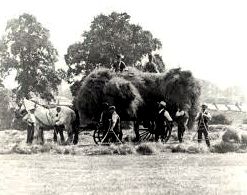
By Eugene Duggan
Source: Athenry A.D.C.’s publication – The Athenry Journal, Vol. 2, No.1, 1996
I was speaking to some people recently and I was surprised when they did not know who, or what, I was talking about, when I referred to “The Spaílpiní”.
The Spaílpíní were migratory farm workers who came from Connemara to work on the bigger and more fertile farms east of the Corrib.
Origin of the Hiring Fair
Athenry being in the centre of the most intensive tillage area in the county had the most important hiring fair. I am not sure but I would say that those hiring fairs started around the turn of the century with the break-up of the large estates and the tenant farmers becoming landowners in their own right. They came to an end in the early sixties with the introduction of mechanisation on the farm and the demise of intensive tillage farming.
The Hiring Fair
The hiring fair took place in Athenry, on Sunday after Mass, usually from about 10 o’clock until 2pm. íThe Spaílpíns stood about the Square, dressed in homespun tweed trousers, hand-knit gansies. These gansies were usually dyed a dark blue. Over this they wore a báinin of homespun flannel and their heavy leather boots were usually referred to as nail boots. In the old days back in the “20”s and 30s when most of the tillage was done with a spade, the Spaílpín provided his own spade.
In those times the Spaílpíns would number at least 100, but in the late forties and fifties the numbers gradually declined and finally petered out in the sixties. The farmer in need of a worker came to town and having sized up what was available, bargained individually with the Spaílpín until he found a suitable worker at a suitable wage. The term of hire could be for a year, a month or a week depending on the farmer’s requirements.
The period from the 1st October to about a week before Christmas saw a big increase in the numbers of both Spaílpíns and farmers attending the hiring fairs, as this period coincided with the harvesting of the potatoes and the sugar beet. The Spaílpíns came in greater numbers because of the increased demand and many came to earn some money to take home to their families for Christmas. The farmers needed more workers as the harvesting of crops was all done by hand in those days. The Spaílpíns came mostly from Carroroe, Rosmuc, Lettermore and Garumna Island. Their surnames were McDonaghs, Flahertys, Conroys, Keanes, Derrones and Kernons. They were native Irish speakers and had practically no English. I knew of a Spaílpín who lived with an English speaking family for about 20 years and still had difficulty with the language. He always referred to a man as “she” and a woman as “he”, which caused a lot of confusion between the Spaílpín and his employer. I remember as a young lad seeing a Spaílpín or two on every farm in the village during the potato and beet harvesting time and, as many of the old people had a fair bit of Irish, the area became a mini Gaeltacht for about two months.
‘Good’ Houses and ‘Bad’ Houses
The Spaílpíns had many stories about the treatment they received from various families for whom they worked. There were good houses and bad houses and I heard them say of bad houses, “You’d get nothing there only Lipton’s tea and Vaseline butter”. Lipton’s tea was the cheapest tea on the market and Vaseline butter was margarine, much frowned upon in those times. There was also a story of the woman who gave only cut potatoes to the Spaípíns for their dinner every day. These were the potatoes that got cut accidently during digging. In order to get their own back the Spaílpíns watched out for the bigger potatoes and cut them in half with the spade. Another story was told about two Spaílpíns who having to travel a long way to their place of employment reached it in the dark of night. They were called so early in the morning and returned so late from the fields in the evening that they did not know if the house was thatched or slated as it was always dark when they left and returned from work.
Fond of a Drink
Some Spaílpíns were fond of a drink and often finished up on a Sunday night with their entire weeks wages spent in the pub. The pubs most frequented by them were Joe Manion’s (now Hair by Claire), Michael Whelan’s (The Square Inn), The Shamrock Bar (Jimmy Payne) and the Central Bar (Glynn’s).The vast majority of them were hardworking men who were often shamelessly exploited by their employers.

