APH
APH
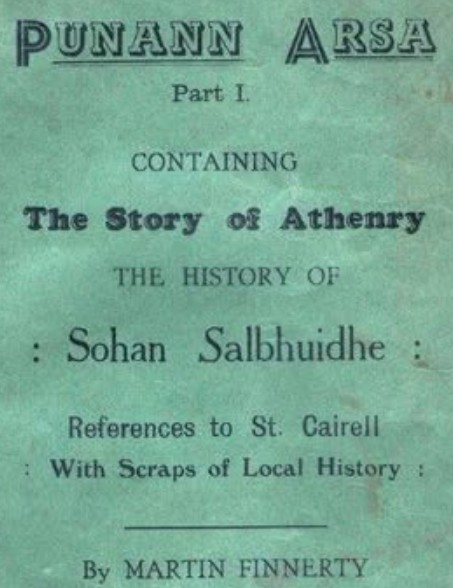
ATHENRY
_________
A LOCAL HISTORY
1850-1983
PEOPLE; EVENTS; CUSTOMS; FOLKLORE
By: Aggie Qualter
1 July, 1984
Price: 70p
If we could take a trip back in time, and visit Athenry in 1850, how would we compare it with the town of today? How was the town community then structured?
What kind of living standards were enjoyed by the people? Were there unemployment or housing problems?
You would be absolutely appalled at the sight. For a town that ranked second in Ireland in the 13th century, Athenry had reached an all-time low. The streets were narrow and unpaved. The houses of a wretched condition – many of them without windows – were built below the level of the streets. The people were condemned to a grinding poverty and deprivation, but let it be plainly understood that these conditions were enforced upon our people by a system of British Law from which they had neither power or hope of extricating themselves. If poverty was a shame or sin, then everyone was guilty. The records reveal that Athenry was no worse than any other village of its size in Ireland, and very much better than most villages in the West. Everyone was poor – that is everyone except the people who lived in the numerous Big Houses that surrounded the town. If I find it hard to describe the misery of our people, I also fail to find words to describe the splendour, grandeur and life-styles of the people known as the “Gentry”. Their houses were palatial residences, built in the best architectural designs – each surrounded by a retinue of servants. They lived in the lap of luxury and had everything and anytihng that money could buy.
The principal Gentry of the locality were:- The Lamberts of Castlelambert and Castle-Ellen; Persses of Bellville and Myode; Halls of Knockbrack; Lopdells of Raheen; Blakes of Rockfield – to mention but a few.
With the exception of four Streets, Chapel St., (now Old Church St.) North Gate St., Cross St., and Bridge St., all the others were known as Lanes. River Lane was absent as the river was not diverted until 1860 or earlier. The old thatch Church called the Mass House was at the back of Hansberry’s, or nearer the Swan Gate.
In 1850 the Dominicans were flourishing, at Esker , and Education was well provided for, which included a College, Agricultural College and also four private paying Schools for young gentlemen. The National and Parochial Schools had an attendance of 800 pupils made up of the poor class. One hundred were provided with food.
Apart from the Landed Gentry the Professional Classes were five. They included, two teachers, a Barrister (John Lopdell), M.J. Edgar (Surgeon) and a Land Agent (J. Barrett). I found strange names:- Hasty, Hickman, Gunnell, Geese and Bradish. Very old family names were: Broderick, Newell, Shaughnessy, Colemen, Hynes, Qualter, Higgins, Kilkelly, Cannon, Barrett, Cunniffe, Quinn and Kearney.
Old Church St. consisted of 49 houses with the names of Thomas Heavey and Patrick Grealy.
At Cross St. I found Michael McNamara – Great Grand Father of Christy O’Grady (Senior) and Grand Father of the late Ann Maria Mac O’Grady, also Thomas Hynes, Great Grand Father of Una Hynes.
Knock-aun-Glass Cnocan-Glas (Small Green Hill). In 1851 there were three cottiers houses. T. Kinneen, T. Whelan and P. Greally. They had 14, 9 and 5 1/2 acres. Traces of some of the ruins are on the town side of the old Pump House.
Caheroyan. Caher O Hine (Hynes’ Quarters) John O’Connor then lived in Caheroyan House with 216 acres. O’Connor Grave at the back of Catholic Church. There were also 12 free houses – all held by Squatters.
Bridge St. in 1851 consisted of six houses and two ruins. No. 1 Josech Barrett. Here are the roots of the present Barrett Family, which leaves them at least six generations in Athenry, Joseph Barrett was Great Grund Father of Christy Barrett, Caheroyan. No. 2 P. Connolly; No. 3 Nick Kane; No. 4 J. Murray; No. 5 Ruins: No. 6 Patrick Cannon. Here are my own paternal roots. Patrick Cannon was my Great Grand Father. He died in the late 1850’s and my Grand Father (Michael Cannon and Family) continued to live there. No. 7 Ruins, but formerly lived in for generations by the Moggin Family. The last Moggin, Johnny (an old man) died in the late 1840s. The Bridge was then called “Moggin’s Bridge”- an old Rustic Bridge that spanned an overflow stream of the main river – which then ran through River Lane and around the Tower to the Pound.
Burke’s Lane seven small houses. (Down by the circle of Coppingers)
McDonald’s Lane. Eight houses and one ruin. At No. 8 the famous Larkin’s Forge. A great meeting place for the young men of the time.
Madden’s Forge started by Tom Madden in the early 1870s. He moved down the road from Baun-mor, where the Madden roots and farm were for generations before, and still are. The Bridge Forge is still very successfully run by Eamon Madden – a grand son of Tom Madden.
Barrack Lane. Five families and two ruins. Three lived at River-Green, Kearns, Culkeen and Higgins and two at the back of Joe Keating’s Garage, Burke and Kelly. The Land League Forge was built on the ruins in 1880 – now John Lawless’ work shop. The five neat thatched cottages on the other side were built in the 1870’s. A great shoe-maker (Dan Kenny) lived nearest the Old Barrack. He made Riding Boots and Sports Shoes for the Gentry.
Court Lane. One house owned by John Coen in 1850.
In the early 1860’s Free Emigration Ship “The Rag a ‘Dee” sailed from Galway. Athenry, they said, was nearly cleared out – more than two hundred people left the town and surrounding town-lands. The Ship was nick-named the Ragetty-Dee – the name tells its own story.
It was a voyage into the unknown, but they believed they were heading for a Utopian Land and expected to find gold on the roads there. When they arrived, there was no one to meet or settle them. The late Michael Shaughnessy in relating the story, as he heard it said “They were the pity of all creation, huddled together – hungry and miserable, not knowing where to turn and without a penny in their pockets”. When they were hired they were sent in all directions to work with all sorts of people and the separation nearly killed them. They did not take kindly to America, but in time they worked their way back to Boston where they settled and prospered. The Irish were then on the same level as the negroes – a sad but true statement.
It was a revelation to hear the late Michael Shaughnessy relate stories of the 1870’s and 80’s:- The finest of men and women were raised here in those years. Men of the finest physiques – tall, lean and athletic; the women tall and stately with flawless complexions, and flowing tresses. Their food consisted of Indian corn bread and stir-a-bout. Rabbits were so plentiful that you could almost catch them rushing for the burrows; the country abounded with hares; the river was alive with the finest of trout and eel. American bacon at 1 1/2d a lb. No Hotel of today could turn out a meal like the stuffed rabbits laced with bacon. The humble spud and cabbage, with plenty of the cabbage juice made up the rest. The food and fuel were there for the taking but no money. If you had 10 half-pennies to jingle, you considered yourself rich. One wonders if the diet of the Athenry hard years was better body-building food than all the vitamins of to-day.
The Railway line was laid as far as Athenry in 1851. About 1870 it became a junction – improving in importance as the lines extended, till finally about 1875 the town was declared a very important Railway-junction. This gave great status to Athenry. Soon a central Post Office was established here, followed by a big R.I.C. Station. The future looked bright, but alas, the greatest tragedy in the town’s history was about to strike.
On the 1st of March 1875 a Baker named Walsh was sent home by his employer in Tuam suffering from the most deadly form of Small Pox. The disease had reached a climax. The local curate was called to administer the Last Rites. Some days later he became gravely ill and died, and so the terrible cycle of Death began.
The town’s sanitary conditions were no better than in 1850, and was a breeding-ground for disease. On the 17th of March the Death Knell sounded – eight outbreaks of Small Pox followed by six deaths. Innoculation proved useless. The plague spread like wild-fire and scarcely a house in the Town was free. May day saw the death roll over a hundred (100). Athenry was isolated and treated like a leper-colony.
Dr. Leonard appealed for a cottage Hospital. One was assigned near Loughrea, but was burned down by the people. One woman lost her husband and three children within days. Panic gripped the town – no grave diggers, no coffins. The mother herself had to bury her last child in the outer abbey.
In order to save the Community from total extinction Dr. Leonard converted the West Wing of his own home (Town House) to a Small Pox Hospital. Not large enough for all the patients, sheds were erected at the back. Beds and blankets were sent by the work house.
After more than four months he halted the plague. Hundreds who survived were disfigured. The Western Wing of the Town House was never reopened, but remained shuttered to the end. This was the saddest Chapter in Athenry’s History.
Dr. Leonard’s total dedication to a poor and oppressed people, his heroism and self-sacrafice, and above all his Christian and Spiritual force ranks him as one of the greatest of his time. He died in 1893. The Leonard Grave is at the back of the Catholic Church.
If the people of the town were sunk in the mire of poverty the tenant-farmers of the parish were even worse. Imagine their plight when out of 4 3/4 million people 4 million lived on the land. The 20 million acres of Irish land were owned by 19,000 people, and 700 men between them owned half the land of Ireland. Evictions were the order of the day, and in fact they doubled in this parish in 1878. To make matters worse England flooded the market with artificial manure, and Athenry lost the valuable sea-weed market.
In 1879 a Star of Hope was rising for Athenry and Ireland. Michael Davitt – the greatest man of the century entered the picture and came to the rescue of the Irish people. The Land League was born.
Men of the town and parish threw themselves heart and soul into the movement. After the assassination of Blake and Burke near Loughrea many of the young men of the Parish were cast into Galway Jail. They included Fenian Broderick and his brother Peter. The movement spread throughout the land like a gorse fire and could not be halted. Athenry was alive with Peelers. An American journalist (Mr. Gorge) was arrested here, because he was seen in the Abbey with the Curate, Father Mc Philpin – a supporter of the League. England did not want the outside world to know of conditions here. All his writings were confiscated by the R.I.C. This most formidable movement of the last century – the movement which broke the back of the system which crippled our people – can be closely identified with conditions which prevailed in Athenry town and parish. Why?
In 1879 when the Land League was launched the registered Land possessions of the big Landlords surrounding the town were as follows;-
Captain William Lambert, Castlelambert Mansion. 4,686 acres
Walter Peter Lambert, Castle Ellen 3,829 acres
Burton Persse of Myode and Belville 9,500 acres
Major Lopdell, Raheen House 1,365 acres
Blakes of Rockfield 986 acres
Major Hall, Knockbrack another big land owned (I failed to find acres). I also found that Robert French, Monivea had 10,121 acres.
Robert French of Monivea Castle was described as a good and progressive Landlord – not tainted by evictions.
At this time the Persses, Frenches and Lamberts were three of the most powerful families in Ireland, and I venture to state that they can be numbered amongst the seven hundred (700), who owned half the land of Ireland in 1879.
Gladstone, knowing he could not beat the ‘Land League’ won enough support to rush the Gladstone Land Act through the ‘Commons’. It was one great step forward and ended the evictions. Other Acts gave greater rights ’til finally the Wyndam Act transferred complete ownership of Lands to the people of Ireland.
Athenry started to move uphill early in the 1880’s. There were reasons for this.
- In 1881 the population was reduced to 813 – a fall of 674 people since 1851.
- Those who left were faithfully sending home the dollars, which neant much to the economy.
- The traders were able to give credit to the farmers, as the Gladstone Act gave them co-ownership of their little holdings and “The Three F.S’,” so the up-surge was on, and steadily improving
In the early 1890’s Abbey Row was built. It was formerly an old Barracks. Mat McDonagh’s, Bridge St. was also built around this time – now a combination of Kinneens and Linnanes. Before that the McDonaghs had a thriving business where the Ulster Bank stands. At one time Napton Persse lived there. It was then called “The Castle”. All carts and creels of turf passing had to throw sods into their yard as part of the Town’s customs or “tolls”.
On the opposite side of the Square Blackall and McDonagh built a big business house. It was like a modern Supermarket – a walk-through from T. Coppinger’s door to Fitzsimons’ in North Gate St. Cash-Balls were flying in all directions. It was opened in 1886. The Building Trade was booming. A new Athenry was taking shape. The houses in the town, though still under thatch were improved and renovated. The Cottages at New Fort, Kingsland and Boyhill went up at the turn of the century. Cross Street houses were complete in 1902 – the hammer stone facing on those is a monument to the craftsmanship of the Howley Brothers – Father and Uncle of Christy Howley. Caheroyan Cottages built about 1910 – the ones nearest the Arch much earlier. Presentation Convent and National Schools were up about this time.
New Houses at Bridge St. in 1911. Browne’s was then the Court Hotel. The Athenry as we know it to-day – without the surrounding estates – was recognisable in 1910. Wages at this time exceeded those of Ballinasloe by 2/6 a week, – a lot of money in those days.
In 1907 the Lambert Estate came up for division. At a meeting at Athenry, Patrick Hynes, the Fenian veteran and local builder started an agitation, and vehemently asserted that the town tenancies be included. This he said was possible. He quoted extracts from the Wyndam Act. The Town Tenants’ League came into operation and ordered to pursue a policy of militancy. The townsmen went wall knocking and cattle-driving. Stephen Jordan was arrested at Castle Ellen in May. The town tenants marched in strength through the Lambert lands and led by a Band they defied the Peelers. When the Estate was divided every town tenant – and that was nearly everyone got a parcel of land, which proved very valuable in later years.
The Town Hall was built by Dick Murphy in 1907. The I.R.B. and volunteers had it free. Volunteers carried out an intensive training course there under Liam Mellows.
A rifle-range was set up in the yard. Leaders were John Clery, Stephen Jordan, Frank Hynes, Jim Barrett, Sean Broderick and Commanding Officer Larry Lardner. Mellows was a familiar figure in the Town and cycled 10-15 miles each day building up the organisation. He stayed at Broderick’s. In order to avoid harrasement by the Peelers he stayed at Frank Hynes’s from 1915, as he had easy and secret access to the back yard through Leonard’s avenue.
Easter-week 1916: Athenry was the centre of insurgent communication, since it was the Headquarters of Mellows. The position was unclear after McNeill countermanded. Larry Lardner with 500 men took the Agricultural College. He was joined by Mellows and his companies from Kinvara, Kilcolgan, Killeeneen and Craughwell. Gort was told to stand until joined by other companies from the South. They were unaware that only Dublin and Wexford were making an effective stand. Mellows with his men – about 700 – marched through Rockmore, and, turning right, across a field track reached Myode Castle – the Strong Hold of the Persse family, who were then in England. They were joined by companies from Castlegar, Tuan, Dunnore. Members of Cumman-na-mBan joined the volunteers at Myode to perform the duties of cooking, washing and all house-hold chores. The Rebels remained in Myode ’till Friday, when Fr. Tom Fahy came, and reported that the Rising had reached a downward path. Dublin was in flames: the leaders arrested. He strongly advised them to disband.
About 150 retreated to Limepark. Hundreds were interned in concentration camps. Twelve were positively identified by a man at Myode, and condemned to Wormwood Scrubs Prison. Known as the twelve Apostles they were:- Thomas Barrett and Charlie White of Caheroyan; Grady Brothers, Church St; Martin Handsberry, Rahard; Peter Murray, Derrydonnell; Michael Higgins, Castlelambert; Patch and Thomas Kennedy, Sliab Rua; Jack Hanniffy, Tallyhoe; Murty Fahy, Sliabh Rua and Michael Donohue. All were in prison until the General Amnesty in 1917 when England desperately needed to take the heat out of the Irish question.
From Limepark Mellows and Frank Hynes (Athenry) headed for the Aughty Mts. Hunted by Peelers (a price on the head of Mellows) they lost their way, met a man named Maloney searching for a colt, who brought them to the safest hide-out in Ireland – a bothy amongst the heather. They were given dry clothes, plenty of blankets, dry straw and food. They remained in the bothy for almost five months. Father Crowe (near Ennis) arranged the escape of Mellows.
He got then to his home from Balloughtra Bothan, where Mellows was disguised as a nun, and accompanied by Miss Barry from Gort – also a nun disguised. They were taken to Rochestown House Priory outside Cork city. He finally escaped on the “Harry Herbert” captained by Capt. Murray, and landed in America in Mid-December. Mellows took the anti-treaty side, defended the Four Courts with O’Connor, was arrested and shot as a reprisal on the 8th December, 1922. A fine bronze bust of Mellows is erected on the grounds of the Boys’ National School to remind the future generations of the part this great man played in the struggle for Irish Independence. The big ACOT College is named “Mellows College”
Extract to his Mother written before his execution:- “I had hoped some day I might rest in some quiet spot, but if it is to be the prison clay it is all the sweeter, for many of our best lie there”. Athenry’s long association with Mellows gives the town a special place in Modern Irish History.
Athenry was split in two politically during the Civil War and still is. So many decent people stand on either side of the political divide. I say “good luck to them all”. The town had two T.D.’s in the 30’s – Sean Broderick, F.G. and Stephen Jordan F.F. They always remained the best of friends and neighbours.
I can vividly recall what life was like in Athenry seventy odd years ago. From a social, economic and educational viewpoint the entire structure of society has changed dranitically. Those born into the modern, and affluent life can never understand the hardships endured by our people in the past. In those far oft days the town was almost completely under thatch, the half-door being the common feature of almost every house. Trunk roads were unheard of. Streets were rough and pot-holed, and dimly lit – the better off shopkeepers had outside parrafin lamps in protective glass cases.
The turn-wheel pump outside the old barracks and the Spa well at Leonard’s park, Abbey Row provided the town water supply – no piped water, no sewer system. Drawing water from pump and well was a constant and arduous job.
Work was scarce, the little of it available was slavery, long hours, meagre wages, no houses – one room one family was the common pattern of life. The families raised in these rooms and tenements were a credit to Athenry and Ireland at home and abroad. Domestic servants worked hard at 2/6 a week. Padraig Kenny the stone-breaker hammered away at Madden’s Bridge from morning ’till night at seven shillings a week. He lived at River Lane. The heel of colonialism pressed heavily; the badge of oppression was visible in Town and country. Emigration was the safe release for the youth.
Turf, the black gold of to-day, was plentiful. Haukers were constantly on the streets at 1/9 an ass-box. Ass-and-carts were anchored to every post and rail in the town.
As children we were as free as air to play and romp on the Streets and fields – no traffic, only a few bikes. Our usual pastime on Sundays was sitting on the Cross watching the “Gentry” arrive for Service in the Protestant Church. They came in carriages, horse-back and rubber-tyred traps – their liveried footmen helping them to alight, – the ladies in their beautiful clothes, feathered hats and veiled faces. All the trimmings and trappings of “Up Stairs, Down Stairs” came to life at Athenry Square on Sundays. A smaller Presbyterian Church was at Minister Burkett’s lawn, River Dale House and there one had a similar display of grandeur, but by lesser numbers.
Many of the old names have disappeared. The ones which come to mind – Matt Daly’s opposite the old Barrack; Johnny Kelly’s now the Square Inn, Mahon’s now Torpeys. Pat McDonagh’s Business complete stretched from Court Lane to the Church Wall linking Bridge St. and the Square. The business names which have survived and prospered are Hessions, Corbetts, Higgins, Ruanes, Glynns, Sweeneys and O’Neills.
In those far-off years times were hard, money was scarce, but there were many compensations for the lack of to-day’s luxuries – the dances at the cross-roads and ball-alley; in winter the kitchen dances and at the country barns, as grown-ups we headed off on “shanks-mare” to enjoy the best of music, and all for nothing.
A great spirit prevailed amongst the people – a feeling of “togetherness”, caring and sharing. No one was lonely or isolated, each person was the concern of all. Happiness the most important ingredient of life was there in abundance, – something which the affluence and prosperity of to-day has failed to provide. The best things in life are free and I say with truth that those were the “Good Old Days”.
Through the decades Athenry had the “ups and downs”; the economic war years of the 30’s; the war years of the 40’s with its after-effects running into the 50’s; the golden years of the 60’s and 70’s.
To-day it ranks as one of the best in the West – a smiling, progressive, prosperous, expanding town with all modern amenities. The business people enjoy a great degree of wealth.
Education at National and Secondary level is well provided for. Two big centres, Presentation College and Vocational School, and also an Agricultural Training School.
The town has many sources of employment – ACOT Research College, Cattle Mart (one of the best in Ireland), Creamery Co-Op. and the Engineering Byrne-Mech Factory, C.I.E. also absorbs many workers.
Community Council has achieved a marvellous degree of success for the parish.
- Community Hall purchased, enlarged and installed with central heating.
- A parcel of land of 5 1/2acres (to be developed later) at the end of Bridge St.
- Outdoor Sports complex at Raheen consisting of four pitches and two Tarmacadam Tennis Courts. It also includes a heated Club House, Function Room, Dressing-Rooms and Showers. Raheen costing £120,000 is the biggest project ever undertaken in Athenry, and will be officially opened in August.
All the above mentioned are owned by the parish community. This is a great tribute to the co-operation and support of the people. Everyone must admit, that in order to serve the needs of a rapidly expanding population, the Raheen project is the way forward. The Community Council deserve and expect further financial support to pay off the remaining debt.
To-day throughout the parish the fruits of Davitt’s dream “The Land for the People” is evident on all sides. One sees the well-kept fertile fields decked with herds of pure-bred cattle and sheep, and everywhere picturesque, well laid out rural dwellings.
Athenry in the heart of the best lime-stone land, and surrounded by such a prosperous rural community can never fail to thrive. The soil is the gold of Ireland. The workers on the land will always hold the Life-Line of the Nation.
HISTORICAL SOCIETY
We had a most enjoyable evening last July, when a large crowd accompanied Professor Wrenn on a Lecture Tour of the Athenry Mediaeval Ruins, which will always be the great attraction to the tourist and the stranger. A great past is visible through the Abbey Ruins. As I listened to Professor Wrenn, and viewed the impressive, towering tombs of the De Berminghans’ and Clanrickards, I could not help thinking, that all those great Norman Lords left nothing but a trail of misery to the people of Ireland. It was easy achieve power, fame and wealth at the expense of others, but Death is the great leveller. – “The paths of glory lead but to the grave”.
All around us were the simple grave-slabs of our own -Lardners, Kellys, Morrisseys, Hanlys and, in the outer Abbey, hundreds of nameless graves. It was those who peopled this town and parish in generations gone by – good, righteous, Christian people who knew no wrong, but who suffered great hardships in their time. Their bones are cradled in this old Abbey; their roots have spread to the farthest ends of the Earth; they have left their imprint on the five vast continents and laid the solid foundation stones of the great Irish Catholic Ethos. I could not attempt to write Local History without remembering them. They were the greats of this parish, and with all the people of their time made up the ‘Greats’ of Ireland. THEIR KIND WILL NOT PASS THIS WAY AGAIN.
DRAMA
Athenry always had an abundance of stage talent. My earliest recollections are of Stephen Jordan, Bridgie Hegarty and Willie Kennedy.
The “Greats” of my own time, and especially those no longer with us are foremost in my mind:- the producer Tommy Reilly (tragically killed at the Arch); Mike Fahy; Jack Cunniffe; Mick Kilkelly; Detta Fahy (who died so young) Noel O’Grady and in later years our lovable curate Fr. Langan. I must also mention that great character-actor who died more than forty years ago – Tom McHugh.
Happily we still have with us Kitty Lardner, Joan Murphy, Christy Howley, Winnie Kennedy, Michael Hession and the talented duo Criss Kearns and Rosemary Kennedy – the latter is building up a name in London with her stage productions.
How we looked forward to the colourful Christmas musicals produced by Joe Mahon (who died last year – a young man) and his wife Joesie Curran! Can Athenry ever forget those gifted people for all the happiness they brought to our lives? Never!
There’s plenty of stage-talent still – it runs in the blood. In 1981 and ’82 Eileen Donohue and Ruth Dobbin gave us Christmas Shows as good as was ever seen – with all the young people participating. Family commitments did not allow them to continue. What a pity!
Folk-Lore Cruckan-Cabair (Hill of Help) on the Eastern End of town was the centre of Fairy Lore. People swore they heard the fairies sing and make music there. They went to the hill and requested favours of the fairies and they said they were granted.
Jack-the-Lantern’s Tree Four trees in one. In Leonard’s Lawn below the bridge. The light could plainly be seen on dark nights.
Big Hound with square face and long ears seen many times guarding the Old Court and retreating to a tunnel under the Castle.
Death Coach heard in dead of night passing through the town. It was never seen or heard since the advent of Electric Light.
CUSTOMS
May Bush hung over every door on May Eve. A great night for Cross-Roads dancing around the May-pole. The tradition of May Bush still continued by a few senior citizens.
Bon Fire Night A great festive occasion – a night of dancing, music and mirth.
Bonfires blazed in town and country. Returning from the Annual Novena on that glorious mid-summer night of last year, I thought of the great bonfire nights I knew.
“Its Bonfire night in Ireland, O God don’t the years go fast;
And here I stand, the lonesome one, all dreaming in the past;
My long life’s toil has ended, the stars come out above;
But they’re not like the stars of old, those twinkling ones I loved;
And neither is this burning night like that of long ago;
Then ’round the auld bonfire we danced down the road to Abbey Row.”
Easter Sunday In my Father’s time the young people were up before sunrise to watch the sun dance. The towers on the four corners of the town were taken over by the cheering youngsters. They adorned themselves with the first flowers of Spring, and joining hands they danced with joy. This I believe was of pagan origin – a form of worship to the Sun God – and was replaced by the Faith in the Risen Christ.
HISTORICAL ITEMS
De Wetts Immortal Sport Stars of 80 years ago. Their achievements on the playing field brought fame and glory to Athenry. They will soon, I understand be given their place on “Roll Call of Fame” in the G.A.A. History Book. They named their team “De Wetts” to honour the hundreds of Connaught men, who fought under General De Wett against the British in the South African Boer Var.
Boer War Mick Good – a great fisherman, and the late Michael Tierney of Caheroyan fought with De Wett. John McBride – Father of Sean McBride – recruited hundreds of Irishmen, and went out to fight with De Wett.
Peter Barrett of Castlelambert figured in the most sensational trial of the last century. Charged with the attempted murder of the Landlord Lambert, he faced trial three times. The pulse of the nation stood still with emotion, as they awaited the final verdict. Every Irish heart – at home and abroad – beat for the cause of Barrett. He was found ‘Not Guilty’, Barrett was defended by Isaac Butt, who for his legal strategy and oratory was described as the “Law Wizard”. He broke down the greatest Counsellors of the Crown. For his defence of Barrett he was conferred with a ‘Knight-Hood’. The year was 1869.
Johnny Kelly a man famous in many ways – a man of great philosophy. He was involved in the G.A.A. in the last century. He could compose a ballad in five minutes. A wonderful story-teller; a great counsellor. My father referred to him as a man of “great lore”. He lived at Whelan’s, The Square.
Julia Mary Morrissy would have married Liam Mellows had he lived, – so her closest friends said. She was a great pianist. She lived in and owned Jimmy Nolan’s Shop.
An Old Prophecy “Athenry was, Galway is, but Aran will yet be the best of the three”. Aran is free from pollution and contamination of the outside world. An island people of simple faith, who hold dear the old values, retain the Irish culture and the soul of the Gael.
When Athenry ranked 2nd in Ireland, Galway was but a small fishing village – Claddagh.
A Coal-Mine was opened at Castlelambert in 1875-76, and a quantity of good coal found. Soon discontinued – trouble over evictions. Proprietor Lambert intended to re-open it.
Old School at Ball-Alley in 1875 had 55 boys and 35 girls. Last lay Principal teacher in girls’ school was Mrs. Dolan. She lived beside the Ball-Alley – now Whelan’s. She had three beautiful daughters – tall, stately and handsome – Minnie, Annie and Aggie – all raised in the 1880’s.
Chaly-Beate Spring. This was mentioned in documents of the 1860’s, 70’s and 80’s. After exhaustive enquiries I found it on an old map only 20 yards from Abbey Row. When I was a child it was called the Spa. A Chaly-Beate Spring is impregnated with minerals particularly Iron. What a pity it is lost to the people!
Rita Persse the great heiress of Belville was married in the Protestant Church about 1910. Her husband was Mr. Keery Bernard, Millionaire. It was the sight of the century. The red carpet stretched out to the Square. The town could hardly hold all the carriages. All the Gentry of Ireland were there. Two members of the British Royal House were present.
Lady Gregory was a Persse of Roxborough Mansion.
Doctor Burkett acknowledged as the greatest Medical Scientist in Europe and Africa is grandson of Dr. Minister Burkett, who lived in Riverdale House until the early 1920’s (Presbyterian Minister).
Professor Margaret Heavey One of the greatest scholars in the British Isles. She mastered many languages:- English, Irish, German, French, Italian, Spanish, Hebrew, Latin and Greek. She was equally brilliant at Mathematics and had complete command of the six books of Euclid at 15 years. Born and raised at Old Church St., she was Professor of Ancient Classics at U.C.G. for many years. She died in 1980.
Padraic Fallon poet and playwright of National and International fame, was born and raised at Old Church St. Son of John Fallon – a great athlete – and nephew of Paddy Fallon a member of the famous “De Wetts”.
Michael Whelan born at the Square, where his mother still lives, he has reached the pinnacle of fame in the Business World. A Barrister by profession, he also holds a Master of Science Degree, and becane Assistant Head of Board Failte at a very early age. After a serious accident he bounced back to become Chief Executive of Aran Energy.
James Ruane installed an Electric Plant in the very early 1920’s which gave light to Streets, Houses and Church. This was a great uplift to the town. James Ruane was a man of great vision, enterprise and initiative – a man before his time.
Michael Shaughnessy in his own simple humble way was one of the most intelligent men I ever knew. Listening to him telling stories was like seeing the past on a television screen. The man never knew his gifts. 120 years of authentic local history was lost by not recording his stories.
Anthony Blyth of Rockfield (now Lord Blyth) crossed the Atlantic with four others in 1952. They sailed from Galway in the ‘Rising’ – a boat specially built in Galway for the occasion. Excitement ran high. There were thousands there to see them off. After 28 days they reached Porto Rico, on to Haiti, Dominican Republic, Cuba, Miami and finally reached New York. This was a daring and dangerous adventure demanding a lot of courage. Their bravery captivated the imagination and admiration of the World.
Kingsland: Legend has it that King Felim O’Connor was slain there at the Battle of Athenry, hence the name. Legend also said that De Bermingham prayed at “Lady’s Well” for victory. Both statements tie with logic. Heights of Kingsland and Rahard were of great strategic importance. The Old Road passed at the back of Madden’s Forge, crossing at Clery’s field to Madden’s hills. It crossed to Kingsland at second turn to Lady’s Well.
Wishing Stone at Kingsland on roadside. “To sit and wish and your dream came true”, A great custom when I was young, and for generations.
The Mill opened by Robert Irvine in 1866. Samuel Taylor of the big land owners, Castle-Taylor bought the mill about 1890 – the last family to run it. Sam Taylor a J.P., Taylors were a protestant family. Eldest son Herbert became a convert at marriage. There is also a four generation Catholic Branch who gave two members to the Church in recent decades – Father Taylor (Maynooth) and Sr. Stanislaus. (Presentation Nun).
Mr. George the man arrested in Athenry during the Land League was the celebrated author of ‘Progress and Poverty’. Extract from his report – “As a result of British Rule in freland, I saw sad and horrific sights everywhere I travelled”.
Parnell of course took the Land League platform with Davitt.
Protestant Church built in 1828. Catholic Church built in 1852.
Major Lopdell lived in the Town House before Raheen House was built. He was killed at the Railway Station – falling between train and platform.
Miss Lopdell married Chichester-Clarke in Northern Ireland. Their son was premier for a short time. He was overthrown by the Unionists because he was a “moderate”.
A Boy of 17 fell from the top of the Ball-Alley in the 1880’s and escaped with a few scratches. The fall was broken by a tree or bush growing out of the wall in the inside Abbey.
Edward Carson Son of Isabella Lambert of Castle Ellen. He spent much time there as a lad and, as a student in Trinity, came there on holidays. He loved the place. My Father, who knew him during the course of his duties, said “Ned Carson was a decent chap – a man of the people, different entirely to the rest of his Breed”. However decent he was, Edward Carson – more than any other – was responsible for the partition of our Country. Whether he intended it to be permanent is another question which I would love to hear a well-informed person answer.
Bogs reclaimed in 1954 and the great industry Bord na Mona started at Attymon and Cloonkeen. A source of great employment for the people of the parish.
Major Hall’s Daughter, Knockbrack married Sir Norman Stronge of Tynan Abbey, Co. Armagh. He and his son were victims of assassination in recent years. Sir Norman was “Speaker” of Stormount.
Calendar of F.J. Finnerty, The Arch, 1895: Big Horse Fairs, Feb. 8th; May 23rd; Aug.17th; Nov 30th.
Inland Postage Rates: Letters not exceeding 4 ozs. 1d and, above that weight, 1d for every additional 2 ozs.
Parcel Post was as follows; 11b. 3d; 1d per 1b. up to 9 1bs; Up to 11 1bs. 1s
Reader it may interest you to know that the total emigration figure for Co. Galway alone, going back from March 1911 to March 1861 was 227,666.
Teacher Athenry had the best teacher in Ireland – or so they said. He turned out great scholars. He educated then on the basis of the 3 R’s. They were all well versed in Latin Roots. He was Mr. O’Reilly, father of Tom and Essie O’Reilly, Old Church St. He was here in 1869.
River Lane When the river was diverted in 1860 people squatted in the eyes of Bridge, and six families erected make-shift houses in the Lane. As no one owned the River-bed they could not be evicted.
Mag Dilleen died in Old River Lane in early century. Mag came from a good family, but she had a hard life – the times were against her – Padraig Fallon has written a poem “The Funeral of Mag Dilleen”.
Old Mike Martin A blind man also lived there. He travelled on ass and cart selling cockles and muscles. The ass acted as guide-dog, and never made a mistake.
Small-Pox “When the disease was raging in Athenry two large families (victims of eviction) lived in the eyes of Madden’s Bridge. Although every house in River Lane had the small-pox; – neither of these families caught the plague. According to Dr. Leonard it was because they had so much contact with cattle. Medical opinion of today may dispute this statement, but this is as I heard it.
Shaughnessy Family reached great Academic Heights in America – so I read on a Boston paper more than forty years ago. Mentioned as the sons of Johnny Shaughnessy, who emigrated from the village of Athenry in the 1880’s one was a famous Attorney; another a University Lecturer; a third (another Lawyer) was Mayor of Waltham, while the fourth son was then the highest Ranking Officer in the American Navy.
Kinneens and Brownes opened two big grocery stores at Bridge Street – one on either side-about forty-five years ago, which resulted in it becoming one of the most important Business streets in the town. Post Office was moved to Bridge St. less than thirty years ago.
Late Dick Morrissey was star in the All Ireland Final, when Galway won in 1923. He married into the Clasby home in Kingsland.
P.J. Molloy Another All-Ireland Star when Galway won in 1980 – a native of the parish and married to an Athenry girl, Pauline Loughnane.
Titanic sunk on maiden voyage April 14th, 1912 – the greatest peacetime sea tragedy in history. Andy Keane, a popular young lad of Tobberua, perished.
Castles Three of the Most beautiful castles in Ireland at the height of their glory were Monivea, Myode and Dunsandle – all only five miles from Athenry.
Robert French is buried in the Mausoleum in Monivea Wood. It would now cost more than ₤100,000 to build. A visit to the Mausoleum is worthwhile. One can also enter the vaults by a winding stairs. Robert French was envoy to Russia at the height of the Tzarist power.
Knockan Glas House: The parish visiting house for generations. Set dancing, cards and story-telling. Ned (the father) had a wonderful memory. Pat Brody and his Clare fairy stories, but the Queen of all stories was Bridgie Clasby. She died in 1977. The old Madden home now vacant stands like a Sentinel guarding the great characters of the past – a landmark in local history as the “Home of the thousand welcomes”.
Derrydonnell: When Red Hugh O’Donnell sacked the town in 1598 he pitched camp at an oak wood there. The name is derived from Darra Donnell, – Darra meaning oak in Gaelic.
Lady’s Well: A famous Marian Shrine for more than seven centuries. One of the Holiest places in Ireland.
Oldest Pub in Town was Kelly’s – opposite Fitzsimmons’ (on corner). At one time it was owned by Carberrys, relatives of Kellys, The Square. Mr. Kelly the last owner was American born – his father left Athenry on the famous “Rag-a-Dee”.
Dr. Brennan’s House, Raheen was built by Dr. Monsell (a private Doctor.). When he left it was bought by the Church of Ireland. Minister Roe was the next tenant, followed by his son – another Protestant Minister.
Christy Howley: During World War II when no toys were available, Christy flooded the market with the best of wooden toys of every shape and make. A man of great crentivity, he became the Parish Santa Claus.
Parnell: When he visited Galway in the 1880’s hundreds walked and jogged there to see the “uncrowned King”. They knew every field-track, stile and short-cut. It seems they were all marathon runners in those days.
Drisheen: A good and delicious meal in by-gone times. Sheep’s blood mixed with some oatmeal, chopped onion, chopped suet, parsley and a little herbs. Tie in clean floured muslin bag – leaving room for expansion. Plunge into salted boiling water. Boil for fifteen minutes and simmer for ¾ hour. Drain by hanging bag. Flavour with salt and pepper while mixing. I believe that Drisheen was never heard of for at least two generations.
Watly’s School – one of the old Hedge Schools, was at Court Lane – somewhere near Mio Dempsey’s Slaughter House. It was probably at the end of Coen’s garden, as the teacher – a great scholar – was named Coen. He was Uncle of the late Thomas Coen.
After the Treaty when the British Garrison handed over Renmore Barracks to the Irish Army, the Commanding Officer was Sean Broderick, later a T.D.
Momny Healy’s Shop was on the site of Mio Dempsey’s Stall. A big, friendly, buxom woman she offered a varied choice of the following for one half penny. Bars of: – Fry’s Chocolate, Peggy’s Leg, Sugar-Candy, Butter-Scotch, Liquorice-Ball or a bag of can-sweets. Weren’t the times great only we hadn’t the half-penny! If one of six or seven was lucky enough to have the “make” we all invaded Mommy’s for a “lick”.
Robert Irvine established Athenry as a market town. Before that the markets were held in Monivea through the influence of the Frenches.
Fred White on his maternal side comes from a very old Athenry Family. His mother was Biddy McNamara- daughter of Michael McNamara (Cross St., 1850). Michael McNamara was married to Biddy Cannon – my father’s Aunt, and the woman who reared him. Fred White’s father came to Blackall McDonagh’s Tailoring Department as a “Cutter”.
Quinns, Caheroyan a very old family. James Quinn married Kate Madden – sister of Edward Madden, Knockan-Glas.
Tom Clery, Abbey Row – a very well-read and knowledgeable man. He died the day the late Brendan Higgins was married. His death caused me great grief. Behind a very arrogant appearance I discovered a man of great feeling and understanding. He married a member of a very old Athenry family “Coppinger”. Thomas Cleary was a man with a “great presence”.
Light: Before the invention of candies or oil-lamps, bog-rush tapers were soaked in Tallow fat and Left to dry. Hung on a devised wall-clip they provided light.
Tom Raftery born and raised in this parish (Coshla) was elected to the European Parliament in June. The fact that he polled 42,000 – 43,000 first preference votes speaks for his popularity. He joined a political party only two weeks before the election. He holds a M.Sc. Degree and was appointed Professor of Dairy Science at the age of thirty. He master-minded the “Fota Project”. A self-effacing man, we wish him luck and success in Europe.
About eighty years ago the occupier of Manning’s Bar was a man naned Martin Headd. He was married to a very beautiful woman, Mary Fahy – Aunt of Kitty Fahy.
Population Figures For Athenry From 1841 – 1901
| Year | Population |
| 1841 | 1236 |
| 1851 | 1487 |
| 1861 | 1283 |
| 1871 | ? (I failed to find) |
| 1881 | 813 |
| 1891 | 774 |
| 1901 | 694 |
A population figure for Athenry town for 1981 I find very hard to accept (1479) – 8 1ess than in 1851. It was given to me by the Library Assistant
|
Grocery Basket |
||||
| 1955 Prices – September | Same Basket June 1983 | |||
| 1 lb. Best Tea | 4/- | = 48D | 1 lb. Best Tea | (Illegible) |
| 1 lb. Butter | 3/9 | = 45D | 1 lb. Butter | 0.94 |
| 1lb. Rashers | 4/- | = 48D | 1lb. Rashers | 1.73 |
| 4 lbs. Sugar | 2/4 | = 28D | 4 lbs. Sugar | 1.30 |
| 1 lb. Marmalade | 1/6 | = 18D | 1 lb. Marmalade | 0.58 |
| 20 Cigarettes | 2/4 | = 28D | 20 Cigarettes
(Players) |
1.44 |
| 2 Loaves | 1/6 | = 18D | 2 Loaves | 0.81 |
| 1 Soda Cake | 0/10 | = 10D | 1 Soda Cake | 0.12 |
| ½lb.Sausages | 1/3 | = 15D | ½ lb. Sausages | 0.44 |
| 1 Tin Fruit | 1/5 | = 17D | 1 Tin Fruit | 0.55 |
| Cornflakes | 1/- | = 12D | Cornflakes | 0.90 |
| Swiss Roll | 2/- | = 24D | Swiss Roll | 0.66 |
| Brack | 0/6 | = 6D | Brack | 0.53 |
| 1 lb. Soap | 1/2 | = 14D | 1 lb. Soap | 0.65 |
| ½ St. Flour | 2/8 | = 32D | ½ St. Flour | 0.85 |
| ½ St. Potatoes | 1/3 | = 15D | ½ St. Potatoes | 1.25 |
| 1 lb. Fruit | 1/5 | = 15D | 1 lb. Fruit | 0.60 |
| 393D | ₤15.73 | |||
393 old pence = £1. 64 1955 Price
To-day’s Price €15.73
393 old pence converted to Dec. Currency = £1. 64
Ballad Written by Johnny Kelly, 1894
On Monday morning early, Murt Cannon and Mat Daly,
Jo Sweeney and MacInery, myself and Patsy Mac,
went down to Johnny Grady, who drives the gentle lady,
To take us to the Races on his Yellow painted Hack,
Chorus
Oh! me dandy hack is on the track,
Napoleon he’s a pacer,
Oh! me dandy hack is on the track,
Napoleon he’s a pacer.
………………………………………………………………………………
Mary Lavin – Athenry has a special claim to this famous Authoress, as she is the daughter of the late Nora Mahon (Mahon & Sons, Cross St., now Torpeys).
She spent her childhood years in Athenry with her grand-parents, and attended Presentation Schools. She ranks as one of Irelands top Authors.
Charlie White removed the Crown from the Police Barrack in the early century. Michael Shaughnessy distracted the police by pumping the water with terrific noise. Charlie was the town’s dare-devil and knew no fear. He also played a part in stealing the police horse in 1908.
All Ireland Prize-Winning Ballad for 1983
Composed by Tony Waldron, Kingsland.
“The Fields of Athenry”
1.
Down by the Claran’s mossy banks one evening I did stray.
To while away those leisure hours before the close of day.
When my mind began to wander back to days long gone by,
When I roamed as free as gac th na siogh o’er the Fields of Athenry.
2.
Oh! how often with our dogs and sticks before the break of day,
Bare footed o’er the dew clad grass we carelessly did stray,
To hunt the rabitt und the hare ’till the moon rose in the sky,
Oh! these were the happy days we spent round the Fields of Athenry.
3.
We had some famous hunting dogs, I’ll mention but a few,
We had Speed and Spot and Rebel Brave we had noble Murty too,
But Brute he was the king of all as o’er the sod he’d fly,
And ’twas woe betide the hare that strayed round the Fields of Athenry
4.
The hunting done by the bright new moon our homeward track we’d make
Across the bogs to Poll Mhic Eoin by Cahertubber Lake,
And then we’d climb up Cruckan-Ceabair the lights of home to spy,
and hear the curlew’s plaintive call o’er the Fields of Athenry.
5.
Now Crucan-Ceabair that fairy hill, it is no longer there,
The gravel-trucks have hauled it off to Galway City fair,
To make concrete for foundations, and the fairies had to fly,
Before the diggers and bulldozers in the Fields of Athenry.
6.
All through the long hot Summer days through these green fields we’d stray,
The youthful blood coursed in our veins and death seemed far away,
We thought we were immortal, that it’s just the old that die,
And now there’s few of the friends I knew ’round the Fields of Athenry.
7.
When the Great Good Lord will come for me and my final peace be made,
On that hallowed hill above the town it’s there I will be laid,
But when the final judgement comes with its fanfare from the sky,
I will rise up then and hunt again through the Fields of Athenry.
_________________________________________
At the All Ireland Festival, this Ballad was sung, to his own composition by Sean Flanagan, Craughwell. Sean is the famous Traditional Irish musician, and Ballad Singer.