APH
APH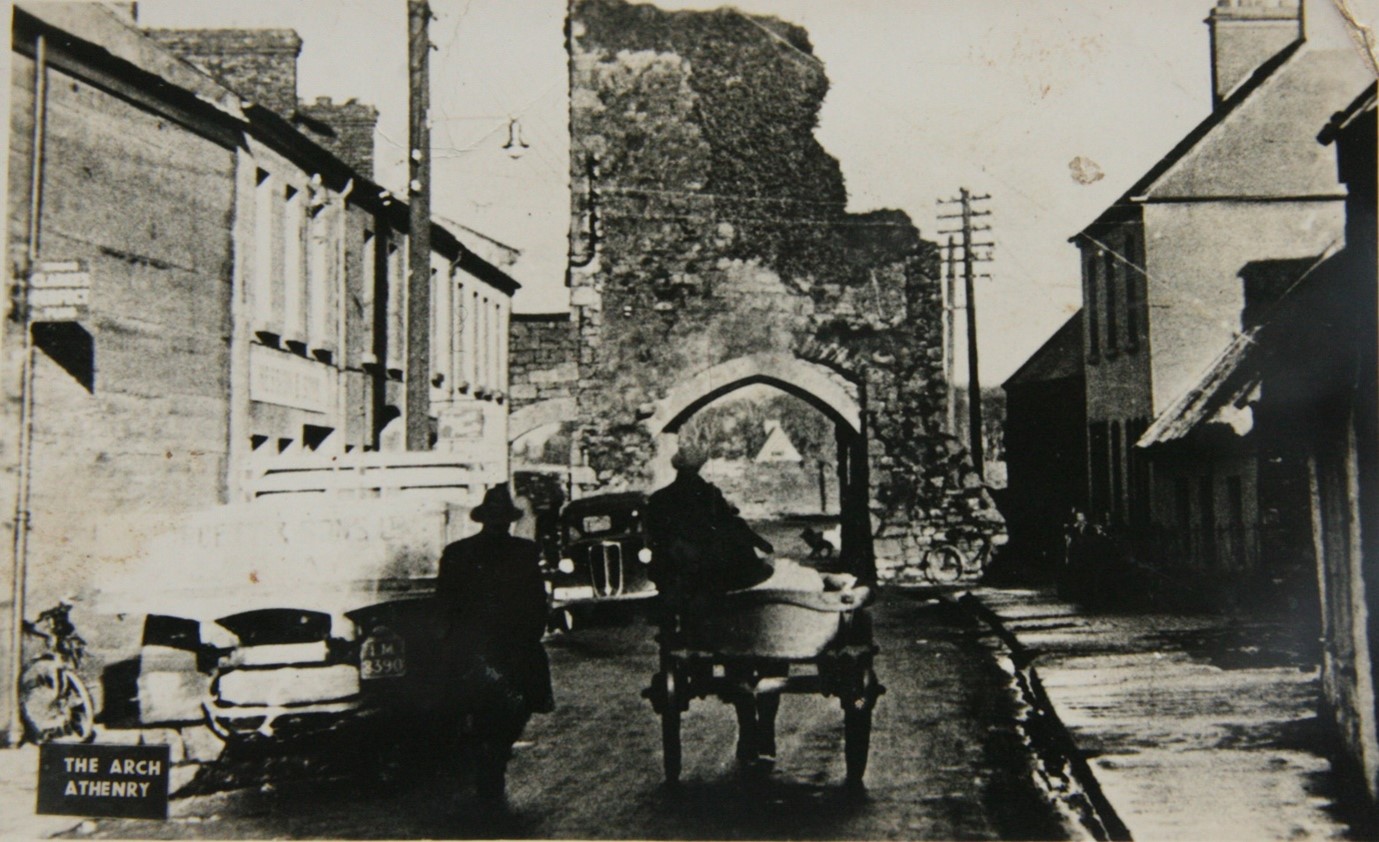
CHAPTERS OF FACT AND COMMENT ON A GREAT CAMPAIGN
BY T.J.K.
I
THE TOWN
Source: Connacht Tribune, Saturday, November 13, 1909
The Town of the Kings is a town of great fights. In whatever, respect it has changed, it has never changed in this. Six centuries ago a bloody contest was waged there. A contest bloodless, but none the less powerful, is going on within the silent old walls of the tumbled-down town today.
When Athenry returned its two members to the Irish Parliament, 12,300 people lived in comfort and ease within the ancient borough boundary. A teeming agricultural population subsisted round about. Today the glory of the past is faded. The borough walls crumble and drop away. King John’s Castle stands deserted. The people have fled to foreign lands. Athenry of the Kings can only boast of nine hundred and eleven people, who live from hand to mouth, and but a very small minority of whom have any permanent or substantial form of livelihood. There are thirty-eight business houses in the town. Thirty-six of these are licenced premises. Industries there were, in the past, but these have one by one disappeared, and with them the population of stalwart workers they maintained. A magnificent tannery existed in Athenry not so long ago. It has gone, so have other means of employment, until about the last industry that remains in the town is the grimly appropriate one of carving tombstones. What a change!
In the twelfth and thirteenth centuries King John’s Castle resounded with the clatter of the arms of chivalrous chieftains, and the town was thronged with their retainers. For in olden times St. John’s Castle was a mighty military stronghold, around which thirteen watch-towers overlook an agricultural prospect thus could scarcely be excelled in any part of the world. But a few of these towers remain-ironical standards of a day that is gone, and silent tombstones of a people that have been driven to foreign lands, or to the no Iess pleasant alternative of poverty and destitution.
Tradition has it that at one time, by a simple expedient, the river which still flows past the Castle could be so diverted as to form a complete belt of waler about the town. The Castle is said to have been built by de Bermingham about 1211, and it is related that over 100 years afterwards a bloody conflict took place within the grounds, when William de Burgo, an ancestor of the Marguis of Clanricarde, met Phelimy O’Connor, King of Connaught, and as a result of his victory over him became Baron of Athenry, 8,000 of O’Connor’s followers were slain, and an incident of the battle shows that the traders of Athenry were then as valorous in fighting for their rights as they are today. Hussey-a butcher from the town, performed a somewhat remarkable feat-so history relates-slaying O’Kelly and his squire together.
One cannot visit Athenry without thinking sadly of the past. But what of the present? It is today a quaint old town with a past-time air that must arrest the attention and arouse the interest of the most casual visitor. The streets are narrow, the houses, small but neat. Here and there the modern premises of enterprising merchants peer out with a look of inquiry as if they had landed from afar and wondered where they had got to. In the centre of the town is the old obelisk, where farmers clinched their bargains in happier times, ere the graziers’ cattle possessed their fields. The old North Gate, with its mullioned arches and stout ramparts, is still there, and the streets, which seem to all run in angles, and generally lead one back to the starting point, impress on the visitor the belief that this town of the Kings was once a centre of considerable importance.
In 1851, when the railway line was laid past Athenry, the population was about 3,000. The town cannot to-day muster 1,000 souls. From twelve thousand down to three thousand, and from three thousand down year after year to nine hundred and eleven. From a town of industry and commerce down to a town without an industry and without employment, and the saddest of all, without people! From a country round about ”where every rood maintained its man,’’ down to a vast treeless prairie, where nought but the beasts of the field live and thrive!
Though Athenry in situated in she midst of what was once at least a great seat of agriculture, and is an important centre, as Western towns go, it is without any modern system of lighting. At night the darkness that has been gathered about the place by that , spirit of landlordism that broods over it, hangs like a pall around its muddied streets. Oil lamps give yellow gleams from tie shop windows, and were it not far the buoyant hearts and high spirits of a courageous people who have withstood all persecution, Athenry of the Kings would be a dull place indeed.
Some time ago a Mr. Cave, from London, placed before the people an offer for the lighting of the town by electricity. He was prepared to expend ₤1,000 in a system of overhead lighting if he were guaranteed ₤40 a year from the residents; but owing to some regrettable split locally the guarantee was not forthcoming and so the town and people suffer from the want of adequate light.
A proper system of sewerage is also sorely needed in Athenry. Of late this matter has been much discussed by the Loughrea District Council, which is, however slow in agreeing to expend the amount of money that would be necessary in order to provide for the proper sanitation for the health of the people. But once having put their hand to the plough, the men of Athenry are seldom deterred in anything they undertake, and this, like other matters, they are determined to fight to the finish. That Athenry needs some system of sewerage no person can dispute, and it is expected that ere long a Local Government Board Inquiry will decide the question.
The saddest thing, shout this much decayed town is the ruin into which many of the buildings have fallen. I have said there are thirty-eight business houses in Athenry. Take these away and you have nothing left but a bunch of miserable hovels, built in hollow ground, and minus the comforts of modern life. Take one of the worst of these as a terrible instance of the havoc landlordism has played with this once prosperous town. It is a hovel almost octagonal in shape with a reeking roof of sedge rather that straw, and a broken and battered chimney through which the smoke issues from the single apartment of this ” home.” Where is the sanitary officer? Where are the local authorities and their sanitary laws? The house is a public scandal and a public danger, and it is a sad thing that human beings should he compelled to dwell in such a hovel in this 20th century for lack of better accommodation.
________________________
II
THE PEOPLE
When writing of the people of a town in an article such as this, one must take them collectively, rather than individually. This is how they are judged, and in any attempts to bring the town back to its former greatness there must be a general and universal effort that will embrace not one particular class or section, but, that will uplift every man and leave behind it no shadow of dissatisfaction or discontent. This is where the Estates Commissioners with its cumbrous machinery and the Department have failed to effect their avowed purpose in the past. If anything is clear, it is that neither the Government nor its satellite bodies have ever made any genuine attempt to get at the root of the evil in Athenry, Fruitful causes of discontent and dissatisfaction are there today as cancerous and as recrudescent as ever; and up against the noses of the people the Department of Agriculture has six hundred acres of splendid land, which it uses not for the purpose for which it was intended, and where it harbours the execrated extra police, who by adding to the taxation makes life harder for the people. Of this more anon.
Despite the very real and pressing grievances of the people they are hopeful. I take them as I find them, and above the disgust and disappointment of years of agitation that has been lulled by expectancy, and that has broken out again as fierce as ever when hopes have been disappointed and promises betrayed, I find hope for the future predominant in the hearts of the stalwart townsmen. Grievances there are galore-very real and very pressing. The sympathetic stranger or the “braw Scotchmen,’’ will tell you the people have only themselves to blame; that they had brought all this upon themselves, and that they are daily making their lives worse. This is a lying libel-the opinion of a man far removed in sympathy and in thought from the people, unable to realise or appropriate the stern difficulties that at every turn beset their thorny path, and the thousand perplexities that face them in every attempt to relieve the situation. I will examine the situation bit by bit, just as is came before me, in a day’s ramble around the neighbourhood, which has for years been as it were the principal centre and seat of the agrarian agitation in Ireland. And I will tell of what I saw and noted just as it came before me. Let the impartial judge.
”Hope springs eternal in the human breast.’’ It is well for the people of Athenry that this is so. They have had enough of disappointment to dry up the most eternal spring. Remember when I speak of the people of Athenry, I speak of the people who live in the many hamlets scattered on the outskirts of the vast grazing prairies, over which they keep watch and ward with longing eyes.
Here and there, in the self reliance of the people themselves, I saw the hope justified. One of the first places I visited was Caheroyan, just a little way beyond the North Gate. On the roadside are some neat cottages built by the Loughrea Rural District Council. They are a credit to the Council and a credit to their owners. The old sunlit Castle of King John seemed to smile down approvingly on the trim gardens and happier times.
John Keating was the proud winner of the first prize in the recent Brighter Homes Exhibition for the best kept cottages in the Loughrea Union. Every inch of his garden he has availed of; fruit trees, vegetables, flowers spring up luxuriantly under the fostering care of himself and his family, and his cottage provides such a home as any working man might well be proud of. There were ten houses entered for the Exhibition. What a pity there were not ten hundred!. In addition to winning the first prize and affording his family the benefits of his fruit and vegetables, Keating had a little turnover out of his half acre plot, which more than paid his rent. Is not this some step in advance; something to make one hopeful for the future? The other cottages in the same row were entered for the competition, and that they have profited from it is obvious to the most casual observer.
A few yards further on, and with hope, one has mingled dismay. It is obvious that the Estates Commissioners bungled badly in affording the people accommodation land in the division of the Caheroyan farm. While a nurse in the employment of the Loughrea Union got land, the people justly complain that men with eight in family were left out in the cold.
This shows that half-hearted or fitful attempts at improvement cannot suffice. The situation must be grappled with courageously, the root of the evil eradicated, if the people of Athenry are ever to be allowed to settle down to a period of peaceable progress. The accommodation plots on this land amount from three to five acres, but I could not help noting that not even a cow grazed upon this land, and that little or none of it was tilled. Was it that the wrong people got the land? Our desire should be to see all Athenry in possession of sufficient land to maintain it in prosperity; but was it not a grave mistake to begin the process of division badly? The facts of the situation must be faced and probed to the bottom-whoever is pleased or displeased. In the vicinity of Athenry there are still immense tracts of land given over to the bullock. There is the Gloves farm of 150 acres; the Boyhill farm of 250, in addition to the Department’s farm and others further off with which I shall deal later.
Under the sale of the Lambert (Minors) estate, the town of Athenry was practically purchased out, and now a large number of the householders have become, or are about to become the owners of their homes. This is a happy augury for the future but it does not allay the thirst for the land. About the sole support of the traders and the people are the magnificent fairs of which the town boasts. They must have land, and the people round about must have land. For without the land to live on, poverty must prevail. And to get the land they have had to have agitation; intermittent but fierce and fiery while it lasted and they are prepared to agitate again until their rights are conceded.
II
THE PEOPLE-(Continued)
Source: Connacht Tribune, Saturday, November 20, 1909
In order to get the land the people have founded themselves into multifarious oraganizations, and out of this desire for organisation has evolved a number of leagues and societies. Athenry might almost be described as a town of leagues. Whether this is good or bad for Athenry is a mooted question. I am very much inclined to the belief that it is decidedly bad. “Organise, organise, and you shall be free,” a great Irish leader cried; but his meaning was that the people should band, themselves together in one solid and potential organisation which would advance the common cause, and where the interests of each individual oppressed would be the interest of the multitude, and where there would be one common bond of union and fellowship and one common aim towards the achievement which the whole power of the organisation could be directed. This is true organisation and one could write columns upon it alone.
To the honour of the people of Athenry, be it said, when a common enemy has to be faced, they stand together in one solid phalanx; pause in the intervals of peace, when the real solid progress has to be made, and when some advantage has to be gained from the sacrifices that had been made and the battles that have been won. I fear the divided energies of the people are driven into too many side channels of national endeavour. I write in no disparaging sense. I believe that every movement which makes for the good of the people must essentially be just and good but if that movement tends by its methods and its doctrine to divide the great army of the people into different camps, which, although fighting for the same cause, are hostile, one to another, it becomes dangerous, and drives in the thin edge of the wedge of national chaos and disunion. Fortunately on the great essentials of national emancipation, Nationalist Ireland has ever been at one. To whatever league we belong, we are agreed that Ireland must have Home Rule, and that our people must have proper security of land tenure ore happiness or contentment, much less prosperity, can be established in our land. Even those whose minds have been obsessed by bigotry and prejudice in the past, have come to agree with us in this. Sturdy Protestants of the North are found today proclaiming for national emancipation and freedom and ready to join, heart and soul, with their Catholic fellow countrymen in that fight. Years ago, poet and politician, pleaded for unity with all the fire of a true- born patriot’s soul:-
”Erin, thy silent tear never shall cease;
Erin, thy languid smile ne’er shall increase,
Till, like the rainbows light,
Thy various tints unite,
And form in heaven’s sight,
One arch of peace.’’
These words of Ireland’s famous poet written many years ago apply to the country with tenfold potency to-day.
The people of Athenry have formed many leagues. There is today the fading fragments of the United Irish League; a vigorous young branch of the Ancient Order of Hibernians; a goodly number of sturdy Gaels; The Town Tenants Association, which seems to be all powerful in the town and which can claim the credit of conducting successfully the recent agrarian campaign. There is, in addition, an association which has for its object the development of Irish industries; and there is a Trade and Labour Society, and a sprinkling of Sinn Féiners. One society that has retained its vigour and its strength through all the changing years is that which has been allied to religion. Very Rev. Canon Canton’s Temperance Club has a long roll of members, and away from the heat of the politics, it is doing excellent work for Faith and Fatherland.
Many of the above societies have, as will be seen at once, objects in common; but it is a matter for regret that they have thinned and emaciated the ranks of the United Irish League, which was at one time a splendid organization in the district. You are quietly given a reason for this ere you have chatted with many people in Athenry, and the reason illustrates one of the mistakes that have militated so sadly against political agitation in Ireland. When people see anything to criticise in an organization, instead of remaining in it and preserving it and upraising is to the standard of their ideals, they one by one drop away from it. I take facts just as I find them and this was one of the things I found out in regard to the United Irish League of Athenry. It is a pity that an organization which has proved so effective and done such magnificent work in the past should be allowed to grow weak at a time when such organizations are sadly needed.
Yet, from the point of view of agitation, the men of Athenry can never be said to be disorganized. When there is a real fight to be fought, or a common enemy to be faced, they are ever ready, and they are ever organized and united. The dull old town can blaze forth into fiery warfare in a single hour, and there are no agitators the forces of the Crown dread so much as those to be met with in and around Athenry of the Kings. Is this related, with some show of justification, that any bad dream of the district inspector or any of his armed satellites is enough to send the central police headquarters into a state of pandemonium. The justification for this assertion lies in the fact that now and then the police, in force, make extraordinary secret excursions that apparently leads to nowhere, and result in nothing. This is profitable policing, truly, when enjoyed at the cost of the people!
I cannot pass from the organizations of the people without paying a compliment to the Town Tenants Association. Though this organization has engaged in agrarian warfare in the past, and is ready to do so again, its attitude in this respect is quite in accord with the fitness of things, for it embraces within its membership town tenants with large families, without a particle of accommodation land, whose claims have been flouted by the Estates Commissioners. The organization has done some admirable work in the past as will appear from a subsequent chapter.
And now of the people themselves. Manliness and a high sense of true patriotism that will never allow Ireland to suffer injury or calumny are characteristics that stand out prominently in the people of Athenry. And they are as hospitable people as can be met with in any part of the world. With the love for sport is invariably allied to hospitality. The people of Athenry although they are considerably handicapped in the matter of facilities, are true lovers of sport. They are presently organizing a monster coursing meeting and there is talk of reviving a race meeting in the locality. It is a thousand pities that the horse and cattle show has been allowed to lapse. Recently, too, there has been a great revival of ball-playing in Athenry, thanks to the energy and organizing ability of Mr. Larry Lardner, one of Athenry’s sturdiest gaels, and most popular GAA Handicappers.
On the whole, the people of Athenry, despite the difficulties they have had to face and the trials they have undergone, are to-day just the sort of people to build up a great township, and to make a great self-reliant community, if only they got a chance.
III
THE LAND WAR
Source: Connacht Tribune, Saturday, November 27, 1909
There are today 1,800 acres of grazing land around Athenry. This comprises the Gloves, Boyhill, Castle Hackett, Colmanstown (Smith’s), Newford and two other farms. Jammed in between these vast grazing ranches are tenants who are subsisting on two or three acres. A farmer must actually consider himself lucky if he has five or six acres, and he is luckier still if he has it all in one place instead of ‘’quilted’’ in with some other land. When the ‘congests of the western seaboard’ are spoken of, those who use the term might well include the ‘congests’ around Athenry. And the strange thing about it all is that while the grazing plains are rich and fertile, the unfortunate tenants appear to be largely confined to the sterile mountains and moorlands. This is no exaggeration, but a stern fact, which anyone sufficiently interested can verify by visiting the district.
The Ashbourne Act benefitted many Irish farmers considerably, but unfortunately it appears to have also benefited the large rancher, for around Athenry are one or two immense tracts of land bought at remunerative terms under the Ashbourne Act and now used as grazing farms.
How, I ask, can a people be patient under such conditions? Would any other people in the world give Mr. Birrell the chance that he has got during the past twelve months, when there has not been a ripple upon the surface? Can the people be expected to continue in this state of peace if out of this ‘chance’ some good does not eventuate?
In May, 1906, when Sir Anthony McDonald was in office, 450 acres of the Caheroyan farm were in the occupation of a number of graziers, and the United Irish League called upon these men to clear off the lands by the 1st May. The graziers cleared off the lands, and Sir Anthony, as he then was, came upon the scene, interviewed Canon Canton in reference to the clearing of this farm, and said that if the graziers were not reinstated the members of the League would be prosecuted. A couple of hours after his visit, I learned that the graziers were allowed to go back to Caheroyan.
It was between the 1st May 1906 and May 1907, the Town Tenants League developed and to some extent at least superseded the National Organization. A strange part of the history is that a large number of outside farmers joined the Town Tenants League. Many of these tenants, however, were occupiers of the Rodney estate of 1,000 acres, which includes portion of the town of Athenry. The tenant farmers from Cahertubber and a number of farmers round about, also joined the Town Tenants League, together with the inhabitants of the Lambert (Minors) estate of 3,000 acres and the Ormsby estate, of about 500 acres. The tenants of the latter estate were huddled together in one congested patch, and no tenants in Ireland ever needed the assistance of a vigorous and courageous organization more than they. In short, the strength and potency of this Town Tenants League became such that it may be literally said to have swept all before it. Its career was a career of complete success-a success that has already brought lasting benefits to the town of Athenry. We would rather have seen the success achieved under the banner of the National Organization, and the same would have been achieved if that body, that has done so much good for Ireland, could have been organized as the Town Tenants League undoubtedly was.
The League first tackled the sale of the town and Caheroyan Farm, together with the grazing farms on the Lambert estate, the Boyhill farm, the Castle Lambert, and other properties.
When the 1st May, 1907, arrived the Town tenants determined to clear the Caheroyan and the Lambert estates, and the Gloves and Castle Lambert farms. In a few days Athenry and its vicinity was a place of agitation, yet the most perfect unity prevailed amongst the members of this all powerful League. Episode followed episode, and all was excitement, not unmixed with enthusiasm and hope for the ultimate success of this great and all-embracing agitation. The police were kept busy, but they proved, as they have always proved on such occasion, utterly incapable of coping with the greatest wave of public opinion and enthusiasm that swept over the district and cleared the bullocks, and drove into hiding the emergency men, and set at nought the proclamation of a government that would listen to nothing in reason, and that had emphatically set its face against ameliorating the condition of an oppressed and enslaved people.
As might be expected, prosecutions, extra police, and a few baton charges followed. In 1907 a regiment for we can call it nothing else, of 120 extra police, was drafted into the town. Three police barracks, or rather military posts where established; one at Bridge Street, one at Cross Street, and the third at Ivy Mount, just outside the town. But these farcical precautions on the part of the government were laughed to scorn, as well they might, by the people, and their effect upon public opinion was to fan into greater fury the fire that had now been raging with some potency in the district, and it rose to deeper depths the enthusiasm infused in the hearts of the outcasts of the British Government, for that is really the position that the people of Ireland occupy in regard to their rulers.
People will be found to argue that this agitation should never have been initiated, and that it has been responsible for the imposition of thousands of pounds upon the rates of the county for the extra police which the Government drafted into the district. They will tell you that the county Galway is mulcted for ₤18,000 for the extra police, and that this has been brought about by the cattle-drivers. Were it not for the cattle-drivers of Athenry and other parts of Ireland, it is very doubtful if Mr. Birrell, sympathetic Chief Secretary that he is, would ever have been driven to push his present Land Bill through the House of Commons. And may I ask, is it morally wrong for people who are enslaved to beggary and whose voice is as a voice crying in the dungeon of a landless tyrant, to resort to whatever measures their honest judgement thinks fit to rid themselves of the slavery that grinds them down to be for ever unproductive howers of wool and drawers of water?
Galway may have been mulcted in thousands of pounds for extra police, but unjust and iniquitous as this charge is, and unfairly as it has been levied, if it placed the people in possession of the trackless prairies over which at present the cattle roam, it would be well worth the extra expenditure and energy that has been utilized on this great movement. The cattle drivers have much to justify their agitation. People living in the height of luxury may laugh them to scorn, but it ill behoves any Irishman or Irishwoman to cast the finger of derision on any movement that seeks to take its down-trodden brothers and sisters out of the slough of poverty and place them a contented peasantry in happy and comfortable homes, where they would rear up a vigorous people to inhabit the plains of this grand old Celtic land, and set moving once more its ruined industries, and bring back again the wealth and the glory that has been driven out of the country by men who are even too reckless or ignorant, to care how we fare.
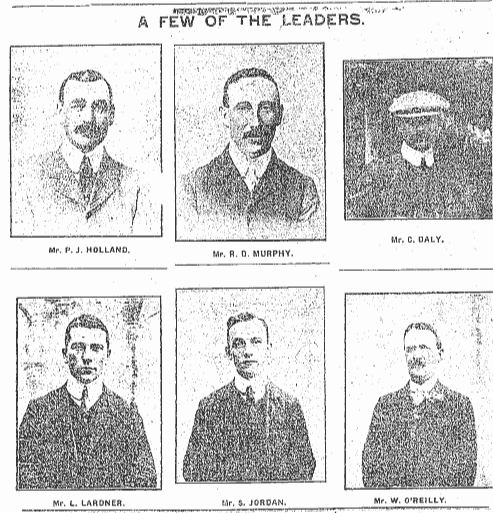
Who were the heads of this great movement? They were a few honest and earnest townsmen from Athenry. First I will place Mr. P.J. Holland, a thorough-going Irishman. Next comes Mr. C. Daly, and then Mr. Richard Murphy, Mr. Patrick Hynes, Mr. Jordan, Mr. Larry Lardner, and Mr. W. O’Reilly, secretary. The latter, indeed, is an indispensable functionary in Athenry. I take facts as I find them, and I say that Mr. William O’Reilly is a man without whom the people of Athenry could do badly. He has entered into every movement that has been inaugurated in the town for years past and his advice and practical assistance have been largely instrumental in ensuring that these movements would be crowned with victory. He has been subjected to much criticism in the past, but if you speak to those who belong to the associations that he has been connected with, and in the work of which he took a prominent and active part, they will tell you with the candidness that characterizes the people of the town that he could not have been done without.
The correspondence in connection with the convention will appear next week, and the writer will then disclose some aspects of the Agricultural Farm.
IV
Mr. T.W. Russell, M.P. on the Unionist Campaign
Source: Connacht Tribune, Saturday, December 04, 1909
This week I am enabled to reproduce the correspondence between the tenantry and the Government officials.
During the year 1905, whilst a Tory Government was in office, there was a considerable amount of agitation in progress throughout the country, and the Athenry Town Tenants passed a resolution condemning the exaggerated reports of occurrences which were appearing in the Tory Press. Amongst others, Mr. T.W. Russell got a copy of the resolution, and his reply throws an interesting light upon the attitude he adopted at that time as compared with the present.
Writing on the 6th April, 1905, to the Secretary of the Athenry Town Tenants’ Association, Mr. Russell said:-
‘’I have been convinced for some time that an organized attempt to defame the country has been brought into existence. The issuing of the circular some weeks ago signed by prominent Unionists requesting information in regard to ‘’loyalist grievances’’ in the South and West-was although perhaps not intended as such-the first step. The second followed almost naturally in the shape of a press crusade, English and Irish, the object being to make every petty quarrel in a parish into an agrarian outrage. The Persse incident was an admirable illustration of this special manufacture, and show what ‘’Our Correspondent’’ can do when he is put to it. The object, of course is plain enough. A section of Irish landlords do not wish certain parts of the Land Act to work. They do not desire to see the people placed on economic holdings, which would mean the abolishing of the grazing ranches. They prefer cattle to the people of Ireland, and they may it be relied upon to stop at nothing that will tend to retard the working of the Act. In these circumstances, I have only one thing to say to these who have sent me the resolution. It is the duty of the people to push down resolutely and firmly all attempts at intimidation, crime, and outrage sins against the law alike of God and man. The people are now in an impregnable position. The Land Act, despite all efforts to destroy it, will work, and the people will be redeemed. What you have to do is to use the Parliamentary weapon at your disposal.
V
First fruits of the Agitation
From this time to May 1906, negotiations were carried on between the agricultural tenants on the Lambert estate and Colonel Lopdell, the receiver. The latter asked 24 2-5 years’ purchase. The tenants offered 21, and the town tenants were refused any sale, as no money could be advanced for town holdings. In June 1905, the country and town tenants on this estate joined, and in June 1906, a meeting was held in Athenry, and the tenants unanimously decided to pay no rent, and to lodge the money in the bank. So matters progressed until the 15th of August, which Mr. W. O’Reilly, acting for the Town Tenants Association, collected a half-year’s rent and lodged it in the Ulster Bank. Processes were immediately issued by the agent, and on the 8th October, at about 10:30 pm, an armed party attacked Lopdell’s House at Rockmore. Two policemen Constables O’ Holleran and Heare who were on protection duty at the time, tried to prevent the men attacking. O’Halloren was shot in the left breast and seriously wounded. Three arrests followed-Tom Rooney, John Cahill, and John Burke-but the prisoners were released after a few remands. The tenants pressed for a sale under section 6 which enables the Estates Commissioners to buy on inspection.
Communications passed between Mr. O’Reilly, who was acting for the town and agricultural tenants and the Estates Commissioners. On July 18th the Commissioners wrote that they were in communication with the receiver with reference to the institution of formal proceedings for the purchase of the estate. They considered no useful purpose could be served by the proposed interview with the tenants’ deputation.
On August 1, the tenants still pressing for purchase, the Commissioners wrote that formal proceedings for purchase had not yet been instituted, adding: ‘’When the estate is formally before them the Commissioners will duly consider the resolutions which accompanies your letter, and if they consider an interview necessary they will so inform you.’’
In the course of a further letter on August 17, the Estates Commissioners said: ‘’The estate is the subject of a minor matter administered in the Court of Chancery, and the Commissioners understand that the solicitors having carriage are taking steps to obtain the consent of the Lord Chancellor to the institution of proceedings for the sale of the estate before them.’’
No further progress has been made on the 1st October, although the tenants had been corresponding with the Estates Commissioners from June. It was a week later Constable O’ Halloran was shot.
After the shooting, Very Rev Canon Canton took the matter up, and in reply to a letter from him, the Commissioners stated that they had intimated to the Lord Chancellor that they were prepared to endeavour to arrange a settlement, and they understood that the matter was engaging his lordship’s attention.
In reply to a query put to Mr. Duffy, MP, in the House of Commons in March, 1905, the Chief Secretary stated that he was informed that the receiver on this estate was in communication with the owners’ solicitors with the object of instituting proceedings for sale to the Estates Commissioners. The estate contained a considerable area of untenanted land which could be included in the sale. The Chief Secretary added that the Commissioners had no information as to the Monatigue farm but would make inquiries regarding it on being forwarded with the names of the owner.
So matters dragged on until the following year, leaving this vexed question unsettled. In July 1907, the Chief Secretary, in reply to Mr. Duffy, M.P., stated that there would be a sale to the Estates Commissioners, and that he would put no obstacle in the way of the sale of the town holdings to the town tenants. The estate, he added, had not come before the Estates Commissioners, but if they did acquire untenanted land in the locality they would consider the best method of utilizing it, and also any application made to them with reference to the town holdings.
The recent agitation continued with unabated fury on all sides: Colonel Lopdell’s and Mrs. Lambert’s houses were under police protection, and battalions of extra police were drafted into the district, which was under a sort of martial law, the police force being controlled by two District Inspectors.
In March, 1905, strong resolutions were passed at a public meeting, on the motion of Mr. P.J. Holland, seconded by Mr. P. Mahon, urging upon the Estates Commissioners that there was ample alternative land in the vicinity of the town for distribution amongst the town tenants-sufficient to secure the advance necessary for the purchase of the town holdings. They called upon the Commissioners to purchase the Caheroyan estate, which contained nearly 400 acres, and to remove the remaining untenanted lands on the Goodbody estate, which adjoined the town.
It is necessary to explain that the difficulty about the purchase of the town was the fact that the houses were not sufficient security for the amount of money to be advanced, and by the addition of accommodation land, the security would be increased, and the full purchase money could be advanced. The proposal of the Commissioners had been to advance a proportion of the purchase money, the tenants to pay good the balance in cash. Ultimately the tenants agree to this, but subsequently they got the accommodation land.
In reply to the resolution given above, Sir J.B. Dougherty, at the time Assistant Under-Secretary to the Lord Lieutenant, wrote:- ‘’I am directed by the Lord Lieutenant to inform you that His Excellency finds an inquiry that the Goodbody estate was purchased for their own purpose by the Department of Agriculture, whole resold a portion of the land to the Estates Commissioners for distribution among the existing tenants of the estates, many of whose holdings were uneconomic. His Excellency understands that the Estates Commissioners have already distributed the lands sold to them; and have selected the portion for the several parcels and have obtained undertakings for them. Under the regulations in force at the time the allocation was made it was not open to the Estates Commissioners to give parcels to persons in town. The suggestion with respect to the Caheroyan and Lambert estates contained in the recent resolution will be brought under the notice of the Estates Commissioners.
On Saturday, April 6, 1907, Messrs. John Dillon, John Roach, and William Duffy, M.P.’s, attended at Athenry for the purpose of attending a great demonstration on the following day. Speaking that night, Mr. Duffy held that the townspeople should get fair play in the distribution of the lands as well as the country people. He knew that the wants of the people of the town were exceptionally great. In the earlier part of his speech, Mr. Duffy made brief allusion to the fact that some young men were arrested on the previous day and taken off to Galway Jail.
On the following day (Sunday) an important demonstration was held. Athenry of the King’s looked its best. Flags and bunting fluttered in the April breeze to welcome the Prince of Irish Parliamentarians, Mr. John Dillon. The Galway independent Brass Band whose instruments are now mouldering on the shelf-the Ballinasloe Brass Band, Mr. Bergin’s Band, and the Roveagh, Kilmeen, Monivea, and Killeenadeema bands attended; and every League branch, even to the farthest end of the county, was represented. It was truly a record day in the agitation at Athenry. When the hour of meeting came the rain came down in torrents, but the men who had defied all the power of Dublin Castle and of successive coercionist Governments cared little for the elemental inconvenience. Very Rev Canon Canton presided at the meeting, and the enthusiasm would inspire hope in the heart of any Irishman. Mr. Duffy, in his speech, alluded amid cheers to the congestion of the town. Everybody knew, he said, that a large number of small holders of land were to be found in proximity to the town. ‘’Some time ago,’’ he continued, ”hope was given to these poor people, when it was rumoured that Messrs Goodbody intended disposing of their estate near Athenry. The presumption was that the estates would be purchased by some of the Government departments for the purpose of benefiting the people of Athenry with some accommodation land, as well as for the purpose of carrying out a much needed scheme of migration. How soon the hopes of Athenry and the poor people concerned were dashed to the ground! The Congested Districts Board bought the estate, and, instead of employing the lands for the purpose I have already mentioned, they actually sold the estate over the heads of the people to one of the most wasteful, incompetent, and extraordinary boards ever set up in Ireland, that is, the Board of Agriculture. The speaker went on to allude to the scandal of how this Board, finding it had too much land for the establishment of the Agricultural College for which the land was intended, forthwith resold 500 acres to the Estates Commissioners, which body sold 100 acres, including a large grove of trees, to Mrs.Lopdell, a large owner of land in the district. This while there was congestion and poverty everywhere around. ”A more scandalous proceeding was never heard of,’’ declared Mr. Duffy amid loud cheers.
This initial step was one of the things that tended so much to embitter the relations between the people and the Department.
At the meeting, Mr. Duffy advised the Department to give to give 300 of the 600 acres that they had retained holding, that they could not need all that land for the establishment of an Agricultural College. Since that day no Agricultural College has been built, although the Department has retained the 600 acres, but of this more next week.
Mr. Duffy dealt in detail with the various other grazing ranches in the district and declared, in conclusion, amid loud cheers, that there was only one way to relieve the congestion and poverty, and that was by breaking up the grazing ranches, and enabling the people to earn by honest toil a fair and decent living.
Of course, the speech of the day was Mr. John Dillon’s. He was cheered to the echo, but his counsel for moderation was little relished by the stalwart men of Athenry, who had learned from sad experience that they could hope for nothing, gain nothing except through active and persistent agitation. Mr. Dillon did not wonder, he said that the impatience of the of the people, having regard to the intolerable delay that was taking place in dividing the grazing lands. ”But’’, he continued ”this I would say to you all: do not allow yourselves to be carried away by impatience; do not forget that it took twenty-five years of steady effort, of sacrifice, to bring things to the level at which we have them to-day.’’ When in 1879 he went on, Michael Davitt called upon the manhood of Ireland to band themselves together and declare war upon landlordism, few people thought that even after twenty-five years, they should have brought landlordism to the point in which it was that day, how cheers rang out, for the veteran Nationalists who stood around in the rain knew full well what the land agitation had achieved. And the younger spirits knew, too what a weapon active agitation was when judiciously used. Their local knowledge was, of course, greater than what Mr. Dillon could be expected to possess. How well they succeeded in their agitation THE succeeding portion of this chapter will prove.
The meeting passed away and to-day it is only a memory. But it galvanized the people together. It brought them into into touch with the leaders. It gave them courage and hope: and it stands out to-day as a proud landmark in a great agitation-a bright beacon along a dreary road.
Despite Mr. Dillon’s advice, having regard to the unaccountable and altogether unnecessary delay, the people found it necessary to continue the agitation and after the inspection of the town buildings in March, 1907, Mr. O’Reilly wrote to the Estates Commissioners regretting that a number of the tenants had to pay cash to secure the purchase of their houses. This was not pleasing to the tenants, as they had expected to get accommodation land in Caheroyan, a course which would save them from the hardship of paying so much cash. The townspeople could not exist any longer without some small plots of land. Arrangements had been made to clear this farm of the graziers on the 2nd of April, which means that between forty and fifty people will be imprisoned and if they could do anything to avert this the people would feel deeply grateful. A good deal has been done by the Commissioners towards effecting a settlement of the district, and it would be fatal if anything should now occur of an unpleasant nature. The great pity was that no matter how long they had to wait, or no matter how long they kept up an agitation, nothing could be got without going to extremes. Mr. Roche’s agent offered to sell the farm to the townspeople, but it would be useless for them to buy it themselves.
Mr. Kineen, the agent for the trustees on the Caheroyan estate, was written to, on the 23rd of February, 1905, he replied denying that he held the lands under the 11 months system. The lands of Caheroyan and Ballydavid which he held, were not held as a grazing letting. Caheroyan and Ballydavid was an old tenancy, dating back from 1849 from Mr. Roche to the O’Connor family, being a bona fide agricultural letting to the O’Connors, who spent thousands on the lands. On the death of old Mr. O’Connor, family arrangements had to be made, lands had to be mortgaged, and a deed of trust executed to carry out the family settlement. Again in 1888 Mr. Roach evicted those lands for four and a half year’s rent. Mr. Scanlon, of Ballinasloe his brother, and himself to secure the money due to them by Mr. Gerald O’Connor, redeemed the lands at a cost of ₤1,490. This redemption also secured the O’Connor family their settlement under the trustees deed. Since then his brother and himself had purchased out of their private funds the claims of the O’Connor family, and they now claimed to be the owners of the O’Connor tenancy in the lands, and as such, they claim to be placed in the same position as any other agricultural tenant, who through want of funds or otherwise, was compelled to let the grazing of his holding to meet rents or interest on family charges.
Mr. Duffy gave all the possible aid to the tenants in their struggles at the time. On the 28th February he wrote-‘’There is only one solution for this case. The people should exert themselves, and make it hot for the graziers and all concerned. If the farm was left derelict for a time, I ventured to say the trustees, not the few people would be clamouring for its sale. That is the only possible or conceivable way of forcing these lands on the market. Have the people around ever made a request to the Kineens about this farm? Have they petitioned the Commissioners, and pointed out the feasibility of procuring this farm? In all events, in all these cases it is at home the work must be done. When turmoil and confusion takes place and the trustees and the government are made see that the people are firm in demanding their rights, then I anticipate the sale of the lands.
Up to the time of the inspection of the town there was not the remotest chance of the Caheroyan farm being purchased, and there was no accommodation land to be got for the town tenants, although Caheroyan had been cleared the previous May, and was then lying derelict,. So much for the manner in which the advice of the trusted M.P. was carried out.
The disturbance continued unabated, and spread to the farm of the Department of Agriculture at Newford. The meadows of the Department were spiked in June, 1907, and Mr. Briscoe, the general secretary of the Town Tenants Association, had an interview with Mr. Russell in regard to the condition of the town tenants. Mr. Russell expressed his readiness to help the tenants, and as a result, he and Mr. Briscoe came to Athenry, where there were met by a committee of the townspeople, who were introduced by the Rev. Father Dalton. Mr. Russell agreed to see the Estates Commissioners with a view to securing the accommodation land for the townspeople.
Mr. O’Reilly thereupon sent Mr. Commissioner Bailey the following list of the unsettled estates in the vicinity:- Lambert (Minors) including three fourths of the town of Athenry, and containing about 3,000 acres, including agricultural and untenanted land; Caheroyan estate, 460 acres of untenanted land adjoining the town; Monatigue farm, containing about 400 acres; the Gloves estate, containing about 220 acres; the Ormsby estate of 160 acres; estates of Mrs. Rodney and others, including quarter of the town and containing 160 acres; Aughrim Park, 460 acres (Frank Shawe Taylor’s) which had been inspected, but in regard to which there was a difference of ₤400 as to price with the result that the landlord refused to sell; Boyhill, 480 acres of untenanted land (Mr. Persse refused to sell) 220 acres Graigue Abbey (Mr. O’Malley’s). This farm had been offered to the Commissioners, but they refused to buy it, as it was not suitable for their purpose. The Lopdell estate, which comprised a number of town holdings.
As a result of the subsequent visit of Mr. Russell and Mr. Commissioner Bailey, the Caheroyan farm was purchased by the Estates Commissioners, and distributed amongst about seventy of the town’s tenants as accommodation land, while the agricultural portion was purchased under section 6, and a far bigger reduction given than if the tenants had purchased through the agent under the zones system. A number of new holdings were given to the tenants, and all the evicted were restored to the comfortable houses which were newly built by the Estates Commissioners with economic holdings attached. The town tenants purchased at an average of 30 percent reduction, and an average purchase of 12 years. The sale of the Rodney estate was arranged at the same time, and it was subsequently purchased by the Estates Commissioners and resold to the tenants under section 6. The Lambert (Minor) estate was sold under arrangement, the average number of years purchased ranging from 16 to 20 years purchased. The Ormsby estate was inspected and the purchase money advanced, while the Monatigue and Castle Lambert farms were inspected and offers made, which, however, the owners refused. Therefore the agitation was not without some very substantial results, for about 800 tenants were placed upon comfortable holdings at reasonable rents. The remaining estates are still in a condition of disaffection, but if there is any merit at all in the new Land Bill, the tenants around Athenry may be expected to extract it from it. Already it has been arranged that the tenants on the Colemanstown, Boyhill, Monatigue, Gloves, Castle Lambert estates will form a joint Estates Committee, to force the new Congested Districts Board to begin operations in the Athenry district immediately.
(To be Continued Next Week)
Editor’s Note:
Although the concluding article was alluded to in two subsequent issues it was not published.
Gerry Burke