APH
APH
by Mary O’Gorman
Source: Athenry Journal, Number 13, 2000
Redmond Carr began his career at Athenry Railway Station in 1945, spending his first three years there, working the platform. This particular job entailed various duties such as maintaining the platform, securing carriage doors and the loading and unloading of mail. Now to those of us who never experienced the era this may sound like quite an easy job, but life in the late 40’s assured the opposite.
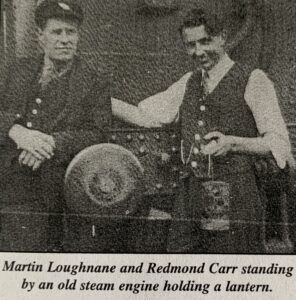
Though times were hard following the end of the Second World War it didn’t slow the tracks of the workers at the Athenry Station as it still continued with its tradition of being an important and busy junction.
The loading and unloading of mail was quite a task for up to 3 weeks preceding Christmas. Up to three mail wagons a day would stop at Athenry servicing collections from a wide radius. Of course during this time, to alleviate the hardship of food rationing, parcelled fowl would often be sent to relations in England. Handling these parcels was not always the nicest element, but one could imagine that receiving them after their long unrefridgerated journey must have been far worse. After his three years on the platform, Redmond went on to spend 20 years “shunting” and then a further 22 years operating the signal cabin. Shunting of course an extremely hard manual task and basically meant joining the wagons together. During the 40s and 50s the beet campaign kept Athenry junction very busy from October to January, transporting collections to the Tuam beet factory from a wide area including Limerick, Athlone, Ennis, Tullamore, Portarlington (to name but a few). During this season there were an extra 10 trains running a day and Athenry’s collective took an extra 20 wagons a day.
The March and October fairs left no time for dust to settle on the tracks into Athenry. The March fair took place around the 2nd week in March, in October it was the 1st week and both fairs were held on Fridays. The fairs brought farmers and jobbers from far and wide. One of the many regular visitors it brought was the father of one prominent Irish Political figure, Mr. John Bruton. John’s father ran a large farm in County Meath and was only one of many who flocked to Athenry to purchase the finest of stock that abounded at these fairs. Over 30 trains would pass through Athenry on those days pulling with them a total of 100 wagons, with each wagon containing 15-16 cattle. It hardly needs to be pointed out that the process of loading and unloading of stock could not have been an easy one. Stock wagons had a hinged doorway called a cattle bank, which could be pulled down to safely, give access from the wagon to the platform. The cattle banks were pebbled to ensure the animals did not obtain any injury while crossing in slippery conditions. Monthly fairs were also held on Fridays, more often than not two to three specials ran on those days. Passing through the Athenry junction during the 50s and 60s were the “Knock specials” that ran on Sundays only. They even stretched from the far south bringing up to 11 passenger trains to Knock which only stopped for water during the era of the steam engines. But after the arrival of the diesel engine they swiftly passed on through the junction. Every diocese had its own day and train but on reaching Claremorris, passengers would have to disembark and then board a bus to continue their journey as the line did not extend to Knock.
 Following his 20 years of shunting Redmond then began working in the signal cabin. At this time many changes had occurred in the working of the railway, steam engines had changed to diesel and the introduction of electrification eased some of the toiling in the signal cabin. The work of a signal cabin operator held a huge responsibility and indeed still does today. The job entails ensuring ultimate safety at all times for the passage of each and every train that uses the line. In his 45 years of service in Athenry railway, Redmond was happy to report that he was never involved in any union strike and that the safety record for the line was quite good. Despite the hardship of the earlier years he quite enjoyed his time working at the station. Since retiring on the 18th of Dec. 1989 he is enjoying good health and plenty of time with his wife Ita and family. We would like to thank him for taking time to chat with us and sharing a little of the picture of Athenry’s railway’s past, reminding us to hold on to its memories as we fastrack in to the new millennium. And to all the lads working down at the station, many thanks for taking the time to show us around. We will definitely be back soon to continue their story and we wish them a Merry Christmas.