APH
APH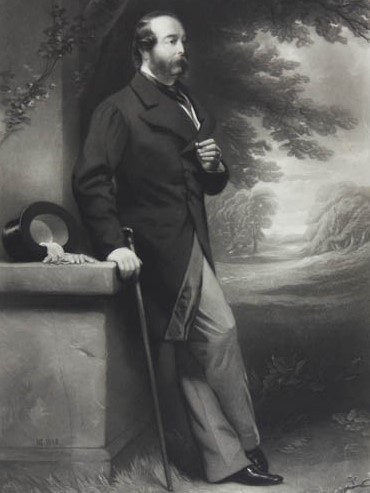
Sources: Freemans Journal, Thursday, August 22, 1867
Galway Advertiser, Thursday, Oct 21, 2010
Galway City Museum Website
Ulick Canning de Burgh, Lord Dunkellin
Ulick Canning de Burgh (1827–67), Lord Dunkellin, was the eldest son of Ulick John de Burgh (1802–74), the first Marquis of Clanricarde, a politician and wealthy land magnate who lorded over one of the largest estates in Co. Galway. Born in London, the Eton-educated Dunkellin pursued a military career. He served as MP (Liberal) for Galway between 1857 and 1865, and for Co. Galway between 1865 and 1867. He died of Bright’s disease (nephritis), a serious and then untreatable kidney disorder, in 1867.
FUNERAL OF LORD DUNKELLIN
(FROM OUR REPORTER)
ATHENRY, WEDNESDAY(21 August)
The funeral of the late Lieutenant Colonel, Lord Dunkellin, which took place here to day, was one in every respect worthy of the deceased nobleman, and of the great house of Clanricarde of which he was a distinguished member. The nobility, the gentry, and a very large concourse of the inhabitants of this great county, assembled to pay their last tribute of respect to one who had filled a high station amongst them, and who had very largely secured the affections of his countrymen of every class and creed with whom he came in contact. The remains of the deceased nobleman were conveyed here this morning by a special train, which left Dublin at half-past ten o’clock, and which arrived at the station adjoining this town at half-past two o’clock. Amongst those who travelled by this train were–The Marquis of Clanricarde, the Marquis of Sligo, the Earl of Clancarty, the Earl of Cork, Viscount St. Lawrence, Lord Hubert de Burgh Canning, now Lord Dunkellin, Lord John Brown, M.P.; Mr. W.. B. Bowment, M.P.; Dr. Wyatt, Surgeon Major of the Coldstream Guards, the medical attendant of the deceased, and Mr. Andrew Browne. A very large number of persons who were in attendance at the funeral had previously left Dublin by the half-past eight train, but long before its arrival at Athenry, the special and ordinary trains from Galway and other stations in the west of Ireland bad brought their thousands of people, who crowded round the station at Athenry, waiting the arrival of the special from Dublin. It was impossible to witness the scene which presented itself on the arrival of the train without being impressed with its solemnity. On the platform and immediately around it were most of the leading gentlemen of the county. The thousands of the well dressed tenantry on the several estates of Lord Clanricarde, wearing scarfs and hat-bands, pressed close to the platform, and many chose the most elevated positions, the bridge crossing the railway, and the raised ground on which the railway hotel stands, where they waited quietly until the procession which led to the tomb of the De Burghs was formed. The remains of the deceased nobleman were enclosed in a leaden coffin, with an outer one of solid polished oak, with rich gilt mountings. On a silver gilt plate on the lid of the outer coffin was the following inscription –
LIEUT-COL. ULICKE CANNING DE BURGH,
LORD DUNKELLIN, M.P.,
BORN 12 JULY, 1827,
Died 16th of August,1867.
On the platform in waiting to receive the remains were Lord Clonbrock, Sir. Thomas Burke, Bart., Marble-hill; Lord Clanmorris, the Most Rev. Dr. Derry, Lord Bishop of Clonfert; Thomas Butler Stoney, Esq.; Major Percy, RM; Rev. R. B. Eyre, Rector of Portumna; William H. Gregory, M.D., &c.
The coffin, over which a black pall was thrown, was raised on the shoulders of the tenantry; who carried it all along the line of procession through the town and on to the fine old ruins of the Abbey of Athenry. Amongst the chief mourners who walked immediately behind the, coffin were : The Marquis of Clanricarde, Lord Hubert Canning. De Burgh, now Lord Dunkellin; the Earl of Cork (brother-In-law of deceased); the Marquis of Sligo, Viscount St. Lawrence and Lord John Brown, M P (cousins); Earl of Clancarty, Lord Clanmorris, Lord Clonbrock, Sir Charles Domville, Bart; Sir Thomas Burke, Bart: Wm. H Gregory, M P; Anthony F Nugent, Pallas; Wm. Nugent, Pallas; Dr Wyatt, Surgeon Major, Coldstream Guards; Andrew W Blake, Furbough: John H Blake, Mathew Rush, Andrew Blake, jun; Edward Thomas Stapleton, Crown Solicitor: Rev Mark Perrin, Rector of Athenry; Robert French, Monivea Castle, Andrew Browne, Mount Hazle: Burton Persse, Moyode Castle; Henry Persse, Galway; John W Lynch, Renmore.
Amongst the other gentlemen present were:-Hon Captain Gough, D K Persse, JP: C St George, E Persse,. Charles Persse, Dr Browne, Professor Owens, Galway College: E E Maunsell JP, M Ryan, H Persse, Captain Gascoigne, Major Mahon, James Browne, Robert Eyre, Eyrestown; Captain R. Lambert, JP, Galway; James Clarke, JP, Henry T Graham, Giles Lambert, JP; Richard D’Arcy, Captain Valentine Blake, Captain O’Hara, JP, DL; Capt. Lowry, Galway; Dr Mulville, W L Mulville, Captain Barnard, James Cunningham, and John F Cunningham, Portumna; Captain McDonogh, Francis McDonagh, R C Barbor, solicitor; Richard Carter, Galway; Walter Seymour, Robert Power, Clerk of the Peace; Captain Mayne Waring, Francis McDonagh, County Inspector; Hubert A W Blake, JP, DL; F M Persse, JP; Captain Blake Foster, JP; J Abbott, — O’Brien, Sub-Inspector; Major Fetherstone, John Dennis, JP; Bourke, Loughrea; James Naughten, Portumna; Thomas Higston, T S Kirwan, J P Blundell, Thomas Lynch, JP, Lavally; Dr Davis, JP; John Redington, Dr. Nolan, Dr Duggan, Martin Whyte, James Galbraith, JP: A B Nolan, Captain Seymour Harrison, James McDermott, JP: George C Kenny, John H Blake, M B Davis, L U Roberts, County Surveyor, Henry Torrens Graham, solicitor; Wm Fenton, John Gill, Ardrew M Comyn, Thomas Horan; James Campbell, JP; R Stevens, R U Somerville, P Joyce, JP; E Donnellan, A Robinson, J Gunning, J Lopdell JP; James Martin, JP; W P Lambert, JP, Captain Lambert, JP: Captain J M Aylward Lewis; J J Hensworth, W Clarke, Portumna; James Concannon, solicitor; James Cloran, Robert Power, solicitor, Galway; Arthur Nugent, John Eyre, J D McCarthy, Dublin.; Thomas Kelly, Captain Maunsell, J Clarke, J W Lynch, JP.; C B Butler, JP; Major Seymour, JP: W J Burke, J P; &c.
Amongst the clergymen present were The Most Rev Dr Derry, Lord Bishop of Clonfert: Rev Peter Conway. P.P, Headfort, Rev Mr. D’Arcy, PP Eyrecourt, Rev Thomas Bourke, PP Portumna; Rev Mr O’Grady, PP: Rev John Larkin, P P,. Woodfort: Rev Mr Head P.P, Newin; Rev Mr Madden, CC Woodfort, Rev Mr Larkin PP, Woodfort, Rev Mr. Pelly P.P, Kiltulla: Rev Mr Coen PP, Kiltormer, Rev Mr Griffin, PP, Leitrim, Rev Dr Sellors, Administrator of Loughrea; Rev Mr Mc Keigue, CC Loughrea, Rev. Mr Walshe, CC, Ballinakill; Rev Mr Raftery, PP, Kilnadeem: Rev J O’Grady, P P, Athenry ; Very Rev Wm Derry, LP, Eyrecourt; Rev. Mark Perrin, Rev J. W Hollowell, Rev Richard Borther, Portumna ; Rev James Comyns, Rev John Hughes, and the Very Rev J Wigham.
The tenantry of the several estates of Lord Clanricarde were represented in the procession by sixteen respectable farmers from each estate, and who walked in the following order :-
Tenantry of the Galway estate.
Tenantry of the Craughwell estate,
Tenantry of the Loughrea estate.
Tenantry of the Portumna estate.
Tenantry of the Woodford estate.
Tenantry of the Eyrecourt, estate.
The procession having, after a slow walk, reached the Abbey, the coffin was borne to the tomb, on which is the following inscription: – This tomb containing the remains of the noble family of De Burgh, was repaired by Ulick John, Marquis of Clanricarde, MDCCCXXXV.” Above are the family arms, with the motto in old French ”Un roy, une foy, une loy.” The Rev. Mark Perrin read the funeral service in the form prescribed by the Established Church. The Rev. Mr. Potter assisted: The remains having been deposited in the vault; and the last tribute of respect to the memory of the deceased nobleman having been paid, the assembled multitude left for their homes in various parts of the county.
Some hundreds of the carriages of the gentry were in the vicinity of the town, but were not used in the procession. The Marquis of Clanricarde and the other noblemen and gentlemen who journeyed with him from Dublin, returned by the special train which left Athenry shortly after four o’clock. The Marquis personally thanked Mr. Duffy, the station master at Athenry, for the excellence of his arrangements in connection with the extra trains.
Lord Dunkellin Memorial
Soon after his death, several of Lord Dunkellin’s peers formed a memorial committee in order to raise funds for a monument and oversee its completion in Galway. A sum of £1,600 was raised within three months, including £10 from the Prince of Wales (later George V of England). The committee resolutely decided that subscriptions for the monument should be confined to Galway City and County, the two constituencies represented by Lord Dunkellin, and returned several subscriptions received from outside the County. In 1873, the Galway Vindicator reported that the ‘subscribers included men of every shade of politics in the County and town of Galway. Clergymen Catholic and Protestant, noblemen and gentlemen, professional and mercantile, all cordially united in a determination to do honour to the memory of the late Lord Dunkellin’. Fifty years later, the Galway Observer conflictingly reported that it was ‘subscribed for by the Clanricarde tenantry, a good deal of which … was obtained from the people by threats’ (27 May 1922).
John Henry Foley
The Committee agreed that the distinguished Anglo-Irish sculptor, John Henry Foley (1818–74), should execute the work. Foley accepted the commission, even though he was preoccupied with the O’Connell Monument for Sackville Street (now O’Connell Street), Dublin. Foley’s monument consisted of a 2.5m bronze statue of Lord Dunkellin on top of a polished Peterhead granite pedestal, which stood on two steps of Aberdeen granite. The inscription on the pedestal read: ‘Lieu. Col. Lord Dunkellin, M.P., for the County of Galway. Born 1827. Died 1867. This statue was erected by the inhabitants of the County and Town of Galway as a tribute of affection and respect to his memory. 1873’.
The memorial committee was impressed with Foley’s work: ‘in none of the great works, which have given him world-wide celebrity, has he shown more genius and skill than in the present instance, where, with only the slender assistance of a photograph, he has been enabled to produce the faithful likeness’ (Galway Vindicator, 24 Sept. 1873). The monument was placed at the northern end of the square, facing the Galway County Club and was flanked by two Crimean Cannons. However, not everyone was enamoured with Foley’s monument: “What I complain of and what I think the people of Galway have reason to complain of, is this – that the only public square in Galway, and the only one which has been railed and planted by the people’s money, should be sacrificed to pander to the ambition and to please the vanity of the friends of the deceased Lord Dunkellin. Is there any reason why the people of Galway should place Lord Dunkellin among the immortal gods, sacrifice their public square to honour him, and bow down their heads as they pass along the public streets in admiration of the late Lord Dunkellin. I answer emphatically – No!” (The Nation, 28 June 1873)
Unveiling
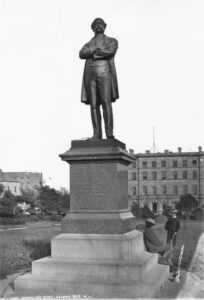
The unveiling ceremony took place in September 1873, during which the Town Commissioners formally accepted the monument from the Memorial Committee. The event ‘gathered together most of the nobility and gentry of county, but of the people there seems to have been a scant attendance’ (The Nation, 27 Sept. 1873). John Redington, Chairman of the Galway Town Commissioners, said “I accept, then, with peculiar gratification, on behalf of the Municipality of Galway, the trust you have this day committed to our charge; and I earnestly hope that this statue may remain to future generations as a symbol of the social harmony which has ever happily existed amongst us, and as a testimony of our appreciation of Lord Dunkellin’s high and sterling qualities of head and heart” (Galway Vindicator, 24 Sept. 1873).
Hubert George de Burgh-Canning
As Lord Dunkellin predeceased his father, his younger brother, Hubert George de Burgh-Canning (1832-1916) inherited the family estate. The second Marquis of Clanricarde had little interest in Ireland or his estate and made a rare visit to Galway for his father’s funeral. He also succeeded Lord Dunkellin as M.P. for Galway but, in 1871, resigned his seat in protest against the Land Act 1870, which was, he believed, ‘fraught with injustice to the landlord’. In 1886, the Woodford evictions on the Clanricarde estate received worldwide attention and the estate became a symbol of landlord oppression. In September, a crowd assembled in Galway and led by a band marched to the County Gaol where they cheered for the Woodford prisoners and denounced Lord Clanricarde, the Chief Secretary and the Attorney-General for not allowing bail; they then continued to the Lord Dunkellin Monument, which they threatened to pull down or blow up using dynamite.
That October, at a meeting of the Galway Town Commissioners, one member submitted a motion: ‘that this Board remove the statue of Lord Dunkellin in the Square to some less prominent position more suitable to his character and the character of his successor the marquis of Clanricarde’. The motion caused uproar, not least because the member in question cast aspirations on Lord Dunkellin’s character; some of those who knew Lord Dunkellin personally were quick to come to his defence, whilst the chairman noted that ‘a man’s fault should die with him’. When the furore was over, the motion was defeated by 7 votes to 12.
Town Tenants League
Despite several threats from those opposing its presence in Eyre Square, the Dunkellin Monument survived in situ for almost half a century. On 25 May 1922, the bronze statue was pulled from its pedestal by members of the Galway Branch of the Town Tenant’s League, which sought similar entitlements for urban dwellers as had been granted to farmers under the land acts.
As soon as the British army evacuated Renmore Barracks, this statue became a target. The Galway Observer of May 27 1922 reported the following….
“On Thursday night, a crowd numbering several thousands assembled inside the Square, and two men set to work sawing at the base of the life-size bronze monument of Lord Dunkellin, a brother of the late Lord Clanricarde. A rope was afterwards procured and fastened around the neck, and with a strong pull, over it went amidst great applause. This monument was erected in 1873, and subscribed for by the Clanricarde tenantry, a good deal of which it was stated, was obtained from the people by threats. When the monument disappeared in the rere, the pedestal was mounted by Mr. W.J. Larkin, Mr. S.J. Cremin, Secretary of the Transport Workers Union, and Mr. P. Kiely, Secretary Galway Tenants Association.
“Mr. Cremin made a lengthy speech in which he said they went before the Urban Council that day, and told them they would pull down that monument which had just fallen to the ground. It was a symbol of landlord tyranny, and they intended to pull down every monument of its kind in Ireland, and put a monument of some good Irishman in its place. The speaker then went on to denounce the present members of the Urban Council, and also the new magistrates as not being representative of the people, and being indifferent to the wants of workers. There was no justice to be had for the workers in the new courts any more than the old courts. They had, he said, 375 houses in town certified by a doctor as unfit for human habitation, and they had sewerage running into the main water pipe. At the Urban Council meeting that day, they wanted to see the schemes of the new houses, which they said was drafted, but they were refused a look at them, and he would not be surprised if those schemes were drafted in the back parlour of some landlord in town. The tenants of Galway were not out to abolish all landlords and would not stop till they had every tenant the owner of a roof over his head.
“After the meeting, a rope was put round the neck of the statue and it was drawn by thousands through the main streets with band playing Irish reels and hornpipes and taken out to the pier head where it was thrown into the water.’’
Lady Gregory’s sister, Arabella, was in her townhouse on Dominick Street when the statue was carried by. Three days later, she wrote to Lady Gregory: “While nurse was putting me to bed we heard cheering and a band in the street. Nurse and Sarah rushed to the hall door and saw a large mob headed by a man dragging with ropes the statue of Lord Dunkellin from Eyre Square, some sitting on the statue as if they were on a sledge”.
“The scene at the pier head was of the most extraordinary kind. The thousands who followed (and dragged the ‘corpse’ ) cheering wildly. As the ‘body’ was being hurried into the sea opposite Devil’s Head on the Claddagh side, Mr. Larkin stated that neither Gettysburg, Bodenstown or Greece had sufficient eloquence to panagerize such a ‘corpse’ —– “Let it go boys” said Mr. Larkin, “and may the devil and all rotten landlordism go with it”. As the body was hurried into the sea, the band amidst a roar of joyous laughter, played ‘I’m for ever blowing bubbles’.”
The next morning, the statue had disappeared from the Quay Stream, removed by some enterprising person. It has never been seen since. In the aftermath of the event, the Weekly Freeman’s Journal reported that ‘to prevent recovery the statue was taken up on the beach and the arms and legs sawn off’ (3 June 1922). The valuable scrap metal disappeared without trace.
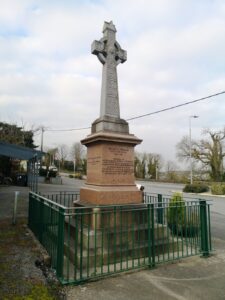
The base was removed to Castlegar, reworked, and today, it is a base for the Castlegar Civil War Monument on the Tuam Road.
In 1935 Éamon De Valera unveiled the Padraic Ó Conaire statue by sculptor Albert Power on the site of the Dunkellin Monument in Eyre Square.