APH
APH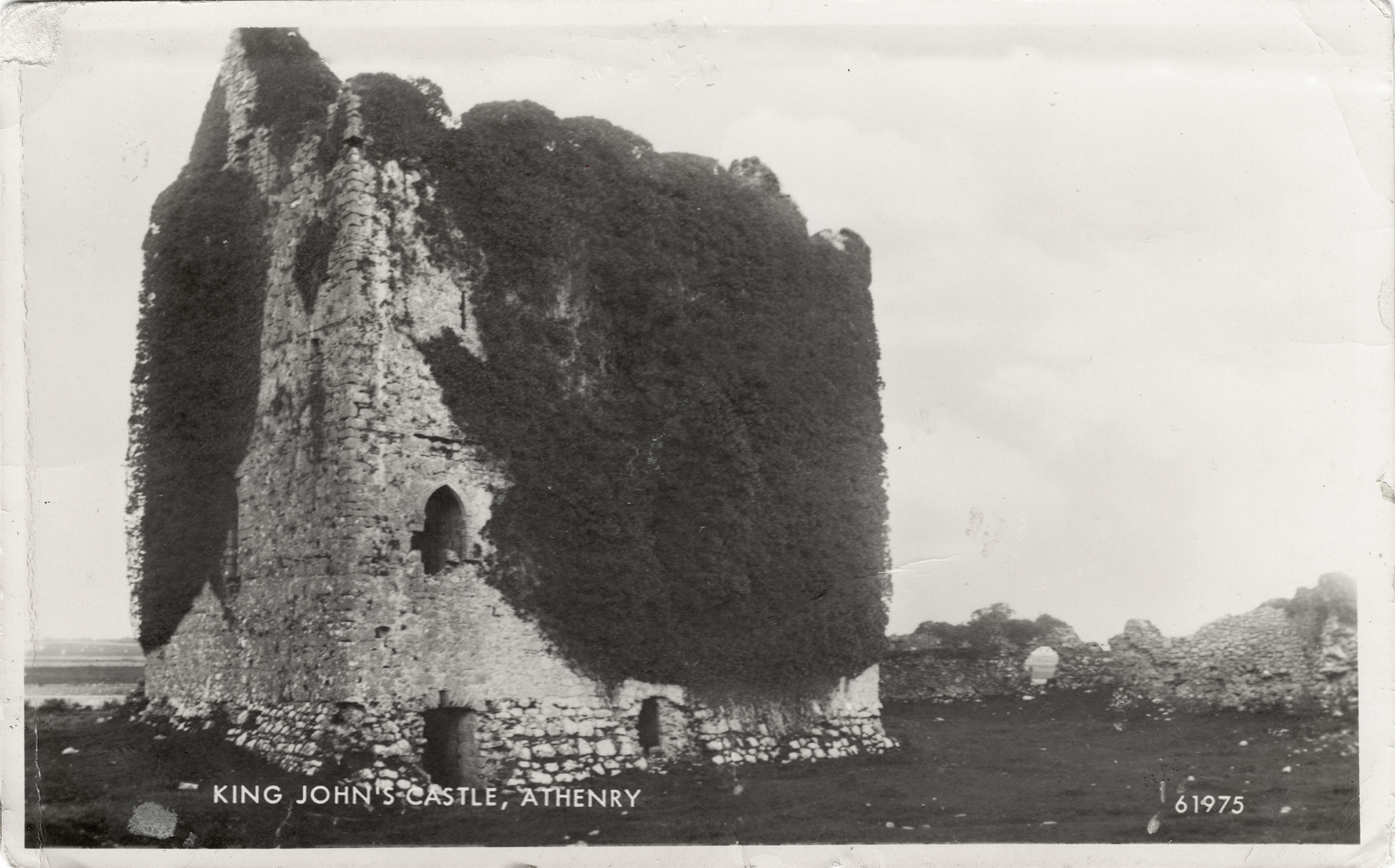
Parish of Athenry
Source: History of the Archdiocese of Tuam, 1928
Author: The Right Rev. Monsignor D’Alton
The name Athenry, the Ford of the Kings, is derived from the fact that here three territories meet-Hy Fiachrah, Hy-Many and Magh Seola. But the name may be differently derived if we are to believe Ptolemy, who places this as the chief seat of the Anteri. It is certain at all events that Athenry stands out prominently, more prominently at least in civil history than any other parish of the archdiocese. As far back as the reign of Lughad MacCon, about 250, it was the scene of a great battle which took place at Magh Mucroimhe near Moyvilla. Art, son of Conn of the Hundred Battles, the nominal King of Ireland, fell in the battle, as did Forga, King of Connaught, and the seven sons of Olioll Olum, King of Munster. The place still bears the old name, and the exact spot where Art fell is called Turlough Art. The result was to give the throne of Ireland to Lughaid MacCon.
Like the remainder of the archdiocese, Athenry in due course became Christian; but we know not who were its first Christian teachers and find no footprints of the earlier saints, such as we find at Annaghdown and Tuam. It is not unlikely that Brendan, passing from Annaghdown to Clonfert, met the people at Athenry and preached to them. In the twelfth century, however, Athenry emerges from obscurity, and at the Synod of Kells the deanery of Athenry, consisting of Athenry itself, Teac Saxon and Kilmeen, was added to Tuam. Its advantageous position attracted the Anglo-Normans, and after De Burgo came to Connaught Meyler de Bermingham came to Athenry, holding the whole barony with the title of baron, not by creation but by tenure. He soon strengthened his new position and built the Norman castle, which is still called the Castle of King John. This would fix the date of the building earlier than 1216.
Twice within the next century Athenry was the scene of a fierce battle, in which national issues were decided. In 1249 the place, strongly held by the English, was assailed by the Connaught chiefs; but the Sheriff, Jordan de Exeter, rushed out ” with harness and arms and sheets of mail,” and the Connaught chiefs left many of their bravest on the field. It was said that the Blessed Virgin fought on the side of the English, for the Irish attacked on the Feast of the Assumption and the English had vainly besought the Irish to desist from profaning the great feast.
A far greater battle was fought at Athenry in 1316. As on a former occasion, the Irish were the assailants. But heavy-armed cavalry and coats of mail were too much for light infantry, and the crossbow and the Norman lance were more deadly than the battle-axe. The English were under Burke and Bermingham, the Irish under Felim O’Connor, King of Connaught. Numbers were certainly on the Irish side, and there was no lack of bravery, but superior weapons and discipline overcame undisciplined valour. Each time the Irish advanced to the attack they were mown down by the terrible crossbows, and when their ranks were broken the English cavalry trampled them under foot. When night fell 8,000 of the Irish lay dead or dying on the field, Felim O’Connor and the Connaught chiefs among them; and the greatest battle fought in Ireland since Strongbow-had been lost and won.
Guarded by discipline and valour and under the capable leadership of the Berminghams, Athenry had already become prosperous, and in 1310 had got from the English king a murage charter empowering ” the bailiffs and good men of Athenry ” to levy tolls and customs for three years so as to
build a wall round the town. It was then inhabited by English settlers and had English institutions, and the “Portreeve, Burgesses and Commonalty of Athenry,” to whom the charter was granted, loved to follow English rather than Irish ways. After 1316 they felt a sense of security and were immune from attack. The spoils of the battle enabled them to still further strengthen their encircling wall and enriched the town; greater prosperity supervened; and when the Viceroy, Sir Henry Sidney, visited Galway in 1567 he could truly say that ” Athenry was a great and ancient town,” fully as large, and even more prosperous than, Galway.
The turn of the tide, however, was at hand. In 1574 the rebellious sons of the Earl of Clarickard burned the town, college and parish church included. Athenry was then described as a fair, large town, well walled, with strong towers. In the same year a petition was sent to the English Privy Council from the inhabitants asking, as loyal inhabitants, for a fee-farm grant of €20 out of the Crown lands in Connaught;” and though it does not appear that this petition was granted, the Privy Council ordered that Clanrickard’s sons should be pardoned, but that the town should be rebuilt at their father’s expense. This, however, was not done, and when Sir Henry Sidney laid fines on Clarickard and his tenants the Earl protested that a levy of £6,000 was too heavy. And lest the rebuilding should be carried through, the Earl’s rebellious sons drove away the masons who were rebuilding the town.” Sidney then described Athenry as “the most woeful spectacle that ever I looked on in any of the Queen’s dominions.” A little later the work of restoration was partially carried out; and in the Parliament of 1585 the two members for Athenry attended and for a time there was peace.
But in 1596 the peace was broken, and Red Hugh O’Donnell and Theobald Burke, with an army of 3,000 foot and 200 horse, attacked Athenry. They soon scaled the walls, forced the gates, and in spite of strong opposition took possession of the castle and all the stores it contained. They destroyed the entire fortress, says O’Donnell’s biographer. And he adds: “O’Donnell and his host remained in the town that night and evacuated it in the morning, after stripping it of everything valuable.”
After this Athenry decayed, and in 1607 there was a petition from the inhabitants asking relief from the English Privy Council. The Council was not unfriendly and recommended that the loyal town should get relief. But Clanrickard wrote to his friend the Earl of Salisbury that Bodkin, the chief promoter of the petition, was a knave, and no relief was given. Four years later the Protestant party, anxious for a majority in the Parliament of 1613, had to lament that there was no hope of getting any Protestant vote from Athenry. Its inhabitants were loyal and English, but they were Catholic. In the Parliament of 1639 the members from Athenry were Richard Martin and Dominick Browne, both, judging by their names, Catholic. In the Parliament of 1689, the Patriot Parliament, the members were James Talbot of Mount Talbot and Charles Daly of Dunsandle. And in 1800 the Parliamentary representation of the borough was in the hands of Theophilus Blakeney, who sold it to Castlereagh for €15,000. After this Athenry ceased to be a Parliamentary borough, and it ceased to be a corporation after the Municipal Reform Act of 1840.
As Athenry cannot be said to have any civil history before the English settled there, neither had it any ecclesiastical history, and its ecclesiastical history is chiefly bound up with the Dominican Abbey that flourished there. A chronicle of events will be sufficient.
1235.-Richard de Burgo, who had already established an English colony at Athenry, having often passed through on his way from Loughrea to Galway, gave a charter to Meyler de Bermingham to levy tolls and customs.
1241.-Meyler de Bermingham founded the Dominican Abbey on land which he purchased for 160 marks from Richard Brannach. His knights and esquires gave contribution.
1250.-Felim O’Connor, son of Cahal Crovderg, built the refectory.
1275.-Meyler de Bermingham died.
1289.-Meyler’s son, William, appointed Archbishop of Tuam, though only in sub-deacon’s orders.
1297.-The Archbishop and the Athenry Dominicans quarrelled, the Dominicans denying his right of visitation and the Archbishop retorting by placing the Abbey under interdict.
1312.-The Archbishop died and was buried in the Abbey.
1322.-Richard de Bermingham, the victor at the great battle of 1316, died and was buried in the Abbey church.
1324.-Sir William de Burgo gave 100 marks to build the front of the church.
1344.-Mac-an-Wallyde de Bermingham built the chapel of the Blessed Sacrament, and James Lynch gave 12 acres of land at Rahard.
1374.-Richard de Bermingham gave the Abbey 18 acres at Gloves. He was buried in the church and so were the sixth, seventh and eighth Lords of Athenry, all of them benefactors.
1400.-Pope Boniface IX. granted an indulgence to all who would visit the Abbey and contribute to its building.
1423.-Large portion of the Abbey burned. The same year Pope Martin V. granted an indulgence to those who contributed to rebuild it. He also authorised the Athenry community to found two houses, which they did by founding Tombeola, and Ballindoon in the Co. Sligo in 1427.
1445.-There were at this date 30 Dominicans in the Abbey.
1462.-William de Burgo died, having given lands, and many others had given lands and money.
1482.-General Chapter held in the Abbey attended by 280 Dominicans.
1488.-Pope Innocent VIII. gave the Abbey Our Lady’s Church in Galway, formerly belonging to the Premonstratensian Abbey of Holy Trinity, Tuam.
1500.-Thomas, Lord Athenry, died, a great benefactor.
1509.-Richard de Burgo gave lands at Carnane.
1524.-Meyler de Bermingham gave lands and a water mill, and helped to entertain the friars-360 in number, who attended a general chapter at Athenry.
1541.-Order of the Irish Privy Council that the Abbey was not to be dissolved, but the friars must wear secular dress.
1574.-Crown grant of Abbey and lands-nearly 1,500 acres-to the Provost and burgesses of Athenry.
1627.-Abbey and lands transferred to four Galway merchants who allowed the friars to return.
1641.-The Dominicans rebuilt the Abbey.
1649.-Dominican Abbey at Athenry joined to four others in Ireland, erected into a University by a General Chapter at Rome.
1652.-The friars expelled by the Cromwellians after the capture of Galway.
1655.-The Abbey and lands granted to Henry Farrelly, “a transplanted Papist ” from Tipperary.
1667.-Francis, Lord Athenry, sued the Portreeve of the town for having sold an ancient monument in brass, valued at £200, on which was a representation of a landing in Ireland of the first Bermingham.
1750.-The Irish Government ordered the Abbey buildings to be pulled down and converted into a barrack-all but the church-and the soldiers defaced many of the monuments in the Abbey.
That there was a parish church in Athenry has been ignored by most writers in spite of the fact that William de Bermingham, Archbishop of Tuam, was Rector of Athenry, and that in the taxation of 1306 the revenue of the parish was given as 40 marks, of which half went to the rector, one-fourth 10 the perpetual vicar and the remaining fourth to the Archbishop of Tuam. In the ” Papal Registers ” there is an entry at 1413 of the appointment of Meyler de Bermingham as perpetual vicar of Athenry, one at 1425 that the rectory, which was in lay patronage, was long vacant; another at1437 showing that the rector and vicar were two different persons, though it would seem that each had fixity of tenure in their positions.
In 1485 there was a revolutionary change. Canon Burke of Tuam was then both rector and perpetual vicar, and in that capacity he obtained a confirmation from Rome of a grant already made by Archbishop O’Murray making the church at Athenry a collegiate church like Galway. Canon Burke was to be Warden of the College and to be assisted in his parochial work by eight secular priests. This helps to explain Sir Henry Sidney’s lament in 1576 that the “College and parish church” had been burned by the sons of the Earl of Clarickard. It also helps to refute the statement of Archdall that there was a Franciscan friary at Athenry, founded in 1464 by the Earl of Kildare. And if there was no such foundation this Franciscan friary could not therefore have ever evolved into the parish church.
Templemoyle in Athenry parish was for the Third Order of St. Francis, but the date of its foundation is unknown. Tysaxon or Teacsaxon was established from Mayo at an early date, probably long before Strongbow’s time. It was burned in 1177. Afterwards, about 1500, it was rebuilt by Burke for Franciscans. At the dissolution it went to the Portreeve and burgesses of Athenry.”
MODERN PARISH PRIESTS.
Rev. William Cullinane-
Rev. Peter Curran-1847-1858.
Rev. John O’Grady-1858-1879.
Very Rev. Canon O’Brien-1879-1883.
Very Rev. Canon Thomas-1883-1890.
Very Rev. Canon Canton-1890-1920.
Very Rev. Canon Farragher-1920-