APH
APH
The Story of Athenry by Samuel J. Maguire
Source: Galway Reader, 2, (3 & 4), (1950)
Galway Reader, 3 (1 & 2), (1950)
ATHENRY, the Ford of the Kings, was the original name of a ford on the western boundary of Hy-Many, the territory of the family of O’Kelly. It was at this point that the ancient lands of O’Heyne and O’Shaughnessy, Hy-Many, and Hy-Briuin Seola, now the barony of Clare, and originally the country of O’Flaherty, met. The castle and town afterwards built were named from the ford, the Anglo-Norman title being written Anry.
The castle was not built by King John but by the Anglo-Norman barons in 1238. The Berminghams took possession and became barons of Athenry. The four Masters record in 1316 a battle between the Irish and the English which resulted in the complete subjugation of the western Irish. The ancient barony of Athenry was held by tenure and not by creation, but the title is now extinct. An old saying still exists: ” Athenry was, Galway is, Aran shall be the best of the three.”
Athenry was surrounded with a wall of great strength enclosing an area of twenty-five Irish acres–three acres more than Galway. The wall was originally enclosed by a ditch into which the river flowed. O’Donovan records in his letters: “This ditch is still traceable on the east and south sides where water still flows through it. The wall was defended with towers and six gates which are called Sparra’s, viz., (I) Briton’s Gate; (2) Castle Gate (called in Irish Sparra an Chaisleáin) ; Spiddle Gate, Sparra an Spideil, the Gate of the Hospital; (4) Lara Gate; (5) Nicholroe Gate, Sparra Niocóil Ruaidh and (6) Templegate, Sparra an Teampuill.
All these gates are now destroyed excepting the north (ie., Briton’s) Gate and a part of Sparra an Chaisleain, which are much injured. It does not appear that they ever had any ornamental work like the Gates of Derry. One tower remains in tolerable preservation on the southeast side. The “Noble Abbey’ which was erected here in 1241 by Meyler de Bermingham at the request of St. Dominic, is still standing in good preservation . . .”
13I5. Ireland was invaded by Edward Bruce. Richard, Earl of Ulster, joined by Fedhlim O’Conor, the chief of his name, marched against him, but was defeated. On theirreturn, Roderic O’Connor, who in the absence of Fedhlim made pretensions to his territory, was taken prisoner and put to death; but the latter, soon after driven to desperation, declared for Bruce; and, though he made several incursions on the English settlers in Connaught, he never was able to do any injury to Galway. Sir William Leigh de Burgh and Richard de Bermingham, the fourth baron of Athenry, were sent against him. Feahlim met them with a strong force near Athenry and was defeated with a loss (according to the old chroniclers) of 8,000 men. Tradition has it that the walls of Athenry were built from the spoils of the battle. This engagement broke the power of the O’Conors for ever.
Richard de Bermingham, referred to, was the fourth baron in descent from William de Bermingham who came to Ireland with Strongbow. He was one of the leading conquerors of Connacht, and was called in Irish, Risdearch-na-gcath, Richard of the Battles, from the number of his successful engagements against the native Irish, particularly these at Togher, Finlo and Athenry, in which the King of Connacht, O’Kelly, King of Maneach, and most of the chiefs of Connacht and Munster, lost their lives.
There is a tradition that “the valour of Hussey, a butcher of Athenry, was very remarkable on that occasion, for he fought with O’Kelly and his squire together, and slew them both; for which he was knighted, and is the ancestor of the reputed Barons of Galtrim.”
By inquisition post mortem, 7 Edw. III., taken at Athenry; William, the third Earl of Ulster, was found to have held of the king, in capite, among others, many lands, tenements and rents in Athenry and district. Pope Bonifice IX.
granted a Bull of indulgence to those who visited and contributed to the repairs and preservation of the Dominican Abbey erected in 1241. An accidental fire having destroyed the church in 1423, Pope Martin V. issued another bull for the reparation. In 1427, William Riedymar and Richard Golber and other Dominicans, having represented to this Pope that there was a want of religious men to instruct the natives, petitioned him for a licence to found two chapels or oratories, with a belfry, bell, cemetery, house, cloisters, and other offices. It is presumed that these chapels were built at Toombeola, at the head of Roundstone Bay in Connemara, and at Ballindown in the County Sligo, respectively. Pope Eugene IV., in I445, renewed the bull of Pope Martin for the repairs of the church, at which time it had thirty friars. In 1644 it was erected into a university (studium generale) with four others for the Dominicans, by order of a general chapter held at Rome. The following certificate was issued: ‘” “We the underwritten do by these presents testify to our posterity and future ages, that we seen and read with our eyes this inscription placed over the door of the refectory of the Dominicans of Athenry. ‘Carolus Manus rubrae me fieri fecit.’ As time will erase these letters, we have given this testimony the 24th of October, 1725. Thomas Power Daly, Carrownakelly, esq.; James Browne, Andrew Semper and Andrew Browne, Athenry; Michael Berny, deputy portrieve of Athenry; R. P, Fr. Raymundus de Burgo; R. P. Fr. Augustinus de Burgo.
In the cemetery of this monastery were buried the De Burgos, Mac Davoes, O’Heynes, Kilkellys, Moghans, Brownes, Lynches Colmans and Dalys.
In the 16th of Elizabeth the monastery, with its appurtenances. thirty acres of land in Athenry, and twelve in the town of Ballindona were granted for ever in capit to the portrieve and burgesses of the town of Athenry, at the yearly rent of 26s. 4d. Irish money.
Towards the end of the eighteenth century part of the monastery was converted into barracks, and the barrack yard was the ground where the cloisters stood.
1402. Sir Stephen Lescrop was appointed to the government of the county of Connacht, and the receiver of the customs of Galway and Athenry; with all the profits as well of the custom of the cocket, as the little custom within both towns, for one year, reserving the salmon fishery in Galway.
14I5. The revenues of Ireland were so reduced that Edward III. sent Sir Nicholas Dagworth from England to enquire into the king’s staple. Before this time the staple for the sale of wool, sheepskins or woolfells, and leather was payable only at Cork and Drogheda. Hardiman records : “The following is one of the many instances which occurred, of the general inconvenience occasioned by the removal of the staple – Thomas Lynche, John Athie, William Botiller, William Webbe and Edmund Blake, of Galvy, merchants, and John Rede, Henry Heryng and John O’Morkowe, merchants of Athenry, having freighted a ship of Lubyk in Spain with 53 lasts, and 18 dacres (18), and 7 hides in the port of Galway, she began her voyage on St. Laurence’s day, 1413, for Kynsale, there to pay the custom due for the said hides, because the king had then no collectors of his customs at Galway; but being driven by storm from the Irish coast, to the port of Scluse in Flanders, after her return, they deposited the custom (which the storm had prevented them from paying at Kynsale, as was upon their intendae,) in the hands of the said Thomas Lynche; the king, petition, pardoned the contempt of carrying the hides out of Ireland, without having first paid the duty, 24th July, 1415.
1432. ” Alex’ Lynch, Henry Blake, Richard Styven, and Walter Kervyk (Kirwan), or any three or two of them were appointed the king’s justices, to enquire of all treasons, felonies, etc., as well within the franchise and liberty of Hanry (Athenry), as within the franchise and liberty of the town of Galvy in Connaught.” (Quoted by Hardiman).
1504. Athenry had, like Galway, enjoyed peace for quite a considerable time until in I504 William de Burgo, O’Brien of Thomond, McNamara, O’Carroll and other chieftains, rose in arms against Gerald, Earl of Kildare, the Lord Deputy, who was assisted by O’Neill, O’Donnell and others. Athenry was taken by the de Burgo army, but was surrendered after the Battle of Knoc-tuadh on I9th August, 1504. While the de Burgo’s forces exceeded the Lord Deputy’s it was defeated with dreadful slaughter. It is interesting to record that it was the largest army ever assembled since the English invasion.
I536. Ordained that no man of Athenry, although he bought his freedom in this town (Galway), be free, unless it be a young man having no house here or there.’
1539. This year Andrew Browne of Athenry was made a freeman of the town (Galway).
1576. “The Lord Deputy having staid three weeks in Galway, set out towards Dublin, and kept sessions in every county he marched into, and settled garrisons in all places convenient. He finished his progress on the 13th day of April, 1576. In a letter he says, among other things, that Athenry was the most miserable spectacle in the world; the whole town was burned by the Mac-an-Earlas, and the church itself not excepted from the general ruin, although the mother of one of those vipers was buried therein; but this was so far from mitigating their fury, that the son being told his mother was buried in the church, replied, that if she was alive, he would sooner burn her and the church together, than that any English church should fortify there; that these Mac-an-Earlas hated each other, and yet like Herod and Pilate joined together against any third person whom they thought to be a common enemy. That the deputy had laid a tax of ten thousand pounds on the county, towards rectifying of Athenry. Shortly after this the deputy received letters from the bishop of Meath, and the mayor of Galway, which informed him that the sons of Clanricarde, who had lately submitted with the connivance of their father, passed the Shannon, changed their English for Irish apparel, sent for their friends and the Scots, and being met went to Athenry, sacked the town again, and set the new gates on fire, defaced the Queen’s arms, drove away some, and slew others of the masons that were building. The deputy with the assistance of Mac William Oughter having dispersed the Irish and the Scots again repaired the town of Athenry.”
1580. Sir William Pelham, Lord Justice, marched to Galway, and returned to Dublin after visiting Athenry.
1581. “A dispute arose between the Mac-an-Earla, Olick and John Burke, on the death of their father. On being referred to commissioners it was ordered that Ulick Burke should have Loughrea and the Earldom of Clanricarde, and that John should have Leitrim, and they both agreed that if either proved a traitor to the Queen the other should have all.”
1625. ” Edmond Semper, of Athenry, Gent, died 8th May, 1625; he was seized of the lands of Monyscribe, Coldragh, Lissinas, Bealagare, etc., which descended to his son John Semper, and his widow Margaret Barry.
Dutton writing in 1824 states that Athenry was a hundred years ago reckoned to be the second town in the County of Galway.
Athenry never recovered from the effects of the many wars. In 1634 a petition from the Portrive, Burgesses and commonalty of Athenry was presented to the Parliament then sitting in Dublin, stating: ”….and continued in great wealth and power, until that in the time of the late Rebellion, the same was by the Rebels taken by sudden assault, and was then burned and sacked, and soon after was infested with the contagious sickness of the Plague which then visited most parts of this Kingdom, since which time the said Town decayed in trade and was dispeopled, until by direction of the state and by consent of all the inhabitants of the said county, both for the convenience of the situation, for the ease of the people, and for the restoring of that Town to its former state and condition, it was appointed that the common Gaol of the shire should be built and kept there; and that the Assizes, Quarter Sessions and County Courts should be also held and kept there, which accordingly for a while continued therein, in which time though very short that Town recovered so much of its former beauty yet without doubt it would by this have been in a fair and flourishing state, but by reason yet the sheriffs, for gratuities or some private consideration, hold their county courts in divers obscure villages, where neither lodgings nor entertainments can be expected; and that, by the favour of the Custos Rotulorum and of the Justices of the peace, the quarter sessions are kept at other places in the said county, and the general Assizes are also removed to Galway, and yet the said Gaol and prisoners being still left in the said Town of Athenry. The poor inhabitants thereof, bearing the charge and danger of the prisoners, and having no benefit by the court, the said town is fallen again into its former misery and desolation, out of which there is but small hope of raising it, unless your honours favour be expended towards it. For as much, therefore, as it is equal and just, that they that feel the burden of the Gaol, shoud taste of the benefit of some of the said courts … your petitioners most humbly pray that the said quarter Sessions, Assizes, county courts, by your homours command, may be continually kept in the said Town of Athenry, or else that the said Gaol may be removed to some of the towns where the said Courts are kept, and your petitioners will ever pray, etc.”
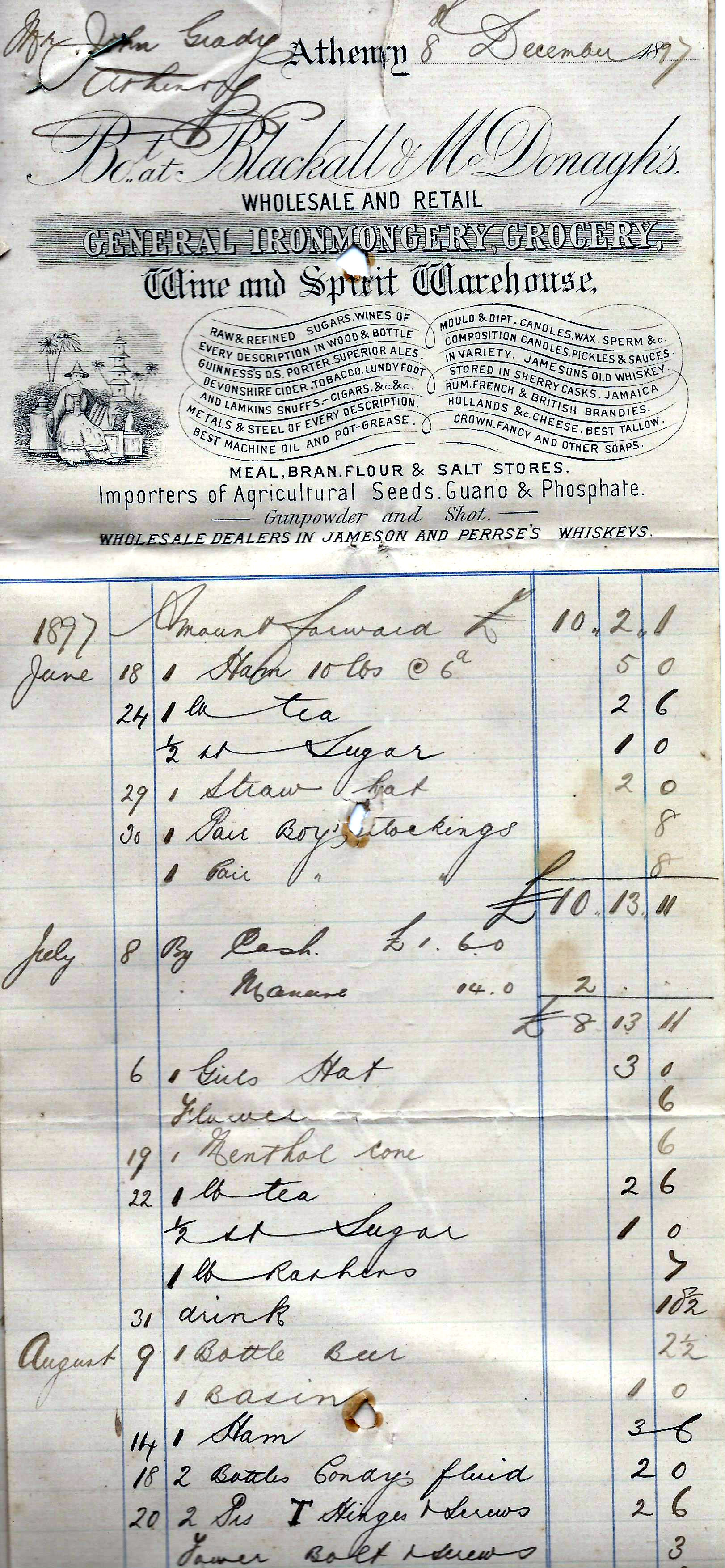
The houses and shops were described in 185I as poor and the streets narrow and unpaved. A chalybeate spring was much resorted to. The market, entitled to be held on Tuesday was not observed, and the fairs, which were but poorly attended were held on 5th May, and July and 2oth October. The population in that year was given as 1,487. Apart from the landed gentry, the professional classes in the town consisted of James Barrett, Land Agent, and Commissioner of Affidavits and Master Extraordinary in Chancery; John Bradish, Master of National School; M. W. Eagar, Surgeon; Nicholas Lawless, Master of Parochial School; and John Lopdell, Barrister of Prospect House. There were three hotels, a Posting House, 5 grocers, I saddler, 2 general stores, 2 carpenters, 5 butchers, 3 drapers, I provision dealer, 4 boot and shoe makers, 1 car maker, 1 stationer, 1 clothier and dyer, 1 tobacconist, 2 black-smiths, 5 publicans, 2 nail makers, 1 gunsmith, 1 dressmaker, 1 cooper, and the inevitable process server.
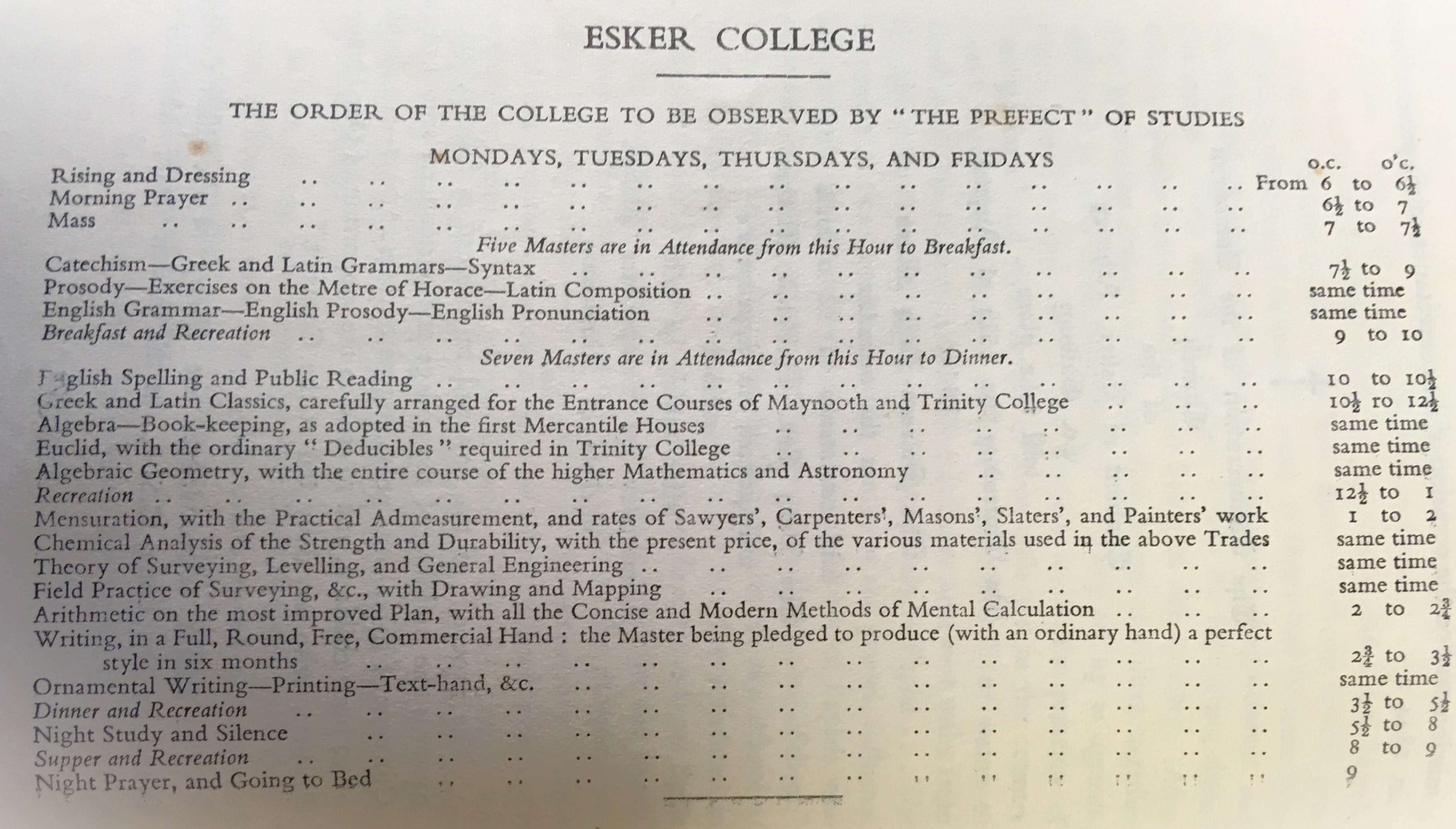
Education was well provided for. The Dominicans who, under the protection of the ‘Dalys of Caronakelly settled at Esker, about three miles from Athenry, and were flourishing there in 1850. They had built a church, a college and an agricultural school for the education of young gentlemen.
For the poorer children there were the national and parochial schools catering for 800 pupils, 100 being provided with food daily. A house of industry educated twenty-four boys and were in turn apprenticed to trades.
The Editor is indebted to the Rev. Dr. Long, C.SS.R., Cluain Mhuire, Galway, and the Editor of The Redemptorist Record for permission to quote from the Rev. Joseph Corr’s articles on Esker Monastery.
” Although a few friars remained behind in Athenry and lived as outlaws in the woods near the town, the main body of the community was forced into exile after the confiscation of the Abbey. The Abbey of Holy Cross at Louvain offered hospitality to more than thirty members of the Athenry friary. There it was that Father John O’ Heyne-who was professed near Esker in 1666-wrote his invaluable record of the Irish Dominicans of those heroic days…. Most of the seventeenth century seems to have been spent by the persecuted friars in the vicinity of Athenry. It is difficult to say when precisely the first friars settled at Esker, because every vestige of their early sojourn there has long since disappeared: ‘etiam ruinae periere‘. It is on record, however, that when the Dominican Provincial asked the Earl of Clonricarde for some place of refuge, he was granted a patch of woodland called Collascaul beside the village of Bresk, which is quite near the present monastery. Here a large college flourished, to which students flocked from places as far apart as Cork and Donegal.”
ATHENRY
(Continued)
” All through the most savage part of the penal era the Catholics of Galway predominated not in numbers only but in wealth and territorial importance. Lords Clanricarde, Athenry and Riverstown were Catholics. So too were the Burkes of Portumna, Milford, Glinske, and Gortmadden, the Dalys of Dunsandle, the Frenches of Durras and Rahassane, the Donnellans of Caltrons, the Martins of Corbeagh and Tyllira, and numerous others.” The earliest notice of the Athenry clergy occurs in the opening year of the century. Robert Blakeney, Mayor of Galway, reported in 1714: “I do find that John Brady a Popish Priest lately lived within the liberties of the said Corporation. Sometimes in the house of Patrick Brown in the town of Athenry and sometimes in the house of Charles French of Geethill near the said Town, and that he the said Brady lately quitted that neighbourhood but I could not find or learn that any other Popish clergymen live or can be found at any place within the said town or liberties thereof.”
The Rev. Joseph Corr, C.Ss.R., in The Redemptorist Record, writes that the pupils of the Dominican school near Bresk led a very different life from that in the colleges of today. The students lived in groups and were housed in wattle-huts, and their relations and friends supplied clothing and food. The staff consisted of friars who had graduated at European universities, and the standard of education and culture was high. The intensification of persecution during the seventeenth century saw the suppression of the school, the friars were dispersed or exiled, many of them became chaplains in the Irish Brigade on the continent.
The letter of Stratford Eyre, of Eyrecourt, dated 3rd March, 1731-2, to Primate Boulter tells how many Catholic landed proprietors in Galway, even though some of them had become Protestants, had set land to Franciscans, Dominicans, Augustinians and Carmelites. Many members of these orders by registering themselves as secular priests succeeded in living in the country. After 1720 persecution abating somewhat they began to collect together again and to form small communities. “They set up as agriculturists, rented a farm, took a few novices under the pretence of ‘servant boys and with the aid of alms collected in the country round about, they managed to live.” Stratford Eyre writes to Boulter: ”The friars of Athenry live at Esker near two miles from the Abbey on the estate of Thomas Power Daly, a Papist . .. The Protestants of this County are in by means of the power, influence and strength, the number and intolerable insolence of Papists who possess entire parishes and not one Protestant family in some of them.” Father Corr remarks that after the suppression of the school at Bresk, Father Anthony McHugo and a lay brother remained in hiding, and some years later were joined by three friars from Spain and by others from Louvain, and settled at Esker in the house, situated between two lakes, which is the site of the present monastery. In 1837 there were seven friars in the monastery. There was a fine cruciform church at the rear of the school which was replaced in 1844 by the present church. The old church was converted into a school. In 1857 Esker became the Novice House of the Irish Dominicans but was closed about 1889. Shortly after the Friary was destroyed by fire, nothing remaining but the walls of the building.
In 1901 it was taken over by the Redemptorist Fathers as a House of Studies, a new wing being added to the old seminary. An adjoining sandhill called “Dominic’s Hill” keeps green the memory of the friars of Esker.
Father Corr in his article reproduces the wording of the admission card on the occasion of the consecration of the present church in 1844:
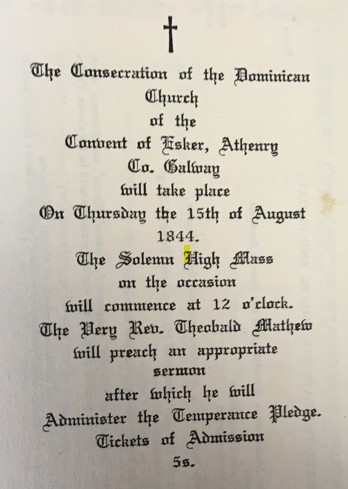 The proceeds of the day will be assigned as follows, viz.:-towards the building of the college and agricultural school of the Convent of Esker–the providing with trades 26 boys–the clothing of so poor children, and to assist in the supporting of One Hundred Paupers, who are daily fed at the Convent.”
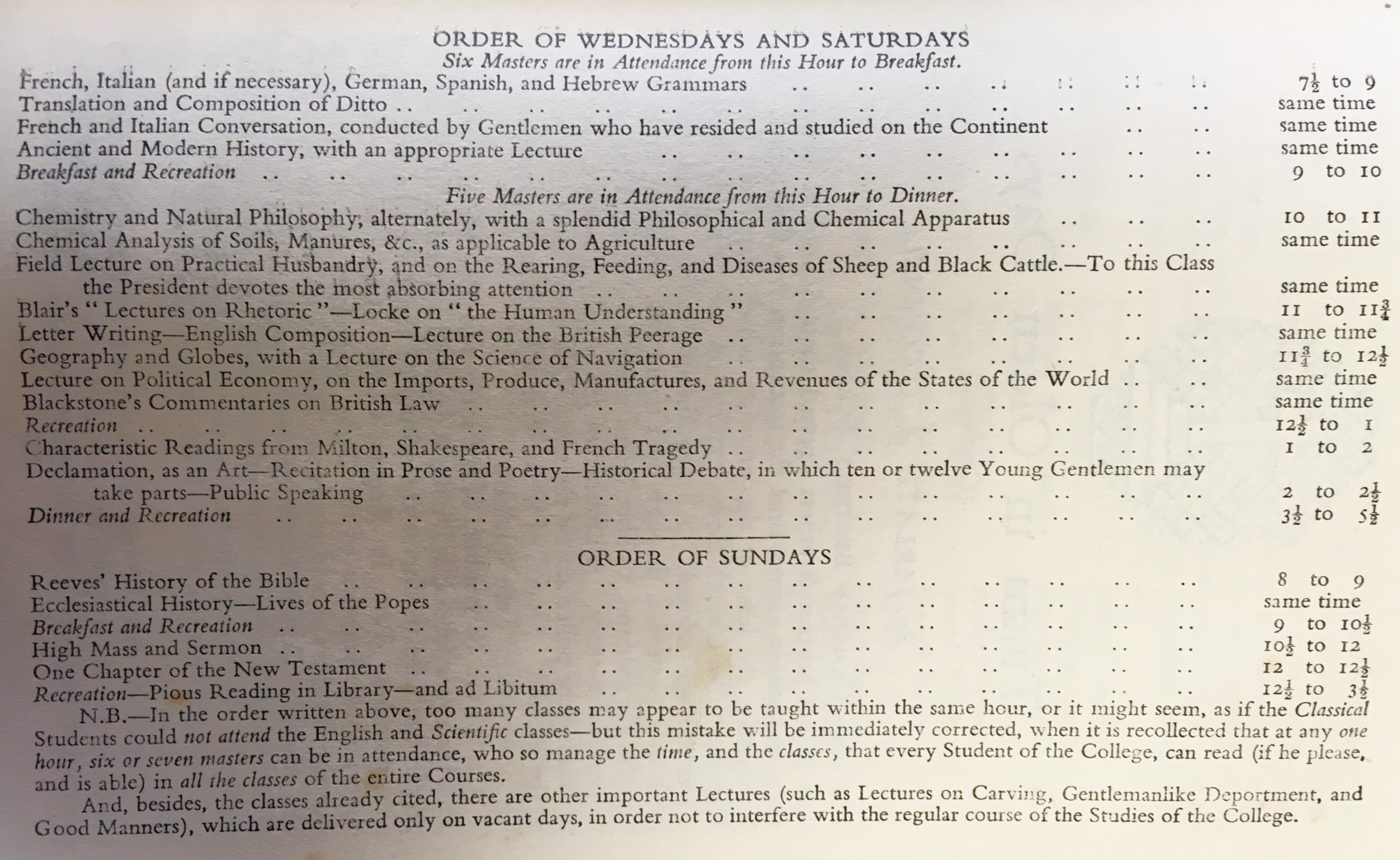
The Editor acknowledges the Horary of the Esker College found by Dr. Long, C.Ss.R., at the present Esker Monastery: