APH
APH
The Agricultural Labourer
Sources: The Tuam Herald, Saturday, September 23, 1893
REPORT BY MR. ROGER C. RICHARDS (ASSISTANT COMMISSIONER), UPON THE POOR LAW UNION OF LOUGHREA (CO. GALWAY).
We continue and conclude this week the Labour Commissioner’s Report on the condition of the Loughrea Union; also Mr Tener’s Report :-
The cottages are for the most part built of stone and mud, and with the exception of a few more modern ones erected by the Marquis of Clanricarde, Captain Smith, and the board of guardians, are thatched. The floors are made of a kind of native concrete, which is said to be very dry and durable when properly mixed and laid. The thatch is laid on wattles, gorse interlaced with strips of wood, and the same material is often used for such partitions as there may be in the cottages, as well as for the chimneys, which often in vain strive to coax the smoke from the peat fire out of the room. In many cases there is no chimney at all, and the smoke after filling the cottage, finds its way out through a hole in the roof made for the purpose, or through other holes, the work of time, or through the open door or half door. There is mostly one window averaging 2 ft. x 1 ft. 6 ins., the casement fixed; in fact the only means by which any ventilation can be obtained is by the doorway. This is in most cases provided either with one door sawn across the middle, or with a door and a half door, the former for night, the latter for day use. The accommodation is varied and only uniform in its utter inadequacy. With the exception of the new cottages built by the guardians, there is no cottage, so I am told, in Loughrea in which there is any outdoor or indoor closet. Such convenience is sought in the fields and the lanes, or in the backyards, which in a large number of cases are a reeking cesspool. In no case could I find that there was any effective drainage from such yards. The rain which came down more or less during the time of my stay no doubt put a severe strain on the drains, but there is in every part of Loughrea an abundant fall, and had there been anything like a free course, the water would have got away as rapidly as it fell. Here and there were more or less dilapidated piggeries ; but these, often an adjunct of an altogether cramped back yard, become an additional source of danger to the miserable cottager, and the pig might with as little inconvenience and risk be, as he is some-times, permanently installed in the cottage.
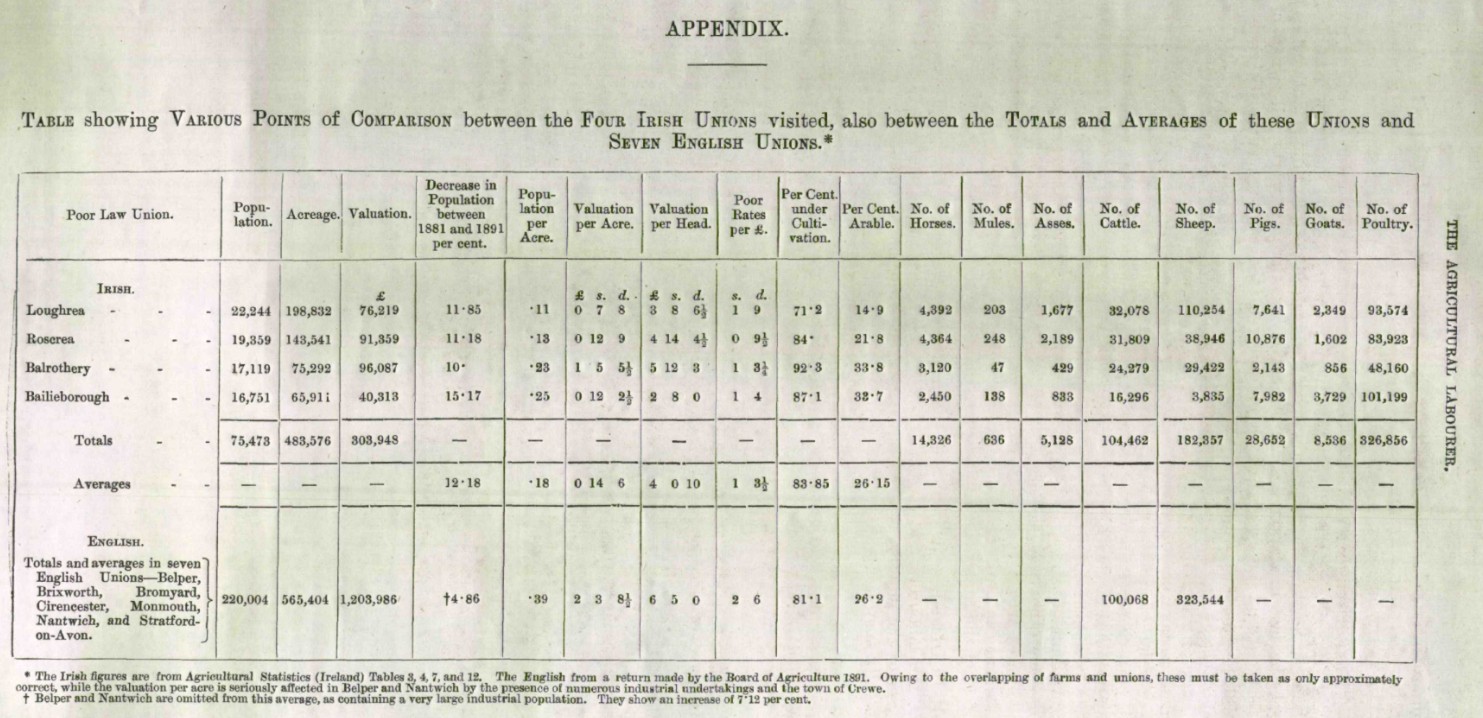
The live stock of the Irish peasant is manifold. First is the almost universal pig. He seems to be inseparable from every household, and often defies the sanitary authorities, who strive to banish him outside the four walls of the cottage. I was somewhat amused at times, when a grunt from an innocent looking box or closed door revealed to the sanitary officer who accompanied me the fact, that he was being thus set at naught. A fair per-centage of the labourers outside Loughrea keep cows, where they have the chance of securing ley for them. Donkeys, and in the more hilly parts goats also, are kept, as also turkeys, geese, ducks, and fowls. The latter share with the pig the honours of inside lodging. On perches over the beds, and in any conceivable point of advantage, the hen is established, and cupboards ostensibly devoted to the family crockery are often a convenient spot for the laying fowl.
Having visited the Loughrea cottages prior to my interview with the Board of Guardians, I was careful to state exactly what I had found, and asked the Board whether there was any special reason for the deplorable state of the cottages, as I was anxious my report should be accompanied by anything which might explain the existing conditions. The chairman Colonel Daly said, he was afraid there was no explanation, except that “nobody is perfect.” From what I gathered elsewhere, both before and after this interview, I am inclined to the opinion, that the state of apathy or inaction with regard to the cottages is owing partially to the friction which has arisen, and still in some measure exists between the Marquis of Clanricarde, the principal owner and his tenantry. Were the guardians to put in force their powers, they would in closing the cottages as unfit for habitation, have to evict the tenants. This they are unwilling to do, though they would have no objection to seeing them evicted by the owner. Owing to this desire to cast the odium of eviction on the shoulders of the other party, or at any rate to the unwillingness to incur such odium, nothing is done, and these nurseries for epidemics are wilfully allowed to continue. Some years ago there was an epidemic in Loughrea, which decimated the population ; and I was assured that were any infectious disease to take root in the place, nothing could avert a repetition of a like calamity. It was further stated as probable, that the large open space of the lake bringing in constantly afresh sea breeze from Galway Bay has alone saved the inhabitants from a constant recurrence of various zymotic diseases.
GENERAL RELATIONS BETWEEN EMPLOYERS AND EMPLOYED
Apart from those existing between masters and servants, or between employers and those dwelling in their cottages, they are very precarious, merely amounting, for the most part, to a daily hire. There is not, however, any feeling of bitterness or hostility, but rather, on the part of the labourers, one of helpless despondency. They will eagerly take any employment which offers continuous work, and, as soon as they have saved enough, emigrate.
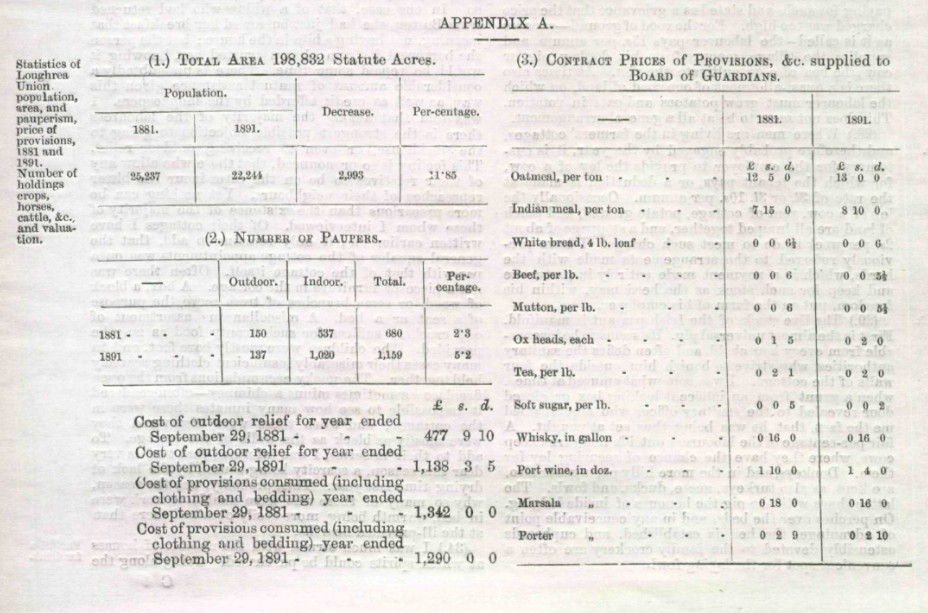
From what has been stated under the heads of Continuity of Employment, Earnings, and Cottages, it will be obvious that the condition of the agricultural labourer in this anion is one of great poverty and wretchedness. Many of those living in the town itself are constantly on the brink of pauperism, i.e. officially so. In one case, that of a widow returned from Boston, she had just borrowed her breakfast that morning, and having a bite in the house; but the person she borrowed it from always trusted her, knowing it would be repaid some time. There is undoubtedly a considerable amount of mutual assistance given this way. as well as credit afforded by the shopkeepers. I am told that among the majority of the labourers there is the strongest possible objection to going to the workhouse, or even to receiving outdoor relief. This feeling is pronounced, that those who allow any of their relatives to be on the rates incur the bitter reproaches of their neighbours. Yet nothing can be more precarious than the existence of the majority of those whom I have interviewed. Of their cottages I have written of earlier on ; it only remains to add, that the general squalor of the cottage appointments was on a par with that of the cottage itself. Often there was not a piece of furniture in the cottage. A box, a block of wood, or some branches of trees serve the purpose of a seat or a bed. A miscellaneous assortment of odd crockery suffices for such scanty food as may be provided. The children were mostly barefoot, and in many cases their miserably insufficient clothing scarcely held together, The smoky accumulations from the open fireplace-sometimes minus a chimney-often rendered it impossible to see how many inmates there were in the cottages and when these were discovered they were mostly as black as the walls of the cottage. To add to their miseries, I was informed that turf was very dear this season, a scarcity being ensured by the lack of drying time last year. This, probably, was she reason why so many of those who were unable to work were in bed, warmth being more easily obtained there than at the ill-provided hearths. I was much struck with the number of bouses at which spirits could be purchased. Going along the main streets or the side streets, is seemed as if every second or third shop were licensed. There are in Loughrea township 483 inhabited bouses, out of which 52, or rather more than 10½ per cent, are licensed. At the fair these places were crowded with people drinking, and though there was said to be much less drunkenness than formerly, there is manifestly great room for improvement, and it would seem just that the temptation to drink should be largely diminished.
Appendix C
1.—BEPORT BY E. S. TENER, Esq., J.P., AGENT TO THE MARQUIS OF CLANRICARDE.
(1) As there is not much tillage, and this district is chiefly pastoral, the farmers have but few permanent hands, and at certain seasons there is not employment for all the labourers. But in spring and at hay harvest the supply of labour is found scant, and, on the whole, is not much in excess of the demand.
(2.) Mainly per day, but men in fairly continuous employment would receive a week’s notice to leave.
(3.) The wages run from 1s. 3d, to 1s. 6d. for fairly permanent hands, and from 2s. to 2s. 6d. for casual labour.
(4.) The cottages are, as a rule, most inferior, and defective in sanitary requirements. In the town, under large owners, the rents are very low, ranging from 6d.per week to 1s. 6d. At such rents the tenants under-took to keep the premises in order. But as that is not done by them, it would be a better arrangement that the owner should execute all repairs, and charge a higher rent.
(5.) The gardens attached to the cottages are small, and it would be desirable to rent to the labourer an additional quantity of land, to not exceed together with his garden, 2 statute acres, care being taken that he should only till a portion, and use the greater part as pasturage for a cow.
(6.) There are no benefit societies to my knowledge.
(7.) The Shepherds’ Association is the sole approach to a trades union. The herdsmen in Galway are much better paid than in Meath, the richest land in Ireland, where the cattle are more valuable, and farmers complain that the custom of paying by Collop, or right to feed a certain number of animals summer and winter, leads to abuse and dishonesty. Many herdsmen have grown rich, and they have as a class the power to make most favourable terms for themselves.
(8.) The relations are not satisfactory ; there is not a benevolent interest taken in the condition of the labourer to the extent that should prevail. On the other hand, the labourer is much of an eye servant, and farmers justly complain of business neglected, and want of diligence.
(9.) In this district the labourer and his family are, as a rule, well clad in home-made frieze or flannel. He does not use slop or old clothes as in other parts—notably in North of Ireland—and the women wear warm skirts and cloaks, and bare feet are seldom seen except in the case of children, and in summer that is not objectionable. But the food of the labourer deserves serious consideration. Formerly he used whole meal made into bread or porridge, and the latter was consumed with milk. Now flour—foreign flour—has taken the place wheaten meal, and oatmeal; and tea, or a vile decoction—boiled tea—instead of milk. Potatoes and flour are used in potato bread. But even that home-made bread is not used as much as formerly. Fine flour bread is purchased, bread carts carry it all over the district, and used with tea, often for all three meals. Vegetables, beyond the commonest cabbage and potatoes, are not grown, and soup is never made. That food is now cheaper than formerly, is an undeniable fact, that is to say, flour, is cheaper. But the food of the labourer used to be more nutritious, living as he did mainly on whole meal, milk, and potatoes. He has now cheap tea, flour, and sugar instead. The clergy of all denominations might do much more than they do to reform household arrangements, and change the food of the labourer. The stimulant of tea too often gives place to the stronger stimulant of whisky and porter. And the scandalous facilities for drinking in Loughrea, which contains 50 licensed houses, provide a temptation for the labourers living in or near the town. I have resided in Loughrea nearly six years, and I have not known or heard of any clergy-man opposing the granting or renewal of licenses. They may preach temperance, but they don’t boldly confront and seek to strike at the root of the evil. I am told by Mr. Toole and others that the neglected state of the streets and footpaths, the filth allowed to lie for weeks, flags broken, &c, is in striking contrast with what obtained before 1882. Mr. Blake, then agent, was murdered in that year. He was chairman of the town commissioners, and. acting chairman of the board of guardians, and under his influence both boards were well worked for the benefit of the rate payers.
With the political and agrarian agitation which took place after Mr. Blake’s death a change followed in the constitution of the town board. The larger ratepayers resigned, because political resolutions and addresses were being constantly brought forward for adoption. Since then, the Board has been controlled by one—the dominant political party—and the state of the streets is an object lesson for those who may imagine that municipal institutions are understood in such towns as Loughrea.
February 25,1893. EDWARD SHAW TENER.

t bo