APH
APH
Source: Tuam Herald, 1889
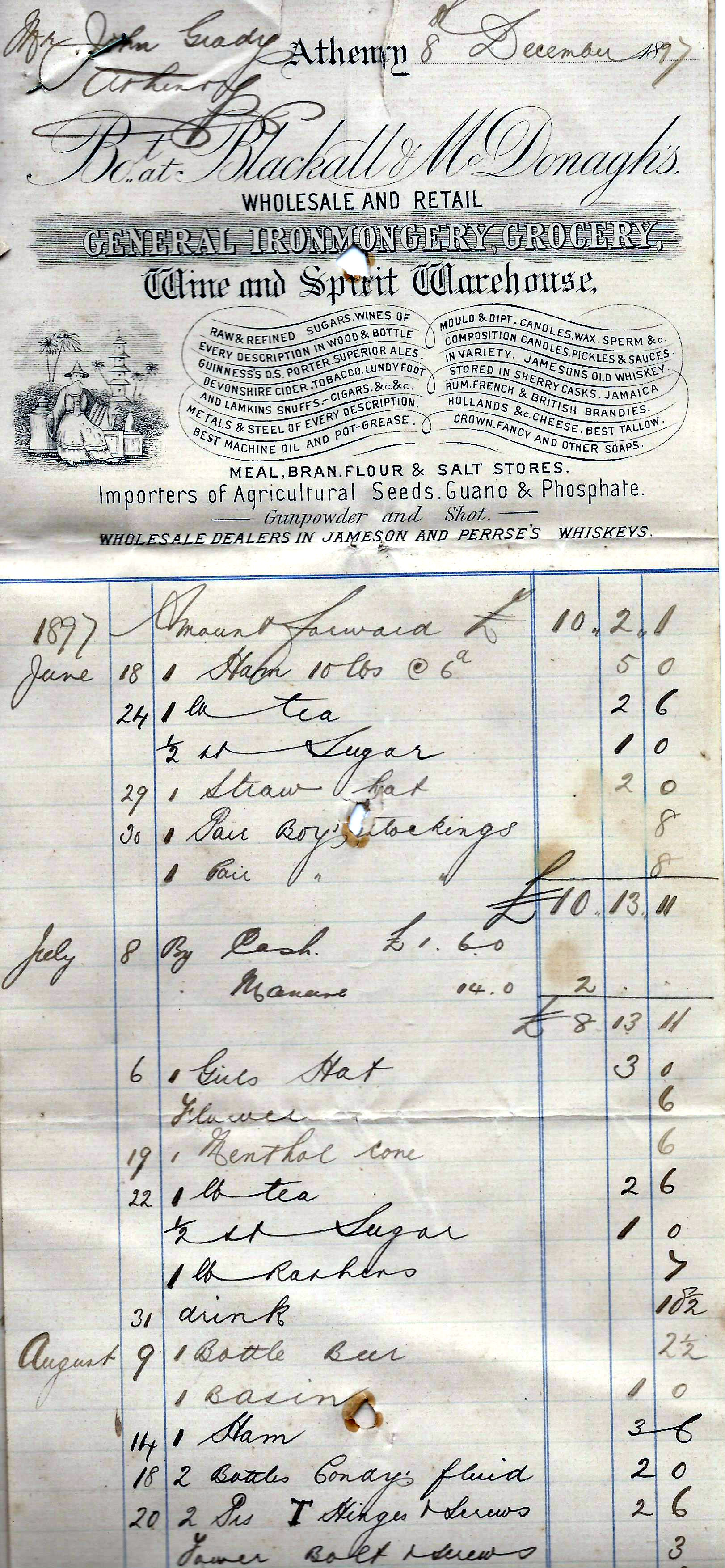
It is pleasing to see in this historic little town such exceptional evidences of prosperity and progress as are to be witnessed in its quaint old streets today. The enterprising merchants, Messrs. Blackhall and McDonagh stand first in this line. They have run up a suite of stores and a set of shops that have not their equal in any other provincial town town in the west. One can easily and cheaply procure at any of their well managed establishments anything from “a needle to an anchor”. This commendable spirit of enterprise and go ahead is eminently creditable, and is a new and gratifying feature in Connaught where except in a few honourable cases of exception, things are for some time past in a sadly unprogressive condition of inexpensiveness and stand-still. Within the past ten years, owing chiefly to the general badness of trade universally prevailing, there seemed no commercial progress, no extension of business premises, no growth of accommodation, and everything appeared to be at a dead level of uniform unprogresssiveness. In Athenry within the past ten years several large houses have been built. A range of clean, well constructed artisan dwellings has been put up, and they were no sooner ready for occupation than they were set, showing that these structures are not only required, but that if decently commodious and cheap can never be unlet and idle. While making mention of the creditable enterprise shown by Messrs McDonagh I may add that other merchants have in their way also tended to improve the place. Mr J Broderick has opened a well stocked millinery and drapery establishment, where the most fashionable goods are for disposal, and so with others.
The Lord of the soil
The chief landlord of the town is Mr Walter Peter Lambert. He purchased the place some years ago and with regard to his relations with his tenants I heard no complaints. Some spoke of his being regular if not exacting, but if the rents are moderate in themselves, that is, so far as I can see, no disadvantage. His only son and the heir of his property, young Mr Lambert manages the estate chiefly. In the times of recent trouble, when agitation prevailed more vigorously than it cares to as sort itself now, Mr Lambert was under police protection. The town of Athenry was garrisoned with soldiers, and the police force were numbered by scores. Now all is changed. Mr Lambert walks securely about as free from molestation, I am glad to think, as any man. The red coats have disappeared; and the police force is now run down to a bare dozen. There are no cases of boycotting, and the best relations of cordial good feeling prevail between landlords and their tenants, which it is for the interest of both parties to maintain.
A few local landlords
The resident landlords are all moderate men not noted for any extreme course of exaction or extortion. So far as I could learn the chief landlords are resident. Major Lopdell of RaheenPark, is known to be a genial, good-humoured sort of man who always lived on the best of terms with his tenants, and those of other estates he manages. I have already spoken of Mr Walter Peter Lambert, who lives at Castle Ellen – a well timbered and fine old place. He, as a landlord, was unpopular, but is not so now. Major Clarke, a local justice, is popular, well meaning and sensible. He lives at Graigue Abbey, and has just retired from the army. Then we have Lord Dunsandle who gained a certain bad pre-eminence for some harsh evictions, but who appears now that the storm then raised is over to have been not so bad as he was painted by the pen of the correspondent, and to have been more sinned against than sinning. At least as bad cases were let pass unnoticed, and not so fiercely written up. The Dalys were always good landlords, and that perhaps made his few exactions the more remarkable and notorious. Anyhow a blessed change has come over his dealings with his tenantry and I am glad there are no evictions. To this fact of the absence of evictions on his estate and others about here is to be mainly attributed to the general peace, good order, and quiet of the place, and it is to be devoutly hoped this fruitful cause of woe, this veritable “causa tererrima beili” will be long absent from the place.
The Parish Priest and his Curate
The spiritual interests of this old Catholic place are in the charge of a fine specimen of a priest, a sound-hearted patriot, well-inclined and active-minded, sympathetic man – Canon Thomas. His curate is also an excellent priest – one who while like his parish priest, not abating one jot of his flocks privileges will, as he does, calmly and reasonably insist on their claims and know no turning or twisting in his advocacy of them. He is greatly liked, and thus though Father William Coen is but a short time here I have been told that since his advent he has been the means of effecting if not bringing about the conversion to the Catholic faith of two persons of different ways of thinking, and if I mention the fact it is not in any controversial spirit but simply as a passing evidence of his zeal which is the more remarkable from the circumstance that if it were known to Fr Coen that it were to be published the first man to forbid the publicity would be his own modest self. One of the persons in question was a Mr Gordon Page, a very learned Englishman, who wrote many erudite books, and was a highly-trained and deep-read man. He insisted on seeing the priest and upon being admitted to the Catholic Church, towards which his convictions always leaned, and his reading only more strongly inclined him.
The Church of Athenry
The Catholic Church is a spacious artistic, and neat building. It was built some 30 or 40 years ago, and owes its erection mainly to Fr Austin O’Dwyer then curate of the place and the P.P. of Kilkerrin, and one of the Canons of the Cathedral of Tuam. Father O’Grady and his successor Father O’Brien – a native of Athenry – did much to the interior of adornment of the place. In the chapel yard is the monument erected to a self-sacrificing young priest who during the rage of a terrible small pox epidemic lost his valuable life in the noble discharge of his duty.
The Historic Monuments of Athenry
Athenry is a place that should be often visited, and better known to tourists and travellers. It contains some very interesting old ruins. The remains of the old walls and fortifications of the place are very interesting, and the Castle and old graveyard are equally so. The old Castle can be plainly seen from the railway station, and it is a fine noble pile yet standing, with but little trace or mark of the ruthless ravages of time. In the graveyard are some quaint and memorable old tombs, mortuary monuments erected by the Clanricardes – the great lords of Connaught in the past – and by other lesser magnates of the county over the deceased members of their family.
The Railway Station
Athenry is a well-known and important junction upon four railway systems – the Midland line from Galway to Dublin, the Waterford and Limerick from Tuam to Limerick, and as controlling and working the lesser lines, the Tuam and Athenry and the Athenry and Ennis.
A Book Stall Wanted
The station is a spacious one with every accommodation but one, and that a book stall. It puzzles a traveller to find that after crossing the Shannon at Athlone he seems to bid goodbye to literature, for at not a single other station is there the approach to such a necessity of modern life and modern thought. I know the country people are not a reading people as the relatively small circulation of their papers show, I know that if by their priests and other guides they were taught and encouraged to take and read newspapers it might be remedied. I hope the Midlands will at once give facilities for opening a book stall at their station for the sale of cheap books, newspapers, the daily and local ones, and I am sure the idea would succeed. It would not cost much to fit up a stall, and I am sure some enterprising young fellow in the town would be willing to rent it, although for the convenience of the travellers on the line the stall should be let for nothing for some time at least.
A Local Director of the Midland
I throw out the hint as there resides in the neighbourhood of Athenry, and deeply interested in its welfare, a popular Director of the Midland – the Hon Richard Nugent, who lives at Rockfield, near the town. He has made his presence and influence on the Board already favourably felt and seen. Through his advocacy a very useful new road has been made by the Company, shortening the way to and from the town, and giving much needed facilities for traffic and the despatch of goods. It is gratifying to see a local proprietor thus connected with a great railway, exercise in so useful and commendable a manner his privileges, and introduce improvements, which while benefitting the public of the locality will also advance the interests and enhance the prosperity of the company. I am sure this terrible blot on the literary reputation of the province will be removed, and that through the gentleman I have named the Midland will do their part and provide out of the ample station accommodation at their disposal, a site for a small book stall at Athenry and also at Galway, and I trust when next visiting the place to see this much needed reform carried out. The station is a nicely built one, and the Midland have provided every accommodation for waiting and for passengers. The station master, Mr Broderick, is an efficient and obliging official, and all the porters willing and anxious servants of the public and of the company.
An Old Country Seat
MoyodeCastle is about two miles from Athenry and it is a splendid old estate. It is the family residence of the Persses, and is now in as good hands as ever being occupied by Mr De Burgh Persse – who has just returned from Australia to enjoy a well-earned rest and to spend some of his well-won wealth in the promotion of the old sport of hunting so long and closely associated and identified with the noble name of Persse.
Moyode Castle and the Hounds
I referred in my last letter to MoyodeCastle, the picturesque seat of the Persses, and as such for generations the centre of the far-famed hunting of the county of Galway. It is situated about two miles from Athenry. The stables of Moyode have been famous ones, producing the best-trained horses that ever crossed a stone wall with the Blazers – the finest pack that ever followed a fox. Burton Persse, a tight built dapper, little man was a capital rider, and as skilled a master as ever threw a pack into covert or cheered one on to a chase. When John Dennis, as I am told, gave up with his hold of life the mastership of the county hounds it was assumed for some short time, and strange to say until death also cut short his career, by John Bodkin, of Kilclooney. When he died the choice of the country, by unanimous and agreeable assent, fell upon Burton Persse, and never was a choice more justified or the hopes reposed in it more fully satisfied. He took over the mastership, and until his decease and for over twenty years he wielded the sceptre of authority with unfailing energy, skill and success. He was a model master and exercised that wholesome control in the field, and that unquestioning autocracy so necessary in the interests of sport. The followers of the Blazers showed that high appreciation of his qualities by presenting him with a splendid oil painting life size of admittedly the premier master of hounds in Ireland. This splendid picture is to be seen, where it is reverently cherished, in Moyode. Dying some ten years ago or so the hounds got into queer hands. Some English gentlemen presuming upon the good nature and credulity of the Irish came over the ‘exploit’ the hounds. One or two left owing bills all round and leaving affecting remembrances after them in the account books of many a shop in Athenry and Galway. The country got perfectly sick of these splendid English bankrupts, bills and blackguards, and it was a relief when poor Captain Butson, a popular resident Irishman, was induced to take over the far-famed and fearless ‘blazers’. Death also a few months ago numbered that genial, good-humoured fellow among its majority, and in fear and with not little trepidation the committee of the hunt found themselves once more obliged to seek a master. Fortune favoured them. A man was found equal to the situation, and what is more – a Persse. Mr De Burgho Persse returned from Australia, where by dint of unassisted hard work, unremitting toil and singular good fortune he had accumulated thousands, volunteered to purchase and pilot the old pack – an offer readily agreed to by the committee owners. He is not master, and long may he wield the horn, and long and cheerily may its pleasant notes resound in Galway’s fields. He has taken over the Moyode establishment, and it being a central and most convenient station, nothing can be more appropriate and no place better selected.
The Banking Accommodation
The banking accommodation of Athenry is supplied by a branch of the Ulster Bank from the head office in Tuam under the efficient and courteous management of Mr J Corry. On every Friday, which is the market day, and on fair days the office is opened for the transaction of business from 10 to 3 o’clock. This is doubtless found an accommodation and a convenience, if, of course, banking is carried on on the principles common to these institutions in Scotland and the North of Ireland.
The Hotels of Athenry
There are two hotels in Athenry, one at the Railway chiefly the resort of travellers during the long waits and tedious delays so often obliged to be undergone at this station by reason of the want of harmony between the two companies who use it. This hotel is under the able control of Mrs Cavanagh, and was built by the Railway Company at the expense of the country, and is consequently a well-arranged, spacious structure. Its massive stone-cut front and picturesque situation make it an object of notice if not of admiration to the passing traveller. The proprietress also runs the refreshment rooms at Mullingar on the Midland system, and her son-in-law Captain Hackett, a solicitor, is the owner of the large and well-managed establishment in Galway. There is another hotel in Athenry owned by a Mr T Kelly, the local commissioner of affidavits, and attached to it is a bar also. In both places the accommodation is good, and I don’t believe there is any cause for complaint found with them.
Fairs and Markets
Every Friday a market is held at Athenry and there are monthly fairs. These are considered good and are usually well supplied with stock. The excellent railway accommodation at hand makes them, of course, very convenient. The district about Athenry is chiefly in pasture, but there are some good villages yet in the neighbourhood which supply the material for markets. The town is obliged to pay tolls and customs to the local owner for his goodness in owning the place and what should go to the keeping up of the place goes to the keeping up of a landlord. Provisions are comparatively cheap and plenty.
Educational Facilities
The Educational requirements of the place are supplied by a male and female national school, under the management of the priests. The system of teaching is the same as at all those schools – a system very much in want of improvement and alteration, to make it more useful and in some way National which it only is in name and nothing more, for to call a system National where neither the language nor history of the country is taught, is a misnomer if ever there was a misapplication of terms.
General Remarks
Athenry is in the Loughrea union, and its medical doctor is a Dr Leonard who resides at a place called the Town House and built as the family mansion of the Hickmans, the former owners of the soil. It has been recently purchased by Dr Leonard (a Tuam man) having been sold by the trustees of the late Robert Irvine who once resided here. After him came a man named Gerald O’Connor, who was appointed a J P of the county and agent for Lord Dunsandle and other local magnates, but who came on hard times and had to leave the country suddenly, giving many cause to lament his career and departure. He is now, it is said, an auctioneer in Buenos Aires. A brother of his, George O’Connor, was a very distinguished Oxford graduate and probably one of the cleverest young Irishmen that ever went to that great University. He died suddenly and when great hopes were entertained of his future – and with reason. There is a memorial tablet erected to his lamented memory in the library of the Galway Queen’s College, which is simple, short, and touching language, recounts his great talents and literary attainments.
Henry George and Athenry
Henry George, the now world-famous economist, the preacher of the new doctrine and the evangelist of the new school, in the height of the Land League agitation visited Athenry, then the heart of the movement, at least the seat of its most active manifestation. No sooner did he land and was his personality known, that the peelers ran him in, as they had under the law then existing unrestricted power to do. “A pigmy peeler prefect”, as he was called, in a tremendous tirade from the old parish priest of the day – Canon O’Brien – named Bell, panting for promotion as all of his cloth do, seized on his quarry, arrested Henry George and his fellow traveller Joynes, a tutor of Eaton and both spent the night in “quod”, only to be liberated the next day as unoffending if not in-offensive politicians, and principally because one was an American citizen, and the brave Lion would not care to quarrel with the great Republic, and the other was an Englishman, and it was the “mere Irish” that were wanted. I was told a very pleasant account of the adventures of the two men and of the horror of the prancing peelers when they found that they had “caught a tartar” and not a poor Irishman whom they could treat as they like.
Athenry, as you approach it from over the railway bridge, presents a curious, quaint, and picturesque appearance. Save a few scattered hovels which are outside, all the houses on this approach are behind the ruins of the old battlemented walls. You can here only get into the town by passing underneath the arch of one of the square towers of former days, and there is a tradition – probably a safe one now – that the massive arch will some day fall when the greatest man in Athenry happens to pass under it but whether it will crush him or not remains to be seen, and can without apprehension be waited for. Then there is the old BirminghamCastle in relatively splendid condition and several yards almost intact of the old walls of this once strongly fortified town – the key to Galway for whenever Athenry fell, with it in a very short time after fell Galway. there are also ruins of an old Dominican convent and an old graveyard rich in antiquities and antiquarian material. For the archaeologist there is not a town in Ireland so rich in ruins of priceless historical value and interest. And yet the guide book makers – those who pen those tedious weary pages that are supposed in Ireland to inform, interest and instruct, but which can be safely trusted to do nothing of the kind never mention Athenry’s ruins. The photographer who takes the views of local noted places in Ireland and puts them on his window in Dublin, never by any chance gives a view of the castle of Athenry, its Abbey, or its walls. The day for all this is probably coming, and I trust the time is not far distant when in such towns as Athenry there will be found in some public place photograph views of the several places of interest in the locality which can be seen by the inquiring and educated tourist, traveller, or natives. Next week I will say a word about “Athenry – as it was”.