APH
APH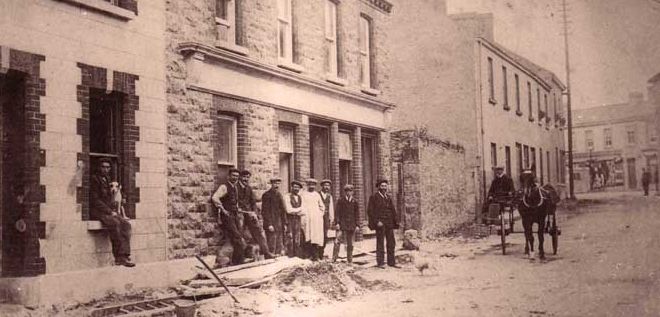
Source: Tuam Herald 14th January 1908.
While we regard the following account of Athenry as it appears in Tuesday’s London Standard as unjust and exaggerated, and as giving an unfair picture of that town, still for many reasons we think that the people down there should know and read what strangers say and think of them. For that reason, and not as agreeing with the remarks in any degree or particular, we publish the article:-
RUIN AT ATHENRY
Take for example, Athenry –“The Ford of the Kings”. Such a spot would have its king, in a country even more remarkable for the prevalence of kings. The soil is ideal for husbandry and absurdly cheap; but it is grass to the horizon, and even the peasant is a grazier, hence the greed for area. The essential demand is not for land to work and live on, but, rather enough land to avoid work, on terms to make industry unnecessary. Thus, the “anti-grazing movement” is in reality, an anti-work movement – a movement for a diffusion of landlordism, in which the labourer is worse than before, under a stupider master, less capable in capital and in knowledge to make employment pay. The old landlord employed somebody, as a necessity of his position; the new one employs nobody, as a necessity of his unfitness. The land becomes less productive, which makes the country poorer, with the leagues and the Land Acts co-operating to perfect the decay.
RUIN OF AGRICULTURE
We enter Athenry from the railway through an ancient gate in the town wall, flanked by a new spire that rises among the ruins and mounds of ivy. As in walled towns the streets are narrow and irregular. The leading characteristics are dirt and decay. “About a third of the buildings in the town appear to be derelict”, I said to a tradesman, and he replied, “More than half”. The ruin of agriculture and agitation destroys the local purchasing power, and down goes the town. Who can keep a shop where there is no one to buy?
The population of Athenry is 853, mainly agitators, but old men tell me there were “five times as many people and ten times as much business” before we began saving Ireland” by agitation. Fenianism, at least, permitted men to till their fields, to stock their shops, and to have some individuality of their own; but the deadlier revolution of the past thirty years, under a “Constitutional” pretende, has killed character and made a prairie, with a sickening slum in the middle of it. Grasping for their competitive shares in a diminishing total, the traders become more and more sordid, while the peasant, the true foundation of trade, dies out under the effect of his own doctrines. With the land idle, and no other means of production, the community decays, and it becomes necessary to blame the “British Government”.
THE ONLY PRODUCTIVE INDUSTRY
Athenry had a member in Grattan’s Parliament, then, the urban constituency had a population of 12,000. Now the area has 853. Much of the town wall stands yet, but the bullock has actually come inside it, fattening over the deserted foundations. After three days I could find only one skilled labourer employed in the town, he was appropriately engaged in the production of gravestones but, with fewer and fewer to be buried, his outlook is doubtful.
EXTRA POLICE IN ATHENRY
On a peace footing Athenry requires seven to eight policemen, but of late there have been seventy or hundred; and those who commit the outrages benefit by the presence of so many policemen and by so much more money coming into the town. In times of sanity, only one police barrack is needed, and now there are three, one of the additional buildings costing the public £30 a month. The present cost of extra police in Athenry alone is over £100 a week, but that is only a small part of the distinction. To protect the life of one man alone in this part of Galway costs the taxpayer between £600 and £700 a year, and he is only one of a multitude, not to mention the great multitude unprotected. The bulk of the victims are actually afraid to admit that they have been attacked, because they recognise the outrage business as the only form of effective government among them. In the long run, Ireland herself has to pay every penny of the additional cost, not to mention the ruin through diverting energy from industry; and this we get from Mr. Redmond’s policy of “making the government of Ireland impossible”. Actual war might be carried on in a country with less destruction to the industrial basis of life and progress.