APH
APH
MRS COADE’S STONE – A LATE 18TH CENTURY
ADDITION TO CO. GALWAY’S
ARCHITECTURAL HERITAGE
Source: Journal of the Galway Archaeological and Historical Society, Vol. 48 (1996), pp. 92-97
Authors: MARTIN FEELY, JERRY LIDWILL and DOMINIC MONAGHAN
In 1769, Mrs Eleanor Coade established a factory at Lambeth, on the south bank of the Thames, for the manufacture of an artificial “stone” to which she gave her name. Coade stone is hard, dense ceramic. Its creamy to light greyish colour made it a useful substitute for the pale limestone and marble which was in widespread use, at the time, in imitation of the architecture and sculpture of ancient Greece and Rome. Its durability is shown by the many examples extant today, reflecting its strong resistance to subaerial weathering, in contrast to natural stone and the later softer Victorian terra cottas. The factory was run by Mrs Coade and her daughter, also called Eleanor, for over forty years, and continued in operation for another thirty years, under the ownership of William Croggon, until 1840, when interest in this form of stoneware appears to have been on the wane 1.
Georgian architecture offered wide scope for the use of Coade stone for decorative purposes. Statues, pediments, columns, bases, capitals, medallions, plaques, vases, porticoes, quoins, reliefs, balustrades, fountains, gateways and entablatures were made to order by Mrs Coade’s craftsmen and shipped to destinations such as Canada, Australia and Brazil. Sometimes original designs were commissioned, but often orders were received for exact replicas of well known ancient works of art. Durable, relatively inexpensive and easily workable, Coade stone admirably fulfilled the aesthetic requirements of the era and was an immediate commercial success.
An air of mystery surrounded the manufacture of Coade stone. The formula and manufacturing process was apparently a well-kept secret. Indeed, it was suggested that the formula for Coade stone was known only to the Coade family and that it died with them. The evidence does not support this theory 2 3. The Coade formula seems to have been widely known throughout the trade in the 19th century. In 1850, ten years after the closure of the Coade factory, Charles Fowler 4 noted the generally used formula for the manufacture of artificial stone: “white potter’s clay forming about one-half; pulverised stone ware from one third to one-fifth; ditto glass, from one-fourth to one-ninth; and some add, for finer purposes, a small portion of Reigate sand and powdered flint, about one tenth part of each”. This formula corresponds with modern analysis 3 , which indicates that the formula for Coade stone consisted of a ball clay, probably from Dorset or Devon. Ball clay is a natural white pottery clay (it used to be rolled into balls for transporting, hence the term ball clay) consisting principally of the mineral kaolinite (china clay). Deposits of this mineral formed in SW England by erosion of kaolinised granites and redeposition of the kaolinite in freshwater lakes (between 23 and 36 million years ago) to form layers of white pottery clay or ball clay.5 The Coades came from Lyme Regis, and would have been familiar with the ball clays of the area. To the ball clay was added, previously fired crushed ceramic (grog), flint, and fine quartz sand, to reduce shrinkage, and soda-lime-silica-glass, as a vitrifying agent. Earlier estimates suggested that these additives constituted about 20% of the composition, but later research indicates a figure closer to 50%. It was fired at temperatures ranging between 1110 and 1150C. Mrs Coade used to advertise her product as “lithodipyra” (“stone twice fired”), a reference to the presence of grog and glass. The hardness, durability and weather resistance of Coade stone can be attributed to the high level of vitrification and low porosity coupled with its chemical composition 3.
In the late 18th and early 19th centuries, Mrs Coade’s stone enjoyed a widespread popularity in Ireland 1. The most prominent examples of the use of Coade Stone are in Dublin – H.A. Baker’s Rutland Memorial Fountain, Merrion Square (1791) and James Gandon used it for reliefs in the Rotunda Lying-in Hospital, Parnell St, (1786). Mrs Coade’s reputation was not, however, confined to the capital, and examples of her artificial stone are to be found elsewhere in Ireland including Co. Galway. 6
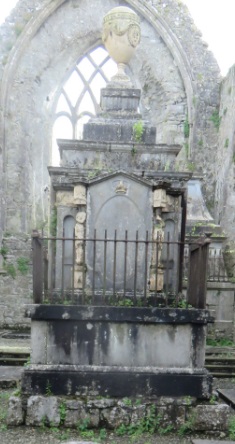
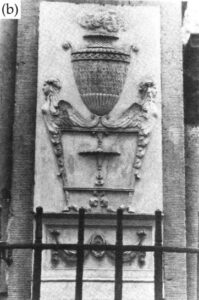
A particularly fine example of decorative Coade stone is to be found in Athenry Friary. In the chancel of this 13th century Friary stands the Bermingham family mausoleum which is constructed of grey limestone. Decorative statuettes together with rectangular and elliptical plaques, all made of Coade Stone, are attached to the mausoleum’s vertical limestone walls (Plate la & b).

The cream colour of the ceramic contrasts markedly with the grey limestone. All of the pieces are in various stages of disrepair. A baroque-style urn made of Coade stone sits on top of the mausoleum. Some of the rectangular plaques are clearly stamped “Coade London 1790” (Plate lc).

A coat of arms of the Cheevers family, made of Coade stone, survives in the ruins of a medieval church located in Killian graveyard approximately 4 miles (6.4km.) NE of Mountbellew. At
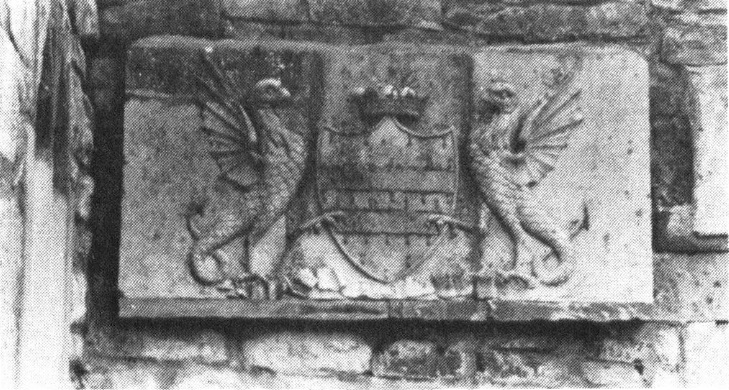
Kilcorban cemetery, approximately 3.5 miles (5.6km.) NE of Portumna, the coat of arms of the Nugent family flanked on either side by a basilisk (a mythical reptile hatched by a serpent from a cock’s egg and said to kill by its breath or glance) provides another fine example of Coade stone (Plate 2).
Elsewhere in Co. Galway Coade stone was used to commemorate a corps of Irish volunteers which helped with the efforts to gain an independent Irish Parliament. Colonel Walter Lawrence 7 8 was a political activist during the granting of independence to Grattan’s Parliament in 1782. In 1782 he founded the Bellevue Volunteers – a corps of 1000 men to help achieve an independent Irish parliament. They wore the Austrian uniform and operated under General De Burgh (Lord Clanricarde) who was commander-in-chief of the Connacht Volunteers. In 1792 Walter Lawrence had a huge piece of Coade stone placed over the main doorway of his mansion, Lisreaghan House, Bellevue, Lawrencetown to commemorate the Bellevue Volunteers who were disbanded in that year 9 10.
This piece carried the inscription “Pro Rege Saepe, Pro Patria Semper” clearly reflecting where Lawrence’s true loyalties lay. This magnificent mansion built by Walter Lawrence has since been demolished but the Coade stone is clearly visible in old photographs of the house. It featured a centrally placed Lawrence family coat of arms which was positioned above two cannons whose barrels protruded outwards at angles over the doorway. This ornamental piece is no longer extant but we have traced one of the barrels which is clearly stamped “Coade London 1792” (Plate 3).

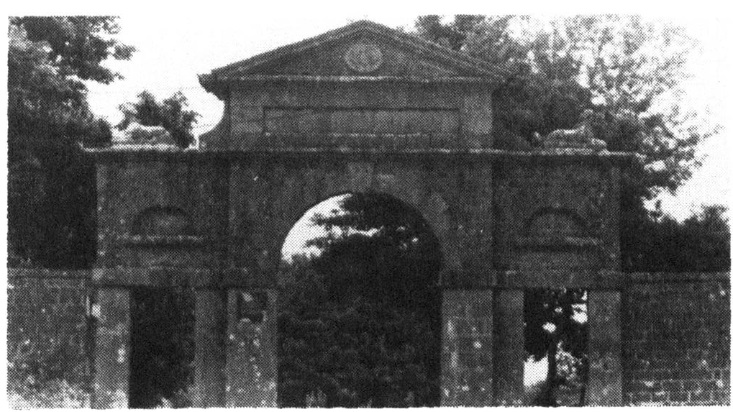
Walter Lawrence also built a gate at the western entrance to his demesne, known as the “New Gate”, to commemorate the achievements of the Volunteers 10” .11 The gate still survives and consists of a main arch flanked on either side by a smaller arch. A Coade stone sphinx sits over each of the smaller arches while an urn and the Lawrence family coat of arms, also made of Coade stone, are located over the main arch (Plate 4).
There is no evidence to indicate that Coade stone was used in Galway City. During the early 19th century, however, a new suburb, Newtown Smith, was established in Galway. It became the location for the Courthouse designed by the architect Sir Richard Morrison in 1812 12. This building was constructed of locally quarried limestone like most of the pre-20th century buildings in Galway 13 14. In 1816, architect Mr John Behan ordered, from Mrs Coade, a Royal Arms of the largest size for the Courthouse in Galway at an estimated cost of 150 guineas1. Indeed Ruch (1970) noted that John Behan’s order “does not seem to have been completed, but Coade made a large Royal Arms at this time, possibly on speculation”. Kelly (1990) however, lists University College Galway as the location for a Royal Arms made of Coade stone which was removed (probably in 1922), from the Galway Courthouse. The Royal Arms from the Courthouse does indeed stand to this day at the outer, westward facing margin of the Quadrangle (see Plate 5) in University College.

This magnificent stone carving is not made of Mrs Coade’s stone but of natural grey fossiliferous limestone similar to the locally quarried limestones used in the City’s pre-20th century buildings. Although Coade stone is no longer manufactured, documents and records relating to the Lambeth factory remain, and although unfortunately incomplete, they are of historical value to Ireland, as there is frequent mention of Irish architects and patrons. Thanks to the durability of her stone, Mrs Coade will not be forgotten, as long as her products adorn our surviving Georgian and Regency buildings and add grandeur to our public parks and squares.
Acknowledgements
The authors would like to thank the Office of Public Works, Athenry, for access to Athenry Friary and to President Colm 0 hEocha, University College Galway, for permission to photograph the Royal Arms. Thanks also to Mr. Christy Cuniffe, Clonfert and to Mr Louis Blehein, Portumna for their advice, and to the latter for access to the cannon barrel from Lisreaghan House.