APH
APH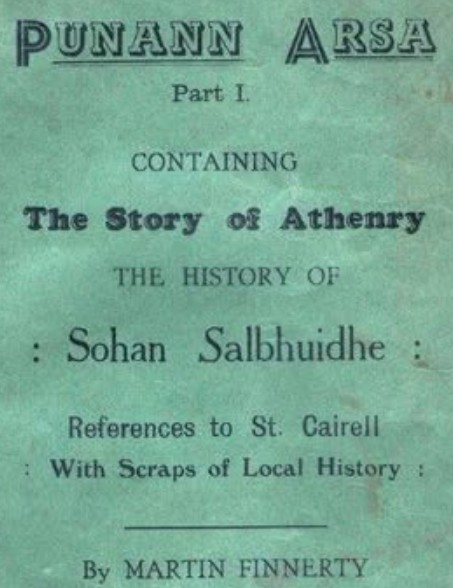
Punann Arsa: The Story of Athenry (Part 2)
Author: Martin Finnerty
Source: Galway Observer, December 9, 1950
In the third century before the Christian Era Coffach Cael Bra murdered his brother Leary Lore monarch of Ireland, and the King’s son, Olioll Aine, and immediately afterwards usurped the throne. Lavra afterwards had revenge for the murder of his father and grandfather; he made a surprise visit on the palace of Dinn Riogh (Dinn Ree) with a small army, and found Collagh holding an assembly with thirty princes and a guard of seven hundred. The palace of Dinn Riogh (Dinn Ree) and the usurper, princes and guard, were all burned to death. Uaen then assumed sovereignty and reigned for nineteen years. There is, therefore, good reason to infer the root name of Athenry (Ait Dinn Riogh) had its origin away back in the very distant past. Dinn Riogh on the other hand lies on the west bank of Barrow and is now called Ballknocken moat.
It is presumable that the great Dun referred to at Athenry was inhabited up to the time of Conn of the Hundred battles, and to the era of the battle of Magh na Cruimhe, for the scene of this historic battle appears to lie immediately outside the ten fortresses. This battle was fought in the year 186, where Cian third son of Olliol Ollum, King of Munster, and his six brothers were amongst the cain, as also were Art son of Con of the hundred battles and Forga, King of Connaught, and so it may be assumed that the place name of Blean’un Riogh and Ait Dinn Riogh had origin centuries previously and at the era when then enchantress had transformed princes and chieftains into badgers, and swans, cornatted them to the badger warrens— to the lakes and ocean &c and got them back to human existence again
So much said, I now propose to give a short account of events in Athenry since the coming of the Normans.
DISASTER FOR IRISH FORCES
Richard de Burgo in the 12th century had taken possession of the town and constructed a great fortress around it. This Richard de Burgo appointed Piers Bermingham as guardian for the town. Sometime before 1216 a castle was built inside the fortress designed to perpetuate the memory of King John of England. In the year 1249 this fortress was attacked and a great battle ensued which ended in disaster for the Irish forces, and kings and chieftans with eight thousand men were left dead on the battlegrounds around Athenry.
Sixty-nine years after that, the town was again attacked and a great battle was fought with disastrous results for the Irish forces when Feilinn O’ Connor and thousands of dead were on the field of slaughter-the greatest battle from the time of Strongbo, fought, lost and won, the leaders and flower of the Irish army lying dead on the field. Piaras Bertningham was at the head of the English and victorious forces As a result of this victory he had been appointed by the King of England. Lord of Athenry.
Again later, Hugh Ruadh O’Donnell attacked. He succeeded in scaling the walls at night and in getting in, but left next morning having ravaged the town and carried off enormous booty.
SYMPTOMS OF DECAY
It is stated that after this the symptoms of decay were evident and from this there was no recovery.
Previous to the descent of Hugh O’Donnell in the year 1574 the town with church was burned by the two sons of Clanricarde. In the year of 1613 a complaint was published to the effect that no Protestant could be returned to represent the town of Athenry in the Dublin parliament. In 1639 Richard Martyn and Dominic Brown were the two representatives and in 1689 James Talbut of Mount Talbut and Charles Daly of Dunsandle. In 1800, Athenry could have only one representative and returned a single member. This was Theophilis Blakeney who sold his vote to Castlereagh for fifteen thousand pounds and the status of borough was no more.
But this is not the end of the history of Athenry. A deal remains to be written of Athenry resurgence. The Dinn Riogh of Wexford to which I referred had a further extraordinary significance in that it had an important bearing on the present day name of the province of Leinster. The army mustered by Uaen to attack the palace of Dinn Righ was comprised of warriors from across the seas; their spears were of a design which were an innovation as compared with those in use at the time in this country. These spears they named Laighne. After this these warriors settled down in Leinster under the patronage of the newly crowned King Uaen, and were from thence known as Laighneachs, and from these the province derived its name Cuigeuige Laighne.
CLANN CIAN
In connection with the Clan Cian or tribe of Cian, facts of history may be found regarding them in various forms: and also accounts of the various Clanns of the succession. To give an account of the various descendants of the clann Cian, it is well to note that as was the custom of those early ages a tribe or clan adopted the cognomen of a common ancestor.
It is to be assumed that with justifiable pride, the above clann who were of the tribe of Cian adopted the ordinary method through all the ages from the commemorating the illustrious progenitor of same. Cian, son of Oliol Ollum, King of Munster with six brothers were slain in the battle of Uanacruive near Athenry. In this battle also fell Forga, King of Connaught, and Art, Son of Conn of the hundred battles as already stated Fiacha Muilleathan, King of Munster in the third century was called Fe Da Liach, the man of the two sorrows, that because on the same day his mother died, his father was killed in the battle of Ua na ekuimhe, that was on the day of his birth and so this accounts for the fourth member of a kingly line to have fallen in this battle and it will be noted that the result of same was that like the battle of Clontarf a nation’s crown was fought for, lost and won. The victor was Louis Mac Conn, a stepson of Olliol Ollum.
Another feature to be noted is the battle had been arranged to be fought at a place convenient to the inlet to the residence of the ancient kings since known as Blea Iun Riogh-Ait Dinn Riogh if you will-this decision was made in the year 186. At that early date in Ireland’s history the greater root of the country was a huge forest. As was customary at the time, the women and children of the combatants were placed in the nearby forest which was on the east side of the place we now call Athenry, at least those of the tribe of Cian. After the battle the widows and fatherless were left to their destiny, to mourn their heavy losses. It will be observed that the hand of providence was with them and not only did they survive their bitter trials, but they and their successors have made history, and to their credit it must be recorded that they have earned from the great forests what is the ancient cradle land of succeeding septs. who have been proved worthy of the traditions of their forbears—the Clann Cian. It is claimed for Ait that he had a prenomination of the divinity, and that he willed not be to be buried in the ancient cemetery of the pagans.
HEWERS OF WOOD
The women and children and those who remained of the manhood of Clann Cian had to seek for an existence in the great forest. Perch by perch, and acre by acre, and mile by mile, they cleared the wood, meantime protecting and defending the territory, which was their well-earned and rightful patrimony, the same they did not wrest by the battle-axe at the expense of others. As most place names did, these woods derived the appropriate designation and were known to the ancients as Collabh Oige, i.e. the woods of au oiege the youth, the orphans and widows of the slain with those of the combabatants who survived the war. Lewy Mae Conu became King of Ireland reigned for 25 years. Apparently as a ruler he was not a success and was treacherously slain in a great assembly on one occasion when he was distributing gold ringlets amongst his warriors. An Oige became men and women— hewers of wood in the actual sense, as well as in the proverbial. History shows that their arms were also trained to war.
Heads of the tribe of Cian was Tadg (Teige). Corma Mac Art the renouned King of Ireland ascended to the throne after Lewy Mae Conn. In the year 226 was fought a battle at Crinna in Meath, between the forces of the King and the North men under Fergus. Cormac defeated the North men at this battle with the assistance of Tadg, because Tadg had brought with him a great army of an oige – of the Clann Dian of Colliahe Oige. For the achievement of Tadg in the battle Cormac bestowed on him and his clann a vast territory extending from the Liffey northward to Drumiskin in Louth. It is recorded that this was the only territory in Ireland that was totally free from forestry.
(TO BE CONTINUED)