APH
APH
HISTORY OF ATHENRY

Here we have Sister waiting to give us some insights into the history of Athenry, beginning with the Normans. I am sure this will be of interest to everyone. You are very welcome Sister.
Thank you Tommy. I an very pleased to have this opportunity to speak on the history of our town.
QUESTION…. Can you tell us something about out its history, now.
Athenry was founded by the Normans because they saw the advantage of its central position & the ford on its river. It is historically connected with Birmingham in England as Donal Kennedy pointed out.
In 1235 Peter de Birmingham from that town, was given possession of lands around Athenry by William de Burgo, the Norman lord. Henry III summoned Peter to Parliament as a Baron — he being the first Lord Athenry. The title to the Barony of Athenry became dormant between the years 1797 and 1802. The family of Birmingham take their name from the old castle of Birminghan in England. After Peter de Birmingham, the Irish in the west of Ireland called the family Mac Feorais i.e. the descendants of Peter or Piers.
The Castle & Abbey were built by Sir Meyler de Birmingham and in the Annals of Birmingham there are no less than 20 references to Athenry town, This was proved by photographer John Whybrow, doing research work in 1973 on the Birmingham family. This town was most important in his research. He invited the people of Athenry over to their Annual Fair.
Q… Athenry was a walled town…when was it built ?
Opinion is divided as to when the Walls were built. Some historians claim the wall was built from the spoils of the battle of Athenry 1316. Mr. Grose writes they were built in 1211 by King John and that the spoils of the battle were used to strengthen them (“New Ireland Review” Vol 2, 1895 )
2. They were built as boundary walls, not for defence … the moat was the means for protection. The walls were surrounded by the ditch or moat. Into it a river flowed. Traces of the moat can still be seen on the road facing Craughwell.
3. The walls enclosed 25 acres.
4.Before they were built, the town was surrounded, in the usual way, by a high rampart with an outer ditch & then a lower rampart. Some of this defence still exists chiefly for about 200 yds, between Laragh Gate site and the east side of the town.
Q….How much of the wall is in existence to-day ?
Two-thirds of the wall still stands. Few other towns in Ireland can beat this or possibly any town on the continent e.g. Carcassonne or Avila.
Q….What was the extent of the wall ?
I will give you a brief outline of that — it extended from the Dominican Abbey to Prospect. After that it runs from behind Ruane’s of Prospect to Brady’s of Church St. (formerly called Chapel Lane ).
Then we lose trace of it for about 200 yds where it ran by the wall of the present churchyard, opposite the sacristy. We pick it up again at the back of the Church, a little before it reaches the convent tower. From this tower to the North gate, the wall is still standing. It forms a boundary wall for both the old & the new Primary schools. Then Court Lane is built on the ditch of the wall. Traces of the wall are in evidence again east of the mill-dam, then through River Lane behind Madden’s forge, where the remains of two houses still stand. Then it joins up at the Abbey.
QUESTION … What about the gates & towers?
There were 6 gates & 6 towers. Number I … North Gate, also called Briton Gate after Breathnac who gave the land. Then Castle Gate at the castle. Laragh Gate next towards Lady’s Well. Spital gate between Monaghan’s of Riversdale & the Pound Road (the name was derived from ospideal – the leper hospital nearby). At Prospect there was Loro Gate or Swan Gate ( the latter called after a public House which was near it). Finally Chapel Gate near the present church. (Nicholroe’s gate or Nicholas’ gate)
QUESTION …Could you tell us something now, about the Dominican Abbey ?
The Dominican Abbey of St Peter & Paul was founded by Sir Meyer de Birmingham in 241 and was recognised by 4 Popes. St Dominic was supposed th have asked for it to be built. In 1423 it was accidentally destroyed by fire. When Elizabeth was queen she gave the lands of the monastery to the Mayor & corporation of Athenry for a rent of £1/22½. In 1574 the Abbey was destroyed again. It was re-built & became a University in 1644. In 1649 Cromwell came to Ireland & the soldiers wrecked the Abbey. They actually stabled their horses there. After that came the Penal Laws. The monks fled to Belgium & some lived in the woods as outlaws. These later started a school in Esker. It is generally believed though, that they never re-established themselves in Athenry after the Penal Laws. Four of the Dominicans were Archbishops of Tuam, 3 at least were bishops elsewhere and 17 of them were recognised for holiness, some of them being martyrs.
QUESTION….Were the Franciscans in Athenry as well ?
Research has proved there were never Franciscans in Athenry (despite information given in 3 Journals). In a later Journal it was noted that the translator from Latin mistook ‘Adare’ for Athenry – hence the long-standing error. To finally verify this, the’ Four Masters’ were consulted and there it states that the Franciscans were brought to Adare in 1464. The ruins, hitherto assigned to the Franciscans, revert to their original the Collegiate & Parish Church of St Mary. (Arch. Jour. Vol. Xl No. 111 & 1V)
Tradition has it that the Church (thatched, like all the houses in the street at the time) was situated in Old Church St. It was probably the one built after Catholic Emancipation in 1829.
THE LEPER HOSPITAL
QUESTION……I believe there was a leper hospital in Athenry ?
A leper hospital did exist close by the Spital Gate. Evidence of the building can still be seen on the inner side of the Town wall. Some people query the fact that there were lepers in Ireland. The fact is, the Crusaders brought the disease back from the East. The disease died out because they were segregated. To add weight to the fact of the leprosy .. there is a leper squint in the Dominican Friary. (Note: the Black Friars they were called)
The hospital was called Spittel St Brigid – probably called after St Brigid’s church, the gable of which still stands in front of Ivy Mount House. (There seems to be some evidence of the Franciscans having been in Ballydavid.
SMALL-POX
QUESTION .. Wasn’t there a small-pox epidemic in the town at one time ?
Yes, there was. It was part of an epidemic that spread over the North and West of Ireland between 1867 – 1874.
2. The disease was directly introduced into Athenry on March Ist of 1874 & became diffused after March 17th.
3. The chief cause of this was the want of hospital accommodation which was not provided until 2 months after the outbreak of the disease. Some people bore the marks of the disease on their faces for the rest of their lives.
4. The location of the small-pox hospital was where Monaghan’s house, Riversdale, stands to-day. Previous to that, during the famine, the soup – kitchen was situated there too.
SHRINE IN NATIONAL MUSEUM
QUESTION…Isn’t there a shrine in Dublin Museum that’s associated with Athenry?
The town’s most priceless treasure, the Shrine of St. Patrick’s tooth is now in the National Museum in Dublin where it is on view. The Latin inscription on it records that it was made about the year 1376 for Thomas Birmingham, Baron of Athenry, Co Galway. Its shape is modelled on a bag or purse and consists of a wooden case covered with cloth and sheathed with bronze and silver. One side bears the crucifixion and the figures of 8 saints in relief, executed in silver. The names of the saints are identifiable – at least four of them..Patrick, Brigid, Colmcille and Benin.
MARKET CROSS (an Eleanor cross)
QUESTION… Now what about the Market cross it would be interesting to hear that?
1. The Market cross is 500 years old. There is a carving of Christ crucified on one side and Mary & the Child on the other. There are animals at the base – it reminds us of Celtic crosses.
2.The cross was used to seal bargains – they touched the cross.
3. It used to be in Parson’s Green – to the east, at the back of Curran’s houses & called after Parson who collected the tolls. This Parson had received a grant, in the reign of Charles I by which the hospital, called the Spittel of St. Brigid , was made over to him together with the right of holding a fair every 18th October.
4. In 1629 permission was given to hold markets in the town and the cross was moved to the Square. A stone with a rectangular hole, still stands in Parsons Green.
5. The cross was made by a man named Coyle
BATTLES
QUESTION…Weren’t there some famous battles fought in Athenry?
Yes, the most important being the battle of 1316.
2. (a) On one side were the Anglo-Normans, consisting of the de Burgos & the Birminghams and many others from around the country. Jordan d’Exter led them.
(b) On the Irish side were the O’ Shaughnessys, the O’Heyne, the O’Kellys ,O’ Flahertys, O’Rourkes and others. Felim O’Connor, King of Connacht led them.
3. The Normans assembled their forces somewhere in the region, between the castle and where the railway now runs.
4.After a day of hard fighting the Irish were beaten.
5. They were beaten mostly by the cross-bows of the Anglo Normans, not long in use at the time.
The Irish put up a brave fight with swords & shields and indeed , some even wore suits of armour – yet! they had no answer to the shower of arrows coming upon them from the cross-bows of the Anglo Normans, who were deadly in their aim.
6. The loss of the battle, finished any hope the Irish had of moving the Angle Normans out of Athenry and indeed of stopping the land-lord system in the west of Ireland.
BATTLE OF 1249
QUESTION…….But wasn’t there also a battle in connection with Lady’s Well?
Yes, that was the battle of 1249 we think.
2. In that year a battle took place between the Normans & the Irish .. as battles often did down the years !
3. The Irish lost.
It is said the B.V.M, fought on the side of the English, for the Irish attacked on the feast of the Assumption and the English had vainly tried to persuade the Irish not to profane such a great feast.
4. It is held that there is reference to this in the Four Masters & the Annals of Clonmacnoise.
5. The Irish then, in atonement for such profanity, established the pilgrimage to Our Lady’s well.
6. The battle was fought shortly after the Dominicans had come to Athenry and as you know, they had special devotion to Our Lady.
SACKING OF THE TOWN 1574
Hadn’t the Mac an Iarlas some connection with our history here in the town ?
1. YES, in 1574 .. the very year in which the Dominican Friary was dissolved, the town itself was sacked & burned by the Mac an Iarlas. They were Ulick and John
Burke, sons of Richard de Burgo, Earl of Claricarde.
2. They even set fire to and plundered the Abbey church, even though their mother was actually buried there. Evidently, their resentment against the Normans overcame any qualms they may have had.
3. After the repair & re-building of the town it was again attacked by them & they drove the labourers away & demolished the new walls & buildings.
RED HUGH O’DONNELL
Q…. Didn’t Red Hugh O’Donnell attack the town later?
He did. In 1596 Red Hugh O’ Donnell & Theobald Burke came with a huge army & burned the town. They took the route through Derrydonnell to launch their attack.
2. They scaled the walls near Spital Gate, by making ladders of their knives stuck into the walls and stepping up along each knife.
3. The Abbey & Church alone escaped the fire.
4. After this, Athenry never recovered its former prosperity and by degrees sank to the condition of a village, remarkable only for its really fine remains of ancient prosperity. As a direct result of this non-development, buildings were never erected outside the town walls, as happened in all other tows. The town walls in Athenry can be clearly seen from the outside.
Now in a lighter vein after the battles !!!!!!! I wonder do many know that the song “Eileen Aroon” was composed by an Athenry man – Charles O’Daly of Laragh Castle, a man of great culture & a noted harper.
He was known as the silver-tongued bard of Connacht:
He was an ancestor of the Dalys of Dunsandle. He fell in love with Eileen O’ Kavanagh the daughter of Mac Murrough in Leinster but his advances were rejected by the chief. Eileen became engaged to Turlough McNamara, a long standing rival of Dalys. O’Daly went to the wedding, disguised as a harper. He was asked to play and he gave his now well known song “Eileen Aroon”
She saw through his disguise and fled with him to Laragh Castle and they were married.
I myself was wondering where Laragh Castle was situated and a pupil from Attymon school told me that his teacher said it was near Attymon. At that time, of course, this district would probably have belonged to the lands of Athenry as they were very widespread.
MACE & SEAL
QUESTION.. Is there any information about the Mace & Seal of the ancient Corporation?
1. The Mace & Seal were in the keeping of John Blakeney of Abbert, a patron of the borough of Athenry and they have been exhibited.
2. It must be assigned at the latest, to the 14th century. It possessed more importance than most of our medieval seals, as it presented perhaps the only contemporary portrait of the Irish mode of wearing the hair & beard, at that period.
3. The design on the seal was that of a castle, from the battlements of which arose two human heads fixed on spikes.
4. We might be justified in assuming that the two impaled heads represented these two kings – Felim O’Connor, King of Connacht and Tadhg O’Kelly, King of Hymany – both of whom were killed in the battle of Athenry. Probably, the design was a warning to future enemies!
5. Now the Mace was the original Mace of the Irish towns. It is of very singular design, being a clenched fist, couped below the wrist, of solid bronze and mounted on a stout ashen handle, about 7 inches long.
6. It is probably the oldest object of its class in the British Isles. Compared with the Athenry example, the other old corporation maces would appear to have been designed, mere for show than use. The Athenry mace was a weapon, which when need required, might prove highly persuasive in the hands of a man of action…rather than of verbal argument.
THE CASTLE
QUESTION… Have you any information on King John’s castle?
1. Same people think that its name refers to King John of England .. of Magna Carta fame and the only King John in its history .. but he was already dead when the castle was built.
2. It is good to remember that it was customary among the Irish to give their lord the title of king .. there is reference to King John Birmingham who was Lord of Athenry.
IS THE CASTLE ARCHITECTURALLY INTERESTING?
1. YES, I will mention a few features to look out for.
2. It is 3 storeys high .. one storey having been added on at a later date.
3. The vaulted roof of the ground floor is supported on square pillars, an unusual feature of such structures.
4. The main apartment above is entered throush a doorway of unusual elaboration. Its pointed arch rests on engaged columns, with delicately wrought capitals.
5. The elegant trefoil windows have pointed heads.
6. Much of the original curtain wall i.e. the outer defensive wall, still stands. It had 3 corner towers and a strongly fortified gate .. the castle not being centrally placed but overlooking the curtain wall at the north-east.
QUESTION…What about the medieval structure of King John’s Castle?
The lowest storey was probably store rooms for food. There was a stone stairs leading to the great hall door and had interesting carvings. The hall floor was of wood, covered with carpets of rushes. In winter, a fire burned on a stone slab in the centre. Smoke escaped through windows covered with skins, to keep out the biting cold winds. The family dined here and entertained guests to wild deer. The Lord & Lady sat at an oak table raised on a platform at one end of the hall. The 3rd storey probably had sleeping rooms. The wooden floor has gone but remains of a ledge are still to be seen. Also defence windows.
THE MILL
The first we hear of it is that it belonged to the Dominicans. In 1574 Elizabeth dissolved the monastery. She granted the property to the provost and burgesses of Athenry & this included the water-mill. They had it until 1627.
Then in 1627 Charles I gave it to the four merchants .. Browne, who fought in the Battle of Athenry, was an ancestor of Lord Oranmore & Browne, Lynch, Martyn, FitzThomas. Browne purchased it for himself in 1662. These merchants were friendly disposed toward the monks & allowed them to return and restore the monastery in 1638.
In 1652 Cromwell took the town, expelled the monks & in 1655 he allotted it to Farrelly who had been transplanted into Connacht by order of Cromwell’s commissioners. He was a Papist turned traitor. The mill etc. remained in his possession until 1668.
In 1662 Charles II passed the Act of Settlement whereby lands taken by Cromwell should be restored. So Catherine Bodkin, wife of Browne, petitioned for the restoration of her husband’s property which included the Mill. Her petition was barred.
Instead in 1668 Charles II granted the Mill & lands of Athenry to Captain Montgomery for pay due to the Royalist troops in Ireland.
Montgomery set up a Naming & Tucking Mill & designed a weaving manufactory – perhaps on this site. The inhabitants then, were almost all weavers and cottoners. Obviously this industry died out but around 1900 there was a weaver working near North Gate..Cunniffe by name – father of Batty and Jack. Their ancestry went back to the time of Montgomery.
We know the mill was in the possession of Irwin because he diverted the course of the river and lowered the river bed by 6 feet to make the mill-race. It was Irwin who built the Town House in the Front Lawn where Dr Leonard and his family lived later. (the Back Lawn belonged to him also.) The last of the Misses Leonards died in 1955. Her brother had succeeded his father as doctor in the town.
The next reference to the mill is that the Taylors owned it until the 1960s. Also butter box and egg box making was carried on there by the Taylors. When the course of the river was changed some people immediately moved in, and built houses there as it was no-mans land, they had no rent to pay. Two of the houses still stand.
OTHER INDUSTRIES
Ruane’s mineral waters .. 1920 – 1946
Ruane’s electricity generating plant until the Shannon scheme took over.
Sack factory 1939 – 1960.
Important dates
1911 – 1929 business peak
1881 – 1929 a prosperous town – exported eggs, poultry, butter & the hinterland trade.
Markets now twice a week. Fairs more than 10 per year in the 1920’s.
1929 – 1939 decay because of economic wars.
1939 – 1955 eggs & poultry good business again. Then about 1959 England herself goes in for large scale egg & poultry business, resulting in big decay here.
Farmers turn to cattle, beet & potatoes.
OTHER ITEMS OF INTEREST
There was a Presbyterian church in Spital Gate area .. of course the church in the middle of the town is distinct from this one. This Presbyterian church had a red galvanised roof. Monaghan’s house, Riversdale was formerly the residence of the Protestant minister Rev. Mr Burkett. Some years ago his son’s name appeared on the Sunday Times for research he was doing in Africa.
Old Athenry .. around Newford
THE LIBERTIES: (most towns that had boroughs, had areas around them called Liberties)
Athenry Liberties extended on the west side towards the village of Oranmore about three and a half miles. The boundaries are not actually defined but a map of the Liberties shows that they include the town and the lands to the north, Carnaun, Cathair Cranog, Carntubber, and Kilcornan on the east. Around Gloves, Bresk & Rahard & Pollnabanny, Ballinameed.
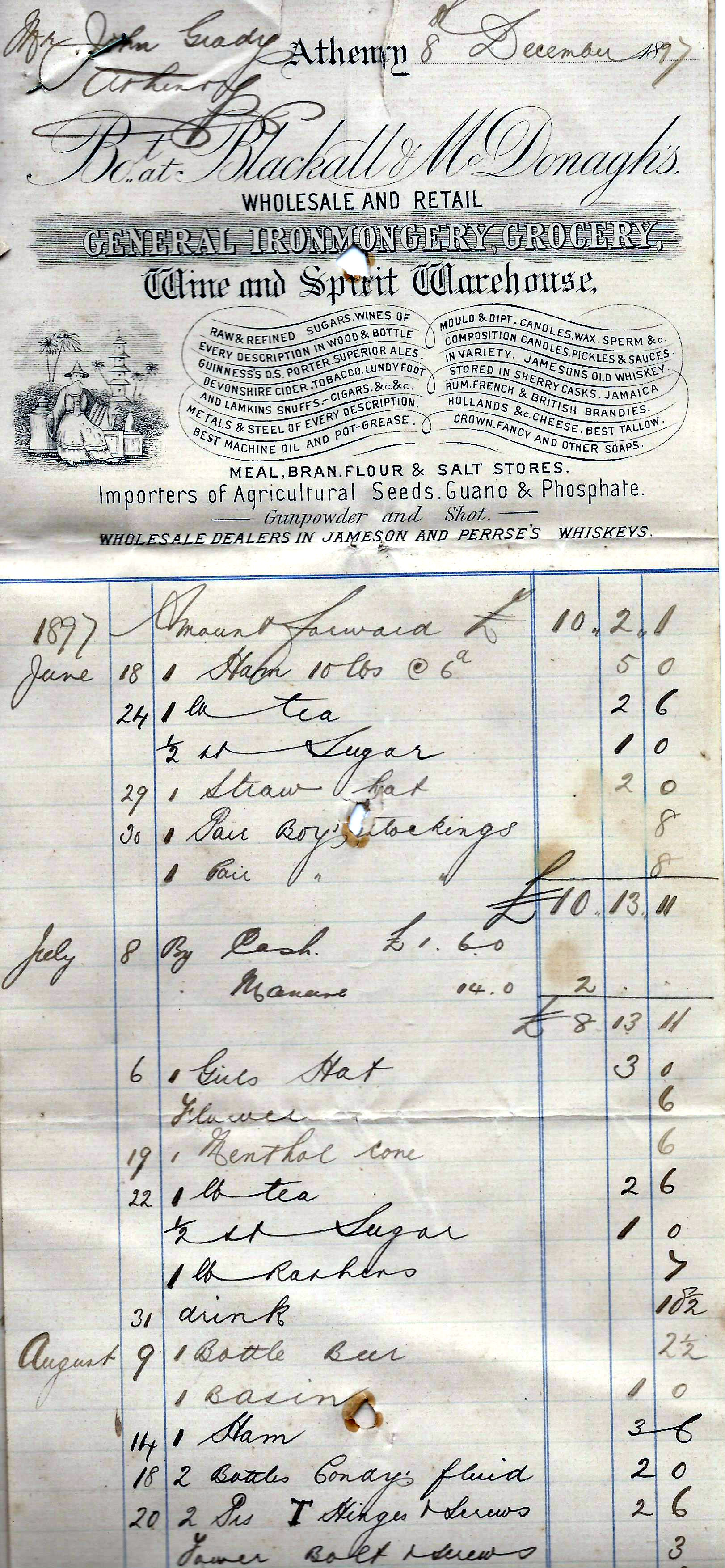
HOUSES & SHOPS IN ATHENRY IN 1851 a poor town, streets narrow. and unpaved, population 14,087.
Professional classes —-
James Barrett, land agent & commissioner.
John Brady, Master of National school.
Mr Eagle, surgeon.
Nicholas Lawless, Master of the local school also.
John Lobdell, Master of Prospect House.
3 hotels, a posting house, 5 grocers, 1 saddler, 2 general stores, 2 carpenters, 5 butchers, 3 drapers, 1 provision dealer, 4 boot & shoe makers, 1 car-maker, 1 stationer, 1 clothier & dyer, 1 tobacconist, 2 blacksmiths, 5 publicans, 2 nail-makers, 1 gun-smith, 1 dress-maker, 1 hooper and the inevitable process server. (Quote from ‘Galway Reader’ …Sam Maguire, Galway Librarian, 15 years ago)
5. Rifles – Casement – Tralee – Banna Strand … some of the rifles were for Athenry mentioned in House of Commons as the ONE DARK SPOT in Ireland……to us the one bright spot !!!
Most of the important leaders in the north had connections with Athenry.
Old Church Street got its name from the former church which was situated where the present Casey’s shop is, opposite Fox’s Lane. Later, the late Canon Canton (P.P. Athenry 1890 – 1920) lived there while the present Parochial House was being built. He invited the Presentation Sisters from Tuam to teach here & he vacated his house for them – it still forms part of the convent. The nuns taught, at first in the Old Primary school in Bridge St. and went there each day in a closed carriage – the Presentation Order was an enclosed Order at the time.
In 1852 the church was built on its present site. The labour in its construction was voluntary – the then P.P. went round on foot to each house in the parish to ask what they would volunteer and so sand & stones were brought voluntarily in their carts drawn by horses.
They built it in their own time as the Railway Hotel was in the course of construction at the time. It later became a private hotel (Duffy’s, The Arch) next a hotel management school & now forms part of the Agricultural College for Training courses for farmers.
7. The extinct corporation consisted of all the burgesses and a Portreeve, who was annually elected, and who in turn appointed the clerk, the sergeant-at-mace, the bell-man, and the other town officials; and a borough court was also held by the Portreeve or Mayor, who was a justice of the peace in virtue of his office.
8. From the reign of Richard II (1377 – 1399) Athenry was represented in Parliament until this privilege was swept away by the Reform Act.
9. In 1698 many priests were executed & others banished during the Penal Laws.. (200) Some of them remained around Athenry & one priest had a secret room at a house in Greethill called Keanes.
10. Sir Edward Carson .. founded Ulster Volunteers . his mother was Lambert from Castle Lambert — descendants of Cromwellian soldiers who settled down here after Cromwellian invasion. Her name was Kathleen Lambert. Her prayer book , “Book of Commor. Prayer”, was found by Donal Kennedy in the old Protestant church.
Edward Carson, born in Dublin, lived for a while in Athenry & came on holidays..Supposed to have played hurling with the Cussaun lads.
11. Loughrea road was also the birth place of a famous Galway man ROBERT O’HARA BURKE he was the first men to cross the wastes of Australia. Fr. Reynolds, a native of Athenry in Australia, in a letter says there is a monument to him in Melbourne. Fr. Reynold’s mother remembers meeting a grand-niece of Robert O’Hara Burke’s down in Leonard’s back Lawn.
12. LOBDELL: One of the Lobdells (landlords) went to Birr& inter-married with the Parsons of Birr who are related to the de Veshies.. Lord Snowdon is related to them. They went from Birr to Kenya & then to New Zealand. Ten years ago, this gentleman came to town. a Mr. Parsons .. an inspector from New Zealand. He visited the house in Raheen and also the Boy’s N. School.