APH
APH
Source: The Antiquities of Ireland, Volume 1, London 1791
Author: Francis Grose
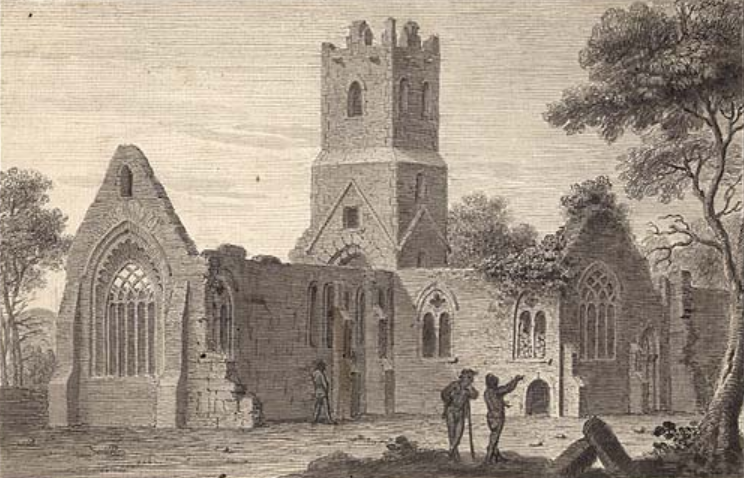
Abbey of Athenry
Athenry was formerly an handsome town, surrounded by walls by King John in 1211. Meyler de Bermingham, second baron of Athenry, granted land to build a Dominican monastery on, and one hundred and sixty marks. St. Dominick, it is said, writ to Bermingham for this purpose, and a noble fabrick was erected in 1241. Florence O’Flin, Archbishop of Tuam, Thomas O’Kelly, Bishop of Clonfert, Walter, Earl of Ulster, William de Burgh, and others, were great benefactors to this church. |
In 1400 Pope Boniface IX. granted a bull of indulgence to those who visited and contributed to the repairs and preservation of this monastery. An accidental fire having consumed the church in 1423, Pope Martin V. issued another bull for its reparation, and in 1427 William Ryedymer and Richard Golber, and other Dominicans, having represented unto the said Pope Martin, that there was a want of religious men to instruct the natives in the Catholic faith, petitioned him for licence to found two chapels or oratories, with a belfry, bell, cemetery, house, cloisters and other offices (cum campanili, campana, cemeterio, domo, claustro & aliis officiniis). Where these chapels were built is not well known, but it is supposed they were at Tombeola, at the head of Roundstown bay, in the barony of Ballynahinch, and at Ballindown, in the county of Sligo.
Pope Eugene IV. in 1445, renewed- the bull of Pope Martin for the repairs of the church, at which time it had thirty monks ; and in 1644 it was erected into an university (studium generale), with four others for the Dominican order, by order of a general chapter held at Rome.
The little dependance to be placed on Monkish inscriptions and antiquities, when the honour or interest of their order is concerned, will evidently appear from the following certificate :
”We, the underwritten, do, by these presents, testify to our posterity and future ages, that we saw and read with our eyes this inscription, placed over the door of the refe ctory of Dominicans, of Athenry.— Carolus manus rubræ me fieri fecit: – As time will eraſe these letters, we have given this testimony this 24th day of October 1725.
Thomas Power Daly, of Carrownokelly, Esq.
Dennis Daly, of Frenchbrook, co. Mayo, counsellor at law.
Peter Daly, of Quansbury, co. Galway, counsellor at law.
James Browne, Athenry
Andrew Semper, Athenry
Andrew Browne, Athenry
Michael Berny, deputy portrieve of Athenry.
R. P. Fr. Raymundus de Burgo.
R. P. Fr. Augustinus de Burgo.”
Without doubt, these respectable persons saw what they testified, but the inscription is a palpable forgery, and allowed to be such by the historiographer of the Dominican order.“ For,” says he, ”how could Cathal Croyderg, the person alluded to, who was titular King of Connaught, and died in 1224, cause this refectory to be made in 1241, the true time of its building.”
The cemetery of this monastery was a great place of interment: in it were laid the de Burghs, M’Davocs, O’Heynes, Killikellies, Moghans, Brownes, Lynches, Colmans and Dalies.
Is the 16th Elizabeth this monastery, with its appurtenances, thirty acres of land in Athenry, and twelve in the town of Ballindana, were granted for ever, in capite, to the portrieve and burgesses of the town of Athenry, at the yearly rent of 26s. 4d. Irish money.
The remains of this monastery show it to have been a noble, extensive pile; part of them are converted into barracks, and the barrack-yard was the ground where the cloisters stood. The tower is unequal, the lower being larger than the upper part. The eastern window is in a good style.
This View was taken from an original drawing by Bigari, in the collection of the Right Honourable William Conyngham.
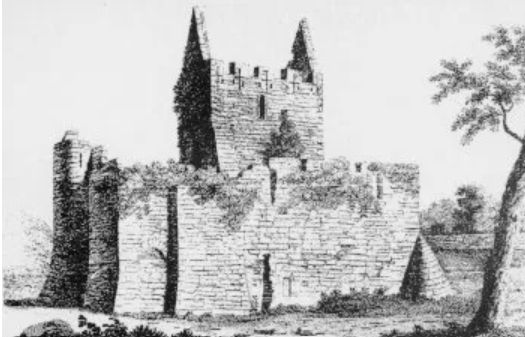
Bermingham Castle
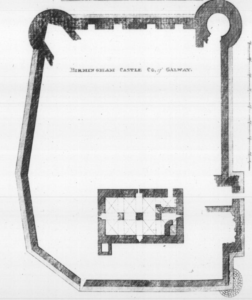
Stands in the town of Athenry. The family of Bermingham was early settled in Connaught, and were no mean assistants in aiding the English in subduing it. This castle, as was usual, was constructed to secure his possessions, by Pierce de Bermingham, in the reign of King John, by whom he was summoned to parliament, and had a grant of 20 marks a year, payable out of the exchequer of Dublin, for his support in the king’s service.
This Castle has been much altered by years and various possessors from what it originally was. It now consists of a square tower, well built, of brownish stone, standing in a large area, surrounded by a wall of irregular figure, composing a sort of hexagon, flanked on one side by two towers. There is a projection at the the entrance, and a walk and parapet on the wall, in which one embrasure is visible, and probably there were more, which are now overgrown with ivy. This View was taken from an original drawing by Bigari, in the collection of the Right Honourable William Conyngham.