APH
APH
Source: The Story of the Presentation Sisters,
Scoil Chroí Naofa and Presentation College, Athenry
1908-2008
Editor and Compiler
Gerald Ahern
Prologue
The Penal Laws of the 18th century and the early part of the 19th prohibited the building of schools for Catholic children. This injustice denied even a basic education to nearly 8 million people.
‘Hedge Schools’ were the only avenue to learning. However, their locations were transitory; the visits and duration thereof of teachers irregular and too few to cope with the growing population of the times.
Folklore has it that in 1808 Watty’s Hedge School in Court Lane, Athenry, provided some basic education for the lucky few that attended.
The Irish National School System
Two years after Catholic Emancipation, the system of National School education was established in 1831. This was to be administered by the Commissioners of Education under the National Education Board. £30,000 was provided to pay teachers’ salaries, give grants to existing schools to fund equipment and, importantly, to provide for the building of new schools. All of this came into existence following a letter (later to be known as Stanley’s letter) sent by the then Irish Chief Secretary, Edward Stanley, to the Duke of Leinster. Parishes were encouraged to apply for funding to build schools and to pay teachers’ salaries.
However, the system was slow to take off in the Archdiocese of Tuam due to the lack of trust of Archbishop John McHale in the educational authorities. He resisted until 1852 when, through a pastoral letter, he gave his approval to Parish Priests and religious to apply for funding to set up local schools. The children of the Archdiocese had lost a quarter of a century’s education. Four years later, Athenry’s children were provided with national schools and, given the puritanical nature of society at that time, the sexes were educated apart.
Athenry’s First Primary Schools
In 1856, Father John O’Grady commenced to collect for the erection of Schools in the town of Athenry. A site on what is today called Abbey Row adjoining “The Abbey”, the ruined Priory of Saints Peter and Paul belonging to the Dominicans, was given free by a Mr. Hickman, a retired Protestant solicitor, who also gave a donation of £5 towards the erection of the schools, which always has been and is parochial property, no help ever having been asked of the Education Board. The schoolhouse was built for two schools (one for boys and the other for girls) under one roof, having no internal communication, each school room having its own door in a twin porch.’
Athenry Parish Inventory Book.
Athenry Female National School.
In 1875, Athenry Female National School had 35 girls on rolls. The Census of 1901 states that 83 girls (two of whom were Protestants) were attending the school and the names of some of those attending that year and the two following years were:
1901: Harriet Cole, Emma Cole, Rosanna McKeon, Mary Whelan, Mary Daly, Annie Clancy, Kate Feeney, Nora Doherty, Margaret Path, Kathleen Path, Nora Nolan, Annie Quinn, Mary R. Mulvenna, Mary E. O’Regan and Bridget Clasby.
1902: Louisa Scully, Mary Kennedy, Josephine Morrissey, Hanoria Curran, Bridget Dunleavy, Sebrina Cahill, Margaret Clasby, Mary Joseph Brady, Kate Kendregan, Mary Halvey, Nora Halvey, Sara Burke, Delia M. Lynskey, Mary E. Kendregan, Annie Henehan, Ellen Regan, Kathleen Cleary, Ellen O’Dea, Ellen Callinan, Maud Flynn, Julia Costello, Eva Kells, Frances Kells, Mary Coen, Annie Kennedy, Annie Flanagan, Elizabeth Judge, Margaret Finnerty, Mary Finnerty, Nora Waldron, Agnes Walshe and Mary Flynn.
1903: Mary Murphy, Margaret Murphy, Sara Niland, Bridget Keane, Mary B. Dunphy, Kathleen Dunphy, Kathleen Sheehan, Mary Higgins, Delia Costello, Mary Cauley, Bridget Walshe, Vera Beatty, Henrietta Beatty, Margaret Mahon, Veronica McMahon, Kathleen Higgins, Sara Ann Daly, Mary Kenny, Annie Barrett, Ellen Barrett, Mary B. Collins, Kate Payne, Mary Kate Treacy, Mary Clancy, Annie Kenny, Mary Connolly, Mary Kate Doherty, Mary Murphy, Mary Ruane, Nora Dunleavy, Mary Doherty, Mary Flood and Helen Flood.
The Inspirational Canon Joseph Canton

Canon Canton’s letter, dated June 18th 1907, to the Reverend Mother of Tuam Presentation Convent requesting Sisters for Athenry Female National School.
In 1907, it was the news of the eminent retirement of the Principal Teacher of Athenry Female National School, Mrs Dolan, that spurred Parish Priest, Canon Joseph Canton to sit in his parlour on the 18th of June to write to the Reverend Mother in the Presentation Convent, Tuam to enquire of her if she would ‘send a few nuns here’ that would establish a Presentation Convent in ‘poor old’ Athenry. In the same letter he expressed his anxiety that ‘the appointment of teachers would be taken out of our hands and county District Councillors would vote for the appointment of a friend’s child in preference to a community’.
It was this letter that set in train the development, to a very large degree, of the educational structures that Athenry enjoys today.
The letter, while having a very explicit request, also implied mistrust in Councillors of the time, whom he believed would put selfish personal interest before the educational needs of local children. He also desired to strengthen and deepen the presence of religious within his parish and maintain Catholic control over local primary education.
The Canon followed up with another letter to Reverend Mother in Tuam on June 20th, to again request ‘if it were at all possible for you to send three or four sisters here so that if, unfortunately, you couldn’t entertain the project I should seek elsewhere so as to have some information to submit to His Grace, (Archbishop John Healy), when I should meet during Retreat Week…’
This was subtle pressure from him on the Reverend Mother to get her to make a decision one way or another as to his invitation. It worked and a commitment was given to send four sisters to establish the Presentation Convent in Athenry. “Thanks be to God, to His Grace and to the Presentation Community-they are the givers, I and the Parish are the receivers.” (Letter dated 19th October 1908.
A New Parochial House and Plans for a Convent National School
Canon Canton was thrilled that ‘the matter is on a firm basis and that we can set to work at once’. This entailed acquiring temporary accommodation in ‘an unfinished building down town’ in Old Church Street (in the building on the right of the present Gardners’ Guest House), as and from the 2nd of January 1908 when he would hand over his home to the Sisters. He also had to get quotations for construction of the new Parochial House, the keenest price being £700 from the Monahans. He intended to site it ‘as far away from the Convent-as we may call it now-as can practically be done with a view to the aesthetic’.
It was also his intention to build a school-house and in his letter of the 15th of August 1907, he stated that “the price for which I could make a school-house, similar to the drawing is £570”. Nine days later he wrote that, after learning from the annual Report of the (National) Commissioners (of Education) that floor space for pupils would be 10 square feet in any proposed new schools, the price would increase to £690.
He forwarded some plans and costings to the Commissioners of Education and received a curt statement that his plans were ‘obsolete’. He was invited to request from them a ‘sketch type plan’ that would assist his architect and then apply for grant aid.
During October 1907, correspondence continued between Canon Canton and the Sisters as to the cost of a new school-house. He gave the sisters’ plans for the building ‘to John Broderick to develop and draw up specifications according to (National Educational) Board’s requirements’. However, nothing came of them and it would be two years later before this project became a reality.
Refurbishment of the Convent and work on Athenry Female National School

Athenry Presentation Convent circa 1918
By the 28th of October, Canon Canton had repaid the debt of £354 7s 5d on his presbytery to the Commissioners of Works and ‘so the Parochial House is free’: the Nuns would be taking over a mortgage-free property. He now set about adjusting the interior to suit its new owners. On December 10th he wrote to Presentation Reverend Mother in Tuam, ‘the first convoy of ammunitions and stones arrived today-two cases of hardware, apparently, and five bedsteads and springs’ and ‘they are safely stored in the convent’.
He submitted stage prices for sand and stone to the sisters in Tuam:
“Stones are 2/10 per cart if left on the site. Sand is 1/6 or 1/8 if left on the site. Labour is dear: 2/6 per day, 3/6 in the spring, but things may calm down”.
A letter, a week later, to the same Reverend Mother states that “I went down to the school (Athenry Female National School, near the Dominician Abbey) today to see how it looked. I shall tomorrow get a man to dry brush down the interior walls and clean and mop the floor. It would scarcely repay the expense to either paint or whitewash it in this damp season but we shall do our best to have it clean and the windows brightened, a river runs in front of the school.”
Evacuation and Moving to Old Church Street.
By December, Canon Canton informed the Sisters that “nearly all the furniture we are bringing to our Town Residence is changed down now. Your Community room is now bare enough for a Poor Clare”. (The ‘we’ in the letter refers to himself and his sister, Mary, who was his housekeeper. After Canon Cantons’ death in 1920, Mary moved into the cottage on the Caheroyn Road, presently occupied by Jimmy and Ann Quinn. She died on 24th of December 1927 and is buried with Canon Canton in the Lios/Rath in the New Cemetery in Boyhill).
Athenry at the beginning of the 20th Century
Due to its 13th and 14th century medieval foundation, its physical layout hadn’t changed for centuries. It retained its De Bermingham Norman Castle, Dominican Priory of Saints Peter and Paul, ancient town walls and lantern tabernacle Market Cross.
The bulk of the population lived at the northern end, leaving green spaces at Swangate and the leper compound, now Kenny park GAA grounds.
The Midland Great Western railway arrived in Athenry in 1851 and shortly afterwards the Railway Hotel, now the Head Office of County Galway V.E.C., was constructed to provide travellers and locals with board, food and beverages.
In the latter half of the 19th century, a report on the smallpox epidemic of 1864 to 1874 in the west of Ireland tells of:
‘the squalid, poverty-stricken nature of the Athenry town. The author wrote in great detail that the sanitary condition was appalling with no public water supply. A single pump was the only source of water for the whole town. A sewerage-polluted river and a few wells of dubious quality were also used by the people.
The houses in Athenry were not fit for human habitation, being sunk below street level, and having one room and many with no windows. River Lane was the worst street with its hovels being wretched and not suitable for human habitation. Indeed very few houses were in good condition.
Houses had dung heaps at the rear and slops were flung out onto the street. Excrement was disposed of in a remarkable way: heather, cut from the bogs, was heaped up against the house, usually close to a window, if there was one. For a whole year all excrement, slops etc., were thrown onto the heather, which acted like a giant sponge, Then, at springtime, the valuable heap was sold to farmers for manure.’
(Source: Tuam Herald Centenary Supplement of 1987- Athenry: a Great Medieval Town by Anne Healy)
Fifteen years later in 1889, shortly before Canon Canton took up duty in the parish, the Tuam Herald published a series of articles from their correspondent on this ‘historic little town’ under the title, Athenry-As It Is.
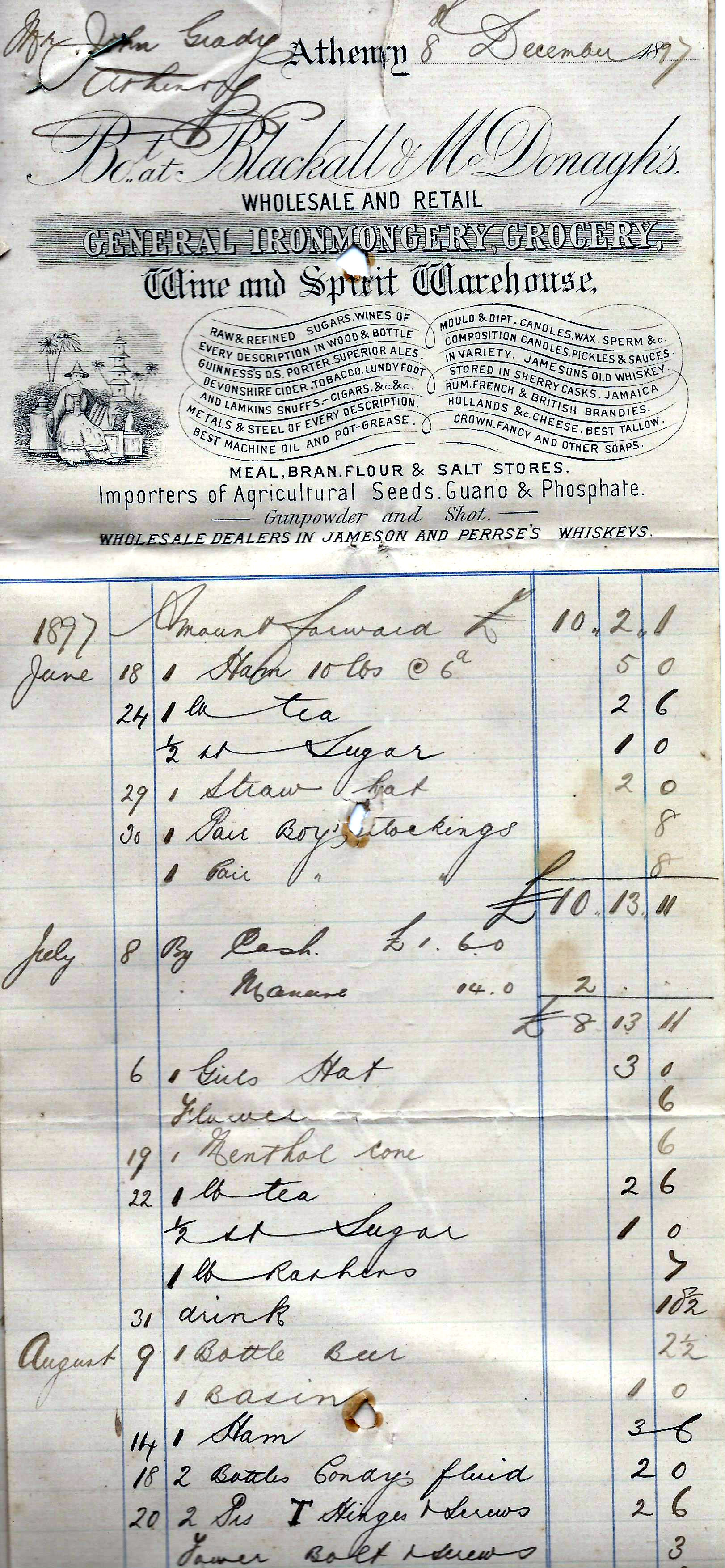
He noted the ‘exceptional evidence of prosperity and progress’, especially of the ‘enterprising merchants, Messrs. Blackhall and McDonagh. (This McDonagh would later move to Galway city and establish the giant hardware business known as Thomas McDonagh & Sons). A Mr. J. Broderick had opened a well-stocked millinary and drapery establishment, where ‘the most fashionable goods are for disposal’.
As to housing, several large houses had been built, and a range of clean, well-constructed artisan dwellings had been put up. All this was happening in Athenry while elsewhere in Connaught ‘things are for some time past in a sadly unprogressive condition of inexpansiveness and stand-still’. (In modern language, the province was in a serious recession)
The Ulster Bank branch, administered from the head office in Tuam, provided banking accommodation for the town under the ‘efficient and courteous management of Mr. J. Corry’. On market and fair days the office was open for business from 10 to 3 o’clock.
The Railway Hotel, Athenry.

The town possessed two hotels, the Railway under the able control of Mrs. Cavanagh was built by the Railway company at the expense of the county, and ‘catered chiefly for travellers during the long waits and tedious delays so often obliged to undergone at this station by reason of the want of harmony between the two railway companies who use it’.
It is a ‘well-arranged and spacious structure and its massive stone-cut front and picturesque situation make it an object of notice if not admiration to the passing traveller’. The other hotel was owned by a Mr. T. Kelly, the local commissioner of affidavits, and had a bar attached.
A weekly market was held on Fridays along with a monthly fair. Farmers bringing their stock into the town had to pay tolls and custom to the local toll-owner, the money going to ‘keeping up the landlord’ instead of the upkeep of the town.
The town had a male and female national school under the management of the priests. The system of education was in want of improvement and alteration to make it more useful, and was National in name only given that ‘neither the language or history of the country is taught’.
The Catholic Church was a spacious, artistic and neat building, having been built 40 years ago by mainly Fr. Austin O’Dwyer, then curate of the place. A Father O’Grady and his successor, Father O’Brien-a native of Athenry-did much to adorn the interior. In the chapel yard is the monument erected to a self-sacrificing young priest who during the rage of a terrible small pox epidemic (1864-1874) lost his valuable life ‘in the noble discharge of his duty’.
The writer noted that the parish priest, Canon Thomas, was a ‘fine specimen of a priest, a sound-hearted patriot, well-inclined, active-minded and sympathetic’. Canon Thomas was popular with the people as was the newly arrived curate, Father William Coen, who ‘has been the means of affecting if not bringing about the conversion to the Catholic faith of two persons of different ways of thinking’.
The limestone fronted houses in Cross Street built in 1902

By 1908 the town was structurally in much better condition due to a mini building boom that had begun in the 1880s. The Abbey Row houses were built in the 1890s along with the two three storey houses beside the present post office in Bridge Street. 1886 had seen the company of Blackhall and McDonagh establish itself in new commercial premises in the Square beside the entrance of the present Athenry Arts and Heritage Centre. The limestone faced houses on the western side of Cross Street were constructed in 1902. Outside the town, new cottage houses were erected at Kingsland, Newford and Boyhill in 1900. The Town Hall (now the Community Hall) in Clarke Street was built by Dick Murphy in 1907 and was used for dances and film shows.
The town was policed by the Royal Irish Constabulary based in the barracks in Cross Street. The streets were paved, leaving the old cobble stones exposed on their edges.
The 1911 Census gives a town population of 791 (432 males and 350 females). This was a 33% decline from the 1871 Census figure of 1194. During that 30 year period, emigration from County Galway totalled 176,828 persons or 5,894 per year (the equivalent population of Ballinasloe today). Demographically the town was in crisis. Nationally and provincially, the economic outlook was drastic with few avenues for employment. Emigration was the release valve, and to succeed in Britain and the USA education would be the key to a productive and full life, especially for females.
Canon Canton must have perceived this whole scenario and decided to make great personal sacrifices to bring his dream about of having the best educational facilities for parish children, namely the Presentation Sisters, thereby equipping them for the harsh adult life he knew was before them.
A Branch House of Tuam Presentation Convent
All was now in readiness for the four Sisters who would occupy the Athenry Presentation Convent. The Convent would be a branch house of the Mother House in Tuam, the first of four such branches-Achill, Tír an Fhia and Headford being the other three- that would be established in the 20th Century by the Tuam Mother House. Athenry Convent Branch House, while having local autonomy, remained until the establishment of the Union of the Presentation Sisters in 1997, in the full control of the Head Sisters in Tuam.
Arrival and straight to Class
A half an hour after departure from Tuam station, the four founding Presentation Sisters arrived in Athenry on the bitterly cold morning of the 2nd of January 1908.
They were met by Canon Canton and the priests and they ‘conducted them to the church where in surplice and stole he blessed and prayed over them’. Afterwards the Canon’s two sisters took them to their new convent, ‘which was quite roomy and comfortable, and where a warm lunch for the visitors and themselves soon cheered them up’.
This was the First Friday of the New Year and the Canon wrote: ‘I did not draw a long breath when after mass today, Sunday, I realised that Athenry had a Convent and that the Nuns were actually installed. I have no doubt that in the summer time when the schools are built it will be an enjoyable and healthy place’.

Athenry Church (Photo: Margie Delaney)
The Interior of The Church of the Assumption, Athenry (built in 1852)

The Four Founding Presentation Sisters of Athenry Convent

Three days after their arrival, Canon Canton wrote to the Reverend Mother in Tuam saying that, ‘I saw our community this evening and I find they are taking wonderfully well to public life, they are able to say their prayers fairly well in the Church today and got in and out of the “choir” without stumbling or knocking down seats. They would feel lonely if they didn’t hear the continuous puffing of engines’.
The Sisters had only a few days to settle into their new home as two of them had to take up teaching duties in the Athenry Female National School when it opened after the Christmas holidays.
On the morning of the 7th of January 1908, a horse drawn carriage with its blinds pulled down came to a halt outside the convent front door.
The driver, Mr O’Grady, alighted and opened the carriage door. The Sisters, with their briefcases quickly boarded and the horse trotted off down the avenue to the gate near the Arch.
Mr. O’Grady halted the carriage under the leafless branches of the two giant horse chestnut trees that stood majestically inside the gate.

He opened it, drove out and turned right. He passed the Old Arch and glided noiselessly down Court Lane and past the ruins of the ivy-covered Athenry Castle. Within minutes he was at the junction with Bridge Street where he skilfully steered left, crossed the River Clarin bridge and turned right into Abbey Lane where the school was located.
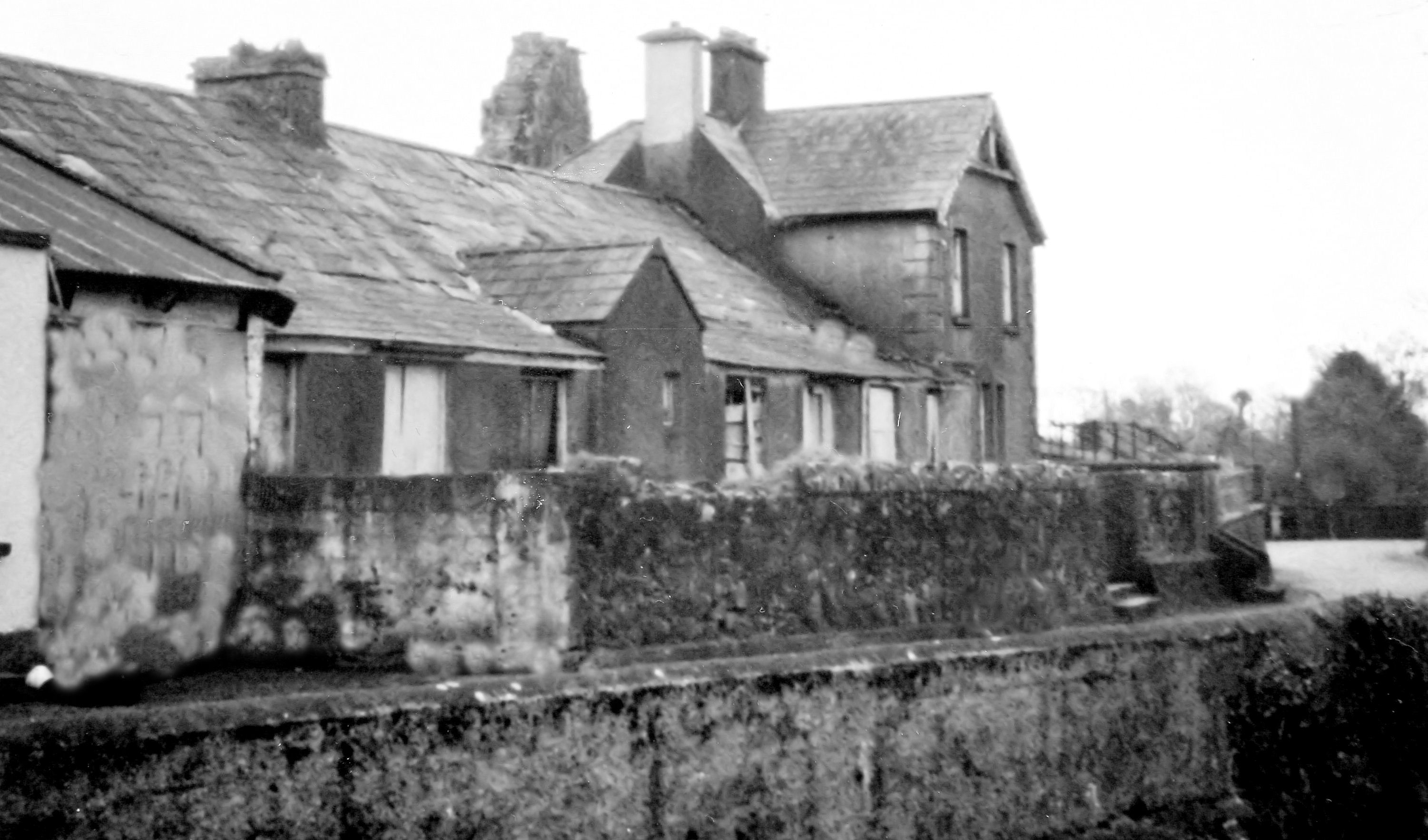
The Athenry Male and Female National Schools and the adjoining Teacher’s residence in Abbey Row beside the River Clarin.
Photo: Gerry Burke
Without looking left or right, the Sisters alighted, mounted the steps fronting the school and were indoors in seconds. There wasn’t a sound from the one-roomed school before the Sister thumbed the latch and entered to the stares of town’s schoolgirls.
The school was in poor condition with one fire to heat the room. It lacked teaching resources and the gradual increase in pupil numbers put severe strain on its ability to cope with this changing environment.
Working in a two teacher school with all classes in one room was not unusual in those days. One Sister taught four classes-Junior and Senior Infants, first and second, while third, fourth, fifth and sixth were in the care of the second Sister. It was a challenging teaching environment but the Sisters’ personal relationship undoubtedly made it bearable and indeed enjoyable.
The Nuns were addressed as Ma’am by the pupils. Outside school, in place of Sister they were called ‘Mrs’.
Shortly after three o’clock they made the return trip, having got through what must have been a trying first day for both Sisters and pupils.
For the next two years, until the new convent national school was opened on the 10th of January 1910, this was their daily routine.
A New Convent Sacred Heart National School.
(Source: Salary Books, National Archives)
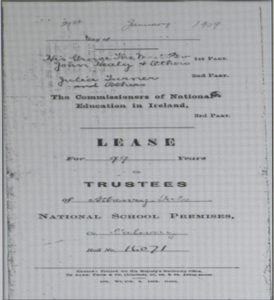 The Sisters attracted more pupils over the next two years. It was obvious to the most casual visitor that the school was unsuitable for such large numbers and so Canon Canton decided to press forward for the construction of a new Convent national school to be located at the rear of the Convent itself.
In 1908 he had plans and costings drawn up and applied to the Commissioners for National Education for ‘aid of grant’. The school, which would accommodate 110 pupils, was to be built on a site at the rear of the Convent, the ownership of which was held in trust by Archbishop Healy, Mother Julia Turner and Canon Canton. An agreement had to be arranged between the Trust and the Commissioners for the leasing of the property to them for 99 years, before grant aid would be provided. This lease (left) was signed and sealed on the 21st of January 1909.
(Following the opening of Scoil Chroi Naofa in 1980, the old school was closed. The lease, which expired in January 2008, prevented the demolition of the building in order to provide a more spacious playground for the primary girls. The school fell to the wrecking ball in October 2008, and it is rather poignant that on the 30th of November the helicopter carrying the President of Ireland, Mary MacAleese, landed exactly on the beautiful new tarmacadam that now covered the site.)
The school would cater for boys from Junior Infants to First Class, and then they would transfer to the Athenry Boys’ National school in Abbey Lane. This arrangement, which still operates today, had the added advantage of greatly relieving pressure on space in the Boys’ school.
(In January 1910, on the Girls school being transferred to the Convent school, an opening was made in the middle gable and the former Girls school was converted into a classroom for the Junior classes. At that time the building was generally repaired and renovated, so that it became a very good, airy and commodious schoolhouse. In 1915 flushed water closets were installed in the school and the adjoining teacher’s residence at a cost of £72-11-3.)
On the 25th of March 1909, the Canon received the letter (right) from the Commissioners of Public Works:
The contractor was John Broderick. It was to consist of four classrooms, each 25 feet long, 20 feet wide and 12 feet high with folding partitions between the rooms. 80 desks, each measuring 3 foot by 2 foot, and 8 desks-one measuring 14 feet and 6 inches, four of 7 feet and three of 3 foot-were to be provided.
Toilets were to be located on the left hand side of the schoolyard at the rear.
Nine months later the new school was completed and officially opened on the 17th of January 1910.
The School Manager was Very Rev. Canon Joseph Canton, Athenry.
The Principalship of Sr. Magdalen Costello
1910-1924
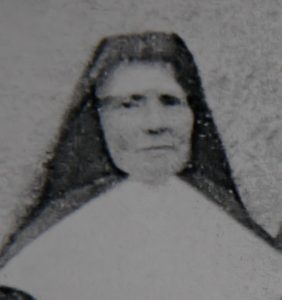 Sr. Magdalen was the principal when the school opened on the 17th of January 1910. Rev. Joseph Canton P.P. was school manager. At the time and according to the Salary Books in the National Archives, the school was in an Irish speaking district. Sr. Magdalen must have rejoiced in this as her father, Michael, had given her a great love of all aspects of Irish language and culture and she promoted this in the school. In the 1911 Census she is listed as being the only Sister able to speak Irish.
The first pupil enrolled was Peter O’Regan (right), father of Sr. Mary O’Regan. Due to the increases in  numbers, extra Nuns came from Tuam to teach in the school. Among them was Sr. Baptist Kelly who arrived in 1913 and stayed until 1982 in the Convent after retirement. Several generations of Athenry girls experienced her good teaching skills and strict regime of discipline.
In the same salary books, between 1910 and 1918 the average mean attendance soared from 132 to 173. In 1915/16 the lay assistant teachers were: Margaret O’Connor, Nora Godivin, Bridget Hurley, Mary O’Sullivan, Mary Slamen, each of whom received an annual salary of £51. The Monitors (classroom assistants) were: Bridget Walshe, Mary E. O’Regan, Mary Bridget McDermott, Mary Kearney, Lizzie Walshe, Julia O’Regan-annual salary for each was £14.11.4. The inspector marked the school as ‘very good’. Allowances were made for school closures for fairs, school fete and prize-giving.
It is recorded in the same books that the school was closed from the 1st – 5th of May 1916 due to ‘disturbances in the locality’, and that from the 11th – 19th of May it was occupied by ‘soldiers’.
In 1917 Mrs. Mary Assumpta Twomey became manager and in 1918 the trustees were Mrs. M.A. Twomey, Canon Canton and Mr. Michael Blake Davies.
In 1919 there were 264 pupils on rolls, the increase in numbers being the result of the construction of ‘artisan dwellings in the neighbourhood’. The school then looked for grant aid for (1) a concrete yard, (2) a shelter, (3) additional accommodation for 50 pupils and (4) the substitution of water closets for existing out-offices (dry toilets). The application noted that the Sisters had, over the last 5 years, expended £305 from their own resources for improvements and upkeep, including £75 for a cookery room, £20 for conveying water from the town supply and £31 for painting.
All were turned down except (4), which was priced at £567.2.0 and a grant of £378.1.4 was provided by the Commissioners for Education in 1920. The Sisters paid the balance.
Sr. Magalen’s tenure was certainly a most arduous and trying time for her.

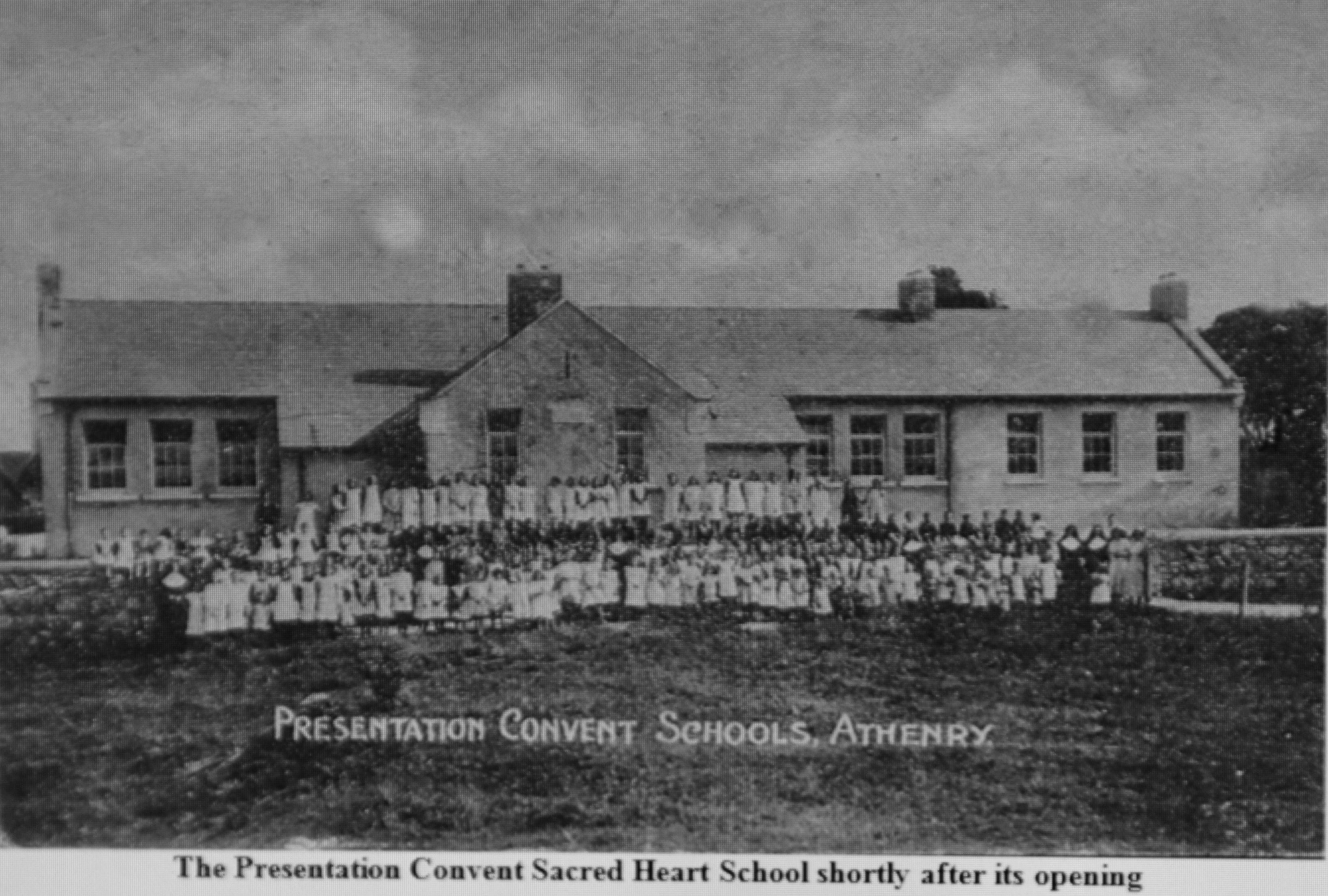
Two years later in 1912, attendance had risen to 181 pupils and an additional classroom to accommodate 50 more was built onto the left rear of the school at a cost of £325 by John Broderick. (In the 1920s this would become the Secondary Top room where Intermediate Education for 7th and 8th classes was provided).
In March 1913 classes commenced in this room. Around this time and in close proximity to the school, a very neat and commodious room was fitted up at a cost to the Nuns of for practical lessons in cooking and laundry.
In 1913, an article with the heading, ‘Successful Athenry Students’ appeared in the public press:
“Signal success has attended the pupils of the Presentation Convent, Athenry, at the recent examination held in the Trinity College of Music, London for their certificates, which are eagerly sought after by young ladies who wish to secure a place and gain the highest diplomas in music. All the pupils sent forward for examination from the Presentation Schools, Athenry, passed and some with honours.
The following passes were noted: In first steps, the Misses Mai and Agnes Hardiman: in the Preparatory Grade, Misses B. Fallon, Lizzie Walshe, Mary and Ellie Ruane, Julia Frances O’Regan and E. Lavelle. Miss Fallon took honours and Miss Walshe also took high marks. In the Intermediate Grade Misses O’Connor, O’Regan and Quinn passed after a searching examination”.
In 1915 extra toilets at a cost of £18-14-0 were provided for the Infant boys attending the school.
Attending the school at that time were the daughters of: farmers (in the majority), soldiers, a detective, policemen and a horse policeman, railway and signalmen, a saddler, a miller, a steward, a ganger, shopkeepers, labourers, a manager, painters and carpenters.
Athenry-A Quiet, Sleepy Town
Athenry, during those years, is remembered by Nora Keane (born in 1909) who lived in the village of Greethill:
‘It was a quiet, sleepy town, which only came to life on Friday, Market Day and Saturday when people came in for confession, and Sunday after mass. On the monthly Fair day, cattle, horses and sheep packed the streets. Householders and shopkeepers put up timber guards to safeguard their windows, doors and walls. There was seaweed from Maree on sale together with bonhams, potatoes, vegetables and sacks of corn. Sellers who came early got the best stands beside the market cross.
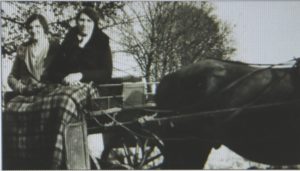 When school was over on Friday, we always looked around for a lift home on an empty ass cart, the drivers of which were often tipsy. However, the horse or donkey knew the road home. There was nothing to impede them: no car, bus or lorry, not even a bicycle: no aeroplane overhead to frighten them; no tractor or machinery of any kind. I now wonder how we kept our white pinafores clean on those occasions.
We loved Fair days, because the men who had stock penned up on the footpath sometimes gave us money for sweets. We could buy a packet of biscuits for two pence, or a “penny worth of sweets”.
Sunday was a very special day in our young lives. We went to Mass in the sidecar. There were two Masses, first and last, which was usually said by the parish priest. The church was always full. Most of the farmers went in the front door, putting a penny in the plate.
Men sat on the right aisle and women on the left. Last mass lasted a long time. It began with “the prayer before mass”. We usually heard a good sermon. After Christmas and Easter collections, the names of each parishioner and the amount they contributed, was read out. No one received Holy Communion at last mass. Most did so once a month on their Sodality day-the men of the Sacred Heart sodality, one Sunday and the women on another, the Third Order of St. Francis on another, and the Children of Mary on another.
Benediction of the Blessed Sacrament, which we seldom see now, was another heavenly experience.
The Presentation nuns had their own cubicle near the sanctuary, and could not leave the church grounds, even for the annual Corpus Christi procession through the town.
After Mass the men usually went for a drink while the women did grocery shopping. All was carried home in the ‘well’ of the sidecar’.
The Easter Rising-‘Athenry is Going Out’
The Easter Rising in1916 saw turmoil in Athenry and the surrounding areas of East Galway. In the May 1982 edition of the Presentation College magazine, ‘Beginnings’, Jimmy Cleary of Abbeyrow who took part in the Athenry Easter Rising was interviewed:
‘The volunteers were started in Athenry in early 1914. It was said that it was the first company west of the Shannon. Companies were formed in the parish areas of Derrydonnell, Newcastle, Cussane and Athenry. Because of unrest in the area, Athenry was described in the British Parliament by Mr. Birrell, Chief Secretary, as the “Blackest spot in the British empire”.
Most people know that Pearse issued the order for the Rising and that McNeill issued the counter order calling it off. McNeill’s order was not accepted in Athenry. When the first order was received from Pearse, three volunteers carrying rifles were sent on bicycles to East Galway. They gave the word to volunteers that Dublin was out and that Athenry was going out. They got back to Athenry on Tuesday evening, had a meal and joined their comrades at the Agricultural Collage where Liam Mellows was in Command. There was a police hut there and the rebels took it and the R.I.C. officers as prisoners. I saw them later at Moyode castle. There were plenty of men but arms were scarce.
Liam Mellows (left) and his rebels moved from Moyode to Limepark, moving south in the hope of getting a share of the 20,000 rifles expected to come on the ‘Aud’ from Germany. At the house near Ardrahan they heard about the loss of the ‘Aud’, and that most of the volunteers throughout Ireland obeyed McNeill’s order, and so outside of Dublin only Enniscorthy and Athenry and that part of Galway went out. In Limepark news came of the surrender in Dublin, and it was there that the order came to disband was given. They brought their arms back to their own areas for another day. Most of them were rounded up and taken to prisons in England.
After a couple of years all were home again. Not so in Dublin where a number of men, including Pearse, were executed’.
Mary Lavin Mary Lavin-The Athenry Dimension
By Muriel Nolan
Source: The Athenry Journal
 Mary Lavin, the acclaimed short story writer who was born in the USA on the 11th of June 1912, was enrolled (Reg. No. 213) in the Presentation Convent National School on the 24th of October 1921. She spent 136 days in fourth class; the day she left the school is not recorded in the register. The memory of that brief stay of less than a year in Athenry became etched in her mind, and was the source of material for many of her stories.
Why choose to write about Mary Lavin in the Athenry Journal? One reason would be that she is acclaimed as the best living short story writer in Ireland, another more compelling reason is that she is “one of our own” as her mother was Nora Mahon of Cross Street. She was not born in Athenry, but in Walpole Massachusetts in 1912, the only child of Thomas Lavin and Nora Mahon.
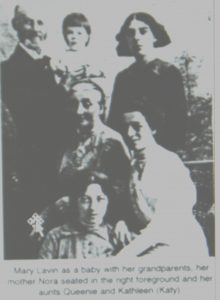 Her mother never liked America and she and Mary returned to Athenry when Mary was nine years old, where they lived with her grandparents, Pat and Nora Mahon, and Mary attended the local school. A year later they moved to Dublin, where her father, now returned from the States as manager of an estate in Bective, Co. Meath, had purchased a house.
Many will remember Mahon’s shop in Cross Street, subsequently owned by Sean and Carmel Torpey and now Iggy’s. In Mahon’s shop, paint, wallpaper, delph and stationery were the main part of the business, while the pub was in a quiet little corner at the back. For a number of years, they had a small lending library, which was a real boon, as there was no public library in the town. I wonder if the lending library owed something to Mary Lavin’s influence.
Although she only lived in Athenry (in the photo, right, is Mahon’s shop in Cross St., Athenry where Mary lived in 1921/2) for a short period, there is a great atmosphere of Athenry in a number of her stories. In an interview with Professor Zack Bowen of the State University of New York she admits readily the influence Athenry had on her – she says, “For years whenever I wrote a story, no matter what gave me the idea, I had to recast it in terms of the people of that town. I used them as prototypes for people like them that I had met elsewhere”.
“In her story “Tomb of an Ancestor”, the Dermodys and Duffys are local shopkeepers – the Duffys having fallen on lean times, had nothing to display in the windows but dummy cartons and a large girded replica of a whiskey bottle, but James Duffy reckons that Mrs. Dermody was making money bowing and scraping to the British constabulary. James Dermody’s spirited reply is that the Duffys are “half-cracked with piousity, running down to the chapel every minute, craw thumping and lighting candles”. This description is reminiscent of Athenry in the first half of the 20th century.
 Some reader has been struck by the resemblance in “Loving Memory” as the book in the Athenry library has Athenry written beside the title. There were galleries in the old church in Athenry and in this story those in the gallery had a good view of Matthias Grimes and his new wife, Alicia, when they came to late mass “linked” on the first Sunday after their marriage. “It’s a wonder she didn’t link him all during mass”, said the gossips.
Her first novel published in 1945, “The House in Clewe Street”, begins “when you are still several miles outside the town of Castlelambert you can see the spire of the church pricking the distant clouds”. Further description is “a view of King John’s Castle through a crack in the rampart wall and the Priory ruin smothered in nettles with its east gable blocked with cement to make a ball alley”. When the children visit a corpse house in “The Living”, it is a cottage at the level crossing, where the woman opens and shuts the railway gates and the corpse room was “got up like the chapel on Lady Day”. The novella, “A Bevy of Aunts”, clearly depicts her aunts-the Mahon family, who were very definite characters. For those of us who knew some of them, the characters are very true to life.
Shopkeepers and business people are prominent characters in some of her work and social standing is also an important feature. Many of the stories are written from the viewpoint of a middle-class background – everyone has their place in the society and keeps it – the servants, business people, professionals and, occasionally, one of the gentry shown as a race apart from the others. While her themes are often poverty, loneliness and death, she has humorous moments as in the confession incident when the priest ejects a foolish woman from the confessional on a Saturday night and says “Stop wasting my time, can’t you see the chapel is full of good, honest to God sinners with decent sins to tell”.
While it is natural that we in Athenry would take special interest in the Athenry dimension, it is only part of Mary Lavin’s story. She is an important Irish writer of the 20th century and ranks with names such as Frank O’Connor, Edna O’Brien and Liam O’Flaherty to name but a few in the Irish Writers Series. Bective, Co. Meath and Dublin, where she has lived most of her life, are also settings for her stories. Here again her very keen perception of people around her, their everyday life and problems is very obvious and recounted in her clear lucid prose, which has been praised by many experts.
Happily her talent has been recognised during her lifetime and she has received many prestigious awards: The Katherine Mansfield Award, the Ella Lynam Cabot Award and two Guggenheim fellowships. It is a further indication of her ability that some of those honours were achieved during a time when she had to raise three young daughters in straightened circumstances due to the early death of her husband, William Walsh, in 1954. In 1969 she married Michael Scott, a former Australian Jesuit student, whom she had met when they both began their studies in U.C.D. They had been very friendly in their student days but at that time both agreed that his vocation as a Jesuit came first and he was ordained and returned to Australia.
When Mary became a widow and had financial problems, Michael Scott was concerned about her welfare. They renewed correspondence and following his laicisation they married. He worked in Dublin as Dean of the School of Irish Studies and died some years later. Perhaps some people remember their visit to Athenry in the late 1970s when Mary very kindly gave a reading of some of her works in Hanberry’s Hotel. She died in 1996.
Irish in 1922
After gaining Independence, Irish was taught in the Convent National School from April 1922. The first child’s name to be recorded in Irish on the school register was Máire Laighin (D.O.B. 06-01-1919)
(Reg. No. 219) who entered on the 27th of April 1922.

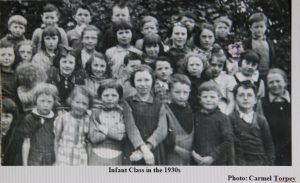
Infant Class c. 1924/5
Book list- 2nd Class 1924
Cara Leabhar-3d; English Reader-4d; Two Copybooks-4d; Blotting Paper-1d; Ink-3d; Catechism-1d; Pen and Pencil-2d; Jotter-2d. Total= 1 shilling and 8 pence.
Unhappy Occasions
One pupil who attended the school between 1918 and 1926 remembers that most of the nuns were very nice people. However, there were one or two who weren’t so nice. As punishment these Sisters made pupils wear the dunce’s hat and either stand in the corner or parade themselves around the school. She remembers brown paper being pinned to the end of her skirt by the nuns if it was considered too short.
The Principalship of Sr. Ignatius Diskin
1924-1942
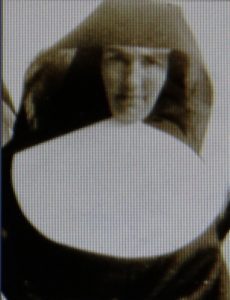 In a tribute to her after her death in 1949, Sr. Agnes wrote that Sr. Ignatius was her superior in Athenry during World War 2. It was her top priority that none of them were hungry or cold during those years. She was a wonderful administrator.
She seemed to have a real aptitude for teaching. Past pupils speak of her with nostalgia. Her norms for cleanliness, order and neatness were proverbial.
She saw to it that the Convent and surroundings were in perfect order. Her contemporaries remember her best for her forthrightness in speech and action. To her would apply-“a plain blunt woman, that loves my friends; they know full well. I only speak right”. Her community was always struck by her calmness and patience, even under provocation.
The School Attendance Act of 1926 made it compulsory for parents to send their children between the ages of six and fourteen to ‘a National School on every day on which the school is open for secular instruction unless there is reasonable excuse for their absence. Penalties on conviction were: First Offence-Fine not exceeding twenty shillings. Second Offence-Fine not exceeding forty shillings or the child may be sent to an Industrial School or placed in the care of a relative or other fit person.’

Primary Ed 1931-1938
 I attended the Presentation National School from 1931-1938. I could never forget my time in school during those years. We were taught by Sisters and lay teachers. The Sisters were: Peter, Baptist, Ignatius, Rose, Dominic, Philomena, Columba and Cecilia. The lay teachers were: Mona Finn, who died shortly after I came to school, Miss King, (niece of the Parish Priest – Canon Conroy), Miss Masie Waldron (left), aunt of Ned Waldron, New Line, Athenry, and Miss Glynn.
In 1932 I made my first communion. It was Eucharistic Congress year in Ireland. As Athenry was in the Archdiocese of Tuam, we were all prepared for the celebration that took place there. We had High Mass as it was called then and the Archbishop of Tuam was present. When I was eight years old I took piano lessons. I was taught by Sr. Baptist and Sr. Columba and I did a few grades for the Leinster School of Music. It was very important to get First Class Honours.
The atmosphere in the school was very good. Classes were not too large and we had an annual inspection usually by a male Inspector.
We were also prepared for concerts, which were held in school for special occasions and sometimes we went to the Town Hall or Taibhearc. I also took dancing lessons. These classes were run by Mr. Coleman. We learned reels, jigs and hornpipes. We also did some outdoor drill, which we did not like in the cold weather.
It was during those years that I first thought of religious life. The idea lasted for some time and then left me completely. This is no reflection on the Presentation Sisters! In God’s good time the vocation returned.
I was confirmed by Archbishop Walsh in 1938. I did have some good friends in school. After all those years I am only in contact with two – Dolores Fitzsimons, now widowed and Mary Mahon now in a Nursing Home nearby and whom I visit.
As I look back on those years I am very grateful for the foundation both spiritual and temporal that we were given. I had plenty to build on when I came to Secondary School in Taylor’s Hill and the Dominican Sisters.
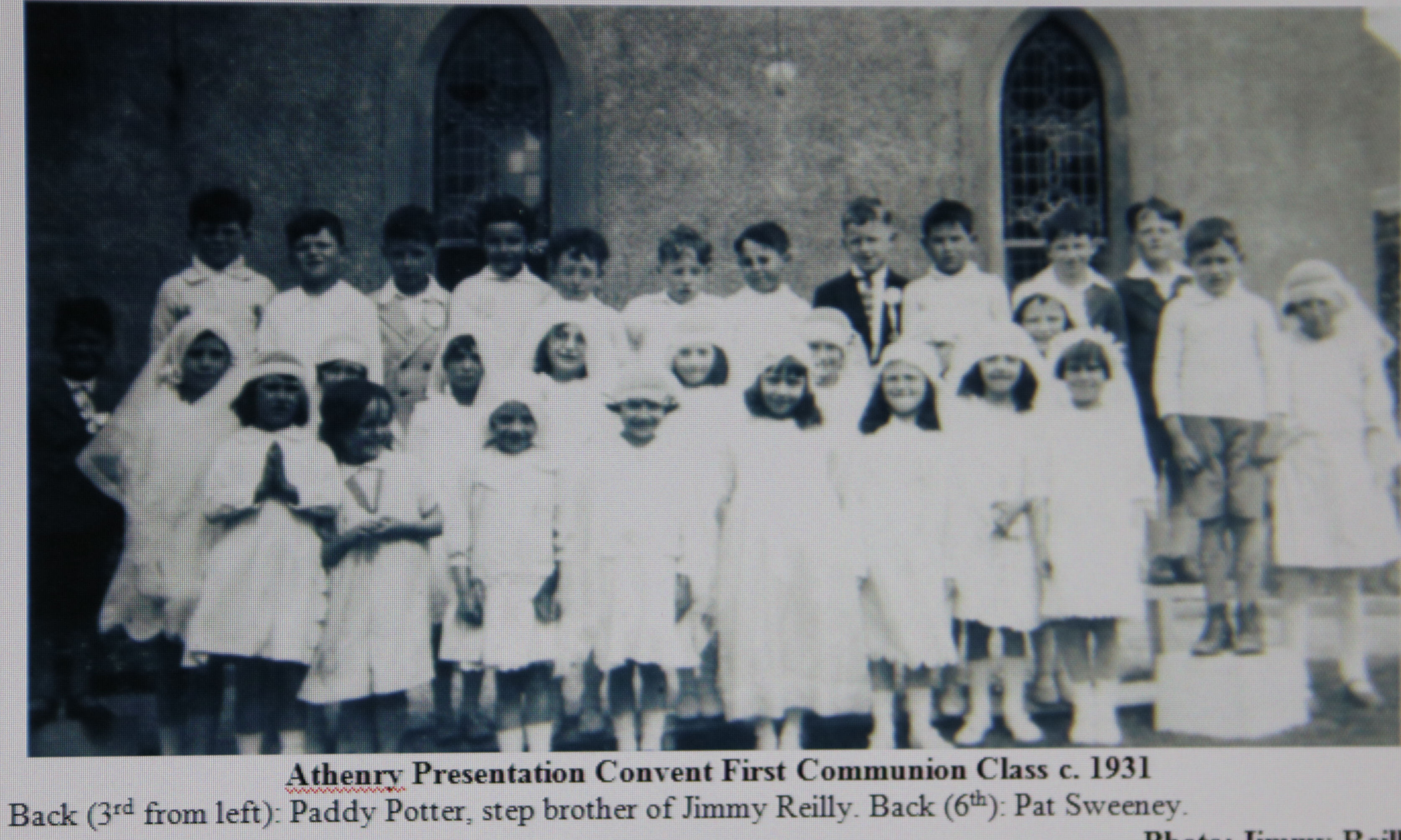
Photo: Jimmy Reilly
Primary Ed 1935/1936
I attended the Convent Primary School in 1935/36 followed by my brothers Raymond and Edmond and my sisters Christina and Berry. My teacher was Sr. Ignatius. I remember clearly the embarrassment I caused by absenting myself from the school, boarding the 1.00 p.m. train to Galway accompanied by a persuasive and older pupil. We were later collected by members of the Gardai from the Savoy Cinema, Galway and transported back home to Athenry.
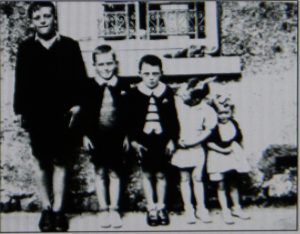
From Left: Jim, Raymond, Edmond, Christine and Berry Kearns
Sr. Columba and Sr. Fursey taught Piano and Violin respectively until their departure to Tuam in 1944. I was fortunate to be a pupil of theirs both in Athenry and Tuam and to share in their enormous talents.
My fellow pupils were: Michael Whelan, Mary Sweeney, Dermot Murray, Jackie Fleming. Music played an important role in the life of the school – particularly the school operettas, participation at local concerts, and music activity generally; the performance of pupils was greatly acknowledged.
There was a healthy rivalry between the boys’ school Principal Martin Walsh M.A. and the Convent girls. I believe the boys shaded it as few 6th Class boys anywhere in Ireland could match a school programme of two/three Shakespeare plays, Therom 21 Geometry, Irish and English Literature.

Primary Education-Mid 1930s to the early 1940s
In the thirties/forties, school days at primary level were very different to what they are today. In the Infant Classes, other than our reader, copy and pencil, equipment consisted of slate, chalk, ball frame and a tin cigarette box (John Players or Gold Flake) containing márla and cipíní (spent matches).
From the very start, Irish was used for the teaching of Maths; our P.E. was Drill – lámha suas, síos, amach, isteach, etc. All the songs taught were in Irish.
The classes and teachers
Junior and Senior Infants were taught together in one room by Sr. Dominic and at one stage by a Miss Waldron. First and Second classes were also in one room, taught by Sr. Baptist, who prepared us for First Holy Communion in First, and Sr. Ignatius. After First Holy Communion, the boys left for the Boy’s School. Occasionally, if very young, a boy or two would remain on in Second class.
Third and Fourth classes were taught in one room by Sr. Bernard. Again, Fifth and Sixth were together. In Fifth we were taught by Sr. Cecilia and when she was transferred we had Sr. Agnes for Sixth. Sr. Agnes – taught poetry as a ‘rebel’ with such lines as: “Break down the bridge…” The children thought the verses were inspiring. At the end of Sixth class the pupils sat the Primary Certificate.
Uniforms, made by Mrs. Tully, consisting of a brown gymslip and red jumper were worn.
Some children, who didn’t or couldn’t perform to the teacher’s standard, were donned with a ‘Dunces Cap’ and sent around to each classroom.
All subjects taught through Irish
Throughout Primary School, all subjects including Maths. History and Geography were taught through the medium of Irish. Sometimes, in the higher classes, a new girl (perhaps the daughter of a Garda or station-master) would arrive from a different part of the country and she would experience difficulty with the Irish. Again, we were encouraged to use Irish in the playground. In Fifth and Sixth classes great emphasis was placed on formal grammar in both English and Irish. Sometimes, classes were taught in the cloakroom. Everyone who lived in town was allowed home for lunch.
The ‘Tap Room’
 Beside the Infants’ Room was a small room known as the “Tap Room”. There, on a Friday afternoon, the inkwells from the desks were washed and returned the classrooms where they were re-filled with new ink from a white enamelled jug. Sr. Dominic (left) brought pupils, mostly boys, who used ‘bad’ language to this room to wash out their tongues with soap.
Liturgical Music and Gregorian Chant
 Sr. Baptist (left) was in charge of the choir and every Friday evening after school we went to the church for Choir Practise. She used to stand on a stool when teaching singing, as she was small. She played the organ in the church and two students took turns pumping the bellows. Singing class was an important part of the curriculum during which we were drilled in the “Doh, Ray, Me” etc. We were also taught liturgical music and Gregorian chant (all in Latin) which was also part of the Religious Education or Catechism Programme as it was called then. We joined the church choir in fourth class, and were expected to attend evening devotions, which consisted of Rosary and Benediction of the Blessed Sacrament every Sunday, and all through Lent, the month of May and October. We sang Latin hymns at one Mass most Sundays.
The Nuns instilled spirituality, discipline and a hard work ethic in the children, which stood to them all their lives.
Music Exams
Since the Presentation Sisters were then an enclosed order, the music rooms were as far as we were allowed to enter in the convent. Sr. Columba taught music. The Music Exams were held in the parlour. The room was huge and had a very highly polished floor. Pupils were afraid of slipping. The picture of Nano Nagle over the fire-place was the same one as was there that time. The music examiner was a lovely lady named Miss Cosgrave, a sister of the former Taoiseach, Liam Cosgrave.
The Convent Library
There was a lovely library in the music rooms (pupils who wished to learn the piano were taught here by Sr. Perpetua) and every Thursday morning before school, Sr. Baptist allowed pupils to borrow a book for one penny per week. Books were expensive and of course there was no public library so this was the children’s first introduction to a variety of reading material. Adults were also allowed to borrow for two pence per week.
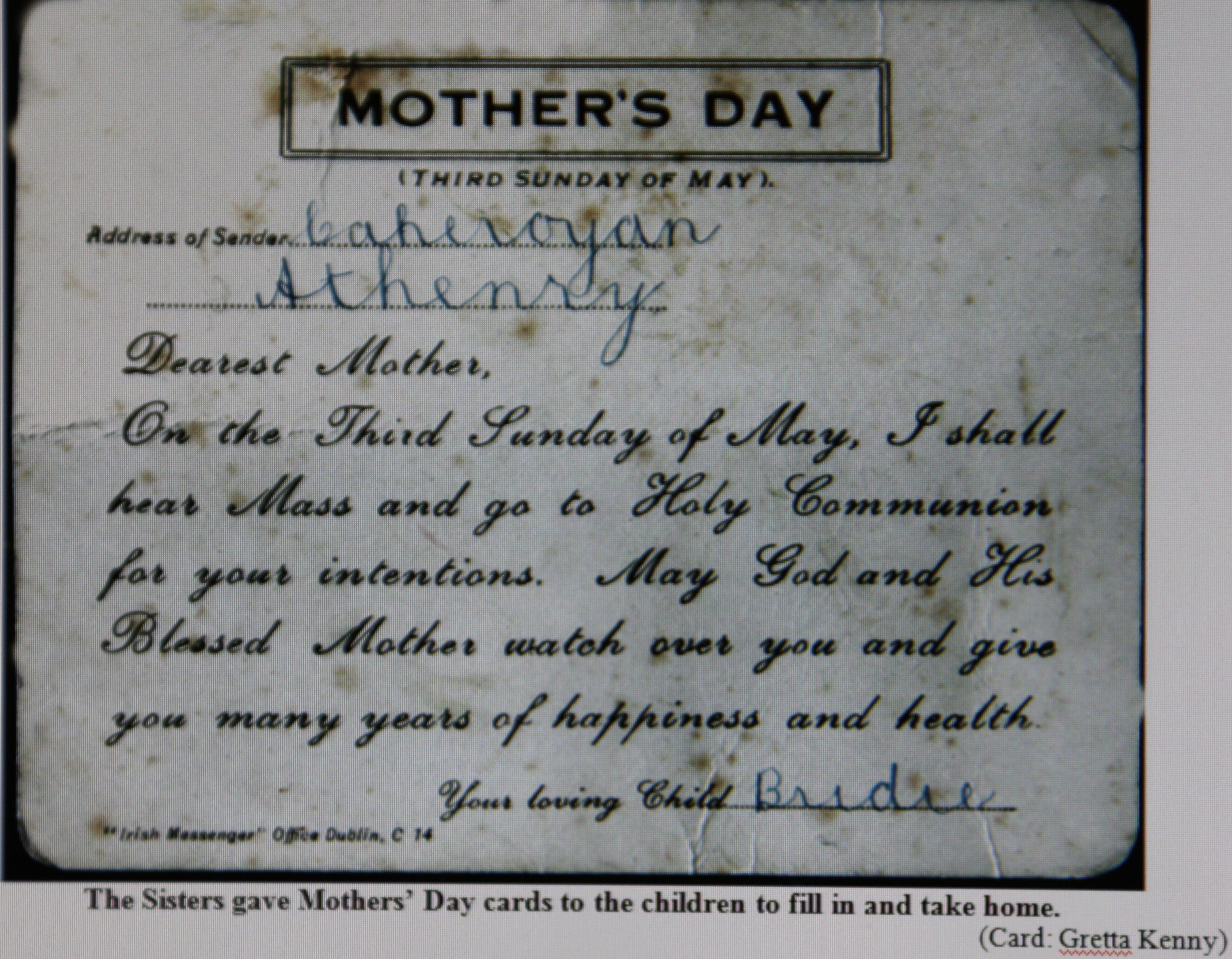
In those days fairs were held on the streets in Athenry and on the Fridays when the fair was expected to be large we had no school. Also, in on around 1940, when central heating was being installed in the school, we had a week off.
The toilets were not in the school building but down in the yard. In the yard also was the shelter where some children had their lunch and played. We played Tag, Blind Man’s Buff, The Big Ship Sails, Rounders, Queenie, Hop- Scotch, Picky Beds, Red Lights (even though we knew nothing about traffic lights then) etc.
Feast of the Sacred Heart
For the Feast of the Sacred Heart, red flowers were put on the altar. Since the school was dedicated to the Sacred Heart, that Feast Day was observed each year by having a party. We brought our own cups and were given tea. Sticky buns were bought from O’Neill Bakery in the Square (where Flanagan’s pharmacy is) and boiled sweets were also supplied. Sports, weather permitting, were held in the field where the present Secondary School is. We practised for days in advance, running, three-legged race, sack race, egg and spoon race. The girls from the Secondary Top held a Fancy Dress Competition.
Special “May” Altars were put up for Our Lady with bluebells and white flowers. All the students faced the altar for prayers.
Rogation days
Another tradition observed in these days was “Rogation Days”. Each day, for three days, before Ascension Thursday, all the pupils and nuns went in procession, led by Sr. Ignatius, around the convent grounds, praying and then back, stopping at the statue of the Sacred Heart and the grotto of Our Lady where prayers were said for various intentions, which always included “a fine harvest”. This procession was held at the same time each day, twelve to twelve-thirty, which was normally “Catechism Time”, 12 noon to 12.30.
During the day each class went in turn to visit the Convent chapel where there was Exposition of the Blessed Sacrament all day.

“Cluasai” and Sister Magdalen
Another nun who, from time to time, came into the classroom and was generally to be seen around the convent and grounds was Sr. Magdalen Costello. To us she appeared to be very old and she was one of the first nuns who came to Athenry. Sr. Magdalen had a little dog called “Cluasaí”. She used to bring the dog out to the school and used the long sleeve of her habit to cover her. However, there was an ‘incident’ with Cluasaí as she attacked Margaret Burke’s lunch. Sr. Magdalene was usually there in the mornings when we arrived early and immediately asked each of us if we had been to 8 a.m. Mass. If we were we were rewarded with a few sweets, which was an encouragement to go the following morning!
Sr. Agnes and Sr. Celestine and later Srs. Marie Therese and Rosario all left a lasting impression on the children and are remembered with fondness by many.
Occasionally, two old nuns came from the convent in Tuam to visit, viz. Sr. Gertrude O’Sullivan and Sr. Catherine Storey. They were the first nuns to come to Athenry. They would come into the classroom and ask each of us our mother’s maiden name to establish if they had taught them.
There was a housekeeper in the convent whose name was Molly. Also employed there, for years, was a gentleman named Mick Mannion. He was a “maintenance man” and looked after the vegetable garden and the poultry in an enclosed walled area where Scoil Chroí Naofa now stands. When Mick Mannion retired he was replaced by the late Tommy Ryan’s father.
The Sisters also owned a field across the road, where the Vocational School is now. There they kept cows.
Memories of the Presentation Sisters 1939
The teaching Sisters were: Sr. Ignatius – Principal, Sr. Baptist, Sr. Dominic, Sr. Philomena, Sr. Celestine, Sr. Cecilia (organist and music teacher), Sr. Agnes, Sr. Columbanus (singing teacher), Sr. Perpetua, Sr. Magdalene.
The lay teachers were: Miss Glynn and Miss McGovern. The school and convent caretaker was Mick Mannion, who also looked after the nuns’ cows and vegetable garden.

A lot of our subjects were taught through Irish. Religion was a big part of our education.
We were prepared for our First Confession, First Holy Communion and later for our Confirmation, when we all took the pledge and became Junior Pioneers. Music and Singing was a big part of our day. Some of us were in the choir and we did lots of practise. We knew all the mass in Latin and for funerals. We were allowed to go to Church to the Requiem Mass. In Lent we wrote all the Hymns in a note book and learned them all by heart. After all those years I remember them all. We were taught great respect for our seniors. We did basic cooking and needle work.
At Christmas we did Concerts or operettas. The Feast of the Sacred Heart was a day of celebration. We were given a currant bun and mug of tea – a special treat.
As for Church traditions, we were expected to attend Stations of the Cross in Lent, fasting for Holy Communion from the night before, Rosary and Benediction in May and October, Church visits in November for the Holy Souls, the Corpus Christi Procession around the town where the children who made their First Holy Communion would strew flower petals before the Blessed Sacrament and Benediction in the Square.
We visited Knock with the schools of the Dioceses every year. We also had a choir outing. On Sports Day we ran in the two legged race, sack race, egg and spoon race.
I have happy memories of my time with the Presentation Sisters many years after leaving Athenry. I kept in touch with some of the Sisters until they passed away. May they all rest in peace.

Photo: Mary Leslie.
Thanks to the following for their contributions to this part of the story:
Minnie Cleary (nee Quinn), Jim Kearns, Mary Leslie (nee Molloy), Sr. Raymund (Viola Corbett), Josie Murphy (nee Houlihan) and Sr. Madeleine Houlihan, Monsie, Nano and Rosemary Kennedy and Clem McGuiness.
Athenry in the 1920s and 1930s
In the Athenry Journal of August 1995, the late Winne Kennedy, born Winnie Beirne in 1914 and the local correspondent of the Connacht Tribune for decades, was interviewed by Paul McNamara about her life, especially in the 1920s and 1930s in Athenry:
‘Local customs included killing a fowl and sprinkling its blood in the four corners of homes every St Martin’s Day on the 11th of November; the putting up of May altars decorated with eggshells and candle; putting a branch of a May bush over their door; bonfires on St John’s Eve and Halloween; leaving the door open on Christmas night no matter how cold the weather in case the Blessed Virgin was passing and she could do with a rest.
In the early 1920s, Eamon de Valera was welcomed to town with a guard of honour along both sides of the railway track, each man holding a pitchfork aloft with a blazing oil soaked sod of turf.
The priest, indeed God himself, was an object of fear. Some priests went around at night looking for courting couples. Others were popular including Canons Farragher and Conroy who were very generous and gave their money to the poor.
Business people made sure that there was at least one priest or nun in the family and this, she believed, was more to do with ‘keeping up with the Jones’ than the propagation of the faith.
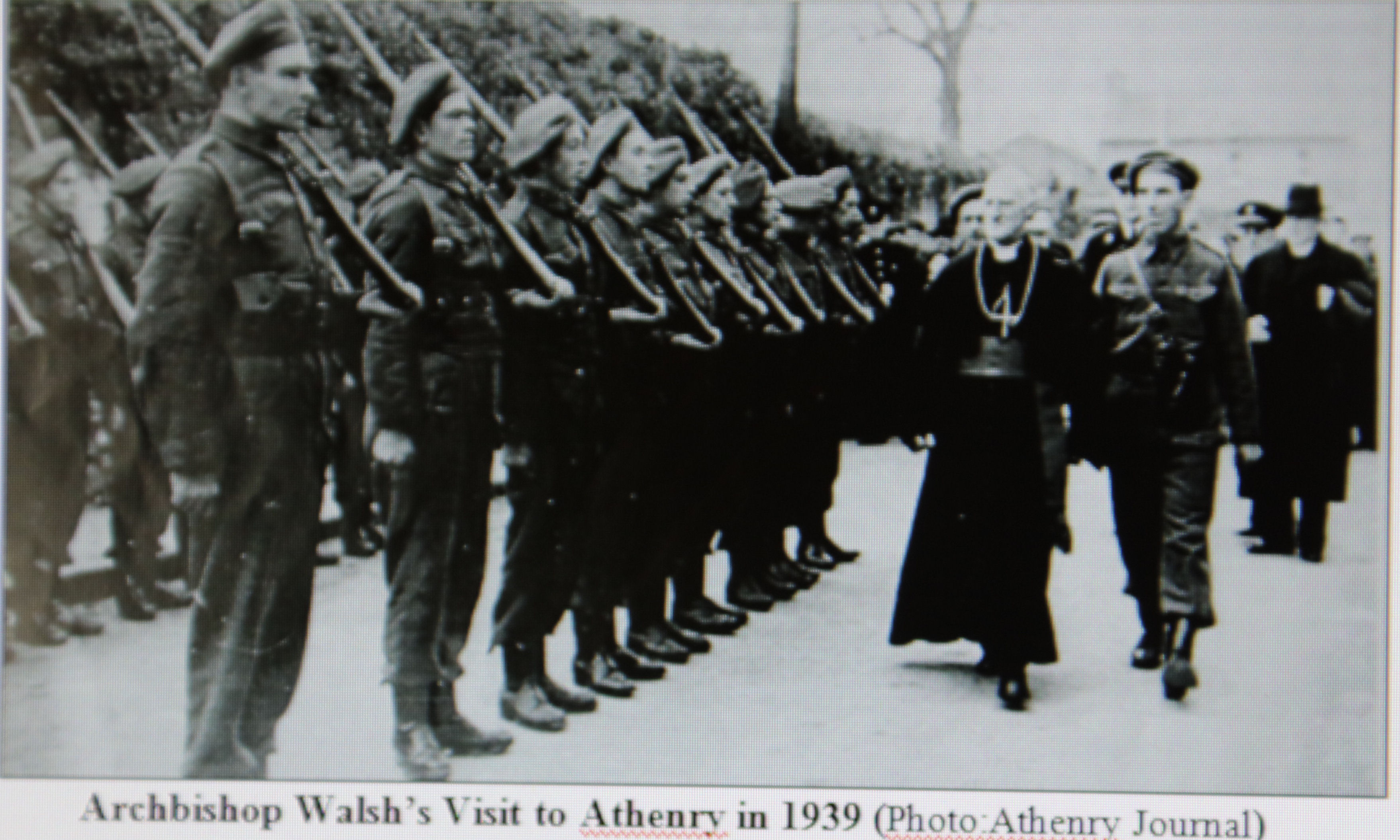
There was a lot of class distinction in Athenry. She remembers a nun threatening to tell the parents of a pal of hers that she shouldn’t be hanging around with Winnie. This kind of snobbery was not just the preserve of the rich. Indeed, the townspeople thought they were better than those in areas outside the walls.
The Canton Hall was constructed in 1932 and vested in the Catholic Church. During the Economic War of the 1930s, it was difficult to make ends meet. There was a thriving black market in the shops where you could buy rationed items such as tea under the counter for a certain price.
Markets and fair days were busy times. Cattle were loaded onto train, often with a bit of cruelty involved-the animals being whipped until they bled. When the markets were over, the council gathered up the dung. There was no street lighting, so street journeys on foot on those evenings were kept to a minimum.
There were a few Protestant children going to school in Athenry and they went out to have their lunch during the Angelus and catechism. The Protestant ministers were lovely people. The rector, Mr. Bomfort, had a lovely garden from which he sold flowers. Surprisingly, he used to give free flowers for the Catholic procession on Corpus Christi’.
The Principalship of Sister Agnes Kyne
1942-1956
Agnes Kyne, the eldest of nine children, was born in Abbeytown House, Caheristrane, on the 16th of December 1899. Her father was a farmer. She attended the local national school and then boarded in the Presentation secondary school, Tuam.
She trained as a primary teacher in 1919-1921 and some time afterwards joined the Presentation Order, entering the Tuam House.
She joined the staff of Athenry Convent national school as principal in 1942. She was a strict, authoritative figure, but totally honest in all her dealings with people.
She was a perfectionist and did things to the letter of the law. People tended to be in awe of her but when one got to know her, one found her to be a kind and pleasant person. She had a terrific memory, liked walking and reading, and spent most of her life in Athenry.
She celebrated her golden jubilee in 1974 and attended the opening of the new Scoil Chroí Naofa in 1980. She died on the 5th of July 1982 and was laid to rest in Tuam.


1946 Corpus Christi Procession in the The Market Square. Father Mulrennan C.C. holds the Monstrance. The Canopy Bearers: Pat Quinn, Frank Healy, J. Kindregan and L. Mahon.
The Corpus Christi Procession
The Corpus Christi procession would start at the Church, walk down Church St., Old Church St., Clarke St., and Cross St. The windows were beautifully decorated. The small children, who had made their First Holy Communion, would be at the head of the procession.
Last of all were a small group of children dressed in white who strewed flower petals before the Blessed Sacrament, which was carried in the Monstrance by the priest under a canopy that was borne by four men. Each child had a basket full of petals of poeni roses and walked backwards so as not to turn their backs on the Blessed Sacrament. They reverently took a petal, kissed it and threw it towards the Blessed Sacrament. The path of the procession was strewn with pink and red rose petals. They felt so privileged, but the next few days were spent nursing bruised toes!
The procession was divided into the Sacred Heart Sodality and the Children of Mary Sodality. They wore beautiful blue cloaks. The Sacred Heart Sodality wore a red sash. All the locals were in the procession as well. The nuns did not participate as they were enclosed until 1968.
Fair Days
Fair Day was great as well. We had no school that day. When the fair was over, our job was to clean the paths with buckets of water. Stalls were in the Square selling clothes. The Fair started very early between 5.30 – 6.00 a.m. It would end around 4.00-5.00 p.m. The shopkeepers and householders protected their windows from the animals stationed in the streets with wooden boards.
It was a big deal to go for a picnic to Leonard’s lawn. It was heaven there. White bread was such a treat.
We shopped in Fahy’s where a turnip was 3p. We ate fish on a Friday and this was sold in the Square at 3p.each. Sugar came in bags. It was a different world.
We played games such as ‘Tig’, marbles and ‘fox and geese’ around the town. We loved to slide on the frost, ringing doorbells and running away.
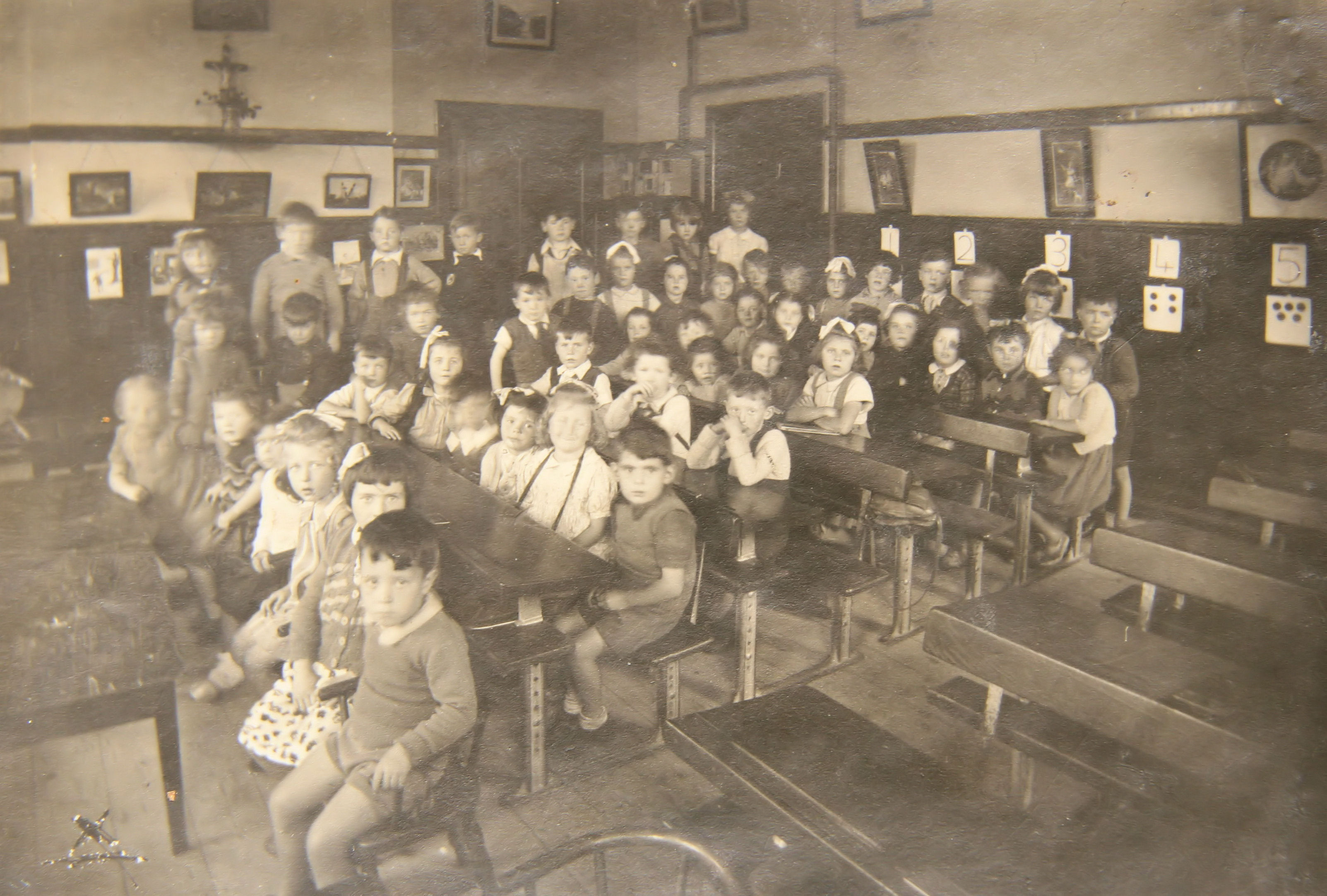
Infants 1946. Photo: Carmel Torpey
Christmas School Concerts in the 1940s
School Concerts at Christmas were the high light of the year. Usually those of us involved had to stay back for one to two hours after school in preparation. First, Second, Third, Fourth Class concerts consisted of little sketches i.e. Cinderella, Red Riding Hood, etc. followed by music and dance. Proceeds from Fifth and Sixth Class went towards the new Secondary School. Parents and friends were invited and three class rooms were opened up into one for the occasion. Sr. Cecilia was director and producer. All of us had such happy times with her. She was so patient and encouraging. The “Dumb Show” was the one I enjoyed most. There were two scenes – the Dentist and Doctor’s Surgery. We had to keep time to the music of ‘Blaze Away’. Rose Hession, the Square, was the nurse and I was the Doctor in Scene Two and Dentist in Scene One. Patients came in accompanied by two helpers or on a stretcher. Teeth were extracted by a huge pincers and the tooth taken out was a large parsnip. This had to be shown to the audience keeping to the music. In Scene Two the patient had her leg amputated by a large saw and huge bandaged wellington was shown to the audience, all to the time of the music. Anaesthetics were administered with a large bicycle pump. Teeth were filled with a bucket of cement.
On the second night Rose Hession exclaimed out loud that the incredible was happening. Sr. Agnes and Miss Glynn were laughing (both never smiled and were very stern) and with that, all of us started to giggle and didn’t the patient fall out of the bed with a big crash. The whole hall was in stitches. On the third night we could hear great laughter from the audience before the show commenced at all. We discovered afterwards that the curtain on the side was not fully drawn; hence they had a great view of all the shenanigans that took place in the wing before going out on the stage.

Children outside Connolly’s Chemist Shop, Old church Street in 1948
Includes: Teresa Reynolds, Brigid, Patricia and Kathleen White, George, Sheila and Peter Connolly, Bernie Maloney, Rena and Máire Curran,________Kennedy, Noelle and Bebe Kavanagh and Collette Aitken.
Photo: Bebe McCarthy (Kavanagh)
Other Memories of school in the 1940s
As I am now in my early seventies, I look back with great fondness and appreciation for the Presentation nuns in Athenry. Five of us Brody sisters attended the National and Secondary school and went on to third level. I have nothing but praise and thanks for all their help and guidance. They certainly gave us great example and a tremendous set of values, also a very deep religious foundation. Great thanks are due to the good nuns and our parents who encouraged us in every way.
First Teachers
My first teacher in Babies and High Infants was Sr. Philomena. We had Sr. Baptist in First Class, Sr. Ignatius in 2nd Class and Sr. Dominic for Religious Studies. These latter three nuns taught our Mother (Mai Madden) who attended the Primary School between 1912-1920 or thereabouts. We had Sr. Cecilia in Third and Fourth Class. She gave me a great love for Art and Music and always included me in the School Concerts at Christmas. She was also in charge of the choir. All of us loved her dearly.
Sr. Agnes taught 5th and 6th Class. She was very strict. Miss Glynn taught Drill.
My school friends in the National School were: Muriel Nolan, Mary Molloy, Sr. Mary Keating, Patricia and Josie Coffey, Josie Pollard, Mary Maloney, Gertie Quinn, Ann Jordan, Bridie and Josie Burke, Cahertubber, Tessie Shaughnessy and the Bane and Conor sisters and Lily Dunleavy. Most of us meet at our Lady’s Well on the 15th of August each year.
The teachers during those years were: Sr. Philomena taught Babies and High Infants;
Sr. Dominic, First Class; Sr. Baptist, Second Class; Sr. Cecilia, Third Class; Sr. Columbanus, Four and Fifth Class; Miss Glynn, Sewing and Sr. Agnes, Sixth Class. Sr. Baptist was the Reverend Mother.
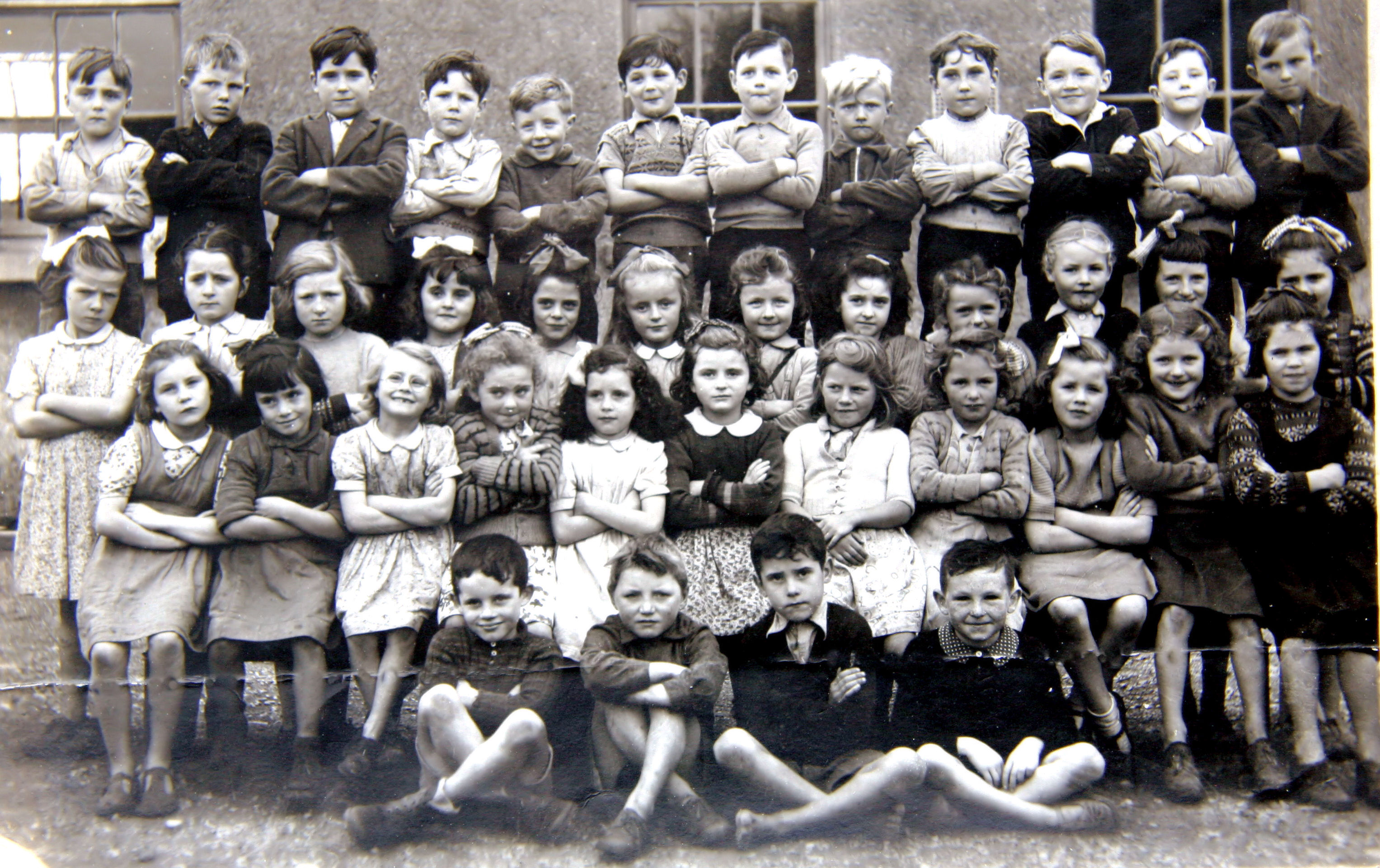
First Class 1947/48
Sitting at front, l-r: ________King,_____Kelly,________and ________Jennings.
2nd Row, l-r: Ann Crosbie, Maisie Costello, Evelyn Ryan, Ann Heavy, Rena Curran, Bridie Sice, Chris Loughnane, Ann Doherty, Agnes Coffey, Ruth Doherty and Brig White. 3rd row, l-r: Mary Shaughnessy, Ann Coyne, Bernadette Healy, Delores Collins, Bridie O’Shea, Eleanor Taylor, Nina Regan, Marta Flannery, Maureen Cahill, Mary Clarke, Carmel Whelan and________. Back, l-r: Larry Nolan, ________Murphy, Sean Waldron, _______Farrell, Hilary Lawless, George Connolly, Jim Barrett, Pat Burke, _________Delaney, Pascal Fahy and _______Murphy.
More Memories of the mid 1940s onwards
On the morning of my first day I clutched my red plaid school bag, in which I had one pencil, and my mother led me by the hand through the Convent gate at the Arch. We passed under the two giant horse chestnut trees that straddled the entrance and walked slowly up the avenue path that ran beside the convent garden, through the latticed iron gate and into the school.
I joined the junior infants’ class with Patricia O’Rourke, Ann Coyne, Maura Kearney, Mary Shaughnessy, Delores Collins and Mary Terese Beatty. Our teacher was the kind and gentle Sister Celestine. We sat on bench desks with a solid back and I remember baby chairs in the room.
We played with small trays filled with sand on which we traced pictures and designs, and when finished we smoothed the sand and started all over again. We sang out the nursery rhymes, wrote and drew pictures of the alphabet letters with chalk on small slates. The schoolroom walls were decorated with dried horse chestnuts used for counting.
The room was heated by large cast iron radiators, the hot water coming from the burning of wood in the furnace room beside the convent.
In first and second class my teacher was Sister Dominic who could be very cross at times and I remember her slapping me across the back of my hand for failing to keep my writing vertical. In our classroom we had a May altar to Mary that was decorated with flowers and ribbons. During those years a musical called ‘Little Red Cap was staged in the school by the fifth and sixth classes. One of the songs was ‘Little Brown Men’ and two verses went like this:
‘Little Brown men of the mountain we,
Gay and free as can be,
Singing and dancing with mirth and glee,
At the still midnight hour.
Naughty and mischief and pranks we play,
Night and day, ‘tis our way,
Caring for nothing but poor mortals,
At the still midnight hour’
Sister Baptist taught me in third and fourth. She was ‘all right’-she didn’t bother me and I didn’t bother her.
Sister Columbanus was in charge of fourth and fifth classes. She was very good at music and took charge of the local church choir.
She was great friends with the curate, Father Delaney and when he visited her for a chat, we enjoyed the free time while they conversed at the top of the room. Sometimes he stayed so long that we went home with no homework as Sister didn’t have time to give us any.
In sixth class, Sister Agnes was a good teacher. She was a cross individual who rarely smiled. I think she had a strong streak of republicanism in her as, every day, when we marched out to the yard singing to the song, ‘Clare’s Dragoons’:
‘When on Ramilles Bloody Fields, The blackened French were forced to yield …….’
The Sun House
During warm summer days, the Sisters walked around the big field while they read their office. Afterwards they relaxed in the sun house in the top corner where the field met the bridge road.

The Feast of the Sacred Heart
The highlight of the year was the Feast of the Sacred Heart on the 21st of June. All the classes assembled in the yard. The procession moved off around the path in front of the convent and saying the Rosary. It ended at the statue of the Sacred Heart and we sang the Hymns, ‘Hail Queen of Heaven’, ‘Sweet Heart of Jesus’ and ‘Daily, Daily, Sing to Mary’, which went:
‘Daily, Daily, Sing to Marty,
Sing our soul and praises due,
All our feasts and actions worship,
Our thoughts and ……………….. new’.
Afterwards we sat in the yard for tea and currant buns, which came in large trays and were baked by local baker, Joe White, father of Kathleen Bane, Brid Caulfield and Patricia Nolan.
The School Dentist
We dreaded the visit of the school dentist, whose presence put the whole school on edge. We trembled as we entered the Cookery Room beside the Convent where he examined our teeth. He used little anaesthetic as he regularly used his thumb to ‘press’ out the bad teeth, which resulted in loud screams echoing around the yard and frightening the daylights out of those waiting to enter his ‘surgery’. The clever and cowardly ones, when they knew he was coming, went ‘sick’ that morning.
The Non Stop Draw
In 1950, this was organised to raise funds for the new secondary school. My father bought a ticket numbered 303 for two shillings for me and I was fortunate to win £5.
Sister Celestine and New Zealand.
I remember 1955 as the year Sister Celestine headed off to New Zealand on board the liner, the ‘Straitard’ to join Sisters from Tuam who had established a convent there in 1950. She sent a postcard to my mother and I can still see in my mind’s eye the photo of the liner on it.
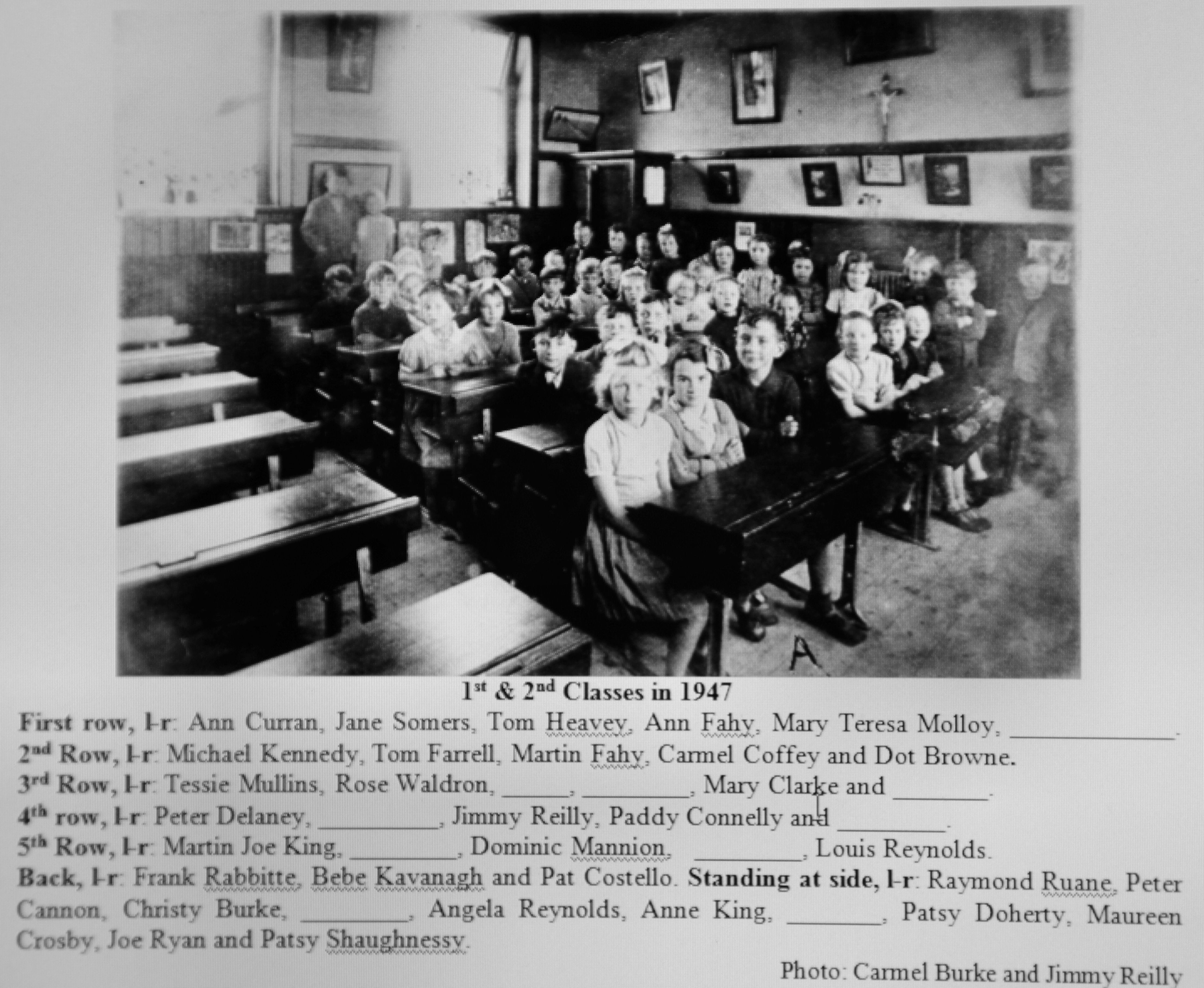
Another pupil’s Memories of Music and ‘Red Cap’ in the 1940s
Giving thought to my Primary School days spent with the Presentation Sisters in Athenry many years ago in the nineteen forties, I must say that they were favourable days for me. The happy times that stand out in my mind are the musical experiences I had during these years. I always loved to sing and play musical instruments and was lucky and privileged to be encouraged to do this in primary school. When I was in Second or Third Class we performed an Operetta entitled “Little Red Cap”. I was given the part of Little Red Cap. My mother got a pretty costume made for me and a long red, woollen pixie cap with a huge tassel. The show was performed at Christmas time in the school. The folding doors were opened between the class rooms to form the hall for the production. We all had a great time doing the show. As it snowed heavily during the time we were doing the Operetta, it was wonderful, adding to our excitement. I remember walking home afterwards through the crunchy, crispy snow. I still remember songs from that musical:
“Little Red Cap
We hear your voice
And we are watching o’er you
Have no fear while we are near
Our treasures lie before you”.
Sr. Teresa played the piano for it and Sr. Columbanus taught us the songs, etc
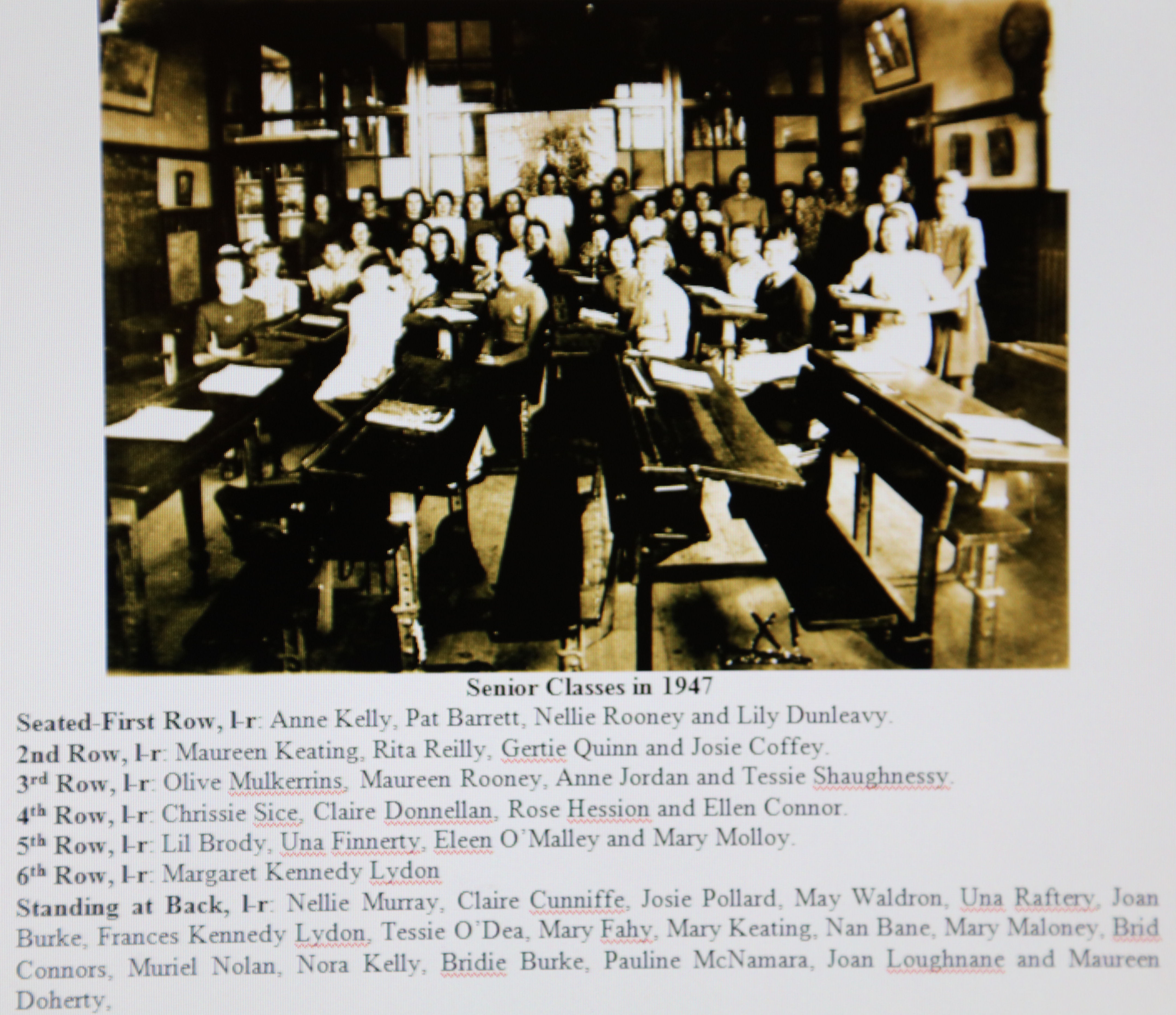
Another pupil’s memory of the One Shoe Elf and Sr. Columbanus’ influence
Possibly my most memorable dramatic/musical event was the production in the National School of ‘Redcap in Fairyland’ in 1949 in which I played the part of a brownie/elf.
Also in the cast were Patsy Doherty, who was ‘Redcap’, Carmel Coffey, Ann King, Ann Curran, and Teresa Reynolds. The latter’s dance was spoiled by my standing on the upturned toe of her felt shoe and necessitating her disappearance from the stage momentarily and resuming with only one shoe. The production was possibly due to Sr. Columbanus, which brings me to record her influence on me.
I have been involved in choral music, as an amateur, all my life and I know that Sr. Columbanus’ teaching and encouragement was the basis for a lifetimes’ enjoyment of and participation in music, particularly choral.

Musical influence of Srs. Teresa and Columbanus
I was encouraged in school to sing. I went to Miss Barry for singing lessons. She was the wife of the Station Master in Athenry at the time. She taught me singing for a few years whilst I was in Primary School. She entered me in local competitions and Feiseanna. I won my first medal in Galway at seven, rocking my favourite doll, singing Brahms Lullaby. The Barry family moved to Ballina when I was in Fifth Class but Mrs. Barry kept in touch. She entered me for the Sligo and Ballina Feiseanna. My Dad brought me there for the competitions where I was successful and he was proud of my achievement winning a cup and two medals. Sr. Teresa taught me the violin. She sold my mother a very good violin, which I still have. I went to Sr. Teresa every Saturday morning to the Convent for the violin lessons. All these musical experiences opened doors for me later in my teenage years and adult life. My teenage years were spent in boarding school, but when I came home on holidays Sr. Columbanus always welcomed me back to sing in the Parish Choir, which I was happy about.
Formidable Women
Srs. Celestine, Dominic, Baptist, Columbanus and Agnes were formidable women, but they were the product of their time and training. They were strict in carrying out their work. Sr. Agnes was very strict. I remember her sitting at her large desk on a high rostrum inside the window of the Sixth Class room each morning, watching out for those coming late to school. These late comers were confronted as to why they were late and a good excuse was necessary or ….. Since we lived across the road from the school there was no excuse to be late.
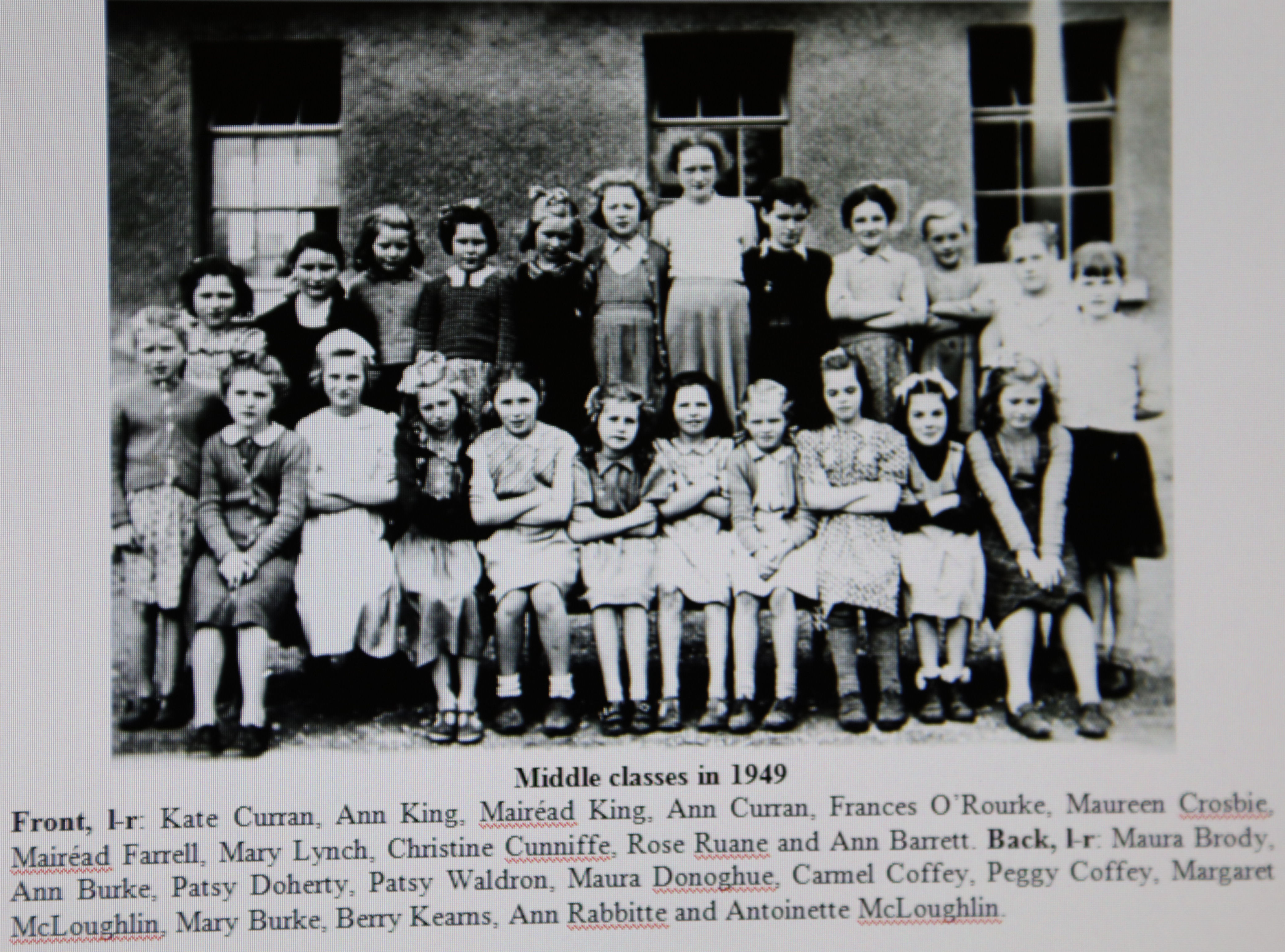
Beautiful Convent Chapel
Each year a special effort was made to erect a May Altar in each class room. The pupils brought in the flowers, wild or cultivated. There was an interest by all to have a peep into each class room to see which class had the nicest altar. I think during May or around the time of the feast of the Presentation I remember going in single file and strict silence through the beautiful, high walled convent garden to the convent chapel. There we sang a hymn, said a prayer and returned to our class room again, in single file and in silence. It was so nice to see the manicured enclosed garden and the beautiful chapel. It always made an impression on me as a child. I can still see the enclosed garden and the chapel in my mind’s eye.
Growing up in Athenry in the 1950s –Freda McGough
I was almost nine years old when I moved to Athenry. An untidy ribbon hung from the side of my tousled, blond hair and I had just left my small, rural, two-teacher school with only nine in my class, to which we all walked through field pathways slushy with mud in Winter and strewn with heavenly-scented primroses and cowslips in Spring. Although I didn’t know it then, moving to Athenry signalled the end for me of a carefree, unstructured romp through a gentle, slow-paced rural Ireland of plough horses, and threshing and wedding receptions held in country kitchens.
Townie schooldays
But what Athenry had to offer was a life of comparative sophistication, top of the list being streetlights, and shops with toys and sweets! Top of my parents’ list was, undoubtedly, to get me settled into my new school run by the Presentations Sisters, with their exotic and strange-looking head dress of white stiff material forming a little bonnet and framing the face, a white, starched sort of bib and, over all, a longish black veil. I just couldn’t take my eyes off the huge black rosary beads that hung from the leather belt. And from one of these strange outfits, on my first day, beamed the smiling face of a young Sister Leo, who became my first teacher there. My anxieties began to subside and by the time we had gone to the ‘old cookery room’ at the back of the Convent to do some nature study, and been invited to bring in some leaves for identification purposes, I was beginning to relax. In fact I was already letting go of my country childhood and surrendering to what I knew was going to be very different but fun. I was fast becoming a townie and loving every minutes of it.
Street games
The fun continued with the arrival, that first summer, of Roseanna Hynes from Drogheda, who came on holidays to her grandparents in Cross Street. She had the most amazing repertoire of children’s street games – previously unknown in Athenry – and which could accommodate any number of children. Just as well, because word soon spread and we were joined by companions from far and wide and spent hours in the long Summer evenings assuming various poses, often standing on one leg, and trying to avoid ‘O-U-T spells OUT’
Otherwise, entertainment in these relatively impoverished fifties was of the homemade variety. There were dreary walks with friends ‘around the pound’ on Sundays, cycles in the direction of Craughwell to pick hazelnuts in the autumn, and I remember picking wild damsons for jam making, somewhere in Kingsland. By summer, we could hardly wait for the visit of the McFadden Family’s travelling players who set up a square tent in Bridge St., in front of the Castle, to present a nightly concert and play. The plays had such riveting titles as ‘Little Nellie Kelly’ and ‘Murder in the Red Barn’ and we cried buckets! Our imaginations were fired too in winter by the fine productions brought to us by Kitty Lardner and the Athenry Players.
Scent of Wallflowers
But above all, it is the scents and sounds of childhood in Athenry which come to mind most readily, the pomp and splendour of the Corpus Christi procession when the Blessed Sacrament was taken through the streets under a golden canopy preceded by children in white dresses walking backwards, strewing thousands of multicoloured flower petals in its path. The petals formed a sort of delicate mosaic on the ground for days afterwards. I’ll never forget the intensity of the clouds of incense dispensed by the thurible in the narrow streets, while the choir and the townspeople sang with fervour, hymns such as ‘Sweet Heart of Jesus’ and ‘Faith of Our Fathers’. The sweet scent of wallflowers still reminds me of May altars in school, decorated with blue and white chains, which we had so lovingly fashioned from crepe paper.
Hearty rural aromas
In the winter months, in total contrast, odours of a different kind predominated when the street fairs took place, and farmers sold cattle and sheep right in the heart of the town. It meant a day off school – always welcome – but the stench of manure hung over the town for days afterwards while the big clean-up took place.
The fifties were hungry times and I distinctly remember seeing migrant workers from Connemara, known as Spailpíns, lined up outside Glynn’s pub in Davis Street after Sunday Mass hoping to be hired by local farmers for the potato picking. The image of these dignified men, hunched in the rain and wind in their inadequate clothing, is one that has stayed with me down the years. But by the sixties, thankfully, all that had changed for the better and my life was changing too. I had my sights set on Dublin and whatever that might bring.
In 1957 St. Mary’s GAA club gain senior hurling status by winning the County Junior Hurling Championship.
Freda McGough broadcast on RTE radio for many years. (Source: The Athenry Journal)


1950 Confirmation Class
Front row, l-r: Bebe Kavanagh, Ann King, Carmel Coffey, Ann Curran and Patricia Glynn. Back, l-r: Margaret McLoughlin, Dot Browne, Josie Maloney, Maura Brody and Patsy Doherty and Anne Barrett.
Photo: Bebe McCarthy (Kavanagh)
Sunday morning after mass in Athenry’s Church of the Assumption in 1950/51
Photo: Teresa Hawkins of New York. Teresa was on her way home to America and was visiting her relations, the family of Jimmy Reilly in Athenry in 1950/51.
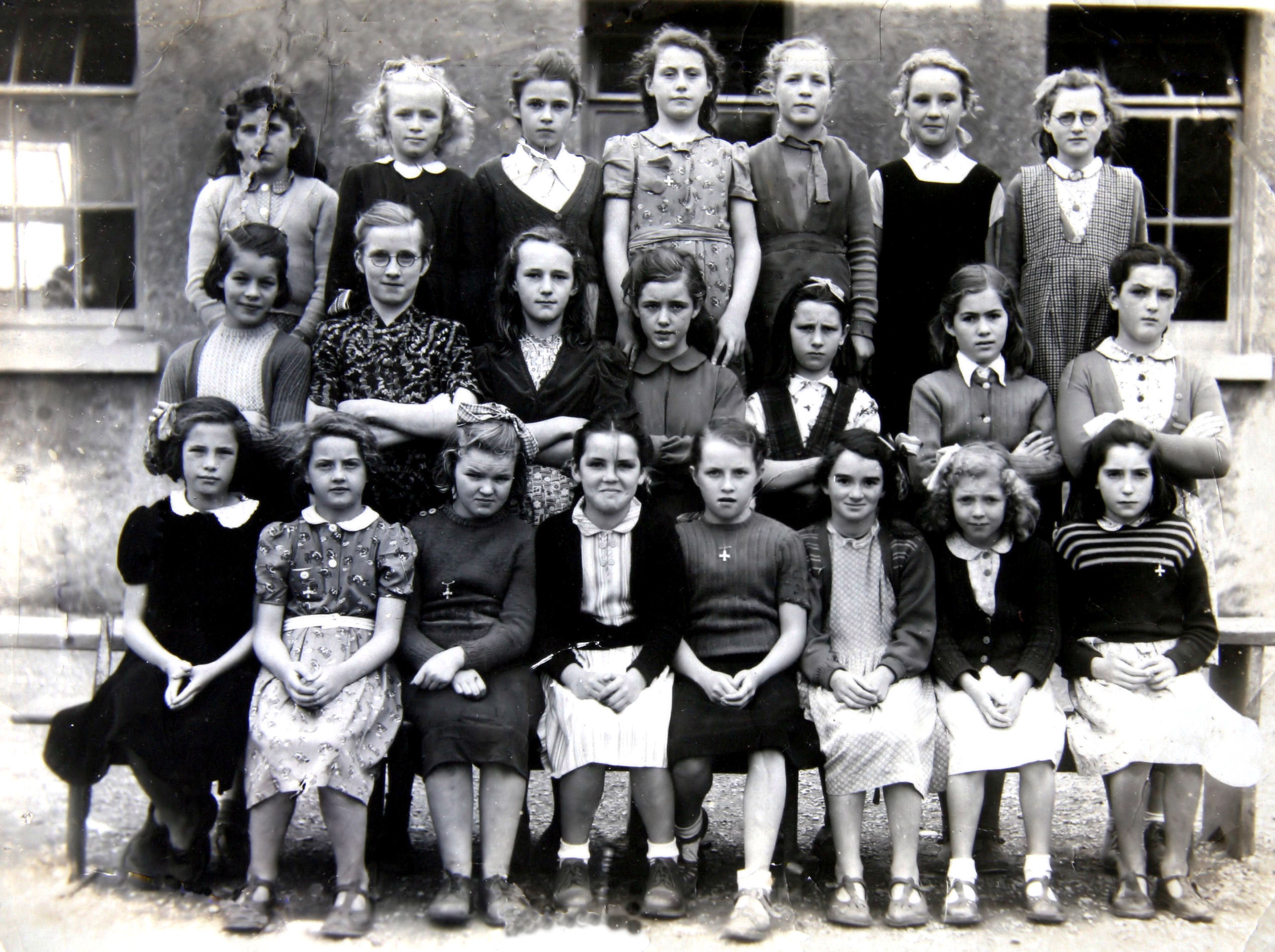
Fifth and Sixth Classes in 1950/51
Front row, l-r: Esther Costello, Patricia Flannery, Nancy Kennedy, Helen Raftery, Dorothy Browne, Jane Somers, Josie Delaney and Rita Ryan. Middle row, l-r: Ann Farrell, Milicent Browne, Teresa Haverty, Margaret Burke, Evelyn Madden, Tura Bierg Cerda (Norwegian girl who lived in Athenry) and Ann Raftery.
Back row, l-r: Kathleen Rooney, Margaret Sice, Maureen Rooney, Peggy Flannery, Margaret Coyne, Betty Burke and Emily Madden.
Photo: Kathleen Cooley
Rousing Marches and Long Tots
Many of my memories seem to be related to music; from Sr. Agnes’ rousing marches viz ‘Kelly the Boy from Killane’, ‘Clare’s Dragoons’ etc. as we went out for break. I met her subsequently and she confessed to having been very worried over what influence those songs might have had on us in relation to a deteriorated political situation. Sr. Baptist taught us ‘The Castle of Dromore’. We perfected long tots with Sr. Agnes for our Primary Cert, a skill I still have.
Memories of our schooldays from
Mary Brady (Mullins), Florence Taylor (Phelan), Freda McGough and Marie Whelan (Gardner)
M.B. The Presentation Sisters are part of the fabric of the town of Athenry and our own family had a great affinity with them from their very arrival. The nuns were held in such high esteem in our household, that it was taken for granted that when one was called upon to run errands or help in anyway you just didn’t question it.
My uncle Johnnie gave great assistance to Mother Peter and the other Sisters when they arrived to take up residence in Canon Canton’s house.
My very first memory of the Sisters was seeing them out for walks in the front grounds behind the high walls. We could see them from our front windows. The only time they were seen was when they were going to the Secondary Top with the pupils, which was then held in the Canon Canton Hall.
Infants
F.T. On Monday,June 5th.,1950 I made my first journey to school. I did not know it then but it was to be the first of many Monday mornings stretching over fifty-four years.
The arrival of a baby brother in November of the previous year may have influenced this starting date.
My parents may have felt it would be easier if I became accustomed to his presence in the house where I had reigned supreme for five years, before introducing me to the big world outside.
Whatever the reason, I was nearly six years old when I made my appearance in the Infant classroom where the much-loved Sr.Celestine cared for both Junior and Senior Infants.
The little wooden chairs caught my eye and I made my way over to sit in one, like Goldilocks in the house of the Bears. Sadly, just like Goldilocks, I found the chair was too small and before I had time to be disappointed, Sr.Celestine shepherded me to one of the Senior Infant desks which proved to be “just right”. There I stayed with the Senior Infants who were much closer to my age than the little four-year-olds in the “baby chairs”. Fortunately, I knew my letters and their sounds, thanks to the diligence of my mother and the very large and useful signage over all places of business in the town. I particularly remember learning “India Rubber” from a bright blue tin sign over Sweeneys’ Garage!
Apart from a few tears when presented with a Headline Writing copy and a Reader starring Tom, Mary and Billy who seemed to be constantly going up,up,up…I settled in well, thanks to the patience and kindness of Sr.Celestine.
Marla, which came in a hinged tin box, was a major feature in our day. We rolled and shaped it on our “mataí ”, which were squares of lino. It always puzzled me where the boxes came from because “Tobacco” was one word I was very familiar with. Where did Sr. Celestine get all those boxes? Could it be possible that the nuns smoked all that tobacco just so that we would have nice boxes for our márla? I had a mental picture of the whole Community sitting around every evening puffing their pipes.
So much did I love school that I announced at home one evening that I never wanted to go to Galway again or even Tofts, just school.
It was during that first year that we had a Christmas Play and I think it may have been a Fundraiser for the new school. I was an Angel.(“A little divil more like”, said Miss Barbara Leonard, who obviously knew me better than most)
It was in Senior Infants too that I received my First Holy Communion from Fr.Delaney on Sunday May 13th, having “made” my First Confession on the previous Friday.
My first book bill is preserved for posterity.
English Primer….7d ( Tom, Mary Billy, no doubt!)
Irish Primer……….7d
Writing Copy… 2d
Drawing Copy… 3d
Crayons……… 1d
Pencil………… 2d
Jotter……………1d
Catechism………1d .
Total 2s 1d
M.B. I started school in the Convent National School in 1949 and attended until 1957. Sr. Celestine was my first teacher. She taught Junior and Senior Infants. She was such a kind and caring person and was ideally suited to teach the induction classes. I remember the toy furniture for every room in the doll’s house and the matchstick and ‘cork’ people. When the door between the Infant and First class rooms was ajar, we could see all the bigger classes and we were in such awe of them.
M.W. I started in the Convent N.S. where Sr.Celestine taught Babies and High infants in the same classroom. On reflection these first two years were my happiest school years and I loved Sr. Celestine. She really mothered us and we felt very secure and protected!
A week after starting we were told there would be a ‘black babies march’ and to bring in a penny for it. I remember being terrified going in to school in case there were black babies there. However, what it meant was we marched around the room to music and dropped our penny into a mission box. A head on the mission box bobbed every time we dropped a coin in. From then on our ‘march’ was the highlight of our week! That was our first ‘Missionary’ effort!
We learned to add and subtract on empty spools! A cord with 10 X 10 empty spools of thread stretched across the room, each 10 a different colour. We had ‘márla’ to play with and our ‘art’ classes were great!
First Class
M.B. Sr. Dominic was our First Class teacher. She prepared us for First Confession and Holy Communion. We made umpteen trips to the Church to prepare. She taught us our prayers so well that I still recite those same prayers today. Before the Mass on our Communion Day we congregated in the Convent and all the class walked to the Church for our big day. We again wore our dresses for the Corpus Christi procession, where we had the privilege of strewing rose petals before the Blessed Sacrament.
F.T. This was the realm of Sr.Dominic and represented a significant step forward in our education, leaving forever the magic world of the Infant room with its toys and sand-trays and Sr.Celestine’s protection. This was serious work and we knew it because we had heard the chanting of the Tables from next door: “A haon móide a haon sin a dó, a haon móide a dó sin a trí “, agus mar sin de.
The flat roofed extension to the front of the school was constructed in the Summer of 1951.

Flat Roof Extension
During the Summer of 1951, major building work went on in the school and its completion did not coincide with the start of the new school year. I remember hearing the words, ”The Presentation Convent Primary School will not re-open until further notice”, on several Sundays at Mass. It must have been a wonderful summer! What other reason could there have been for the lightness of heart I felt at those words? Could my love of school have cooled a little, or was it anxiety at the thought of the impending Tables and Sr.Dominic’s strict regime, as reported by those who had gone before? I was never to know, because poor Sr.Dominic broke her hip and our class was the only Rang a hAon for years not to have experienced her guiding hand.
That year was exciting and full of surprises. What child does not enjoy variety? We had a succession of substitutes of whom I only remember two: Miss McGovern and Miss Quinn, or Minnie as we irreverently but affectionately called her.
F. McG: Because I only joined the school in third class, I escaped the attention of the legendary Sr. Dominic, a small, rotund woman with beady eyes and a fine strong voice, who taught First Class and prepared the children for First Holy Communion (including boys, who only went to the Boy’s School after that event).
My youngest sister, Fionnuala Cleary, clearly remembers Sr. Dominic keeping a bit of soap in a mustard tin and rubbing the soap on the tongue of any child who told a lie. Apparently, the soap washed the sin away. She also ran the Children of Mary (for secondary school students and adults).
They participated as a group in all church processions, wearing a white veil on their heads and a blue cloak and a big Child of Mary medal hanging from a wide blue petersham ribbon around the neck. Sr. Dominic had eyes everywhere, all over town, and there were plenty of “oul wans”, as we would have called them, who ate the toes of the statues for breakfast and delighted in “reporting” the alleged misconduct of some of her Children of Mary … dreadful behaviour such as climbing the tower with the boys, along the town wall – opposite the ‘pump house’ and near where the silos are now….AFTER DARK, or worse on long bright Summer evenings, giving scandal to all who could see them.
Oh! The disgrace of it. And you could forfeit your Child of Mary medal – and some did. And it mattered to those who did.
All of that said, I still liked her with her twinkling, beady eyes.
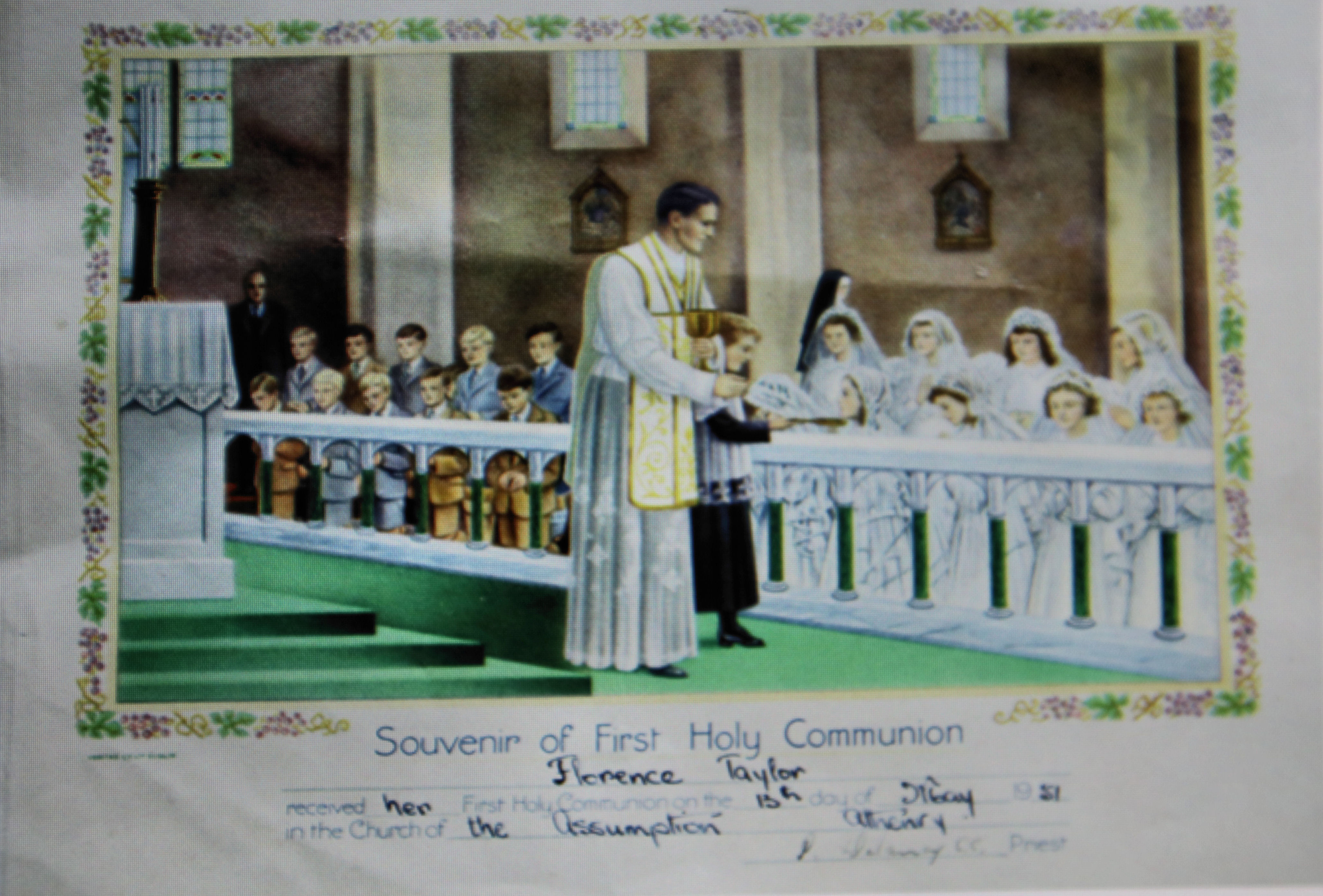
M.W. I graduated to 1st class and the good times were over. Sr. Dominic told us to take out our ‘scribblers’ and we didn’t know what she was talking about. She got cross with us and told us we were not babies any longer – we had grown up!
The seating arrangement was different here too. Gone were the lovely baby chairs and tables and replaced with two-seater desks . Each girl was put sitting beside a boy .I was sitting beside a boy named Billy Burke from Abbey Row. We got on great for the year and I remember being lonely for him when the year was over and he went to the boy school. [His family left Athenry later and I never heard of him since]
Before the summer holidays we had to clean the room. Wax was produced and the desks waxed and polished. The windows were cleaned inside and outside and the blackboards were washed. The same holiday clean-up happened every year from then on. We had grown up.
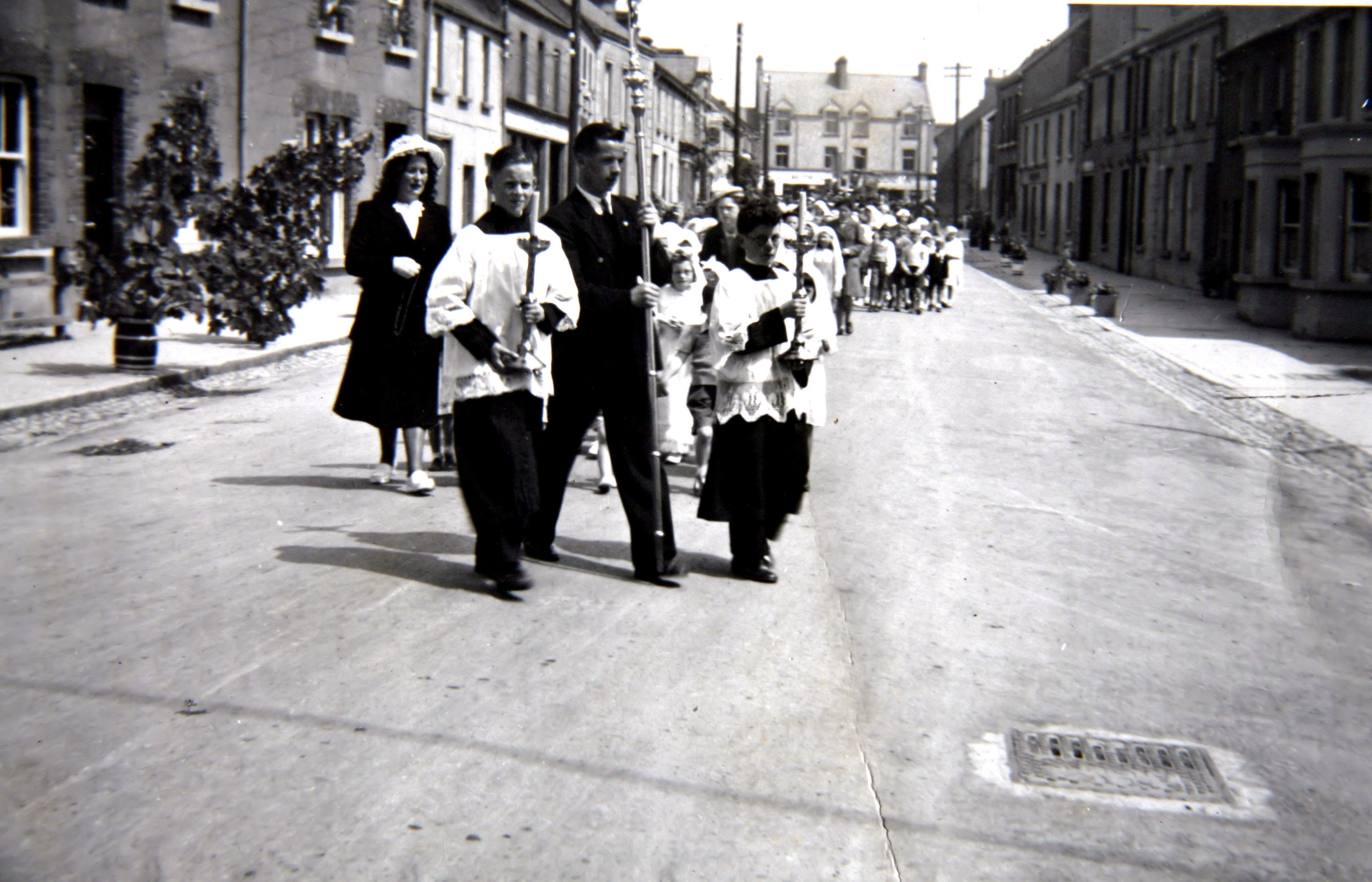
Corpus Christi Procession circa 1950
Left front is Moira McGovern (teacher) followed by the school children of the Presentation National School. Note the potted plants on the edge of the footpaths.
Second Class
F.T. Sr.Baptist, who was also Reverend Mother, taught me here. She seemed extremely old to me and this impression was compounded by the knowledge that she had taught my aunt and uncle years before. She often referred to the twin Taylors who had made history by attending the Convent school. They were by all accounts model children and not at all like me! We shared the large middle room with Third Class so that when we were promoted, we physically moved in reverse but academically very definitely forward.
It was at about this time that I made a very important discovery, which shocked and surprised me greatly. I was discussing something with my parents at home when I must have let slip that I doubted the fact that nuns had legs and feet. An argument followed, but I would not back down. I insisted that they glided along supported only by their voluminous skirts. My mother advised me to be more observant in future and that I woud be sure to notice footwear at least. Next day, I fastened my eyes to the floor and before long, lo and behold, a well-polished shoe emerged. I had really believed until then that nuns were heavenly beings sent to earth to guide us through school. Never one to give in easily, I announced that I was at least half right. Weren’t they really holy? They could have wings tucked away somewhere, couldn’t they?
M.W. Second class was taught by Sr. Baptist. She was a great friend of my mother so I was home and dry! Everyone liked her and we felt very grown up beside her because she was very small. One day she said I looked very pale (even though I felt fine) and brought me to the convent for hot milk. The milk was boiled with a skin on it and I felt sick for the rest of the day after it! However, this highlights how caring she was.

Athenry Mass Servers 1951/52
Back, l-r: Bobby Walsh, Michael King, Seán Glynn (The Square), Seamus Donaghue (The Arch), Seamus Fahy, Hillary Lawless and Joe Pollard. Front, l-r: Michael Quinn, Bernie Conneelly, Jimmy Reilly, Seán Cheevers, Joe Keating, Paddy Clarke, Johnny Cannon and Peter Cannon.
Photo: Jimmy Reilly
Third Class
F. McG. The gentle Sr. Leo (Jane Hackett from Headford) was my lucky introduction in 1950 to Presentation Convent, Athenry. Having come from a small, two-teacher country school in Belclare, Co. Galway (class size about 12!) and never having seen a nun before, I was just a tiny bit anxious (and at the same time excited) about how this new experience would work out.
Sr. Leo taught 3rd class and, while I remember very little about general studies, apart from having constantly inky fingers from learning to write with a pen, I cherished the time spent with her when we adjourned to “the old cookery room” attached to the back of the convent. It contained a huge black range and had a sort of glassed in/conservatory-type area as an entrance from the yard.
There she taught us nature studies and encouraged us to bring in leaves and nuts from the various trees around us. It didn’t seem like work and was the perfect introduction for a child who grew up on a farm. We all loved Sr. Leo.
F.T. During the previous year we had been aspiring to becoming pupils of the youthful and energetic Sr.Leo (left). Imagine our dismay when we learned that Sr.Leo was leaving. Another stressful Summer wondering who would replace her!
We needn’t have worried because Sr.Sylvester was even younger and I for one was very happy. I even enjoyed copying her clever headlines from the Blackboard:
“ A stitch in time saves nine.” “Better luck next time.”

Cross Street decorated for the procession of Christ the King in the 1950s
Fourth and Fifth Classes
M.B. Sr. Columbanus taught Fourth and Fifth Classes. She introduced us to painting, which we all loved. She had a glass-case with lots of birds’ nests and eggs – of all sizes, colours, speckled and plain.
History was my favourite subject here, as we explored our local environment. We gathered lots of interesting facts about historic Athenry, the Castle, round towers, walls, gates, etc. I feel it gave me an abiding love for and interest in history, which I pursued later at University to degree level.
F.T. Sr.Columbanus! I was terrified of her! My writing was uafásach. I was useless at drawing and painting. I could not under any circumstances arrange flowers artistically in her hand-painted vases. I couldn’t use a ruler to draw and measure straight lines in my sums copy and I managed to knit and raise the heel of a sock back-to-front while at the same time spilling a cup of sugary tea on it. I was “killed”!
At least I could sing and that redeemed me slightly in her eyes, though I didn’t measure up to the Kavanaghs’ talent. Still, it was something. I could also spell but spoiled everything by boasting that having got all my spellings correct, I hadn’t learned them at all. “Killed” again!
One day, in Fourth Class I believe, a little girl who had been out of school for the previous year arrived in our classroom and was put sitting beside me. Her name was Olive Dobbyn. Thus began a friendship that has endured through the decades, not only with “Oll Doll” but with her younger sister, Ruth.
Talking of friends, I was surrounded by cousins who were also good friends: the Taylors: Eleanor, Nina, Sam, Deborah and Marguerite; the Kavanaghs; Noelle and Bebe and the Paynes; Ronnie and Norman.
Although I always felt nervous in Sr. Columbanus’ class, I owe her a debt of gratitude for the sound foundation she gave me in Gramadach na Gaeilge, and for the fact that she taught me all I know of Liturgical music both in Primary and Secondary school and in the church Choir. Both have served me well as a Primary teacher in a small rural community.
F. McG. These were taught by Sr. Columbanus, who was already a qualified primary teacher before she entered the convent, in a large classroom – 4th on the left and 5th on the right. She became a dear friend for many years after I left Athenry. She had the air of a woman who was happy in her chosen vocation and was quite an independent spirit and always spoke out for what she believed in. And she had a most engaging personality and laughed a lot. She had come from the convent in Keel, Achill Island, and often told us stories about how impoverished some households were there when she first arrived. Many families had fathers who had to emigrate for work and times were really tough. Strong on Irish history, art, choir and English grammar she was very much a Republican and I distinctly remember an incident in which two sisters were sent home from school from her class on the day of Princess Elizabeth’s Coronation Day in 1952 for daring to appear with red, white and blue ribbons in their pigtails. They were asked not to come back until the ribbons had been removed. That quietened us for the day. But the interesting thing about those times was that parents didn’t question the authority of the nuns. Imagine if that happened today?

Some of sixth class pupils 1955
Front, l-r: Maura Kearney, Bibi Reilly and Patricia O’Rourke.
Back, l-r: Geraldine Doherty, Ann Burke, Mary Ann McNamara and Mary Shaughnessy.
(Toilets and shelter can be seen in the background)
Photo: Geraldine Ahern (nee Doherty)
M.W. Sr. Columbanus taught 4th and 5th classes. These were not my best years! Every Tuesday and Thursday at 11 a.m. I had to go to music lessons during history and geography class. To this day I still have big gaps in these subjects.
Sr. Columbanus was in charge of the junior and senior choirs. Sr. Teresa played the organ. The choirs sang at 11.30 Mass every Sunday, Rosary and Benediction every Sunday night [Choir practice after this], Funeral Masses, Processions, Christmas carol singing on Christmas Eve which followed the same route as the Corpus Christi procession. Male singers from the town were enlisted into the choir. Sr. Columbanus and Sr. Teresa put a lot of work into these choirs.
F.McG. All the “town children” who could sing were in Sr. Columbanus’ church choir and Sr. Teresa (Conway) played the organ. Devotions consisted of the rosary and, at the end, Benediction, with the swaying thurible wafting clouds of heavenly incense from the altar as we sang “Tantum Ergo Sacramentum ….”. Most of the church hymns were in Latin then and while we didn’t always know what they meant, we knew them by heart. We always walked the two nuns back to the side gate of the convent after evening devotions and Sr. Columbanus told us all about the night sky … the Plough, Orion, etc. That was all before light pollution hid the stars.
F.T. Sr. Agnes left in 1956 while I was in sixth class and was replaced by Sr. Paul Canavan.
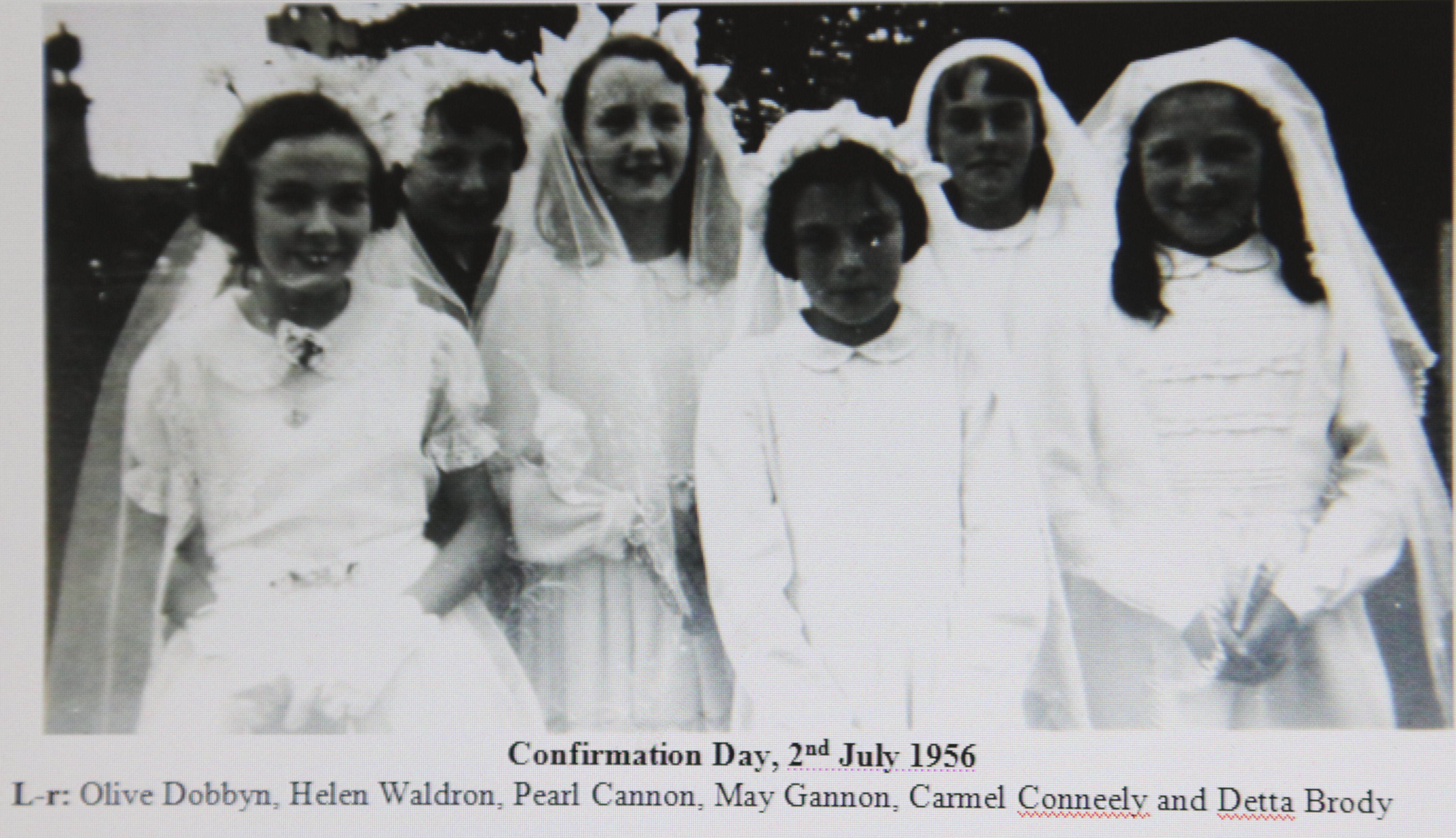
F.McG. St. Agnes taught me in sixth class and had the unenviable task of preparing us for our next big move – secondary school or where? The majority would have gone on to secondary school – most to just across the school yard, some to boarding school – but a very few did not go beyond sixth class. Sr. Agnes was a tall, stout woman with a very high colouring. She was calm, kind and an excellent teacher and loved to teach us rousing ballads with gutsy choruses, such as ‘Ireland Boys Hurrah’, which began with the words “Deep in Canadian woods we’ve met from one bright island flown …” The chorus ended, I seem to remember with the words, ” we toast old Ireland, dear old Ireland, Ireland boys hurrah”. Blood curdling stuff! Another favourite of hers was ‘The West’s Awake’. I can still hear this lovely woman with a high-pitched strong voice as clear as a bell, beating out the time. We loved all that. But that was ‘in class’ and Sr. Columbanus still came in to teach Choral singing and singing in harmony. This I adored. She had a beautiful contralto voice herself.
We now had to learn to sew and this involved cutting out a pattern of a “lady’s knickers” – double gusset, with long legs almost to the knees and elastic on the ends of the legs and at the waist. Mine was made from a lurid green cotton material with a scattering of flowers (it was NEVER going to be worn). There was great mirth when we all (but not in the presence of Sr. Agnes) put the knickers – pre-elastic – up against the bottom half of the classroom windows … a perfect fit.
For recreation at break time, we walked in groups round and round the school building. And a really inspired lay teacher, Mary Heneghan, who came out from Galway every day on the train, taught us drill in the yard, which we hated with a vengeance.
For one thing we didn’t particularly like cold, fresh air and we certainly didn’t like the formality of drill where we all stood in lines as if on a barrack square trying to touch our toes with straight legs! But, apart from drill, we adored Miss Heneghan who taught us French and also read us English poetry as if she really loved it – which she did. She also read us Oscar Wilde’s The Happy Prince and told us magical stories about Paris and the great classical buildings such as Notre Dame Cathedral, with its flying buttresses. It was
there in her classroom that my lifelong love affair with France began.
At about second year, the nuns decided that we should play camogie. This we all loved but for some reason which I can’t remember our interest waned or the field was not suitable, but it gradually petered out.

It strikes me, as I look back over my school days that we were all very respectful towards the nuns and very serious in their presence and we were, I suppose, afraid of making a wrong move that might upset them or show us up in an unfavourable light. In a sense we were “goody goodies”, which must have been a bit boring for the poor nuns!
It was the era of being “seen and not heard” and we would have been the same with adults around the town or neighbours. But that said, there were one or two cases in the school where pupils who might have had difficulties in their family lives were a bit giddy and “wild” and broke the rules now and again and the nuns showed enormous compassion and understanding and we could tell that they actually liked the spiritedness and honesty of the girls in question and they always made clear their love for them. And, far from being resentful of this or interpreting it as favouritism, the rest of us understood perfectly the dynamics of the relationships and the issues involved.
Thanks to the following for their contributions to this part of the story:
Freda McGough, Cha Taylor, Geraldine Ahern (Doherty), Maura Brody-McKenna, Lily Kavanagh, Marie Gardner (Whelan), Teresa Hawkins, Kathleen Cooley, Florence Taylor, Lily Keenan (Brody), Ann Rabbitte (Crosby), Bebe McCarthy (Kavanagh), Patsy Elliott (Doherty).
Athenry in the 1940s
This was the time of the ‘Emergency’ and to defend the state, appeals to join the local defence forces were made to young men by Fr. Levelle and TDs Sean Broderick and Mark Kilillea. The new Boys’ National School was opened in 1940 and it was planned to have improvement work carried out on Carnaun N.S. and a new school built in Lisheenkyle. The Athenry Development Association of the time had plans to improve the town’s water supply and provide a fire engine. The Association was especially concerned that the town had no representative on Galway County Council. New woods were planted in Derrydonnell (600 acres) and Moyode (400 acres).
During World War 2 there was rationing, with tea being particularly scarce. There were very few cars on the roads. Only priests and the doctor would have owned them, and you had to start them in the front with a handle.
In January 1943, a US Air Force Flying Fortress bomber with top army generals on board crash-landed in fields of Mellows College. The generals were brought to the Railway Hotel, and afterwards transported across the border into Northern Ireland. Later, the plane was segmented and also brought across the border.
(A detailed account of this major event of World War 2 is to be found in Eagles Over Ireland by Paul Browne, 2003)
In the town, Corbetts of Northgate Street, under manager Mr. John Corbett, was the largest retail business with thriving saddlery, grocery, egg and hardware departments.
Dempsey’s Butchers in the town centre did a thriving business.

Photo: Claire Dempsey and her mother, Mai Dempsey (nee Doherty) outside the shop in the late 1940s)
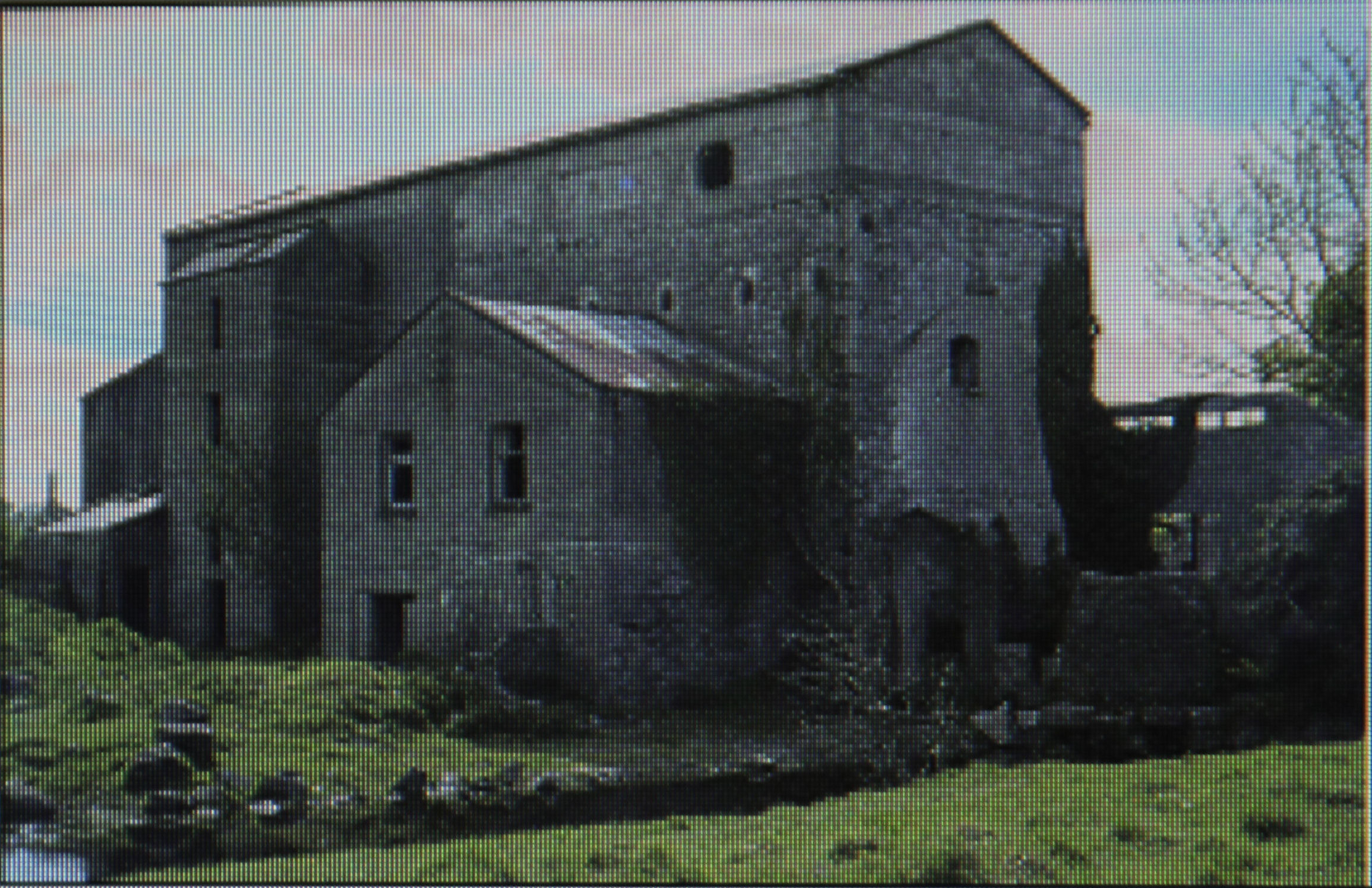
Near the Castle was Taylor’s Mill (right) owned by Hubert Taylor. The mill, with its huge brick chimney, was powered by a large water wheel.
Millers, Mattie Ryan and Paddy Greally ground wheat and oats, while sawyers, Stephen Burke and Charlie Collins were busy cutting the large tree trunks and laying them out to dry and season in the field fronting the Castle.
The Principalship of Sister Paul Canavan
1956-1964
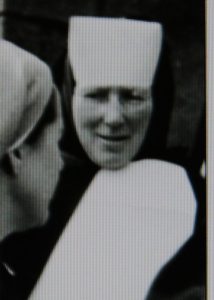 I worked with her in school in Tuam, Keel and Athenry. Her outstanding qualities were efficiency and thoroughness. When she was moved from senior classes to junior as necessity arose, she made no difficulty about it. Although she was a born teacher, she never neglected a thorough preparation for all her work. I have reason to know she was scrupulous about money matters and use of her time. She was a great example to all of us who had the privilege of working with her. She left no stone unturned in teaching religion.
Her thoroughness was not reserved for her work alone. She brought the same quality to her religious duties. Her devotion to the Blessed Sacrament was remarkable.
Hers was a very charming personality. I think she made a great effort to put her patron’s ambition into practice..’be all things to all men ..and women’. (Sr. Agnes)
Sr. Ena Canny (then Sr. Vincent) came to the school:
I arrived in Athenry with Sister Philomena on the 16th of September 1958 where Mick Mannion met us and brought our cases to the convent in his wheelbarrow. Sister Paul was the principal. Sr. Baptist was teaching second class and Sister Columbanus had third and fourth.
After our dinner, Sister Dominic, who taught first class, told us we’d be working in the primary school and she’d show us what to do. Before I knew where I was, she had the children lined up in the yard with their fingers to their lips. I was assigned to work with the juniors helping the Sister who was teaching high infants. I wasn’t good at art. I helped the classes with maths and sewing.
The pupils found Sr. Columbanus difficult to please when it came to sewing. One girl, whose mother was a dressmaker, was told to rip a piece she had completed and redo it. I was in the yard and I could see the child’s difficulty. I did the sewing for her but told her not to say that I helped her. When she showed the piece, Sr. Columbanus said, ‘that’s much improved, good girl’.
I found the children lovely and the parents very supportive.
Pupils’ memories of those years
Sr. Paul
She was a joy. She treated us all with such respect and kindness. We enjoyed a very happy last year in National School.
Srs. Teresa and Baptist
Both Srs. Teresa and Baptist taught piano and singing. Elocution was also available in the evenings. We had our exams in the Convent parlour. As children we were all excited going into the Sisters’ beautiful room. I still remember the smell of polish in the parlour as the big round table and chairs were always shining. Miss Cosgrove was the music examiner, who arrived from Dublin. It was my job to accompany her to the train station in the evening and help her with her bags.
Writing was too big
However, my troubles were far from over as my writing was much too big for someone about to start Secondary school in a few months. Back to the drawing-board, as they say and a drastic reduction in size.Would I ever get it right? Now nobody wants to read handwriting, which is why I’m slaving over a hot keyboard.
”What do we get from Brussels?”
This would be the year of the dreaded Primary Cert., but before that we faced another change. Sr.Agnes, who had been Principal and had taught this class for as long as I could remember, was replaced by Sr.Paul, who had come all the way from Achill Island. Poor Sr.Paul found it very difficult to settle down in the metropolis of Athenry after the peace of island life. Worst of all were the beet trains clattering their way, night after night, almost outside her window, to the factory in Tuam. Would the campaign ever end, she wondered? It did, eventually and Sr. Paul settled down with us and we with her.
One day we had a visit from the dreaded Cigire. One of the Geography questions he asked was,”What do we get from Brussels?” Unfortunately, he caught my eye and, not having a clue as to the answer, I guessed “sprouts”. He was not impressed and neither was Sr.Paul.
At last the day of the Primary came and went and our days with Sr.Paul were over.
Our last days were spent in utter bliss in the old Cookery Room with the beautiful Sr.Lucy who read suitable material to us and gave us time for quiet reading as well as enjoyable written work, which was totally stress-free. The weather was fine so the door was left open and the sounds of the town and the school and birdsong and the lazy droning of bees in the Convent garden accompanied our winding-down to holiday time, as we say now. We had one such word for it. We called it heaven.
‘Daisy Day’
What you called ‘Daisy Day’ always stayed with me for some reason.
I remember when we were in high infants we were taken to a large green field in the summertime where the school car park is now. There was a hill in this field and when we had enough daisies picked we would sit up on the hill. The nuns would have cardboard cut-outs of cats and dogs and about every quarter of an inch or so they would have punched a hole. We would fit a daisy into each hole and cross the stems at the back to hold together. When finished we had the shape of a cat or dog, all trimmed with daisies. They looked lovely.

Sr. Paul and the Buns
Then there was the usual Presentation Day party when we would sit on the wall outside and Sr. Paul would go around with the large cardboard box full of buns with pink or white icing and the large pots of tea. To finish, the gleaming can was produced with all the sweets and she carefully counted out two for each of us. No such luck that two might be left stuck together and we might get three.
Follow the Leader
I remember one year when the time came for the boys to leave the Presentation Convent and become part of the Boys’ National School. How important I felt the day I was chosen to lead them from the Convent school right down through Northgate Street and Old Church Street to the Boys’ School at Swan gate. The changeover went well.

Male memories of those years
I started my primary schooling in Presentation Convent, Athenry in 1960. My earliest memory of that first classroom of ‘low and high’ infants was of the very tall windows and looking up to see the old, ivied tower of the town wall in what was then Corbett’s yard behind the school; my first view through a school window.
I cannot remember the nun’s name who taught us. I think there was a Sr. Vincent, I believe, who either taught ‘high infants’ or ‘low infants’. Up the school, there was Sr. Paul who was a large woman who wore glasses.
For ‘first class’ in 1961 we went into Sr. Dominic’s class. She was short and the sight of her pursed lips struck fear into all of us! She was slightly stooped. Additionally, she had, like all the other nuns, a very shiny black leather belt around her black habit at her waist. The skirt of the black habit was pleated and the chalk dust was noticeable on it.
She had a well earned reputation for discipline. She was fair in such matters and I suppose it is understandable that when pupils get to ‘know’ their new school, they sometimes step out of line and need some ‘correction’.
In Sr. Dominic’s class boys sat on one side of the classroom and girls on the other, like in church. We also used real blue ink and dipped our wooden pens with detachable steel nibs into the ink well in our desks. Amongst our books, we had a ‘tables book’ for learning our ‘times tables’ and a catechism for learning about our religion. A fellow pupil, Pádraig Quinn, left our class a few times a week for a piano lesson with one of the nuns in the ‘music room’ in the convent building itself.
I also remember that we had a ‘party’ on certain saints feast days, which involved us having a treat of buns and tea.
Other classmates of mine in first class included: Brian Murphy whose father was a vet in the town, Sean Monaghan, Riverdale/Leonard’s Lawn and Martin Finnerty whose father was a well respected doctor in the town, Ann Stack of Church Street whose parents owned the shop beside the Canton Hall, Gerry McNamara, Caherroyn Crescent, Eithne Kennedy, Cross Street and daughter of Dónal Ó Cinnéide, Principal of the Boys Primary School, Damian Duddy, Old Church Street, Ann Ward whose father was Principal in the Agricultural College, Geraldine Coyne, Park and Paddy Waldron of Rockfield/Clamperpark.
After first class was completed, all of us boys left the school and went to the Boys’ Primary School, Old Church Street, the present site of Somer’s Service station in the town.

National School 14 September 1963.
L-r: Mary Flannery, Margaret Garvin, Ann Feeney.
Photo: Mary Feeney
School and Mass Fashions
During my time in Primary school there was no uniform. Fashion however was not an issue. No one had much to spend on clothes. What money was spent was reserved for “Sunday going to mass clothes”. These “Mass” clothes had to include a hat or scarf for the girls, as females had to have their heads covered in the church.
Children often came to school in wellies. Most clothes at that time were homemade, hand knitted and practical. My mother was a great seamstress and made wonderful dresses from hand-me-downs. When I look back at old family photo, I marvel at her ingenuity
It was common at the time for emigrants to return for summer holidays. The American emigrant outfits were dazzling in colour, pattern and design. If you had a family member in the states, you were on a winner when “the box” arrived by post and you were the proud owner of an American creation. These ensembles would find their way to the school yard eventually, having given their day as Mass clothes.
Wallpaper Book Covers
Where we scored on the tam ratings was in the book-cover stakes. When September came, we all returned with schoolbags full of newly covered books. We spent the first few days examining and admiring the different wallpapers used for this purpose. We loved to see what kind of paper families had in the” parlour”.
I can’t remember how we came by these books, whether they were new or second hand, or indeed much of the knowledge they contained, but I can still see the colours and patterns of the wallpaper covers.
A State Secret
At that time you were never told when you would get your summer holidays. It was almost a state secret. We knew that the time was nigh when the cleaning began. The beautiful red geraniums that adorned the deep window sills would be taken down. They were taken to the convent for the summer. We, however, were never allowed into the convent except for music or elocution exams in the parlour. I can still smell the parlour-leather and beeswax, and when I recall these I can feel the fear and anxiety of exam time.
Nuns’ Changing Fashion
During my days in primary schools the sisters wore the traditional garb. This covered their hair completely. Each order of nuns had a different distinctive garb. After Vatican 2 there were major changes in the church. The most startling during my schooldays was the exposure to daylight of the nuns’ hair.
For weeks beforehand we speculated as to the colour and style of each nun’s hair. On the morning the new revealing veil first appeared, we were fascinated at the difference the sudden appearance of hair made to these semi-surreal creatures.
When a little later their skirts changed from floor to ankle-length, the speculation began again. Which nun would have the shortest skirt, the nicest shoes? Nothing, however, could equal the excitement of the exposure of the hairlines.
There were no lay teachers in the primary school at that time. Only two men ever darkened the door of the classroom-the guard and the priest.
Thanks to the following for their contributions to this part of the story: Florence Taylor (Phelan), Des Glynn, Anne Keary (Ward) and Barbara Gibbons.
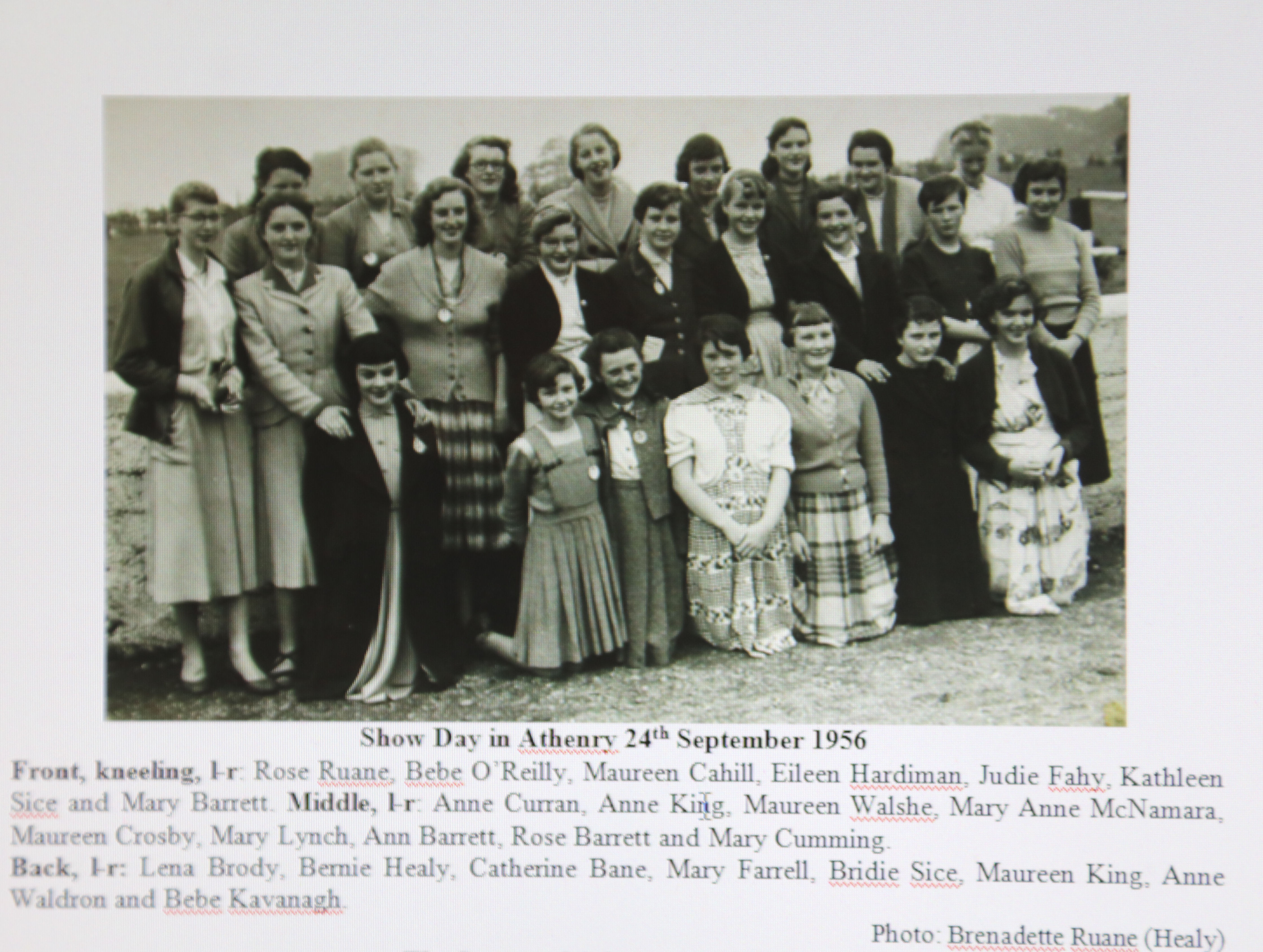
The Streets of Athenry in the 1960s
The walk through the town to school was magic! At the time there were not many cars and people still used the horse and cart or pony and trap. Outside Bridgie Glynn’s pub it was quite common to see a horse tied up with his nosebag, happily chewing away while his owner went about his business.
Then there were the fair days! These were a bone of contention as the boys’ school closed for the fair but the girls’ school stayed open. What a sight it was! The town became one great cattle or sheep pen. There were animals everywhere-some in makeshift pens often tied to the front doors of innocent family houses, others just standing in the street or on the footpath. Animals would sometimes make a bid for freedom and the ensuing confusion was no place for the faint hearted. How no child was killed or maimed was proof of the power of the nuns! The streets became a sea of frightened animals with dung everywhere. To this day I can hear the lowing of the animals, the shouting of the sellers and the tanglers. These men sealed the bargain and bridged the gap between the buyer and the seller. Nowadays they would be called professional negotiators and would have a fine salary to boot. And the smell! Only someone who was there could imagine the devastation the fair day left behind.
Changes during those years: 1956 saw the Athenry branch of the I.C.A. set up in town and the first parish schools sports were held. The Co-operative movement began; the mart was built in 1961 and the fairs were no more. In 1963 the Athenry Co-Op in Cross Street was formed and in 1964 the community grounds in Raheen were purchased.
On a wider front, a great era in Galway Senior football had just finished with a three-in-a-row All-Ireland winning sequence and the World Cup was shown on television in 1966. Television was now becoming widespread and Tom Dunphy sang ‘If I could choose’ in representing Ireland at the Eurovision Song Contest. The Vietnam War was taking place during these years. The new Church of the Assumption, Athenry was dedicated in 1968 by Archbishop Joseph Cunnane.
The Principalships of Sister Agnes Kyne 1964-67
And Sister L.O’Brien 1/7/1968-1/9/68
The School years 1964-1972
Sr. Agnes was principal from 1964 to 1967 and when she retired Sr. Labouré (Margaret) O’Brien was principal for two months.
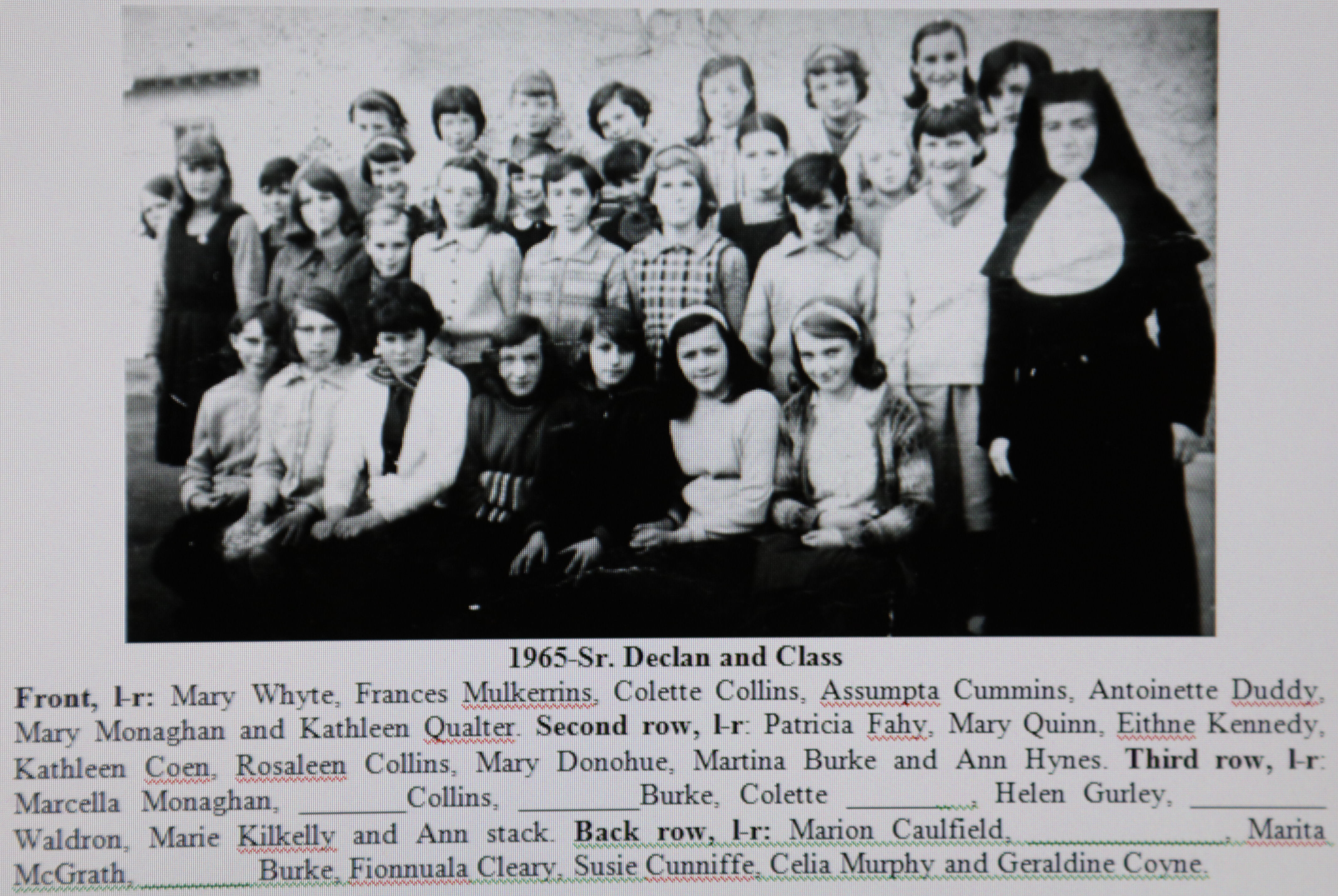
Memories of those years
Ita Higgins( Archer) memories
I started Junior Infants in 1967 and I have memories of being in that first room on the long corridor of the old school, which is now boarded up. There was no uniform then in Primary school so we looked like a motley crew in our school photos.
Márla
There were shelves with boxes of Márla (similar to Play Dough) and it was a great treat to roll it out into all sorts of shapes. We used squares of linoleum floor tiles to keep the desks clean. Considering the new child-centered curriculum did not come in until 1971, it was far seeing of our teacher, Sr. Raphael McDonagh (left) (now Sr. Kathleen) to have such hands-on activities for us. Other treats involved access to the box of child scissors or the percussion instruments – though not at the same time.
Break time
The toilets were in an outdoor block near the yard, and were an excuse to get outside and maybe take a wander over the hen yard to make sure all was well! Between the school and the Arch car park, where the present school is built, were trees and a little garden, and at lunch break nuns would walk up and down the long path and keep the peace.
If the weather was too wet to play outside, Sr. Dominic would patrol the rooms to keep an eye on us. I have vivid memories of her saying the Angelus with us, and maybe the Rosary, as she always had a pair of Rosary beads hanging from her belt.
Changing Classes
We sat in rows in the wooden desks and wondered for two years what the ink-wells were for. It was a big step-up to get into First Class and be allowed to use pen, ink and blotting paper. We changed classes each year at the beginning of July, and I remember walking through the inter-connecting doors to graduate to the next room, feeling a few inches taller. Sr. Raphael moved on to Senior Infants with us, and for her sins moved with us again into First Class. I remember her writing ‘1970’ on the blackboard when we came back after the Christmas holidays. She hadn’t seen the last of me even then, as many years later, I was a newly-qualified primary teacher on the staff of the Presentation Girls School in Co. Kildare where she was the principal! We made our First Communion in May 1970 and shortly afterwards the boys moved on to finish their Primary years in the Boys School.
Sr. Lucy
As numbers in Athenry grew in the early 70’s, we even saw classes being taught in the cloakrooms. The building of a brand new (then state-of-the-art) cookery room, complete with cookers and sinks, was a big event. It was used by Second class, taught by the benevolent Sr. Lucy (left).
Sr. Miriam’s legs
In our early school years, nuns wore full length habits, and it was a big event in the early 1970s when they changed to a more modern knee-length dress and veil. Poor Sr. Miriam blushed the first day she came in to our Third Class and we all ‘ooed’ and ‘ahhed’ over her legs!
Music and smells of baking
Music was always a feature of our time in with the nuns. From First Class on, everyone learned tin-whistle. As a seven year old, I took a notion that I’d like to learn piano, possibly enticed by the thought that I would be excused from class for 20 minutes. I would skip across the yard to the convent where Sr. Baptist was my first piano teacher, and later Sr. Evelyn Geraghty. There were two small piano rooms at the side entrance of the convent, and the smell of baking and dinner from the nearby kitchen was a homely distraction for this wandering scholar.
As we had no piano at home, I was allowed into the school or convent in the evenings to practise for piano exams. I remember on evenings too wet for walks in the garden, one or two nuns would walk the length of the school corridor saying the Rosary while I hammered away at scales and chords. Other days, it felt a bit spooky being back in the school when all the children were gone home!
For piano exams, usually in May, we were ushered into the parlour with its grand furniture and smell of wax. It was an extraordinary chance for those girls interested in music – the nuns never took payment for any of these lessons and I often think how I never got to say thanks for those three or four years. Thanks to the good start, I continued on with local piano teacher Anne Walsh until I finished Grade 8. It would probably never have happened without the Sisters.
Rita Brady (Melia) remembers
My own earliest memory of school in Athenry, is the memory of Sr. Dominic, dressed in the long black habit, with the veil, complete with a white surround, not a rib of hair in sight, heavy black shoes, rosary beads hanging. I remember Sr. Dominic, walking up through the old school at lunchtime with a tin box of jam sandwiches for any child who did not have a lunch with them. There were other nuns: Sr. Agnes (left) and Srs. Fabian and Columbanus come to mind. I can remember the calling of the roll. Rita Ní Bhrádaigh “ Anseo” or “ Nil sí anseo inniu”. The huge abacus for doing the sums.
Toilets
That was the time when the toilets were out in the yard. There were toilets for the young children and the toilets for the older children. When you went out to the toilets you brought your friend with you to “hold the door” while you put your foot under the door to keep it closed.
In the yard we played, ‘Jack Stones’, ‘Red Rover’ and ‘Tig’.
Presentation Day
The most important day of the school year was Presentation Day, November 21st. We (Anne Lyons, Paula Linnane, Mary Moran, Caroline Higgins, the New Line Crew, Anne Farrell, Noreen Fitzpatrick, Ethna and Dympna Archer, Anne Kavanagh) played in the yard and waited for the Lydon House van to come with the buns. The Abbey Row contingent of Margaret McNamara, Josie Dempsey, Angela and Noreen Ryan, the Finns Mary and Carmel, all wondering what colour bun we would each get this year-brown, yellow or pink. I always wanted the brown, coffee flavoured one, as coffee was exotic in those days. Regardless of the colour or flavour of the bun, this was the most exciting day in our calendar. The buns were served with milky tea from big jugs. Happy days!
Teachers’ Presents
The medical hall and Frank O Neill was the port of call for the Christmas present for the teacher. 4711 eau de cologne was the gift of choice for nuns, or so we all thought. There were occasions when I was sent over on an errand to the convent. We would go into the convent via the back door; there we would see the retired nuns of the time, busy in the laundry. As a child this was a very exciting event, if you were requesting to see one of the nuns you mentioned which nun you were waiting for and then the nuns would be called, using a bell: 1 dong for Sr. Agnes, 6 dongs for Sr. Raphael or the likes.
Thanks to the following for their contributions to this part of the story:
Rita Melia (nee Brady) and Ita Higgins (nee Archer)
Athenry in the 1960s
During the early years of this decade, Barrack Lane and Abbey Row were mini-farming areas where families kept cows, calves, hens, ducks and pigs on their properties. 1962 saw the formation of the Athenry Gymkhana Committee and the following year the Athenry Branch of the Apostolic Works came into existence. The Athenry Fire Station was constructed in 1964, while two years later the Athenry Credit Union set up its first office in the Canton Hall with total deposits of £9 on opening night. During the same year, the parish grounds at Rahhen were purchased for sport and recreational activities.
In 1965 Newcastle’s Church of the Immaculate Conception was dedicated. Three years later saw the dedication of the new Athenry Church of the Assumption with its dramatic and very modern design.
The same year, Athenry Vocational School opened its doors to its first pupils in the field that the Presentation Sisters had exchanged with County Galway Vocational Educational Committee for their field further along the Caheroyn Road, now the Presentation Sports Field.
The Principalships of
Sr. Mairéad Rabbitte 1968/69 and Sr. Maura Balfe 1969-1972
Sr. Mairéad Rabbitte’s overview of the years 1968/69
Sr. Agnes Kyne was principal and retired in June ’67. She was replaced by Sr. Margaret O’Brien who remained in the position for just one year. I was made principal but moved to Tuam in June ’69 as I was studying for a BA. I was replaced by a lay teacher, the first on the staff and Sr. Maura Balfe became principal.
As regards cultural events, each Sister was responsible for her own class in Arts, Crafts and Music. There would have been a big emphasis on the three Rs. We had elocution classes at the weekends.
I had first class and prepared children for first Holy Communion and Confession. This took place in the Bag factory on the Caheroyn Road while the new Church was being built.
The senior classes went on an annual tour. The junior classes would not have gone on tours.
It was during these years that adult classes were set up for the travelling community. We were all involved and I think that would have been the beginning of adult education.
Some of the older members would be aware of the Presentation Sisters ‘enclosure’. We were not even allowed to walk on the roads, strict enclosure! In church we were segregated behind a green curtain. It was during my time in Athenry that renovations took place in the convent.
The Sisters who taught with me were: Sr. Kathleen McDonagh, Sr. Catherine Leonard, Sr. Attracta Heneghan, Sr. Maura Balfe, Sr. Teresa Dolan, sister of the late Sr. Colette, Sr. Miriam O’Malley and Sr. Luke Murphy.
Sr. Catherine Leonard’s memories
I went to Presentation Convent, Athenry in 1968. There were over twenty Sisters there then and Sr. Berchmans was the Superior. I came fresh from Carysfort Training College to teach in the old Primary School. There was great interest among the senior nuns in all the activities of both schools. I remember being asked repeatedly “Had you a good school today?” She was thinking of the “Capitation” days.
Looking back now life seemed more simple and relaxed. That shows that I’m just getting old!
I took the middle classes – 3rd and 4th. They are all married and have their own families now, I suppose. I was to do my Teacher’s Diploma. That took two years then. The new Curriculum was implemented that year. I was lucky to be trained in the new approach which was “Child Centred”. The Inspector, Mr. Eamon Carey came regularly to watch what was happening. Years afterwards he told me he was learning the new approach himself.
The very first morning, on my way to my post, the yard between the old Secondary and the old Primary School was crowded with 2nd level students. They had come in from Coolarne with Fr. M.O’Grady and were waiting for classrooms while Sr. Brid and Gerry Cloonan tried to make space for them all.
Mary Mullins (nee Brady) remembers the years 1970-1980
In 1970, I again returned to the Convent, this time as a teacher in the National School. I spent ten very happy years teaching in Scoil Chroí Naofa. Since I was already acquainted with all the Sisters on the staff, being the only lay teacher there never seemed an issue. They treated me like one of their own. As a staff we were one big happy family.
Sr. Maura Balfe was the Principal when I joined the staff. She was always kind, helpful and courteous. Sr. Declan Allen, always the lady, replaced her. She also treated me well, even consulting and facilitating me regarding holidays, etc. She is of course a renowned and wonderful artist.
Two of my former teachers were on the staff, namely Sr. Celestine and Sr. Lucy. Sr. Celestine had returned from her missionary work in New Zealand and was again in her favourite class – the Infants.
Sr. Lucy taught Second Class. She was such a lovely person. We became great friends. Other Sisters who taught with me during those years were: Srs. Raphael, Vincent, Alphonsus, Colette, Catherine Leonard, Miriam and Carmella. Sr. Kevin was my final Principal.
Sr.Vincent, who has such musical talent, started the school band. They were a credit to her, and the children got such a great opportunity to perfect their musical skills.
Sr. Berchmans was the Reverend Mother and Manager of the School. Before learning support teachers were heard of, or available, both Srs. Baptist and Dominic fulfilled that role in the school.
There was great excitement when we moved from our original building to a lovely new school with lots of spacious rooms and a large assembly hall. It gave us such an incentive to fully implement the new physical education programme.
The children really enjoyed painting the mural on the wall in the assembly hall. It was so exciting for them at the time.
As I was the only lay teacher on the staff, I was entrusted to sponsor all the children who were receiving the Sacrament of Confirmation.
In 1980, with great reluctance and a heavy heart, I departed my beloved school and my good friends on the staff, and accepted a post in Barnaderg National School, which was more convenient to my home.

1972 Sixth Class with Sr. Claude (Maura) Balfe
L-r: Bridie Feeney, Sheilanne Monaghan, Ellen Connor, Pamela Holian, Anne Ryan, Kathleen Ward, Noreen Tracey, Noreen Carr and Sr. Claude (Maura) Balfe.
The Principalship of Sr. Declan Allen
1972-1977
Sr. Declan’s overview of those years
 I was a student in Athenry School from 1945-1950. I cycled the five-six miles from Craughwell to school everyday. I think we studied for Inter Cert in the Primary School and in the Canton Hall, and then six of us went on to do Leaving Cert. I know we spent a while in the small parlour in Athenry Convent – six of us and eight Fifth Years as well.
The new Secondary School was opened in 1950. That same year, I entered the Presentation Convent in Tuam and then in later years was transferred to Athenry Convent, 1961-68. I was teaching Third and Fourth Standards for a few years and then I moved on to Fifth and Sixth Standards. The Athenry children were lovely to teach and their parents were so kind and grateful and very helpful in many ways.
I moved on to Achill Island and was there from 1968-1972. Then I was transferred back to Athenry again in 1972-77.
The New Curriculum had started and we had great variety between Elocution, Art, Drama, P.E., Music and Dancing etc. Most of the students did exams in Elocution, Music and Dancing, though the Sisters taught music away back and the students did exams even then. I had been Principal of the school during the years 1972-1977 and was teaching as well. We also put some of the Sixth Class students in for Scholarship exams, Preparatory and County Council.
Now the numbers on roll were getting bigger and we also got a letter from the Department of Education saying we could only have such a number of Junior Infants in that class. So we had to move fast to get a new school and extra classrooms, etc. Canon Gibbons, our Parish Priest and Mr. Carey, our School Inspector, went to the Department of Education and got the new school going and got a very good grant for it. We had to put up £12,000 ourselves. The Athenry people were so good and generous. During the first week we gathered £11,000 plus, we got the go ahead for the school very fast. During these years the numbers on roll were so high that I could have been a walking Principal, so the Sister who replaced me had teaching duties. Then I took a break and went to Maynooth College for a year’s Theology Course and really enjoyed it.
Pupil’s Memories of the years 1971-1975
My earliest memories of education at the Presentation primary school in Athenry is not comprised so much of individuals, but rather the image of God they conveyed to us. With a few exceptions, the Presentation Sisters that gave a free education to the children of Athenry in the early seventies were a group of young, laughing women, who obviously enjoyed each other and loved us.
More by their attitude than what they said, they communicated to us a motherly God with a sense of humour, a God who doesn’t want us to take ourselves too seriously!
With regard to earliest memories of personalities, I will never forget the quiet Gospel witness of Sr. Dominic giving sandwiches every day to traveller children. I doubt that she will ever have a solemn canonisation ceremony in Rome, but such a ceremony would be surplus to requirements.
We loved and were absolutely loved by Sr. Laura, who used to give us delicious iced buns baked in the convent kitchen. I’ve never tasted any like them since. They were always iced in pink and white, and they made another appearance at the party the sisters put on for our first Holy Communion.
Sister Laura left us heartbroken when she left for the missions in New Zealand. She was replaced by an individual called Miss Hardiman, who used to drive in every day on a motorbike.


Sr. Celestine Whyte and Junior Infants

Sr. Declan and Senior Pupils
Another pupil’s memories
Sr. Raphael prepared me for my first Holy Communion and confession, then as today, the Presentation Sisters were committed to the religious education of the children in their care.
In the early 1970s, the first new class room was completed, this was Sr. Lucy’s room, I remember that the room was built like a domestic science room complete with cooker and sink.
We all sat on three long benches. I always sat on the third bench which was the lowest bench; the girls who sat on the highest bench, their feet never reached the ground
It was at this time that the first glamorous nun arrived in Athenry- Sr. Laura (left). What a breath of fresh air! She was the singing nun, complete with guitar; it was from here on, that Presentation Convent National School had its own folk choir and prayer group.
Our parents bought us guitars in Rafterys in Galway and we began to sing. If there is any abiding memory, I have a wonderful memory of my time with the Presentation Order and it is that they nurtured and supported my love for music, which they are still doing today with my children.

1973 Third and Fourth classes with Sr. Laura Boyle.
Front two desks, l-r: Paula Ruane, Anne Farrell, Edel Gardner and Marie Hollian.
2nd row, l-r: Charlotte Zonenblick, Noreen Fitzpatrick, Margaret McNamara, Patricia Bane, Noreen Ryan and Anne Dempsey. 3rd row, l-r: Dympna Archer, Anne Kavanagh, Marie Lally, Ann Marie Cullinane, Orla Ruane, Denise Callinan, Deirdre Holland and Sr. Laura. 4th row, l-r: Mary Moran, Mary Flaherty, Patricia Rohan, Assumpta King, Maeve Kearns, Catherine Loughnane, Sheila Waldron, Dolores Farrell and Deirdre Cunney.
At back, standing, l-r: Rita Brady, Ethna Archer, Bridgid Mongan, Louise Whelan, Caroline Burke, Caroline Higgins, Clare Murphy, Paula Linnane, Ellen Mongan, Bridgid Mongan and Ann Mongan. At side, standing, l-r: Fiona Burke, Ann Lyons and Carmel Finn.
Photo; Sr. Laura Boyle
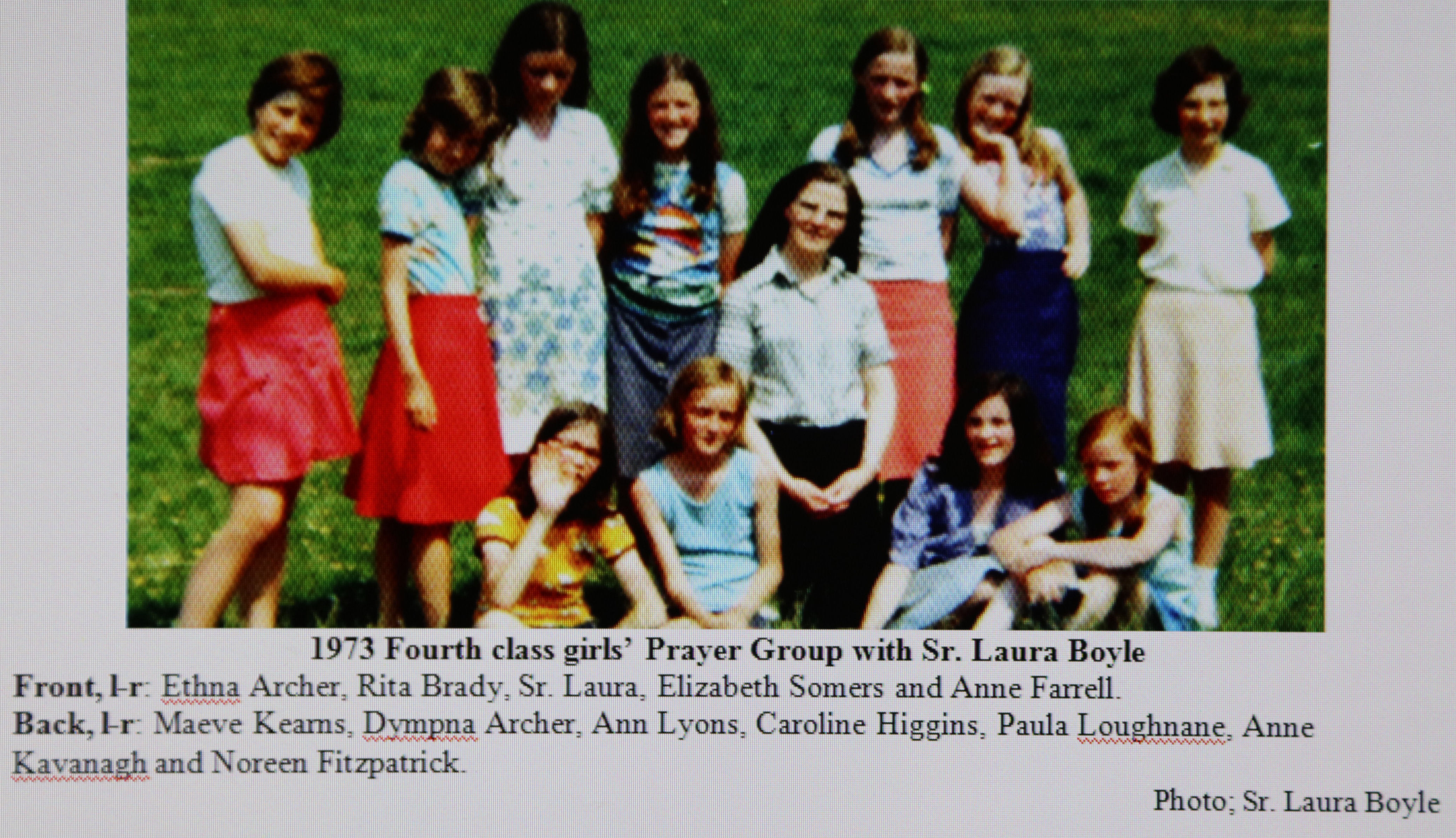
Memories of Athenry and the first School Band-Sr. Ena (Vincent) Canny
 I came to Athenry a second time in 1974, after spending ten years in Tír an Fhia, Connemra. I replaced Sr. Laura and taught third and fourth classes. Life was very different at that stage in the 1970s. Starting a school band gave a lift to everybody in the community and parish. Music is very special to me. It is the soul of the universe.
I started the convent school band in September 1974. I taught my own classes the tin whistle and the melodica.
By degrees the other classes joined in. As the children improved, we added button accordions, piano accordions, melodicas, bell lyres and we purchased a set of drums. At this stage children from first class up were imvolved as well as flag bearers and majorettes.
We decided to get a band costume in the red and white of Athenry. Mrs. Tully from Pollnabonny, a dressmaker, and her two daughters, Geraldine and Maeve, helped to choose the material and design the outfit-a black velvet waistcoat, red skirts, white blouses, red pill box hats with a black bow, white knee socks and black shoes.
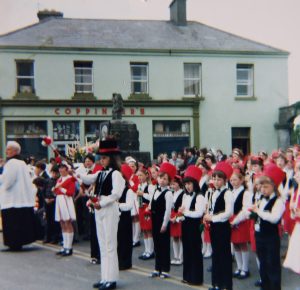 There were about sixty children in the band at this stage. Instruments were bought and the parents were very generous in helping out in many ways.
Canon Gibbons was very proud of the school band. He called regularly to hear the band practice and play. When the playing improved, we went outside the school. We went to Galway for the Community games with our parish and won first prize. This gave a great lift to the children and parents.
In 1975 on Corpus Christi the school band played for the first time. Dressed in Báinín costumes they led the procession playing hymns. Croke Park in 1976 was a very interesting and enjoyable trip.
The band played for the camogie team in the All Ireland Final (left). They took part in the Dublin City parade for National Children’s Day a few times and also gave recitals during half-time at hurling and football matches.
St. Patrick’s Day is always a very special day in Athenry. On that day the band played in the church. The Irish airs and marches gave a great sense of celebration.
Every Friday afternoon we faithfully had our band practice and we lived religiously by our motto: “Tír gan ceol, Tír gan anam”.
Tá áthas orm go bhfuil an banna ceoil i Scoil Chroí Naofa ag dul ó neart go neart ó shin. Gura fad buan é.
I returned to the Convent in Athenry for the third time in August 2008. A the poet says, “Fond memories bring the light of other days around me”. The ceol brought great joy to me and was one of the joys of my teaching career. All of this did wonders for the children’s confidence. It helped to remove the shyness that is in all of us. The parents, families and my teaching colleagues were fantastic in their support, without which I could not have succeeded.

Band playing in Athenry church at the St. Patrick’d Day mass
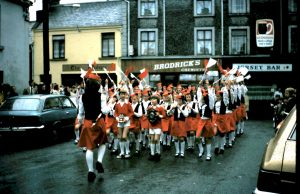
Athenry Convent National School Band paraded through the Town in May 1977

School Staff in 1976
Front, l-r: Sr. Colette Dolan, Sr. Raphael McDonagh, Ms. Mary Brady and Sr. Catherine Leonard.
Back, l-r: Sr. Declan Allen (Principal), St. Celestine Whyte, Sr. Vincent Canny and Sr. Lucy Kenny.

On Tour with Srs. Celestine Whyte, Lucy, Raphael and Catherine
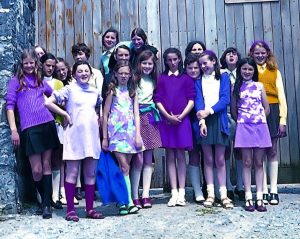
Sr. Declan and Pupils at Athenry Castle.

Sr. Colette Dolan and Pupils 1976/77
More memories of those years.
There was always a musical activity in fifth class. Sr. Catherine, who at that stage was operating from the first pre-fabricated class room in the school, organized a dance which was performed on the altar on Easter Saturday.
Wearing long white tunics with gold braiding, Charlotte Zonenblick, Caroline Higgins, Paula Linnane, Anne Lyons, Anne Kavanagh, Dympna Archer, Paula Ruane and myself, believed we were stars.
History plays
Around that time, as numbers continued to grow in the Primary, a new pre-fab arrived in our school yard and Sr. Catherine Leonard was installed with fifth class. The pre-fab seemed so modern to us – imagine being able to see out the windows!
She got us to act out a history play with songs like Boolavogue, and our mothers were invited to see it- perhaps the first time they would have done so.

Sr. Lucy Kenny and Second Class Pupils
An Roinn Oideachais-Department of Education
Liosta na Leabhar 1976-Book List 1976
English Series: Hopscotch, New Horizon, Signposts, Links and Now We Read.
Mathematics Series: Primary Aim Maths, Meeting Maths, New Programme Maths, Thinking Through Maths, New Course in Primary Maths, Maths in Action, I dTreo na Maitamatice.
Gaeilge: Sraith na Cainte, Seal ag Léamh, Sraith an Aoibhnis, Bí ag Léamh.
History: Irish Myth and Magic, The Living Past, Discover the Past.
Geography: Exploring Geography, Unfolding Geography, Enjoying Geography, Primary Geography.
Social and Environmental Studies: The World Around Us, Elementary Science, Finding Out, Illustrated Civics, Nature Study for Primary Schools, Look Around You.
Music: Children Make Music, Listen, Sing and Play, Ceolta Gael, Cas Amhrán.
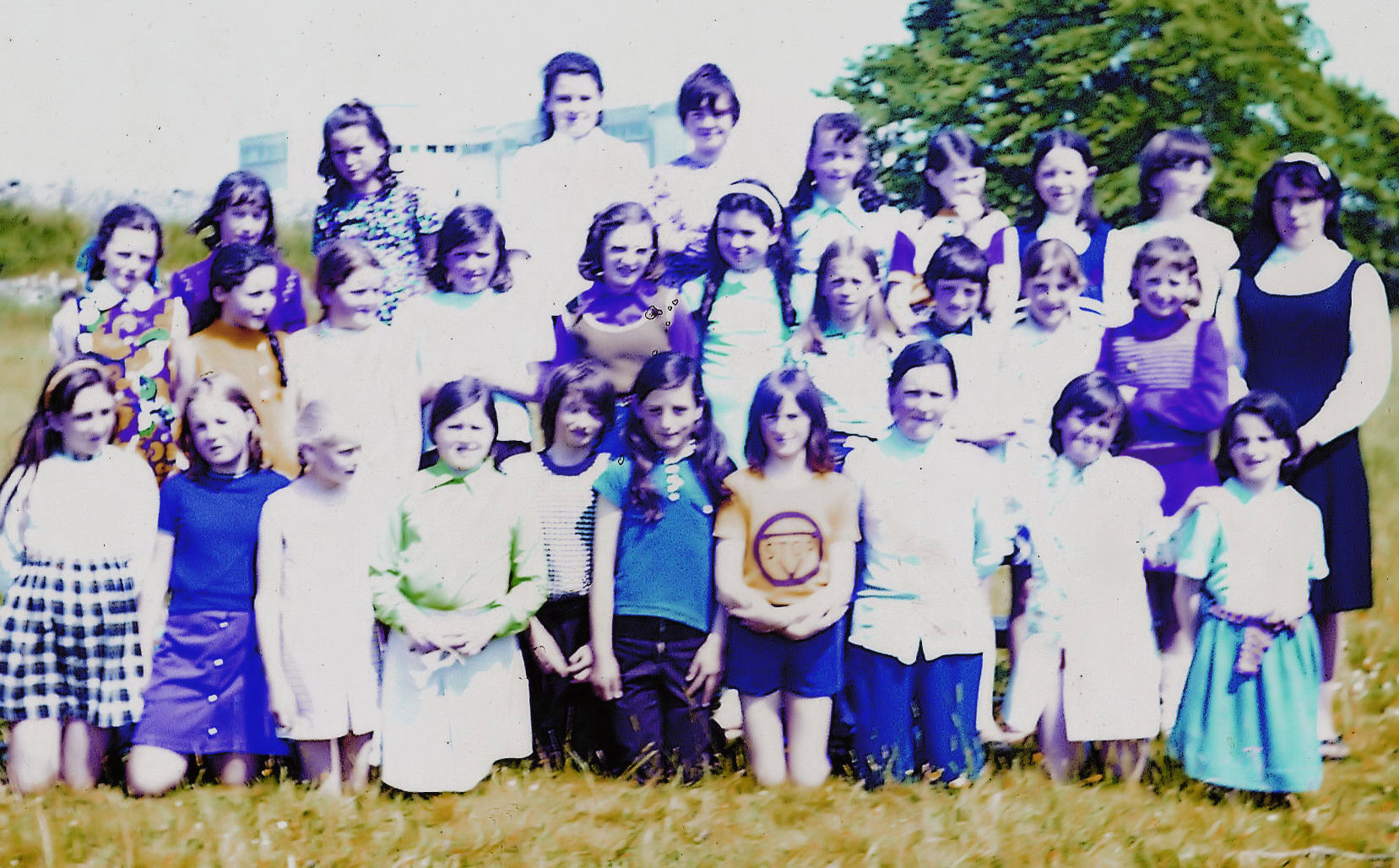
Sr. Catherine Leonard and Pupils

Archbishop Joseph Cunnane and Confirmation Class

On Tour in Dublin
Dawdling back to class
In those days, most mothers worked at home so town dwellers used to walk home for lunch and there was a big group of us from the New Line who would gallop home through the Railway Station, and dawdle back to school well fed.
There was always someone to walk or cycle to school with, and older children minded younger ones – only occasionally leading them astray! It meant that we all knew our neighbours and the bond is there to this day. Families we grew up with on the New Line are still friends, and now our children continue the friendship into the third generation.
I don’t remember being aware that our primary school was called Scoil Croí Naofa –I must have been asleep for that lesson! If anyone asked where we went to school, we always said ‘The Convent’, until later years when it was pointed out to us that there was a difference between ‘convent’ and ‘school’.
The principal teacher, Sr. Declan Allen taught us in sixth class and she was a gifted water-colour artist. Like other nuns, she had the silver can of sweets in her press, and those “can-sweets” were the reward for our good behaviour – clove rock, bulls-eye and other gob-stoppers, which we adored.

On Tour with Sr. Catherine Leonard and Sr. Eugenia Murphy
Thanks to the following for their contribution to this part of the story:
Sr. Declan Allen, Sr. Ena Canny (Sr. Vincent), Rita Brady and Ita Archer.
Athenry in the 1970s
1971: Athenry Soccer Club was established.
1972: The Athenry band, the Swingtime Aces, gave their last performance in Manchester.
1973: Athenry Camogie Club was formed. The same year saw the opening of the New Athenry Vocational School and the formation of Newcastle Community Council. Athenry athletes participated in the Community Games for the first time.
1975: Athenry Branch of Junior Chamber Ireland was set up, as was Athenry Chess Club. Coffey Construction Company was formed the same year. The first meeting of Athenry Community Care took place, and Athenry Credit Union opened its new premises in Old Church Street, opposite its current offices.
1976: The Athenry Association of Priests and Religious was established.
1977: Athenry Community Council was formed, while Athenry Montessori School came into existence the same year. Newcastle’s new Oliver Plunkett National School was blessed and opened. The Northgate/Arch was restored by Galway County Council. On the emigration front, the Athenry and District London Association was established.
1978: The Byrne-Mech factory in Raheen opened and Athenry Golf Club moved to its new course in Palmerstown.
1979: The new Handball Alley adjacent to Kenny Park was opened. To the detriment of the views of the Town Walls, giant grain silos were constructed close to the south eastern tower.
The Principalship of Sr. Kevin Curran
1977-1983
Sr. Kevin’s overview of those years
 Having lived and ministered in Presentation Convent, Tuam from 1949, I was then transferred to Presentation Convent, Athenry in 1977 where I was warmly welcomed by Sr. Genevieve Kilbane and Community.
My new role as Principal of the Sacred Heart School was both a challenge and a privilege. The staff of eight consisting of seven Presentation Sisters and Mary Brady-Mullins, were most welcoming. All were teachers of the highest calibre devoted to the education of the young people, and very much in touch with parents and the wider parish community.
School Building
The Sacred Heart School by that time was overcrowded and despite various renovations through the years was now inadequate for the growing numbers on the roll. A new Cookery room was built in the sixties by Colman Moylan. It served many purposes – Cookery classes, classroom, Staff meeting room and Lunch room. It was now evident that a new Primary school was urgently needed.
Building a new School
Parents rallied to the cause and many meetings and consultations followed. The site was provided by the Presentation Sisters – once a vegetable garden and hen run! The estimated cost of the building was £176,000. Of this, £19,555 was to be from a Local contribution, and £156,445 was to be paid by the Office of Public Works. A finance Committee was set up consisting of parents and school staff, and in a short time the local contribution was collected. The generous support of all was much appreciated. In no time the foundation of the new school building was dug. Gradually the structure took shape, and finally on May 31st, 1979 we were ready to transfer from the old structure to the new.
Official opening, September 4th 1980
On September 4th 1980 the official opening of Scoil Chroí Naofa took place. The school of our dreams had ten spacious classrooms, an Assembly Hall and a staff of nine teachers dedicated to the education of 300 pupils. It was a great day for all – the Presentation Sisters, staff, pupils, members of the Board of Management, parents, friends and the whole parish community. Mr. John Thompson (Architect), Bernard McNamara (Building Contractor), Mark Kilillea T.D. and Parish clergy were all in attendance. Mr. Kilillea congratulated the whole School Community for their wonderful co-operation in the project. He especially commended the Presentation Sisters for their contribution to Education in Athenry and indeed to Education as a whole in the country. There was a huge attendance at the concelebrated Mass which followed the official opening. Celebrations followed to mark the wonderful occasion.
Art – Environment
One outstanding memory I have of this time is the artistic work done by artists and students in the Assembly hall of the new school. Two parents alerted us to the fact that a grant was available for painting murals. In February 1981 the Arts Council announced the launch of a new scheme “Paint on the Walls”. Two artists visited the school and helped the children paint a mural. The pupils chose local scenes – shops, historic ruins and life in Athenry in olden time. They also painted the fairytale of “Snow white and the Seven Dwarfs” and the Irish legend “The Children of Lir”. The entire end wall of the Assembly hall was filled with a blaze of colour, dazzling to the eye. All of this visual art enhanced the environs of the new school, and 28 years later the murals are as vibrant as ever.
Retirement
The years passed quickly and retirement age caught up with me in 1983. This was a sad time for me – to part with the school community of Scoil Chroí Naofa. I will never forget the great commitment of staff, pupils, parents and all our helpers over the years. On the other hand, it was a time to let go after all the years of teaching and responsibility. It was a time for me to relax, to take up new interests, walk new paths and enjoy life.
I was delighted to be involved for a few years in Presentation College where I continued to keep in touch with my past students from Scoil Chroí Naofa. Then I had the experience of seven happy years in the Gaeltacht in our convent in Tiernea, Lettermore. There I helped in the Primary school, visited the aged and housebound. I returned to Athenry eventually where I am living out my life in peace and quiet, in contact with all my old friends and past pupils.
Scoil Chroí Naofa has gone from strength to strength with many additions to the “new school” building. While there is an increase in staff, only one Presentation Sister remains in Scoil Chroí Naofa. The number of pupils has increased a lot. They are indeed in ‘safe hands’ in the hands of a dedicated, creative and committed staff who are nobly carrying out the great tradition of education started in the first Athenry Primary School in 1910.
I wish you all the best and I want you to know that you will always have a special place in my heart.
Athenry in the 1980s
The new Scoil Chroí Naofa opened in 1980, while on the farming front ACOT was established at Mellows College. 1982 saw the formation of Athenry Project Society by ex-members of Athenry Junior Chamber. Two years later the Newcastle Community opened their new Community Hall.
ACOT was renamed Teagasc in its new offices in Mellows College in 1984. I985 saw the establishment of Athenry Catholic Boys scouts in the town and the following year, after 18 months of voluntary evening work, Athenry Project Society refurbished St. Mary’s Church of Ireland into a den for them.
Two years later, Athenry Girl Guides was formed and they shared the den with the scouts. In 1989 Athenry Civil Defence was established.
Cathal Rabbitte’s memories
At the moment (November 2008), I’m living in Bombay on the west coast of India. I think the philosophy of my teachers could be summed up in one phrase: ‘Mol an óige agus tiocfaidh sí’.
I don’t remember anything about the first day in National School beyond meeting the famous Sr. Celestine in the flesh. Sr. Celestine was a lovely teacher, who eased me into formal learning. I remember Sr. Kevin for her kindness. Sr. Colette always emphasised the need to be considerate of others and if offered a choice of 2 items, to take the one the other person is less likely to want. In India at the moment, I see very little of that thoughtfulness in the way people treat the poor. All of the Sisters had a commitment to education regardless of family background. They insisted on quality.

Urgent need for a New School
The Sacred Heart School by the mid-sixties became overcrowded and, despite various renovations down through the years, was by then inadequate for the growing numbers on roll. The new cookery room was built in the late 60s by Colman Moylan, father of Mrs. Teresa Neylon, present principal of Scoil Chroí Naofa. This room was used as an extra classroom due to the rising numbers of pupils.
Negotiations with the Department of Education for a new school began in 1972. The establishment of Boards of Management for National School occurred in 1975, and at its second meeting in March 1976, the BOM of the Presentation Convent N.S. had completed plans for the school at a cost of £167,900. The Board sent a delegation of Sr. Nuala Newell, Canon Gibbons and Tommy McNamara to meet Dept. of Ed. officials. It was agreed that the Dept. would give 8/9ths of a grant towards the building of the new school. £20,000 of a local contribution needed to be raised.
The Sisters gave the site for the school, £2,400 and an interest free loan of £10,500 towards the new school. Sr. Kevin came to Athenry from Tuam as Principal in 1977. By 1979 the cost of construction had risen to £266,000 and an increase of £5.000 in the local contribution was required. She set up a Finance Committee of parents and school staff who collected the local contributions from people in the school catchment area.
Their efforts were very generously supported and soon work commenced on the new school, which was later to be called Scoil Naisiúnta Chroí Naofa, Baile Átha an Rí. ( Dept. of Ed. Letter dated 5th of September 1977)
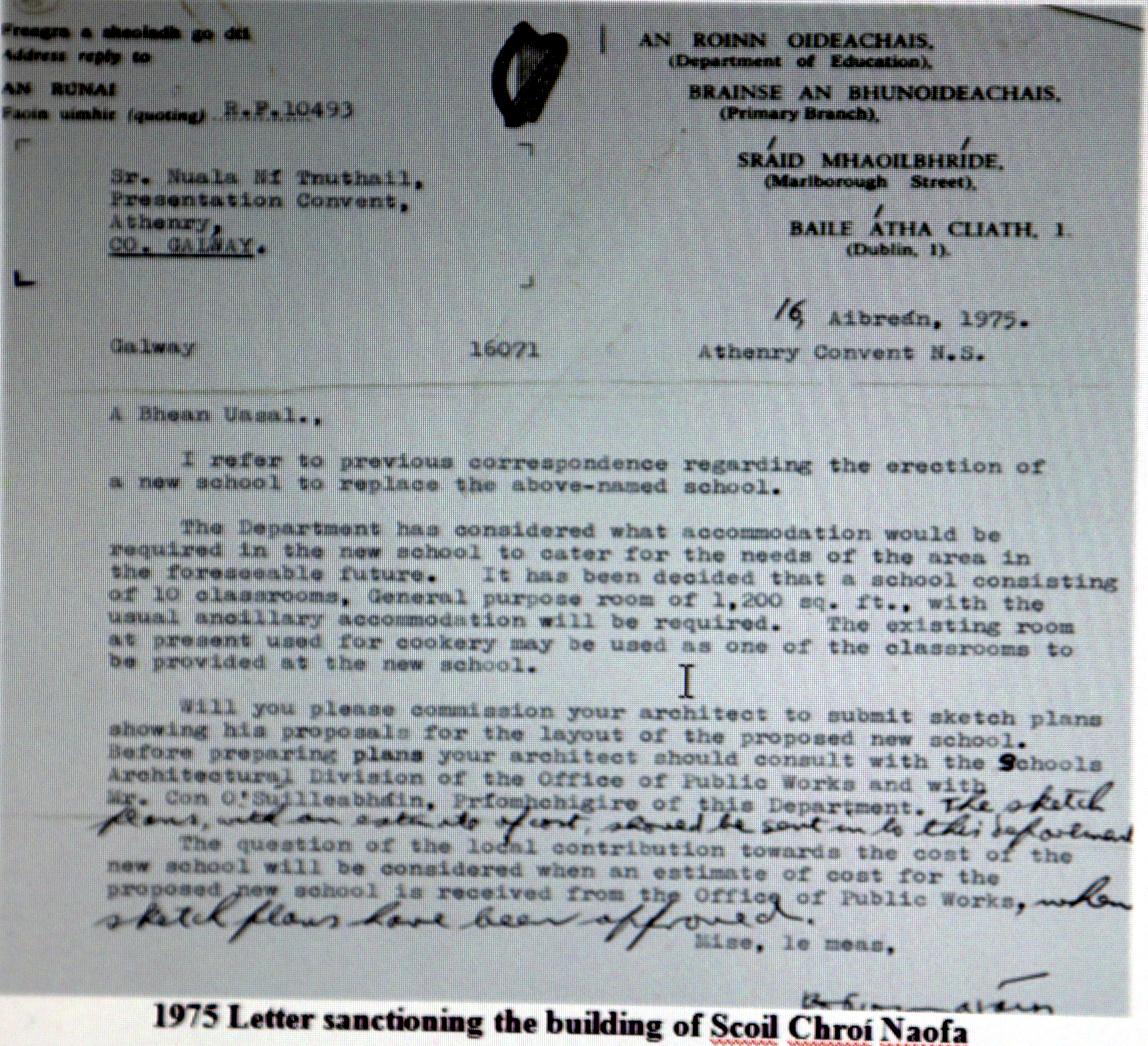


Sr. Kevin with Kathleen Ryan, who was very active in fundraising for Scoil Chroi Naofa.
SR. KEVIN’S ACCOUNT OF THE MOVE TO THE NEW SCHOOL AND THE OFFICIAL OPENING
“May 31st 1979 was a Red-letter day in the lives of the Primary School Staff and pupils. It was then that the great Exodus took place from the old building to the new. Sister Bríd and the College staff kindly sent over their students to help with the transfer of furniture, goods and chattels. Excitement ran high and the noise was tremendous. By the evening everything was in readiness for school the following day. June 1st, being the first day of the month of the Sacred Heart, it was decided to have our initial celebration in Scoil Chroí Naofa.
Canon Gibbons came along for a special prayer service with the staff and pupils, gathered together in the Assembly Hall. We had hymn singing and some lovely Intercessory Prayers from the children. A Mass and Blessing of the classrooms were planned for the Feast of Sacred Heart., to which parents were invited. There was little standing room between grown-ups, babies in arms and pre-school children. We were pleased to have our Provincial – Sister Clement – on that day too.
The Mass itself was a very touching celebration. When the time came for the Intercessory Prayers, each class, beginning with the tiny tots had their own special petitions. We felt the Sacred Heart must have been pleased to hear their little voices, loud and clear and so sincere. Then we had the Offertory Procession with suitable hymns and all the children, from the fervent First Communicants upwards receiving Our Lord in their lovely new school. It was a fitting tribute to the great feast we were celebrating. When Mass was over the parents were invited on a tour of the building and there was much reminiscing about bygone days. We pray that the Sacred Heart will continue to watch over Scoil Chroí Naofa and its staff and pupils in years ahead.
The 1st of September 1980 was fixed for the official opening of Scoil Chroi Naofa

BLESSING OF THE NEW SCHOOL BY VERY REVEREND CANON JAMES GIBBONS P.P. AT THE OFFICIAL OPENING ON THE 1ST OF SEPTEMBER 1980
“We are assembled here to praise and thank Almighty God for the completion of the building of this Primary School and to ask his blessing on all who work here. Come Holy Spirit, fill the hearts of your faithful and kindle in them the fire of your love.
V. Send forth your Spirit and they shall be created
R. And you shall renew the face of the earth.
Let us pray
God our Father, pour out your gifts of the Spirit on the school.
As you sent the Spirit on your Church to begin the teaching of the Gospel, we ask today for the guidance and protection of the Holy Spirit on the work of this school.
Lord, show us always what to do and help us to do it, may every prayer and work of ours always begin from you and through you be happily ended.
Lord Jesus, you said to your Apostles – when you enter a house, greet all and say “Peace to this house”. May that peace come now to this school as we ask your blessing on all who administer it, all who teach or are taught in it. May all of them be strong in your service.
We pray that the Primary Schools of our diocese may reflect in every way the Presence of the Holy Spirit.
We ask you, Lord, that the teachers of this school may always have the Spirit of Wisdom in their teaching and guidance of the young and the Spirit of knowledge in the religious formation of all their pupils.
We pray that the pupils may always bring the Spirit of Love and Charity into this school, and that all may have the Spirit of Courage to carry out God’s will and their Christian vocation in the modern world.
We make this prayer through Christ our Lord. Amen
(Holy water is taken and the school is blessed as celebrant proceeds around school building)
Bless this school Lord, that there may always be within it health and holiness, humility and goodness, docility and obedience and gratitude to God the Father, God the Son and God the Holy Spirit.
And may Almighty God, Father, Son and Holy Spirit descend upon you all today and remain with you forever. Amen”.
 Sr. Agnes, who taught for over 30 years in the first Presentation Convent National School, was present for the opening of the new Scoil Chroí Naofa on 1st September 1980

Official Opening of Scoil Chroí Naofa by Mark Killilea T.D. on 1st September 1980
L-R: Barry Cunniffe, Construction Foreman, V.R. Mgsr. Paul Hession, Bernard Mc Namara, Contractor, V.R. James Canon Gibbons P.P., Marc Killalea T.D, John Thompson, Architect, Bobby Gardiner, B.O.M. and Bernard Farrell, B.O.M.

After the opening, Very Rev. Canon Gibbons P.P. celebrated the Mass together with (l-r): Mons. Paul Hession, Father Charles O’Malley C.C. and Father John D. Flannery C.C.
Sr. Kevin remembers:
“The Mass itself was a very touching celebration. When the time came for the Intercessory Prayers, each class, beginning with the tiny tots had their own special petitions. We felt the Sacred Heart must have been pleased to hear their little voices, loud and clear and so sincere. Then we had the Offertory Procession with suitable hymns and all the children, from the fervent First Communicants upwards receiving Our Lord in their lovely new school. It was a fitting tribute to the great feast we were celebrating. When Mass was over the parents were invited on a tour of the building and there was much reminiscing about bygone days. We pray that the Sacred Heart will continue to watch over Scoil Chroí Naofa and its staff and pupils in years ahead.”
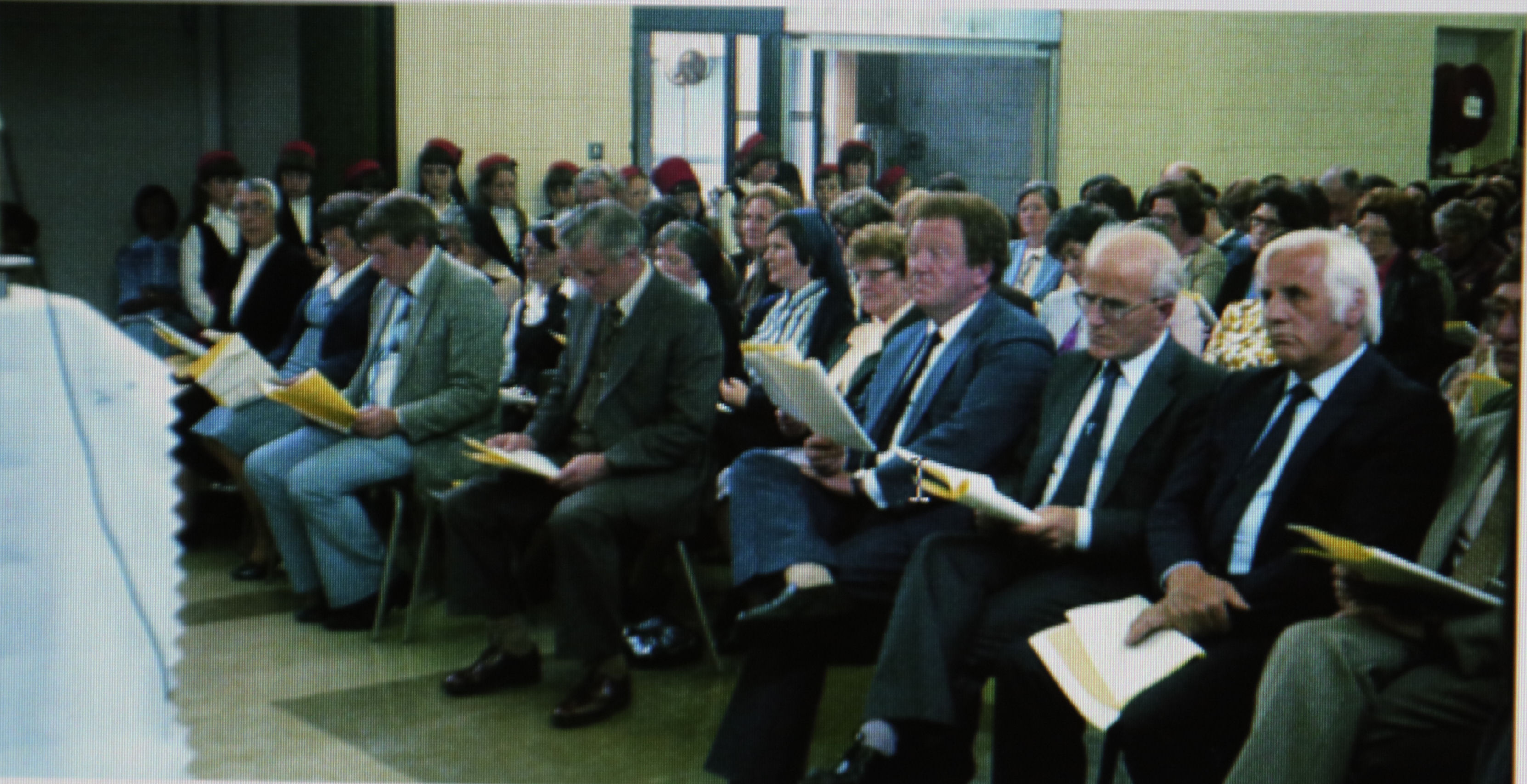
Also present at the Mass were: Finbarr Slattery (Representative of Roinn Oideachais), Mr. John Thompson (Architect), Bernard McNamara (Building Contractor), Members of the Board of Management, Presentation Sisters, School Staff, Ex-Staff, Parents and friends.
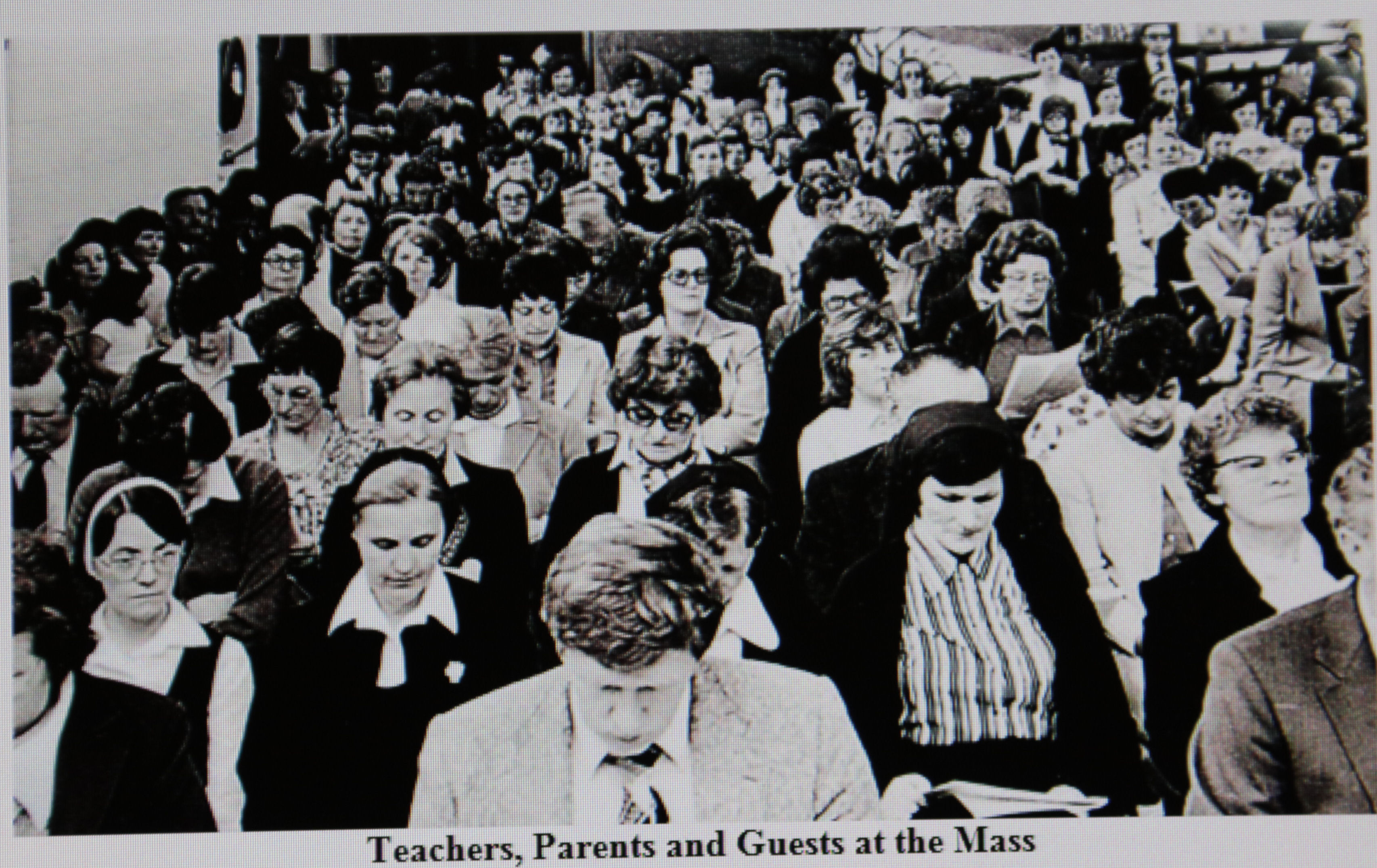
Teachers, Parents and Guests at the Mass
The school choir conducted by Sr. Carmela Fitzpatrick (left) sang parts of the Mass, which was attended by a huge crowd.
Mass was followed by refreshments served in the class rooms by a committee of parents and staff and the afternoon was enjoyed by both adults and children who marveled at the bright new classrooms with their many modem facilities.

 Staff, Ex Members of Staff and Community Members
Front, l-r: Sr. Katherine Burke, Sr. Raphael McDonagh, Mrs. Norah Joyce, Sr. Kevin Curran, Mrs. Mary Brady Mullins, Sr. Declan Allen, Sr. Alphonsus Allen and Sr. Colmbanus Noone. Back, l-r: Sr. Nuala Newell, Sr. Celestine Whyte, Sr. Carmela Fitzpatrick, Sr. Genevieve Kilbane, Sr. Colette Dolan and Sr. Vincent Canney.
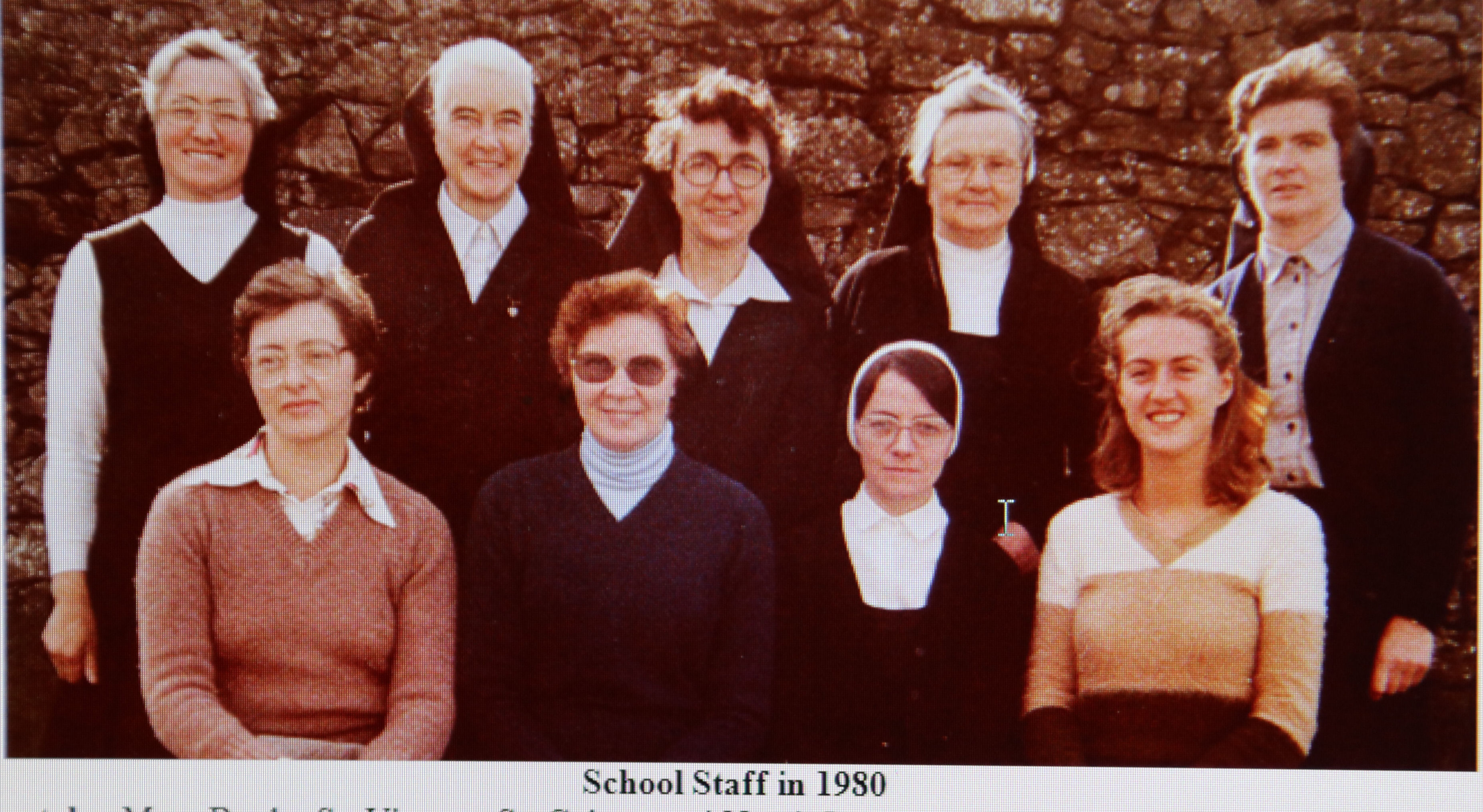
Front, l-r: Mary Brady, Sr. Vincent, Sr. Colette and Norah Joyce.
Back, l-r: Sr. Alphonsus, Sr. Celestine, Sr. Carmela, Sr. Kevin and Sr. Raphael.
Vision Statement
We, in Scoil Chroí Naofa aim to develop the whole child.
Mission Statement
The staff of Scoil Chroí Naofa are committed to the development of the whole child :
• By living out the Christian message and handing on the faith and its values.
• By providing for the physical, intellectual, emotional, aesthetic, creative, spiritual and social development of the child.
• By providing a positive learning environment with a broad balanced integrated curriculum.
• By providing opportunities to enable the whole child to develop at his or her own rate to their fullest potential.
• By enabling each pupil to live a full life as a child.
• By equipping him/her to avail of further education so that he or she may go on to live a full and useful life as an adult in society.
• By welcoming children from diverse, cultural and religious backgrounds.
• With the co-operation and support of the school community.
Act of Consecration to the Sacred Heart
Lord Jesus, we believe you are here present. We, the teachers, staff and pupils of this school dedicate ourselves and our school to your loving heart.
Together with Mary your Mother and St. Joseph, watch over us and help us.
Bless our school and our work, bless our parents and our staff, families and friends. Help us to grow in love and to show love to each other.
Thank you for all the graces and blessings you have given to us.
Lord Jesus Christ, keep us in your loving Sacred Heart. Amen

Sixth Class 1980
Front, l-r : Josephine Finn, Maeve Somers, Elizabeth Sheehan, Elaine Kavanagh, Claire Gormley, Angela Sweeney and Rosemary Mulkerrins. Back, l-r: Carmel Bane, Eleanor Hall, Carol Keane, Sr. Kevin, Keelin Walsh, Anne Loughlin, Teresa Cunniffe, Margaret Waldron and Colette Martyn.
Mural in the School
The mural in the hall was painted in 1981 as part of the Art Council’s “Paint on the Wall” Scheme. Two artists, Derval Jordan and Helen O’Donoghue, visited Scoil Chroí Naofa and helped the children to paint the mural. The pupils were taken out of school to local scenes, which they selected to paint on the wall.

The children in the school came up with the ideas and made drawings of Athenry. The artists drew the children’s pictures to scale on the walls of the hall, which the children filled with appropriate colours.
They chose shops, historic ruins and came up with a very colourful depiction of the meeting of the Galway Blazers, so much part of the Athenry scene.

Some of the Mural Painters
Front,l-r : Bridget Higgins, Anne Marie Holian, Catherine Waldron. Middle, l-r : Marie Dillon, Nora Monaghan, Helen O’Brien, Mary Morrissey, Sandra Regan. Back, l-r : Kathleen Kennedy, Jane Mongan, Anne O’Connell.

Front, l-r : Tara McNamara, Martina Farragher, Ann Melley, Mary O’Connell, Eileen Brady and Bernadette Kelly. 2nd Row, l-r: Deirdre Waldron, Carmel Murphy, Carmel Kindregan, Stella Madden, Kathleen Kennedy, Deirdre Rabbitte, Marie Dillon, Nora Monaghan and Mary Monaghan. 3rd Row, l-r: Anita Donoghue, Ann O’Connell, Mary Morrissey, Tara Curran, Margaret Fitzgerald, Carol Hynes, Sandra Regan, Aileen McNamara, Mary Ruane, Paula Rohan and Susan Devally. Back, l-r: Sr. Carmela, Deirdre Glynn, Alison Murphy, Linda Murphy, Fiona Waldron, Valerie Whelan, Aileen Bane, Bridgie Higgins, Helen O’Brien, Catherine Waldron, Martina Morrissey and Marian Somers.

Front, l-r: Teresa Martyn, Eithne Brady, Áine Foran, Fleur McCormack, Margaret Burke. Second Row, l-r: Eleanor Keane, Jacqueline Mulkerrins, Melinda Melia, Fiona Madden, Tanya Keating, Tanya McKenna, Louise McNamara, Grace Callanan, Cathryn Delaney, Siobhán Keane. Third Row, l-r: Karen Corban, Neasa Glynn, Edel Hynes, Caitríona Cannon, Deirdre Hoyne, Gráinne Reidy, Caroline Somers, Natasha Blyth, Jacqueline Kennedy. Back, l-r: Miss Geraldine Costello, Claire Dempsey, Sandra Kirwan, Anne McCarthy, Marie McNamara, Fiona Caulfield, Fidelma Burke, Suzanne Raftery, Clare Carr. .

Infants in the early 1980s
We are indebted to the authors of the publication, ‘Primary Education in Athenry-Scoil Chroí Naofa Silver Jubliee Book 1980-2005’ for extracts for this part of the story.
The Principalship of Sr. Eithne Cunniffe
1984-1993
Sr. Eithne’s overview of those years
 As I approached the town of Athenry one dull cloudy afternoon in August 1984, to my left was the ruins of the Dominican Priory with its magnificent window. A little further along the road the ruins of a roofless Castle came into view. I was later to learn that I had entered a historic medieval walled town with gates set at intervals in the walls, bearing names telling the life story of the people of Athenry in the Middle Ages. It took a while for the full significance of these surroundings to impinge upon my mind as I was regretting leaving Mullingar and my friends there and apprehensive about my appointment in Athenry.
I came to the Presentation Convent and to the Primary School that year as Principal to replace Sr. Kevin Curran. At that time there were four Sisters on the staff and five lay teachers. Breaking with tradition, in September of 1984, Mrs. Nora Joyce was appointed the first lay Vice-Principal. We were fortunate to have two new schools at First and Second Level and a Sports Centre on the grounds.
From the beginning I felt at home in Athenry and found the people friendly, courteous, helpful and interested in all that went on in the school and the same was true of the children. The setting up of the Parents’ Council was a great blessing for the school. The parents were always solicitous for the school’s development for the good of the children. They contributed greatly to the life of the school through fund raising, taking children to volley ball matches, helping with the making of school band uniforms and accompanying the band to competitions in various parts of the country. These were exciting outings especially for the children when they arrived home, after a long tiring day, carrying their trophies or medals. The school band also participated in the St. Patrick’s Day Parade in the town; in welcoming home our County Teams from Croke Park, always a great occasion; in the Féile na nÓg games held in the GAA pitch on two occasions; the re-enactment of the ‘Battle of Athenry’ at King John’s Castle and many other events including the Festivals of Athenry.
The 1980s saw a big increase in the population of Athenry and consequently the enrolment in the school increased, necessitating the employment of more teachers on the staff. Though no extra classrooms were available, we experimented with shared teaching for two years, which proved very successful. The children in fifth and sixth class, under the direction of their teachers also took part in the National Children’s Choir bi-annually and this event was a source of great pride and joy to their parents who enjoyed a night out in the New National Concert Hall in Dublin.
What shall I say about the teaching staff? Here were a group of highly gifted, dedicated, committed, enthusiastic, professional women who had the interests of the children always at heart and who developed the gifts and talents of the pupils in their care. Prior to my leaving Athenry in 1993, Mrs. Teresa Neylon was appointed the first Lay Principal in the school, which was another land mark.
Now in 2008 I am glad to hear that the school is still progressing, expanding and carrying on the Presentation ethos. The Presentation Sisters are still present in Athenry Convent continuing the work, which Nano Nagle began in Cork in 1775. The times may not be as bad now as in Nano’s time but the children’s development still needs response and nurture in ways suitable for our times and the very different environment in which they are growing. May I take this opportunity to wish the school and the teachers every Blessing in the future.

Fourth Class 1984.
Front, l-r: Angela Somers, Dora Fahy, Sinéad Foran, Fionnuala Glynn, Martina Rooney, Aisling Keane, Sonia Torpey, Siobhán Farrell, Tanya McKenna, Brighid Cannon. Second Row, l-r: Paula Conlon, Eithne Donoghue, Mairéad Quinn, Mary Morton, Ciara Ward, Helen Duane, Louise McNamara, Maeve Seery, Caroline Sweeney. Third Row, l-r: Shirley Keane, Martina Murphy, Mary Claire Hynes, Fiona Madden, Lisa Doherty, Fiona Farrell, Aileen Rabbitte, Celine Moran, Fiona Duane, Helen Mannion. Back, l-r: Sr. Bríd Kenny, Tanya Keating, Ellen Ward, Georgina Mongey, Aoife O’Neill, Joan Kilcommins, Melinda Melia, Mary Sice, Orna Thompson. Sr. Eithne Cunniffe.

1985/86 Infants with Sr. Colette and Sr. Eithne Cunniffe (Principal)
Front, l-r: Stella Casey, Ruth Maloney, Alison Coffey, Niamh O’Keeffe, Rachel Sweeney, Denise Melia, Lorraine Ryan, Denise Martin and Karen Gawley.
Middle, l-r: Niamh Barrett, Kathy Doherty, Rose Barrett, Sarah Ruane, Paul Thompson, Daniel Gill, Albert Hanley, Adrian Brennan, Simon McNamara and Sandra Connelly.
Back, l-r: Sr. Colette Dolan, Fergal Foran, Jane Callinane, Niall Walsh, Aifric O’Neill, David Casserly, Clodagh Higgins, Sean O’Donovan, Ailbhe Ward, Patrick Quinn and Sr. Eithne Cunniffe.

First Holy Communion 1985
Front, l-r: Séamus Somers, Gerard Goonan, Conor T. McNamara, Michael Noone, Paddy Ward, Shane Feeney, Tomas Thompson, John Farrell, Shane Gannon, Joseph Jennings and Micheál Cannon.
2nd Row, l-r: Aoife Shields, Mary Cloonan, Teresa Brady, Noelle Walsh, Cathy Keating, Susan Hogan, Erika Callinan, Aphria Coffey, Lorraine Glynn, Sabrina Kinneen, Tríona Holland, Jennifer Huban, Claire Coffey, Elizabeth Ryan, Tracey Flannery, Nora Melia, Martina Somers. 3rd Row, l-r: Micheál Quinn, Aiden Poniard, Dónal Keane, Richard Brady, Sharon Spellman, Derval Reidy, Louise Corban, Nicola Harney, Rachel Small, Tania Ryan, Attracta Farrell, Sharon Rooney, Joanne Bane, Adrian Ryan, Michael Duane, Joseph Hynes, Michael McGee and Liam O’Brien. Back Row, l-r: Mark Pomphrett, Brian Reidy, Kieran Lyons, Niall Martyn, Conor McNamara, Mattie Egan, Enda Nevin, Barra Nevin, David Kelly, James Delaney, Seán Kennedy-Lydon, Philip Somers, Seamus Burke, Ross Davis, David Walshe, Ronan Melia and Liam Foran.
Mrs. Norah Joyce’s Memories
 I was the second lay teacher to be appointed. I taught 29 Junior Infants in a small cloakroom in the Sacred Heart School.
There was only one toilet available in the school, the others having been demolished. So twice in the morning and once in the afternoon I brought the whole class to the toilet in the convent. How there weren’t any “accidents” is a miracle!
There was no staffroom either so we gathered together in the cookery room at 11.00 a.m. for a quick cuppa.
At lunchtime, which was from 12.30 to 1.15 p.m., the nuns went to the convent to eat and the only other lay teacher besides myself went home. I spent lunchtime alone in the Remedial Room, another cloakroom, unless I was on duty in the yard. Most of the children also went home for lunch.
The whole school was waiting impatiently for the new school to be built as the old school was over crowded. We were all delighted to move to Scoil Chroí Naofa in June 1979, where classrooms were bigger and brighter and each had toilets. I had very little equipment to bring with me. Money for toys and jigsaws etc was not as plentiful then, so my tape recorder was the only valuable item I had.
The number of children gradually increased over the next few years and so did the teachers. Mrs. Breda Burke arrived, then Mrs. Holland and Mrs. Donohue together.
Sr. Kevin retired as Principal but she stayed on to help the new Principal, Sr. Eithne, for another year.
The uniform, chosen by parents and staff, was introduced when Sr. Eithne was Principal. Tom Mc Namara and I shopped around Galway for materials and prices and best quotations. The crest came later which was designed around the logo of the Presentation Order. The School Band was well established by Sr. Ena. She wished to add another section to her band of musicians, majorettes and flag bearers. I taught the children movements and steps. Sr. Eithne ordered costumes.
In 1989 Sr. Eithne asked me if I would like to join the National Children’s Choir, which was founded by Seán Cramer in 1987. The aim of this choir was to have children from all over Ireland sing a repertoire of songs in unison and in two and three part harmonies. Songs were of many different styles: ballads, songs from operas, traditional songs, modern pop songs and religious hymns.
She knew of my interest in music, especially choral singing and so began what for many of the children in the school was their most abiding memory, singing in Leisureland and for the lucky few in the National Concert Hall.
The School Band was well established by the time I arrived in Scoil Chroí Naofa, but Sr. Vincent (now Sr. Ena) wanted to add more interest and colour. So she gave me Majorette movements and steps, which she had been sent from America. I learned the routines and simplified the steps, taught them to the children who in turn taught them to the younger girls as they joined the band each year. Sr. Eithne ordered simple costumes for smaller children and so a new dimension was added to the band complete with flags and sticks. The Majorettes and Flossies joined the musicians.
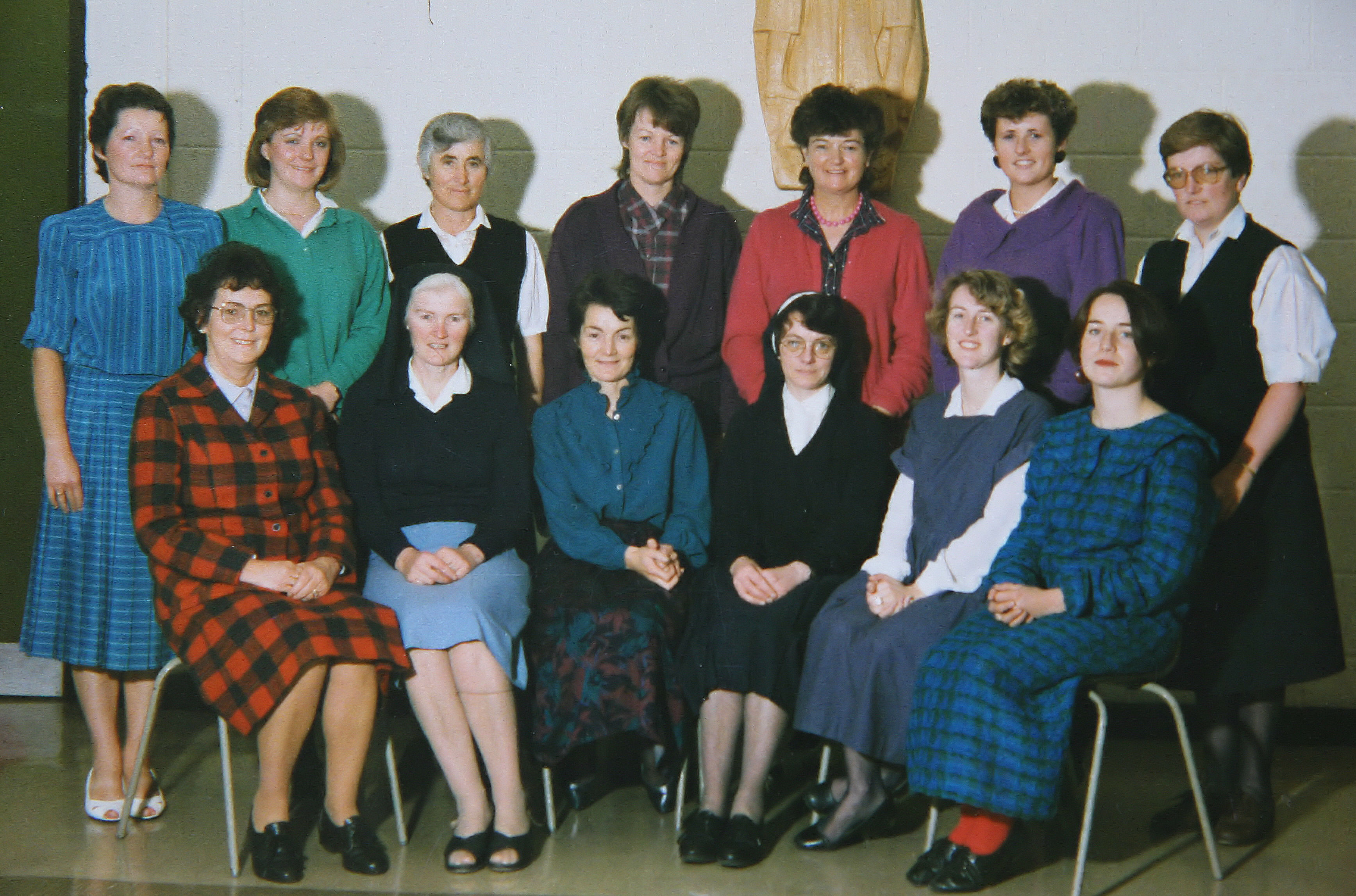
School Staff 1986/87
Front, l-r: Eilish Galvin, Sr. Eithne, Margaret Seery, Sr. Colette Dolan, Norah Joyce and Maud Hand.
Back, l-r: Mary Holland, Anne Farrell, Sr. Alphonsus Allen, Maura Donohue, Breda Burke,
Claire Thompson and Sr. Bríd Kenny.

First Class 1987
Front: Cormac Brady, Kevin McCarthy, Ronan McNamara, Aidan Holland. Second Row: Elaine Kelly, Niamh Tierney, Mary Teresa Ward, Mary Ward, Kate Walshe, Aoife Lynch, Gráinne Burns, Sarah Lawless, Sharon Lawless. Third Row: David Walshe, Karen O’Shea, Michael Mannion, Cathy Hanley, David Glynn, Paula O’Shaughnessy, Martin Somers. Back: Mrs. Maura Donohue, Attracta Mongey, Martin Walsh, Donna Flaherty, Tadhg O’Donovan, Aideen O’Neill, Patrick Murphy, Jennifer Poniard, David Dempsey.
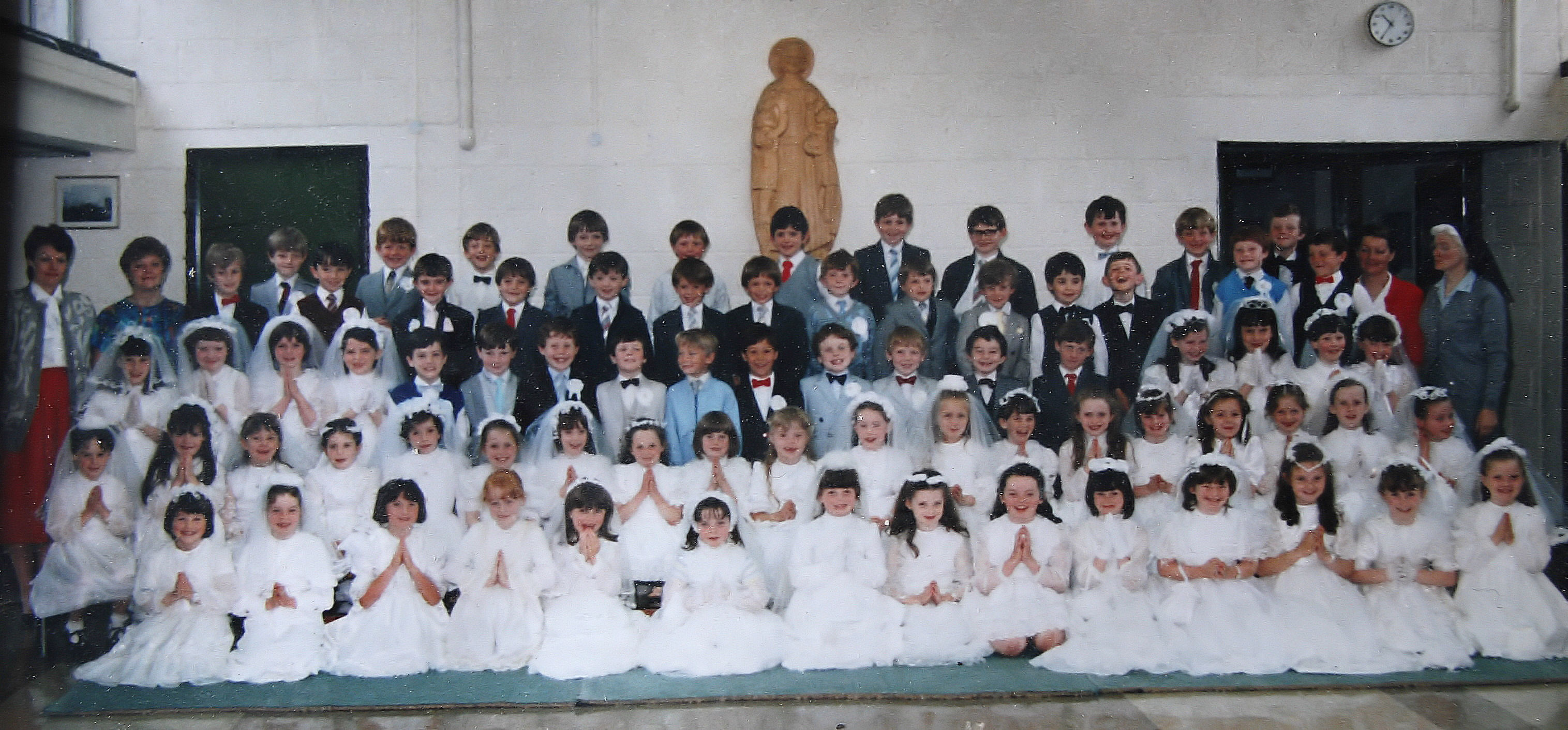
First Holy Communion 1987
Front, l-r: Gráinne Burns, Catherine Hanley, Niamh Tierney, Paula O’Shaughnessy, Attracta Mongey, Mary Teresa Ward, Mary Ward, Karen O’Shea, Aideen O’Neill, Elaine Kelly, Sharon Lawless, Donna Flaherty, Jennifer Poniard, Sarah Lawless. Second Row, l-r: Martina Coffey, Tara McDonagh, Tracey Moran, Lorraine Sweeney, Niamh Hoyne, Lynn Harney, Caroline Kelly, Ann Marie McCarthy, Susan Pomphrett, Karen Dwyer, Ann Marie Ryan, Tara Gallagher, Aoife Healy, Nicola Nally, Denise O’Reilly, Kate Walsh, Aoife Lynch, Brenda McNamara, Ríona Ward. Third Row, l-r: Deirdre King, Patricia Sice, Mary Claire Delaney, Angela Ryan, Enda Laffey, Kevin McCarthy, David Glynn, Fergal Melia, Derek Carroll, Jason Quigley, Gerard Barrett, Stephen Barrett, Gerry Tierney, Keith Starr, Lorraine Higgins, Colette King, Niamh Casserly, Aisling Kelly. Fourth Row, l-r: Mrs.Maura Donohue, Miss Anne Farrell, David Walshe, Michael Mannion, Ronan McNamara, David McDonagh, Aidan Holland, David Donohue, Shane Donohue, Keith Daly, Kieran Corban, Cormac Brady, Martin Somers, Paul Molloy, John Paul Ward, Derek McGee. Mrs. Mary Holland, Sr. Eithne Cunniffe (Principal).
Back,l-r: Donal Flynn, Martin Walsh, Darren Torpey, Diarmaid Cloonan, Robert Murphy, Tadhg O’Donovan, Darren Nally, Fergus Farrell, David Dempsey, Patrick Murphy, Paul Butler.

School Staff 1988
Front, l-r: Maud Hand, Claire Thompson, Sr. Eithne, Mary Holland and Sr. Colette Dolan.
Back,l-r: Sr. Bríd Kelly, Geraldine Costello, Eilish Galvin, Breda Burke, Maura Donohue, Anne Farrell and Norah Joyce.

First Holy Communion 1989
Front row, l-r: Noel Mullins, Donal Fleming, John Kelly, Paul Treacy, Kenneth McGee, Paul Tierney, Noel Coffey, Joseph Naughton, Darren Madden, Brian Somers, Michael John Quinn, Kenneth Feeney, Senan Coffey, Alan Lynch and Jason Ollerenshaw.
Middle row, l-r: John Ward, T.J. Walshe, Domhnall Foran, Bridie Ward, Olivia Barrett, Victoria Walshe, Ellen Ward, Jennifer O’Reilly, Janet Somers, Siobhán King, Niamh Conlan, David Flaherty, Sheamus Quinn and Brian Atkinson. Back row, l-r: Sr. Eithne, Miss Flaherty, Maureen Flynn, Cora Hynes, Breda Ward, Sue Doherty, Loretta Cunniffe, Kathleen Ward, Geraldine Cronnelly, Yvonne Brannelly, Mary Neary, Lisa Melia, Fiona Costello, Nicola McGee, Aileen McNamara, Arlene Fergus and Mrs. Maura Donohue.

Second Class 1990/91
Front, l-r: Majella Dillon, Debbie Hynes, Melissa Tracey, Catherine Melia, Orla Gannon, Bríd Casserly, Áine Byrnes, Suzanne Nally and Bridie Ward. Middle, l-r: Aoife Melia, Zara Quinn, Angela Ward, Paula Flannery, Alice Poniard, Sarah O’Connor, Aisling Gallagher and Sr. Alphonsus.
Back,l-r: Aisling Holland, Orla Tierney, Michelle Fergus and Aoife Barrett.
1991-Scoil Chroí Naofa won the Water section of the Church and General Children’s Safety Awards
Source: Connacht Tribune
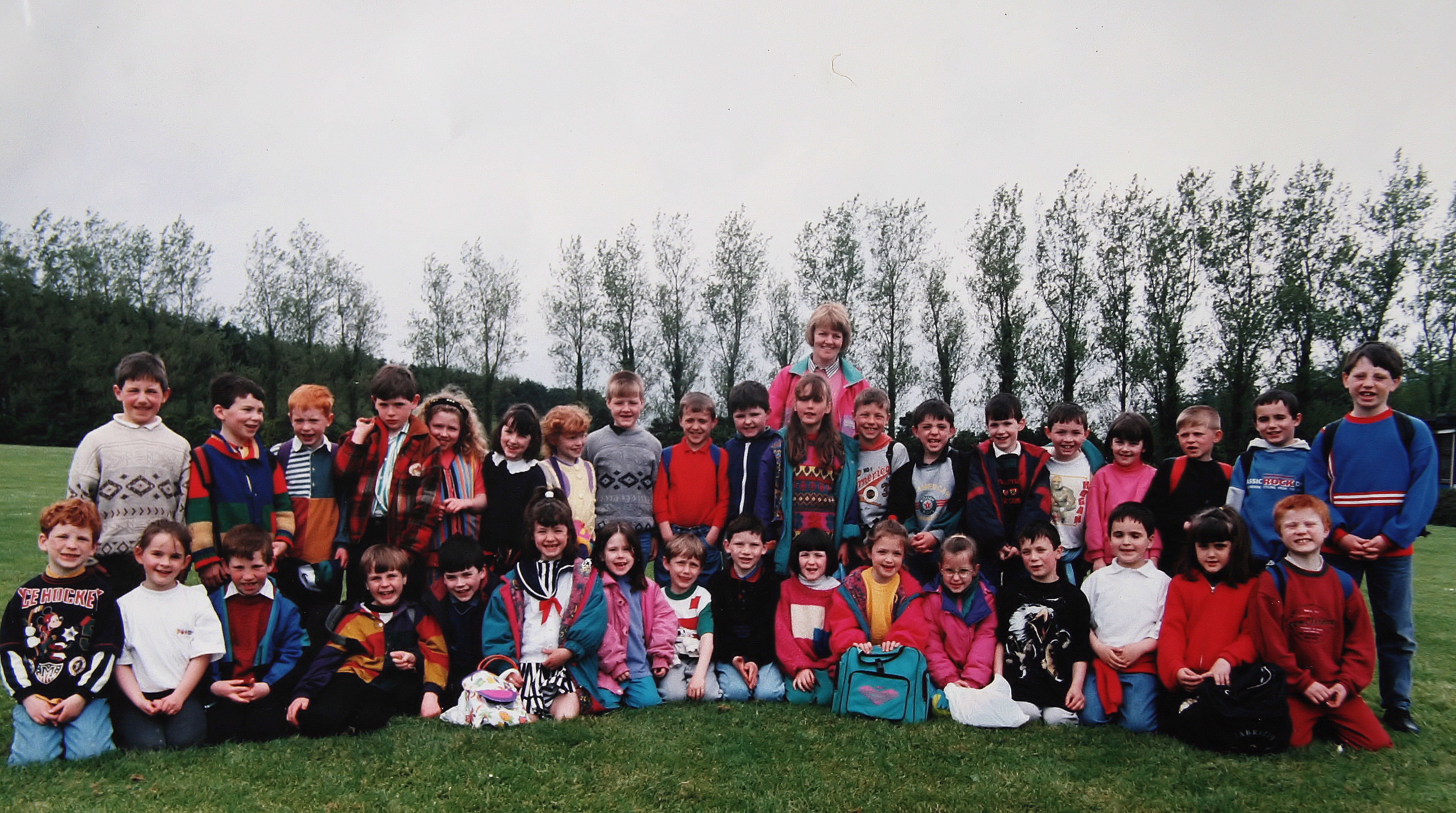
1990/91 Infants with Mrs. Maura Donohue
Front, l-r: Declan Loughnane, Michelle Molloy, Ronan Killeen, Eoin McDonagh, Shane Kilkelly, Rebecca Martin, Patricia Ryan, Paul Donohue, Steven Flannery, Michelle Flannery, Ciara Barrett, Tara Ollerenshaw, Oliver Gill, Graeme Dean, Shauna Coll and Edward Ward. Back, l-r: Adrian Brannelly, Cathal Atkinson, Emmet McGowan, Ciarán O’Donavan, Olivia Grimes, Emma Healy, Lisa Holland, Ian Morton, Jarlath Daly, Alan Fahy, Laura Ward, Nigel McGee, Richard Gannon, Philip Kelly, Hugh Kirwan, Ciara Costello, Steven Kelly, Kieran Healy and Edward Mongan.

First Holy Communion 1990
Front, l-r: Tony Judge, Ronan Cahill, David Carroll, Brian Rooney, Adrian Cunniffe, John Jennings, Cormac Cloonan, Keith Kennedy. 2nd Row, l-r: Miss Flaherty, Sharon Moran, Alice Poniard, Aoife Barrett, Michelle Fergus, Debbie Hynes, Sarah O’Connor, Catherine Melia, Melissa Treacy, Ann Burns, Bridie Ward, Aisling Holland, Majella Dillon, Sr. Eithne Cunniffe (Principal). 3rd Row, l-r: Mrs. Maura Donohue, Sandra Gartland, Orla Tierney, Zara Quinn, Aisling Gallagher, Orla Gannon, Suzanne Nally, Louise Ward, Aoife Melia, Bríd Casserly, Regina Glynn, Angela Ward, Mons. Michael Mooney P.P.
Back, l-r: Colin Morrissey, Paul Hession, Michael Donovan, Douglas Costello, Seán O’Brien, Michael Farrell, Shane Rabbitte, Darren Kennedy, Edward Ward, Ronan Commins, Pat Kennedy Lydon, Brian Farrell, Colin Connolly, George Higgins, Alan Lynskey.
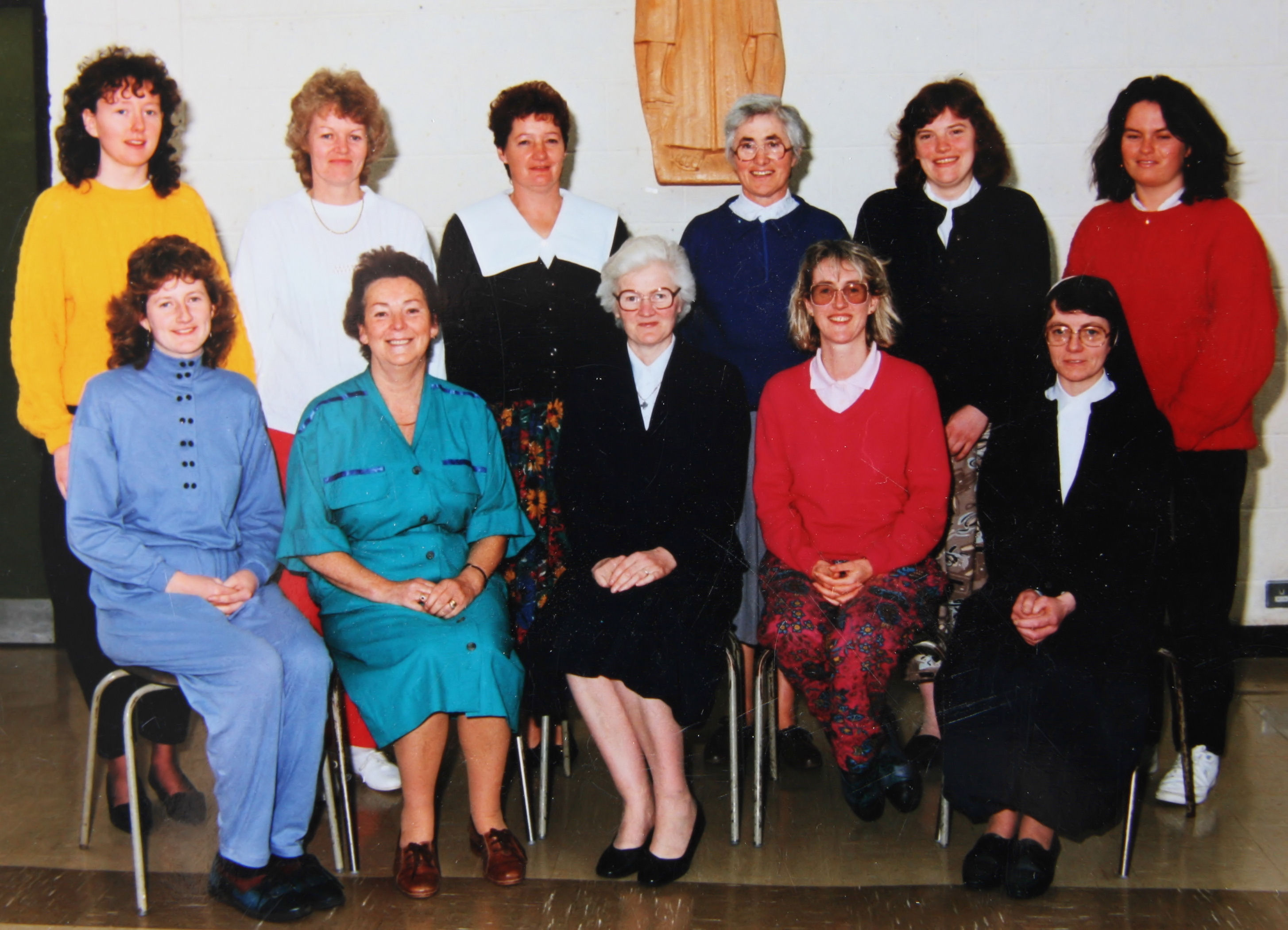
School Staff (Circa) 1991
Seated: Carmel Burns, Éilish Galvin, Sr. Eithne Cunniffe, Norah Joyce, Sr. Colette Dolan.
Standing: Marie Touhy, Maura Donohue, Mary Holland, Sr. Alphonsus Allen, Nuala Flaherty, Margaret O’Brien
Athenry in the 1990s
This was the decade of great change and development in Athenry.
The Nano Nagle School was opened in 1990. 1991 saw the opening of Athenry Credit Union’s new premises in Old Church Street, while out in Palmerstown, Athenry Golf Club expanded its course to 18 holes. Socially, the Womens’ Group was founded, while the community’s camera enthusiasts founded the Athenry Camera Club. That year also, the History of Carnaun N.S. was published.
The following year Seamus Heaney came to town for the Athenry Poetry Festival. On the business and environmental fronts, Athenry Chamber of Commerce and the Tidy Towns Committee came into being.
In 1993, Athenry got a 24 hour water supply for the first time and the town was designated a Heritage Town by Bórd Fáilte. The new Chamber of Commerce launched an Arts and Crafts Festival along with a monster Christmas Draw. The next year, the Parish Steering Committee, promoting development on a wide range of community areas, was established.
The old buildings at the Railway station became the headquarters for Galway Rural Development. ‘Welcome to Athenry’ signs were erected on the approach roads to the town by the Chamber of Commerce with the view to encouraging people to shop locally. Esker Monastery opened its Youth Village.
The highlights of 1995: the first Medieval Festival brought huge crowds to town; Gold medals for Athenry Chess Club in the Community Games; Athenry Neighbourhood Watch was set up; the 107th Athenry Agricultural Show and the 21st Cashla Gymkhana attracted large attendances and C & F Tooling opened its factory out in Lisheenkyle.
CSO figures show that Athenry’s house building boom started in 1996 and continued for 11 consecutive years. In the Community Hall, the Parish Steering Committee launched its Development Plan and ADC was formed to implement the many programmes with the Plan.
The outstanding event of 1997 was the winning, to the delight of the whole community and county, of the All-Ireland Club Championship by St. Mary’s Hurling Club for the first time. The spiritual health of the parish received a boost with the formation the Parish Pastoral Committee. To provide an alternative to pub socialisation for parish youth, Athenry No Name club came into being. That same year Athenry Civil Defence opened its new headquarters in Clarke Street.
The memorable events of 1998: the founding of Soilse, Athenry Friends of People with Special Needs; the huge crowds that came from all over the country to attend Teagasc’s national farming event in Mellows College; the unveiling of the ‘Winged Horse’ monument to Pádraic Fallon in Castle Park and Athenry Boys National School winning of the County Schools Hurling Championship.
The decade closed on a very high note when Taoiseach, Bertie Ahern, to great fanfare, opened Athenry Heritage Centre in 1999. St. Mary’s won back to back County Senior Hurling titles and also launched their website.
On the cultural front, Athenry Musical Society took to the stage for its first show; and the Milennium Park was developed at Lady’s well; new heritage public lighted was switched on in some of the town’s streets and ‘The Lamberts of Athenry’ was published. Athenry’s 14th Century Mace and Seal was returned to the community by Anthony Blishem and placed in the Heritage Centre.
The Principalship of Mrs. Teresa Neylon
1993-2008
Mrs. Neylon’s overview of those years
Staff
 In 1993, there were ten teachers on staff, nine class teachers and one Remedial Teacher. Norah Joyce was Vice Principal, Eilish Galvin was the Remedial Teacher and the class teachers were Sr. Alphonsus, Sr. Colette, Breda Burke, Mary Holland, Maura Donohue, Carmel Burns, Marie Broderick and Margaret Scully. In 2008 there are twenty three members on staff, i.e. ten class teachers, a learning support teacher, three language teachers, two resource teachers for travellers, two resource teachers for special needs, four special needs assistants and the Principal
Resource Teacher for Special Needs
In the late nineties, children with special needs started to enroll. Margaret Seery became the first resource teacher for special needs shared with the Boys School. In the year 2000, a full time position was sanctioned and in 2008 there are two resource teachers for special needs on staff, Maura Donohue and Sr Marie. As a result of some of these children having physical care needs the following special needs assistants were employed: Rosaleen Devally, Teresa Coppinger, Joan Mongey, Margaret Hallissey, Mary Cannon and Maura Hanley.

Resource Teacher for Travellers
In the mid 90s the Department sanctioned extra teachers to cater for the needs of the travelling children. Mary Whyte and Marie Hansberry were appointed. In 2000 a third Resource Teacher for Travellers was sanctioned due to travellers with special needs enrolling. This position was different from all the other positions in that the teacher was allowed to teach in a mainstream class and hence reduced all the numbers throughout the eight classes in the school to give a total of nine classes. In 2008 there are still two positions. Mary O’Sullivan has succeeded Marie Hansberry and Patricia Leonard.

1993/94-Sixth Class
Front, l-r: Kathleen Ward, Cora Hynes, Maria Melia, Siobhán McKenna, Mary Neary, Lisa Melia, Janet Somers, Niamh Conlon, Tracey McDonagh, Jennifer O’Reilly, Stella Casey. Middle, l-r: Mrs. Teresa Neylon, Yvonne Brannelly, Aoife O’Brien, Elaine Finn, Ríona Burke, Aileen McNamara, Fiona Costello, Laura Noone, Margaret Berry, Sharon Connelly, Siobhán King, Miss Carmel Burns. Back, l-r: Ruth Maloney, Clodagh Higgins, Emma Rooney, Cathy Doherty, Sarah Ruane, Bernadette Bane, Carina Walsh. (Missing from Photo: Niamh Barrett)
Photo: Mary Doherty
Remedial/Learning Support Teacher
The following were our Remedial/Learning Support Teachers shared with the Boys School: Eilish Galvin, Sr. Alphonsus, Mr. Speakman and Mr. Murphy. In the year 2005 this position was made full time. Norah Joyce is presently our Learning Support Teacher
Language Teacher
In 2005 the Department sanctioned Sr. Marie Ward as a Language Teacher to teach English to the non English speaking newcomer children. As more and more children from other countries started to enrol, the Department sanctioned three language teachers. Mary Holland, Margaret Scully and Marie Broderick are currently teaching in these positions.
Ancillary Staff
The school had no secretary in 1993. Two years later a grant was received from the Department for ancillary services. The following secretaries were employed: Mary Donohue, Cathríona Cannon, Geraldine Ní Bhrosnacháin, Karen Jackson and presently Deirdre Earls. Maureen Farrell and her daughter Bridie have been cleaning the school over the years. Caretakers also employed included: Johnny O’Brien, Middy Flannery, Paddy Farrell (Senior) and Paddy Farrell (Junior).

School Staff 1996-97
Front, l-r: Brona Smyth, Sr. Colette, Norah Joyce, Teresa Neylon and Mary Whyte.
Back, l-r: Sr. Alphonsus, Mary Holland, Maura Donohue, Marie Broderick and Margaret Scully.
PRESENTATION SISTERS
Four of the Presentation Sisters worked in the school during the period 1993 to 2008:
Sr. Leo Hackett has been the Chairperson of the Board of Management.
In 1993 Sr. Alphonsus was teaching first and second class. When Mrs. Galvin retired she moved into a Learning Support Position. She has now retired..
Sr. Colette was teaching Junior Infants up until the time she died on the 19th of February 2005.
Sr. Marie Ward taught in Pakistan for a number of years. She was teaching in Mountmellick and she is employed as our Language Teacher.
SCHOOL MANAGEMENT
Due to the ever increasing workload on Principals and Deputy Principals, the Department of Education & Science initiated a new Middle Management Structure in all primary schools at the turn of the century. This initiative was very beneficial to Scoil Chroí Naofa. Initially, our school was sanctioned for two Special Duties Positions but by 2005 the number increased to five positions along with an Assistant Principal Position. All post holders took on extra duties and were reimbursed by the Department.
PUPILS
In 1993 there were 273 pupils on roll to include nine mainstream classes. Seven years later our numbers decreased to 220 pupils. In 2003 our numbers began to increase again and in 2005 our school was recognised as a Developing School; hence an extra class teacher was appointed. There are presently 286 pupils on roll divided amongst ten mainstream classes.
REVISED CURRICULUM
In 1993, the teachers were teaching the 1971 New Curriculum. However in 1998 this curriculum was revised. There are now eleven subjects: English, Irish, Maths, History, Geography, Science, Music, Drama, Physical Education, Visual Arts and Social, Personal and Health Education. These subjects are taught to all children from Junior Infants up to 6th Class. From the year 2000 onwards, the teachers have been receiving in-service training on the different subjects. The Department of Education has allowed four school planning days each year in order for teachers to plan whole school programmes on each subject of the Revised Curriculum.
OTHER PROGRAMMES
Stay Safe
A new programme was introduced in 1993 called the Stay Safe Programme and is taught in all classes except Junior Infants. The aim of the programme is to teach children personal safety skills, so they can look after themselves in situations which could be upsetting or dangerous. It deals initially with common situations, which most children will experience at some stage or other, e.g. getting lost or being bullied. The programme also teaches children the safety skills necessary to protect themselves from physical or sexual abuse. Children will be taught to tell a trusted adult about any problems they may have.
Walk Tall Programme and Relationships and Sexuality in Education
In 1998 teachers received in-service training on the Walk Tall Programme, and the Relationships and Sexuality in Education Programme. The above three programmes are taught as modules in Social, Personal and Health Education.
Alive-O Series
The Religious Programme taught in 1993 was based on the Children of God Series. This programme has now been revised and is presently called the Alive-O Series.
BAND
In the late eighties the band competed in the Irish Marching Association Summer Competition. From 1994 onwards the band focussed more on local events. Band activities remained an extra curricular activity up to 1995. A year later the band grew because every child from 2nd class up to 6th became members and it was taught as part of the music curriculum within school hours. Children from 2nd class became majorettes and flag bearers and were taught routines. Children from 3rd to 6th were taught a music repertoire selected by the staff. Children had the opportunity to learn a number of instruments: tin whistle, melodica, bell lyre, accordion. Children who had very good rhythm were selected by Norah Joyce to play the drums. Drumming lessons were given by Paul Millar. More instruments were purchased: melodicas, bell lyres, piano accordions, bodhrans and percussion instruments. Other items were also purchased: raincoats, band sweaters, leotards, band uniforms, majorette sticks, flags, pom poms and drum carriers. Over the years the band took part in the following events: St. Patrick’s Day Parade, Lighting of the Christmas Tree, Palm Sunday Procession, Corpus Christi Procession, Local Matches, Athenry Festival, Loughrea Feis, Cór Fhéile, President Mary Robinson’s Visit to the Opening of the Monivea Rugby Club, President Mary McAleese’s Visit to Athenry, the Visit of St Therese’s Relics to Athenry, the Ordination of Fr. Robert Mc Namara and the Scoil Chroí Naofa Annual Feis. A special committee supported the band over the years. The Parents Council have taken over this responsibility as part of their duties. Fundraising events consist mainly of a Sponsored Walk and a Church Gate Collection.
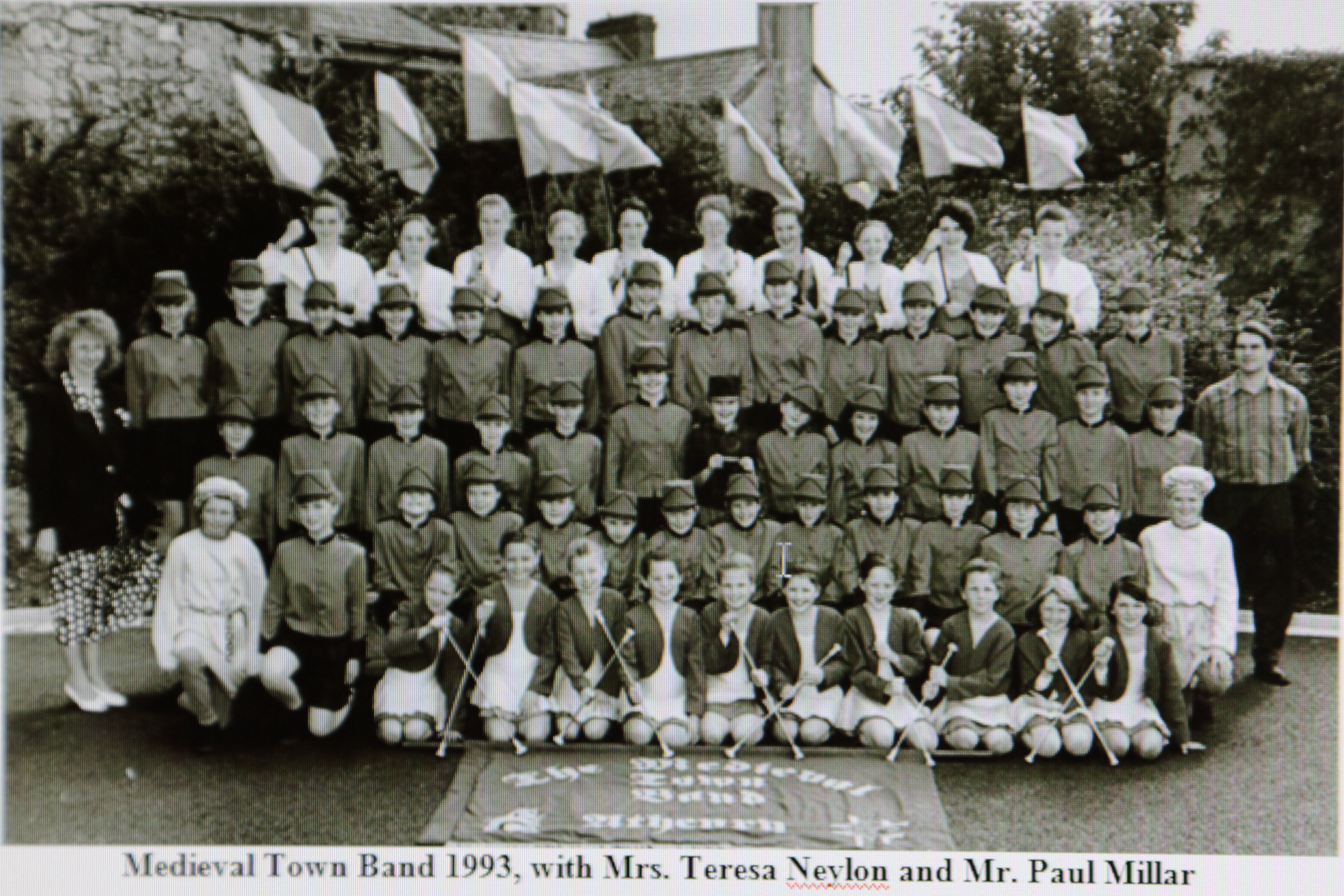
Medieval Town Band 1993, with Mrs. Teresa Neylon and Mr. Paul Millar

Discovery Science Programme
Our school has participated in the Discovery Science Programme since 2004. The teachers from the senior classes taught their pupils many interesting science lessons and the children had the opportunity to carry out very interesting scientific experiments. Some of the experiments are demonstrated by the pupils to the rest of the school at our Science day at the end of the school year. The teachers and their pupils have been awarded our four Discovery Science Awards of Excellence as a result of all their hard work.

Included are: Ailish McDonagh, Laura Mentane, Laura Kehoe, Amy Kilkelly, Elaine Shaughnessy, Ola Krzynowska, Elileen Kuhl, Danielle Whyte, Rachel Ward, Niamh Burke, Bernadette Carter, Dara Fahy, Emer Costello, Shauna Ward, Shannon Lukiena, Amy Kilkelly, Elaine Corcoran, Sarah Gaughran, Courtney Gill, Megan Wilkinson, Finola Leahy, Amy Shaughnessy, Orlaith Melia, Annette Higgins, Niamh Delmer, Kathlyn Ward, Laoise Kenny, Niamh House, Meadhbh Curran, Shonagh Burke, Cliodhna Kelly, Laydiane Costa Ramos, Emma Delmer, Saoirse Doherty, Michelle Kindregan
Green School Programme
One of our millennium projects was to become involved in the Green School Programme. We adopted the 3R Policy i.e. Reduce, Re-use and Recycle. This programme has made our school community more aware of how we can become friends of the environment. We have received four Green School Flags. We are presently working towards our fifth Green Flag under the management of Ms. Treacy and the Green School Committee. Our new project is based on the Travel Theme.
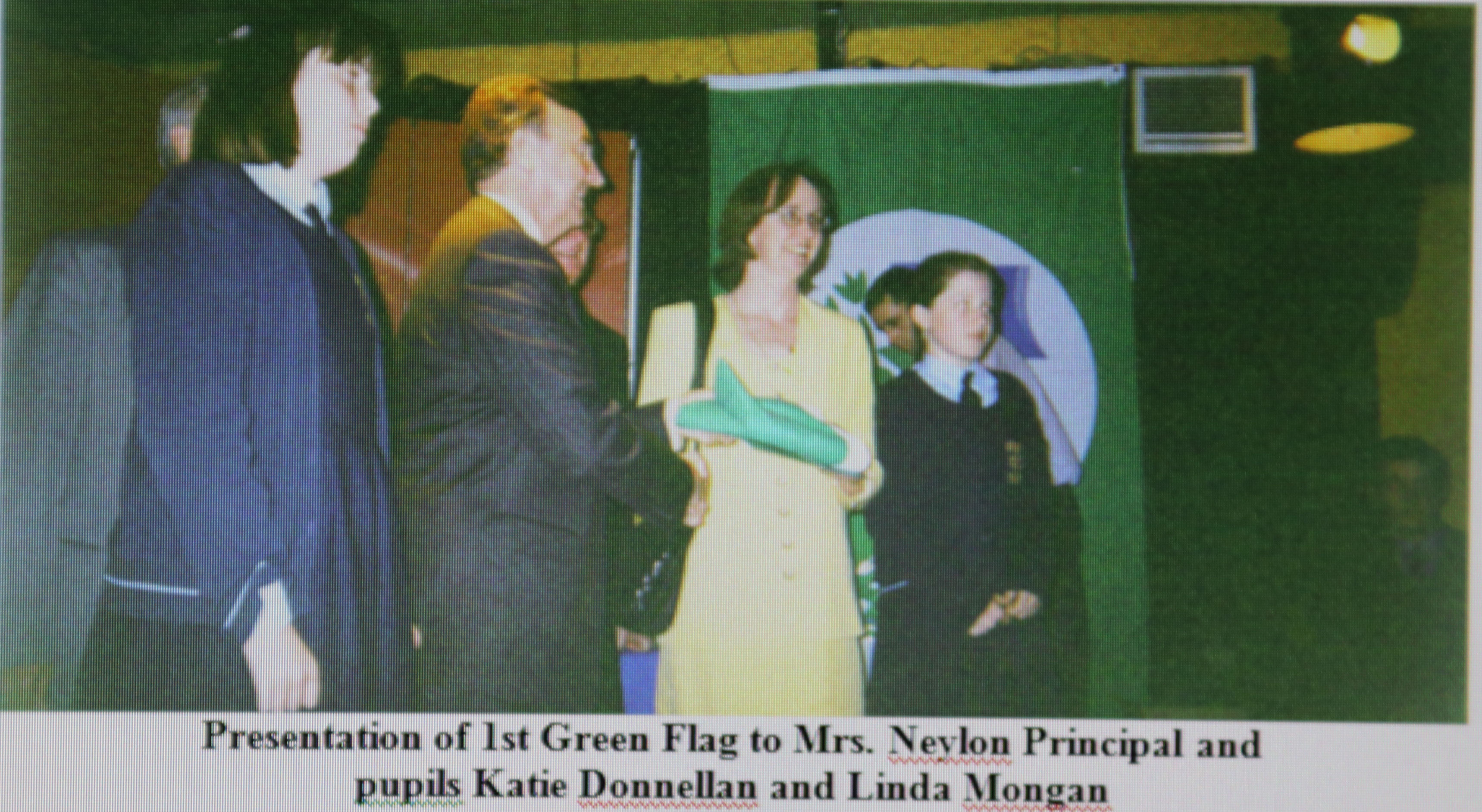
We in Scoil Chroí Naofa have become friends of the environment by:
• Keeping our school clean and tidy.
• Disposing of our waste in the correct bins.
• Saving electricity.
• Making the best use of heat.
• Practising at home and in the locality of Athenry what we have learned in school.
Information Technology
At the turn of the century the Department of Education started to give Information Technology grants to schools in order to equip staff and pupils for the modern technological world. A committee was
established in our school consisting of two parents Bernie Ryan and James Lundon and three teachers, Mary O’Sullivan, Mark Speakman and Principal. Our Information Technology Plan is reviewed each year.
All classrooms and support rooms are equipped with computers and printers. Laptops are also available if needed. A broadband service has been provided to all the classrooms and prefabs. Children in the senior classes have the opportunity to use the internet with the consent of their parents. Highly recommended software based on English and Maths has been purchased for all classes. Software is also available in the other curricular areas.
Mary O’Sullivan is our Information and Communications Technology Co-ordinator. She updates our website annually with the help and support of the children and staff. Please visit our website at www.athenryprimarypres.scoilnet.ie
National Children’s Choir
The aim of the choir is to foster a love of choral singing. Children in the Senior Classes take part in this National Event every second year. The children are taught a repertoire of songs using 2/3 part harmonies by Mrs. Joyce and a dedicated team of teachers.
The children sing together with other Primary Schools in the County and perform this repertoire at the Regional National Children Choir Concert in Galway. Our children also perform a recital for our whole school in June. Ten pupils are selected along with other children from schools all over Ireland to sing in the National Concert Hall, Dublin.
.
Sport
Mrs. Donohue has been coaching our school Camogie team for the past number of years. They compete in the Cumann na mBunscoil League and the INTO Mini 7s each year. They have won both competitions.
In the year 2005 the G.A.A. Galway Coaching Games Committee organised a coach to train all the children in one of the senior classes in Camogie skills. Children from first up to sixth classes had the opportunity to also attend coaching sessions in Go-Games.
In 2007 Maura became our Camogie Co-ordinator where she organises and supports all Camogie events. Darrelle Coen joined our teaching staff in 2006 and now coaches the Camogie Team. Darrelle also provides an intensive Coaching Course in Gaelic Games for the boys and girls in 1st and 2nd classes during the months of May and June after school hours. Darrelle and Elaine Monson have provided a Sports Club for children in the middle classes as an extra curricular activity throughout the school year.
The course includes a variety of games, skills, dance and co-operative games. Basketball also has been taught as an extra curricular over the years by various members of staff.
Back, l-r: Shikiara Mulkerins, Catherine O’Grady, Hazel Kilkelly, Áine Lydon, Helena McGough, Hannah Kindregan, Maura Donohue. Middle, l-r: Orna Glynn, Michaela Depinna, Cara Loughnane, Sinéad O’Brien. Front, l-r: Kanesha Parr, Chleo Rooney, Amanda Fahy, Marie Lundon, Róisín O’Brien, Sarah Curran.
Extra Curricular Activities
The school offers a great variety of after school activities. Times and days for these activities vary from year to year. Activities consist of: Sports Club, Art Classes, Camogie, Get Smart with Science Course, French Lessons, Spanish Lessons, Basketball, Guitar Lessons, Easter & Summer Camp, Instrumental Lessons, Table Quiz Coaching, Creative Dance, Speech and Drama and National Children’s Choir.


Four Generations of the Hardiman and Earls Families have attended Presentation Schools, Athenry.
Ciarán Hardiman Ronan and Mark Hardiman Ava, Megan and Ríbh Earls
Ciarán’s father, John, and Ronan and Mark’s father, Paul, attended both Presentation primary and secondary schools. Ciarán’s mother, Maura Hardiman (nee Burke) received her secondary education at Presentation College. Their grandmothers, Maura Hardiman (nee Kearney) and Mary Burke (nee Corley) were pupils of the Presentation primary and secondary schools. Their great-grandparents, Malachy Kearney, Ursula Kearney (nee Daly) and Jimmy Corley attended the primary school.
Ava, Megan and Ríbh’s mother, Deidre Earls (nee Rabbittee) attended the Presentation primary and secondary schools. Their grandfather, Greg Rabbitte, attended primary school up to first class, after which he transferred to Athenry Boys’ National School. Their grandmother, Ann Rabbitte (nee Crosby) was a pupil of the Presentation primary school. Their great-grandmother, Mary B. Crosby (nee Kindregan) attended the primary school.
SCHOOL BUILDING
Shared Area
In 1980 there was a classroom called the Shared Area which consisted of a big classroom and two small classrooms. It was initially used as a P.E. Room, and a room to cater for many pupils e.g. choir practice and band practice. In the eighties Mrs. Donohue and Mrs. Holland taught their two classes in the shared area.
As the numbers grew in the late eighties it was used as one classroom. In the early 1990s it became a storage room for all our band equipment and the two small rooms each side became Resource Rooms.
In the late 1990s it became a Computer Room. In the year 1998/1999 it reverted back to being a classroom. In the year 2000 the main classroom area was divided into four sections for Resource Teacher, Special Needs and two smaller rooms for Special Needs Assistants. From the year 2005 onwards, the Language Teacher, Resource Teacher for Special Needs and Special Needs Assistant teach in this room.
Other Changes
In 1993 the present secretary’s office was a school library. When the Department sanctioned money for the Board of Management to employ a secretary, the library became the secretary’s office.
The staff room has been painted and modernised over the years with new presses, dishwasher, burco boiler, fridge, new table and chairs, notice boards.
An Equipment Room has been set up in one of the Resource Rooms to enable teachers to share and pool resources.
The school was painted a few years ago. The original doors were replaced with fire safety doors and an alarm system was installed.
From 1993 up to 2000 the staff and children used the old school for PE classes in Basketball, Volleyball and Olympic Handball.
In the year 2000 as part of the Millennium Project there was a mural painted in the shelter in the bottom yard. Ruth Pokall, a parent of the school at the time, outlined the scene of the modern school versus the old school. All the children had an opportunity to paint.
In the late 1990s our caretaker Johnny O’Brien painted Hopscotch in the bottom yard and top yard. Rosaleen Devally, Cathríona O’Connell and Michael Flannery painted games on our bottom yard. The Parents’ Council added more games and repainted in 2008.
Due to a rise in the pupil population three prefabs have been erected on site catering for two classrooms and two resource rooms. The Prefabs are called St. Therese and St Ann.
The green areas in the front of the school have been replaced by car parking facilities.
Green fencing was erected to protect the children from the number of cars entering the property.
A barrier system financed by the Presentation Sisters was installed in 2008 to cater for the safety of children and to regulate and control car parking facilities for staff.
In August 2008 the old school was demolished and the Nano Nagle Pre-School closed. The site is now used as a playground.
On the 30th of October, President MacAleese’s helicopter landed in the new playground. The President’s came to unveil the Centenary Commemorative Plaque on the front of Presentation Convent, Athenry.
Scoil Chroí Naofa Commemorated the Centenary of the Presentation Sisters in Athenry with a Pageant of the Life Story of Nano Nagle in The Church of the Assumption, Athenry on 12th February 2008
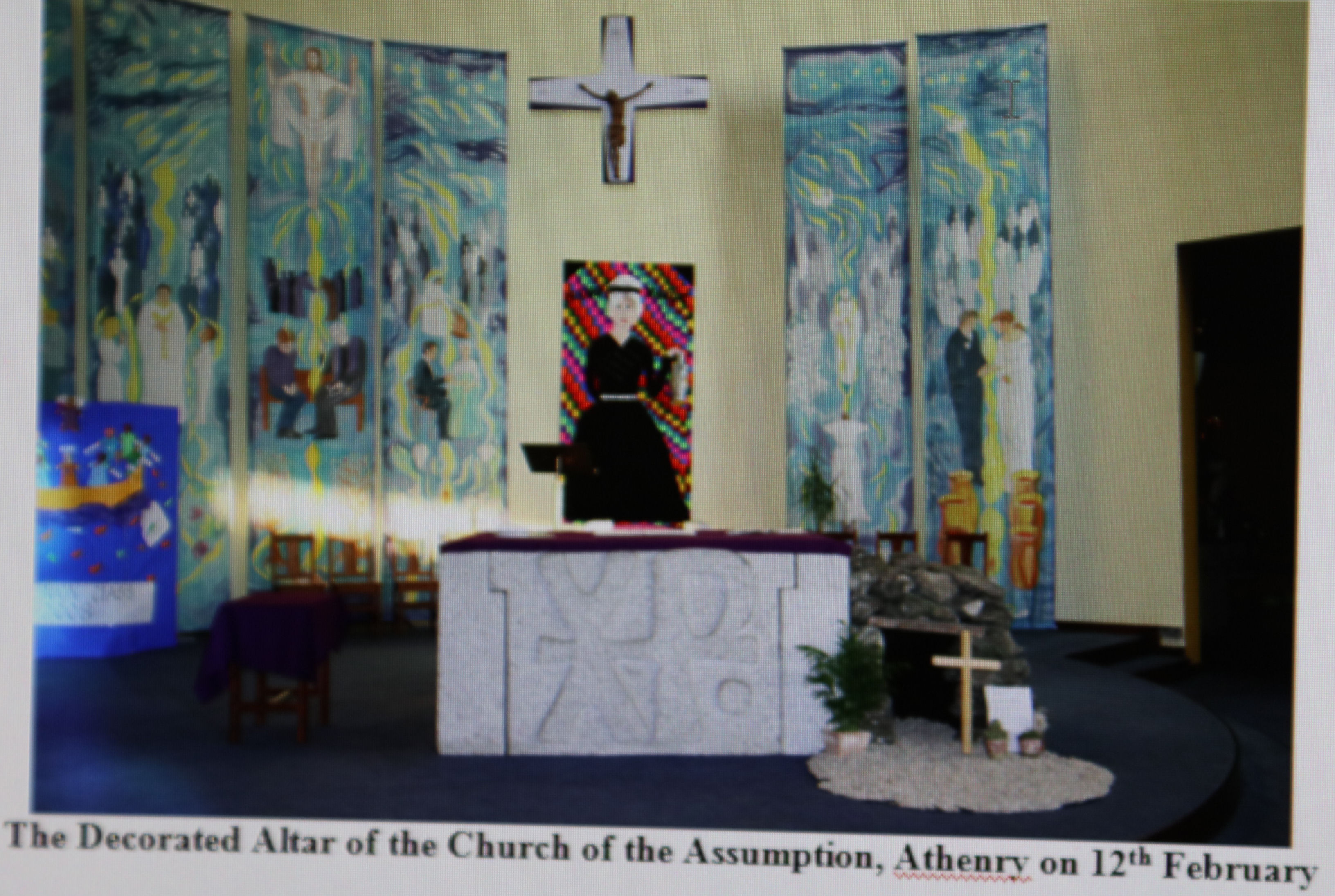
Photo:Tuam Herald

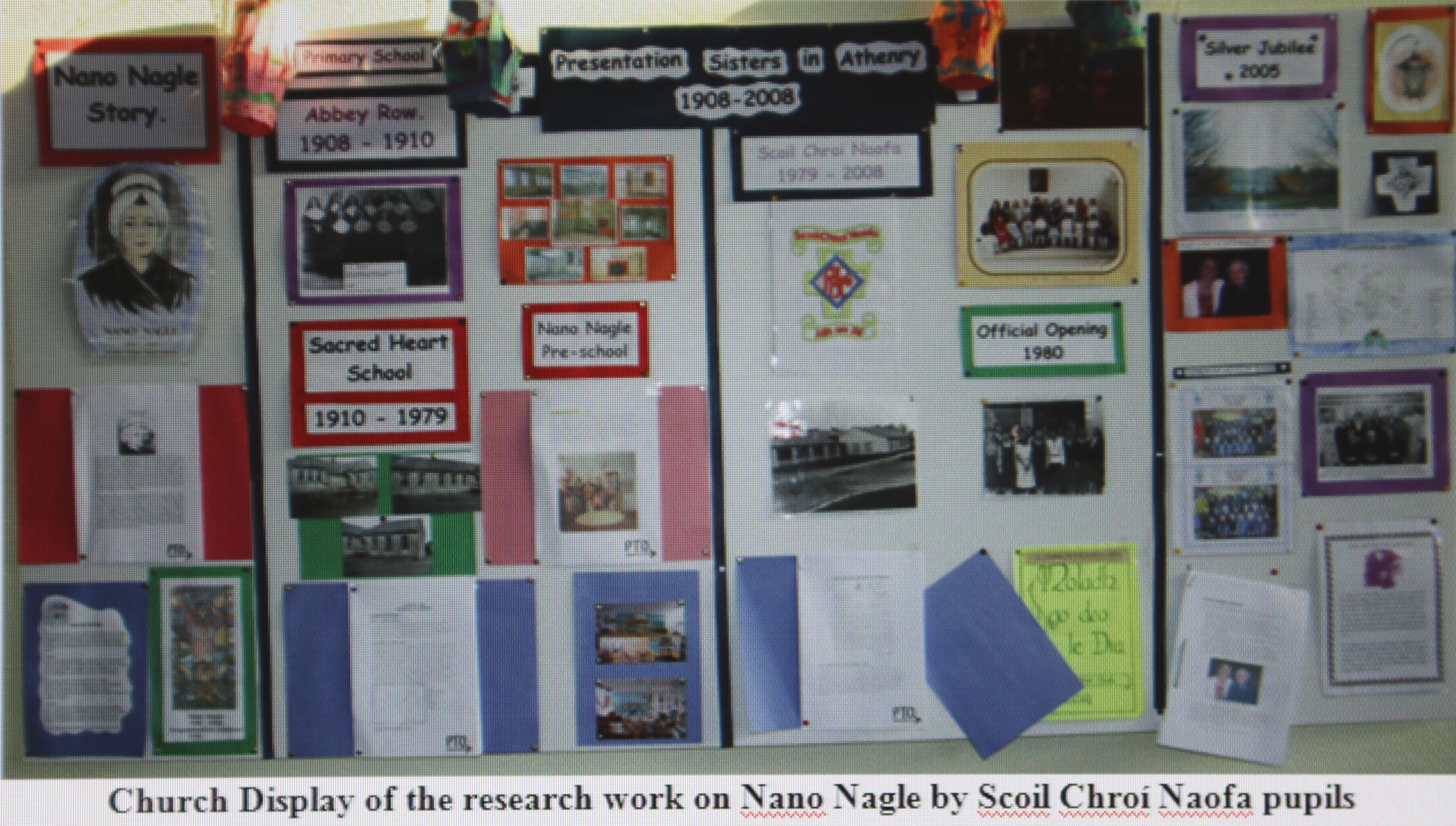
Church Display of the research work on Nano Nagle by Scoil Chroí Naofa pupils
MRS. TERESA NEYLON’S SPEECH AT CENTENARY EVENT ON 23RD May 2008
Lordship, Reverend Fathers, Presentation Sisters, Colleagues, and Friends we are all gathered here to celebrate, thank and congratulate the Presentation Sisters on the contribution that they have made to education and to the community of Athenry over the last 100 years. We owe an enormous debt of gratitude to the Presentation Sisters for their dedicated service to their work. I am going to speak very briefly about the following three points:
The History of the Presentation Sisters
Education in Athenry has a history. The Sisters have a very important role in that history.
Nano Nagle, foundress of the Presentation Order was first educated at home and also in a hedge school. The penal laws were in force at the time and Catholic children found it very difficult to get an education. Poverty was widespread. When Nano Nagle was 29 years she founded seven schools in Cork to cater for the most disadvantaged children. Against this background she founded the Presentation Order in 1775, which flourished to all parts of Ireland. Nano Nagle had two messages for her sisters: love one another and look after the poor. Her total dedication to God and the poor is her legacy to all Presentation Sisters.
In 1828 Catholic Emancipation was granted. As a result, the National School System was established three years later. However, it took many decades before every town and village had its own primary school.
The History of Primary Education in Athenry 1908 – 2008
The first primary school under the Department of Education in Athenry was built in Abbey Row in the late nineteenth century to cater for boys and girls.
However in 1908 the Parish Priest, Canon Canton saw an urgent need for a Catholic education for the children of Athenry. As a result he invited the Presentation Sisters to Athenry. First they taught in the primary school in Abbey Row.
In 1910 they moved to the Sacred Heart School. This became the first Presentation School. This school taught boys up to first class and girls up to 6th class. Some of these girls continued on to Intermediate Certificate Education level. During this time more and more children availed of primary education. They provided a school for many people who otherwise would not have been educated.
The school continued to grow. Two new rooms were built on. My father, Colman Moylan, built on the second room which is presently the premises for the Nano Nagle Pre-school for Travellers. Little did he know at the time that his daughter would be teaching in the Primary School a number of years later.
A new school called Scoil Chroí Naofa had to be built in 1980. In the new school the Presentation Sisters continued to provide children with opportunities in education and to enjoy a better life.
How the Presentation Sisters have contributed to the Athenry Community
They have made an extraordinary contribution to countless generations of people in Athenry over the last hundred years
They provided:
– A Religious education and moral framework for the children.
– An academic and a vocational education for the girls.
– The boys with a great foundation before they attended the boys’ school
– Extra help for weaker pupils in English, Maths and Irish
They put Athenry on the map by establishing a school band in 1974
They supported families who were suffering hardship
They visited the poor, the old and the lonely
They comforted the sick and the bereaved
They established a Pre-School for travellers in 1990.
They continued to support it financially until it closed in 2008.
They helped in the community, e.g. Meals on Wheels, and Soilse
They did much unseen work in the community
One of their greatest assets is that they prayed regularly for the community
The children remember their kindness with fondness on the following occasions:
– On the Feast of the Sacred Heart, the nuns gave the children tea and currant buns from Joe Whytes Bakery. In later years they received chocolate buns from Lydon House Bakery
– When the children received their First Holy Communion they were invited into the Convent for medals and treats
– When certain visitors came to the school e.g., priests, nuns, dentists, inspector, the nuns gave the children lollipops
Sr. Colette taught in the Sacred Heart School and in Scoil Chroí Naofa for many years. I’d like to share with you a Senior Infant perception of her – one of the pupils met her over a weekend and he asked his mother “why was Sr. Colette wearing her school uniform at the weekend?”
Conclusion
I was educated by the Mercy Nuns in Primary School and Secondary School. I also taught in the Mercy National School in Galway. In 1993 I got a call from the Presentation Sisters. During my 15 years in Athenry, I have witnessed how the Presentation Sisters have touched many people’s lives. We are all present here tonight to show them our appreciation, which they so rightfully deserve.
To conclude, Scoil Chroí Naofa has already marked the centenary of the Presentation Sisters in Athenry earlier this year with the production of a pageant of the Life Story of Nano Nagle. So on behalf of the Board of Management and staff of Scoil Chroí Naofa, I wish the Presentation Sisters health, happiness and continued success in their great work.
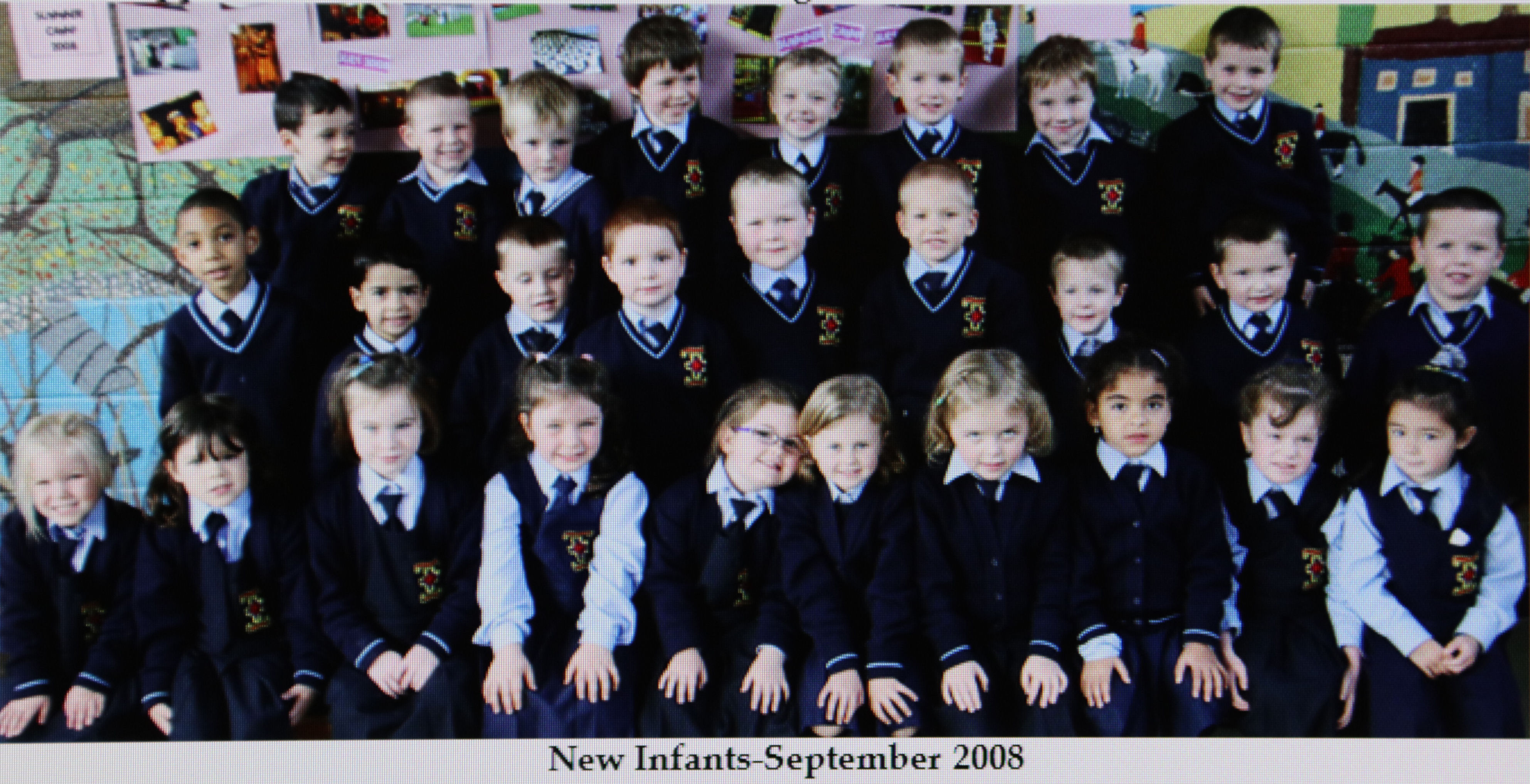
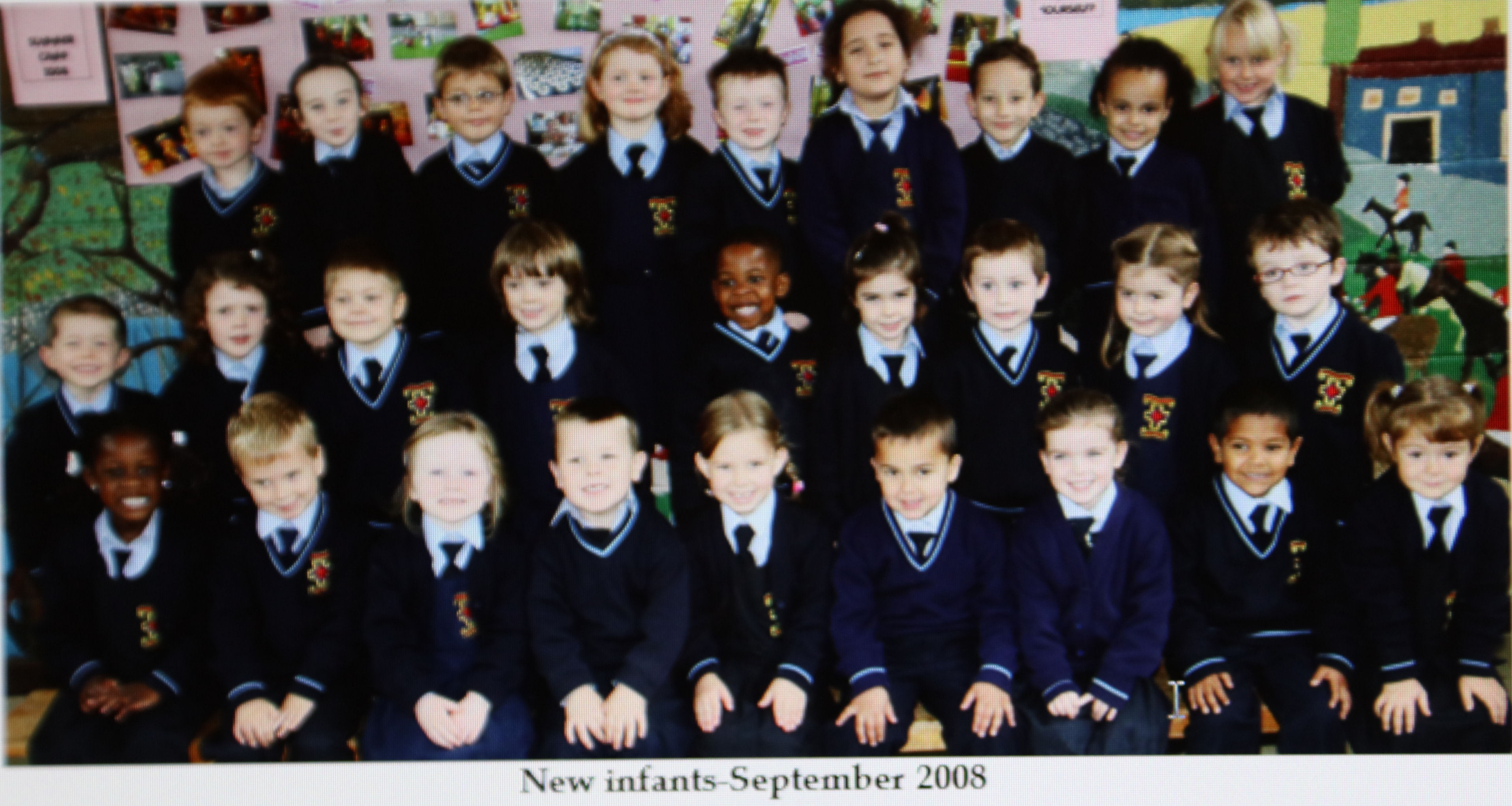
President McAleeese visited Presentation Convent to unveil the Centenary Commemorative Plaque on 30th October 2008

Scoil Chroí Naofa pupil, Annette Higgins presented a Bouquet of Flowers to President McAleese on her arrival at Presentation Convent.
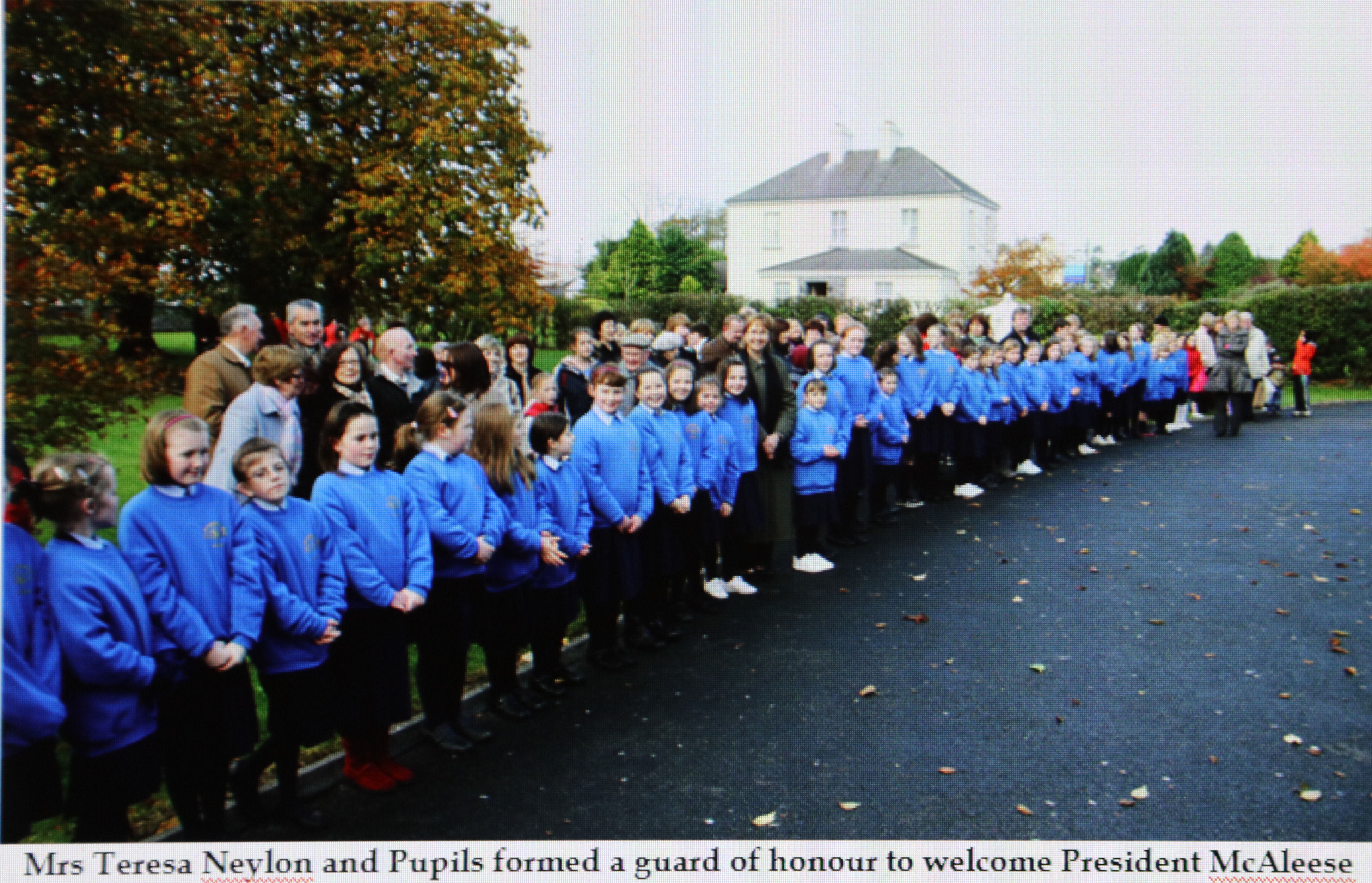

Members of the Board of Management 1975-1990
Christy Archer, Anne Cullinane, Patrick Ryan, Thomas McNamara, Mary McGovern, Mary Mullins,
E. Somers, Mrs Kearns, Mona Raftery, Bernard Farrell, Sean Ward, Norah Joyce, Sr. Eithne Cunniffe,
Sr. Genevieve Kilbane, Sr. Catherine Burke, Geraldine Costello, Maria Glynn, Paddy Lyons, Tommy Quinn, Anne Farrell Keane, Margaret Shanahan, Jimmy Flynn, Maud Hand, Eilish Galvin, Kathleen Quinn, Madelyn Brody, Joan O’Dwyer, Gerry Farrell, Martin O’Grady, Ned Waldron, June Barrett.
PARENTS’ COUNCIL SCOIL CHROÍ NAOFA
1992-93
Geraldine Connolly Peggy Healy Nelly Lynskey Margaret Cotter
Noreen Kelly Breda Burns Owen Hession Mary King
Mary Doherty Geraldine O’Dowd Geraldine Ollerenshaw Mary Ryan
Kathleen Commins Nuala Daly Kathleen Bane Ann Melia
Leister McNamara Marie Gardner Teresa Ryan Carmel Barrett
Trudy Treacy Teresa Coffey Moira Coen Claire Noone
Martin O’Grady
1994-1995
Bernie Mulkerrins Pearse Coffey Luke Moran Tadhg Costello
Ciarán O’Keeffe Midge Glynn Brigid McGowan Carmel Burns
Michael Kennedy Maeve Kilkelly Gearóidín Ní Bhrosnacháin Phil Donohue
Pauline Molloy Seán Mannion Marie Murphy Donna Nedrick
Christine O’Reilly Helen McNamara
1996
Bernie Dempsey Mary Sheridan Seán Lawless Geraldine Hession
Margaret Scully Eoin Baxter Orla Delaney Marie Quinn
Rita Melia Bernie Goya Gerry Ryan
1997-1998
Pat Callanan Patricia Lonferme Linda Devally Ann O’Dwyer
Rosaline Devally Georgina McHale Marie Murphy Mary Cullinane
John Eagle Brigette Corcoran Catherine Freeney Fiona Duane
Breda Gibbons Carmel Mitchell Patricia Foran Bernie Dempsey
1999-2000
Nora Coffey Sylvia Ryan Patricia O’Grady Claire Lundon
Mary O’Gorman Trevor Tuffy Madelyn Brody Tom Lane
Michael Donnellan Barbara Coyne Teresa O’Brien Patricia Cantwell
Veronica Gaughran Connie Albracht Suzanne Houlian Angela McGoughy
2002-2003
Bernie Ryan Fiona Kelly
We are indebted to the authors of ‘Primary Education in Athenry-Scoil Chroí Naofa Silver Jubilee Book 1980-2008’ for extracts for this part of the story.
Athenry 2000-2008
This decade began on a terrific sporting highlight with St. Mary’s GAA club, Athenry claiming the All Ireland Club Championship for the second time. Athenry Musical Society staged ‘Fiddler on the Roof’ to packed houses, while two new clubs started: for the youth, Athenry Foróige and for older citizens, Athenry Active Retirement Association.
The events of 2001: or that should be the non-event of the year was the cancellation of the Agricultural Show due the outbreak of foot and mouth disease in Britain; Athenry retained their All Ireland Hurling Club title; the construction of the Brothers of Charity Day Centre in Raheen; the beginning of the linking of Athenry to the Tuam regional water supply and the formation of Athenry Bowling Club.
2002 saw the introduction of the Euro currency. The town got a Community Warden. Athenry Golf Club celebrates its centenary. Athenry Athletic Club was reconstituted and the parish won the All Ireland Community Games Camogie Championship.
January 2003 saw the launch of the book ‘Eagles Over Ireland’ by Paul Browne in Mellows College.
2003 was European Year of the Disabled and Soilse, in commemoration, planted an oak tree in the Raheen grounds of the Brothers of Charity.
The Church of the Assumption was re-roofed. Athenry town twinned with Quemperle, Brittany. Athenry Cancer care centre was opened by Tommie Gorman and Galway East Tourism was launched to promote the regions attractions. Down in Moonbaun, Athenry Soccer club opened its state of the art gym and clubhouse.
2004 kicked off with the production of ‘My Fair Lady’ by Athenry Musical Society. Former PCA student Peter Feeney was elected to Galway County Council, and the contract was signed to develop the old Railway Hotel into the new head offices of County Galway’s Vocational Educational Committee.
President MacAleese came to open Athenry I.T. centre in the ADC premises on Station Road, and, to the delight of motorists, Galway County Council introduced a one-way traffic system. During the summer, the parish children played in their new Playground beside the Clarin River.
Galway County Council paved part of the medieval Square in 2005. The next year Gael Scoil Riada opened its doors to pupils in the Raheen parish grounds. ‘Primary Education in Athenry-Scoil Chroí Naofa Silver Jubilee Book 1980-2008’ was launched.
2006 saw Athenry Parish Project Society initiate the first proposal to conserve and enhance the Medieval Walls of Athenry, and later that year a steering committee was formed to develop a Conservation and Management Plan for the Walls.
Construction of the new Galway to Dublin motorway started at Mellows College in 2007, and excavations at Prospect revealed the Loro Gate foundations.
All during 2008, hundreds of heavy lorries carrying material for the new motorway thundered from 7 a.m. to 7 p.m. through and around the town.
A Last Walk through the Old Convent National School in June 2008
By Mary Keary

Having heard that the Old Primary School was soon to be demolished, I arranged with others to view it for the last time. The ninety-nine lease to the Department of Education was up in 2008.
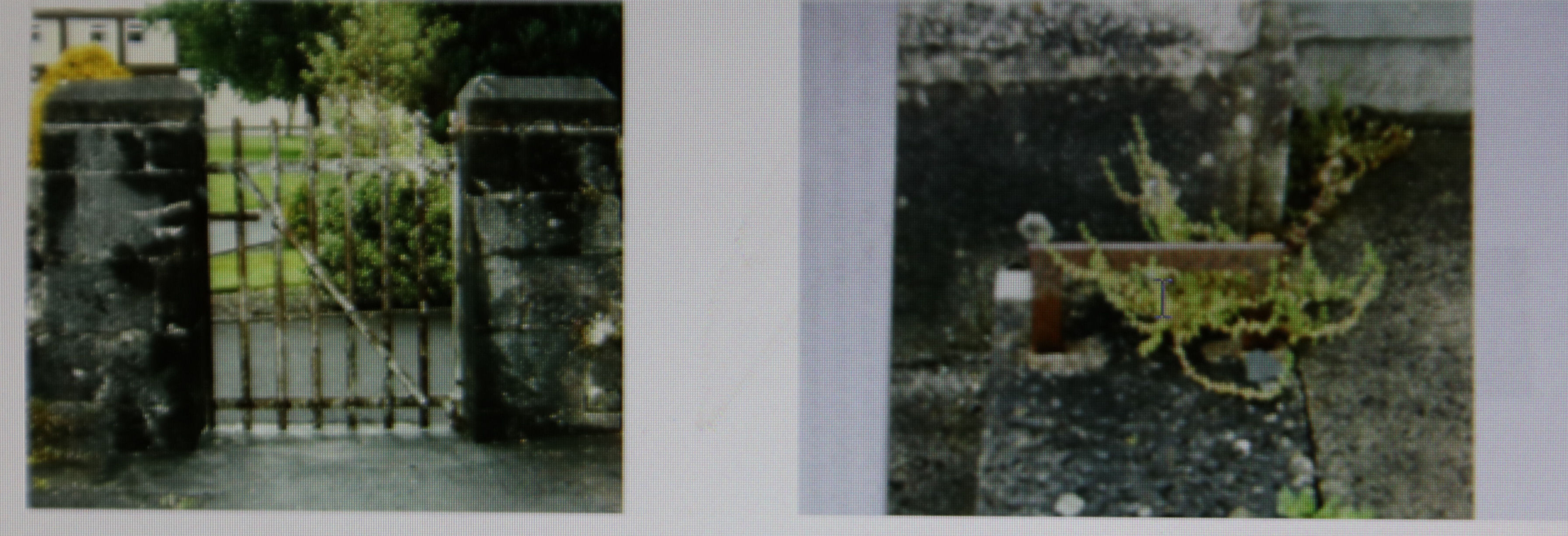
Waiting for the keys, we walked around the now boarded up and locked school. The small silver gate; the shoe/boot scrapers were still in place outside all doors; the outside toilets were long gone but the shed wall was still there beside the Old Tower of the Town Walls.

I entered, armed with flash light and camera through the ‘New Room’ door into the small corridor between the fourth/fifth classroom and into Sr. Agnes’s Sixth Classroom – blackboard still in place. The red brick fireplace and wooden windows were as I remembered them over fifty years ago. We went out to the small corridor, the latch still on the door leading to Sr. Columbanus’ room where I spent fourth and fifth class. The rostrum and high chair were gone, as well as the corner shelf where of Our Lady’s statue stood. The wainscoting and the original wooden floorboards were still in place. Also missing was the press where we found the mercury one wet lunch time – it spilled in shiny bubbles around the floor only to make smaller ones as we tried in vain to sweep it up. The folding doors to Sr. Baptists’ Second Class Room and Third Class were gone; all partitions as far as Sr. Dominic’s Classroom were long removed.
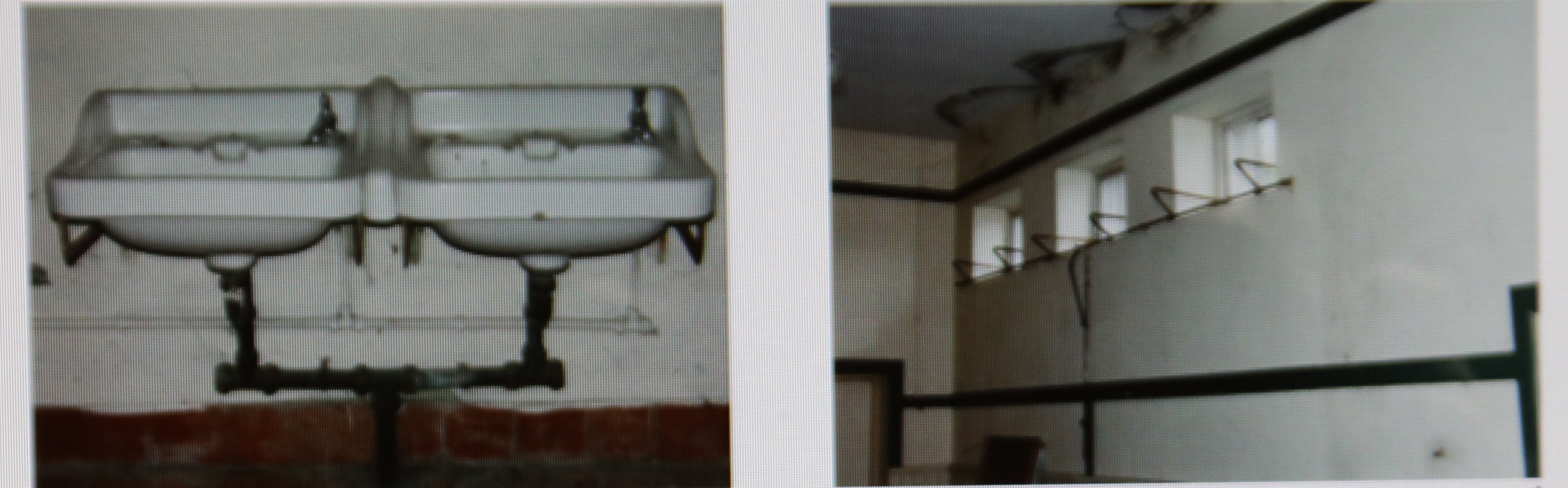
We went out the door into the long corridor – the double white sinks, where the ink was made by reliable students was still there outside the cloakroom. Down the corridor and there was the green door to Sr. Dominic’s First Classroom and inside the closed up fireplace.
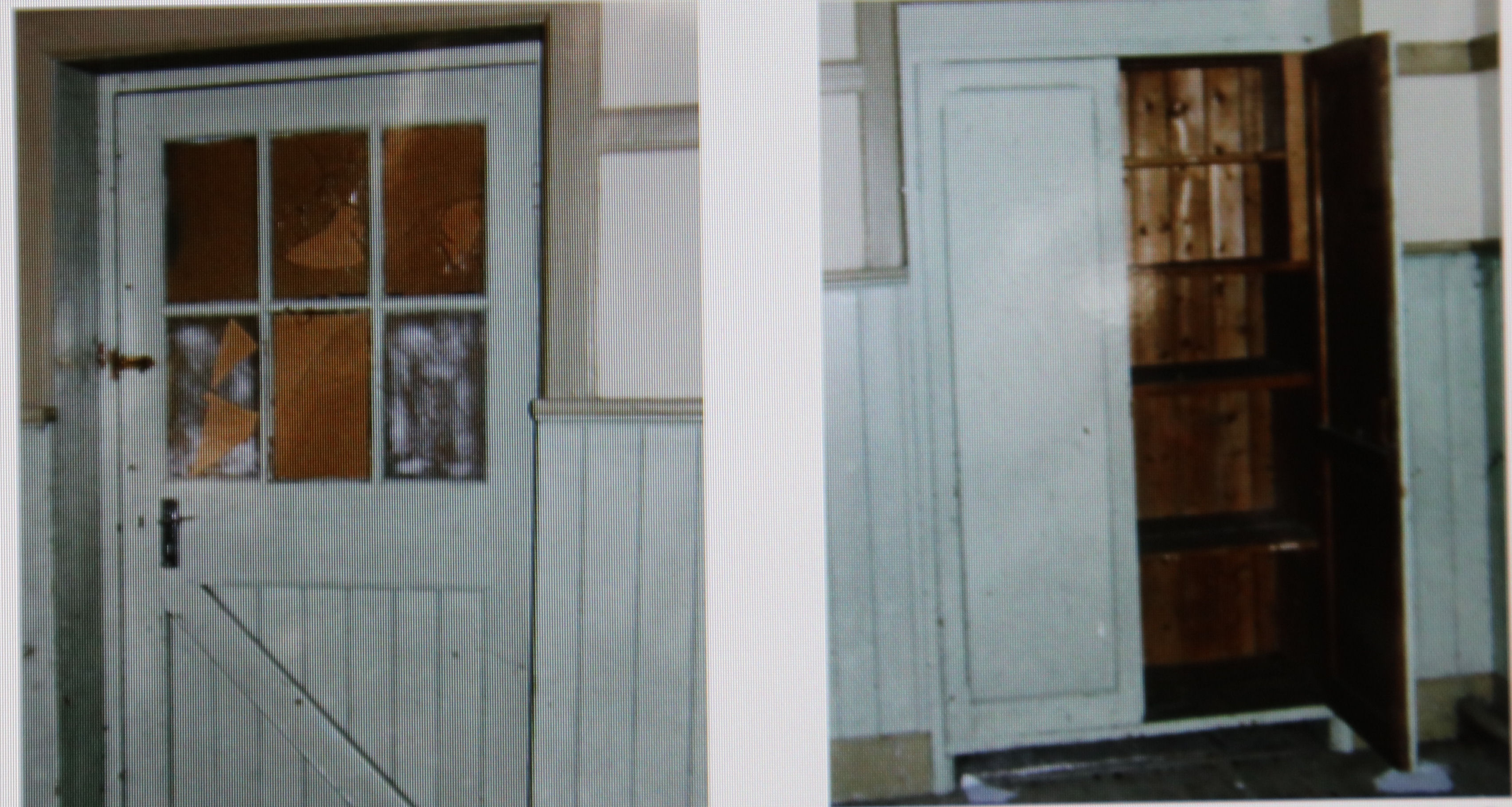
Next we went to Sr. Celestine’s room where I spent my first day in school in September 1949. I delayed – took a long look at the door with its six glass panels that led into Sr. Dominic’s room-old floor boards, blocks where blackboard was mounted, the old ‘copy’ press, the red brick fireplace, wainscoting, the twelve paned windows – top three opened by pulley, old white plastic light shades on the six hanging lights – floods of memories.
Then it was out to the corridor with its three white sinks and the cloakroom – now empty of the numbered iron double-coat hangers. My last visit was all over!
On 30th October 2008 President Mary McAleese landed by helicopter on the level site when she arrived to unveil a plaque…….