APH
APH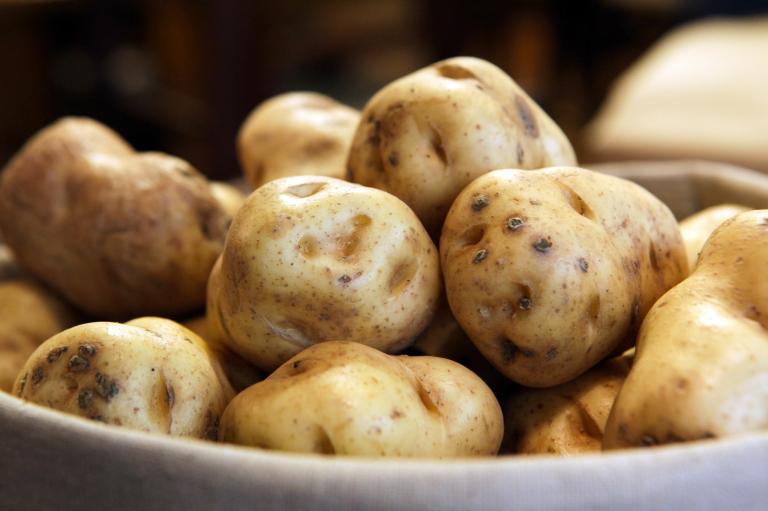
ATIIENRY FARMERS’ CLUB
At the late monthly meeting of the Athenry Farmers’ Club, the Rev. Mr. Perrin in the chair, Mr. Irvine read a paper on “The Growth and Cultivation of the Potato Crop,” which went to prove that drill system is the most economical mode of cultivating the potato crop. We make the following extract from the Report of the proceedings, in the Galway Express to show the writer’s estimate of the relative expense of the lazy bed, or ridge culture, and the Drill system advocated by him.
” In the spring of each year, and particularly in the months of March arid April, wherever the traveller directs his steps throughout this country, he sees our peasantry toiling hard in the preparation for, and planting their potato crop, which, allow me here to say, they depend too much on as their staple food ; but there they are men, women, and children, busily engaged spreading seaweed (a very expensive manure when cartage is far), and spreading a dry dusting of guano, that robber of our country and stimulant of indolence, that yearly drains from the peasant the money his own industry, when rightly directed, would effectually prevent. See the peasant further tolling hard with an implement called a loy, which, did time and opportunity permit, we could easily prove more fit to become a schoolboy’s toy than a suitable implement in the hands of an able labourer. When spade work is at all to be done, much more can be done, and with greater ease to the well-trained and hardy labourer, by his having a good, well-made spade in his hand; but the fruits of this we will not now continue. From what we have said you will all anticipate that spade, or what is generally termed lazy-bed culture, is that most adopted amongst us, and which, I will endeavour to prove, is not the most economical method, but is the most expensive and least profitable. In other words, is the very reverse of what the farmer aims at.
” To cultivate the potato properly and profitably, the growers’’ first look out, after be is provided with suitable land, is to provide suitable manure, which we once showed in this room could be plentifully made by himself. No matter what size or extent of holding he possessed, by proper management, combined with a little energy and industry, he will have thereon sufficient materials to enable him to provide abundant manure for all the crops he requires to grow. Having thus provided his manure, his next step is the preparation of the land to receive the crop. Here we must stop to say that where very old lea is to be broken, if not in sufficient heart to give a good grain crop, or when any rough or heathy land is to be broken up and brought into cultivation, there is no better method of doing so than by spade culture of the potato crop, and land of this kind would be the only exception on which the use of guano could be supported. The course next to be pursued, which is, to make the land into drills not less than thirty inches apart, and so light, that when the manure is put into them the seed or sets, when placed on it, will be as near as possible on a level with the even surface of the field, then plant the potatoes at from ten to twelve inches apart in a straight line, in the centre of the drill; cover with the drill-plough, taking care to run the plough in the centre between the rows of sets, so that the buds or tops will be right in the centre of the formed drill when coming up. In the growing of the potato to perfection lime is a useful and valuable adjunct to the land, and at this stage of the cultivation is a good time to apply it. A cart will easily pass without injury along the hollows of the drills, so as to drop the lime in quantities at given distances for a given number of drills, according: to the quantity per acre to be applied. When slacked and evenly spread over the drills, before the chain or saddle harrow would pass over them, so that it would be in the following operations well mixed into tbc soil, and would have in this way the advantage of being kept near the surface, which is a more essential point in the application of lime to land ; but whether limed or not, in about ten days or so after the seed has been planted and drills covered, the tops should he lightly harrowed off them cither with a saddle harrow, which is made for the purpose, or with a chain harrow, which, I believe, is the best for the purpose, or with any light grass harrow having short pins, or a common harrow inverted, or what I have seen on more than one occasion, just a flick laid across two drills, and thus drawn along the tops, which it levelled wonderfully well; but an implement that will stir the earth of the sides of the drills, as well as the tops, answers best, because it more effectually prevents the growth of weeds.
We will just for a moment, count the cost, first of the lazy-bed system, which I need not describe, it being so general, and secondly, of that we recommend, and will crave your marked attention, and beg you will correct me hereafter if I err in my estimate of the cost in any particular of either system. For example sake, we will take an Irish acre, which I assume is stubble land in each case, and will require culture, etc, as follows:—
First-Ploughing into ridges £10 10 0
Harrowing 0 2 0
Manure, as usual in this County,
viz. 6 cwt Peruvian Guano,
14s per cwt. (credit price) … £4 4 0
3 boats Seaweed at £4 10 0per boatload £13 10 0
Seed-100 stones, at 4d per, £1 13 4
Planting say 18 men at 1s 6d £1 7 0
Cutting and laying seed, 6 0
Second spitting-12 men at 1s. £0 12 0
Weeding—say an average, £0 10 0
Digging 25 men at 1s £1 5 0
10 women at 8d 6 8 £1 11 8
Or a total cost per acre £13 6 6
The average produce of which I calculated at 15 barrels of 6 stones per barrel, or 6 tons of sound potatoes, and about 2tons of black ones, which calculated at £2 5s per ton, being about the highest price they would bring on an average of seasons When dug and just as they are dug without sorting, and black as deceased ones at 10s per ton. This gives the value of the crop to be £14 10 and the cost of producing it £15 6s 6d leaving the grower a loss of 16s 6d besided the rent of his acre. The whole crop thus cost him 4d per stone, and the rent of the land after. I am perfectly well aware that in many cases a much larger expense is gone to in manures -, especially when the grower has to pay high for the cartage of the seaweed, and that higher wages are paid in many cases. But against that I am also aware that in a large majority of cases a great deal of the labour is due to the grower’s own family, and is therefore not to he paid for in hard cash; so that I put it down so low that it cannot fail to be seen although the grower does not actually lay out his cash for the work done, he certainly loses equal to the amount I put it down at. And on the whole, I consider I am rather under the estimate of the actual outlay. Cut I make it so low that even the rudest calculator would see that his outlay was equal to, if not over my estimate, and thus the better to impress on their minds the necessity of trying a less expensive mode of cultivation.
Having thus seen what I consider a plain and glaring truth regarding the potato culture as pursued by our peasantry, who are consequently dragging out a miserable existence, never thinking of the sum their potato crop costs them, nor even dreaming that for the same, if not a less cost, they could provide themselves with a better and more substantial food, let us now see what our drill-culture will cost, the items of which I calculate as follows:-
Ploughing £0 12 6
Harrowing – £0 5 0
Grubbing and Harrowing £0 12 6
Picking off Scutch, etc £0 7 6
Drilling, including opening and closing £0 7 6
Seed 60 stone, at 4d. per £1 6 8
Manure, viz. carting out 160
loads dung £2 4 0
3 cwt_ Bone Superphosphate £1 4 0
Spreading Dung, etc £0 7 6
Cutting and laying Seed 5 0
Harrowing tops off Drills £0 2 0
Trench Ploughing Alleys and earthing up £0 12 0
Second earthing up £0 5 0
Weeding £0 5 0
Grubbing Drills before digging £0 6 0
Digging, viz.15 men at 1s 2d. £0 17 6
10 Women at 3d. £0 6 6
Or a total cost per acre of £9 3 4
The average yield I calculate 8 tons of sound and 2 tons diseased potatoes, which, calculated at our previous prices, gives a return of £10 per acre, which is no extraordinary yield. I have myself, for the past few years, sold portions of our potato crop, grown exactly according to a these descriptions, for £19 per acre and the buyers to dig themselves who have often told me that they had the potatoes for £2 per ton, and the black ones to pay the digging. Eight tons as in average produce in good drill culture is a low estimate. I have often seen 10 tons—and in some cases 12 tons, and even more. Besides this increase in yield in drill culture on the lazy-
bed culture, the potatoes are of a more regular size, much fewer small and unmarketable ones, and have less proportion black or diseased. I am sure, most people who grow potatoes, will have remarked in digging lazy-beds, that the row next the brows of the beds are always sounder than those in the middle of the ridges, and that they are also larger in proportion. Any who have not already noticed this, if they pay attention to the digging next year, I have no doubt but they will find it to be the case and as every drill becomes exposed in itself as the brow of a ridge is a good argument in favour of drill culture, and on which we may hereafter endeavour to explain more clearly. However, from a comparison of the two modes and their relative expenses and remuneration, 1 think it is easy to arrive at a conclusion