APH
APH
Henry George Arrest at Athenry (1882)
Part 2
The following Appeal to the President of the United States by Mr. Henry George was published on the front page of The Washington Post on Sept. 17, 1882. It is an account of his experience of his encounters with the RIC in Loughrea and Athenry. The letter was filed at the White House by Mr. J. Hale Sypher, along with a communication from Mr. Sypher himself, in which he, as representative of Mr. George’s friends, bespeaks early consideration by the Executive of the history of Mr. George’s wrongs.
The following is the text of Mr. George’s letter:
Dublin, August 26, 1882
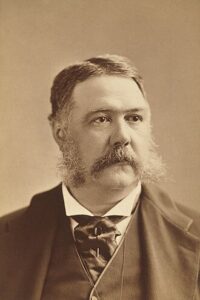
To Chester A. Arthur, President of the United States – Mr. President. I desire respectfully to call your attention to annoyances and indignities to which citizens of the United States travelling in Ireland are exposed, and for the purpose to state my own experience.
I am a citizen of the United States-born in the State of Pennsylvania-and long a citizen of the State of California. I landed first in Ireland on the 25th day of October, 1881, and have, in all parts of the dominions of the Queen of Great Britain and Ireland that I have visited, conducted myself in a lawful manner.
On the 9th instant I started from the city of Dublin for the west of Ireland for the purpose of seeing the country and informing myself as to the condition of the people. Immediately upon my arrival in the town of Loughrea, in the County of Galway, at about six o’clock in the evening I was seized by the Royal Irish Constabulary and carried to the police prison, where, in spite of my declaration that I was a citizen of the United States, of reputable character, travelling through the country without criminal intent or unlawful purpose, I was held a close prisoner for about three hours, during which time my baggage and person were searched, and all my letters and papers minutely examined by a number of constables. Finally a magistrate-to wit, Resident Magistrate Byrne-was brought. The sub-inspector of constabulary declared to him that he had arrested me upon telegraphic information that I was a suspicious stranger, but my request to be informed of the source of the information and ground of suspicion was refused. The sub-inspector further stated that nothing suspicious had been found upon my person or in my effects. The magistrate upon this discharged me from custody.
I thereupon protested to the magistrate against the imprisonment and indignity to which I had been subjected as unprovoked, unnecessary and unreasonable, declaring that if any suspicion had been entertained of me I should have been given reasonable opportunity of clearing it up before being arrested, imprisoned and searched.
On the following day I left Loughrea and proceeded to Athenry, a town only a few miles distant in the same county and within the district of the same police inspector and the jurisdiction of the same resident magistrate. I stayed there for the night and having during the next morning visited the antiquities of the place, was about taking a train to proceed to the town of Galway, when I was stopped by a sub-inspector of the constabulary and questioned as to my name, nationality, business, from whence I had come, whither I was going, etc. To all these questions I gave true answers showing that I was an American citizen, of reputable character, travelling upon lawful business. Nevertheless, I was not permitted to take the train, but was placed under arrest, carried to the police barracks and my clothing and luggage again searched in the same manner as at Loughrea, notwithstanding the fact that my arrest, search and discharge at Loughrea were well known to the constabulary at Athenry ; and although I demanded to be taken promptly before a magistrate, I was detained a close prisoner until the same magistrate before whom I had been taken at Loughrea had arrived at Athenry in the evening, and then I was not discharged until nearly midnight and after a long, frivolous examination, having been restrained of my liberty for about ten hours, and compelled, owing to the running of the trains, to lose nearly a day in my journey.
The wantonness of this second arrest and imprisonment will appear not merely from the fact that my arrest, search and discharge at Loughrea were well known to the constabulary at Athenry, but from the reason for my arrest given to the magistrate by the sub-inspector, who deposed that he had arrested me because I had, in the town of Athenry, associated with suspicious persons, and who, in proof of this, brought forward two constables who testified that they had seen me visiting the ruins of an old abbey in company with the Rev. Father MePhilpin, the Catholic curate of Athenry, and an English gentleman, James Leigh Joynes, of Eton College; and also that they, had seen me entering the shops on the main street where I had gone to make a small purchase, and which they averred were the shops of “suspects,” i. e., persons who had been imprisoned on suspicion of having committed a certain crime peculiar to this country, to wit, “of having encouraged divers persons to incite other persons to intimidate certain persons from doing what they had a legal right to do.”
I would not, Mr. President, think of addressing you on this subject were my case an isolated one, as then it would merely show an abuse of power by certain officials, But, on the contrary, such cases are constantly occurring, and many American citizens have already, in various parts of the country, been subject to similar and even to much worse indignities and hardships-and this evidently not by accident, but because of being Americans; for while it is true that the masses of the people of these islands entertain toward us those feelings of friendship which it is to be hoped may always exist, it is at the same time notorious that by some local officials in certain parts of Ireland an American is regarded as peculiarly a subject for suspicion and annoyance,
I fully realise, Mr. President, that it is the duty of an American citizen in a foreign country to conform his conduct to the laws of that country, and that he cannot expect exemption from such police regulations as its Government may deem necessary
But at the same time, I submit to you that it is due to their own dignity that the United States should claim for their citizens travelling in countries with whichcthey maintain relations of amity, exemption from wanton annoyances. unreasonable inquisitions, and imprisonment upon frivolous pretexts.
Yet I regret to say that the belief prevails here that the United States take no interest in the treatment of their citizens in foreign parts. American citizens have been imprisoned here for long periods without trial, and ever without specific accusation, on the mere suspicion of just such officials as those of whom I had experience as before related, while the only action taken by the United States in the matter, so far as known and currently reported here, is that the American Consuls have visited these imprisoned citizens and attempted to bribe them by offers of money into acknowledgment of the justice of such arbitrary imprisonment by agreeing to leave the country as a condition of release. The contemptible position in which the United States have been placed in the eyes of the people of this country may be well imagined, but is not a pleasant thing for an American citizen to portray. Having discharged what I deemed to be my duty in laying these facts before you, as Chief Executive of the Nation, for such consideration as you may deem it your duty to give them, I am, Mr. President, most respectfully your fellow-citizen,
Henry George
PS. Insomuch as since I have been in Ireland mail matter of mine arriving from the United States has been detained in the Irish Post Office, and, as I have been credibly informed, opened and burned, though all official information in relation thereto was refused me; and inasmuch as it is the belief of many of the subjects of her Majesty the Queen of Great Britain and Ireland that their letters are tampered with in her Majesty’s Post Office, I take the precaution of sending this to the United States under cover, where it will be mailed to you.
British Government Apology
The Nation, 11 November 1882
The Recent Arrest of Mr. Henry George
The following letter has been received by Mr. Henry George from the American Secretary of State in reply to the letter addressed recently by Mr. George to President Arthur :-
Washington, October 17.
Sir-The Department of State has received from Mr. William J. Hoppin, Charge d’Affaires, ad interim, of the United States as London, a despatch enclosing a copy of a note from Lord Granville to him, dated the 27th ultimo, in which his lordship says that on the receipt of Mr. Lowell’s note in reference to your arrest he lost no time in applying to the Lord Lieutenant of Ireland for an explanation of the circumstances which led to it. After mentioning your arrest, your re-arrest, and the circumstances alleged to have been calculated to excite suspicion as to the object of your visit to Ireland, Lord Granville says :- “I am convinced that the United States Government will readily acknowledge that considerable allowance must be made for the difficulties with which the officials charged with the preservation of order in that country have to contend at the present time. Nevertheless, in view of the information furnished by Mr. Lowell as to the character and pursuits of Mr. George, which certainly rebut any presumption of unlawful design on bis part, I can only express to you the regret of her Majesty’s Government that this incident should have occurred,” Let me add, Mr, George, that it would give me pleasure to have an interview with you at this Department at your convenience .- I remain, sir, your obedient servant,
Frederick T. Frelinghuysen