APH
APH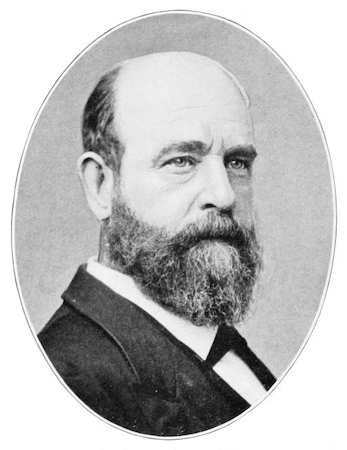
Henry George Arrest at Athenry (1882)
Part 1
Introduction: Henry George
Source: ‘Progress and Poverty’ – Henry George and Land Reform in modern Ireland, The Irish Story, Irish History Online.
Author: Barry Sheppard
A native of Philadelphia, Henry George was born in 1839 into a lower-middle class family of English and Scottish heritage. As many young men of his generation, he left school at an early age to seek a fortune. He boarded a trading vessel which sailed to India, where his experiences in Calcutta witnessing large scale overpopulation and poverty would help form his later theories on the need for international land reform.
His journey terminated in San Francisco at the age of 19. It was in that city he tried his hand at a number of careers before eventually finding his voice as a journalist for The San Francisco Post and The San Francisco Times. During his time working on these newspapers he witnessed the treatment of migrant railroad workers as well as land-grabbing practices of the railroad tycoons themselves, this too contributed to his land reform ideas.
George’s land reform ideas came to the fore with the publication of Progress and Poverty in 1879 and his Single Tax on Land Theory. George held that the ownership of the soil belongs inalienably to the whole community, due the fact that it was created for all by God. With the use of the land under the provision that the tenant (with fixed tenure and right of transmitting to others) pay a tax on the land he uses to the community (viz., to the State) representing the natural productivity of that particular piece of land plus the extra value it may have acquired owing to adventitious causes other than the labour of the occupier.
The book was slow to catch on in San Francisco, so making a move to the East Coast George hoped to find a more receptive audience. It was here that his association with Irish Land Reform began. George had a long-standing interest in international land reform as he saw land monopoly as knowing no borders.
During this period George met Michael Davitt who was in the United States on a fundraising exercise on behalf of the Land League. Davitt was intensely interested in George’s ideas and promised to do what he could to push the sale of Progress and Poverty in Britain.
His association with Ireland would become more prominent, for in 1881 for a period of a year George was sent to Ireland to cover the Land War for The Irish World newspaper.
During his period covering the Land War, George was asked to speak at a number of events. One such event was to endear him to the Irish cause of the time. On 21 November 1881 he spoke on ‘Land and Labour’ for the benefit of the Political Prisoners’ Aid Society at the Round Room, Rotundo, Dublin.
This speech was warmly received, and was reportedly such a success that the committee of management were able to hand over to the funds of the society ‘a handsome contribution’. Publicity of this kind had placed George firmly in the inner-circle of the Irish land debate of the time. His reputation as a friend to the Irish people was further enhanced when was arrested by the Royal Irish Constabulary (RIC) on his journey from Dublin to the West of Ireland in Loughrea and Athenry.
The arrest generated a considerable amount of publicity on both sides of the Atlantic, with George penning a letter to the then President of the United States, Chester A. Arthur.
George informed Arthur in the letter (which he had smuggled out of Ireland due to claims that previous correspondence had been intercepted and even burned) that he had been travelling from Dublin for the West of Ireland ‘for the purposes of seeing the country and informing myself as to the condition of the people’, when he was arrested and temporarily detained on two separate occasions over a two day period.
Vociferously protesting the treatment he received at the hands of the Irish constabulary, as well as that of other American citizens who had ‘been imprisoned here for long periods without trial, and even special accusation’, he caused considerable embarrassment to the British establishment. A British civil servant swiftly contacted the United States Government to express regret that the incident ever occurred. A letter from the US Government containing the British apology was reproduced in The Nation on 11th November 1882, and was a publicity boon for the Land League.
Henry George was accompanied by an English gentleman, Mr. J.L. Joynes, Master of Eton College when he visited Ireland. Joynes’ account of his travels, A Political Tour of Ireland, was published in the Times September 4, 1882, causing great scandal in Etonian circles. When Eton College’s, learnt of his plan to publish his book The Adventures of a Tourist in Ireland, he was given the choice between remaining as a Master or leaving for his beliefs, he left Eton.
Source: The adventures of a tourist in Ireland, Kegan Paul, Trench & Co, 1882
Author: James Leigh Joynes
CHAPTER I
VISIT TO THE LADIES’ LAND LEAGUE, AND ARREST AT LOUGHREA
…….So with Loughrea as the goal of our day’s journey we took tickets for Ballinasloe, intending there to leave the train and drive across the country. We travelled with a labouring man, who had gone over to England for the harvest, as he could there earn 4s. a day, in place of the 1s. which was the remuneration for his day’s work (that is, when he could get any employment) at home. I wondered whether this could be called idleness, yet the landlords say that the labourers are idle, and the landlords are honourable men. This particular labourer, whose fine, intelligent face struck me very much, had been obliged to return to his home before the end of the harvest, having unfortunately fallen over a scythe and inflicted a terrible wound on his leg. It was a mystery to me how he could walk at all, and he was evidently in great pain ; but he had tied up his wound with a handkerchief in a miserably clumsy fashion, and to my horror said that he had seen no doctor, and would not do so until he reached home, miles beyond Westport, the last station on the line. His foot and leg were a dreadful sight, but he had wished not to waste on himself the money earned in harvesting, which he had intended for his wife and children on the other side of Westport. This did not look like wastefulness or extravagance; yet the landlords say the tenants are wasteful, and the landlords are all honourable men. I wished that I had gone through a course of ambulance lectures, and learned something of surgery ; but I could do nothing beyond making the man promise to have his leg bandaged at Westport, and presenting him with a fee for the doctor there. He was not even smoking to divert his thoughts from his pain, for tobacco cost money, and that he wanted for his wife; so George gave him a cigar, which puzzled and amused him considerably, as he made vain attempts to smoke it without cutting off the end, his former experiences of smoking not having gone beyond a pipe.
The train stopped at a great many stations, and at every station there were a great many police on the platform, assisting, as far as their presence went, at the arrival and departure of every train. This they always seem to do at the smallest stations in the most peaceable districts ; in fact, they are an all-pervading presence, and no picture of Irish scenery gives at all a correct impression unless the finest house in the foreground is a police barrack and the landscape is well peopled with constables. The only occasions on which they are conspicuous by their absence are those on which the long-suffering peasants retaliate on their oppressors by some dreadful agrarian outrage. With these unfortunate exceptions they may be said to be always on the spot ; but as with these identical exceptions Ireland is practically free from crime, it would seem to an outside observer that the large sums spent in maintaining in idleness this army of able-bodied policemen are rather more uselessly wasted than if they were thrown into the sea, where they would not serve to irritate the people against the Government by keeping up a perpetual system of petty tyranny in their midst.
Be this as it may, however, we were carefully scanned by several members of the Royal Irish Constabulary as we alighted from the train at Ballinasloe, and proceeded to order a car to drive over to Loughrea. Indeed, extra vigilance in connection with railway passengers had lately been instilled into their ranks, for there was an exhibition of Irish manufactures shortly to be opened in Dublin, and no one could tell what desperate characters might be enticed from the country to the capital by an exhibition which was patronised rather by the Land League than by the lawful authorities. So the lawful authorities, by a judicious exercise of their characteristic tact, had issued an order to the police in all the country districts to furnish them with the number, the names, and the political opinions of all persons about to visit Dublin ; and hence a specially eager inspection of trains on their part, extending even to those passengers who were outward bound.
Ignorant, however, of the suspicion our appearance was exciting, we ordered some lunch at Ballinasloe (although it was obvious to the police that, if we had been really bent on any honest business, we might have brought it in our pockets from Dublin, and eaten it, without delay, in the train), and while the car was being got ready and the horse fed, we went, under the very noses of the watchful police, to call on Mr. Matthew Harris, then residing in the aforesaid village of Ballinasloe. Now this Mr. Harris was well known to the police as one of the traversers in the famous State trial along with Mr. Parnell and other bad characters of that description, so that any doubt which the police might at first have had of our object in visiting these dangerous districts was finally dispelled ; but, as they had no inspector at hand to direct their movements, they decided that it would be as well to throw all responsibility on the authorities at Loughrea, and accordingly telegraphed the news that a couple of desperate ruffians were coming, and that the Loughrea police must assemble in force and play the men on their arrival.
We, meanwhile, were having a most interesting talk with Mr. Harris, who held strong opinions about the state of the country and the responsibility of the landlords for its disturbed condition. He told us that in our drive of nearly twenty miles to Loughrea we should hardly pass a single house, for grazing was now more profitable to the landlords than agriculture, and they had therefore exterminated the inhabitants in order to add a few pounds to their rents. This had happened more than once in the history of the country, and the culture had been changed from corn to grass, and vice versa whenever a profit might be expected from the alteration, and without any reference to the rights of the unfortunate tenants. He was enthusiastic about the good qualities of the Irish people, who would make a splendid nation, and he was most anxious that they should think for themselves, and not follow their leaders blindly in anything. As to the charge of idleness, he utterly denied it, and, on the other hand, charged the English with undervaluing intellectual recreation, and admiring nothing but physical capacity for work — a quality in which they were easily surpassed by that patient animal the ass.
We parted on excellent terms, and started on our drive entirely ignorant of the reception which the fates and the police were preparing for us at the other end of our journey. We drove through a rich tract of country, and saw, as had been predicted, scarcely a single house. The district had formerly been full of people, and was now inhabited by sheep. Ruins of houses we occasionally saw, but these had been almost entirely obliterated, and the stones used for the walls which intersect the country. Reddish-brown stains in these stones would sometimes indicate that they had once formed the chimney of a cottage, in which a farmer’s family had maintained the peat-fire on the hearth till its smoke had left a lasting mark which the weather had as yet been unable to destroy. Few and far between, we now and then saw the cottages of the herdsmen, and at one of these we stopped and inquired of its occupant concerning his condition and livelihood. He was one of those courteous and gentlemanly peasants of whom there seem to be so many specimens in Ireland, and he readily told us the terms on which he worked for his bread. The work which he gave to his landlord was the supervision of 180 acres of grass land, with the care of 100 sheep and 50 cattle. The wages he received in return consisted of a cottage and three acres of land rent free. Out of these three acres he managed to make a fair livelihood by cultivating them in the time which he could spare from the management of the 100 sheep and the 50 cattle on the 180 acres of grazing land. We asked after his crop of potatoes, and he said that the blight was in them, but not so bad as it might be.
About this time our driver, who had taken the opportunity to refresh himself as well as his horse during the interval of our lunch and talk with Mr. Harris, became very ‘ sleepy ‘ — a fact of which we were made aware by the eccentric conduct of the horse, which twice preferred to turn aside into grassy lanes that led nowhere rather than keep steadily along the hard high road. So we deposed him from his seat as driver, and put him to sleep comfortably on the cushions, warning him at the same time to hold on well, for an Irish car is not well adapted to give safe accommodation to sleepers. But, alas ! our warnings were unheeded, and before long a heavy thud was heard, and the driver was seen sprawling on his back in the dust in the middle of the road, groaning sadly. However, he was more frightened than hurt, and after this rude awakening took more care to hold on for the rest of the way. We saw nothing remarkable by the way, except a police hut erected at the roadside for the better protection of those who go out from and come into Loughrea. These police huts on the one side and the Land League huts on the other make quite a new feature in the scenery, partly resembling the cabmen’s shelters which may be seen in the streets of London. (Editor’s Note: When evictions occurred, evicted tenants could be found sleeping in ditches by the roadside even in winter, but wherever there was a Land League presence it was always ready to supply the evicted tenants with huts. The police usually positioned themselves on the opposite side of the road to these huts with the objective of ensuring safe passage for all road users.)
Moralising on these huts and their causes and objects, we drove into the village of Loughrea, and immediately noticed that here the police were even more plentiful than at the railway stations. Not for an instant supposing this fact had any connection with our arrival, we drove up to the door of the hotel and dismounted from our car. To our horror we then discovered that these numerous police were all converging upon one common centre, and that we ourselves were occupying that unenviable position. A sub-inspector in plain clothes suddenly advanced and informed us that we were arrested under the Prevention of Crime Act, and must instantly resume our seats on the car, in order to drive to a very different destination from that which we had proposed to ourselves when we started. It was useless to protest, and to ask at least to be told on what charge we were arrested. The only answer vouchsafed was, ‘Get up instantly into the car.’ There was nothing for it but to comply, so we climbed into our seats again. Two policemen with loaded rifles took their seats beside us; a procession of similarly armed constables walked before, behind, and on each side of us; and at the slow pace of a military funeral we proceeded through the main street of the village, a sight for all beholders. The people of the place, however, were too well accustomed to such sights to display much emotion, although they sympathised with any new victim who had the misfortune to fall into the clutch of their oppressors. We arrived at the police barracks and were placed in a small room furnished with a table and a form, and with strong iron bars to its window. Here our pockets were carefully searched for papers and a minute examination of our luggage was made. In mine, besides the ‘ flannels,’ they made the discovery of six clean white linen shirts, and this at once aroused their strongest suspicion. They asked me if I had supposed that it would be impossible to get a shirt washed in Ireland, and the question was certainly most apposite to the occasion, for in their zealous search for treasonable documents they thrust their dirty fingers into every fold of the aforesaid shirts, and made their speedy washing a thing of primary necessity. Having collected every scrap of paper that was to be found, they proceeded to examine their spoils. I was asked if I denied the authorship of a pamphlet on the land question which had been put into my hands in Dublin, and which I had not yet had time to read. This I accordingly did, and the statement was duly recorded. The sub-inspector and a constable, one after the other, read through every one of our private letters and diaries and note-books, and with some difficulty and much solemnity managed to spell out between them the only thing I was ashamed of — viz. some verses I had jotted down on a scrap of paper in imitation of the Irish national songs. When this was over, the sub-inspector departed, taking all our documents with him, and leaving us in the charge of a couple of constables. We were informed that as soon as a magistrate could be obtained our case should be tried before him, but when this would be was problematical.
It was now eight o’clock, and we had already been in custody for two hours and were getting hungry as well as tired. We asked if we might be guarded to the hotel, eat some dinner under police supervision, and return to the barracks in a less famished condition to defend our case before the magistrate when he should arrive. This was refused, so we modified our demands, and asked to be supplied with some bread and water, thinking that this, at least, was orthodox prison fare. Even this, however, could not be allowed, and our only resource was to try to forget our hunger, and to amuse ourselves as best we might by alternately sitting on our form and looking through the bars of our window into the court-yard. At last a policeman, whom I wish to take this opportunity of thanking, took pity on us, and procured at his own expense a glass of milk for each of us, and thus refreshed we hoped to be able shortly to face the magistrate. He was a long time coming, however — and time passes slowly to prisoners — but before he came we were allowed an interview with our late driver, who had come to the police-station with the double object of getting his pay and expressing his sympathy. He lamented over our misfortune, and earnestly hoped that we should soon be released ; but there was no saying what the police might or might not do. This was cheering, but we could only wait. At nine o’clock Mr. Byrne arrived, the resident magistrate for the district, and informed us that it was by the merest chance that he was in the neighbourhood, and that otherwise we should have been necessarily locked up all night. Here was a great subject of congratulation. Meanwhile preparations were made for our formal trial, for everything must be done regularly even under Coercion Acts, and all the evidence must be taken down in full on regular printed forms, of which there were none at hand, but which could not be replaced by ordinary foolscap paper, While these forms were being sent for, I made an informal statement of my aim and object in travelling through the country, and disclaimed all intention of committing an outrage at Loughrea, giving references to persons in authority which could be verified by the letters which the police had abstracted from me. Mr, Byrne was evidently anxious to get rid of us, and when the forms at last arrived he asked of the sub-inspector if, after having read our letters and listened to my statement, he still entertained suspicions of our criminal intent. To this he replied in the negative, and the magistrate had nothing more to do than to discharge us and express his regret for our arrest, after which we were free to return to our hotel. I asked Mr. Byrne to give me a letter to prevent the recurrence of such an unpleasant episode, and this he said he would do ; but when I received a letter from him later in the evening it only stated that he thought this sort of safe-conduct would be unnecessary. So the prospect was not very pleasant.
The next day we visited a convent of Carmelites, a brotherhood of barefooted friars, who trace their origin from the schools of the prophets instituted by Elijah on Mount Carmel. We were shown over the place and its beautiful ivy-covered ruins by a most courteous friar dressed in the regular long flowing dark-brown robe. He was much interested in our experience of the police, and invited us to a vegetarian dinner, for by the rules of their Order they may not touch meat, and we dined with him and six other Carmelites, enjoying a most savoury feast, of which the chief dish was a stew of Spanish beans. In the evening we strolled about the town, and visited several shops from which ‘suspects’ had been arrested after the murder of Mr. Blake. There were still about two dozen shopkeepers detained in prison on suspicion for this murder, although the priests assured us that most of them had been at mass at the time.
At eight o’clock in the evening, when it was getting cool after a very hot day, we started on a car for Athenry, passing in the twilight several police huts loopholed for firing on the people if attacked, and the scenes of some very recent murders. It was getting dark when we came suddenly upon some police patrols, who were guarding the house of the widow of a man who was murdered for taking another man’s land. It was a beautiful night for driving, but the associations of the scenes that had been enacted there fastened on the fancy and spoilt the enjoyment. I could hardly consider that system of law and government satisfactory which had made it possible for the present state of things to arise. We talked to the driver about the murders, and could easily see that he regarded them as just executions for cruelty, tyranny, or the violation of unwritten but well-known laws. He said that if a man was notorious for harshness and cruelty, he was solemnly warned by a message from a secret assembly. If he would not amend his ways, he was warned again, and, if he still persisted, he received his final notice, and after that his sudden death might at any time ensue. He evidently considered that these three notices, which are always delivered to a man before his death is determined on, regularised the proceedings, and took away from them any imputation of lawlessness to which they might otherwise have been open.
CHAPTER II
ARREST AND TRIAL OF MR. GEORGE AT ATHENRY
We drove into the village of Athenry, where, finding the atmosphere close after the heat of the day, we strolled up and down in front of the hotel, and were carefully followed and watched by our old friends the police, who at once began to suspect an opportunity for distinguishing themselves. We knew, however, that telegraphic information of the circumstances of our previous arrest had already been supplied to them, and accordingly felt secure from a repetition of the annoyance, though it was impossible to discover the exact nature of the information, as the magistrate who had discharged us at Loughrea had expressly told us, when we asked on what grounds we had been arrested, that the police would not give any answer to this question, and that he was not even at liberty to ask it.
Next morning we breakfasted with a magistrate, who told us that he was going about the country to try cases under the Coercion Act. He had been a barrister, and it seems necessary that in pronouncing sentences of hard labour one of the magistrates present should have legal knowledge. He justified the wholesale arrest of respectable shopkeepers at Loughrea after the murder of Mr. Blake, although they were at Mass at the time, 0n the somewhat unsatisfactory grounds that those who ordered their arrest knew more about the matter than we did. Our own experience of the ‘reliable information’ of inspectors of the police did not lead to a similar conclusion ; and it is a well-known fact that some constables, eager for promotion, and unscrupulous in their methods of attaining it, have dictated to their private friends the reliable information with which they wish to be furnished by them.
After breakfast I went out into the town to look at its interesting old walls and ruins, and had a talk with the head constable of the place ; and it is to this conversation that I ascribed my immunity from arrest at Athenry. On returning to the hotel I found Mr. George talking to the curate, who declared that I had already been taken for a detective, and that my talk and walk with the constable would strengthen this idea, and effectually prevent my obtaining information from the people. We went out together, and strolled about the town, passing on our way some houses in course of erection. I had seen a great many houses in ruins, but no building as yet, so I stopped and asked the contractor for whom they were intended. He replied shortly, and we passed on ; but this short conversation had been carefully noted by the police, who were following us as usual at some little distance, and gathering grounds of suspicion which might be described as reasonable and culminate in an arrest. For this contractor was a man of the name of A , who had been imprisoned for some time in Galway Gaol as a suspect, and lately released, because an influential person in Athenry wanted to get these houses built, and there was no one else in the place who was competent to undertake the job. In happy ignorance that we had been speaking to a suspicious character, we went on to the house of a man named B, who had been boycotted by the local branch of the Land League for having taken some land from which the previous tenant had been evicted.
Having as yet seen nothing of this system of boycotting obnoxious individuals, I was glad to talk with the man, thus confirming the previous suspicions of the police ; though, as no one else in the place would speak to the man at all, this conversation ought to have counted as a point in our favour, but the police are not bound to be logical. I compared this man’s account with that of C, the former tenant, and the facts seem to have been as follows : C had held a farm for twenty-one years at 70l. rent, but the landlord now asked 100l. for it. This increase of rent C refused to pay, as the higher value of the land was owing to his own improvements, and he was accordingly evicted. Upon this B had taken a portion of the farm, and this is just the proceeding which has so often led to the commission of outrages in Ireland before the existence of the Land League, when its powerful organisation could not be brought to bear upon the offenders against its unwritten laws. It is obvious that, if new tenants could always be found when the old are evicted, there would be no security whatever against rack-renting in its worst forms; and it seems manifest that the lesser penalty of boycotting has saved many a man from becoming the victim of an outrage. Accordingly the local Land League determined to boycott the man B ; and, as he was a blacksmith, they erected a new forge, to which all the village went to have their horses shod. He told me that he had lost 200l. by it, and ‘ had such a bother, that he was afeared, and applied for police protection’ and after being guarded for some time was finally driven to give up the land again, and now no longer needed protection. Four young men who had been active for the League had been arrested as suspects when this new forge was put up, and were still in Galway Prison.
While talking to the man I happened to cast my eyes on his cow, and noticed that it was in the same condition as the Manx cats. Considerably horrified, I inquired if it had been the victim of an outrage, for I had been told in England that I should find almost all the Irish cattle tailless, but had as yet seen nothing of this grotesque and cruel form of retaliation on their owners. However, he hastened to assure me that his cow’s condition was the result of accident, not of outrage, and that it had no connection with his present trouble; and during the remainder of my tour I never once saw any animal that had been maltreated in this or any other way. Horrible outrages there have certainly been, but they have been much less frequent than is commonly supposed in England.
While talking to this man I noticed a cavalcade of policemen armed with rifles on the road to Loughrea. In the midst of it was a car in which I recognised our two magisterial acquaintances — Mr. Byrne, who had discharged us at Loughrea, and Mr. Lyster, who had talked to us that morning. We proceeded with the curate to pay a visit to a ruined abbey which is now only used as a burial ground ; and, finding the ruins extremely interesting, we stayed a considerable time in the grateful shade of its ivy-coloured arches, for the day was one of the hottest in August But an eye was upon us when we entered its walls, and the ever-vigilant police made due record of the fact that we had spent a considerable time in a graveyard without any ostensible object, and unaccompanied by any one whose condition required the performance of the funeral service. Here, if anywhere, were reasonable grounds for strong suspicion, but the police were wary and still preferred to bide their time, hoping finally to confront us with the overwhelming evidence which they had diligently amassed.
At mid-day we retired to our inn, and were regaled by the curate on a repast of bread and butter and a cooling beverage compounded of innocent ingredients, soda water and raspberry wine. We purposed to take the train at one to Galway, and just before we started for the station Mr. George, in want of a shirt-stud, went rapidly into three shops in succession to buy one, succeeding in his object at the third shop. Now these three identical shops happened to belong to three people whom the police considered suspicious characters, and this unfortunate hunt after a button added the last link to their chain of evidence, which was now complete. However, with such a notable prisoner as Mr. George things must not be done in a corner, and they decided that the greatest glory would redound to themselves, and the maximum of inconvenience be inflicted on their victim, if they arrested him among the crowds at the station after he had actually taken his ticket for Galway. They knew how to bide their time, and could sympathise with the feelings of a cat that plays with its mouse. So in all ignorance we drove to the station and took our tickets, though we noticed that the presence of the police seemed even more pervading than before. The train arrived, and I had already put in our luggage and taken our places, when I observed that my friend was not on the platform, and in fact I could see nothing but police. Just as the train was starting he reappeared, and told me that he had been again arrested, and that his captor, a youth of about twenty-one years of age, had permitted him to come and inform me of the fact. This young sub-inspector also advanced, and told me very politely that he must detain my friend, but that I was free to continue my journey; or, in case I preferred to remain, he could offer me a seat on the police car to drive back to the barracks. I accepted this kind proposal, and hurriedly saved the luggage from going on alone to Galway; and for the second time we drove through gazing crowds, guarded on all sides by armed police.
On arriving at the police barracks Mr. George was shut up, while the usual search for treasonable documents began, although the inspector was well aware that this had already been done most minutely at Loughrea less than forty-eight hours ago. However, he read all his papers and notebooks, and gathered evidence from the latter which he could present with pride before any magistrate. Meanwhile there was no magistrate to be had, for Mr. Byrne had departed to Loughrea, and telegraphed that he could not be back before seven o’clock. There was nothing to be done but to wait, my friend in the guard-room, and myself at the inn. I was allowed to pay him occasional visits, and I occupied the intervals in strolling about and conversing with the people, who had immense sympathy for any one who was in difficulties with the police. Exactly in front of the barracks stands the only pump in the whole village, and to this pump the barefooted women and girls were continually coming to fill their various pails and pans. The pump was worked by a huge wheel, which it taxed all their energies to turn ; and I was rather indignant with the group of stalwart policemen who were always lounging at the door of their station with nothing on earth to do, while the women and children struggled with the wheel. So thinking that example was better than precept, I offered to turn it for an old woman who was waiting with her pail; but I soon found that I was in for a harder task than I had expected, for as fast as one pail was full another was presented, and I could not refuse to fill it; and the succession of empty pails was kept up by the women until I had worked for nearly half an hour, earning showers of blessings, and causing huge amusement, especially among the police.
About five o’clock the inspector announced that he would take my friend before Major Lopdell, J. P., who might perhaps be persuaded to hear the case; although the ordinary magistrates generally refuse to do anything under the Coercion Act, from a wholesome fear of burning their fingers with it, and getting into hot water either with the Government or the people. Accordingly we drove off to his residence outside the town, entered some beautiful grounds, and ascertained to our annoyance that the Major was out. However, just at the nick of time he was seen returning, and the inspector informed him of the state of the case. To our astonishment he declared that he had business of his own which would occupy him until seven o’clock, the precise time when he knew Mr. Byrne would be back from Loughrea, a most curious coincidence. I ventured to tell him that as he was a magistrate his business was to attend to us ; but, without stopping to argue the point, he turned and went off rapidly across his fields. There was no help for it, so we drove back again, though the inspector admitted that it was his duty to hear the case ; and, on arriving again at the barracks, he stretched a point of discipline, and allowed my friend to accompany me to the inn under police supervision, and there partake of any refreshment he might prefer. After this interlude he was again locked up, and the time wore slowly away until past eight o’clock, when Mr. Byrne returned with his escort of police, and soon after arrived at the barracks. Preparations were made for hearing and recording evidence, but the accommodation was miserably limited, and the trial was adjourned by consent to a private room in the hotel, whither we all proceeded.
The trial was opened by Inspector Bell, who brought forward his suspicions, and confirmed them by the sworn testimony of various constables. All the proceedings were formally taken down by a policeman, and this caused considerable delay, for he was not a quick writer. The inspector produced a pamphlet on the Land Question, written by Mr. George, and containing some scandalous statements which tended to show that rent was only another form of robbery, and that the State was the true owner of the soil, which private individuals ought not to be allowed to monopolise. He had busily marked special passages in this treasonable pamphlet, which he put in evidence as a whole, although parts were particularly objectionable. Evidence was given that the prisoner had spoken to A, the builder, and B, the blacksmith, though neither of these facts was correct, as I was the culprit in both cases. Evidence was given that his notebook contained suspicious names and addresses, and that there was a most suspicious F. C. appended to some names not otherwise objectionable, letters which could surely mean nothing more or less than Fenian Centre. Evidence was also given that he had visited the abbey graveyard, and stayed a long time there without ostensible reason in company with suspicious characters, viz. Father MacPhilpin, the curate, and myself; and, finally, that he had entered the shops of three more suspicious persons, and had entries in his note-book referring to the late murders at Loughrea. This closed the inspector’s case, and it was now Mr. George’s turn to reply to it as best he could.
He began by asking the magistrate to dismiss it at once as a frivolous and foolish charge. But this he refused to do, saying that there seemed to be some ground for the inspector’s suspicions. So Mr. George made a detailed statement, saying that he was the correspondent of an American paper, and that the note-book was simply used to found his letters upon; that his acquaintance was wide, and included men who might be called suspicious, whose names the inspector had picked out from several hundred others; that the suspicious letters were not F. C, but T. C, and were intended for Town Councillor instead of Fenian Centre ; that he had visited the ruined abbey for the purpose of inspecting the ruins, and without knowing that the curate was a suspicious character; that he had not spoken either to A or B; that he had gone into suspicious shops with the harmless intention of buying a button, which button he bought at the last of the three, and now produced for the magistrate’s inspection; that the entry in his note-book about the murders was for the same purpose as the very next entry about the bees and the vegetarians of the Carmelite Convent at Loughrea ; and, finally, that his pamphlet could not be judged by excerpted passages torn from their context, but that he would be happy to present every one in the room with a copy for perusal at their own leisure, which copies he accordingly handed round at once. This was his answer to the charge, and the magistrate was about to give his decision, when Inspector Bell, who had been looking very much annoyed at the prospect of his prisoner’s release, suggested that the entry in the note-book about bees, & c, might have been added after our first arrest, to give the book a more peaceable character, and that the prisoner might have known that one of the shops did not sell buttons. However, to his great chagrin the magistrate decided that, although there were grounds for his suspicion, the prisoner had cleared himself, and was accordingly discharged; and at precisely eleven o’clock we returned to our hotel, after Mr. George had been in custody for ten hours.
The next morning we made a more successful start for Galway, travelling with the parish priest of Athenry. He told us that we ought to have come to him for information instead of to his curate, as any friends of his were quite safe from the police, and that ‘he cared no more for the peelers than he did for Queen Victoria of England’ He was very hard on the police as a body, declaring that they had all the vices of the military and none of their virtues. I said that I had seen some good fellows among them, but to this he replied, ‘ Sir, if you go down below, and shake the place well, you will find some good fellows, but as a class they are bad.’ He was very indignant at the bad name which had been given to his parish, saying it was only owing to its proximity to Loughrea; as correspondents come to the hotel at Athenry, and with that as their head-quarters send descriptions to the papers of the state of the neighbouring district. As to his own parish, he asserted with great emphasis, ‘Sorra an outrage has taken place in all Athenry since the creation of cats, and we all know they were made before Irishmen.’
We travelled through a stony, depopulated country, and at last arrived at Galway. In the afternoon we took a car and drove to a village in the neighbourhood, first watching the salmon waiting in numbers beneath the bridge to leap the falls and go up Lough Corrib. Just as we were driving out of the town, the young fellow who had called the car for us ran up and informed us in an impressive whisper that a man had just been at our hotel asking in what direction we had gone, and that that man was — a policeman. However, we did not disquiet ourselves for the matter, but drove on to our destination, where, while Mr, George went to see some people whose friends he had known in America, I had an interview with the priest. He was, as usual, very courteous, and glad to give any information about the state of his parishioners. He said that, so far from being idle, they worked like slaves, especially at this season of the year, beginning at 4 a.m. and going on till late in the evening. They were a very good set of people, and in all his large parish there had not been a case of immorality for the last forty years. They were poor, and some of them had to pay very high rents, though only one had been evicted, and he had been a tenant of the notorious Blake, who was murdered at Loughrea. His rent had been 17l., though the valuation was only 4l., and his land was too wet to feed sheep. He had kept a few cattle, but these he had sold one by one to pay the rent when the bad seasons came; and then he could pay nothing, and was promptly evicted. There were many tenants in this parish who owed several years’ rent, and were quite unable to pay. The Arrears Bill would help most of them, but he knew one or two who could not take advantage of this, having nothing whatever; but to these he intended to lend a year’s rent, and so give them a fresh start.
CHAPTER III
DOGGED BY A DETECTIVE
Next morning we breakfasted with an Irish-English clergyman from Norfolk, who told us a story, which had been in the English papers, of a man called Adair, who had bought one of the encumbered estates, and, when a tenant asked for a reduction of rent, presented a pistol at his head, and threatened to shoot him if he did not pay in full. This ‘ firm attitude ‘ had been highly praised in a London Conservative paper.
After breakfast we went to look at the Claddagh, a strange, disorderly collection of miserable fishing huts, and, on talking to the people about emigration, were mobbed by girls who wanted to be sent to America, and entreated us to take their names down for that purpose. Then we went to the gaol, and paid a visit to a suspect who had been taken up at Athenry on the usual charge of intimidation, and inciting to the non-payment of rent. He came into the visitors’ cage straight from ‘ a game of ball’ and seemed to be having a very good time of it, and only to regret that he was very much missed at home just now, when they wanted his work for the harvest. But he said that the neighbours were very kind, and that they would manage to get it in for him. He had been first arrested for intimidation, been tried, and acquitted ; and then, as he stepped out of the gates of the gaol, he had been taken up again as a suspect and detained for an indefinite time. This struck me as an arbitrary method of proceeding, as I did not perceive the use of having a trial if the man was to be imprisoned in any case; but it was explained to me that the object of the trial was to get him sentenced to hard labour; and that, when that failed, the authorities had to content themselves with simple imprisonment. This rearresting at the moment of acquittal has been very widely practised, and seems a very neat application of the principle embodied in the simple phrase, ‘ Heads I win, tails you lose.’
In the afternoon we hired a car, and drove to a large draper’s shop to buy an overcoat, for we were going for a short tour in Connemara, and, as there had been no rain for three weeks, we thought it must come down before long. We noticed as usual that the police watched the door of the shop as long as we were inside it. Indifferent to this petty annoyance, we drove out of the town, with the village of Spiddle for our destination, at which place we intended to get another car, as our horse did not seem fit for a long journey. Before we had left the town of Galway far behind, we became aware of another car with a single occupant besides the driver, which was hurrying after us and nearing fast. It advanced to within twenty yards of us, and then steadily maintained that distance, trotting when ours trotted, walking when our tired horse insisted for his part on that mode of progression, and stopping entirely whenever we stopped, either to look at an object of interest, or to ask a question of the people of the place. To such an extent did its occupant insist on copying our movements, that when we preferred to walk ourselves he instantly jumped out of his car and walked too; and we could only conjecture that if we had chosen to stand on our heads, he would have pretended to find that position the most agreeable. Now imitation is often the sincerest form of flattery, and it is conceivable that this was our imitator’s only object; but we did not see it in this light, and began to be seriously annoyed at the persecution. The mere fact of our being dogged by a detective would be a passport to the friendship of the people, but we began to be afraid that, if we conversed with any of them on our way, we should expose them to suspicion, and the same sort of persecution would be practised on them.
While we were walking a little in advance of our car, the detective took the opportunity to ask our driver what was our destination. I turned and asked him where he was going to, and he gave me the same answer which our driver had given him. For the rest of the way he never let us out of his sight for a moment, and on our arrival at Spiddle drew up at the door of the same inn. The reason of this special form of annoyance was that we had now passed beyond the range of the telegraph wire. Hitherto the police had easily kept themselves informed of our movements by its aid, but now they were obliged to have recourse to the more expensive method of a man in a car. We saw that we should furnish occasion to several detectives during our trip for pleasant drives through interesting scenery, but I was sorry to think that the tax-payers’ money was being wasted in so useless a manner, as of course all the pay for the hire of the cars would have to come out of the pockets of the people. This, however, we could not help, and it was evident that the authorities were equally powerless to prevent it, for we knew that Mr. Trevelyan had sent orders to the police to leave us alone, orders which they were systematically disobeying, as the local inspectors have a habit of managing these things according to their own ideas, and entirely without reference to those of the central Government; and it is to their irresponsible action that so much of the odium which the police have to incur is chiefly due.
At Spiddal we met with an unexpected delay. It was market day in Galway, and all the cars had gone into town to market, so that there was no chance of our getting one for another hour or two. The detective was waiting and watching to see what we were going to do. I noticed a bad sore on the horse which had brought him so far, so I went up to him and informed him that I should be back in Galway in a day or two, and should then prosecute the owner of the horse for cruelty to animals if it was driven any more in that condition. He replied that he was returning to Galway at once, and would not allow it to be used again. Meanwhile, to fill up the time, we went down to the sea and bathed, borrowing in the village what they called towels, but what turned out to be a tablecloth and a dinner napkin, which made an unfair division between two.
After bathing we came back to the village, and were informed by a friendly shopkeeper, who had promised to get us a car, that the detective had gone back to Galway, but that another had been already sent on before us from the police station to Carraroe, having found out that this was our destination for the night. This arrangement was much less annoying than being kept in sight all the way, and we were pleased to hear it, being grateful for small mercies from our enemies the police.
However, as it happened, we threw them off the scent for a time, for we had many miles between us and Carraroe, and we wanted to pay a visit to a man who lived more than a mile off the road, whose cottage could only be reached by walking along a stony path, which had been built up by the cottagers through the midst of the immense bog that stretched away on every side of us. All this would take time, and it was doubtful if we could reach Carraroe that night, if we persisted in the visit. But we did not like to give it up, and determined to trust to the chapter of accidents.