APH
APH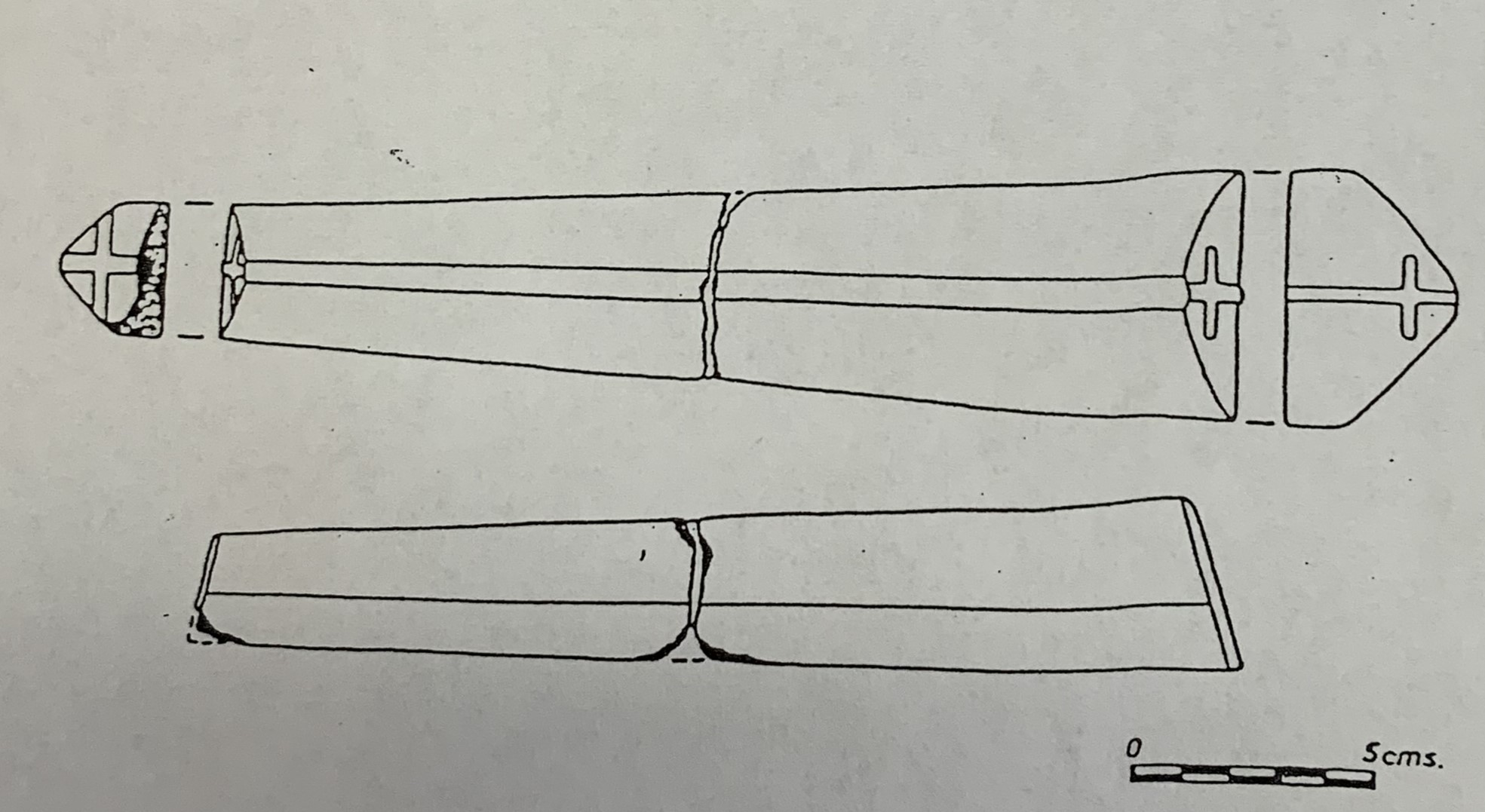
Author: Prof. Etienne Rynne
Source: Journal of the Galway Archaeological and Historical Society, Vol.41 (1987-88), pp. 144-147
By kind permission of Ms. Aideen Rynne
The early history of the Berminghams (equally correctly spelled Birmingham, they having assumed the surname from the town of that name in Warwickshire, England) in Athenry is unclear. This is due to several reasons, perhaps even to some extent because of the use of the same christian names, particularly Piers/Pierce (Peter) and Meiler/Meyler, from generation to generation. In The Peerage of Ireland… John Lodge tells us (Archdall 1789, 51) that the creation of the Baronetcy of Athenry occurred ‘by tenure in the reign of K. Henry Il’ whose Irish regnal dates are 1172-1189. This would concur with the often reputed belief that Piers de Bermingham was so entitled in 1178, long before there was ever a town of Athenry; the title-holder, nonetheless, was also termed Premier Baron of the Kingdom of Ireland (ibid., 50) which would support such an early belief. On page 32 of the same volume we are also informed that ‘Pierce (Peter) de Bermingham was an eminent person in the reign of Henry III from which King in 1234 he had the grant of 20 marcs a year, payable out of the Exchequer at Dublin, for his support in the King’s service; being summoned to parliament by him and his predecessor K. John’. The writ summoning him to parliament indicates that Pierce was clearly regarded as a Baron of Parliament during the periods 1199-1216 (John’s reign) and 1216-1272 (Henry III’s reign), even though Athenry still did not exist as a Norman town by the time of King John’s death. Despite this apparently contradictory fact, Piers/Pierce, the progenitor of this branch of the family, is always regarded as the 1st Baron of Athenry.
However, it is his eldest son Meiler, the 2nd Baron of Athenry, who is generally credited with the foundation of the town. Having assisted Richard de Burgh in the conquest of Connacht, he was granted lands to the east of Galway city in 1235, and probably around 1238 (the generally accepted date, though recent tendency is to suggest a slightly later one) he erected a castle overlooking the ford across the River Clareen. Extending south and westwards from this he laid out the town of Athenry.
As part of the general development of the new town, Meiler introduced the Dominicans in 1241, allegedly at the express request of St. Dominic (1170-1221) himself. Meiler purchased a site near the Brittin Gate in the east of the town for 160 marks (£106.13s.4d. or, in decimal terms, £106.67) from Sir Robert Braynach, i.e. Robert the Welshman, and presented it to the friars, together with another 160 marks and other gifts including wine, English cloth, and horses to draw stones to build a monastery (O.S. 6-inch sheet 84, co-ords 426 188; NGR 15031 22793). He also induced his knights and soldiers to contribute to the work. A year later, in 1242, a provincial chapter of the Order was held there, in the Priory of SS. Peter and Paul, though the whole complex was not completed until 1261.
Clearly Meiler would have been highly regarded as a benefactor of the town and priory, and it is therefore not surprising that when he died in 1252 near Cashel, in Co. Tipperary, his body was brought back to Athenry and buried close to the high altar in the church of the as yet unfinished Dominican Priory. It is reasonable to believe that his grave would have been suitably marked, but until recently no grave-monument or tombstone, among the many still within the priory, could be dated earlier than the late 15th or 16th centuries.
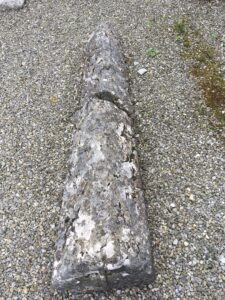
During cleaning operations carried out by the Office of Public Works in the 1970s two joining fragments of a coped grave-cover were found. These have now been placed centrally in the church just east of the huge tomb of Lady Matilda Birmingham which itself probably occupies the site of the original high altar (Plate I).

The grave-cover (Fig. 1) is broken almost exactly midway across its length. It is trapezoidal in plan, 208 cm long and is 52 cm wide at its higher (34 cm) western end, tapering to 29 cm wide at its lower (22 cm) eastern end. Both gable-like ends incline inwards to the flat ridged top, the western by about 10 cm and the eastern by about a cm, and each bears a plain Latin cross in high relict. The vertical sides also taper in height, from 14 cm to about 9 cm. The stone seems to be limestone and appears to be undecorated-the irregular shallow crack-like grooves along its top and sides appear to be due to natural weathering rather than to any attempt at tegulation.
House-shaped recumbent grave-covers of this type are apparently unknown elsewhere in Ireland, but are not uncommon in England. Though their ancestry goes back to the Viking-Age hogbacks, the plainer, straight-sided type with gabled ends often bearing a cross in relief, is best dated to about the middle of the 13th century, a date which coincides perfectly with the death (1252) of Meiler de Bermingham. It would seem justifiable, therefore, to identify the Athenry coped grave-cover as that pertaining to the burial of the founder of the town.
ETIENNE RYNNE