APH
APH
AS TOLD TO BERNARD CONNOLLY
SOURCE: ATHENRY ADC’S PUBLICATION
THE ATHENRY JOURNAL, VOL. 2, NO. 2, 1996

I was born in 1903, the youngest of 9 children, about 2 miles from Kilconnell, Ballinasloe. My late mother was a schoolteacher; and my late father, Tom Kelly, having obtained a job as a herd for Shaw Taylor, Moorepark, Athenry, the last landlord to farm the huge Castlelambert estate, my family moved to Castlelambert in 1908.
Hay, ploughing and milk production
This huge estate was run by the Lambert family in the last century, a branch of which resided at Castle Ellen, Athenry, the birthplace of Edward Carson’s mother. Hay baling and ploughing by steam engine was carried out on the Castlelambert estate in the last century and at one period, milk produced in Castlelambert yard was taken by horse and cart to Athenry Railway Station, and by train to Dublin for daily delivery.
Family farm and first house built
On the subsequent division of the Taylor estate, my father acquired a small farm, which myself and my family have farmed and where we live to this day. I commenced adult life as a tradesman, having worked and trained for a period with my cousin, Larry Morgan, a carpenter in Ballinasloe, and grandfather of Billy Morgan, the well known Cork All-Ireland footballer and trainer.
I built my first house in 1932, a two story slated house, for the Rooney family, Monatigue, Craughwell. This style of farmhouse with 2 large gables with chimneys was popular in the 1930s and 1940s with 3 or 4 bedrooms upstairs, and a large kitchen, sitting room and scullery downstairs. Sometimes, a downstairs bedroom was included behind the sitting room.
No cavity walls or central heating
There were no concrete blocks or cavity walls or central heating in those days. The walls were built of mass concrete, filled into timber “casings”, which were then raised, row by row as the walls progressed upwards, and the house roofed with “Blue-Bangor” slates. All concrete was mixed by shovel in these early years, an 8:1 mix of sand and cement for walls, and a 3:1 mix for plastering.
Outside finishes were wooden floated plaster or “rough cast” finish, either by pebbles dashed on to plaster, or with a plaster/pebble mix dashed on to the house. Inside walls, were steel-trowel plastered and hardwall finish applied.
Houses built
Generally, a roofed and reinforced water-tank was built beside the house to collect roof water. Also, surrounding walls at front, with gates and paths were constructed. I also made the front and rear doors, windows and fitted glass. All houses were painted both inside, outside, before I finished. Rooms and ceilings got emulsion paint, with oil-paint and varnish used on windows and doors.
All help for the tradesman was provided by the farmer or owner, as help was plentiful in rural areas in those days. I built a number of similar two-storey houses around my home locality, for the Kelly and Connell families, Castlelambert, for “Sonny Ryder, Derrydonnell , for John O’Malley (now Padraic’s), Cashla, for Jimmy Farrell’s family, Boyhill, for Frank Curran (now Donnellan’s) Farnablake, and for Larry Fox, Carnmore.
I built a two-storey house in Old Church St., Athenry, for the late Professor Heavey (now Teresa Kelly’s hairdressing salon, “Finesse”), and I reconstructed the late Mattie McNamara’s house in Old Church St. (now the Old Church Diner).
£50 houses
Those early two-storey houses were built for a fee of £50 while the Co. Council grant came to £75. During this period, I made a timber foot-bridge across the Clare river, at Grange. The bridge, which has since been replaced by a concrete structure, was made at Castlelambert from larch timber and taken by horse and cart to Grange.
In some case, I drew the plans for these houses, and made out the full list of building materials required, down to the last nail. This was needed to obtain quotations from the builders’ providers, usually Corbett’s Hardware, Northgate St., (now D.H. Burke’s) or Sweeney’s Hardware, Cross St., Athenry (now Frank Sweeney’s’ Auctioneers).
One of the earliest houses I had built, in the 1930’s, was a bungalow for John Thornton in Spiddal, an uncle of the well-known boxer, Mairtin Thornton. I had also built a bungalow for Jimmy Hynes at Lisduff, Coldwood. This style of dwelling house became popular in the 1940s and 1950s, and I built bungalows for Tommy Madden, Pack Higgins, Thomas Higgins, Johnny Grealish and Hughie Kelly in Lisheenkyle; for Johnny and Jack Kelly, Castlelambert; for Frank Curran, Veterinary Surgeon, Pollna-groagh; for the Clancy family, Castle Ellen; for Angela Burke (nee Egan) Coshla; for Greaneys and Mike Fox, Carnmore; and Monaghans, Moyvilla.
Renovations and extensions
In addition to building houses, I carried out renovations and extensions to numerous dwelling houses throughout my career, especially prior to having the “Station” Masses. Back extensions and bathrooms were added to Kelly’s, Connells, Freaneys, Mick Dunleavy’s and Moylan’s at Castlelambert and Johnny Grealish’s, Lisheenkyle. Other improvements were carried out for Seán Ruane, Tony Burke, Eugene Quirke, Joe and Nonie Higgins, Michael and Aggie Courtney, Castlelambert; John Joe Ruane and the “Bernan” Kelly’s, Lisheenkyle; Connolly’s, Birchgrove; Josie Duffy and Eamon Brady, Moanbawn; Morrissey’s, Deerpark; Broderick’s and Conway’s, Moorepark; and Willie Cullinane, Grange.
I also carried out renovations in Bridge St., at Curleys and Torpeys (formerly Nurse O’Gorman’s, now Rooney’s), and at the Square Inn (then Kevin Whelan’s) and Torpey’s shop and pub (now Iggy’s) in Cross St., Athenry.
I also undertook improvements at Poniards, Derrydonnell, Raftery’s, Egan’s Bar, Mattie William Higgins, Eddie McDonaghs (now John), Lardners and Hessions, Coshla; Burkes, Cregmore; at Paddy Coffey’s, Tim Rabbittes Stanley McHughs (now Laffertys), Cartymore; at Walter Walsh’s, Ballybacka; and for Mike Joyce, Phil Fahy, Coens and Jack and Tom Rabbitte, Carnaun, and also to Carnaun National School.
Dining rooms furniture, improvements and farm buildings
I made a set of dining room tables for the Sisters of Charity who had come to Coolarne Convent in 1928, and who taught a domestic science course for girls. I also worked at Canon Bomforts rectory (now Drs. Vivian and Ann Brennan’s), including erecting headstones for his domestic pet animals, and I carried out restoration work at the Protestant Churches in Athenry and Monivea.
I renovated a house at Taylor’s Hill, Galway for Mr. Glynn, former Ulster Bank Manager, Athenry, cycling to Galway each morning and being brought home by car each evening.
I also undertook improvements at Mrs. Hogan’s pub, Prospect Hill, Galway, aunt of my wife, Bridget, and at Mike Costello’s (now Gerry’s) Toberroe; and at Eagle’s, Keane’s, Healy’s and Dominick Mannion’s, Greethill.
Several other farm buildings were also constructed during my career, including barns, cowbyres, piggeries, cattle crushes, dungsteads, water tanks and troughs, walls, gates and pillars, etc.
New York visit
In 1973, I paid a visit to New York, to my brother Jimmy and family, and to visit the families of my brother Thomas, and sister Lily, and my other nephews and nieces. While there, I got the opportunity to climb the Twin Towers (which were then the tallest buildings in the USA) before they were fully completed and officially opened.
Other tradesmen, craftsmen, carpenters and painters
Other local tradesmen, craftsmen, carpenters and painters who worked during my era included Joe Maloney, Christy Howley, Jimmy Cleary, John Lawless, Michael John Quinn, Michael J. Gardiner & Sons, Waltie Burke, Martin Qualter (father of Pat, Jimmy and Martin), Christy Barrett, the Gibbons brothers and Michael Farrell, Clamper, and Paddy Cahill and Peter Mahon, block layers, who built walls of a number of the more recent dwelling houses that I constructed.
One of the latest houses I built was a two-storey house for Padraic and Peter Dunleavy, Ballygurrane, and I concluded my career by building two bungalows, one for myself and my family at Castlelambert, and my final house for my son Vincent and family at Lisheenkyle.
Retirement
It is pleasing to look back and reflect on the many changes which have taken place throughout a long and rewarding career, as I enjoy my retirement with my wife Bridget and family.
Epilogue
The above interview with the late Pat Kelly, R.I.P. took place about eight weeks before he peacefully passed to his eternal reward on 18th May 1996, and it narrowly missed inclusion in the previous issue of the Athenry Journal.
Since then some friends of Pat, including our Journal Editor, Finbarr O’Regan N.T., have referred to Pat’s literary interests and abilities, and this has prompted me to enquire into this aspect of Pat’s life.
It appears that Pat was involved with both producing and acting in local plays and drama during three distinct periods of his life, and involving three different groups of local actors and actresses; during the 1920s and the 1940s, before he was married, and at a later stage, after his marriage to Bridgid Costello, during the 1950s and 1960s. It is hoped to write about these plays and the characters who took part in them, in a future article in The Athenry Journal.
A man of great character, he declined to accept the old age pension while he was “still fit for work”.
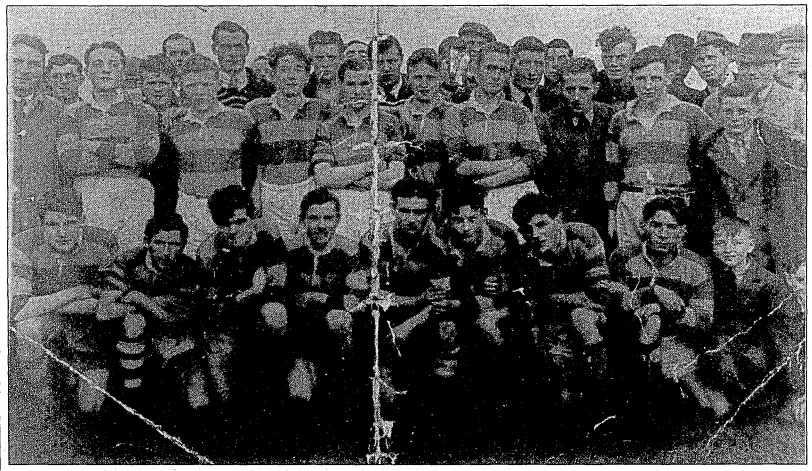
Pat was also a noted singer and was asked to sing at several “Station” parties, in houses where he had carried out renovations, painting, etc., prior to the “Station” Masses. He had also hurled with the Derrydonnell Hurling Club, and at one period, had acted as Secretary/Treasurer for the Club.
Ar dheis De go raibh a anam.