APH
APH
Editor: Gerry Burke
Source: A Tour in England, Ireland and France in the Years 1828 and 1829 by A German Prince, Volume 1, pp. 229-239
Source: “…. A STRANGE SPECTACLE ….” GERMAN TRAVELLERS IN THE WEST 1828-1858 by HERMANN RASCHE, Journal of the Galway Archaeological and Historical Society, Vol. 47 (1995), pp. 87-107
Despite the fact that a “considerable body of sophisticated German commentary [had been] written in the 1830’s and 40’s on the subject of Ireland”, the actual number of German travellers visiting the west of Ireland during the first part of the nineteenth century can literally be counted on the fingers of one hand.
There were German writers who took a general interest “in such a small and relatively distant country, labouring, as it was, under political, economic and religious suppression.” They saw the similarities between the feudalistic structures in this country and those in their own fatherland. The role O’Connell played at that time in Irish politics also held a particular fascination for the more politically oriented German observer.
But interest in matters Celtic tended to be focused more on Scotland. If a German set foot in Ireland, it was often more by chance than by choice. In contrast to a tour of Scotland or even of England, which was usually planned well in advance and then eagerly anticipated, Ireland tended to be a mere afterthought in the overall itinerary.
As may be expected, actual first-hand narratives by German visitors to the western counties of Ireland are even thinner on the ground.
IN SEARCH OF A WEALTHY HEIRESS
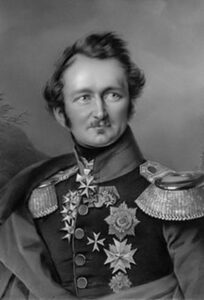 Prince Hermann von Pückler-Muskau, whom we shall accompany on his visit to the ‘West’, was by all accounts one of the most remarkable men of his generation. A former soldier and diplomat, an eccentric dandy (he introduced the square monocle into London society), a popular socialite and dashing rogue, he was credited “with more loves than Don Juan’s and Solomon’s added together.´´ But he was also a highly talented landscape-gardener, a gifted writer and an indefatigable traveller. Today he is mainly remembered for a delicious ice-cream which bears his name and which he is reputed to have created.
Pückler was the hereditary ruler of the small absolute principality of Muskau, Lusatia, in the extreme eastern part of Germany. He had also inherited his father’s extravagant tastes; foremost among them was his “parkomania”, his very costly partiality towards landscape-gardening. In order to satisfy his passion, he had run through not only his own inheritance, but that of his wife, Countess Lucie, née Hardenberg, too. Thereafter the couple lived largely on credit, and in order to stave off imminent and total financial ruin, they worked out an ingenious plan Prince Hermann was to divorce his beloved Lucie and marry a wealthy heiress in her stead, “an accursed prospect, for they were still passionately devoted to each other, and the thought of parting was agony to both of them” But they finally obtained a divorce on the grounds that the marriage had produced no heir.
In the spring of 1826, Pückler set out for England (“the richest country in Europe and so the most fertile garden of heiresses”) Matrimonial prospects did not materialize in England, however, and he was forced to try his luck in Ireland. (”I intend to marry a fortune or not at all; the prospects are propitious, and Ireland, not England, is likely to fulfil my intentions”, he wrote to his mother from Bangor, before crossing the Irish Sea).
Pückler spent nearly five months in Ireland, from August to December 1828. Almost daily he wrote journal-letters to Lucie, describing to her everything he was doing, thinking and feeling. She had asked him for the smallest details of everyday life, “since nothing gives a livelier picture of a foreign land.”
Two years after his return, in 1830, Pückler published these letters under the flamboyant title Briefe eines Verstorbenen. Ein fragmentarisches Tagebuch aus England, Wales, Irland und Frankreich, geschrieben in den Jahren 1826-29. (A Dead Man’s Letters – A Tour through England, Ireland and France in the Years 1826-29.
Warm praise by, among others, J.W. von Goethe helped to make the book a major literary and, more importantly, an enormous financial success story. Large sections of the book were soon translated into English and other continental languages. The Tour demonstrated Pückler’s excellent gift of observation and his power of description, and it established Pückler as one of the most popular authors of travel accounts. Moreover, with one of the biggest publisher’s cheques yet received in Germany, Pückler was able to turn to the maintenance and embellishment of Muskau once again and to continue planting trees whenever he returned from his roaming and roving journeys throughout Europe, Turkey, the Near East, Africa and Egypt.
After an adventurous and fulfilled life, Pückler died at Branitz, another park he had developed not far from Muskau, where he was buried beneath a great pyramid. He had designed it as his tomb, inspired to do so by a sentence from the Koran: “Graves are the mountain-tops of a distant, lovely land.”
Although his original mission, i.e. to find a wealthy heiress in order to solve his financial problems, was destined to fail, he found instead a wealth of material for a fascinating epistolary documentation about a country that was completely unknown to him.
Pückler is not a systematic political observer, but it is interesting to note that during his stay in Ireland his commentary became increasingly more political. Initially his position with regard to the destiny of the Gaelic – Catholic lower classes was one of indifference, but gradually he began to side with them against some of the Anglo-Irish Protestant gentry “Although landlordism was self-evident for Pückler, himself the owner of a large estate, he came more and more to criticize its excesses in Ireland “
Meeting Daniel O’Connell at Derrynane turned out to be a crucially important event, since it significantly influenced Pückler’s political attitude towards Ireland. In enthusiastic tones he relates the conversation with O’Connell, in whom he saw the only possible hope for a resolution of the Irish malaise.
“GO TO HELL OR CONNAUGHT”
“This wild part of Ireland – never visited by strangers, seldom by natives – is held in such bad reputation that there is a proverb which says :´´Go to hell or Connaught´´ thus begins Pückler’s letter of September 5th, 1828. Initially he had not intended to venture westwards and his decision to do so is purely coincidental: walking along the promenade in Bray, he meets a young parson who extends a cordial invitation to accompany him to his father’s house in Connacht, “no less hospitable than rich.” Our intrepid adventurer consents, since he is, as he says, “attracted to an undertaking that may deter others.”
After twenty-four hours along seemingly endless plains covered with bog, Pückler finally arrives at his friend’s estate “B….m, in the West of Ireland, where Nature becomes more smiling and blue hills peek above the horizon.”
Note: In his Tour Pückler frequently refers to people and places only by their initials. All circumstantial evidence point to B(irmingham) House, to its landlord Captain B(lake) and to Mount B(ellew),
Though Captain B——-, Pückler’s host, is one of the “Notables” in this area, Pückler’s first impressions are of “a house not better than that of an average German nobleman of moderate wealth”. English elegance and English luxury are wanting here, wax lights are unknown, as are claret and champagne; sherry and port, but above all whiskey-punch, are consumed in great quantities; the coffee is detestable, but the food is nourishing and plentiful. (Unfortunately Pückler does not inform us as to the details of the menu.) The house itself is not particularly clean, and the few domestics are “respectable from length of service, zeal and attachment, but of a somewhat unkempt and boorish appearance.”
That first night the rain (“for alas! it does rain in Ireland”) pours through the windows and falls in romantic cascades from the window-sill to the floor, where an old carpet soaks up the stream. The furniture is rather rickety, but Pückler has enough tables for his “multitude of things”, and the bed seems comfortable enough, Sods of excellent turf smoulder in the chimney, which not only gives heat “but covers everything with fine ashes like an eruption of Vesuvius.” However, with good humour, our gentleman-traveller assures Lucie that these little inconveniences are many times outweighed by the cheerful hospitality he receives.
Captain B. is seventy-two years old and still as hale and hearty as a man twenty years his junior. He is the proud father of twelve sons and seven daughters (“all by the same wife, who is still living, though just too unwell for me to see”, Pückler regrets). Some of the sons and daughters have long been married, and the old man now enjoys watching his grandson of twelve play with his youngest daughter of fourteen. The greater part of the family is present, and that renders the place rather noisy. This is aggravated by the musical talents of the daughters, who perform daily on instruments which are wildly out of tune. The master of the house constantly drinks to Pückler’s health, but there are no napkins at the dinner-table, “handkerchiefs or the corners of the table-cloth serve as substitutes.” The men seem to be talking about horses and dogs all day long, Pückler finds them “generally somewhat uninstructed”. A squire from the neighbourhood, for example, “searched long and patiently in a map of Europe for the United States and at last his brother-in-law gave him the fortunate suggestion of trying his luck on the map of the world …. The general ignorance according to our educational standards”, Pückler continues, “is without precedence. Nobody among the so-called educated classes at the table had ever heard of the phenomenon of magnetism or knew of the existence of places like Prague and Carlsbad in Bohemia* Everything outside Paris and Great Britain was all Greek to them,”
Amusements are arranged for the next few days. In the “little neighbouring cathedral town of Tuam” Pückler and his little party of friends spend four long hours watching the ordination of four clergymen by the archbishop. In contrast to the religious service with which he is familiar on the Continent, Pückler finds the English Protestant service in Ireland an odd mixture of Catholic ceremony and Protestant simplicity. Pictures are permitted on the windows, but not on the wall. The sermons are long and tedious, especially the endless prayers with their incessantly repeated refrains, “offering a veritable instruction in English history.”
On September 8th they attend the races in Galway, here Pückler witnesses his first faction fight in Ireland.
THE FAIR LADY FROM ATHENRY
Two items fascinate him in Athenry which he visits on September 10th.
Athenrye, Sept. 10th: Morning
I write to you this morning from the house of one of the sweetest women I ever saw in my life: an African too,-and as she tells me, by birth a Mademoiselle H——.“Que dites vous de cela? But more of her hereafter. You must now accompany me to the ‘race-course,’ and see the running and leaping from the beginning. It is a remarkable sight of its kind, and exactly suited to a half-savage nation. I confess that it far exceeded my expectations, and kept me in a state of intense anxiety; only one must leave pity and humanity at home, as you will see from what follows.-The race-course is an elongated circle. On the left side is the starting post; opposite to it, on the right, is the goal. Between them, at the opposite points of the circumference, are built walls of stone without mortar, five feet high and two broad. The course, two English miles in length, is run over once and a half. You see then, from my description, that the first wall must be leaped twice, the second only once in each heat. Many horses run, but none is declared winner till he has beaten the others in two heats; so that this is often repeated three, four, or even five times, if a different horse comes in a-head each time. Today they ran four times; so that the winner, in a space of less than two hours, reckoning the intervals, ran twelve English miles at full speed and leaped the high wall twelve times!– a fatigue which it is difficult to conceive how any horse can stand. Six gentlemen in elegant jokey dresses of coloured silk jackets and caps, leather breeches and top-boots, rode the ‘race.’ I had an excellent hunter belonging to the son of my host, and could therefore, by crossing the course, keep up perfectly well, and be present at every leap.
It is impossible not to have a favourite on such occasions. Mine, and indeed that of the public, was an extremely beautiful dark bay, called Gamecock, ridden by a gentleman in yellow,-a handsome young man of good family, and a most admirable rider.
After him, the horse which pleased me the most was a dark brown mare called Rosina, ridden by a cousin of Captain B—-, a bad rider, in sky blue. The third in goodness, in my opinion, Killarney, was a strong but not very handsome horse, ridden by a young man who showed more power of endurance than perfect horsemanship: his dress was crimson.
The fourth gentleman, perhaps the most skilful, though not the strongest of the riders, rode a brown horse not remarkable in its appearance, and was dressed in brown. The other two deserve no mention, as they were “hors du jeu” from the beginning: they both fell at the first leap; the one sustained a severe injury on the head, the other came off with a slight contusion, but was disabled from riding again. Gamecock, who darted off with such fury that his rider could hardly hold him in, and flew, rather than leapt, over the walls, with incredible bounds, won the first heat with ease. Immediately after him came Rosina without her rider, whom she had thrown, and took the remaining leaps of her own accord with great grace. Gamecock was now so decidedly the favourite that the bets were five to one upon him: but the result was far different from these expectations, and very tragical. After this noble animal had distanced the other two in two successive heats and had achieved the two first leaps in the most brilliant manner, he set his foot, in the third, on a loose stone which one of the less skilful horses had pushed down as he fell, and which it was not permitted to remove out of the course. He fell backward upon his rider with such violence that both lay motionless, when the other riders came up, took not the slightest notice of them, and accomplished the leap. After a few seconds Gamecock got up, but his rider did not recover his senses, A surgeon present soon pronounced his state to be hopeless; both his breastbone and scull were fractured. His old father, who stood by when the accident happened, fell senseless on the ground, and his sister threw herself with heart-rending cries on the yet palpitating though unconscious body. But the general sympathy was very slight. After the poor young man had been repeatedly bled, so that he lay on the turf weltering in his blood, he was taken away, and the race began again at the appointed time as if nothing had happened.
The brown rider had been the first in the preceding heat, and hoped to win the last and decisive one. It was what the English call ‘ a hard race.’ Both horses and men did their part admirably, they ran and leaped almost in rank. Killarney at last won only by a quarter of a head:-it was necessary therefore to run again. This last contest was of course the most interesting, since one of the two running must of necessity win everything. There was a great deal of betting, which at first was even. Twice did the victory appear decided, and yet at last terminated on the contrary side. At the first leap the horses were together; before they reached the second it was evident that the brown was exhausted, and Killarney gained so much upon him that he reached the second wall more than a hundred paces before him. But here, contrary to all expectations, he refused to leap, and the rider had lost all power over him. Before he could be brought to obey, the brown came up, -made his leap well; and now putting out all his strength, was so much a-head that he seemed sure of winning. Bets were now ten to one. But the last wall was yet to cross, and this was fatal to him. The tired animal, who had exhausted his last remaining strength in fast running, tried the leap willingly enough indeed, but had no longer power to effect it; and half breaking down the wall, he rolled bleeding over and over, burying his rider under him, so that it was impossible for him to rise.
Killarney’s rider had in the meantime brought his refractory horse into subjection, achieved the two remaining leaps amid the cheers of the multitude, and then rode at a foot pace, perfectly at his ease and without a rival, to the goal. He was so exhausted, however, that he could scarcely speak.
In the intervals between the preceding heats I was introduced to many ladies and gentlemen, all of whom most hospitably invited me to their houses. I however preferred following my young host, who promised to show me the fairest of the fair, if I would give myself up to his guidance, and not object to riding ten miles in the dark. On the way he told me that this lady was called Mrs.—–, and was the daughter of the late Dutch governor of —–, that she had had a complaint in the lungs, and was now staying in the solitary village of Athenrye, on account of the salubrity of its air.
We did not arrive till ten; and surprised her in her little cottage (for the place is miserable,) at tea.I wish I could describe this sweet and lovely being to you in such a manner as to place her visibly before you; certain that you, like me, would love her at the first glance. But I feel that here all description falls short;-all about her is heart and soul, and that is not to be described;-she was dressed in black, with the greatest simplicity, her dress up to the neck, but fitting closely to her beautiful form. Her person is slender and extremely youthful, full of gentle grace, and yet not without animation and fire in her movements. Her complexion is of a pure and clear brown and has the soft polish of marble. More beautiful and brilliant black eyes, or teeth of more dazzling whiteness, I never beheld. Her mouth too, with the angelic, childlike character of her smile, is enchanting.
Her refined unaffected good-breeding, the sportive graces of her gay and witty conversation were of that rare sort which are innate, and must therefore please whether in Paris or in Pekin, in town or country. The greatest experience of society could not give more ease or address, and no girl of fifteen could blush more sweetly or jest more joyously. And yet her life had been the most simple and uniform, and her youth was rather the unfading spring of the soul than that of the body; for she was mother of four children, near thirty, and but just recovered from an attack on the lungs which had threatened to prove fatal. But the fire of all her movements, the lightning-flashes of her conversation, had all the freshness and all the power of youth, imparting a resistless charm to the gentleness of her nature. One felt that this was the child of a warmer and kindlier sun, of a more luxuriant soil, than are to be found in our misty climes. And indeed she felt the most melancholy longings after her native land, and a painful expression passed over all her lovely features as she said, she should never more breathe that balmy air charged with sweet odours. I was too much absorbed in looking at her to think of food, had she not, with all the kind activity of a good housewife, made preparations for entertaining us as well as she could in her little cabin. A table was set in the room in which we sat; so that our frugal meal caused no interruption to the conversation, and it was long after midnight ere we separated.
It was not till I was in bed that I learned that, finding it impossible to get us beds in a place consisting of only a few cabins, this kind-hearted and unceremonious woman had quitted her own for me, and gone to sleep with her eldest daughter.
Concerning her family, whose name was necessarily so striking to me, Mrs.———herself could tell me but little. She had married Mr.————, then a captain in the British army, in her twelfth year: immediately afterwards she lost her father, and embarked with her husband for Ireland, which she had never left. She had heard, indeed, that she had relations in Germany, but never corresponded with them. Three years ago, she received a business letter from a cousin in A———-, announcing that her father’s brother had died and had left her heir to his whole property. The indifference of this African child of nature went so far, that she had not only up to the present time left this letter unanswered, but as she told me, had never been able to decypher the whole of it, as it was written in Dutch, and she had almost entirely forgotten the language. “I don’t know the man,” added she innocently, ” and the money affairs I left to my husband.”
ATHENRY, A BATHING PLACE LIKE A POLISH VILLAGE
This bathing-place, Athenrye, is also one of the curiosities of Ireland. From what I have already said, you will conclude that no Polish village can have a more wretched aspect. The cluster of cabins is on a bare hill rising out of the bog, without tree or bush, without an inn, without any convenience, inhabited only by ragged beggars, and by the few invalids who bring with them every thing they want, and must send for even the most trifling article of food to Galway, a distance of twelve miles. Once it was otherwise; and it saddens one to see at the further extremity of this wretched village the proud ruins of better times. Here stood a rich abbey, now overgrown with ivy, the arches which once protected the sanctuary lie in fragments amid the unsheltered altars and tombstones. Further on is a castle with walls ten feet thick, in which King John held his court of justice when he came over to Ireland.
I visited these ruins with a most numerous company: I do not exaggerate when I say that at least two hundred half-naked beings, two-thirds of whom were children, had collected round my carriage at a very early hour in the morning, doing nothing: they now thronged round me, all begging, and shouting, ” Long life to your honour!” Every individual among them stuck faithfully by me, leaping over stones and brambles. The strangest compliment now and then resounded from the midst of the crowd: at last, some called out, “Long life to the King!” On my return I threw two or three handfuls of copper among them; and in a minute half of them, old and young, lay prostrate in the sand, while the others ran with all speed into a whisky shop, fighting furiously all the way.
Such is Ireland! Neglected or oppressed by the Government, debased by the stupid intolerance of the English priesthood, and marked by poverty and the poison of whiskey, for the abode of naked beggars – I have already mentioned that even among the educated classes of this province, the ignorance appears, with our notions of education, perfectly unequalled; I will only give you one or two examples. Today something was said about magnetism, and no one present had ever heard the slightest mention of it. Nay, in B———-m, in a company of twenty persons, nobody knew that such places as Carlsbad and Prague existed. The information that they were situated in Bohemia did not mend the matter: Bohemia was not less unknown; and in short, everything out of Great Britain and Paris was a country in the moon.
“And where do you come from?” asked one.
“From Brobdignag,” said I in jest. ” O! is that on the sea? -Have they whisky there?” asked another. The son of my host, whom I have repeatedly mentioned, asked me one day very seriously as we met some asses, whether there were any such animals in my country? “Ah! but too many.”
Two days later (September 12th), Pückler is back at Birmingham House. From here he sets out on his horse to Castle Hackett, “an attractive country house at the foot of Knockmaa, a solitary mountain, and according to local folklore a favourite place with faeries, the ‘good people’, as they are called here.”
On September 15th, Pückler is in high spirits. The fair African lady has arrived at Birmingham! Immediately they set out in a party of ten on a ride into the country, in the course of which the old captain shows them his bog cultivation and his draining “with all the ardour of a young man. He was as proud of potatoe-fields as I was enchanted by the company of my fair lady.”
THE MAD ORANGEMAN
Eventually Mr. L., too, arrives at Birmingham. He turns out to be a loathsome gentleman, ugly, old, and mean-spirited – the opposite to his charming, wife. Pückler is further shocked by the chilling bigotry of this ‘Orange maniac’. “I have”, so Pückler quotes his violent declarations, “served the crown in all parts of the world and I wish for nothing more than to see the peasants in Ireland at last rebel. Then I shall resume my service and gladly give my life. Without the complete extermination of that race there will be no peace in Ireland. Only an open rebellion, and an English army that would totally exterminate the Catholics in retaliation, could bring that about.”
On several occasions during his travels in Ireland Pückler takes the opportunity to condemn similarly bigoted opinions among the land-owning Protestant upper classes. And in that context he also pokes fun at their ignorance and compares their education unfavourably with that of the poor. Pückler “was struck by the value placed by the peasantry on education.”* He had noticed that “all Catholic children in Ireland are well taught and able at least to read, whereas the Protestant children are often highly ignorant.” Pückler finally suggests that this evil fool, “immersed in bile”, should be imprisoned and his lovely wife be given to a more deserving man. (Maybe he thought of himself as a deserving case …. But then, she would probably not have fulfilled the necessary requirements Pückler was still hoping to find in a wealthy heiress.) To everybody’s delight the “mad orangeman” departs the following day. So the party rejoices and sets out for Mount B….., the “handsome property of a country gentleman.”
Note: The case of the identity of Mr. L. and Mrs. L. in Athenry is doubtful: initials could refer to Lopdell, a family of that name living in Athenry at that time. There is an interesting reference in Aggie Qualter, Athenry, History from 1780 – Folk – Recollections, (Athenry 1987), p. 52. She writes: “The Lopdells were not popular in Athenry. I heard my father refer to them as proper ‘Orange Bastards’. I then believed that they grew oranges at ‘Raheen’ as I was unable to relate the word ‘oranges’ with bastard’. Now I know better. ”