APH
APH
An Unusual Burial at Ballygarraun West
Source: Seanda, NRA Archaeology Magazine, 2007 Issue 2
Author: Pat Randolph-Quinney
Pat Randolph-Quinney, lecturer in Forensic Anthropology at the University of Dundee, details analysis of a possible ‘charcoal burial’ discovered on the route of the N6 Galway–East Ballinasloe PPP scheme.
In September 2005 human skeletal remains were discovered in Ballygarraun West townland, c. 2 km south-west of Athenry, in east County Galway. The site was initially identified by geophysical survey, which suggested the presence of multiple pit features. These were subsequently tested and excavated by archaeologists John Lehane and Eoghan Moore on behalf of Valerie J Keeley Ltd. During this process a single isolated inhumation was uncovered, and analyses of the grave contents and environmental remains have revealed an unusual example of early medieval burial practice.
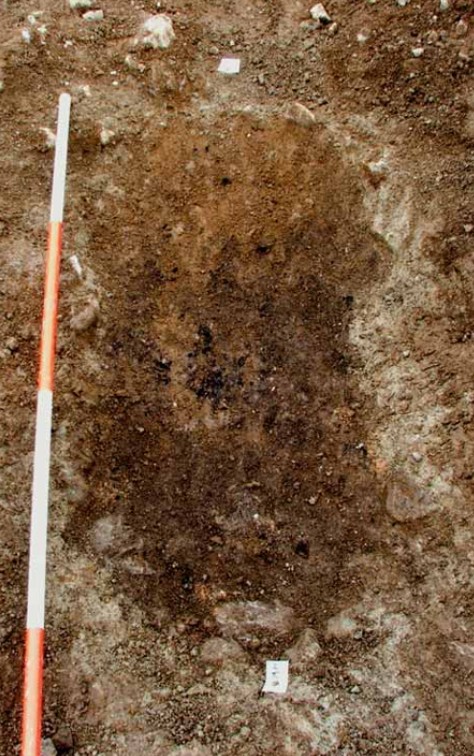
The grave comprised a simple east–west-aligned subrectangular cut, 1.5 m long and 0.8 m wide, which had been heavily disturbed by ploughing. Several large, weathered stones were scattered above the grave fill, possibly representing the remains of a covering cairn. This probable cairn appeared to delineate the grave cut. The grave contained the fragmentary bones of a single human skeleton, which had been placed in an extended supine position (i.e. lying flat on the back), with the head to the west and the arms and legs extended along the sides of the body. The inhumation was found to be lying directly on a shallow bed of carbonised plant matter. This layer was made up of alder and hazelwood, together with various cereal grains identified by environmental specialist Mary Dillon as black bindweed, barley and wheat; the plant matter does not appear to have been burnt directly in the grave. Instead, it was scattered before the deposition of the body. No grave goods (jewellery, pottery, etc.) were recovered, though a large worked piece of naturally shed red deer antler was placed over the pubic region of the individual.

The human remains were badly decomposed and in very poor condition—having been broken up by ploughing and weathered by the corrosive action of plant roots—with the effect that less than half of the skeleton survived. Thankfully, enough bone was present to allow for a determination of the gender, approximate age at death and stature (living height) of the person buried in the grave. The shape of the bones of the pelvis and chin suggested the individual was female. The degeneration (wear and tear) of the joint surfaces of the pelvis suggest she was well into her late forties or early fifties at the time of death. Measurements taken on the surviving leg bones allowed for an estimation of living stature at around 1.41 m tall (4 ft 8in.). The woman displayed age-related skeletal conditions consistent with mature adulthood, including spinal osteoarthritis and heavy wear of the grinding surfaces of the teeth. She also displayed a build-up of mineralised plaque deposit on the cheek teeth and chronic inflammation of the supporting bone around the roots of both the upper and lower molar teeth; these two factors are generally indicative of poor oral hygiene.
Radiocarbon dates were obtained from the human bone and underlying burnt material and indicate that the woman died sometime between the early fifth to mid/late seventh centuries (AD 432–661), and is therefore broadly contemporary with the spread of Christianity in Ireland.
The symbolism of the burial, especially the presence of scattered charcoal and grain, is interesting in the light of these early dates. So-called charcoal burials are a phenomenon of the medieval period, occurring in Britain, Sweden, Denmark, Norway, Iceland, Greenland, Ireland and France. In this type of burial a layer of charcoal (usually oak) is present in the grave fill, either under or over the body, or occasionally encapsulating it completely, and is often associated with high-status burials (predominantly of males) in cathedrals and churches. Most post-date the Ballygarraun burial, dating from around AD 700–1100, though early examples with charcoal are known from Merovingian France (Mazerny, Ardennes-sur-Meuse, dating from the sixth to seventh centuries) and with charred grain from Anglo-Saxon contexts in southern England (fifth to seventh centuries). Whilst charcoal burials do occur in Ireland, they
are so far known only from the church of St. Peter’s in Waterford, which is of much later date. In this instance the burial rite is thought to be a Christianised version of an earlier pagan practice from Scandinavia and England, which is perhaps unsurprising given Waterford’s connections with the two regions.
Does Ballygarraun represent an early Irish example of a charcoal burial? Possibly it does, although there are differences in the form of the grave, the lack of high-status grave goods and the sex of the deceased compared to ‘classic’ charcoal burials. Certainly the burial can be considered as a pagan rather than Christian act—a ritual that took place during the time of transition to a Christian belief system in Ireland. In particular,
the presence of burnt grain has parallels with Anglo-Saxon burials and a handful of Irish burials. The use of grain within these contexts is seen by scholars (such as Dr Elizabeth O’Brien) as a symbolic act associated with the purification of the dead. The burning of grain in this way was condemned by the early Church as a pagan ritual, which would suggest that the people who buried the Ballygarraun woman did not care for, or were unconcerned by, the opinions of the Church. That they were pagan is further suggested by the placement of red deer antler over the woman’s pelvis; this rite is not unknown during the pagan Christian transition, as evidenced by a female burial of similar date with red deer antler (though without charcoal) from Eelweir Hill, Lehinch, in east Offaly.

showing cut marks and working.
The Ballygarraun burial has clear parallels with southern English and Irish burial deposits of similar and later date, though the exact meaning behind the ritual remains unknown. Continued fieldwork and synthetic research may shed some light on these enigmatic mortuary practices, expressions of a pagan belief system during the rise of Christianity in Ireland.