APH
APH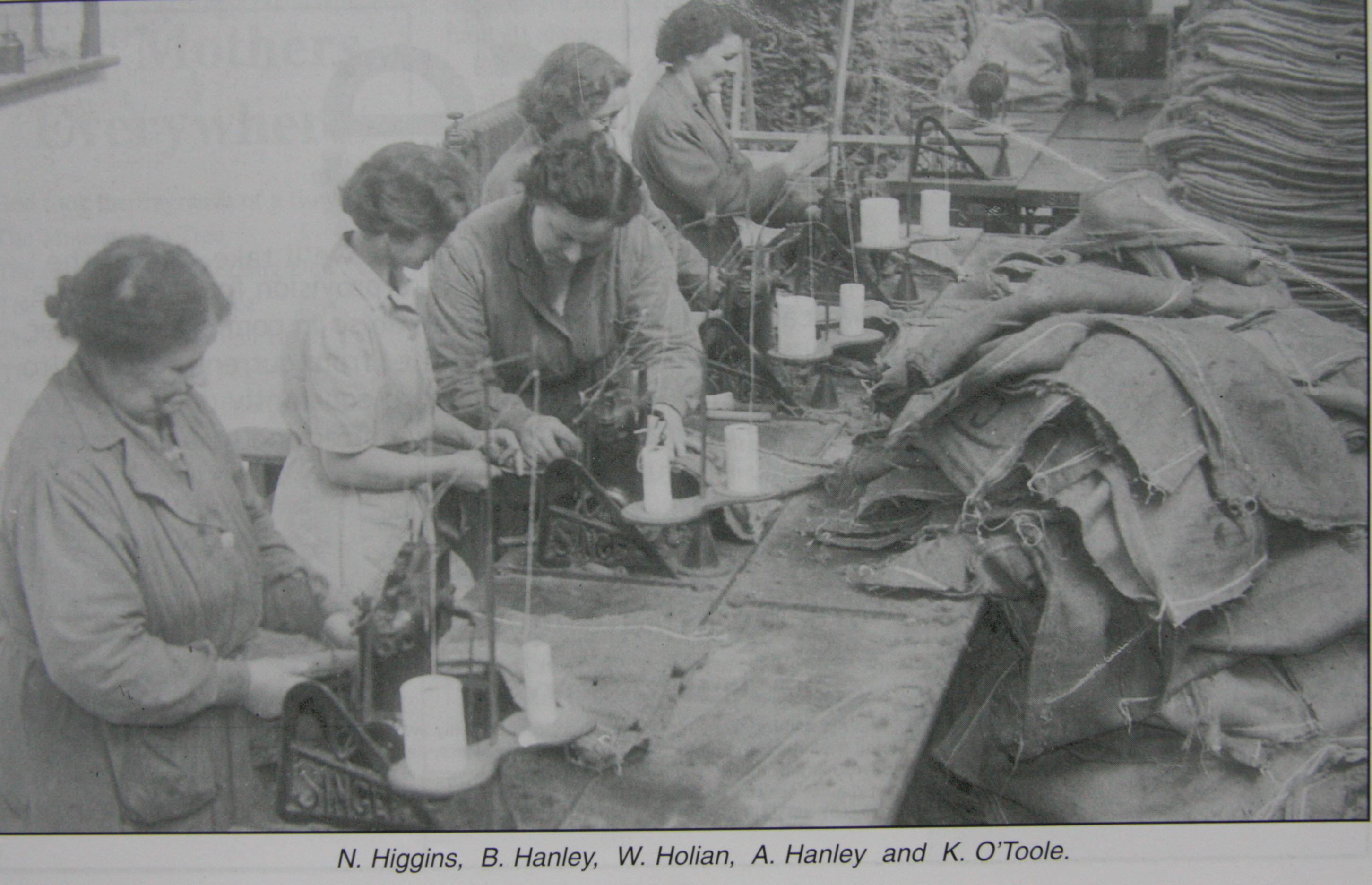

The Bag Factory
The beet factory was supposed to be built in Athenry but it was found out that the volume and quality of the river water was insufficient. So it went to Tuam and Athenry got the Bag factory instead. Women were mostly employed there except for the manager, Mr. Hayes and Paddy Kilkelly. Mr. Hayes was a big stout man who always wore a ‘dicky bow’ and carried an umbrella. Baba Varley used to walk to work from Castle Ellen and she later married Mick Gill. Anne Gill cycled up from Mountain North and she married Mattie Healy. Detta Fahy was in the office. The three Hanley sisters and Winnie Holian worked there too. I remember them passing by Swangate every morning when we lived there. A woman named Nora-I don’t know if she was Joe Mooney’s sister or his wife’s sister-walked from Boyhill every morning, Winter and Summer. They used to wash the bags in the river. They had a big mangel and they put the bags through it and squeezed the water out of them.
Photo: The Athenry Journal, 2001
The arrival of plastic bags all but finished the factory. The last thing they made were Braths for covering cocks of hay and stacks of corn. It was handier than thatching them. Winnie Holian was the last ‘charge hand’ before it closed.
Later in the 1960s Mass was said there while the new Athenry church was being built. Then Mattie McNamara set up a garage there until he retired. Nowadays there is a garage and car sales business there.
The Riot at Swangate in 1934
The County Council went to widen the corner at Swangate and put railings along the top of the wall to improve the view. The local workers were after setting up a branch of the I.T.G.W.U. All the workers to do the job were members. So when the Council brought in workers from out the country who were not members of the Union the lads around the town had no job and ‘all hell broke loose’. All work was abandoned and all made for Swangate. The ‘Scabs’ and ‘Blacklegs’ were routed and there was a stand-off with the Guards. The union lads lined up like an army. There were some who had service in the First World War and more had been out in the Civil War. They were all in the front line and the young lads were behind them with stones. They were the ‘artillery’. A few women joined them with their aprons filled with stones.
A detective named Clarke came up near the front line and he had his baton in his hand. My father took it from him and fired it over the wall. The Garda Sergeant said that he was going to send to Renmore (Barracks) for the army. He was reminded that they knew more people in the Barracks than he did as a lot of them were not long out of the Free State Army. Canon Conroy was the parish priest at the time. He was a bit of a socialist so he came over before anyone got hurt and he defused the situation.
They were all marched to the Garda barracks and were remanded in custody to Mountjoy jail in Dublin until the next court in Athenry. However, to get them to Mountjoy proved to be another problem. Buses came out from Galway and as the drivers were union men they refused to drive them to jail. They returned to Galway. They eventually got a private bus company to come and take the job and what a job it was. I don’t know how long it took to get to Dublin because the bell on the bus was rung every mile for someone wanting to go to the toilet. And if the driver didn’t stop ‘it’ was made in the bus and with all the stories we heard the buses became a health hazard when they were finished with them. The men were nearly all married with families. Well, I believe money came from everywhere there was a union branch. The wives were a lot better off than when their husbands were at home as they had a lot more money.
The day they came back from the court the Dockers Band from Galway was there to meet them. The Guards got it very hard to find witnesses to give evidence against the men. They surrounded some of the lads involved. There was one man, Sonny Curran, who lived in a thatched house beside the river. When he took the stand, whatever he was asked he wouldn’t give a straight answer. So the judge looked at him and said: ‘Mr. Curran! The next question you are asked just answer yes or no’. So when he was asked the question he answered ‘yes and no, your Honour’. When the judge heard the answer he ran him from the stand and that was just what Sonny wanted.
They were all bound to the peace. There was a big article in the Connacht tribune about the court case.
Athenry Pipe Band
The band was started in 1937/38. I remember they went to Ennis collecting for it and my father brought home a goldfinch in a cage. My mother, who was alive then, died in 1940. I remember my father bringing me on the bar of the bike down to O’Neill’s bakery where the band did their practice. Sergeant Bishop was the pipe major in Renmore Barracks and he used to come and teach them. They didn’t have pipes at the time. They had ‘chanters’ instead. ‘Chanters’ made the same sound as the pipes but it was very hard to blow them. I remember some of them at home in the house.
Then they got pipes. They would have to blow up the bag to bring up the treacle in order to seal the bag so that it wouldn’t lose air. The band had some great pipers: the two Reillys, Willie and Martin, Pat Flannery, Pakie Higgins and John Devock. The drummers were Martin Cunniffe, Eddie Cunniffe and Dennis Madden. I think Jackie Cunniffe was in the band too. And last but not least the big drum was played by Padraic Fahy. You’d want to see his actions with the drumsticks and he swinging them behind his back and over his head while still keeping perfect time with the music.
Leading the band was Donal Barrett, the flag-bearer with the tri-colour. It was some sight to see then marching down the streets in their full regalia. The band was supposed to be non-political but when Tony D’Arcy died on hunger-strike some of them went out to meet the funeral and that finished the band. The old sores were still raw after the Civil War.
The Fields of Athenry
WORDS: Tony Waldron
Down by the Clarin’s mossy banks one evening I did stray
To while away the leisure hours before the close of day.
When my mind began to wander to the days long long gone by
When I roamed as free as Gaoth na Sí o’er the fields of Athenry.
Oh how often with our dogs and sticks before at the break of day,
Barefooted o’er the dew clad grass how carelessly we did stray.
To hunt the rabbit and course the hare ’til the moon rose in the sky.
Ah they were the happy days we spent ’round the fields of Athenry.
We had some famous hunting dogs I’ll mention but a few.
We had Speed and Spot and Rebel brave, we had noble Murty too.
But Bruno was the king of all as o’er the sod he’d fly
And ’twas woe betides the hare that strayed ’round the fields of Athenry.
As the sun went down a hare we found upon Graig Abbey hill
And the hunt we had that evening it’s in my memory still.
We were hungry and our dogs were tired but we made off in full cry
As for Toorkeel the hare did wheel from the fields of Athenry.
The hunting done by bright new moon our homeward trek we’d make
Across the bogs to Roll Mhic Eoin by Cahertubber lake.
And then we’d climb up Crucan Gabhair the lights of home to spy
And we’d hear the curlew plaintive call o’er the fields of athenry.
Now Cruacan Gabhair that fairy hill it is no longer there
The gravel trucks have hauled it off to GalwayCity fair
To make concrete for foundations the fairies had to fly
Before diggers and bulldozers in the fields of Athenry.
All through the long hot summer days through those green fields we strayed
While a youthful blood coursed in our veins and death seemed far away.
Sure we thought we were immortal that ’twas just the old that died.
Ah but now there’s few of the friends I knew round the fields of Athenry.
I remember now young Timmy he was so wild and had no care
As he sped across the Moneen you could see his flaxen hair
Just to watch himself and Rebel it would fill your heart with joy
As they hunted for the rabbits ’round the fields of Athenry.
I recall to mind young Joseph who joined the Irish Guards.
He was tall and square with long blonde hair he outran us all by yards.
But I know in all his wanderings beneath that alien sky,
His heart was at home hunting round the fields of Athenry.
There’s no heath on the moorland now where once we coursed the hare
The furze-clad hills where rabbits were, they now look gaunt and bare.
Where Bruno made that mighty leap as the pheasant rose on high
Where that Rannach grew there’s houses now in that field of Athenry.
Ah but now I’m old and my head is grey and I’m bowed with the weight of years.
When I think about those happy times my eyes grow dim with tears.
But still I love to ramble where the trout rise to the fly.
Down by the Clarin’s mossy banks that flows through Athenry.
The Good Lord soon will come for me and my final peace be made.
On that hallowed hill above the town ’tis there I will be laid.
And when the final judgement comes with its fanfare from the sky
I will rise up then and hunt again through the fields of Athenry.
History of my poem/song “The Fields of Athenry”
The history of the poem goes like this:
It started out as a crooked argument I was having over The Fields of Athenry. This was before Paddy Reilly took it over. I was having an argument with Sean Flanagan and there were others butting in as well and they were getting the better of me. I said I’d write it better myself and the ‘gun was put to my head’. I was told to go ahead and do it. You know when you are working on your own out along the line building walls your mind starts to wander back to your younger days and all the things that you had done and the pals you had.
The first day I had six verses written. I was down the garden when Sean Flanagan came in. I told him I had six verses written and showed them to him and he said to have a good ballad you had to tell the whole story.
We spent a lot of time along the River Clarin either swimming or fishing in it. We knew every hole in the wall from the Mill Dam down to the Ball Alley. We’d get an onion bag and put a wire around and with a bit of stick poked it into the hole and put the trout into the bag. On another day we’d head off hunting. The dogs would get excited and start barking and they’d draw every dog with us. We knew every furze bush and every clump of briars where we’d get a rabbit. We knew every burrow and we’d go in the morning and wouldn’t be back until dark. If we came to a field of turnips we used to pull one and hit it against the wall to break it and eat it. We used to walk and run miles. When you’d rise a hare you’d run miles after it. It would be getting dark and you could find yourself down with in Knockbrack or up in Ballyboggan. Coming around Chocan Gabhair we could see the lights of home. The hill (Chocan) is all gone now, dug out and shifted off to Galway.
There was a story about the ‘Fairy Hill’. When the roads were let out on contract a man could take the section from Athenry to Monivea. He would have to keep the potholes filled, the sides edged and the water tables cleaned. It was very handy if you had your own sandpit. You could fill your horse-load of sand and head off and fill the potholes. The man who owned the ‘Fairy Hill’ had the road from Athenry to Monivea. He decided to open a pit in Cnocan Gabhair. He got on okay the first morning but the next one the horse dropped dead under the cart. It was supposed to be the work of the fairies. So the hill wasn’t touched until Tommy O’Shea came home from England. He had a digger and lorry and he shifted it all to Galway when McInerney was building the houses in Renmore. So the fairies had to go as they were able to deal with the horse but not the horse power of the digger.
If I was writing it now where the furze clad hills look gaunt and bare, I’d have to say they’re no longer there. All the big sand hills are gone and there are houses where we used to catch rabbits. I thought that when we were young we were never going to die. It was just old people that died but now when I look around nearly all my old pals are gone. There’s not many left.
So I finished off making my final peace with God but when Michael blows his horn on the last day, I hope I’ll rise up and hunt again o’er the Fields of Athenry.
The 1940s and 1950s
A lot of what is in the song happened in the 1940s and 1950s. We did a lot of hurling up in Boyhill in Grady’s field.
Our team was called ‘Boyhill’. Michael Finn was secretary. Sadly, he was called to his heavenly reward last week upon his death in New Zealand. Nearly all of them have been called ‘home’: the Finns, the Farrells, Fallons, the Burkes, Waldrons, Jimmy Nolan-all gone.
We used to meet at the Four Roads every evening. If we had any money we could go playing ‘Pitch and Toss’, or a big stone would be got to see who could fire it the farthest, or a stick was fetched and two lads would sit down and put their feet against each other. The stick would be left across their toes and they each had to hold the stick and when they got the word they had to pull and see who could lift the other off the ground. We often stayed there at the Four Roads until the birds started to sing. All the old landmarks are gone: the Piper’s Bush, the Pump at the Four Roads.
All are no more.
The Flying Fortress Crash 1943
We were at school the day the flying fortress landed in the nursery field out in the Farmyard, now Mellow’s College, and ended up in the four acre field. The pilot must have been a master pilot because of the way he was able to land that huge plane. We all went back the minute we were let out from school. We got oranges and saw the bullet proof glass. The bottom gun turret got broken when it hit the wall. It was the first plane that went on bombing missions and had its own protection to defend itself. It was called ‘Yanky Clipper Stinky Forty Five’. A crowd of engineers came down from Baldonnell and dismantled it. They were there for months. They stayed in Curran’s house in North Gate Street.
The Night in Athenry when the Republic was Declared
We had a night in the Square the night the republic was declared. There was a big bonfire and a platform and speeches were made. Sean Mac Bride was after starting up Clann na Poblachta. It was the first rainbow government consisting of Clann na Poblachta, Labour, Clann na Talamh and Fine Geal. Sean Mac bride had been the commander-in-chief of the I.R.A. before that happened.
V. P. Shields was a CountyCounsellor, so he was ‘chief cook and bottle-washer’. You had Mickey Hession and Michael McLoughlan. I remember Mike McLachlan ended his speech with the words ‘we have a republic for 26 now but we won’t rest until the last British soldier sails down the Lagan’. The cheer he got could be heard in Stormont.
Characters
Pat Glennon was one of the best known of the town characters. He came from up around Gort. His people were well off but he wouldn’t stay at home with them. He used to spend a lot of time with Sonny Glynn doing odd jobs. Then all of a sudden he’d take off around the country. He came into my grandfather’s one day and himself and the grandfather had a great chat. There was a big mug with a blue stripe around it. Any lad like Pat who came in got the full of it of tea and a couple of slices of bread
‘Parley’, as he was called, was another character. His real name was Johnny Cleary. He used to stay in Walsh’s where Dan’s Bar is now. He was always well dressed with a sports coat and grey trousers. If he hadn’t a big coloured handkerchief in his top pocket, he’d have a flower in his buttonhole. He sold programmes at the Galway races. He also went around from house to house and he’s sing a song and get a few coppers. He had to have the night’s rent by evening time.
On Fair Days the town used to be filled with characters. The street singers were great. They went around the streets singing a song. Then they’d come back and try to sell the words on a ‘Penny Ballad Sheet’.
You had another lad and he’d come with a bag of broken glass. He’s spread it out on the ground, take off his shirt and lie down on it. He’d ask one of the crowd to stand on his chest. After that he’d have a big stone on chest and he’s get someone to break it with a sledge. The crowd would fire coppers into his cap when his show ended.
There was another character that would arrive with a wheel of a horse cart. When he had a good crowd present he’d get a rope and swing it around his head and made a crack like a gunshot. He’d also take the wheel and rise it up and balance it on his chin while he walked around the Square. He used to get a fair amount of money from the crowd. All the farmers knew the weight of the wheel as they were used to greasing the axles. He had few sayings: ‘if money could keep you alive the rich man would live and the poor man would die’.
Then you had the lad with the cleaner. That was the time of the old ‘spec caps’. The ‘specs’ used to get all greasy and when he’d see a greasy ‘spec’ he’s get it off the man and he’d brush the cleaner on the spec. Then he’d hold up the cap as proof that his bottle worked and he’d try and make a few sales there and then.
You had the black doctor. He’s pull your teeth or he’d sell you a bottle that would cure all ills.
The ‘cheap jacks’ sold second hand clothes and horse harnesses. I was watching one of them one day fitting out a man with a waistcoat. The man was fairly small and the waistcoat was too large for him. But the ‘cheap jack’ was telling him how it was perfect fit and he having the full of his fist of it caught up behind the man’s back and he closing the front buttons.
Bucky Hynes
Bucky, who lived before my time, was a great character. I heard a lot of stories about him. I know where he lived. It was up behind Finn’s in Rocklodge. Bucky’s field was there and the remains of an old house was in the corner. I often worked in Bucky’s field with John Finn making hay and pulling turnips. Bucky was a fast runner and a great jumper. A story is told how he put the blood of a fox on his feet and ran before the hounds from Moyode to Derrydonnell and they couldn’t catch him. He ran in the middle of the track from the Farmyard to the railway station in front of the mail train. He was able to jump across the river at Taylor’s mill in the town park.
Bucky went to Renmore Barracks to join the army. He was what used to be called ‘pigeon-toed’-his feet were turned in and so he failed the medical examination. When he was leaving the Captain was out after him and instead of going out the gate he took a little run and jumped over the big fence. The Captain did his best to get him to come back but Bucky wasn’t having any of it.
Halls, the owners of the Knockbrack estate, used to have a soup kitchen. To get a bowl of soup you had to spit on the statue of the Blessed virgin. Bucky went to get a bowl. He always chewed tobacco and as he got his bowl of soup Mrs. Hall produced the statue for him to spit on it. But instead of doing so he nearly ‘cut the two eyes’ out of her with a huge tobacco spit and off with him.
Bucky could take off in the morning and walk for miles. This day he was in Roovah in the parish of Clarinbridge. He was passing this house and two lads were drawing straw for thatching. He asked them for a rope of straw and they said, ‘why wouldn’t we. Go into the house there and get a mug of tea and we’ll fill it for you’. They were two playboys and decided to play a trick on Bucky. They got the ‘cap of a stand’ and put in into the middle of the bundle of straw and tied it up. When Bucky came out the two caught the rope of straw. It put them to the ‘pin of their collar’ to ‘rise’ it onto Bucky’s back. Off goes Bucky with the rope of straw and the big stone. When he came to the river bridge at Caherfinesker he left it on the wall of the bridge to have a rest and out rolled the stone into the river. I believe it was there for years.
Town Businesses
Corbetts of North Gate Street
Corbetts had a big business in Athenry. It was a branch of Corbetts in Galway. They had a grocery, hardware and a public bar. At one time they had all sorts of building materials. They had carpenters making windows and doors. They had two saddlers making horse harnesses and repairing them. They were coal merchants and during the Second World War when there was no coal to be got they had a big store filled with turf. You could buy a bag and you paid by weight-it was so much a hundredweight. You could get a big bag for two shillings and sixpence. And you borrowed one of their hand trucks to wheel it home.
There was another one of the jobs we used to get a few pence for. They had two lorries and during the war they ran them on gas made from charcoal, but sin sceal eile.
They had a thriving business in certified potatoes. They used to sow a lot themselves. They had a team of horses and a man, Peter Madden, working for them. They used to take conacre to sow the potatoes. They hired extra men in springtime to sow them. It was a busy time with manure and sowing the potatoes. People used to sow certified seed on farms all down north Galway, Monivea, Menlough and Corrafin. They had to be careful not to grow them too big as they had to be a certain size. They had to ‘scib’ them, bag them and when they had them ready Corbetts sent out the potato inspector, John Tully, to certify them. John was employed by the Department of Agriculture. If they passed, Corbetts sent out one of their lorries to transport them to their store or if the boat was in they were carried straight to Galway docks for export to Britain.
Corbetts were big employers back then. Jimmy Burke and Mattie Tierney were the first lorry drivers. Mattie Walsh was another, Glavin from Turloughmore, Padraic Connors, Mattie Gannon, Jimmy McCormack, Joe Egan and his brother, Laoi, Tommy Reilly, John O’Dowd, Mattie Feeney, Greg Rabbitte, Stephen Burke, my father, Martin Ryan were there a few years in springtime.
Taylor’s Saw and Flour Mills by the River
Taylor’s Mills was the next big business with a saw mill and a flour mill. They had the Collins-Tommy, John Joe, Charlie and Benignus, making egg boxes. They were making them on contract with so much per box. They used to work all hours when the order for the boxes came in. They used to load the wagons with them down at the station. They had a white pony and cart with a frame on it. Stephen Burke used to bring big loads to the station.
Gerard Collins was the sawyer. Martin Beatty was on the bench winding into the saw with the big log on it. There was a lot of timber cut at that time. There were the three Quinns, all of whom were cartmakers and wheelwrights, using Larch timber. The box and creels were made from larch. The wheel fellows were of ash, the spokes of larch and the stock was elm. All that timber had to be cut and left to season.
The flour mill was a great business too. All the farmers grew their own feeding stuff-oats, barley and wheat. You could bring in so many stone of oats and you would get back so many stone of oatmeal. There was always a small pot of oatmeal cooking by the fire. Some of it would be put into a bucket with milk for the calves. It was great to put a few handfuls into a can of spring water. It made a great drink-‘white water’ it was called.
Ruanes Farm Machinery of North Gate Street and later on the Craughwell Road.
They had a large business in North Gate Street where the Castlegate Hotel is now. They were supplying electricity to the town before the Shannon Hydroelectric scheme started. Everard was the electrician. Paddy Dobbyn served his time there before he joined the ESB. Pat Flannery kept the generator going.
They used to being in threshing mills and repair them. There were transported by rail and Ned Madden used to bring them up to the repair yard with a big Clydesdale horse called ‘Roisin’. Mattie Feeney from Newford and Josie Burke from Raford did the repair work.
In later years Ruanes were agents for Massey Fergusson Tractors. They employed a lot of workers. They left North Gate Street and set up a larger business premises on the Craughwell road where Laffey’s Garage is now
Sweeneys of Old Church Street and Cross Street
There were two Sweeneys, one in Cross Street and the other in Old Church Street. The Cross Street business sold hardware and manure. Mickie McNamara and Christy and Malachy Kearney, Pat Kearney’s father, worked there. Plunkett was in the office and John O’Rourke was in the shop. They had a petrol station where O’Hara’s Solicitors is now at the corner of Barrack Lane. James Sweeney and his sister lived there in the shop.
The other Sweeneys had their business in Old Church Street where the Fields Bar is now. They were wool merchants and also sold food stuffs like Bran, Pollard and Indian meal. Pat was the son and he worked in the shop. The other son was Joe Sweeney, who had his office in Cross Street. Martin Higgins worked in the yard and Ena McHugh was in the Bar and grocery. Martin and Ena left and went to England and got married there. John Costello and Monica Connolly from Cahercrin replaced them. Later on Monica married Tommy Fox.
Fox’s Pub and Grocery
They had a pub and grocery business and were also wool and grain merchants. They bought large amounts of both. Many is the day I spent there when I was ‘dodging’ from school. I helped Tom Cawley pack the wool. I used to go in the back packing the fleeces when Tom would fire them in. When it was filled there was a flap that covered the end and you had to sew it with a packing needle and binder twine. Then it was rolled up on a two-wheeled ‘jockey’ and stacked in another store. When there was enough stored they used to bring it to the station and load it on wagons.
It was the same way with the corn. When people brought it in it was weighed and spilled out. When the order came in it was filled into bags, which were weighed and then sewn up. It was loaded on to a horse cart if it was going by rail. Bur if a lorry was coming and it couldn’t get into the yard the lorry would park out in the lane and it had to be humped out the yard and up a plank and on to the lorry. Tom Cawley and Pete Walsh were carrying the bags while Tommy Fox and I were in the store. We had a barrel turned upside down and we were lifting the bags on to it. So they had no delay-a man backed into the bag and took off. Jimmy Nolan came working in it after that. They bought a Volkswagen Beetle and a big trailer and they used to go out and collect the corn themselves. Jimmy Nolan was able to catch a bag of oats with his teeth and leave it up on the lorry. They sold feeding stuff as well. When Taylor’s mill closed they started grinding corn. Fox’s was a busy place at that time. When I now come up ‘Fox’s Lane’ (McDonald’s Lane) I hate to look at the state of the yard.
Fitzsimons of North Gate Street
This was a large drapery shop catering for men and women. Eddie Somers spent most of his life working there. He married one of the daughters, Rhoda. Rhoda’s brother, Frank, became a priest.
Dalys of North Gate Street.
They had their shop at the top of the street at the junction with Davis Street and Old Church Street. Paddy Ryan’s wife, Kathleen, and her sister worked there for a while. Willie Scally from Gloves worked there too. Dalys had land in Raheen where the Raheen Woods Hotel is now. It went from the Ballygurrane road to the Raheen road. They used to keep horses. I remember Pat Ryan working there along with Martin Ryan and Joe Burke. They looked after the horses and saved the hay. All that land is built up now with houses.Old sayings in
English
Birds of a feather flock together.
A bird never flew on one wing.
One swallow never made a summer.
Every dog is stiff at his own door.
If you lie down with dogs you’ll get up with fleas.
Nature breaks out through the eyes of a cat.
Every dog has his day and every cat its night.
Never put off till tomorrow what you can do today.
You can only reap what you sow.
A watched pot never boils.
You never miss the water till the well runs dry.
Mind the pennies and the pounds will look after themselves.
A stitch in time saves nine.
There’s no fool like an old fool.
Trot mare, trot foal.
Someone who would hit my dog would hit me.
The loud laugh betrays the empty mind.
Always look before you leap.
It’s no good locking the stable door after the horse is gone.
No rush till there’s gold in view, then steady is the way to win.
Re-double your blows and the battle is won.
If the cuckoo crows on a bare thorn, sell your stock and buy corn.
Time and tide waits for no man.
Make the hay while the sun shines.
Hit the iron while it’s hot.
Neither praise nor dispraise growing crops till the month of June is over.
Patience is plaster for all sores.
It’s an ill wind that doesn’t blow good for someone.
The night of the storm isn’t the night to be putting up the scolp.
He’s as gentle as the claws of a cat.
Never blackguard a willing horse.
Set a thief to catch a thief.
A wet and windy May fills the haggard with corn and hay.
It’s time to catch the fox when he starts stealing near his den.
The fox is caught in the long run.
It’s better to be an old man’s darling than a young man’s slave.
A bad workman blames his tools.
Patience is a virtue, have it if you can,
Always in a woman, never in a man.
Spare the rod and spoil the child.
A heavy purse makes a light heart.
A burnt child fears the fire.
It’s hard to teach an old dog new tricks.
The old dog for the hard road.
It’s a long road that doesn’t have a turn.
When the old cock crows the young one follows.
A bird in the hand is worth two in the bush.
You won’t catch an old bird with chaff.
As contrary as a mule’s hind leg.
He’d bite his nose to spite his face.
An ounce of brains is worth a ton of brawn.
Fools and their money are easily parted.
Money is the root of all evil.
Money makes the world go round.
It’s hard to make a silk purse out of a sow’s ear.
Put a beggar on a horse and he’d ride to the devil.
Never count your chickens before they are hatched.
There are two things empty since the lord knows when,
The pocket of the gambler and the gizzard of a hen.
Love is blind but marriage is an eye opener.
Many hands make light work.
The wind from the east isn’t good for man or beast.
Too many cooks spoil the broth.
Eaten bread is soon forgotten.
Half a loaf is better than no bread.
The longest way round is the shortest way home.
The man who never made a mistake never made anything.
It’s by mistakes you learn.
It’s best to learn from other people’s mistakes.
Never judge the book by the cover.
A shut mouth catches no flies.
It’s better late than never.
Sticks and stones will break my bones but names will never hurt me.
The darkest hour is always before the dawn.
There’s many a slip between cup and lip.
Long churning makes bad butter.