APH
APH
Sports

I remember in the 1940s very few people had radios. We used to gather at Jordan’s window in Davis Street. Stephen Jordan used to open the window so we could hear the match. That time you had to have two batteries, a wet one and a dry one, and a tall pole with an aerial coming in from it to the back of the radio. You could get the wet battery charged in the garage. I heard the match between Kerry and Cavan in the Polo Grounds in New York in Joe Shaughnessy’s house. I had a shilling bet on Kerrry. Kerry had two goals disallowed that day and lost to the Cavan team. I wasn’t too worried about the shilling as I was after winning it in ‘Pitch and Toss’ shortly before the football match.I played a lot of hurling in my time. The first match I played in was a minor match against Cussane down in Mick Broderick’s field in Cloonavadooge. We were well beaten as all we had was a crowd of young lads that had been gathered up from around the town. There was no one to look after the young lads at that time. We used to go down to the ‘Back Lawn’ (Kenny Park) as it was known at that time and often we had no ball. We made a collection of pennies and tuppences. If we could make up two shillings and sixpence or three shillings, some two lads would be dispatched to Sweeny’s shop. They’d knock on the door and Mr. Sweeney would come out and ask, ‘What do you want?’ The lads would ask ‘have you any hurling balls?’ ‘I have’, he’d say. ‘How much are they?’ He’d say the price and we’d say we hadn’t enough. He’d ask how much we had and we’d tell him. He’d say ‘give me what ye have’. He’d never let us go without a ball. I’ve never seen a word written about him in any G.A.A. books. We had to arrange matches between ourselves and the Park lads against the Caheroyan lads or the Old Church street lads. I played minor with Cussane for two years as there was no team in Athenry.
When I went up to my uncle we started a team called ‘Boyhill’-that would be in the early 1950s. We reached the North Board final one year against Coolarne. They beat us and went on to win the County final. They had a senior team and they got permission to have Bobby Gardner, Bill Conway and Tom to play with them. They won the CountyCup with Turloughmore.
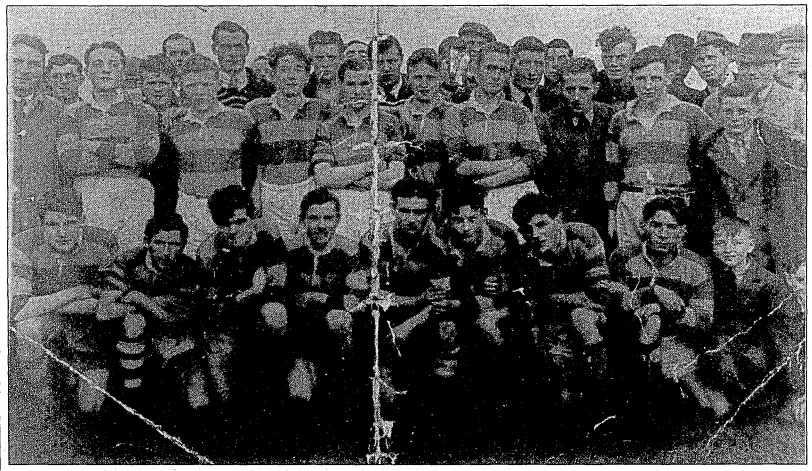
Father Kearney came to the parish and he said that he’d unite the all the teams in the parish. He got a cool reception in places. Paddy Ryan came from Newcastle and John Anthony Kelly came from Cussane. I can’t think of any others. I remember the meeting. You had to have a name before you could affiliate a team, so the team was registered as St. Marys, Athenry. We were lucky enough to win the intermediate hurling championship in 1957. I played in goals. Newcastle won it the year after. Then the G.A.A. brought in a rule that there could be only one senior team in any parish. So we had the grade made and that was the first St. Mary’s team. The first senior match was played against Carnmore in Kenny Park. I played in the forwards for that match. We won it well and the next match was against a combination of Craughwell and Ardrahan. There wasn’t much between the teams during the game. Again I was the goalie in that game. The next one was played against Gort and we won that fairly handy. I think that was the last game that Josie Gallagher played for Gort
Then I went to England. Athenry went on to the county semi-final and lost against Castlegar in a replay. During the 1940s there were great matches between Galway, Kilkenny and Cork. We had some great Kenny Memorial matches down in Daly’s field in Raheen between Liam Mellows and Castlegar.
Dancing
The best dances were the station dances. The musicians would come and play until daylight. They’d have to be sprinkling water on the floor to keep down the dust. They used to have a pot buried under the floor and if you were dancing over where the pot was you’d be told ‘dance or get off the pot’. You learned how to dance a ‘Half-Set’ there along with the ‘Verse of Vienna’, the ‘Barn Dance’ and the ‘Old Time Waltz’. The dancers went around the kitchen like spinning tops and never bumped into each other. When you went to the dance halls you were able to hold your own against anyone.
The parochial halls came about in the 1940s. There used to be great Ceili’s there. The best bands played there. If the parish priest caught you with a girl on your knee he could put you outside the door. The Galway Sheep Breeders’ Dance was a big night in Craughwell. You’d hardly be able to get in the door and there was no space to dance.
The Marquettes came then and the Showbands but they only lasted for a while. Hurling and football clubs used to run the dances. I think myself the showbands got greedy and in order for the clubs to get 40% of the takings they had to put their own man in the ticket office at the door to check the money. The dance organizers had to keep law and order at the dance, pay for the electricity and pay for the Marquette out of the 40%. It’s no wonder they didn’t last too long.
Goban Soar
The Goban Saor was a master builder in Ireland long ago. It is said that he built most of the old castles that you see around the country. There are a lot of stories told about him. He had one policy: always make friends with the women where ever he went and nothing would go on unknown to him. The Goban had a son who was serving his time with his father. They used to kill a sheep once every year, so this year when they killed the sheep and it was skinned the Goban sent the son to the market with the skin. He gave him strict orders to bring the skin home and the price of it. He told him the price he had to get for it. Off went the son to the market and he wasn’t happy. People were coming up asking what he wanted for the skin. When he told them they went away laughing. He was beginning to think the Father was making a fool of him. It was nearly evening and he was thinking of calling it a day. Just then along comes this lady who had a big bag on her shoulder. She asked him what he wanted for the skin. He told her but he said he had to bring the skin home to his father. To his great surprise she said ‘all right’. She sat down and took big clippers out of her bag and didn’t leave as much wool on the skin that would ‘blind your eye’. ‘Here’s your skin now’, she said. ‘I don’t want it’, she says to the son. So he went home to the Goban with the money and the skin. When the Goban heard the story he told his son to go back and find the woman and ask her to marry him, which he did. So that’s how the Goban’s son got the wife and she was the only one that was able for him.
There’s another story. The son had been a few years working with the father so he said to himself that it was time to give him a bit of a test. He brought him to where there was a heap of stones. He told him to build a straight wall with them. He had the wall built by evening time when the Goban came to examine it. He looked at it and scattered the stones all sides and told the son to come again tomorrow and rebuild it. So the next day he came and did as the father asked him. Again the Goban came at evening time and he gave him the same treatment. He told him to come again the following day and build it straight. By now the son was getting browned off. His temper was beginning to rise and he was in a very bad mood. When the cat looked at him he didn’t leave a leg on the half-door he went that quick out. His wife saw the puss on him. She asked him what was biting him and he told her the story. ‘Ah’, she said, ‘that’s no problem’. She was knitting and she put her hand into her knitting bag and took out a ball of thread. She said to him ‘you’ll bring that with you tomorrow and you’ll put a stone on both ends of the wall. Put the thread and pull it nice and tight and tie it around the other. Then place all your stones along by the thread.’ He hardly slept at all that night. He was up before the cock crowed as he couldn’t wait to work his wife’s plan. He had the wall built that evening when the Goban came. He looked at it and it was as straight as a dye. He asked the son how he did it and the son told him. The Goban said ‘I wonder does she realize what she’s done’. ‘What do you mean?’, said the son. ‘Well, I’ll tell you’, said the Goban, ‘from this day on any amadan can build a straight wall’.
And there’s another story. The King of Gwent, now know as Monmouthshire in south Wales, wanted to build a castle the likes of which was never seen before. So he sent to Ireland for the Goban, the Master Builder. The Goban agreed to build it and as always he made friends with the women of the King’s family. The King and his son were talking one day and the son said ‘what’s to stop the Goban from building a bigger one for someone else’. The King said, ‘I’ll have him killed when he’s finished the work’. The king didn’t know that one of the women heard the conversation and didn’t she tell the Goban. The Goban thanked her for letting him know and he kept on building. The women couldn’t understand it. He had built it up to the top. He’d go up every day and be moving this big stone around. The King asked him one day what was the matter that he couldn’t fix the stone and the Goban said to him, ‘I have a certain tool for putting that stone in place and it’s at home in Ireland. That’s the problem’. ‘I’ll send someone back for it’, said the King. ‘That’s no good’, said the Goban, ‘only the King’s son will get it’. ‘Sure, I’ll send my lad back for it’, replied the King. ‘All right’, said the Goban, ‘and tell him to ask for the crooked against the crooked against the straight’. Off went the King’s son and it wasn’t long before he arrived at the Goban’s house. The son’s wife met him at the door. He told her that the Goban had sent him for the crooked against the crooked against the straight. She thought for a minute and she said that it was upstairs. ‘Come up and we’ll get it’, she said. So up they went and she took the lock off a big trunk and opened it. ‘There it is’, she said and when he stooped down into the trunk she caught him by the legs and tumbled him in and slapped down the lid and locked it. She sent a messenger to the King saying if he wanted to see his son again he’d better pay the Goban and see that he came home safely. The King paid up and the Goban set the last stone and when the Goban got home they opened the trunk and let the King’s son go home.
No one could ever find out what sort of timber the Goban used in the castles he built. It was his secret. Anyway he was near death and he was going to bring the secret with him. But the son’s wife knew how she’d get it. He was on his last legs. She went into the room and whispered into his ear. She said that the King of the Woods was coming to see him that day. He opened his eyes and said, ‘the Gallant Holly’. So his secret was out and he knew it was safe with her and he died happy.
Transport
 When I was young transport was very scarce. The Second World War was on and petrol and oil were rationed. You couldn’t get a tube or a tyre for a bicycle so they started making solid tyres. However when you went around a corner the tyre flew off. They made other ones of rubber rings and they weren’t a big success either. Lads used to get two old tyres and stitch them together. The tubes were covered with patches. There were lads that repaired bicycles such as Willie Farrell who had a workshop where Rooney Monuments is today down Abbey Row.
Trains were very scarce with only one or two a week going from Galway When I was young transport was very scarce. The Second World War was on and petrol and oil were rationed. You couldn’t get a tube or a tyre for a bicycle so they started making solid tyres. However, when you went around a corner the tyre flew offto Dublin. Some of the goods trains were days late. The steam trains burned timber and turf but those fuels were unable to maintain the steam pressure to power the engine. When the pressure fell below a certain point the brakes came on and the train stopped. Then they had to try and raise the pressure again to get the train moving. I remember that there was a big reek of turf and timber stacked from the water tank to the station platform, all the way down to the signal cabin. When the beet season was in full flow Athenry station was a busy place with trains going all night to the sugar factory in Tuam.
A lot of lorries and vans ran on gas made from charcoal. Broderick’s bread van from Athlone used to come to Athenry every week and it too was powered by gas. Carbetts had two lorries and they used gas as fuel. Mick Kelly had a gang of workers up near Craughwell burning charcoal. Jack Brennan had a gang over in Caherfinesker making fuel out of hazel wood. So they just about kept ‘the wheels turning’ during the war.
Buses too were scarce on the roads. If you had a bicycle you could put it on the roof of the bus. I often saw the roof of the bus stacked with old bicycles.
When the Galway races came round many people who had a horse and sidecar made for Ballybrit race course. There used to be a shuttle service in and out from the city to the race course for so much a head. They had a harvest for the two days. There was a horse and sidecar race every Sunday morning up the Tuam road when they were going to Mass. There were the two Cullinanes, Willie and John Joe, and they had sidecars pulled by two big half bred horses. Tommy Madden had a lovely grey Connemara pony. Eddie Commins and Paddy Treacy had lovely covered traps. The Bohans had a horse and a big trap as had John Anthony Kelly’s father. It was the ‘Charge of the Light Brigade’ from Castle Ellen to Carnaun. However, most people walked to Mass.
Working for Farmers
Farm working methods have changed beyond all recognition since I was fourteen years of age in 1947. It was all hard manual work done with horses for ploughing and tilling. If you spent a day spring harrowing with two lively horses there would be no fear of you having trouble with your hamstrings. You were walking in the soft clay all the time. Ploughing with horses was a nice job with the seagulls rising up from in front of you and flying back over your head. You’d have a crick in your neck from the draught of their wings.
Ploughing
All that preparation work had to be done in early spring. In autumn the stubbles would be ploughed in the late harvest so that the winter frosts would break it up and make it easy to till in the spring for sowing the potatoes. The potatoes were sown where the corn was the year before. All the crops were rotated. The potatoes had to be sown before the Cuckoo came or you’d be late. When the drills were made you spread the slit potatoes and covered them with the spade. Then the dung was put out and spread with a fork. When that was done you had to spread the artificial manure and then close the drills. You’d knock the tops off the drills. When the potatoes came up over the ground you scuffled them and ‘landed’ them up. God had to do the rest.
Sowing corn and beet
Sowing the corn-wheat, oats, and barley was a quicker job as it was sown where the root crops were the year before.Everyone sowed an acre of wheat at that time. ‘White Standup’ was the best for making flour. Before you sowed the wheat you had to spill it out on the barn floor and spill a bottle of cold tar on it. You then kept tossing it until every grain was black. You had to shake the tarred seed out of a bucket and you can imagine how your hands would look after that work. The Tar was put on the seed to stop the crows from eating it. When you had it spread on the clay you harrowed the ground to cover it. Sowing the oats and barley was easier. You’d get a sheet and tie the two corners and put it over your shoulder and make a ‘prascin’ out of it. You filled it with grain and walked forward scattering the seed left, centre and right. It was important that the corn grew up evenly with no empty/bald areas or else you’d be the laughing stock of the farming community. Barley was harder to spread than oats. Ten stone of ‘Yemer’ seed would sow an acre whereas you had to have thirty stone of oatsto cover an acre. Beet had to be sown as well. For each acre sowed you four stone of sugar. Where there was a few lads in the house they’d all sow an acre so they all got four stone of sugar during the war when sugar was rationed. Beet pulp, the stuff left after the sugar was taken from the beet, was great feeding material. However, you had to scald it before feeding it to the cattle and calves. It was mixed with crushed oats or rolled barley for sheep. It was very sweet.
Lambing time
Lambing time was another busy job. You could be out most of the night and end up bringing a lamb into the house and leaving it on the warm flagstone beside the fire to keep it warm. There was always a bottle of ‘Poitin’ at hand during lambing time. You’d open the lamb’s mouth and put in a spoonful of poitin and that would warm it up for sure and the creature would soon be standing. You could do with a ‘shot’ of it yourself when you’d be out on a frosty night.
Turnips, mangolds and turf
Turnips and mangolds were sown too and there were ten to twenty drills of Aberdeens, which were large white turnips. You’d bring home a box of them, tops and all and when the cows were milked you gave out two or three to each beast. If you gave them to the cows before milking them you’d get a taste from the milk. Around the end of April you put bags on your knees and go thinning the beet, turnips and mangolds. People used to help each other at that time. If you had your own beet thinned you’d give a day to the neighbour or the other way round. When the beet got to a certain stage it was scuffled and ‘landed’ up. By then you were coming into the summer and the turf had to be cut with a slane. It was filled into special barrows and wheeled out in rows. It was then ‘footed’ and saved. The potatoes had to be ‘landed up’.
Saving the hay
The hay was cut with a horse and mowing machine. It was turned by hand using rakes and hay forks. When it was fit to ‘tram’ it was made into rows using a ‘tumbling rake’. After that it was gathered up and made into ‘tram cocks’. The cocks had to be raked down the sides to stop the rain from getting into the hay. Then ‘sugan’ ropes made from the hay were made and tied over the cocks to stop the wind from scattering the hay. Sheep shearing had to done. The animals were dipped to keep away the blue flies. Noxious Weeds on the land such as thistles, dock leaves and ragworth were cut down. Farmers could be summoned if they were found to be growing on their land. All that is gone now. The fox wouldn’t go into some of the fields you’d see now. You’d be shoving near harvest time and the hay was brought into the haggard and made into what they used to call ‘sheep cocks’. A big pole was stuck into the ground and piles of hazel rods were placed on the ground around the pole to keep the hay up off the damp ground. The sheep cock was made around the pole. By the time the hay was in it was time to cut the corn.
Harvesting the corn
There was reaping gear for the mowing machine that cut the corn. There was an extra seat over the wheel and there was what was called the ‘creel’, which had a step on it where you put your foot and let it up and down. You used a ‘knocking’ rake to keep the corn tidy on the ‘creel’. When you had a sheaf you let up your foot and let the sheaf go. A lot of corn was bound by hand. You made a ‘double band’ so you wouldn’t be tying the seed. When it was bound, ‘stooks’ were made of it if the weather wasn’t good. It you got a fine day it was made into ‘hand stacks’. If you made it that far you’d be fairly safe. After all that work the job was nearly done. Stands for the corn were fixed up. There were six large square stones standing around in a circle and one in the middle. There was a round stone called the ‘cap’ stone. There was one for each upright and you had to put one up and balance it on top of each upright. Then you got good strong timbers and put them from one to the other and one from each on to the one in the middle. These timbers were covered with heavy branches with the light ones on the top. The stack of corn was built on that base. Rats couldn’t get at it unless someone left something leaning against it. Those stacks wouldn’t be threshed for a while. A few stacks of wheat, oats and barley were made on the ground but they were threshed immediately. Straw was used to thatch the cocks of hay and corn. The Galway races were over by then and you took an ass and cart to the bog. The turf was stacked by the roadside. If you had time it was brought home with horses and carts. If you hadn’t time you hired a lorry. You filled it yourself and at home you emptied the load, all by hand.
Potatoes and Beet
At the end of September and the start of October the potatoes were dug out. The drills were scuffled and then split with a double plough. With bags around your knees off you went on your hands and knees and ‘crubbed’ out the spuds. Three drills were made into one to make it easy to pick them. They were put into a pit and covered with straw. When you had them all dug you tidied up and covered them with clay to protect them from the frost. Then the beet was pulled, crowned and put out on to the roadside ready to be loaded into wagons at the railway station. When you got your order it was done with horse and cart. If you had a fine day it was alright but if you got your order no matter what sort of day it was you had to fill your wagon. When the beet was done you had pull the turnips and mangolds and cover them for the winter. After that you started ploughing the stubbles and it would be easy to till come springtime.
Winter work
During the winter work involved odd jobs like remaking walls, trimming around headlands and trimming bushes. There was always some job to be done. Cows and calves, pigs and horses, all in stables, had to be cleaned out every day and fresh beds put in for them. You had to put a bag on your knee and with a big knife slice turnips for the cows. The horses were each given two large mangolds; a manger of hay was given to both horses and cows. A big pot of spuds had to be boiled for the pigs. This was nearly always done at night when the help was there. The pot was hung on the crane and filled with a bucket of water. There was a big tub and you ‘fired in’ a bag of spuds and a couple of buckets of water. You stirred and rattled the lot with a large stick and that washed them. You picked out some of the nice ones for your dinner. You got your buckets and brought in the rest and ‘maoled’ up the pot. It was then covered with a bag and as the spuds were boiling the large thongs was fetched and they were belted down. It took two men to take the pot off the crane and bring it up to where it would be mixed up. You mashed in crushed oats and maybe a shovel of Indian meal. Everything was given some of that mixture and that would put a ‘shine on their skins’.
Pisreoga
There were a lot of Pisreoga in use when I was a lad. Most seemed to be centred around May Day.
If you were going on a journey and the first person you met was a red-haired woman you had to turn back as she was bad luck.
Entering a house and the woman was churning, you had to take the handle and give it a few twists.
There were people who could take your crops. They’d go out on May morning and put eggs in your potatoes. I saw them among the potatoes afterwards and they were all rotten. There was a special day in Esker for blessing the seed. I
heard a story of a man who went to buy a cow. He had the bargain made but hadn’t paid for it. He had to fetch something so he told the seller that he would be back in a minute. He went around the corner but something told him to turn back and there he caught the seller milking the cow down on to his boots. A row arose and the buyer said that he could bring home the cow as he was going to bring home the milk. This family had a cow and she was due to calf. The father sent the son to see if the cow was alright. When the son got to where the cow was didn’t he see this man and he’d drawn the cow’s teats. A few days later the cow calved but she didn’t have enough milk for her calf. The son told the father what he had seen the lad doing to the cow. The father went off to Esker and told the story to one of the priests. They gave him a bottle of holy water and told him to shake it on the cow and didn’t the milk come back to the cow.
It’s not many years ago there were eggs put in the hay in the ‘Farmyard’. Canon Heaney was parish priest at the time and he was told what had happened. I remember he gave a sermon about it at Mass and said that God wouldn’t destroy anyone’s crops and that there was only ‘one other’ that had that power
That time the cows were milked by hand. When you had the cow milked you dipped your finger in the froth of the milk and made the sign of the cross and on the cow’s hip to keep away evil.
I heard a story about this lad and he was fairly handy. He could put a pair of half soles on a pair of boots or shoes. A man came to him and asked him to put soles on his boots. He had the leather, the tacks and studs. The lad spent the night putting on the soles and when he went to put on the studs there was an uneven number. So he had to put one more on the boot. He was out walking early on May morning and after a while he went to where he had the spuds sowed to see if there any sign of them coming up. He saw where the clay had been disturbed, so he rooted down with his hand and found an egg. He searched some more and found foot prints. He examined them. He saw the amount of studs that was on each sole so he knew who the culprit was. He said that he’d give him a dose of his own medicine and he buried the eggs in that man’s field.
Pictures (Films) in Athenry
During the 1940s I remember a man used to come from Strokestown in County Roscommon and show films in the Town Hall in Clarke Street. The films used to break down a lot on him and when he couldn’t get it going he’d give you back your money or a ticket for the next night. Richard Murphy started showing films such as ‘The Bad Man from Brimstone’, ‘Hopalong Cassidy’, ‘Tom Mix’, ‘Buffalo Bill and the Indians’. We saw Diana Durbin who was a wonderful singer, Nelson Eddy and Janette MacDonald, Roy Rodgers and his horse Trigger.
It was 4 pence, 9 pence and 1 shilling and 3 pence to get in. To raise the cash to go to the pictures we went around the dumps and searched for stout, lemonade and small baby Power whiskey bottles and jam jars. You’d get 1 penny for a two pounds jam jar and a ½ penny for a 1 pound jar. We brought them to the pump or the river and washed them. We stopped when we had enough money for the films and five Woodbine cigarettes. We sold them to P.J. Duffy at the Arch. That’s the way we earned the price of the pictures most of the time.
Travelling Dramatic Players
Andrew McMaster Players
Andrew McMaster and his players came nearly every year to Athenry. They put on Shakespeare stuff that was fairly ‘heavy going’.
‘Bam Boozealem’, the magician, was another great show. He’d hypnotise a person and put him or her doing all sorts of things. He had a kettle and he could give you any sort of drink you’d ask for. Another lad could play a lovely tune on a handsaw. They had great variety in the shows along with some smashing singers.
The Shannon Players
The Shannon Players were a wonderful group. They’d put on a different play each night and some variety acts after the play. Each player could perform his or her own special act of singing or playing an instrument. There was nearly always a comedian in the show who would come out and tell jokes and funny stories.
McFadden’s Players
This group also came to Athenry every year. They used to set up in Payne’s Hall, Cross Street, opposite where the New Park Hotel is today. They showed films and put on some variety acts too. They showed film serials each night. I remember they showed ‘The Clutching Hands’, ‘Burn up Barnes’ and ‘The Lost Jungle’. Before ‘The Lost Jungle’ was shown a map would come up on the screen and you’d hear that ‘The Lost Jungle’ was an island where Lions, Tigers, Bears and other animals lived together. How did they get there? Scientists tell us that Asia and Africa were once joined together by land which later sunk into the Atlantic Ocean and only the tops of the mountains remain. The film would start from there.
Clyde Beatty was the star and he played the part of the animal trainer. Each episode always ended with him in trouble and the words ‘what will happen to Beatty?’ Later on they moved the venue to Taylor’s field where the town park is now. They used to have pictures and a variety show. Liam Ivory was with them and an Usher girl. She and Liam had a country and western act. He played the piano accordion while she played the guitar. They both sang and he would yodelled. They were a wonderful act.
They also held a talent competition and that’s where Derek Kennedy made his debut. He won the competition with the song ‘St. Teresa of the Roses’. Harry McFadden came to town later on Lady Day, the 15th of August, with amusements like chair-a-planes, swinging boats and bumpers.
The Athenry Players
Of course we had our own group of players who put on terrific plays such as ‘The Plough and the Stars’, ‘The Righteous Bold’, ‘The Dark Stranger’, ‘The Playboy of the Western World’, ‘Sive’ and many more. The group had many talented actors such as Kitty Lardner, Christ Howley, Mick Fahy, Jack Cunniffe, Christy Barrett, Tom Armstrong, Detta Fahy. I couldn’t count them all.