APH
APH
Catching Rabbits
Rabbits were very plentiful when I was a young lad. We caught them with ferrets, snares and dogs. All the large coverts of furze are long gone as are the sand hills where they had big burrows. We used traps to catch them there. We came the day before and blocked all the holes leading into their burrows. The following day we returned and set traps in every hole that was open. We stayed up all night to mind them as foxes were abroad and when they would hear the rabbit squealing they wouldn’t be long coming on the scene. When a rabbit was caught in the trap you had to take it out and set it again.
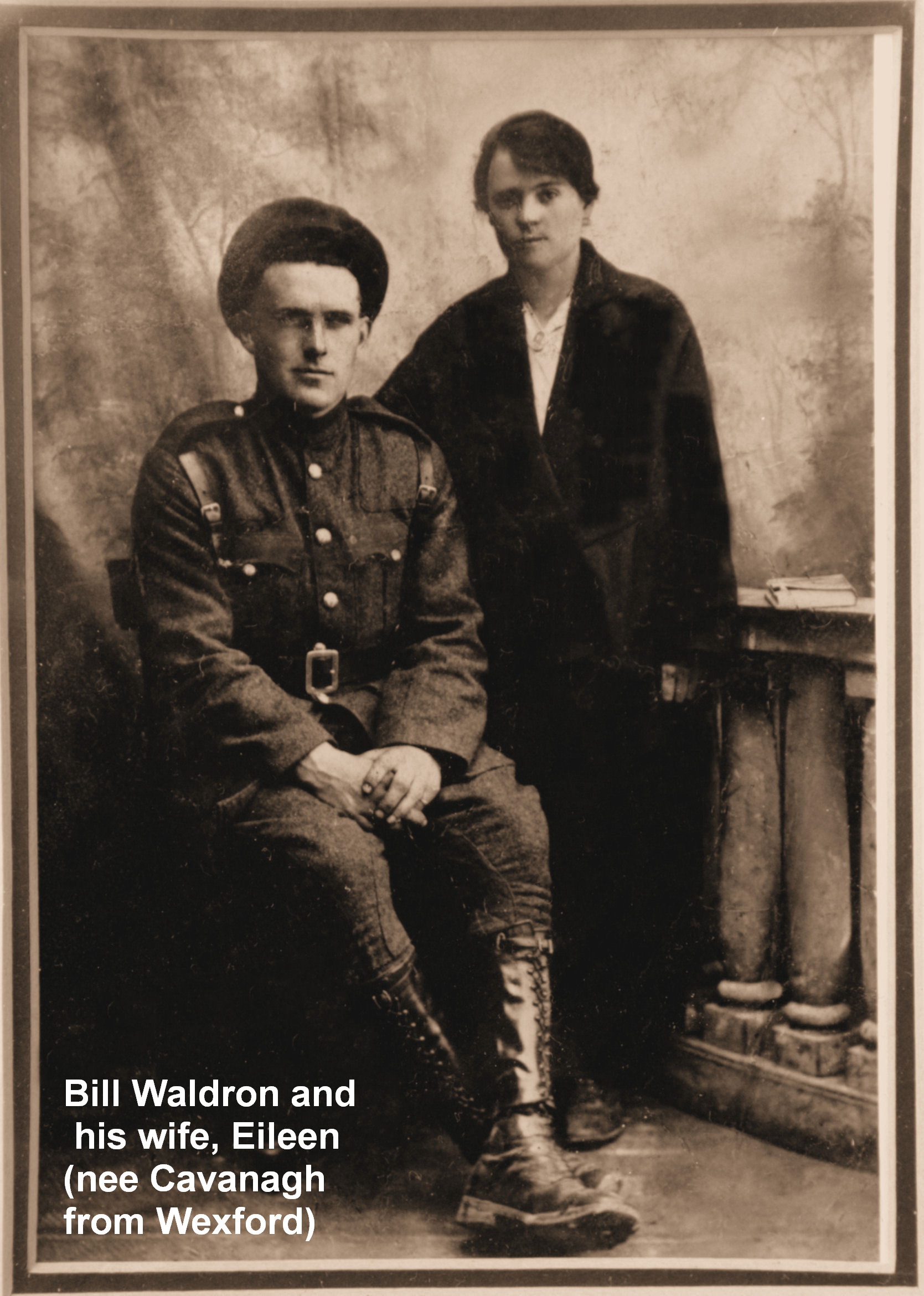 I remember my father, Bill Waldron (left), spent a week down in Kinuisce on the Galway/Tuam road. He stayed in an old barn belonging to Mick Casserly, who was known as ‘small’ Mick. He came up on Saturday morning and got Broderick’s pony and cart. He brought me with him when he was going back down. I remember every pillar outside houses had an alcove and a statue in it covered with glass. It wasn’t so long after the Eucharistic Congress. When we arrived down below he had all the ropes tied from one side to the other. The rabbits were braced in pairs and hung on the ropes. We had a full load of wing boards and all. We had a mighty pile of rabbits and we got 2 shillings a pair. It would have taken a month to earn the same amount at ordinary work.
We also took trips down to Mick Broderick’s in Cloonavadoge where there were big coverts of furze. The place was ‘shaking’ with rabbits. The railway ditch was another great place to hunt for them. At that time Mick Broderick had a field of turnips between the railway and the furze. He had a ‘scrape’ of ploughing turned all around the field and net wire let down in it. The ‘scrape’ was turned back and the net wire pulled up and tacked on to stakes. However, the rabbits bored their way under it and when we later looked at the field we thought 20 sheep had been in it what with all the turnips that were pinched by the rabbits. We used to set around 300 to 400 snares all around the turnips and the furze. When they were set we returned to the railway bridge.
Mick always brought us in for the tea. Afterwards we’d go out again and we’d hear the rabbits being caught in the snares. At 12 o’clock we’d do a turn and take any of them that was caught out of the snares and reset them. We always had a spade with us and when we had them all collected we dug a hole and ‘panched’ (gutted) them into it and covered up the guts. We braced every two together and wait for a while. When it would be getting near dawn we’d do a final tour of the snares. We gathered the ones that were caught, pulled the snares up and tied them together. We seldom missed a snare as we usually set them in a direct line.
We made our own snares and nets for ferreting. We often spent a fortnight of nights making snares. We bought rolls of snare wire and strong white twine in Corbetts. We put six wires in each snare. We cut the wire twice the length of the snare and then doubled it. Three of them were put together and we put a pencil in the loop. We had a lid of an oven and we put the pencil with the wire around it, through the top of the lid while we held the other end of the wires. We gave the lid a good spin and that spun all the wires together. We took it off the lid and the pencil out of the loop. We put the other end through the loop on that side for the twine. We cut the twine and made a double and we put the double side through. When we had it through the double end we pulled it tight. We knotted the ends of the twines together and got a peg to drive into the ground.
With the peg we cut a v-shaped notch out of it all round the top to hold the twine. We made a loop on the twine and put the peg into it and tightened it. Then we made our setting peg using hazel rod pegs, which were very hardy. We cut it to the length and put a point on one end and then took a slice off each side at the top. We put a little split with the knife. When setting the snare we put the wire into the split on top of the setting peg and that held the snare in place. We made a lot of nets for ferreting (ferret pictured left). No matter how many holes were in the burrow we had nets to cover all of them. All we needed were two rings and good strong chord. My aunt brought home strong cotton chord from England where she had been working in a cotton mill in Manchester. All we had to do was to put a ring up on the wall. We cut the chord twice the length we wanted for the nets. Then we doubled it and put the double end through the ring. We put the other two ends through the double end and tightened it on the ring. We continued on until the ring was covered. Then we started knotting. If we started from the left we left the outside chord and knotted the next two. How far we left between the knots determined the size of the squares in the net. We kept going until we came near the end of the chords. Then we tied them all on another ring. We made a running chord that was threaded all round the net from one ring to the other. The two ends were knotted together and a small peg was put on it.
The net was spread over the burrow and the little peg stuck into the ground. When the rabbit raced out of the burrow it went into the net and it closed around it. When the ferret was after a rabbit under the ground we could hear the noise. We knew from the level of noise if the ferret had caught the rabbit. If it did we pinpointed the place by listening with an ear to the ground. Then we got the spade and dug down at that spot. If we were lucky we got the rabbit or sometimes three or four of them. They were usually at the end of the burrow.
Calm weather was needed for ferreting while frosty weather was even better as there would be no breeze and we could hear the ferret underground. When ferreting in ditches we needed two persons, one on each side. The best places with long ditches were in Knockbrack and down in Park in Fahys and Feeneys. The fields weren’t too wide and the rabbits played havoc with the corn. There used to be a large section on each side of the field that was not worth cutting. Pat Healy and Mick Lally regularly contacted my father and asked him to go down and catch the rabbits. There was no talk of cruelty to animals at that time as it meant putting food on the table and catching rabbits did that.
Cutting and Saving the Turf
I went to the bog in Cloonkeen at a fairly young age. My job was to get off the cart at the village and fetch a can of water from Harte’s well for drinking and making tea. Tea was scarce at that time but you could get it for 2 shillings and 6 pence an ounce on the ‘black market’. My father used to cut and save the turf for Pat Holland’s father and Micko Cronnelly. Both men had their turf at the same bank. He cut, footed and clamped it and put it out on the road. Micko brought his turf home in a lorry that he was driving for C.I.E. Pat Holland used two horses and carts with creels to carry his turf home. You’d bring a twenty foot reek home in four loads. If you were early you’d bring three loads but with the work so hard you wouldn’t be talking too much. Hollands had a lovely cream coloured Connemara pony and was he some animal. We used to pass out lads on bicycles coming from the bog. The roads weren’t tarred that time and we had a rubber-tyred cart. All you’d see was a cloud of dust as the pony sped down the road.
The bog was a lovely place when the weather was fine. When I was 13 or 14 years old I found out what it was like to really work in the bog. I was sent to clean the bank by taking off the top ‘scraws’ first. The only way was to cut it in squares with a hay knife and with your spade’s sharp edge you’d go in underneath and turn it up. When you had a piece of it done you used a fork to pitch all the ‘scraws’ out beyond the boghole. When you had that done you got the hay knife again and cut it into big lumps. You started on the opposite side of the drain so you’d drive the water before you as you cleaned the bank. When the bank was finally cleaned you levelled out the boghole. Then you got the ‘scraws’ and turned them upside down on top of the cleaned bank and laid them out like tiles. If you were short a few you had to go up on top and cut them.
I was with my two uncles when they were cutting the bank. It was six perches long and it was eleven yards to the perch in the bog. The upper was taken off first. I had the job of filling it into the barrow and wheeling it out until I met the uncle coming in. You had to leave room for the bottom inside. Each bench of turf was cut with a hay knife so all the sods were the same length. The work was grand until a shower of rain came down and you had to turn the barrow up and took shelter under it until the rain passed.
While working, you’d be listening for the skylark. The skylark was a great weather forecaster. If that bird went up singing you could be sure the weather was going to clear up. Each morning on arriving in the bog the first thing that was done was to put the bottle of milk down into the water drain to stop it from turning sour.
Then we worked away until twelve o’clock when it was time to start the fire and boil the kettle for the tea and the duck eggs. When smoke rose up from one bank it was only minutes before smoke was streaming up from all the other banks where the people were also cutting their turf. Two lads kept working away while the other one was making the dinner. Soon he had the brown cake cut, the tea wet and the eggs boiled. He gave the ‘shout’ that it was ready. He hadn’t to shout the second time as the bog was one place that gave you an appetite. When the dinner was eaten you started off with no break until half past four. The fire was lit up again and more tea was wet and eggs boiled for what was called the ‘Rushin’. When that was eaten you worked away until seven or eight o’clock.
That was the time you’d hear the Jacksnipe, the Grouse and Cuckoo. The bog was a very peaceful place during those years as there were no big machines and Bord na Mona hadn’t started. When the upper bank was cut you entered the bottom section. The wheelers had it easier as they hadn’t to go far. You could spread a lot of it with the fork. You just left enough room for the dam as that was what was left to keep the cleaning from falling in. It was always one sod in. When you had so much of the bottom turf up you put a dam across the bog hole. You threw up the dam as far as where you put up the dam across the bog hole and then you continued on cutting the bottom. You repeated the same thing until you had the whole lot done. By that time there was turf spread out all the way up to the bog hole.
If the weather was fine for a fortnight you could start stirring it. If the weather was right good, and if you were stuck for time, turning was a good plan. You’d have it stirred very quickly. If you got a couple of weeks anyway of middling weather you could make big ‘duchains’ of it and you were safe then. But if the weather wasn’t good you were better off making ‘grogins’ as there was a better chance of drying it than if you turned it upside down. If it was spread right and only three rows on the barrow-that would each take 18 sods in all-it was easy enough to save it. It was put out then on the roadside using a donkey or pony and cart.
By that time it was almost September. You’d make two runs to Carnakelly with the two horse carts with creels and you wouldn’t be long in bringing it home. When I visit the bog now I don’t hear the Skylark, the Jacksnipe or the Grouse. The Cuckoo is seldom heard and I think we are witnessing her demise. The work in the bog has changed dramatically and you won’t see any smoke rising from the banks now but rather the roar of the giant turf-cutting machines.
The Cuckoo
All through this day I hear a song.
It’s just two tuneless notes.
The blood goes coursing through my veins
As o’er the fields it floats.
There’s one thing I’m sure of now
When those tuneless notes I hear,
Winter it is over
And spring at last is here.
The violets and the primroses
Now their rainment is supreme.
The May bush bud is breaking
And the chestnuts getting green.
The sycamore and the Elm
Now take on an emerald hue,
And the thrush’s song gets loud and long
When she hears the Cuckoo too.
The swans are nesting on the lake.
Oh, what a regal pair!
The hoarse crow of the pheasant
From the woodland now you’ll hear.
Now all things seem to come to life
That winter’s frost had smote.
As the life sap springs within all things
When they hear the Cuckoo’s note.
A Faragh hits the farmer
When the Cuckoo’s note he’ll hear.
The spud they were a fortnight sowed
When I hear that bird last year.
I better get a move on now
Or I’ll end up in a fix,
And he goes to bed with a restless head
And sets his clock for six.
What changes will the Cuckoo see
Since the days of yore?
Will she miss old Ned with his grey old head
As he leant on his half door?
Or will she miss the ploughman
With his sweating straining team
Or the hoarse croak of the Corncrake
From out the meadows green?
Or will she miss the milkmaid
With her three-legged stool,
Or the gossoons with their sods of turf
As they make their way to school?
And will she miss the old mill
Where the ‘caiscins’ once were ground,
Or the travelers with their ass and cart
And three quarter bred greyhounds?
The country is gone crazy now
For there’s noise everywhere.
There’s ‘artics’ thundering down the roads
And there’s jet planes in the air.
How Mother Nature deals with this
Is my greatest fear,
As I wait and hope to hear the Cuckoo’s note
At the dawning of next year.
Pitch and Toss
We had some great ‘schools’ of ‘pitch and toss” in Athenry when I was a young lad. They were held down in the Ball Alley in Abbey Row or down where Rooney Monuments is now. That place was covered with sawdust which was dumped from Taylor’s sawmills up beside the castle. If you were playing there you’d want to have old Queen Victoria or King Edward pennies. They were great for sliding in the sawdust. The game went like this. A stone (called a ‘bob’) was got and placed on the ground. You took ten or twelve good steps back and made a stroke line on the ground. Everyone had to pitch from there. Whoever got nearest the ‘bob’ got the first toss. There were lots of arguments as to who was nearest the ‘bob’. To try and settle the matter a bit of a ‘trainin’ was got and the pennies were measured. The nearest corner of the ‘bob’ to the nearest edge of the penny won. Often they couldn’t be separated, so whoever was measuring tossed a penny and whoever won got to toss first. If there were six lads pitching he got six tosses. When he tossed he had to keep all the ‘heads’ and whoever was second picked up the ‘harps’. If there was one toss that came up ‘harp heads’ you had to toss them until you made ‘head’ or ‘harp’ of them. Then the next lad had to toss the ‘harps’ that the first lad made. When the tossing was going on there were bets made on whether they might be ‘heads’ or ‘harps’. Most lads wanted to bet on harps. You could only ‘head’ a toss once, but you ‘harp’ it ten times.
There was great skill involved in playing the game. I often saw a penny touching the ‘bob’ and along would come a lad and knock it out with the first pitch and land inside it with the next one. Another time there could be four or five pennies around the ‘bob’ and the last lad would come and slide in his penny and put the pennies on all sides. That’s when the row started as to which penny belonged to whom and it could go on for half an hour. In the end it would be sorted out. Everyone had their own ‘tosser’, which was a nice little flat board. Others used a hair comb. Everyone had their own style of tossing. To toss you had to send the pennies higher than your head. If a penny fell off the ‘tosser’, you could bar the toss and if it hit someone coming down you were allowed to toss them again. Sometimes you’d be nearly ‘broke’ and suddenly your luck would change. I often saw a lad that was ‘broke’ and another would give him two pence to pitch and, if his luck was in, he’d make a ‘comeback’. There was never too much money won or lost because we didn’t have a lot of it. However, the very older lads who were working had big money. Sometimes one of them would lose their week’s wages. Pitch and Toss can be a nice game but it can also be a curse.
First piece of music you bought
I never bought any music. All the music at that time was on old 48 records and only a few people had them. They’d bring it out on a Sunday after dinner and play the records. The ‘Aughrim Slopes’ and the Ballinakill Band were the best at playing traditional Irish music. The Flanagan brothers were terrific players. They also had funny songs like ‘The Peeler and the Goat’, ‘The Piper who went to the Party’, ‘The Donegal Widow’ and ‘Getting rid of the Beanshee’, all of which was great sport. There were no tape recorders at that time so you had to make a record.
We had great singers like the famous John McCormack. Delia Murphy was a great singer too. I heard foreign singers such as Nelson Eddy, Jeanette Mac Donald, Diana Durban, Richard Tauber, Jack Doyle and Mavita. Before you bought a record you’d have to have a gramophone to play it and they were very few of them around.
There were no tape recorders like now. Nowadays you can buy CDs and play them at home. It’s easier now for musicians and singers to make recordings today.
Music would you choose
I’d choose all the music of the Ballinakill and Aughrim Slopes Ceili Bands. They were the first to make records of Irish Music. They composed a lot of their own tunes and they played tunes that were handed down to them from their grandfathers and great grandfathers.
The old Aughrim Slopes were returning home one morning. They were coming up Doon Hill when the car ran out of petrol. The lot of them took out their instruments and started playing and in the end they composed a new tune called ‘Doon Hill’. It’s still played today.
All the bands had a singer. I remember Pat Corbett who sang with the Aughrim Slopes. Our own John McCormack was a lovely singer, the best in the world. And I loved Paul Robeson singing “Old Man River’. There would be a lot that we never heard because radios were scarce back then. There were no transistors and you had to have a long pole out in the garden with a wire coming in the window and into the back of the radio. The radio was powered by two batteries, one wet and the other dry. Most of the time the batteries would be spared for listening to the news and the big match on Sunday.
Card Playing
 Card playing was very popular when I was young, more so out the country than in the town. During October and November there were always big games. Turkeys and geese were reared on most farms and people came to the houses to play for them. The nine players were divided into three sets of three. Each nine was divided into three sets of three, each of which played as a team. The usual prizes were three turkeys or three geese so the winning three players each got a bird. Whichever three players got to five games first were the winners.
It was a tough game to win as the old lads who had spent years playing could nearly tell what cards you had in your hand. They could remind you what cards you played so it was no good trying to ‘renage’ or cheat. As the hands of cards were played they knew which ‘trumps’ that were gone and the ones that were left. When you were playing against those boys you had to keep your eyes open.
I remember we had two great nights of card playing for a pig that was fit for killing over in Martin Morrissey’s in Moneytigue. There were two sets of nines. I was only a young lad and nobody wanted to play with me. Tommy Kinneen said he’d play with me, so myself, Tommy and Mick Flaherty were partners. We first played for three turkeys and six cocks and we didn’t get a ‘look-in’. However, when the game for the pig started I got ‘cards in bundles’ and, best of all, I nearly got a trick for each one I played. We ‘walked’ the game for the pig. The lads who won the turkeys and the cocks said they’d put so much money with the fowl against the pig we had won and that we’d play for the whole lot. So the bargain was made and we could put the money in our pockets and play for the rest. We won the lot. Then three lads said they put up so much money against the cocks, so we said ok. They won that game. Now they said they’d put what they had just won up against the turkeys and we agreed to play. We won them back again. That went on all night and they couldn’t win the pig back from us. We cross played for the cocks and turkeys. There was a ‘let in’ along with us. Mick Flaherty won the cocks and Paddy Burke won the turkeys. When we went ‘cross playing’ for the pig, ten players were ‘let in’ to play for it. That meant there were ten hands of cards being played and you’d want to be able to count the play and how the score was going. It wouldn’t do to ‘hit’ someone and let the game ‘out’. Two games we had on him and it went on for hours.
It was twelve o’clock the next day when it finished, so he said we’d have another game some other night. Tommy Kinneen won him so he said we’d have another game some other night. The following Friday night was agreed for the game and all the same lads turned up again. I remember Tommy Kinneen let me play for free as he wouldn’t take any money from me. It was the same partners again and whichever team won five games would be declared the winners. There was a barrel of porter on tap so no one went thirsty. We won the pig again for the second time. Then there were ten single hands for what they called the final ‘scubin’. John Kennedy won the pig. He killed him before he took him down off the cart. I remember the day after when myself and the uncle were pulling turnips. When the dinner came we ate it and both of us fell asleep as we weren’t in bed the night before and we were exhausted.
We also had wonderful games in the uncle’s house in Mulpit. There was always a great flock of turkeys as prizes. There were ‘tight’ games but everyone won a bird. The lad who got the last trick gave a ‘belt’ to the table and shouted ‘that’s feathers’. After playing for the fowl we played for three Aran jumpers knitted by my aunt and grandmother. There was more demand for the jumpers than the fowl. I remember Tony Murphy wanted to know if the women had any jumpers knitted so they could have a game for them. Sadly, all the players are dead and gone and I’m beginning to understand how Oisin felt when he returned from Tir na nOg.
Fishing
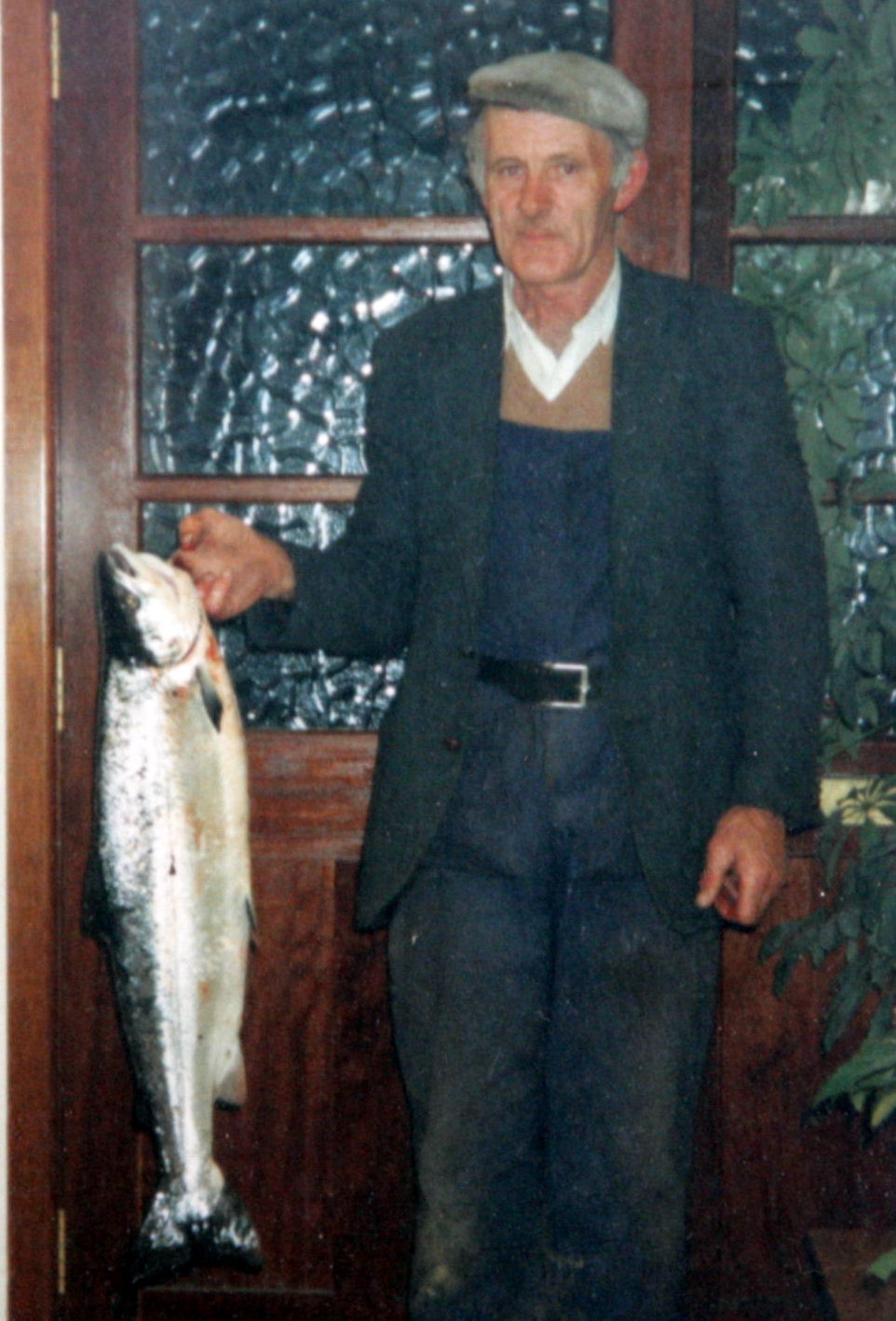 The first place I went fishing was in CahertubberLake which had Roach in it. I had a rod made from a cane which I got in Miss Powell’s garden. (Gerry Holian lives there now). I bought the line and hooks in Browne’s shop in Bridge Street. I made the eyes for the rod out of bits of wire and I wound hemp around them and covered them with glue or nail varnish the way it wouldn’t come off. If a lad didn’t have a reel he got a piece of board and fixed it to the bottom of the cane. Then he got a big spool and put a nail through it and nailed it to the board. He wound the line around the spool and brought the line up and through the eyes. No lead was needed. A cork was tied on to the line and a piece of bread put on the hook. The hook was fired into the water and all eyes were on the cork. When it was pulled under the water you knew you had one caught. On a good day you could catch a bag of them in a couple of hours. They were alright to eat but there were a lot of bones in them. Where we used to fish is now all closed in with reeds. The level of the lake dropped when they deepened the river. We also used to fish in the Clarin river out along Gort na hAbhann and Newford.
The Clarin was a great river for trout. At that time I often saw Pa Hall’s father fly-fishing just above the Mill dam and sometimes he caught two on the one cast. He used to do a lot of fishing for Pike up in Raford where there are some very deep pools. Rashin Turlough was another terrific place to catch big pike.
Myself and Paddy Mulkerins often cycled down to the Kilaclogher river to fish for trout, some of which were on the small side. We always used worms as bait. The amount of lead you used depended on the flow of river water. Sometimes you let the worms float off with the current into the deep pools and let it settle there where you had a great chance of catching one. If there was any take at all on the line you had to have patience. The old Irish saying: ‘eist le ceol na habhann agus geobhaidh tu breac’ rings true here because if you sit quietly down and don’t be moving about you have a better chance of catching fish.
One day I was down by the Ball Alley and I met Gerry Collins. He said to me to keep the guts of any rabbit I caught for him as he wanted to go ‘bobbing’. He told me that Dominic Murphy had seen big eels fighting at the MillBridge, which was used as the town dump at that time. I had my dog, Bruno, with me and off we went to Madden’s ‘cala’ and it wasn’t long until he ‘rose’ a hare. After a bit of a hunt Bruno caught the hare. Gerry Collins was staying in Joe Howley’s house and I went in with the hare. He was delighted. ‘We need a few rotten eggs too’, he said and I wasn’t long in fetching some ‘gluggers’ and nest eggs from my uncle in Mulpit. The problem then was to get them to Athenry without breaking them. It was like carrying a bomb.
Eventually, I got back to Gerry. He had the ‘bob’ made out of the lungs of the hare. He had it tied up like a ball. He had seven hooks in it. ‘It’s a little early’, he said, ‘we’ll have a cup of tea first’. Peig, his wife, made it for us. After the tea we went to where the gate of the old boys’ school was as there was a flat stone sticking out of the water. He told me to break the eggs on the stone and let them run into the river. Well, the eels must come from as far away as Clarinbridge. They were coming out of the water and up on to the stone to get the egg shells.
Then just like you’d clap your hands they vanished and then we saw a wave coming up the river-the ‘king’ of the eels-the ‘Big Fellow’- arrived. He grabbed egg shells and devoured them. Gerry let down the ‘Bob’ to him and he ate that too. Gerry started to reel him in immediately. He gave the ‘king’ no chance to wrap his tail around the stone. The rod was bent but he landed him up on to the road. The road wasn’t tarred and the “Big Fellow’ was rising dust. You’d be afraid to go near him. But then who comes around the corner of the bridge but Mick Goode. He had a stick and he always went in a little ‘sudder’. He gave the eel one ‘cnap’ of the stick and he killed him ‘dead as a door nail’. Word flew about that the “Big Fellow’ had been caught. We hung him on the gate and he was so long that his tail came down the steps. Who was going to get him was the next question. Paddy Nolan wanted to have him to eat as eel flesh was supposed to relieve pains in the joints. Tom Cleary, who was Jimmy’s father, wanted to skin him to make razor straps. I don’t know how they got on with him. All I know was that I was delighted to have played my part in catching him.
There were a lot of fishermen in Athenry at that time. All the Collins used to fish as did John Crosby, Mick Hall, Pa Hall, Ned Kennedy, Mattie Ryan, Frank Hynes, Christy O’Grady’s father, Tommy Ryan, Paddy Mulkerrins, Paddy Gardner and Mick Goode. Mick used to be after us when we were young lads. When he’d see us coming with onion bags he used to hate it. I remember one day I was walking out to my uncle’s house in Mulpit. I went out Leonard’s Lawn to the Pound, over the road, across the bridge, in over Gort na hAbhann gate and along by the river. Paddy Corley was fishing near the railway bridge and he had a little dog with him. You’d want to see the antics of the dog when a trout started to bite on the hook. He’d be shivering with excitement and his tail was going ‘a mile a minute’. When Paddy was pulling the trout out of the river the barking started. He was so cute that he’d nearly go fishing himself.
My time in England.
In 1958 I went back to Wales first with my first cousin, Seamus. I went working in Newport, Monmouthshire for the ‘Bomber’ Treacy. They were putting in a large gas main up to where the Steel works was to be built. It had to go down deep. It was going through ground that had been reclaimed from the sea. All the trenches had to be timbered and when the tide used to be coming in you’d hear the struts creaking from the water pressure. When we finished there we went to Pembroke Dock. We were working in Soundersfoot putting in the gas from the furnaces in Port Talbot. It was all work with jack hammers, picks and shovels. It was handy work and you just had to get down to it.
From there we went to Haverford West for a while. We used to cross in the ferry from Pembroke dock to Nelyon and be picked up in a truck and brought to the job. We went from there to Epsom doing sewer work. Some of the pipes were so large you could walk down them without bending your head. We had to dig out a tunnel for some of them. That was tricky work as you had to get your ‘centres’ and ‘levels’ right as you worked along. You had to put in a timber frame every four feet with head boards and side boards to stop it from caving in. We were on ‘piece work’. We got so much for taking out the ‘heading’, so much for putting in the pipes, which had to be back-filled with concrete. In winter time when it was frosty you wouldn’t be allowed to back-fill the concrete until the temperature rose to a certain level. We worked in pairs at the headings. Myself and Paddy Reilly worked together at Epsom. The ground was all white chalk. We had to dig a shaft where there was a manhole going to be put in. If the distance was too far we dug an intermediate shaft so that you’d be accurate with the ‘centres’ and ‘levels’ when you broke through the ground. 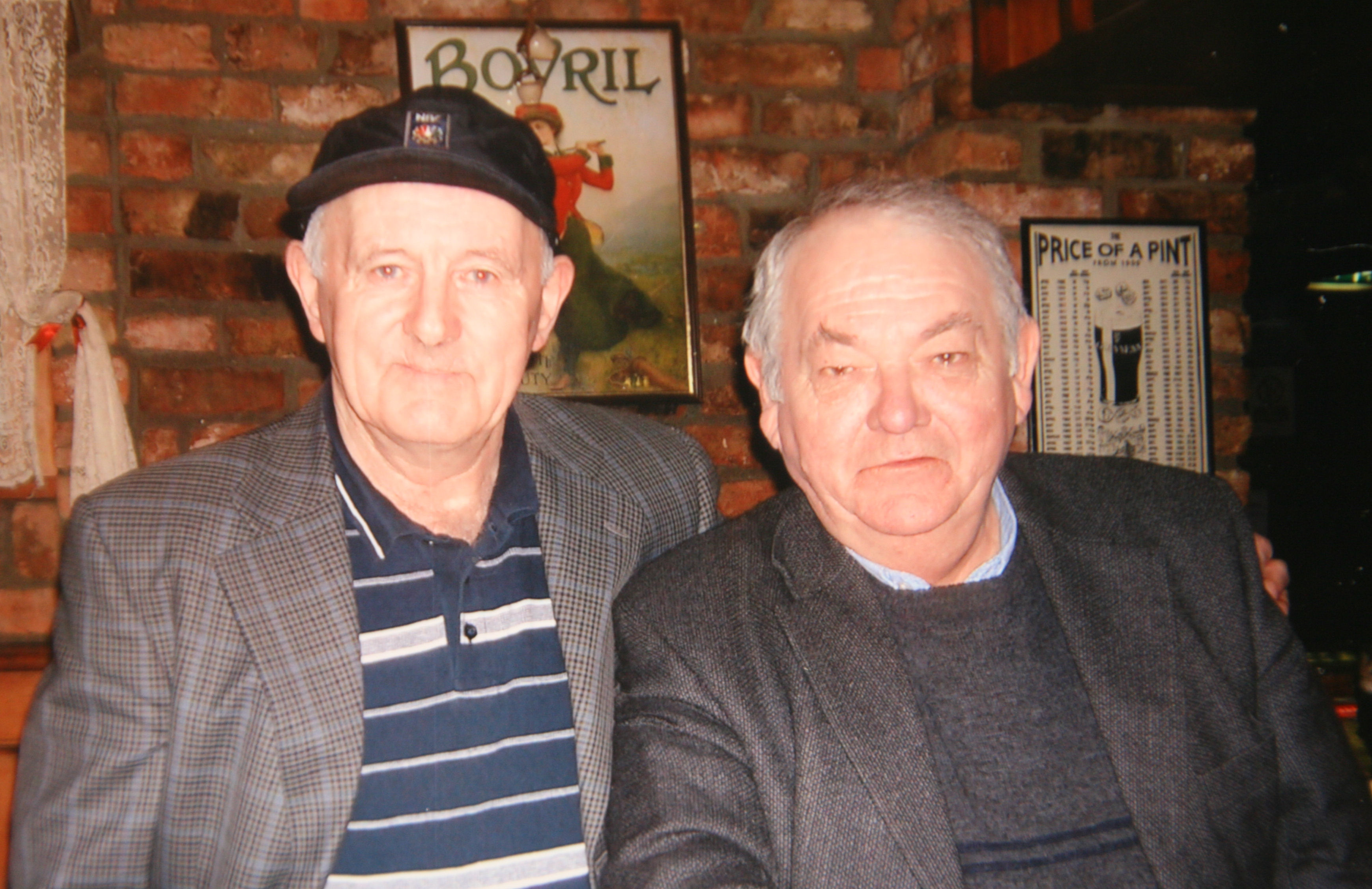
When I was in London I stayed in Drayton Park Road just at the back of the Arsenal football grounds. It was owned by Paddy and Mary McDonagh from Bealadangan. Along with myself and Paddy Reilly there were a lot of Athenry lads staying there at the time: Kerill and Michael Burke, Mattie Tyrell, Barry Cunniffe and Frank Healy. Dermot Nestor (pictured left with Tony), who now stars in the television soap ‘Ros na Run’ as Seamus Michil Tom, was lodging there. There was a family of Flahertys who were known as Seanin, Sean Maithis. The McDonagh family staying there was known as the Willie, Willies. The O’Malleys were called Tom, Paddy, Michael. Another girl, who was a great singer, used to come and visit and she was known as Bob Taimin Bideog. There’s only myself and Kerill Burke alive now. All the rest from Athenry, including Paddy Reilly, are gone. Some of the Flahertys and McDonaghs are gone too. May they rest in peace. I worked in Harrow and Whealdstone with a lad from Cavan, Joe Galligan. We started in the yard of Schweppes factory and went all the way up to Pinner road. When we finished there I went back working with Treacy’s lads. They were at it in Berkley outside of Bristol. That was the last place I worked in before returning home.
Tony Waldron 2014
Edited by Gerry Ahern